Archive for December 15, 2018

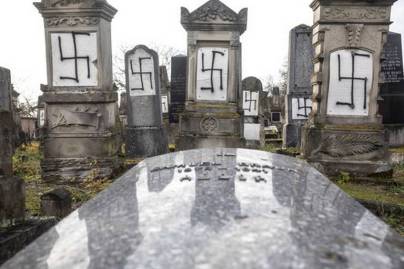
Off Topic:  French Jewish cemetery desecrated with swastikas

December 15, 2018

Source: French Jewish cemetery desecrated with swastikas | Idaho Statesman

Jewish tombstones are seen desecrated with swastikas in the Herrlisheim Jewish cemetery, north of Strasbourg, eastern France, Thursday, Dec. 13, 2018. Dozens of tombs were defaced were discovered Tuesday.
Jewish tombstones are seen desecrated with swastikas in the Herrlisheim Jewish cemetery, north of Strasbourg, eastern France, Thursday, Dec. 13, 2018. Dozens of tombs were defaced were discovered Tuesday.JEAN-FRANCOIS BADIAS AP PHOTO


Lebanese wary as Israel destroys Hezbollah border tunnels

December 15, 2018

Source: Lebanese wary as Israel destroys Hezbollah border tunnels | The Times of Israel

One resident says fortification work on frontier means Israel must be ‘scared’; another believes the Jewish state is attempting to change the border and ‘occupy’ Lebanese villages

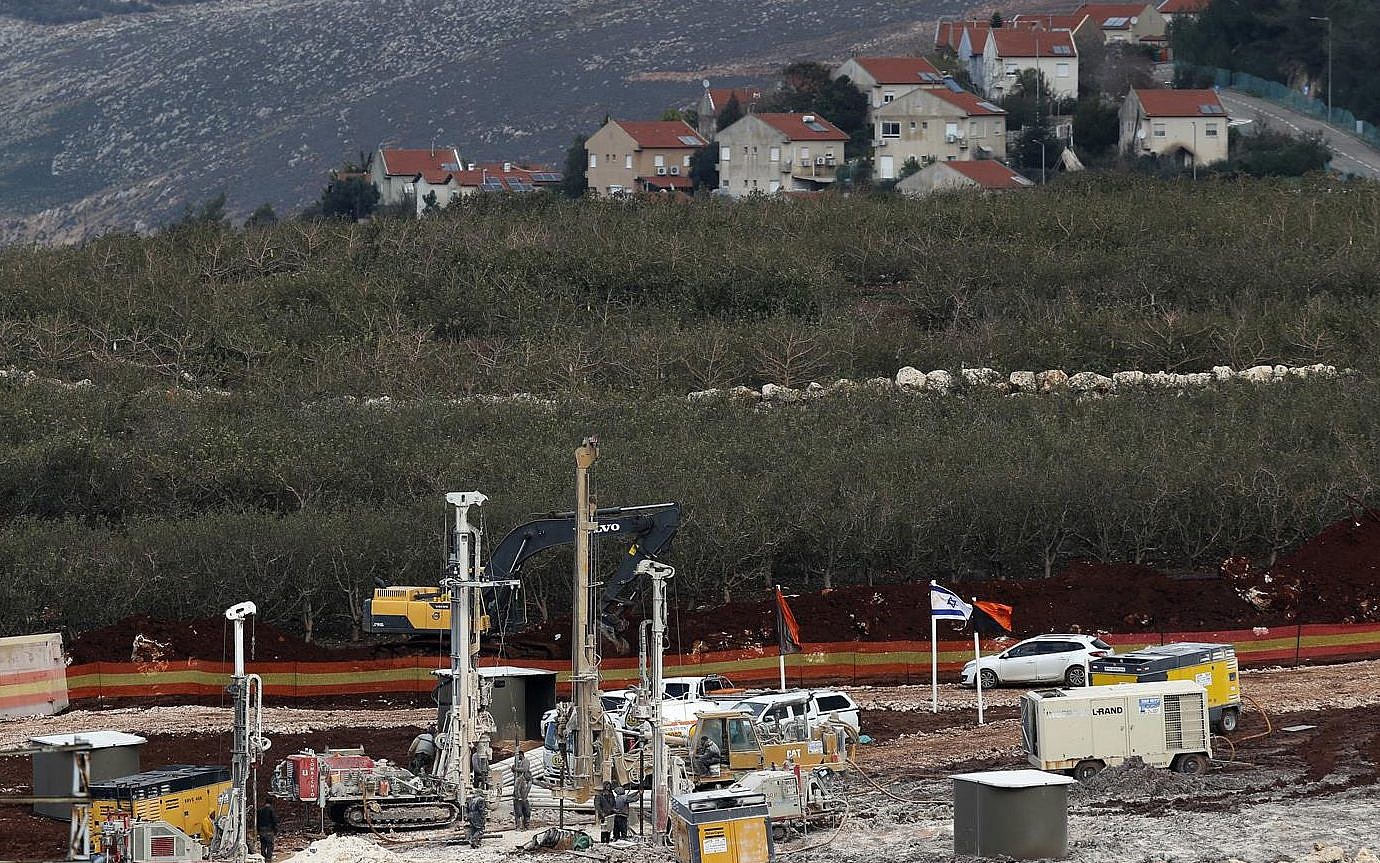
In this Thursday, Dec. 13, 2018 photo, Israeli military equipment works on the Lebanese-Israeli border in front of the Israeli town of Metula, background, near the southern village of Kafr Kila, Lebanon (AP Photo/Hussein Malla)

In this Thursday, Dec. 13, 2018 photo, Israeli military equipment works on the Lebanese-Israeli border in front of the Israeli town of Metula, background, near the southern village of Kafr Kila, Lebanon (AP Photo/Hussein Malla)

MAYS AL-JABAL, Lebanon — As Israeli excavators dug into the rocky hills along the frontier with a Lebanese village, a crowd of young Lebanese men gathered to watch.

The mood was light as the crowd observed what Israel says is a military operation — dubbed “Northern Shield” — aimed at destroying attack tunnels built by Hezbollah. The young men posed for selfies, with the Israeli crew in the background, as they burned fires and brewed tea to keep warm.

But Lebanese soldiers were visibly on high alert, deploying to new camouflaged posts behind sandbags and inside abandoned homes. About two dozen UN peacekeepers stood in a long line, just ahead of the blue line demarcating the frontier between the two countries technically still at war.

The scene highlights the palpable anxiety that any misstep could lead to a conflagration between Israel and Lebanon that no one seems to want.

Underscoring such jitters, shadowy figures appearing across the misty hills of the border village of Mays al-Jabal last weekend sparked concern, and Israeli soldiers fired in the air to warn the men to stay away. Israel later said it fired at Hezbollah members who came to the site to dismantle sensors installed to detect tunnels. Lebanon said it was a Lebanese military intelligence patrol.

Israel’s tunnel search comes at a time when the civil war in neighboring Syria seems to be winding down. Hezbollah had sent hundreds of troops to Syria in 2013 to fight alongside the forces of Syrian President Bashar Assad. With Assad’s forces emerging victorious, attention now seems to be returning to the tense Israel-Lebanon border.
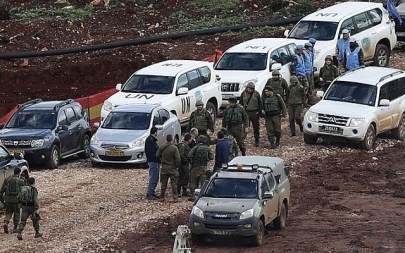
In this Thursday, December 13, 2018 photo, Israeli soldiers and UN peacekeepers gather at the site where the Israeli army works on the Lebanese-Israeli border in the southern village of Kafr Kila, Lebanon (AP Photo/Hussein Malla)

Israel said its troops have discovered at least three tunnels dug below the frontier and called on the international community to impose new sanctions on Hezbollah.

The Israeli military said it believes the tunnels were meant to be used by Hezbollah as a surprise component of an opening salvo in a future war, alongside the mass infiltration of operatives above ground and the launching of rockets, missiles and mortar shells at northern Israel.

The terror group, which fought a bruising but inconclusive war with Israel in 2006, has not commented on the Israeli operation or statements.

Lebanese Prime Minister Saad Hariri said Thursday that neither Israel nor Lebanon wanted to go to war, but noted that Israel violates Lebanese airspace and international waters on a regular basis.

He said the Lebanese army “will deal with this issue” after receiving a full report from the UN peacekeeping force, but did not elaborate.

The peacekeeping force, known as UNIFIL, has confirmed the presence of tunnels and said it is working with both sides to address the situation in line with UN Security Council resolutions.
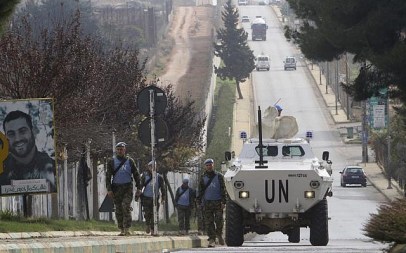
Serbian UN peacekeepers patrol the Lebanese side of the Lebanon-Israel border in the southern village of Kfar Kila, Tuesday, December 4, 2018 (AP Photo/Mohammed Zaatari)

In southern Lebanon on Thursday, Lebanese army soldiers observed the frontier in Mays al-Jabal, taking photos of their Israeli counterparts operating only a few meters (yards) away. At times, the Lebanese soldiers asked the young men to move back, away from the frontier.

Lebanese homes and farms are nestled at the bottom of the hill where the operations run from daybreak until sundown. No civilian Israeli homes are visible from that tense border.

Ali Jaber, a 21-year-old resident of Mays al-Jabal, said he believes that Hezbollah is more popular after the Syria war, and that this is the reason Israel is now turning to it. “But whoever puts up a shield and is hiding and making fortifications must be scared,” he said.

Hussein Melhem, a 19-year old electrician from the village, came to watch. His cheeks ruddy on a cold but clear day, he covered his head with a tight hood. He alleged that Israel was trying to change the border.

“If they could occupy all of this, they would,” he said, in an apparent reference to Israel’s 18-year military occupation of southern Lebanon which ended in 2000. “But the resistance will prevent them.”
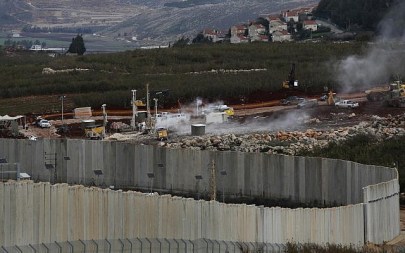
In this Thursday, December 13, 2018 photo, Israeli military equipment works on the Lebanese-Israeli border, next to a wall that was built by Israel, in the southern village of Kafr Kila, Lebanon (AP Photo/Hussein Malla)

The 2006 war was sparked when Hezbollah attacked an IDF patrol in July, killing five soldiers and abducting the bodies of two.

As a seven-year-old in 2006, Melhem and his family left Mays al-Jabal when Israel invaded. His village was badly damaged but has since largely recovered and he said he found their home intact.

It is hard to forget about war in the villages and towns along the frontier. Pictures of Hezbollah fighters who died in the 2006 war, as well as the one raging in neighboring Syria, known locally as the “Sacred Defense,” are everywhere. Posts on town squares boast of defeating Israel or urge the locals to “know their enemy.”

During the Syrian civil war, Israel has frequently carried out airstrikes in Syria against Iranian-allied forces, particularly Hezbollah. Israel says it aims to prevent sophisticated weaponry from reaching Hezbollah, which it considers its most pressing security concern.

In Lebanon, Israeli Prime Minister Benjamin Netanyahu’s warnings have raised suspicions that he is also using the tunnel operation as a diplomatic pressure card.

Netanyahu has called for more sanctions against Hezbollah. In a visit to the frontier earlier this week, he warned that if Hezbollah tries to disrupt the search for tunnels, “it will be hit in a way it cannot even imagine.”

In Israel, some newspaper commentators have been critical of the UN peacekeeping force, whose mandate Israel and the United States have unsuccessfully attempted to expand to include “intervention and deterrence.”
 

Mashaal calls for guerrilla warfare to ‘liberate West Bank’ and ‘all Palestine’ 

December 15, 2018

Source: Mashaal calls for guerrilla warfare to ‘liberate West Bank’ and ‘all Palestine’ | The Times of Israel

Former Hamas chief says ‘resistance’ is ‘pinnacle of life’ and defines Palestinians: ‘I resist, therefore I am’

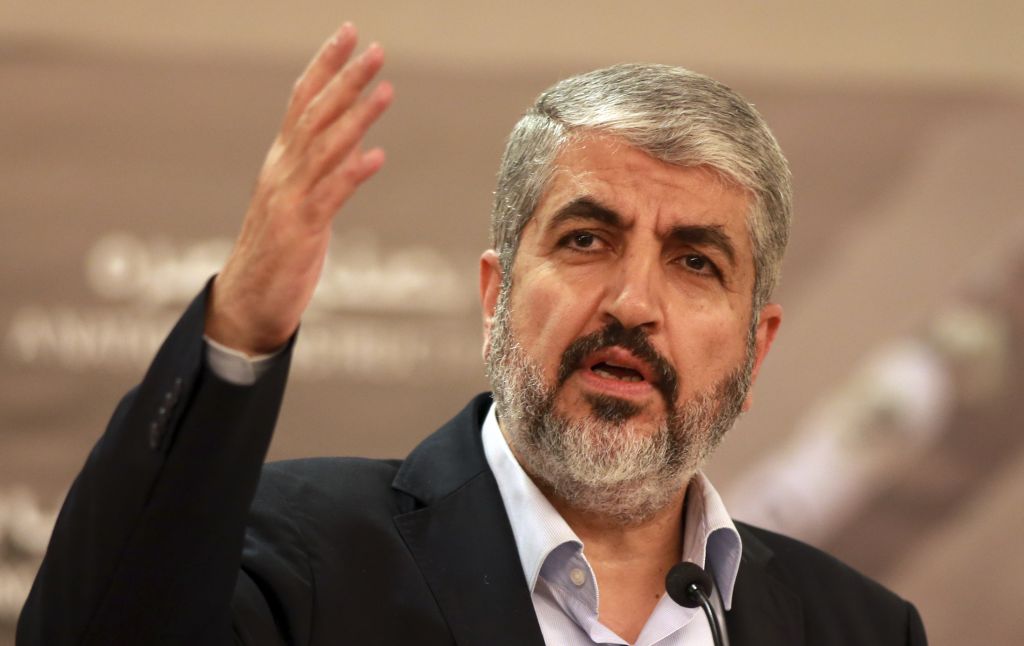
Khaled Mashaal speaks in Doha, Qatar, August 28, 2014. (AP/Osama Faisal)

Khaled Mashaal speaks in Doha, Qatar, August 28, 2014. (AP/Osama Faisal)

The former leader of the Hamas terror group has called on West Bank Palestinians to prepare for “guerrilla warfare” in the West Bank and ongoing “resistance” to force Israel to retreat from the territory.

Khaled Mashaal said this would be a step on the way to its retreat from “all of Palestine.”

Speaking on the Al-Jazeera TV network on December 2, Mashaal, in a play on René Descartes’ famous philosophical proposition, said: “The Palestinians say ‘I resist, therefore I am.’”

In comments translated by the Middle East Media Research Institute, Mashaal said that according to the Quran, “Jihad, resistance, and self-defense [are] the essence of life.

“The abandonment of Jihad leads to humiliation and death. Hence, resistance is the pinnacle of life. A person who lives under occupation, and who does not resist, is in fact dead.”

Mashaal, who headed Hamas’s political bureau between 1996 and 2017, claimed there was no alternative way to “liberate” the Palestinian nation.

“When did Israel withdraw from southern Lebanon? It wasn’t a result of negotiations — not in Madrid and not in Washington. It retreated as a result of resistance. When did it retreat from Gaza? After the [Second] Intifada in 2000 and the heroic resistance. Today we are being called and preparing to force Israel to retreat from Jerusalem and from the West Bank. Allah willing, this is on the way to its retreat from all of Palestine,” he said.

Embedded video

MEMRI

@MEMRIReports

He called on the West Bank’s Fatah to join Hamas in popular resistance against Israel, saying it should take an example from the people of the Gaza Strip.

“The West Bank spans over 5,600 square kilometers, and has mountains and valleys. I’m from there, I know the landscape. It has everything necessary for guerilla warfare. Why are we not preparing for that?”

A Fatah spokesman on Thursday called on Palestinians to ignore calls for a new armed uprising against Israel in the West Bank, urging them to instead step up peaceful protests against the Jewish state’s military rule.

“We need to be smart…and not listen to the talk of the demagogues about the necessity of going to an armed confrontation,” Fatah spokesman Osama Qawasma told Palestine TV, the official Palestinian Authority television channel, Thursday night. “My words are candid. We must escalate popular resistance in the Palestinian lands.”

Hamas has for years called on Palestinians to stir up a confrontation with Israel in the West Bank.

On Friday the Palestinian Authority police cracked down on a Hamas protest in the southern West Bank city of Hebron, beating demonstrators with batons and throwing stun grenades.

Some 50 Hamas activists confronted Palestinian forces after Muslim prayers on Friday, as the terror group marked the 31st anniversary of its establishment.

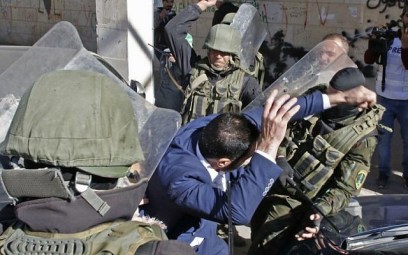
Palestinian security forces beat a Hamas supporter as they try to disperse a rally marking the 31st anniversary of the founding of the terror group in Hebron on December 14, 2018. (Hazem Bader/AFP)

Hamas condemned the PA for suppressing the demonstrations. Hamas spokesman Fawzi Barhoum said in a statement on the Hamas website that the “barbaric behavior” was proof the PA “denigrated the blood of the martyrs.”

The Palestinian Authority, led by president Mahmoud Abbas and his Fatah party, cooperates closely with Israeli security, while Hamas has fought three wars with the Jewish state since 2008.

Hamas cells continue operate in the West Bank despite PA and Israeli efforts to arrest them. The protests come amid a surge of terror attacks in the West Bank, some of them claimed by Hamas.

Two Israeli soldiers were killed Thursday and two other Israelis injured when a man opened fire at a bus stop at a settlement in the West Bank, before fleeing.

Hamas has claimed two other recent shooting attacks in the West Bank but has so far not taken responsibility for Thursday’s attack, near the settlement of Givat Assaf.

The Israeli military says it believes a Hamas cell conducted a drive-by shooting attack near the settlement of Ofra Sunday, in which seven people were wounded. One victim’s baby was delivered prematurely in an emergency operation, but died on Wednesday afternoon.

Agencies and Adam Rasgon contributed to this report.


Australia recognizes West Jerusalem as Israel’s capital

December 15, 2018

Source: Australia recognizes West Jerusalem as Israel’s capital | The Times of Israel

Prime Minister Scott Morrison says embassy won’t move from Tel Aviv until peace is achieved, but country will establish a defense and trade office in Jerusalem

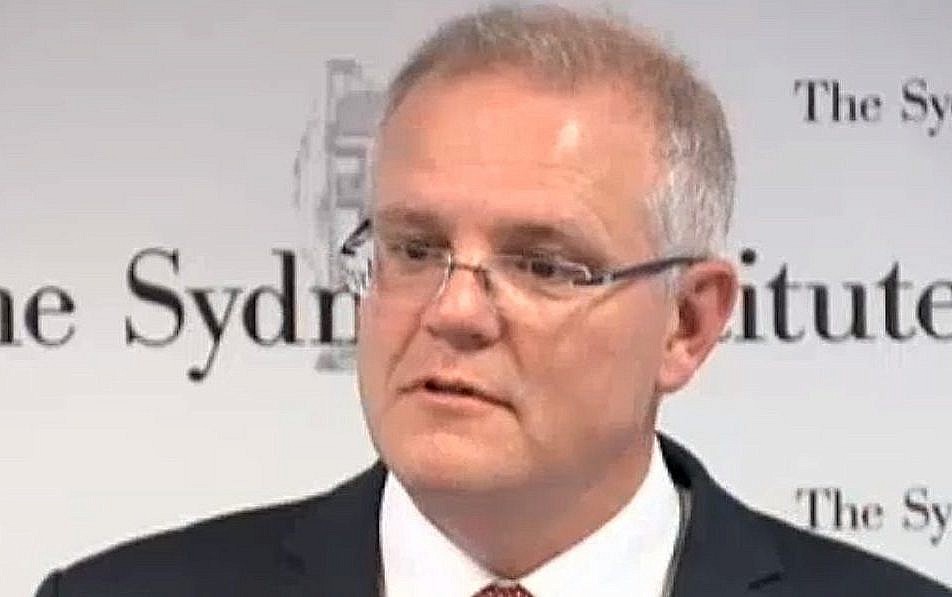
Australian Prime Minister Scott Morrison declares West Jerusalem to be Israel’s capital, Sydney, December 15, 2018. (Screen grab via ABC News)

Australia on Saturday officially recognized West Jerusalem as Israel’s capital, Prime Minister Scott Morrison said, but a contentious embassy shift from Tel Aviv will not occur until a peace settlement is achieved.

“The Australian government has decided that Australia now recognizes West Jerusalem, as the seat of the Knesset and many of the institutions of government, is the capital of Israel,” he said.

He said the decision respects both a commitment to a two-state solution and longstanding respect for relevant UN Security Council resolutions.

Morrison also committed to recognizing the aspirations for a future state of Palestine with East Jerusalem as its capital when the city’s status is determined in a peace deal.

While the embassy move is delayed, Morrison said his government will establish a defense and trade office in Jerusalem and will also start looking for an appropriate site for the embassy.

“We look forward to moving our embassy to West Jerusalem when practical, in support of and after final status of determination,” he said, adding that work on a new site for the embassy was under way.

The prime minister said it was in Australia’s interests to support “liberal democracy” in the Middle East and took aim at the United Nations he said was a place where Israel is “bullied.”

Australia had on Friday warned citizens to take care while traveling in neighboring Muslim-majority Indonesia ahead of the expected announcement by Morrison.

Protesters wave Palestinian flags during a rally against the US plan to move its embassy in Israel from Tel Aviv to Jerusalem, at Monas, the national monument, in Jakarta, Indonesia, May 11, 2018. (AP Photo/Achmad Ibrahim)

While Australia’s then-foreign minister Julie Bishop said in June that “the Australian government will not be moving our embassy to Jerusalem,” Morrison said in October that he was “open-minded” regarding following the American example.

But Morrison’s statement was seen by many Australians as a political stunt. Critics called it a cynical attempt to win votes in a by-election in October for a Sydney seat with a high Jewish population.

Opposition leader Bill Shorten said Saturday that the decision to recognize West Jerusalem as Israel’s capital but not move the embassy there was a “humiliating backdown” from the October by-election campaign.

“What I’m worried is that Mr. Morrison put his political interest ahead of our national interest,” Shorten told reporters.

Both Israel and the Palestinians claim Jerusalem as their capital. Israel captured Arab East Jerusalem in the 1967 Six Day War and later annexed it in a move never recognized by the international community. It sees the entire city as its capital.

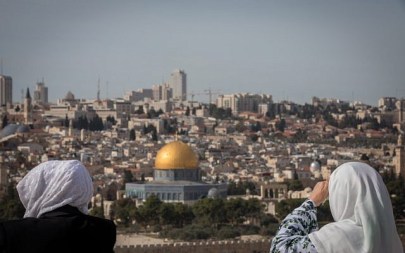
Tourists look at the view of the Dome of the Rock and the Temple Mount from the lookout of the Mount of Olives overlooking the Old city of Jerusalem, on November 28, 2018. (Yonatan Sindel/Flash90)

For decades the international community maintained that the city’s status should be negotiated between Israel and the Palestinians. Critics say declaring Jerusalem the capital of either inflames tensions and prejudges the outcome of final status peace talks.

Morrison’s mid-October announcement that he was “open-minded” to following the United States in recognizing Jerusalem as the Israeli capital, drew criticism at home. Australia’s spy agency warned the move could provoke further violent unrest in Israel, while opposition lawmakers accused the prime minister of cynically pandering to Jewish voters ahead of a crucial by-election.

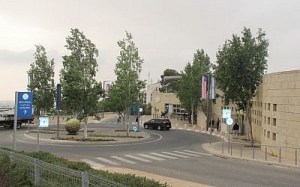
The US Embassy in Jerusalem sits on a traffic circle recently named for US President Donald Trump. The compound is in the middle of Arnona, a quiet residential neighborhood in the city’s south. (Ben Sales/JTA)

Senior Palestinian official Saeb Erekat also harshly criticized the planned move, and called on Arab and Muslim countries to sever all diplomatic ties with Australia if it changed its policy on Jerusalem. In a tweet Tuesday morning Erekat said that various Arab and Muslim summits have adopted resolutions committing to ending diplomatic ties with any country that recognizes Jerusalem as belonging to Israel.

Recognizing Jerusalem is expected to help the embattled Australian PM — who faces the prospect of an election drubbing next year — with Jewish and conservative Christian voters and win him friends in the White House.

His supporters argue Israel has the right to choose its own capital and peace talks are dead in the water, so there is no peace to prejudge.

But the move still risks heightening unrest, not least in Australia’s immediate neighbor and the world’s most populous Muslim nation.

Indonesia’s government, facing domestic pressure at home, had reacted angrily earlier this year, when Morrison floated the idea of both recognizing Jerusalem and moving the Australian embassy there.

The issue has put the conclusion of a bilateral trade agreement on hold.


Whoever attacks Israel will ‘pay with his life’ – TV7 Israel News 14.12.18 

December 15, 2018


Israel’s challenges from its northern frontier- Jerusalem Studio 382

December 15, 2018