Archive for December 14, 2018

Stopping the wave of terror attacks, before the tsunami hits

December 14, 2018

Source: Stopping the wave of terror attacks, before the tsunami hits

Op-ed: Israeli security forces must take several immediate steps to halt the deadly wave of terrorism in the West Bank, including speeding up questioning of suspects to gather intel on planned attacks and increasing military presence in the territories. The Palestinian despair could be addressed with a political-economical initiative.

The killing of the terrorists who carried out the Barkan and Ofra shootings, and the capture of many of their accomplices within a relatively short time, would have, under normal circumstances, created deterrence in the territories. But the unrest in Judea and Samaria and Jerusalem, which has increasingly escalated over the past few months, has already picked up momentum of painful terror attacks.

Israeli defense officials estimated that this violent wave of attacks will continue, and perhaps even worsen over the coming months. The events of the past two days confirm this assessment.

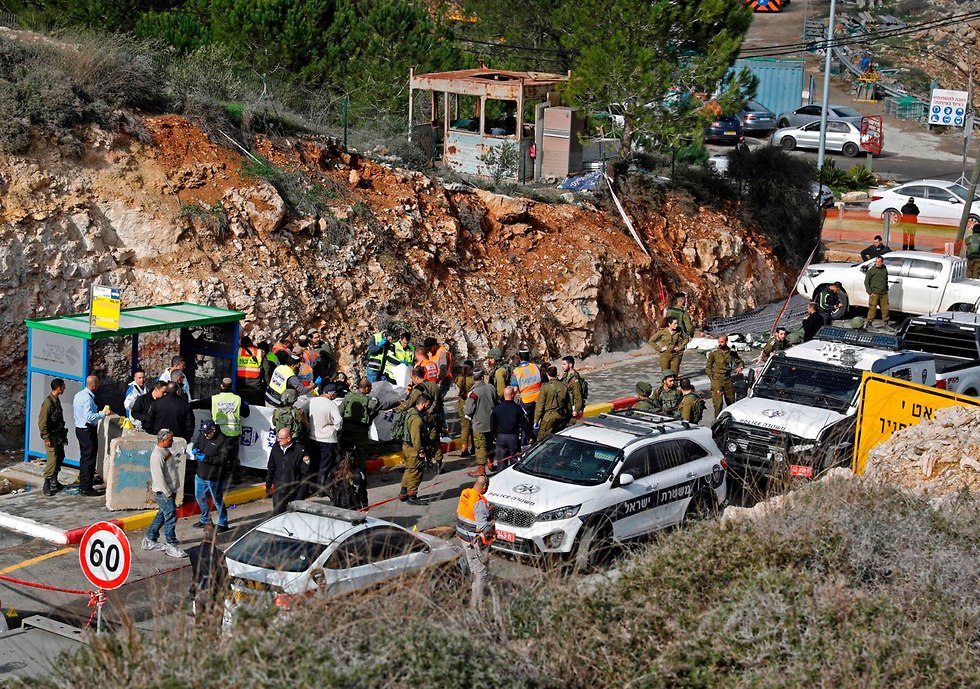
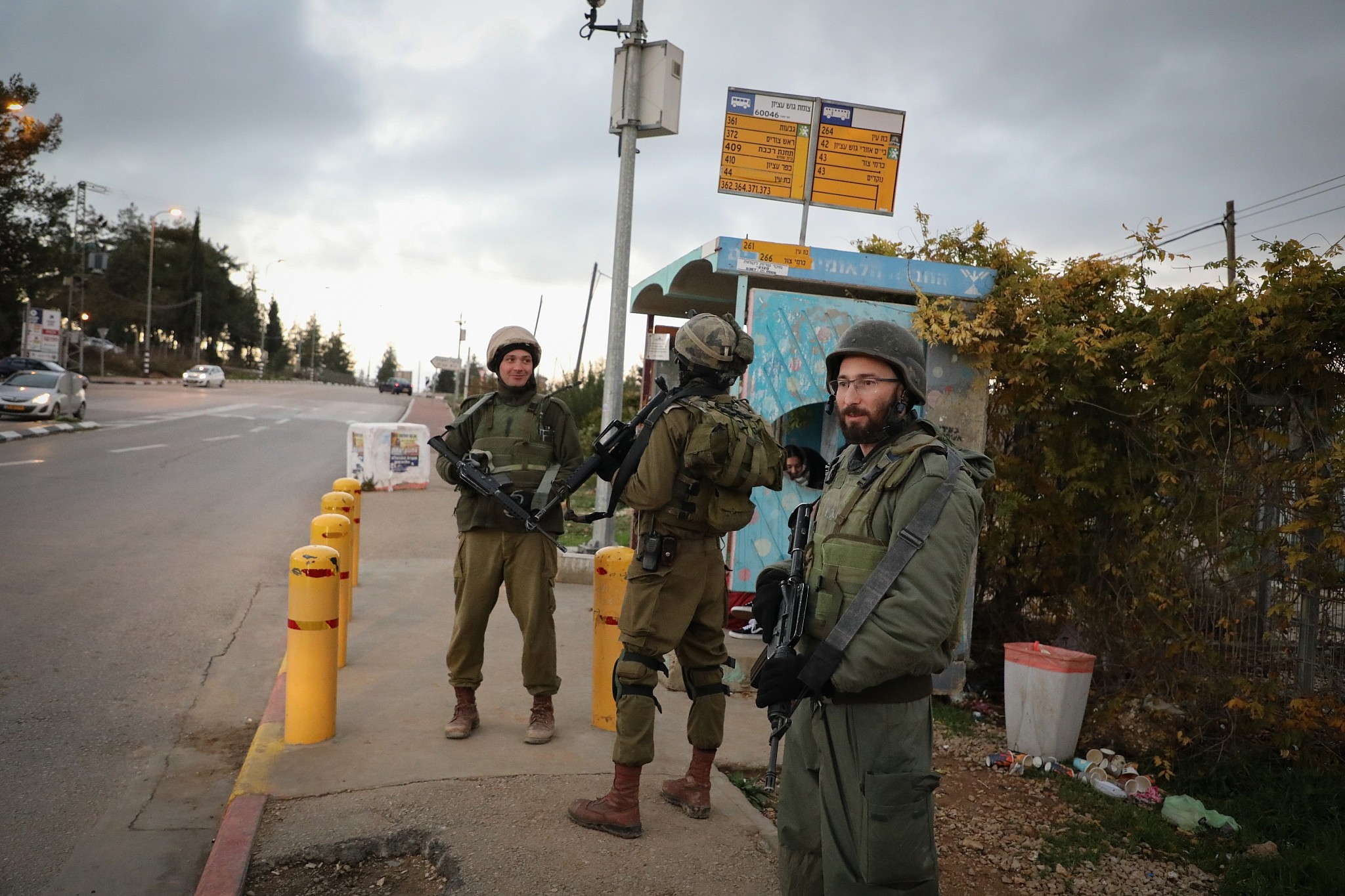
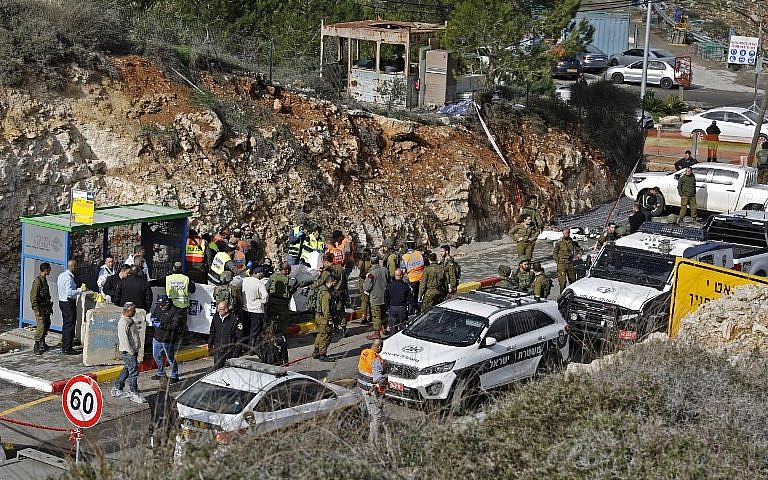
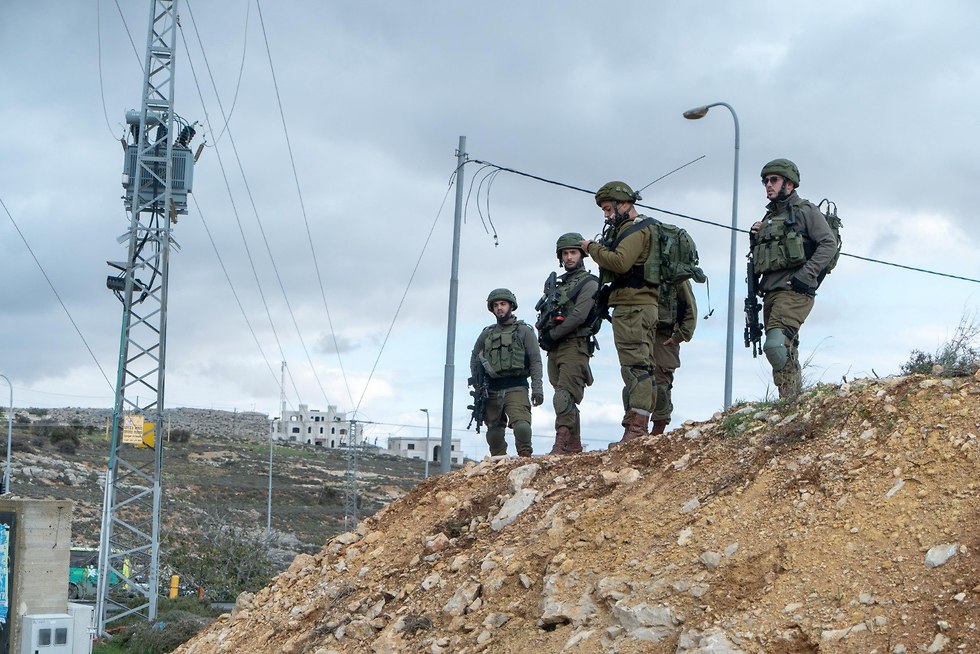
Soldiers at the Asaf Junction, where the shooting attack took place. (Photo: IDF spokesperson)

Soldiers at the Asaf Junction, where the shooting attack took place. (Photo: IDF spokesperson)

The IDF, the Shin Bet and the Israel Police will have to invest massive forces and a great intelligence effort in the West Bank to stop the situation from deteriorating further: from “lone wolf” terrorists who carry out stabbings or car-rammings inspired by successful shooting attacks, to “local terror cells” made up of young Palestinians, from the same family or village, who carry out shooting attacks on IDF soldiers patrolling roads, as well as organized terror attacks, directed by outside elements (mostly Hamas) using weapons and explosives and trying to abduct soldiers.

The Jewish settlers in the territories will have to take extra precautions in the foreseeable future. A wave of violence must be broken before it becomes a tsunami. The main threat right now is from “lone wolf” terrorists and drive-by shootings, likely perpetrated by “local cells.”

To contain this escalation, security forces will have to immediately take the following steps:

• The IDF will have to deploy additional forces and increase its presence in the West Bank, especially in areas likely to be targeted, such as roads used by Jewish settlers that pass through Palestinian villages, bus stations and shopping centers.

IDF activity in the West Bank must be done in accordance with urban warfare rules: operate behind cover as much as possible and travel in armored vehicles. Unannounced checkpoints on roads have already proven themselves as an effective measure against drive-by shootings.

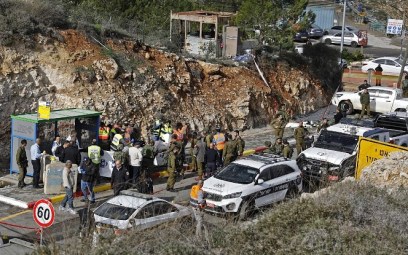
The shooting attack scene at Asaf Junction (Photo: AFP)

The shooting attack scene at Asaf Junction (Photo: AFP)

At the same time, it’s important that the IDF makes a significant effort not to disrupt the daily life or endanger the livelihood of Palestinians who are not involved in terrorism, so others won’t be pushed to joining the circle of violence.

• The Shin Bet must quickly question all suspects and accomplices arrested in recent days to gain intelligence that could be used to thwart terror attacks. It was the hard work of dozens of Shin Bet personnel in a variety of intelligence activities, including the use of cyber measures and AI, which helped locate and capture the murderers who carried out the Barkan and Ofra attacks.

Now is the time to focus on local cells, likely inspired by Hamas and Islamic Jihad, which send money and instructions to its agents in the West Bank from Gaza, Lebanon and Turkey. At the head of these operations is Hamas’s Saleh al-Arouri.

• The IDF and Shin Bet need to do everything possible to maintain the security coordination with the Palestinian security forces, so in the future the Palestinians might help or at the very least not get in the way of Israeli operations to foil attacks.

The real reason for the recent outbreak of violence in the West Bank is the younger generation’s frustration in light of what they see as a dead end, with no future or hope, in all areas of life—which Hamas takes advantage of.

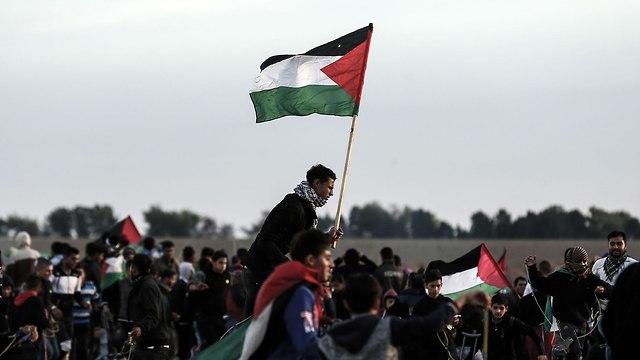
Protests at the Gaza border (Photo: AFP)

Protests at the Gaza border (Photo: AFP)

Hamas has a clear motive: to create a wave of terrorism in the West Bank to remedy the damage to its image after it agreed to take Qatari money and in return end the war of attrition it has waged against Israel since March.

It’s also time to admit that the months of rioting on the Gaza Border also eroded the IDF and the Shin Bet’s deterrence in the West Bank. This deterrence was very effective in curbing violence.

In light of this, Israel’s security goal should now be to weaken Hamas, while its political-financial goal should be arousing some kind of hope in the younger Palestinian generation. Israel needn’t wait for the US and its peace initiative, but rather propose to Palestinian President Mahmoud Abbas projects that hold economic benefits he cannot refuse.

This course of action has already proved itself in the Gaza Strip. Egyptian mediators have made progress in negotiations with Hamas, Islamic Jihad and other Palestinian factions in an effort to achieve calm and improve the humanitarian situation in the strip. There is likely already a clear outline for an agreement accepted on all sides, including Israel

This outline includes the reimplementation of the Protective Edge understandings—12 hours of electricity per day, salaries for Hamas officials, and a 12 nautical miles fishing zone. The agreement does not, at present, include the Israel’s MIAs and POWs in Gaza, but the Israeli government has made it clear that there will be no large-scale rehabilitation in Gaza (including a sea port, among other projects), before a solution for this matter is found. If this agreement goes into effect in the coming days, it could have a soothing effect over Gaza that will also be felt in the West Bank.


Column One: Corbyn’s threat to Israel 

December 14, 2018

Source: Column One: Corbyn’s threat to Israel – Opinion – Jerusalem Post

Britain is a global power and a key player not only in Europe, but throughout the world.

BY CAROLINE B. GLICK
 DECEMBER 13, 2018 18:30
Column One: Corbyn’s threat to Israel

Imagine that in considering its responses to Palestinian shooting attacks against Israelis in Judea and Samaria, or Hezbollah’s offensive tunnels in northern Israel, or Hamas’s rocket barrages into southern Israel, Israel was required to take British Labour Party leader Jeremy Corbyn’s positions into account.

How would Corbyn’s leadership of Britain – the US’s closest ally and Israel’s largest trading partner in Europe – affect Israel’s maneuver room?

Following British Prime Minister Theresa May’s far-from-resounding victory in the no-confidence vote her Conservative Party colleagues conducted against her, this question needs to be considered urgently.

May’s victory Wednesday did not stabilize the political situation in Britain. The fact that 117 Conservative lawmakers voted to unseat her, and the fact that May felt compelled to commit not to seek reelection in 2022, showed how tenuous her grip on power is today.
Whether the government falls over the Brexit vote in March, or limps into the 2022 elections, one thing is clear enough: The Tories’ divisions work to Labour’s advantage. The weaker and more incompetent the Conservatives appear, and the more incoherent their governing ethos becomes, the stronger and more competent Corbyn and his Labour Party will look and the more compelling its message will become.

As a consequence, the time has come for Israel to take a long, hard look at the implications for Israel of a Corbyn government.
Generally speaking, most of the conversations about the implications of a Corbyn government revolve around the fate of British Jewry. And this makes sense. Over the summer, pollsters found that nearly 40% of British Jews will consider emigrating if Corbyn becomes prime minister.

It is certainly reasonable to assume that if and when Corbyn becomes prime minister, there will be a wave of British aliyah unprecedented in scale. And Israel must prepare for their arrival, just as it must prepare for the arrival of a tens of thousands of Jews from France, Germany and Belgium.

But the prospect of mass migration of Jews out of Britain in response to Corbyn’s rise to power is but one aspect of the overall and entirely negative impact a Corbyn government will have on Israel.

Britain isn’t Turkey. Britain is a global power and a key player not only in Europe, but throughout the world. It is America’s closest ally and a permanent member of the United Nations Security Council.

With Turkey, Israel took a major hit and continues to suffer the aftershocks of Turkish President Recep Erdogan’s transformation of Turkey from a key strategic ally of Israel’s into a large and rapidly expanding threat to the Jewish state. Yet for all the damage Erdogan has caused and continues to cause Israel, the hit Israel took with him is nothing compared to hits it will take from Britain if and when Corbyn forms a government.

First of all, there is the issue of Israel’s bilateral ties to Britain. Last month, Liam Fox, Britain’s secretary for international trade, visited Israel to conduct negotiations toward a post-Brexit bilateral free trade deal with Israel.

Britain is Israel’s largest European trading partner. Trade between the two countries has increased massively over the past several years. Last year bilateral trade stood at $9 billion. In the first half of 2018, British exports to Israel increased 75% over the same period in 2017.

All of this will be jeopardized if and when Corbyn comes to power. In a speech in 2015, Corbyn expressed support for the boycott, divestment and sanctions campaign against Israel. In his words, “I think the boycott campaign, divestment campaign, is part and parcel of a legal process that has to be adopted.”

HE ADDED, “I believe that sanctions against Israel, because of its breach of the trade agreement, are the appropriate way of promoting the peace process.”

At the Labour Party conference in September, Corbyn pledged to recognize “Palestine” as soon as he forms a government.
The economic hit that Israel is liable to take from reduced trade with Britain is dwarfed by the blow a Corbyn government will cast on its military and intelligence interests.

At the Labour Party conference, Labour members voted in favor of a motion to ban military sales to Israel. The measure didn’t come out of nowhere. Corbyn speaks frequently about banning such sales. This past April, shortly after the Hamas regime in Gaza initiated its operations against Israel along the border wall separating Gaza from Israel, Corbyn called for a review of British arms sales to Israel and attacked Israel’s efforts to keep the rioters from overrunning its territory as “illegal and inhuman.” He referred to the Palestinian rioters as “unarmed Palestinian demonstrators.”

He also called on the May government to support an “independent and transparent” UN investigation of the border clashes.
From 2015 through 2017, UK weapons sales to Israel totaled $445 million. Much of Britain’s arms exports are not stand-alone systems. Rather, they are components in larger US platforms. For instance, 15% of the F-35 is made by British firms BAE and Rolls Royce. Components of F-16s and drones are likewise produced in Britain.

Does Israel have a ready alternative supplier to replace the British if and when Corbyn takes over?

Then there is the issue of intelligence cooperation. There are contradictory indications in everything related to intelligence cooperation between Israel and Britain. On the one hand, British and Israeli intelligence officials have acknowledged close cooperation between their agencies. On the other hand, documents published by Edward Snowden exposed widespread British espionage against Israel. Israeli targets exposed by the Snowden documents include Israeli diplomatic personnel in key African countries, MASHAV-Israel’s agency for international development, Israeli scientific research centers, particularly at the Hebrew University of Jerusalem, and defense firms.

There is nothing surprising about Britain’s spying. Britain has traditionally had a love-hate relationship with Israel, where it cooperates with Israel at the same time it undercuts it.

And yet, for all of Britain’s two-facedness, there is still a difference between an untrustworthy ally that knows your intelligence capabilities and operations and a hostile power having that information. This is doubly true in Corbyn’s case given his pronounced support and friendship for Hezbollah, Hamas, Iran and Russia.

Corbyn’s most powerful adviser is his communications guru Seumas Milne. Milne, who served in the past as opinion editor at The Guardian, is ferociously anti-Israel. Among other things, Milne has argued that Israel has no right to defend itself, and that Palestinian terrorism is justified. Officials in Jerusalem see his relationship with Corbyn as a sign that if and when Corbyn rises to power, diplomatic relations between the two countries will effectively end.

And ending Britain’s ties with Israel is just the tip of the iceberg. The UK is a global power. The first place his impact will be felt is among members of the British Commonwealth, particularly Australia and Canada.

In Australia’s case, this week most of the discussion relating to Australian-Israel relations revolved around the dispute brewing between Prime Minister Scott Morrison and his government on the one side and Australia’s foreign policy establishment on the other. Morrison and his colleagues wish to recognize that Jerusalem as Israel’s capital and move the Australian Embassy to Jerusalem. The foreign policy establishment opposes the move vociferously.

BUT WHILE we have been focused on this issue, we have ignored a larger issue. Over the past three years, Australia’s Labour Party has been following the lead of Corbyn’s Labour Party, particularly with regard to Israel.

Under the influence of former foreign minister Bob Carr, the largest branch of the party in New South Wales voted last year to recognize “Palestine.” The NSW branch has also voted to ban members from traveling to Israel on trips organized by pro-Israel groups. The Labour Party is expected to win the next Australian elections.

If and when Corbyn rises to power, the Australian Labour party is likely to be even more radicalized, particularly with regard to Israel.
A Corbyn government will likely have a similar effect on Canadian politics.

Beyond the Commonwealth, and far more importantly, stands America. Britain has more influence on American politics and culture than any other foreign power. Traditionally, British leaders have used their influence in the US to push administrations away from Israel.

For instance, immediately after the September 11 attacks, then-British prime minister Tony Blair flew to Washington. He was the first foreign leader to meet with then-president George W. Bush. Blair’s visit had a singular impact on US policy toward Israel at the dawn of the US war against Islamic terrorism. Thanks almost entirely to Blair’s lobbying, Bush agreed to exempt Palestinian terrorism against Israel from his general rebuke. Blair convinced Bush that Palestinian jihadists who waged a terrorist war against Israel were not as objectionable as al-Qaeda jihadists were. The consequences of Blair’s efforts are still being felt – as the victims of this week’s Palestinian terrorist attacks make clear.

A prime minister, Corbyn will have a profound impact on the balance of forces in today’s Democratic Party. There can be little doubt that his rise will empower radical, extreme Israel haters in the party at the expense of more moderate forces. If a prime minister Corbyn is met in Washington by a Democratic president, his influence on US-Israel ties will be profoundly damaging.

Liberal American philosopher Michael Waltzer has argued that leftist foreign policy in the US stems more from attitudes and prejudices than from a significant, rational view of the world. There are two main twitches that underpin the foreign policy of the American Left: anti-Americanism and support for empowering international institutions at America’s expense.

Given Corbyn’s oft-stated intention to unleash the UN against Israel, Israel can expect for the UN to become even more peripatetic and hostile in its anti-Israel operations in the era of a Corbyn government. Britain, a permanent, veto-wielding member of the Security Council is liable to submit draft resolutions condemning Israel on a regular basis. Other UN institutions from UNESCO to UNICEF to the World Court can be expected to intensify their operations against Israel on multiple fronts. And if a Democratic president serves parallel to Corbyn, the implications for Israel are liable to be disastrous.

On Wednesday, May responded to Corbyn’s attacks against her for her handling of Brexit by saying, “The biggest threat to the UK is not Brexit, it is a Corbyn government.”

It’s possible that enough British voters agree with her to ensure that the Conservatives will win the next elections. But it is possible that they won’t.

Israel cannot wait to find out. Israel needs to act now to prepare itself for the day after a Corbyn government is formed. Because without a doubt, Corbyn intends to use his power to harm Israel. And as the prime minister of Britain, he will have significant means to achieve his goal.

http://www.CarolineGlick.com
 

Sweden arrests man suspected of preparing terror attack 

December 14, 2018

Source: Sweden arrests man suspected of preparing terror attack | The Times of Israel

After raids in Gothenburg, security services offer no details on motive or identity of would-be terrorist, but say his activities had ‘international links’

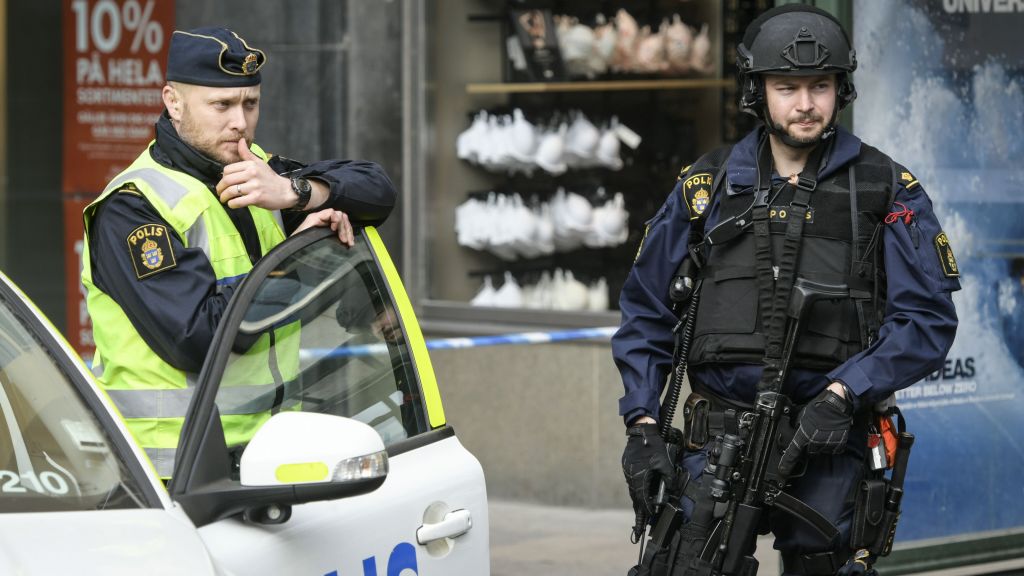
Illustrative: Police patrol near the scene of a terror attack in central Stockholm, Sweden, April 8, 2017. (Anders Wiklund/TT via AP)

Illustrative: Police patrol near the scene of a terror attack in central Stockholm, Sweden, April 8, 2017. (Anders Wiklund/TT via AP)

STOCKHOLM — A man has been arrested in western Sweden on suspicion of preparing a terrorist attack, the country’s security services said Thursday.

The SAPO agency said “preparations for the suspected terrorist offense have been underway for some time” and added that “there are international links.” It did not elaborate.

The person was not identified.

Several raids were carried out early Thursday in western Sweden and several people were brought in for questioning.

The Goteborg Tidning newspaper says the raids took place in Gothenburg, Sweden’s second largest city, and in suburbs to its north.

The operation was not linked to the jihadist attack in Strasbourg, France, that left two dead, one person brain dead and 12 others injured on Wednesday, SAPO’s Gabriel Wernstedt told the Swedish daily Aftonbladet.

Sweden’s terror threat remained unchanged at elevated — the third level on a five-degree scale, meaning that an attack can occur, SAPO said.

Two attacks have hit Sweden in the past eight years.

On April 7, 2017, an Uzbek man drove a stolen truck into a crowd in Stockholm, killing five people and wounding 14 others. He was convicted of terror-related murder and given a life sentence.

In December 2010, a suicide bomber blew himself up in downtown Stockholm among panicked Christmas shoppers, injuring two people.


Gunman who killed three in Strasbourg market shot dead by French police

December 14, 2018

Source: Gunman who killed three in Strasbourg market shot dead by French police | The Times of Israel

Cherif Chekatt, who Islamic State says was one of its ‘soldiers,’ killed in exchange of fire in Neudorf area of city

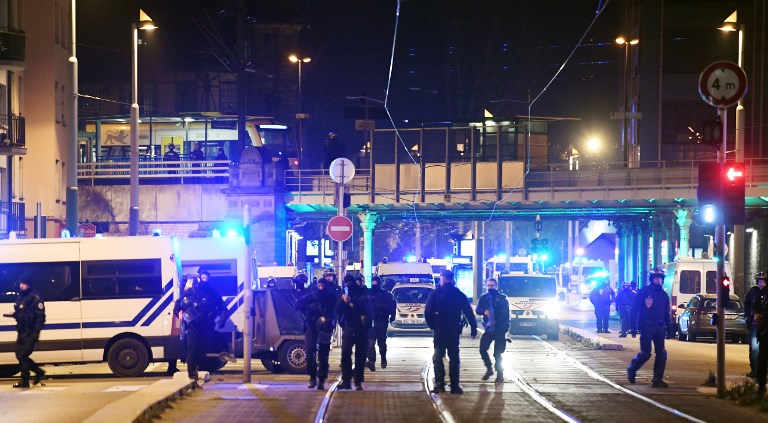
French police officers block the road near the site where Cherif Chekatt, the alleged gunman who had been on the run since allegedly killing three people at Strasbourg's popular Christmas market, was shot dead by police in the Neudorf neighborhood of Strasbourg on December 13, 2018. (Alain JOCARD/AFP)

French police officers block the road near the site where Cherif Chekatt, the alleged gunman who had been on the run since allegedly killing three people at Strasbourg’s popular Christmas market, was shot dead by police in the Neudorf neighborhood of Strasbourg on December 13, 2018. (Alain JOCARD/AFP)

STRASBOURG, France (AFP) — French police on Thursday shot dead a gunman who had been on the run since killing three people at Strasbourg’s popular Christmas market.

More than 700 French security forces had been hunting for 29-year-old Cherif Chekatt since the bloodshed on Tuesday night.

He was believed to have been injured after exchanging fire with soldiers during the attack, but managed to escape and had not been seen since getting out of a taxi in the Neudorf area of the northern French city.

Minutes before the fatal shooting on Thursday, a helicopter with powerful searchlight flew over Neudorf.

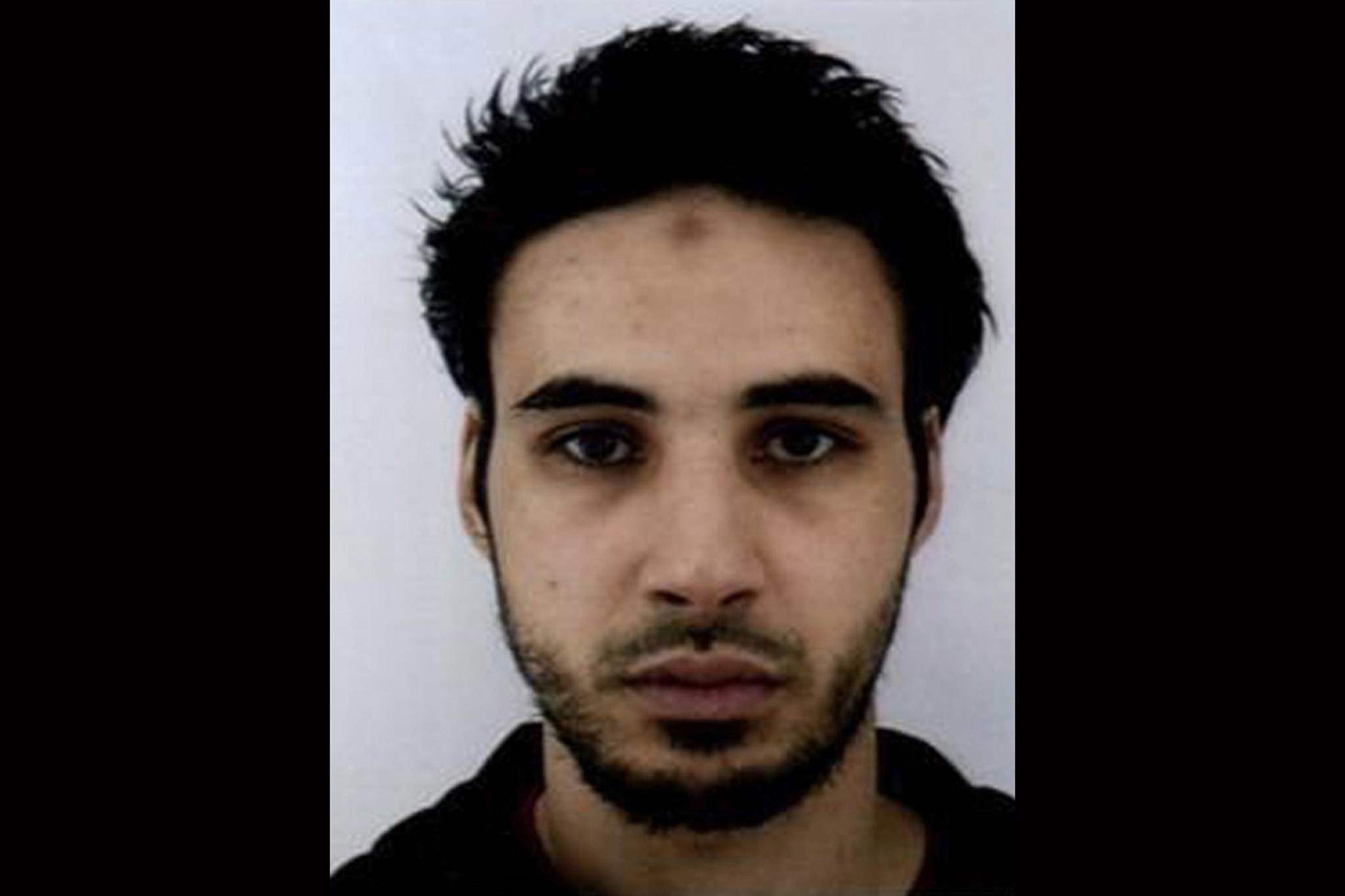
This undated handout photo provided by French police shows Cherif Chekatt, the suspect in the shooting in Strasbourg, France, on December 11, 2018. (French Police via AP, File)

Interior Minister Christophe Castaner told reporters police swooped after the suspect was spotted in the street.

Officers tried to arrest him, but he shot at police. “They immediately returned fire and neutralized the assailant,” Castaner said.

Dozens of police vehicles converged on the area where police were applauded after the shooting. “Bravo!” some shouted as people gathered at the police cordon.

Police in several other countries earlier joined the manhunt for Chekatt, a Strasbourg native and career criminal with at least 27 convictions in four European states.

The Islamic State terrorist group said Thursday that he was one of their “soldiers.”

The perpetrator of “the attack in the city of Strasbourg… is one of the soldiers of the Islamic State and carried out the operation in response to calls to target nationals of the coalition” against IS, the Amaq agency said in a message posted on Twitter.

The terrorist group offered no evidence for the claim.

Authorities published Chekatt’s picture late Wednesday with police describing him as dangerous and urging people not to approach him.

A fifth person was detained by police for questioning on Thursday, in addition to the suspect’s parents and two brothers who have been in custody since Wednesday.

Castaner has announced that the Strasbourg Christmas market would reopen on Friday.

Police vehicles move at the center of the city of Strasbourg following a shooting, December 11, 2018. (Jean-Francois Badias/AP)

French President Emmanuel Macron expressed “the solidarity of the whole country” towards the victims as he arrived for a European summit in Brussels.

“It is not only France that has been hit… but a great European city as well,” he added, referring to the seat of the European parliament in the eastern French city that lies on the border with Germany.

Plea to ‘yellow vests’

As police were hunting Chekatt Thursday, the French government urged “yellow vest” protesters not to hold another round of demonstrations this weekend, given the strain on the country’s security forces.

Government spokesman Benjamin Griveaux called on the anti-government protesters to be “reasonable” and not protest again Saturday, after nearly four weeks of often violent demonstrations which has led the government to offer a range of financial relief to low earners.

“Our security forces have been deployed extensively these past few weeks,” Griveaux told CNews television.

“It would be better if everyone could go about their business calmly on Saturday, before the year-end celebrations with their families, instead of demonstrating and putting our security forces to work once again,” he added.

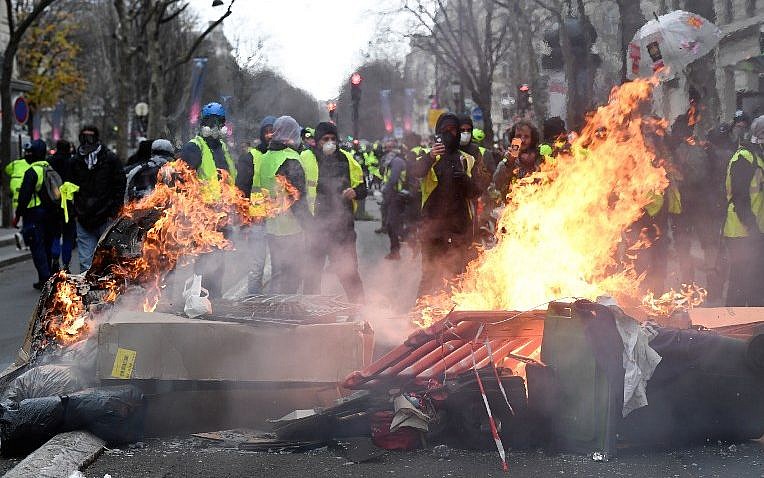
Demonstrators wearing “yellow vests” stand next objects during protests near the Champ Elysees in Paris on December 8, 2018. (Bertrand Guay/AFP)

The “yellow vest” protesters, known for their fluorescent high-visibility jackets, had called for a fifth round of protests this Saturday.

The protests began on November 17 over fuel tax increases, but snowballed into a revolt over living standards as well as Macron’s perceived indifference to the problems of ordinary citizens.

Underscoring attempts to ease tensions, Prime Minister Edouard Philippe confirmed a proposed constitutional reform, which was to be debated in January, had been postponed to allow time for more discussions over local grievances.

Some union leaders also put pressure on “yellow vests” not to demonstrate on Saturday so they would not overburden police as they dealt with security after the Strasbourg attack.

But some “yellow vest” demonstrators dismissed calls to suspend protests.

A 23-year-old protester was killed after he was hit by a truck on a roundabout in southern France near Avignon late on Thursday, the sixth person to have died during the weeks of demonstrations.

Wide search

Strasbourg’s location in the heart of western Europe means that Germany, Switzerland, Belgium and Luxembourg can be easily reached by car or train, making the search for Chekatt more complicated.

Swiss police had reinforced border checks, while German authorities also widely published the photo of the suspect, which showed him with dark hair, a short beard and a visible mark on his forehead.

In 2016, a jihadist responsible for an attack on a Christmas market in Berlin was shot and killed only three days later in Milan in northern Italy after travelling through the Netherlands and France.

A woman lights a candle to pay respects to the victims of a deadly terror attack in Strasbourg, eastern France, two days after the attack, on Thursday, December 13, 2018. (AP Photo/Christophe Ena)

The Strasbourg suspect, who lived in a rundown apartment block a short drive from the city center, was flagged by French security forces in 2015 as a possible Islamic extremist.

France has been hit by a wave of attacks from gunmen claiming allegiance to Al Qaeda or the Islamic State group since 2015, which have claimed the lives of 246 people before Tuesday’s attack, according to an AFP toll.

No group has claimed responsibility for the Strasbourg attack, but social media accounts used by Islamic State sympathizers have celebrated the killings.

Times of Israel staff contributed to this report.


After deadly attacks, US envoy assails PA over terrorist stipends

December 14, 2018

Source: After deadly attacks, US envoy assails PA over terrorist stipends | The Times of Israel

Ambassador to Israel David Friedman says Palestinian Authority ‘can be a political body OR a sponsor of terror, not both’

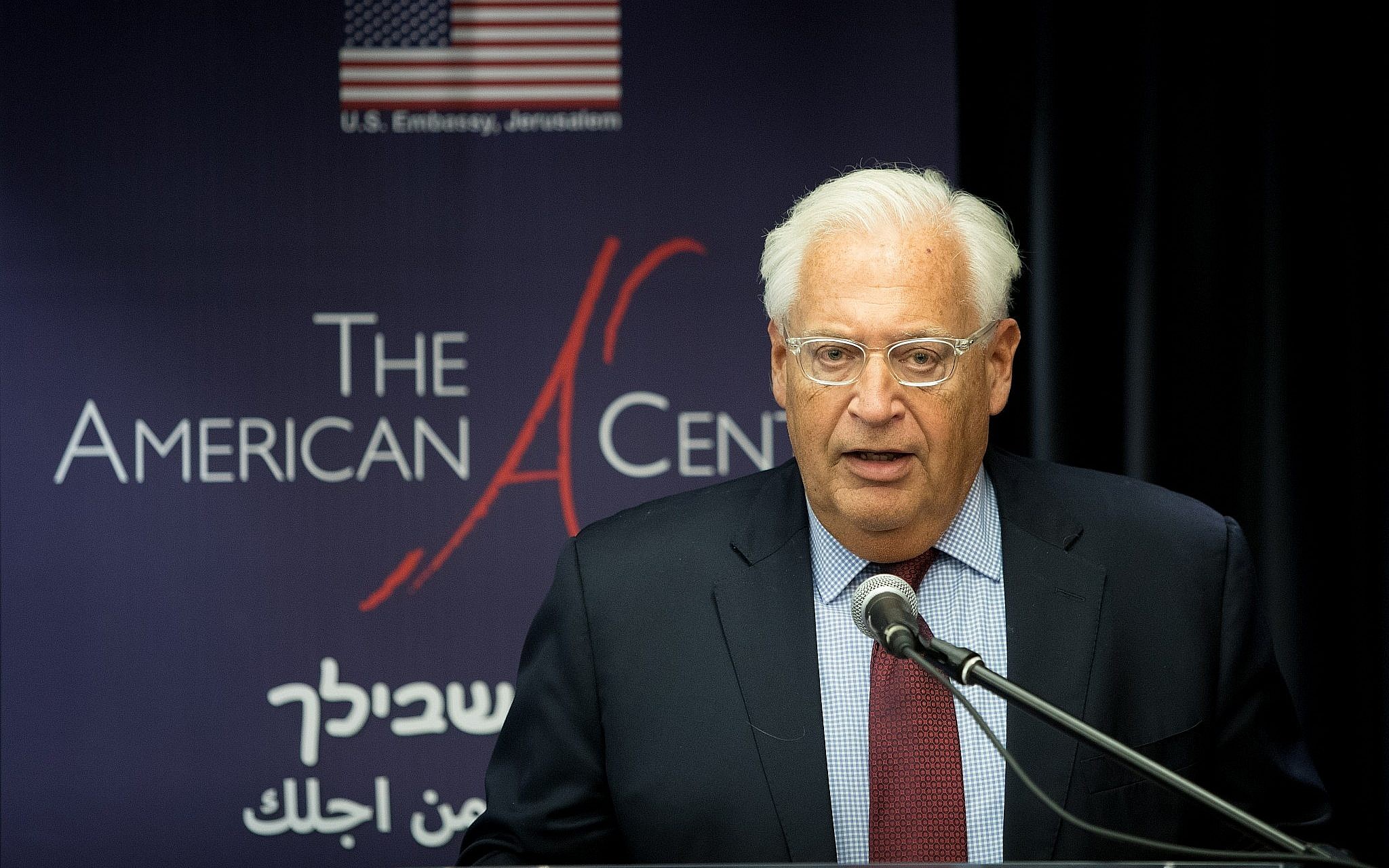
US Ambassador to Israel David Friedman speaks at an event in Jerusalem on October 16, 2018. (Noam Revkin Fenton/Flash90)

US Ambassador to Israel David Friedman speaks at an event in Jerusalem on October 16, 2018. (Noam Revkin Fenton/Flash90)

US Ambassador to Israel David Friedman accused the Palestinian Authority of encouraging terrorism after two Israeli soldiers were killed on Thursday in a shooting attack in the West Bank.

Noting a string of attacks over the past week, Friedman assailed the PA’s policy of paying stipends to the families of Palestinian assailants caught or killed committing “heinous acts” of terrorism against Israelis.

“The PA can be a political body OR a sponsor of terror, not both,” the American ambassador wrote on Twitter.

Friedman has previously criticized the payments by the PA, which critics charge encourage Palestinians to carry out attacks on Israelis.

David M. Friedman

@USAmbIsrael

In the past week terrorists have killed or wounded 14 in multiple attacks. The Pal Authority maintains laws that will compensate these terrorists and their families for their heinous acts. The PA can be a political body OR a sponsor of terror, not both.

His tweet came hours after two Israeli soldiers were killed and a third seriously wounded in a terror attack at a bus stop in the central West Bank. An Israeli woman was also seriously injured in the shooting.

Also Thursday, two Border Police officers were lightly injured in a stabbing in Jerusalem’s Old City. One of them shot and killed the assailant.

On Sunday, seven Israelis were injured in a shooting outside the Ofra settlement, including a pregnant woman whose baby was delivered by an emergency Caesarian-section but died on Wednesday.

The West Bank also saw a string of car-ramming attacks this week.

PA President Mahmoud Abbas’s office on Thursday condemned recent violence, but did not refer explicitly to the Palestinian attacks. It also blamed the prevailing “climate” driving the uptick in West Bank violence on Israeli military raids in Palestinian cities, settler incitement against the PA president, and the stalled peace process.

Families of Palestinians who meet the PA’s definition of a prisoner are entitled to a monthly payment, according to the PA Prisoners and Liberated Prisoners law. The law defines a prisoner as “anyone in the occupation’s prisons for participating in the struggle against the occupation.” Many Palestinians who the PA defines as prisoners have carried out terrorist attacks against Israelis and others.

Both the United States and Israel have passed legislation over the past year targeting the PA’s practice of paying the families of security prisoners, including terrorists. The Trump administration has since cut hundreds of millions of dollars in aid to the Palestinians amid the PA’s boycott of the White House for recognizing Jerusalem as Israel’s capital.

Israeli security forces and forensic experts inspect the scene of a terror shooting outside the Givat Asaf settlement outpost, northeast of the West Bank city of Ramallah, on December 13, 2018. (Ahmad Gharabli/AFP)

According to Israel’s Defense Ministry, the PA in 2017 paid NIS 687 million ($198 million) to the so-called “martyrs’ families fund” and NIS 550 million ($160 million) to the Palestinian Prisoners’ Club — some 7 percent of its overall budget.

Israel has called on Palestinians for years to halt the stipends, which benefit roughly 35,000 families of Palestinians killed, wounded, or jailed in the conflict with Israel, many of them accused of involvement in terror. Israel says the stipends encourage violence.

Abbas has condemned the US and Israeli laws and vowed to continue to make the payments.


Senior IDF commander signals a single Hamas cell behind both West Bank shootings

December 14, 2018

Source: Senior IDF commander signals a single Hamas cell behind both West Bank shootings | The Times of Israel

In first indication that Ofra, Givat Assaf terror attacks may be linked, Central Command chief Maj. Gen. Nadav Padan vows to ‘settle the score’ with on-the-lam terrorists

Israeli soldiers stand guard at a West Bank junction, following a terror attack earlier in the day where two Israeli soldiers were shot dead by Palestinian terrorists, December 13, 2018. (Gershon Elinson/FLASH90)

Israeli soldiers stand guard at a West Bank junction, following a terror attack earlier in the day where two Israeli soldiers were shot dead by Palestinian terrorists, December 13, 2018. (Gershon Elinson/FLASH90)

A senior Israel Defense Forces commander on Thursday indicated that the same Hamas terror cell carried out two drive-by shooting attacks in the West Bank this week, in which two IDF soldiers were killed, a baby lost his life, and nine other Israelis were injured.

It appeared to be the first official confirmation that the two terror attacks, which occurred along the same highway and days apart, were directly linked.

IDF Central Command chief Maj. Gen. Nadav Padan vowed that the IDF would hunt down the terrorists, some of whom remain on the run.

“In the past few days a Hamas terror group cell managed to harm us and exact from us a heavy price,” Padan said. “We will pursue them and settle the score with this cell.”

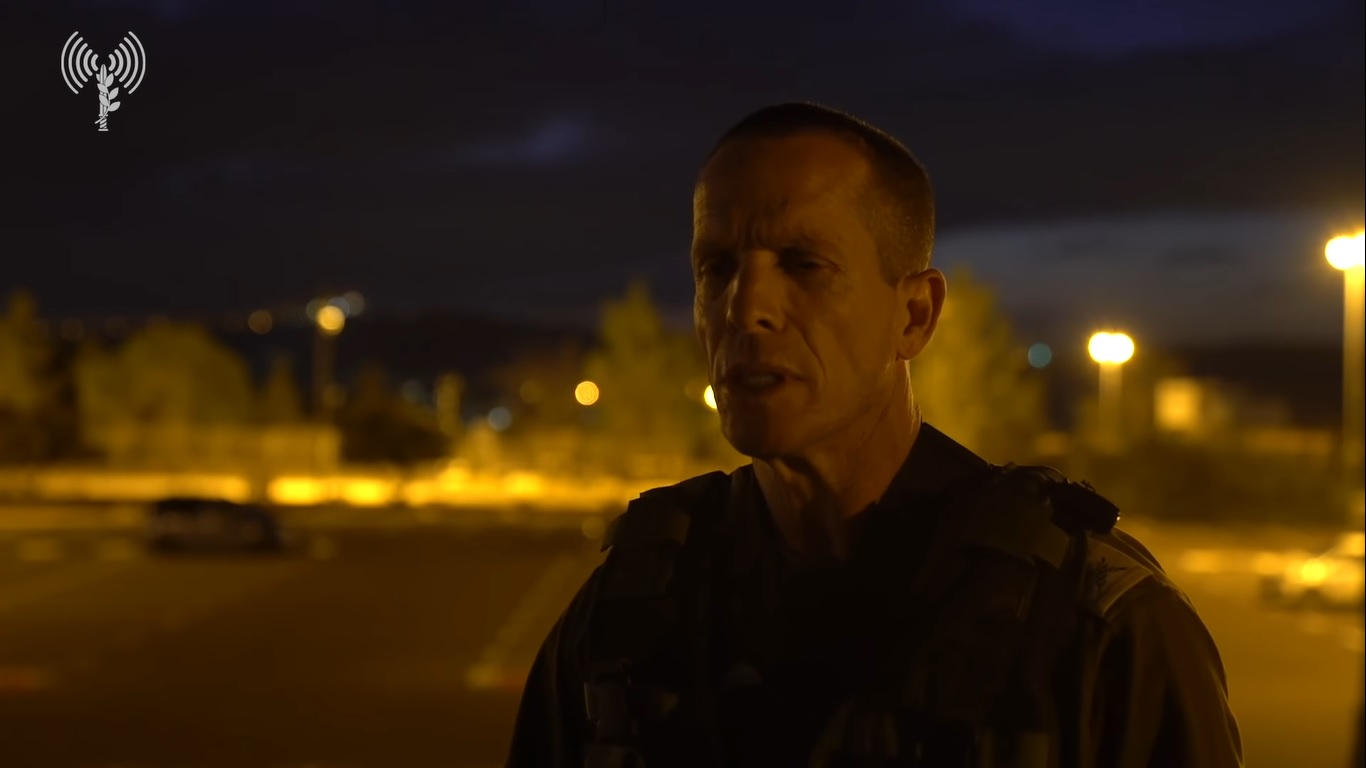
Screen capture from video of IDF Central Command chief Maj. Gen. Nadav Padan. (YouTube)

On Thursday afternoon, a Palestinian terrorist opened fire at the bus stop near the Givat Assaf outpost, killing two soldiers, critically injuring a third, and seriously wounding a civilian woman, before fleeing the scene. The IDF later identified the slain soldiers as Staff Sgt. Yovel Mor Yosef, 20, and Sgt. Yosef Cohen, 19.

The Kan public broadcaster reported on Thursday night that an IDF soldier’s rifle was snatched by the Palestinian gunmen during the shooting attack.

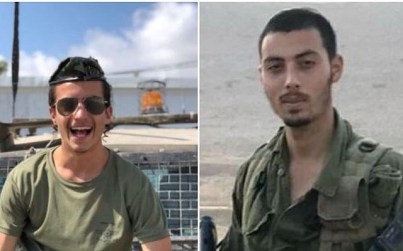
A photo composite shows Sgt. Yosef Cohen (L) and Staff. Sgt Yoval Mor Yosef of the Israel Defense Forces’ Kfir Brigade. The two were killed on December 13, 2018, in a terrorist shooting attack outside the Givat Assaf settlement outpost in the central West Bank. (Israel Defense Forces)

The shooting attack took place on Route 60, some two kilometers (1.25 miles) from Ofra, where on Sunday a number of terrorists driving in a white car opened fire at a group of people standing at the settlement’s bus stop, hitting seven of them, including a heavily pregnant woman who was seriously injured and whose baby — delivered in emergency surgery — later died as a result of the attack.

“There will no hiding place for the attackers in all of Judea and Samaria,” Padan said, using the biblical names for the West Bank. “The IDF will continue to hunt them. Following the attack we are increasing forces, protecting the roads and settlements, and expanding the efforts to thwart terror.”

Late Wednesday night, Israeli security forces conducted a series of raids in the Ramallah area to find the terrorists responsible for Sunday’s shooting. At least four suspects were arrested and one, Salih Omar Barghouti, 29, was shot dead after troops said he tried to attack them while attempting to escape in the village of Kobar, outside Ramallah. Hamas later claimed Barghouti as a member.

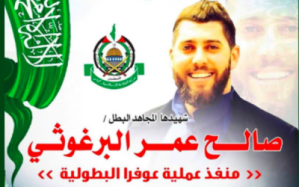
A poster published by Hamas claiming the December 9, 2108, Ofra terror attack and praising the ‘martyr’ Salih Barghouti, posted on Hamas’s official Twitter account, December 12, 2108. (Twitter)

But the military on Thursday afternoon acknowledged that it may not yet have arrested all of the suspects in the  drive-by shooting attack outside the Ofra settlement.

“We’re still in the midst of a manhunt,” a senior officer in the IDF Central Command said on Thursday morning, speaking to reporters on condition of anonymity.

Prime Minister Benjamin Netanyahu, responding to the attacks, ordered a series of security measures, including escalating administrative detention of Hamas members in the West Bank, a measure that enables holding them under arrest for extended periods without trial.

“The prime minister sent a sharp message to Hamas: We will operate against you if you carry out [acts of] terrorism from Judea and Samaria,” a senior official said, using the biblical name for the West Bank. “There will not be a situation in which there is a ceasefire in Gaza and the use of fire in Judea and Samaria.”

The IDF also bolstered its troops in the West Bank on Thursday in the wake of the attacks and amid the ongoing manhunt.

The army refused to specify the number of additional battalions it was deploying in the West Bank. An IDF spokesperson said the reinforcements would assist in the search for the shooter and any accomplices, as well as provide additional protection to settlements and the area’s roadways.

Israeli security forces and forensic experts inspect the scene of a terror shooting outside the Givat Assaf settlement outpost, northeast of the West Bank city of Ramallah, on December 13, 2018. (Ahmad Gharabli/AFP)

The past week has seen a significant escalation in the level of violence in the West Bank and Jerusalem. Before dawn on Thursday morning, a Palestinian man stabbed two border guards in the Old City of Jerusalem, lightly injuring them, before he was shot dead by the officers.

Hours after the Givat Assaf shooting attack, the army said a Palestinian man attempted to ram his car into a group of soldiers who were taking part in the effort to find the gunman outside the town of el-Bireh, adjacent to Ramallah. The troops opened fire, killing the man, later identified by Palestinian officials as Hamdan al-Arda. One soldier was lightly injured. The Palestinian man’s family denied the army’s claims, saying it was not an attack, but rather a traffic accident. Arda, a 56-year-old aluminum factory owner, was hard of hearing, his relatives told the Haaretz daily.

Ashraf Walid Suleiman Na’alowa, a Palestinian man suspected of carrying out a deadly terror attack on October 7, 2018 in the Barkan Industrial Zone in the northern West Bank. (Courtesy)

Separately, Israeli troops located a terrorist who killed two Israelis in October at the Barkan industrial zone after a two-month manhunt. The suspect was killed in a shootout with troops overnight Wednesday-Thursday.

There has been an increase in the number of attacks on Israeli civilians and soldiers in recent weeks, after months of relative calm in the area, raising concerns of a potential renewed outbreak of regular, serious violence in the region.

The military blamed the increase in attacks both on terror groups’ ongoing efforts, the “copycat” phenomenon and a number of significant dates coming up this week, notably the anniversary of Hamas’s founding.

Judah Ari Gross contributed to this report.