Muslims in Indonesia can use a smartphone app to report insults to the Prophet Mohammed and Islam. Does the U.S. Constitution protect the individual’s right to use an app like that? Bill Whittle Now considers the impact of 21st century technology to enforce 7th century law.
BEIRUT, LEBANON (3:30 P.M.) – Minutes ago, the Turkish Army began heavily shelling the Kurdish-led People’s Protection Units (YPG) in the northern countryside of the Aleppo Governorate.
According to the nearby Syrian Arab Army (SAA), the Turkish military has been heavily shelling the YPG’s positions at the town of Tal Rifa’at.
The Syrian Arab Army said they are on high alert now because the Turkish Army shells were landing near their positions in the Tal Rifa’at countryside.
Israeli security forces shot dead a suspect and arrested a number of accomplices on Wednesday night, but the military isn’t sure that the entire terror cell has been caught.
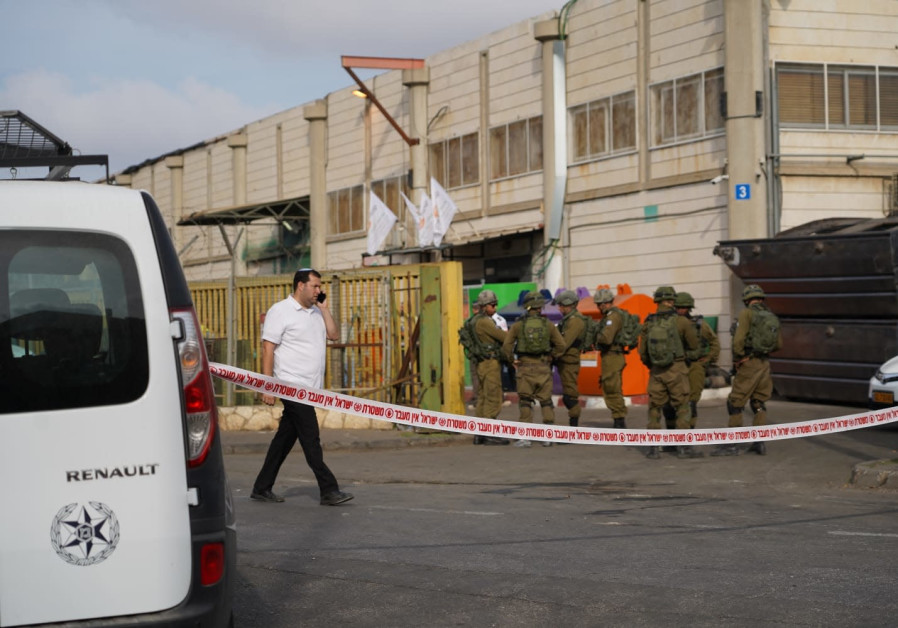
IDF and Magen David Adom at the sceneof the terror shooting in the Barkan industrial Zone. (photo credit: HALLEL MEIR/TPS)
After months of relative calm, two deadly shooting attacks in less than one week.
That’s the current situation in the southern West Bank, and it is feared that this might only be the beginning of another wave of deadly attacks against Israeli civilians and soldiers.
While there was an overall drop in attacks in the West Bank in the first six months of 2018, according to the Shin Bet General Security Service, October saw a significant rise in attacks. That rise has led to the deaths of 11 Israelis and the wounding of another 76 in the West Bank this year.
The question has to be asked: Why have Israel’s fabled security services not been able to foil these deadly attacks?
On Sunday night Palestinians driving a white car opened fire on a group of Israelis at a bus stop outside the West Bank settlement of Ofra, injuring seven, including a pregnant 21-year-old woman who gave birth in an emergency cesarean section. The baby died four days later.
It was the most serious attack in the West Bank since the deadly Barkan attack in October in which a terrorist killed two Israeli civilians.
Until today when two IDF soldiers were killed and another in critical condition and moderately injured a civilian near the Givat Asaf settlement on the West Bank’s Route 60 highway, a mere two kilometers from where Sunday’s attack took place.
On Wednesday night Israeli security forces shot dead a suspect and arrested a number of accomplices. But the military isn’t sure the entire cell has been caught and it is exploring whether Thursday’s attack might be connected.
“We got one of the terrorists from the Ofra attack, but we are still working because we have to be sure we have the whole cell, so we are still in pursuit. It could be that this is it, but it may be that there are still others on the run,” a senior IDF officer told reporters before Thursday’s attack.
In November Shin Bet Director Nadav Argaman told the Knesset’s Foreign Affairs and Defense Committee that security forces has thwarted 480 terrorist attacks in the West Bank, including 219 attacks planned by Hamas cells and 590 planned by so-called “lone wolves” working on their own.
According to one senior IDF officer, the military works every night with the Shin Bet and special forces “to deal with the challenge of terrorism,” arresting more than 2,700 Palestinians this year alone.
“THE LARGE part of the population in the West Bank is very violent and wants to carry out attacks. Only this year we succeeded in thwarting hundreds of terrorist attacks and we have arrested more than 2,700 people, but every month between four to eight attacks are successful,” he said, adding that “there is constant evaluation of the situation.”
Attacks by lone wolves, the IDF has admitted, are much more challenging to thwart than those planned by groups. But with some attacks having a similar modus operandi, how likely is it they are actually organized by individuals acting alone?
Speaking on a conference call organized by The Israel Project, Dr. Barak Ben-Zur, an expert in strategic intelligence and counter-terrorism and former head of the Shin Bet security agency’s Intelligence and Research Division, said Hamas is trying to open up a new front in the West Bank.
“If we are looking at the recent incidents in the West Bank, it was in the same area and because we saw that those were squads that used the same modus-operandi, we can assume that it’s a new wave,” he said. “It’s maybe the same infrastructure. And we can take in consideration that those who initiated those terror attacks are approximately the same guys that tried some two months ago to open a new wave of attacks – meaning Hamas.”
According to Ben-Zur, the attacks are not carried out lone-wolf attackers, but are “a part of the new initiative of this organization [Hamas] that decided to open a new front in the West Bank. After a period of time they got to the conclusion that they will ease down their efforts from the Gaza Strip.”
Israel has foiled large-scale Hamas attacks in the past. So it is possible that Hamas has learned the IDF’s weak spot and decided it is more practical to carry out attacks by small cells instead of large-scale bombings by large networks of operatives.
Hamas’s military wing, Izzadin al-Qassam Brigades, released a statement praising Thursday’s attack and warning of more attacks to come.
“The enemy must not dream of security, security and stability… the West Bank will burn the occupiers and harass them in ways that the enemy does not expect,” the statement said, adding, “All attempts to destroy our resistance and take our weapons in the West Bank will fail.”
“Israel’s leaders must understand that they are not able to protect their soldiers.”
BY JERUSALEM POST STAFF
DECEMBER 13, 2018 12:46
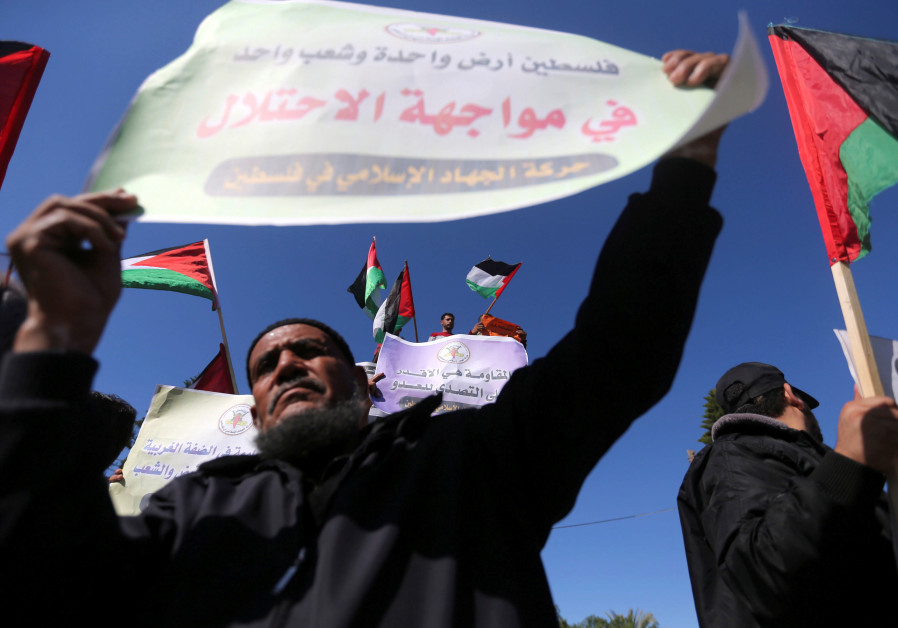
Palestinians take part in a protest calling on Hamas and Fatah factions to conclude the reconciliation, in Gaza city December 3, 2017. (photo credit: REUTERS/IBRAHEEM ABU MUSTAFA)
Fatah called on Palestinians to escalate the situation and hold protests throughout the West Bank Thursday afternoon, “to commemorate the Martyrs and to realize our goals.”
The organization warned IDF soldiers and settlers of “the continued bloodshed and aggression that will lead to a stronger confrontation.”
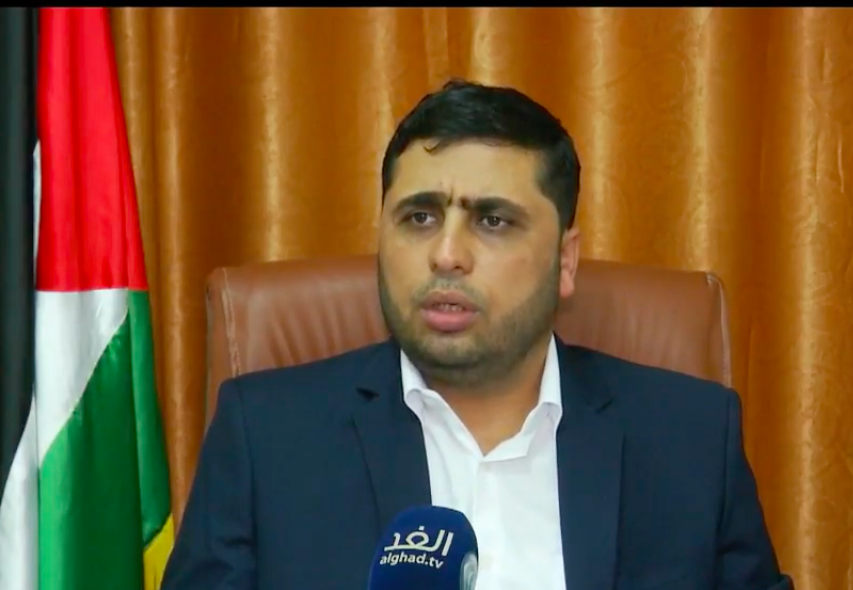
“Hamas praises the numerous resistance attacks as well as the citizens of the occupied West Bank and the revolutionary youth,” Hamas Spokesman Abdel Latif al-Qanou said. The attack, he said, “is in response to the crimes of the Zionist occupation in the occupied West Bank. Our members will stand against the occupation and will resist it – until it ends.”
Fatah placed the blame for the attack on Israel.
“When the occupation army harms and destroys Palestinian land and Israeli soldiers execute three Palestinians in a kangaroo court, they have to understand that the Palestinian response will be in proportion to the aggression,” said Fatah spokesperson Munir Jaghoub.
“Israel’s leaders must understand that they are not able to protect their soldiers, and they have tried every way they can think of to make Palestinians raise the white flag of surrender,” Jaghoub said. “Israel has no way of protecting its soldiers and the murderous settlers, aside from withdrawing to the June 1967 lines.”
The scene of a stabbing attack in Jerusalem’s Old City on December 13, 2018. (Police Spokesperson)
Two Border Police officers were stabbed and lightly wounded in a terror attack before dawn Thursday in the Old City of Jerusalem, before shooting dead their assailant, police and medics said.
The male officer was stabbed in the face, near his eye. The female border guard was stabbed in the leg. The attacker, a 26-year-old Palestinian from the West Bank, was shot dead by the officers.
Surveillance footage from the scene, released by police, shows the assailant running up to the officers and rapidly stabbing them with the knife. Prior to the stabbing attack, the assailant was also seen on camera pushing an ultra-Orthodox man to the ground in the alleyways of the Old City.
The weapon was recovered at the scene.
“The terrorist came from the direction of the Damascus Gate, took out a knife, attacked a Jewish man on Hagai Street and tried to stab him, when he failed to do so, he continued running toward a team of border guards — a male and female officer — who were stationed nearby and tried to stab them,” police said.
“During a fight with the terrorist, the border guards succeeded in neutralizing him by shooting him,” police said in a statement
Security forces and medics arrived at the scene and the two officers were taken to hospitals for further treatment, the Magen David Adom rescue service said.
The female officer was taken to the capital’s Hadassah Hospital Ein Kerem. She was treated in the trauma center with light injuries, the hospital said.
The male border guard was taken to Jerusalem’s Shaare Zedek Medical Center with stab wounds to the face, the hospital said.
The Old City in Jerusalem has been a frequent site of stabbing attacks by Palestinians in recent years.
The attack followed a night of violence in which Israel forces killed two suspected Palestinian terrorists in separate incidents.
After a two-month manhunt, Israeli forces found and killed a Palestinian man suspected of carrying out a brutal terror attack in which he shot dead two Israeli coworkers in a West Bank factory, the Shin Bet security service said early Thursday.
Ashraf Walid Suleiman Na’alowa, a Palestinian man suspected of carrying out a deadly terror attack on October 7, 2018 in the Barkan Industrial Zone in the northern West Bank. (Courtesy)
On October 7, Ashraf Na’alowa, 23, allegedly killed his coworkers Kim Levengrond Yehezkel and Ziv Hajbi at a factory where all three worked in the Barkan Industrial Zone. Another Israeli woman was also injured in the attack.
Na’alowa, from the West Bank village of Shuweika near Tulkarem, remained on the run for over two months, repeatedly eluding capture by Israel security forces. In the interim, a number of his relatives and alleged accomplices have been detained and indicted as part of the manhunt.
Early Thursday morning, Israeli forces tried to arrest him in a joint operation between the IDF, the Shin Bet security services and the Israel police. He was killed during the operation, the Shin Bet said, adding that he was armed.
The army gave no further details on the location of the raid, saying only that he was found following a wide-ranging intelligence effort and that he was planning on carrying out another attack.
Na’alowa was the second suspected terrorist killed in a matter of hours.
Late Wednesday, Israeli forces killed Salih Omar Barghouti who was suspcted of the drive-by shooting attack on a bus stop outside of Ofra on Sunday night, hitting a 30-weeks pregnant woman who was seriously injured. The baby was delivered in an emergency operation, but died earlier Wednesday.
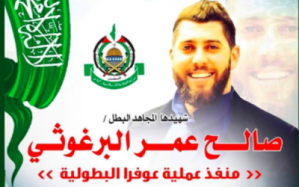
A poster published by Hamas claiming the December 9, 2108, Ofra terror attack and praising the ‘martyr’ Salih Barghouti, posted on Hamas’s official Twitter account, December 12, 2108. (Twitter)
Barghouti, 29, a resident of Kobar, a village near Ramallah, was killed Wednesday evening after he tried to attack troops while escaping arrest and was shot, the Shin Bet security agency said, adding that he was believed to have carried out the Ofra terror attack.
Hamas later claimed Barghouti as a member, calling the attack “heroic.”
Four other people suspected of being involved in the attack were arrested, the Shin Bet said.
“The heroic Silwad operation is a response to the Zionist occupation’s crimes and behavior in the occupied West Bank,” Abdelatif al-Qanou, a spokesman for the terror group, wrote on Twitter, referring to a Palestinian village near Ofra. “The West Bank’s youth and men will remain rebels against the occupation and continue to clash with it until it is banished.”
The perpetrators of the attack fled the scene, the IDF said, and troops were searching for them.
Hamas officials have frequently encouraged and praised shooting, stabbing and ramming attacks in the West Bank and Israel.
Both the US and Israel consider Hamas a terrorist group.
Earlier on Thursday, the Izz ad-Din al-Qassam Brigades, Hamas’s military wing, appeared to take responsibility for two other shooting attacks — one earlier this week outside Ofra and another in the Barkan Industrial Zone in the northern West Bank.
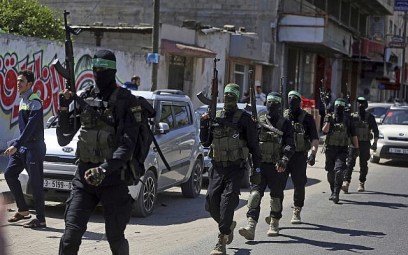
Masked gunmen from the Izzedine al-Qassam Brigades, a military wing of the Hamas terror group, march with their weapons, during a large-scale drill across the Gaza strip, March 25, 2018. (AP Photo/ Khalil Hamra)
“From the heroic Barkan operation to the Ofra operation, the Qassam Brigades are undertaking a new battle,” the Qassam Brigades said in a statement.
Seven people were wounded in the drive-by shooting attack on a bus stop outside of Ofra on Sunday night, including a 30-weeks pregnant woman who was seriously injured. The baby was delivered in an emergency operation, but died on Wednesday afternoon.
In October, 28-year-old Kim Levengrond Yehezkel and 35-year-old Ziv Hajbi were killed in a shooting attack in the Barkan Industrial Zone.
Two Palestinians suspected of separately carrying out the terror attacks in Ofra earlier this week and in Barkan were killed by Israeli forces Wednesday night and Thursday morning.
Salih Barghouti, 29, from Kobar, a village near Ramallah, was killed Wednesday evening after he tried to attack troops while escaping arrest and was shot, the Shin Bet security service said, adding that he was believed to have carried out the Ofra terror attack.
Hamas wrote on its official Twitter account that Barghouti carried out the shooting adjacent to Ofra and said he was a member of the terror group.
Ashraf Na’alowa, 23 and a resident of Shuweika, a village near Tulkarem, was killed Thursday morning, the Shin Bet said early Thursday. Na’alowa was suspected of killing Yehezkel and Hajbi. He remained on the run for over two months, repeatedly eluding capture by Israel security forces.
The Qassam Brigades said he carried out the attack in Barkan and was a Hamas member.
“Everyone should be vigilant because our enemy America is sly and evil and may have plans for 2019,” Iran’s supreme leader says • “My advice to the youth and the country’s various organizations is to be careful and not make matters easier for the enemy.”
Reuters and Israel Hayom Staff
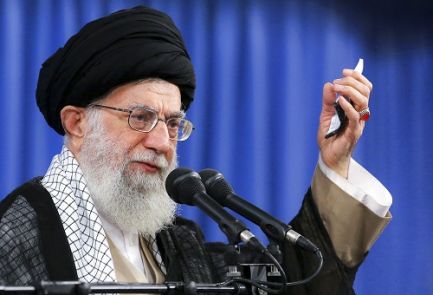
Iranian Supreme Leader Ayatollah Ali Khamenei
|Archives: AP
Iran’s Supreme Leader Ayatollah Ali Khamenei urged his countrymen on Wednesday to stay united, saying the United States would exploit divisions and was likely to launch plots against Iran in 2019.
Iran is struggling with the economic impact of U.S. President Donald Trump’s decision to pull out of a 2015 nuclear deal between Iran and six major powers and reimpose sanctions.
“Everyone should be vigilant, because our enemy America is sly and evil … and may have plans for 2019,” Khamenei said in a speech, the text of which was posted on his website. “But we are stronger than them and they will fail as they have in the past.”
The Islamic republic’s rial currency has lost about 60% of its value in 2018, as Iranians have increasingly sought dollars and gold coins to protect their savings. Factional tensions and worker protests have been on the rise as the sanctions have spurred inflation and unemployment.
“My advice to the Iranian nation, especially the youth and the country’s various organizations, professional or political, is to be careful and not make matters easier for the enemy,” Khamenei said.
Iran has accused the United States, Israel, regional rival Saudi Arabia and government opponents living in exile, of fomenting unrest.
“Iran’s ballistic missile activity is out of control,” Secretary of State Mike Pompeo tells Security Council as he criticizes it for the lax ban on nuclear-capable Iranian missiles • Iranian envoy accuses the U.S. of “lies, fabrications” about the nuclear program.
Associated Press and Israel Hayom Staff
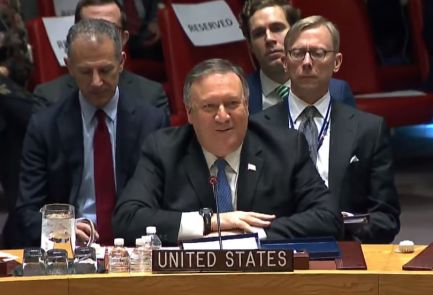
U.S. Secretary of State Mike Pompeo speaks before the U.N. Security Council, Wednesday
|Screenshot: YouTube
U.S. Secretary of State Mike Pompeo urged the U.N. Security Council on Wednesday to again ban Iranian ballistic missiles capable of delivering nuclear weapons and to maintain an arms embargo that is scheduled to be lifted in 2020 under the landmark Iran nuclear deal.
He also urged the council to prevent Iran from circumventing existing arms restrictions by authorizing the inspection of ships in ports and stopping them on the high seas.
“Iran’s ballistic missile activity is out of control,” Pompeo said. “Iran has been on a testing spree and a proliferation spree that must come to an end.”
Pompeo spoke at a Security Council meeting on Iran’s compliance with the 2015 nuclear agreement that the Trump administration pulled out of earlier this year and the council resolution endorsing it.
The United States faces an uphill struggle in getting Security Council approval for Pompeo’s proposals, especially following U.S. withdrawal from the 2015 nuclear deal, which is still supported by Russia, China, Britain, France and Germany.
The Trump administration’s reimposition in November of sanctions against Iran that it had eased under the nuclear deal has also angered some key council members, as well as U.N. Secretary General António Guterres.
Pompeo criticized the council for weakening the ban on nuclear-capable Iranian missiles that was in effect from 2010 to 2015. The resolution adopted in 2015 to endorse the nuclear deal “calls upon” – but does not require – Iran to halt such activity, and it also supports lifting the arms embargo in 2020.
Iran’s Deputy U.N. Ambassador Eshagh Al Habib, accused the United States of “another series of lies, fabrications, disinformation and deceptive statements” about its ballistic missile program.
He told the Security Council that “Iran’s ballistic missile program is designed to be exclusively capable of delivering conventional warheads required to deter foreign threats.” He said it has no nuclear component.
Russian Ambassador Vassily Nebenzia said Iran is not banned from conducting ballistic missile launches and there is no proof its missiles are capable of carrying nuclear weapons.
Pompeo accused Iran of building the largest ballistic missile force in the region, one capable of threatening the Mideast and Europe, saying it has more than 10 ballistic missile systems in its inventory or in development and hundreds of missiles. He quoted the head of the Iranian Revolutionary Guard’s Airspace Division Gen. Amir Ali Hajzadeh, boasting Monday that Iran is capable of building missiles with a range beyond 2,000 kilometers (1,200 miles).
“Iran has exploited the goodwill of nations and defied multiple Security Council resolutions in its quest for a robust ballistic missile force,” Pompeo said. “The United States will never stand for this. No nation that seeks peace and prosperity in the Middle East should either.”
He said the Trump administration will exert “American leadership” to build a coalition of countries around the world to acknowledge and deter Iran’s continued missile proliferation.
Pompeo said the U.S. and Europe have a different view on the Iran nuclear deal. “They view it as the linchpin; I view it as a disaster,” he said.
But, he added, Europeans are concerned about the Iranian ballistic missile buildup.
Before the council meeting, eight European Union nations underlined their commitment to the Iran nuclear deal while urging Tehran to stop its “destabilizing regional activities” especially the launch of ballistic missiles.
Ambassadors of the eight nations – Belgium, France, Germany, Italy, Netherlands, Poland, Sweden and the United Kingdom – said that “it has been confirmed that Iran continues to implement its nuclear-related commitments.”
But they warned that “ballistic missile-related activities such as the launch of nuclear-capable missiles and any transfers of missiles, missile technologies and components … would be in violation of Security Council resolutions.”
Nebenzia lashed out at the Trump administration for abandoning the 2015 nuclear deal and for “trying to punish all other member states” for implementing the agreement and the Security Council resolution endorsing it.
He said “Iran is ready for a dialogue” but the United States and other Security Council members appear to be more interested in further escalating “anti-Iran hysteria and to demonize Iran.”
“To lower the crisis what we need to do is pool international and regional efforts,” Nebenzia said, saying that one way to start is to hold a conference with countries in the region and then broaden it to the entire Middle East.
French Ambassador François Delattre also stressed that a long-term strategy in the Middle East cannot rest on “exerting pressures and sanctions” on Iran but must include “a firm and frank dialogue” with the Iranians on issues including their ballistic missiles and destabilizing activities.
Dialogue is the only way the international community will be able to lay the foundations for a new agreement with Iran that will include the nuclear issue, its ballistic missile activity and regional stability, he said.
“There is no other way to make sure there is lasting stability in the region or to attain the goal of Iran never obtaining nuclear weapons,” Delattre said.
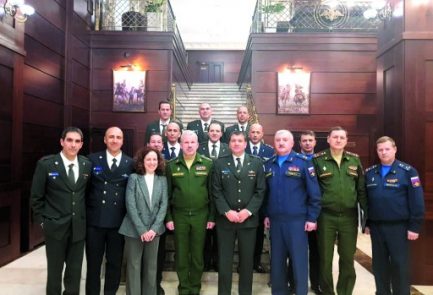
In Moscow, IDF delegation briefs Russian defense officials on the operation launched last week to expose and neutralize Hezbollah terror tunnels snaking into Israel • Sides will also “continue to work together” to improve deconfliction mechanism in Syria.
Lilach Shoval, News Agencies and Israel Hayom Staff
The Israeli and Russian military delegations in Moscow, Wednesday
|Photo: IDF Spokesperson’s Unit
An IDF delegation met with Russian defense officials in Moscow on Wednesday and briefed them on an operation launched last week to expose and neutralize Hezbollah attack tunnels into Israel.
They also discussed “improving the two militaries’ deconfliction mechanism” in Syria, where Russia and Israel maintain a hotline to coordinate operations and prevent aerial collisions.
In September, previously close ties were strained after a Russian warplane was hit by Syrian forces responding to an Israeli air raid. All 15 people aboard were killed and Russia blamed Israel for the incident. In October, Moscow said it had delivered S-300 surface-to-air missiles to Syria as a response.
“The delegations reached understandings and they agreed to continue their joint work together,” the IDF said in a statement after the meeting.
Israel frequently carries out airstrikes in Syria against Iran and its proxies, in an effort to prevent sophisticated weaponry from reaching Lebanon’s terrorist Hezbollah group.
On Saturday, Prime Minister Benjamin Netanyahu briefed Russian President Vladimir Putin on Israel’s crackdown along its border with Lebanon.
During their phone call, initiated by Netanyahu, Putin “stressed the importance of ensuring stability in the region,” the Kremlin statement said.
A statement from Netanyahu said that in his phone call with Putin he had also “stressed once more Israel’s policy aimed at preventing Iran’s entrenchment in Syria and at acting against Iran and Hezbollah’s aggression.”
Thus far the Israel-Lebanon border has remained largely quiet but there are fears of an escalation.
The United Nations Interim Force in Lebanon confirmed the existence of a tunnel near the Blue Line, the U.N.-demarcated border between Israel and Lebanon, last Thursday, describing it as a “serious occurrence.”
Israel is also concerned about Hezbollah obtaining precision-missiles and in September identified three locations in Lebanon where it said the group was converting “inaccurate projectiles” into precision-guided missiles – something Lebanon’s government has denied.
Manhunt for terrorists who opened fire on Israelis at a bus stop near Givat Asaf is underway • Hamas, Islamic Jihad laud attack, threaten current uptick in violence across Judea and Samaria is “only the beginning.”
Efrat Forsher, Daniel Siryoti, Yori Yalon, Lilach Shoval, News Agencies and Israel Hayom Staff
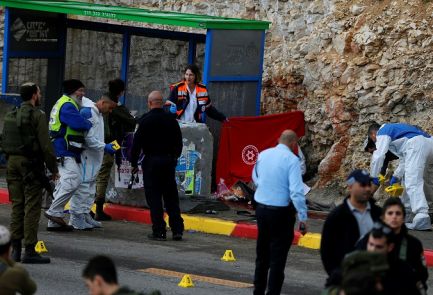
Israeli forces and medics at the scene of Thursday’s shooting in Samaria
|Photo: Reuters
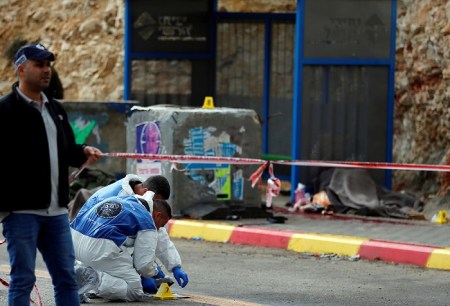
Palestinian gunmen opened fire on Israelis standing at a Samaria bus stop Thursday, killing two people and wounding two others.
The shooting took place near the entrance to the Givat Asaf outpost, in the Binyamin region, shortly before noon.
According to available details, the terrorists’ car slowed to a crawl as it approached the group waiting at the bus stop, then one of the passengers stepped out and opened fire on them. He then jumped back into the car, which sped away in the direction of Ramallah.
First responders who arrived at the bus stop pronounced two men in their 20s dead at the scene. A 20-year-old woman suffering from injuries to her lower extremities was rushed to Shaare Zedek Medical Center in Jerusalem in serious condition. Another victim, a 21-year-old man, sustained critical head injuries and was rushed to Hadassah Ein Kerem Hospital in the capital.
Security forces scrambled to the scene and were canvassing the area for the terrorists. The vehicle was found, abandoned, near Ramallah, about an hour after the attack.
”Given the tensions on the ground, the IDF has bolstered its deployment across Judea and Samaria and has surrounded Ramallah,” IDF Spokesperson Brig. Gen. Ronen Manelis said in a statement.
”Incidents like we have seen on Sunday and today inspire copycats. We are therefore focused, other than finding the terrorists, on increasing security on the roads in the area and preventing future incidents,” he said.
Reuters
Israeli police forensic experts at the scene of Thursday’s shooting
Hamas, the terrorist group that rules the Gaza Strip, and Islamic Jihad lauded the attack and threatened the uptick in violence was “only the beginning.”
Hamas called on the Palestinians in Gaza and across the West Bank to stage mass demonstrations on Friday, to “defy the occupation.”
Hamas spokesman Abdelatif al-Qanou tweeted, “The heroic operation is a response to the Zionist occupation’s crimes and behavior in the occupied West Bank. The West Bank’s youth and men will remain rebels against the occupation and continue to clash with it until it is banished.”
The Palestinian Authority, for its part, was reportedly trying to de-escalate tensions, relaying messages to Israel that it had no interest in a flare-up in its territory.
However, the Al-Aqsa Martyrs Brigades, the Fatah’s military wing, issued a statement saying the violence was a “small response to the Israeli aggression in Palestinian cities.” The group said that as long as Israeli forces raid Palestinian cities, “Israel will have to understand that retaliation will come.”
Thursday’s attack comes on the heels of a similar shooting Sunday evening in which seven Israelis, including a pregnant woman, were wounded at a bus stop near the Samaria settlement of Ofra, just 2 kilometers (1.2 miles) north of Givat Asaf.
The woman’s baby, delivered via emergency C-section at 30 weeks, was in critical condition for three days. He died on Wednesday evening.
Late Wednesday night, security forces killed one terrorist and apprehended four others for their involvement in the Ofra shooting.
A defense official said that at this time, no immediate link has been established between the cell that carried out Thursday’s attack and the cell behind Sunday’s shooting.
Earlier Thursday, two border policemen sustained minor wounds in a stabbing attack in the Old City of Jerusalem. Other police officers present at the scene shot and killed the assailant.
Police Spokesman Micky Rosenfeld said the attack took place in the early hours of Thursday morning on Al Wad Hagai Street, near the Damascus Gate entrance to the Old City, when a terrorist armed with a knife stormed two border policemen standing guard nearby.
Magen David Adom emergency services paramedics were called to the scene to treat the two, a 21-year-old man and a 20-year-old woman, then rushed them to Hadassah Ein Kerem Hospital in the capital for further treatment.
Rosenfeld noted that police forces throughout Jerusalem have been placed on high alert following the incident.






 anneinpt
 artaxes
 danmillerinpanama
 davidking1530
 Peter Hofman
 Joseph Wouk
 Peter
Peter Louisiana Steve
 WarSclerotic
Recent Comments