Archive for December 11, 2018

Australia to recognize Jerusalem as Israeli capital, delay embassy move – report 

December 11, 2018

Source: Australia to recognize Jerusalem as Israeli capital, delay embassy move – report | The Times of Israel

Scott Morrison’s cabinet said to approve shift in foreign policy, while putting off relocating mission due to $200 million price tag
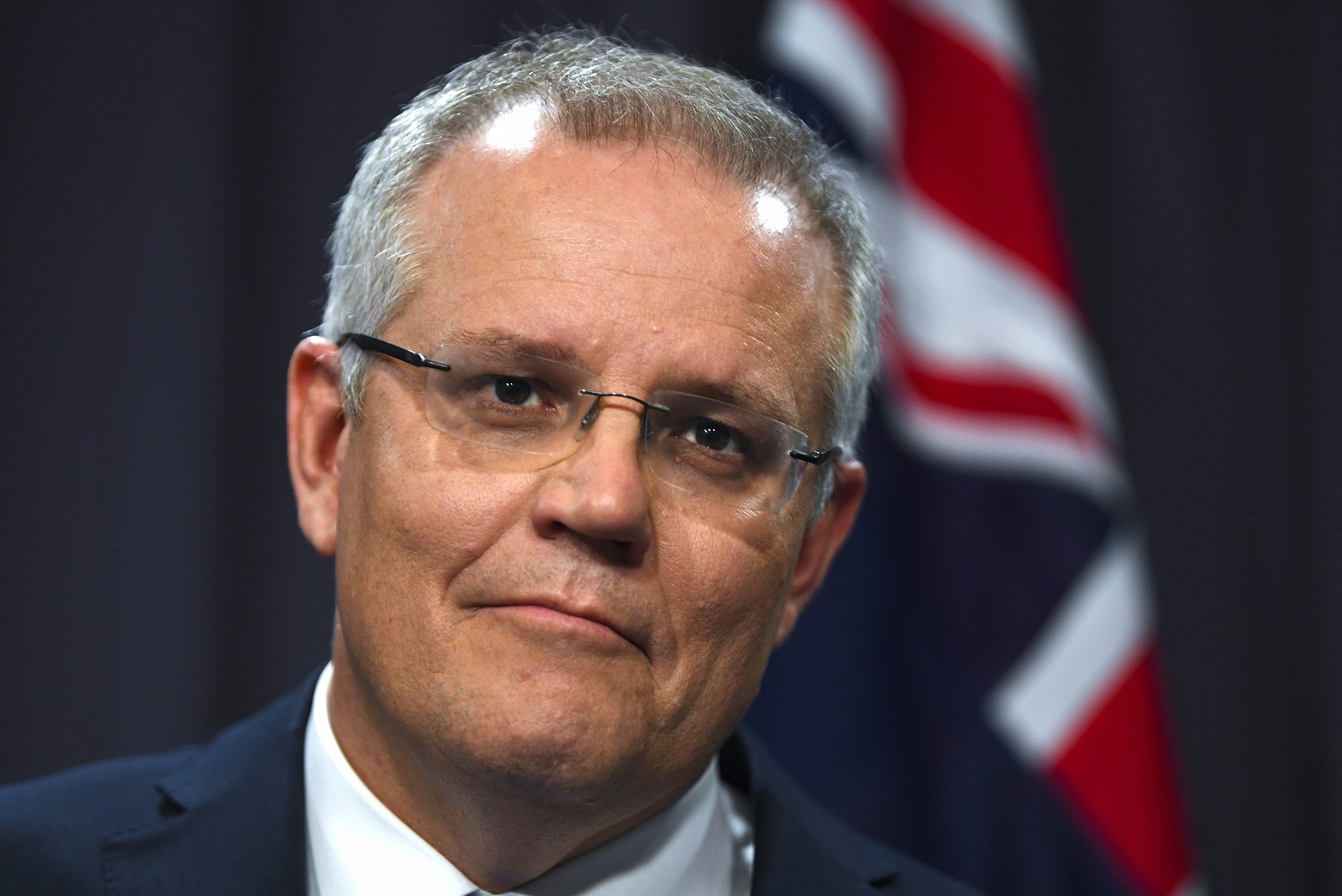
Newly elected leader of Australia’s Liberal Party, Scott Morrison addresses media at a press conference at Parliament House in Canberra, August 24, 2018. (Lukas Coch/AAP Image via AP)

The Australian government is reportedly set to formally recognize Jerusalem as the capital of Israel on Wednesday, but will likely delay moving its embassy there from Tel Aviv due to cost concerns.

Senior government sources told The Australian newspaper that Prime Minister Scott Morrison’s cabinet approved the policy change at a national security meeting Tuesday night following extensive discussions on the matter.

Cabinet ministers agreed that moving the embassy to Jerusalem would take place at a later stage, the report said, due to the estimated $200 million it would cost to relocate the diplomatic mission.

Sources told the paper that Canberra would establish a consular office in Jerusalem until the embassy could be moved there.

The report said the decision would likely be announced during Wednesday’s Council of Australian Governments meeting.

It was not clear if the government intended to recognize the entirety of Jerusalem as the Israeli capital, or just West Jerusalem, which Israel has held throughout its existence — as opposed to the eastern sectors of the city that it captured in the 1967 Six Day War.
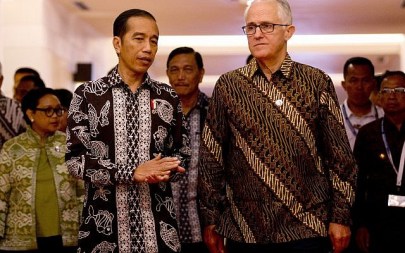
Indonesia President Joko “Jokowi” Widodo, front left, with Australia’s former prime minister Malcolm Turnbull, front right, during their bilateral meeting at Our Ocean Conference in Bali, Indonesia, October 29, 2018. (AP Photo/Firdia Lisnawati)

In October, Morrison told reporters he was “open-minded” to following the United States in recognizing Jerusalem as the Israeli capital, in what would be a sharp break in longstanding Australian foreign policy.

The announcement was welcomed by Israel, but heavily criticized by Palestinians and a number of Muslim-majority countries in Asia, including neighboring Indonesia, with which Australia is trying to clinch a landmark free-trade deal.

Morrison at the time said that the potential recognition and relocation of the embassy would not disrupt the Indonesia trade deal or negate Canberra’s longstanding support of the two-state solution to the Israeli-Palestinian conflict.

In a followup statement, Morrison’s government indicated that recognizing Jerusalem as the Israeli capital would only extend to the western part of the city, and East Jerusalem would be designated as the capital of a future Palestinian state.

Relations between Australia and the Muslim-majority Indonesia have been strained since Morrison’s announcement, with Jakarta officials initially indicating the deal may be called off over the changed foreign policy.
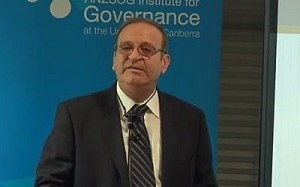
Izzat Abdulhadi, head of the Palestinian delegation to Canberra (YouTube screen capture)

According to The Australian, Foreign Minister Marise Payne informed Indonesian leaders of her government’s intention to recognize Jerusalem during a meeting in Bali last week.

On Tuesday, the Palestinian Authority delegation to Australia slammed the reported upcoming announcement, with envoy Izzat Abdulhadi saying his people should not have to “pay the price for some kind of face-saving move.”

In a statement to The Sydney Morning Herald, Abdulhadi rejected recognizing West Jerusalem as the Israeli capital, saying that such a compromise still “legitimize[d] the illegal occupation of Jerusalem.”

Senior Palestinian official Saeb Erekat also harshly criticized the reported move, and called on Arab and Muslim countries to sever all diplomatic ties with Australia if it changed its policy on Jerusalem. In a tweet Tuesday morning, Erekat said that various Arab and Muslim summits have adopted resolutions committing to ending diplomatic ties with any country that recognizes Jerusalem as belonging to Israel.

Morrison’s mid-October announcement also drew criticism at home. Australia’s spy agency warned the move could could provoke further violent unrest in Israel, while opposition lawmakers accused the prime minister of cynically pandering to Jewish voters ahead of a crucial by-election.
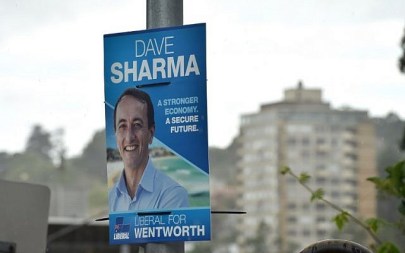
An election poster of Liberal candidate Dave Sharma is seen on a street in the seat of Wentworth in Sydney on October 18, 2018. (Photo by Peter PARKS / AFP)

A top secret bulletin drafted by the Australian Security Intelligence Organization, obtained by The Guardian in October, said the move “may be perceived as shifting to a pro-Israel/anti-Iran stance,” and warned it could damage Australia’s diplomatic and business interests in the Islamic republic.

Morrison floated the idea of recognizing Jerusalem moving the Australian embassy there days before an October by-election in a Sydney electorate with a large Jewish population that featured his fellow party member Dave Sharma, a former ambassador to Israel.

The campaign in Wentworth drew international attention after Morrison raised the prospect of the embassy move, a remark that was slammed by critics and opposition lawmakers as a cynical attempt to pander to Jewish voters.

The government lost the by-election and its single-seat majority in the House of Representatives, forcing Morrison to rely on deals with independent lawmakers to guarantee confidence in his government, enact legislation and ensure money supply.
 

Two car-ramming attempts reported in West Bank; one suspected attacker shot dead 

December 11, 2018

Source: Two car-ramming attempts reported in West Bank; one suspected attacker shot dead | The Times of Israel

In separate incidents, one near Hebron, the other in Jordan Valley, Palestinians allegedly try to run over border guards

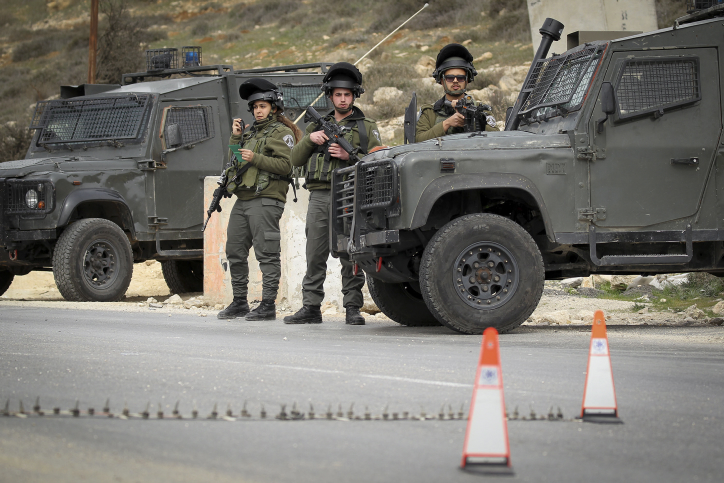
Illustrative: Border Police officers guard a checkpoint in the West Bank on January 26, 2017. (Wisam Hashlamoun/Flash90)

Illustrative: Border Police officers guard a checkpoint in the West Bank on January 26, 2017. (Wisam Hashlamoun/Flash90)

Israeli border guards shot dead a Palestinian driver who they said tried to ram his car into them outside of Hebron on Tuesday morning.

In a separate incident, in the northern Jordan Valley, a Palestinian man allegedly accelerated his car toward a group of Border Police officers. The troops fired warning shots into the air, and the suspect stopped and was arrested, police said.

The police said both cases were being investigated.

The Border Police officers in the town of Idhna, outside Hebron, were standing guard as members of the Defense Ministry’s Civil Administration, which oversees day-to-day activities in the West Bank, were taking part in an effort to crack down on the illegal burning of garbage.

According to police, the Palestinian suspect drove through a checkpoint the border guards had set up, hit a security vehicle with his car and then “accelerated toward a Border Police officer.”

The border guards opened fire at the vehicle, fatally wounding the suspect, who was identified by Palestinian authorities as 27-year-old Omar Hassan al-Awawdeh.

No Israeli troops were injured.

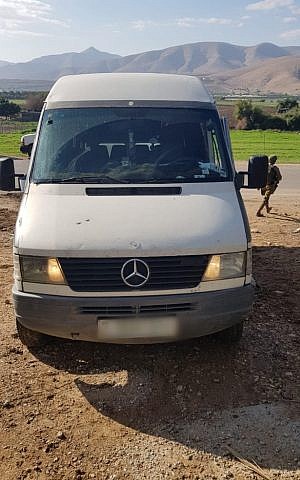
A van used in a suspected attempted car ramming against Israeli border guards in the Palestinian village of al-Jiftlik in the northern Jordan Valley in the West Bank on December 11, 2018. (Israel Police)

In the village of al-Jiftlik in the northern Jordan Valley, the border guards were guarding Civil Administration troops who were knocking down illegally constructed buildings when the Palestinian suspect drove toward them.

Police said the suspect was a 30-year-old man from the village.

He was handed over to the Shin Bet security service for further questioning.

The two seemingly unconnected incidents came two days after terrorists in a white car opened fire at a group of Israelis standing at a bus stop outside the Ofra settlement, near Ramallah, injuring seven of them, including a pregnant woman who was seriously injured.

The pregnant woman’s baby was delivered prematurely by C-section. While the mother’s condition has improved, the infant boy is still in critical condition at Jerusalem’s Shaare Zedek Medical Center.

The suspects fled the scene, prompting an ongoing manhunt by Israeli security forces.


Iran confirms recent ‘significant’ missile test amid Western criticism

December 11, 2018

Source: Iran confirms recent ‘significant’ missile test amid Western criticism | The Times of Israel

Tehran military aerospace commander says reaction by US shows how significant and upsetting rocket launch was for Washington

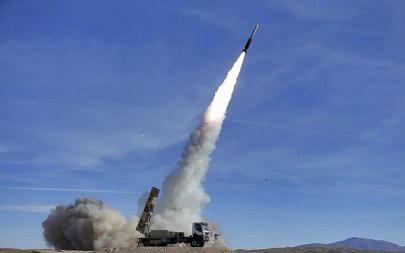
In this photo released on October 1, 2018, by the Iranian Revolutionary Guard Corps, a missile is fired from city of Kermanshah in western Iran targeting the Islamic State group in Syria. (Sepahnews via AP)

In this photo released on October 1, 2018, by the Iranian Revolutionary Guard Corps, a missile is fired from city of Kermanshah in western Iran targeting the Islamic State group in Syria. (Sepahnews via AP)

TEHRAN, Iran — Iran confirmed on Tuesday that it had carried out a recent test of a medium-range ballistic missile after Western powers sharply criticized a December 1 launch.

“We are continuing our missile tests and this recent one was a significant test,” the Fars news agency reported, citing Revolutionary Guards aerospace commander Brigadier General Amirali Hajizadeh.

“The US reaction showed that it was a big thing for them and that it upset them,” the conservative news agency said, adding that Iran carried out between 40 and 50 missile tests a year.

Iran has pressed on with its ballistic missile program after reining in much of its nuclear program under a landmark 2015 deal with major powers.

A UN Security Council resolution adopted after the agreement calls on Iran to refrain from testing missiles capable of carrying a nuclear weapon, but does not specifically bar Tehran from missile launches.

The UN Security Council convened at the request of Britain and France on December 4 to discuss the latest test which both governments described as “provocative” and “inconsistent” with Resolution 2231.

Britain said that the types of missiles fired had capabilities that “go way beyond legitimate defensive needs.”

Iran has developed several types of ballistic missiles with a range of up to 3,000 kilometers (1,875 miles) — sufficient to reach Israel and Western bases across the region.

In its report, Fars did not specify the date of the latest test or say which types of missile were fired.

Washington, which quit the nuclear deal in May, described the test as an outright “violation” of Resolution 2231 and called on the Security Councilto condemn it.

But veto-wielding Moscow has defended Tehran’s right to carry out the missile tests, and the December 4 meeting ended with no joint statement or any plan for follow-up action.

The council is due to meet again on December 19 for a regular review of the resolution’s implementation.

Iran has received regular certifications of compliance with the provisions of the nuclear deal from the UN atomic watchdog.

Western criticism has focused instead on Tehran’s missile program and its military interventions in the region.


Lebanese border ‘volatile,’ intel chief warns amid tunnel-busting effort 

December 11, 2018

Source: Lebanese border ‘volatile,’ intel chief warns amid tunnel-busting effort | The Times of Israel

IDF’s Maj. Gen. Tamir Hyman says that while prospects of intentional war are low, the potential exists for events to spiral out of control

Military Intelligence chief Maj. Gen. Tamir Hyman, left, speaks at the Knesset’s powerful Foreign Affairs and Defense Committee next to its chairman MK Avi Dichter on December 11, 2018. (Yitzhak Harari/Knesset)

The head of Military Intelligence on Tuesday told lawmakers that the prospect of an intentionally initiated war with the Hezbollah terrorist group is low, but the potential exists for circumstances to escalate out of control.

The general’s warning came a week after the Israel Defense Forces launched Northern Shield, an effort to locate and destroy attack tunnels the army says Hezbollah dug into Israeli territory from southern Lebanon. The IDF operation along the Lebanese border sparked fears internationally that Israel and the Iran-backed Hezbollah could be heading toward a major confrontation, the first since 2006.

Military Intelligence chief Maj. Gen. Tamir Hyman told the Knesset’s powerful Foreign Affairs and Defense Committee that while the northern region — Lebanon and Syria — was “volatile,” Operation Northern Shield was nevertheless critical in that it would remove the “cornerstone” of Hezbollah’s war plans.

According to the military, the terror group planned to use the tunnels to send dozens or hundreds of soldiers into Israeli territory, alongside masses of troops above-ground and a barrage of rockets and mortar shells, as a way to kick off a future war with Israel.

In general, Hyman said, Israel was taking advantage of the fact that the chances of war are low, in part because the country’s enemies are not currently interested in starting one now.

“Regional upheavals are coming to an end, as well as great changes, and this brings with it opportunities as well as risks in all regions,” he said.

Hyman was likely referring to the Syrian civil war, which dictator Bashar Assad is poised to win, as well as larger regional trends like Saudi Arabia and the Persian Gulf states’ increasing cooperation with Israel against mutual enemies like Iran.

“It is an era of thwarting [enemy plans], of redesign and of formation,” the general told lawmakers.

He said Iran was pulling back its troops and its proxies from Syria’s border with Israel’s Golan Heights as the IDF has made fighting Tehran’s effort to entrench itself in Syria a primary concern.

“The cost of Iran establishing itself in Syria has prompted arguments among top decision-makers in Iran, and as a result there has been a trend of stopping and significantly scaling back,” he said, according to a statement from the Knesset.

Hyman also discussed Hezbollah’s massive rocket arsenal, which Israel says comprises 100,000 to 150,000 projectiles.

Israel has long warned that the Iran-backed group is working to convert its “dumb” rockets, which follow a straight line once launched, into smarter, precision-guided munitions that would pose a substantially greater risk to the Jewish state. Earlier this year at the United Nations’ General Assembly, Prime Minister Benjamin Netanyahu presented the coordinates of Hezbollah facilities where the terror group was working to develop such capabilities.

On Tuesday, the Military Intelligence chief said Hezbollah has yet to develop a way to mass-produce such missiles and still possesses only simpler rockets.

Looking beyond the strictly military arena, Hyman said his soldiers were also carefully tracking Iran’s economy in order to see if it is in violation of international sanctions.

“Military Intelligence is successfully monitoring the efforts to get around the sanctions, and is also taking action with the relevant figures in the international community,” the Knesset said in a statement.


Iranian general says nation can extend missile range beyond 2,000 kilometers 

December 11, 2018

Source: Iranian general says nation can extend missile range beyond 2,000 kilometers | The Times of Israel

IRGC Aerospace Force commander brags Tehran not limited by technology or international agreements, but only by its military needs

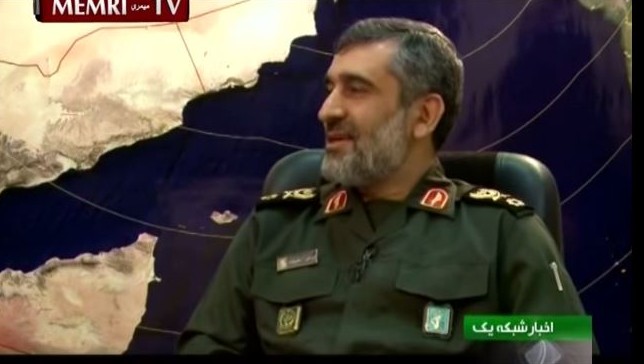
Commander of the Islamic Revolution Guards Corps (IRGC) Aerospace Force Brigadier General Amir Ali Hajizadeh. (screen capture: YouTube/MEMRITVVideos)

Commander of the Islamic Revolution Guards Corps (IRGC) Aerospace Force Brigadier General Amir Ali Hajizadeh. (screen capture: YouTube/MEMRITVVideos)

A senior commander in Iran’s Revolutionary Guards said Monday that the Islamic Republic is capable of extending the range of its ballistic missiles beyond its current 2,000 kilometer (1,240 mile) limit, and has not done so until now only due to a lack of need.

“We have the capability to build missiles with higher ranges,” IRGC Aerospace Force commander Brig. Gen. Amir Ali Hajizadeh said, according to the Fars news agency. “The number 2,000 kilometers is not a divine decree… what has been decided until today is based on our needs.”

He noted that many “enemy bases” were located 300-800 kilometers from the country’s borders.

But Tehran was not limited by technical knowledge or by any international conventions on pursuing longer-range missiles, he said.

Iran has been under pressure to rein in its missile program. US President Donald Trump earlier this year pulled Washington out of the 2015 nuclear agreement with Iran, putting sanctions back in place. The administration cited a lack of curbs on Iranian missile development as one of the flaws of the agreement.

US special envoy for Iran Brian Hook last week said US discussions with the Europeans about missile sanctions were gaining traction. Those talks center on slapping penalties on companies and people involved in Iran’s program.

Iran insisted last week that its missile program is defensive and not in violation of UN resolutions, after US Secretary of State Mike Pompeo accused the Islamic state of testing a medium-range ballistic missile capable of “carrying multiple warheads,” which he said could strike “anywhere” in the Middle East and even parts of Europe.

“Iran’s missile program is defensive in nature… There is no Security Council resolution prohibiting the missile program and missile tests by Iran,” the official state news agency IRNA quoted Foreign Ministry spokesman Bahram Qasemi as saying in response to Pompeo’s statement, the Reuters news agency reported.

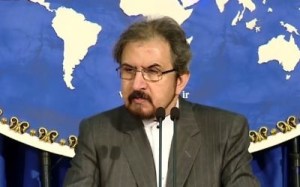
Iranian Foreign Ministry Spokesman Bahram Qasemi (YouTube screenshot)

Qasemi neither confirmed nor denied that Iran had carried out the alleged test.

Last week, the Security Council met behind closed doors at the request of France and Britain to discuss the missile test. The meeting ended with no joint statement or any plan for followup action, but the council is scheduled to take stock of the implementation of the resolution on December 19.

France and Britain maintain that missile launches are inconsistent with the UN resolution that endorsed the 2015 Iran nuclear deal, while the United States has taken a harder stance and views them as an outright violation.

Hajizadeh, the IRGC Aerospace Force commander, said Monday: “Europe and the US are the two blades of the same pair of scissors to pressure the Iranian nation. Their strategy is similar and they have just distributed the tasks.”

In November Hajizadeh said US military personnel and assets in the Middle East were within range of his country’s missiles. The commander said improvements to Iran’s missile arsenal had put US bases in Qatar, the UAE and Afghanistan within reach, as well as US aircraft carriers stationed in the Persian Gulf, according to Iran’s Tasnim news agency.

On Sunday the German Die Welt daily reported that Iran has more than doubled the number of missile tests it has performed in the past year in possible violation of the 2015 nuclear deal.

In 2018, Tehran test-fired at least seven medium-range missiles and at least five short-range missiles and cruise missiles, the report said, citing documents obtained from unspecified Western intelligence services and verified “with various sources.”

By comparison, only four such tests of medium-range missiles and one test launch of a short range missile were said to have been conducted in 2017.

The report said it was possible that the missiles were nuclear-capable ballistic weapons, which the Islamic Republic was banned from testing as part of the 2015 internationally supported agreement.

In this photo provided on November 5, 2018, by the Iranian Army, a Sayyad 2 missile is fired by the Talash air defense system during drills in an undisclosed location in Iran. (Iranian Army/ AP)

The UN resolution calls on Iran to refrain from testing missiles capable of carrying a nuclear weapon, but does not specifically bar Tehran from missile launches.

The missiles tested this year reportedly include at least three different variants of the Shahab 3 medium-range missile, at least two tests on variants of the Qiam 1 cruise missile, at least one Khorramashahr medium-range missile, a Scud variant, and at least five short-range Zolfaghar missiles.

The report said two of the launches were directed against the Islamic State terror group in Syria, but said that such use could “also serve to test and further develop missiles.”

AFP contributed to this report.


Hizballah plans Hamas-style mob violence against IDF troops from the Lebanese border – DEBKAfile

December 11, 2018

Source: Hizballah plans Hamas-style mob violence against IDF troops from the Lebanese border – DEBKAfile

DEBKAfile Exclusive: On Monday, Dec. 1, Hizballah activists began organizing groups of “demonstrators” in the Shiite villages of South Lebanon for mob assaults from behind the Lebanese border on the IDF teams excavating tunnels.

They plan to take a leaf from the violent disturbances Hamas and Islamic Jihad staged against Israeli troops from the Gaza border for months. Hizballah strategists estimate that thousands of Shiite men, women and children can be mobilized to harass the Israeli soldiers unearthing its tunnels. By turning up at different points, they would seriously hamper the Israeli operation.

Since the IDF keeps to the Israeli side of the Lebanese border, these groups would at first be ordered to stay at least 20 meters from the soldiers’ excavation sites. Our exclusive sources add that Hizballah obtained a Lebanese army guarantee to secure the Shiite riots. Preparations appear to be in progress for the first outbreak to occur around the village of Meiss ej-Jabal in the Marj Ayoun district opposite Israeli Zar’it. This patch was chosen as the starting point for the crowd assault on Israeli troops because there is no fence or wall blocking access between Lebanon and Israel. This first pilot “demonstration” will be staged to test results and gauge Israel’s response. If the stratagem works for Hizballah, it will be expanded to other parts of the border.

A close watch is being kept on the Gaza Strip in case the Palestinian terrorists, Hamas and Islamic Jihad, which are closely aligned with Hizballah, decide to go back to their former full-scale rampages against Israeli troops as a “second front.” In the last few weeks, they were persuaded to slacken the violence by the intake of Qatari dollars.