Archive for December 8, 2018

Off Topic:  New York Times columnist defends anti-Zionism 

December 8, 2018

Source: New York Times columnist defends anti-Zionism | The Times of Israel

( Leave it to the mouthpiece of the Democrat party to provide a platform for Jewish self-hatred at its worst. – JW ) 

Michelle Goldberg says as long as Israeli government de facto opposes Palestinian statehood, rejecting Jewish ethno-nationalism is legitimate, does not constitute anti-Semitism

New York Times columnist Michelle Goldberg interviews author Margaret Atwood (not shown) during the ninth annual Women in the World Summit on April 13, 2018, in New York. (AP/Mary Altaffer)

New York Times columnist Michelle Goldberg interviews author Margaret Atwood (not shown) during the ninth annual Women in the World Summit on April 13, 2018, in New York. (AP/Mary Altaffer)

JTA — Michelle Goldberg, a columnist for The New York Times, wrote a piece defending anti-Zionism and saying it is not anti-Semitism.

“The conflation of anti-Zionism with anti-Semitism is a bit of rhetorical sleight-of-hand that depends on treating Israel as the embodiment of the Jewish people everywhere,” she wrote Friday. “Certainly, some criticism of Israel is anti-Semitic, but it’s entirely possible to oppose Jewish ethno-nationalism without being a bigot.”

The column is a big deal because while The Times opinion page is generally left wing on Israel, most of its columnists who write on the country range from liberal to conservative Zionists.

Goldberg noted that two incoming Democratic congresswoman, Ilhan Omar and Rashida Tlaib, have endorsed the Boycott, Divestment and Sanctions movement against Israel, or BDS. She wrote that many people call BDS anti-Semitic because it subjects Israel to a double standard and, in endorsing a return of Palestinian refugees to Israel, could lead to the end of a Jewish-majority state.
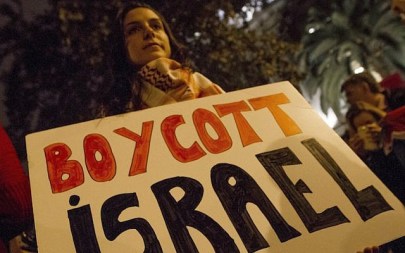
Demonstrators protesting outside the Spanish Government Delegation in Barcelona, on October 20, 2015. (Albert Llop/Anadolu Agency/Getty Images/via JTA/File)

Indeed, equating BDS with anti-Semitism is the consensus among a broad swath of Jewish organizations; last week, the Conference of Presidents of Major American Jewish Organizations, representing over 50 Jewish groups, called Pink Floyd front man Roger Waters “anti-Israel and anti-Jewish” for his vocal support of BDS.

But Goldberg said that opposing Israel and calling for a binational Israeli-Palestinian state is legitimate. She criticized Israel for its government’s close relationship to the Trump administration and right-wing nationalist governments in Europe, as well as for West Bank settlement expansion and the Israeli government’s opposition to Palestinian statehood.

“As long as the de facto policy of the Israeli government is that there should be only one state in historic Palestine,” Goldberg wrote, “it’s unreasonable to regard Palestinian demands for equal rights in that state as anti-Semitic.”
 

Iran says US arms sales to Middle East turning region into ‘tinderbox’ 

December 8, 2018

Source: Iran says US arms sales to Middle East turning region into ‘tinderbox’ | The Times of Israel

Foreign Minister Zarif says Washington is selling weaponry that is beyond the region’s needs

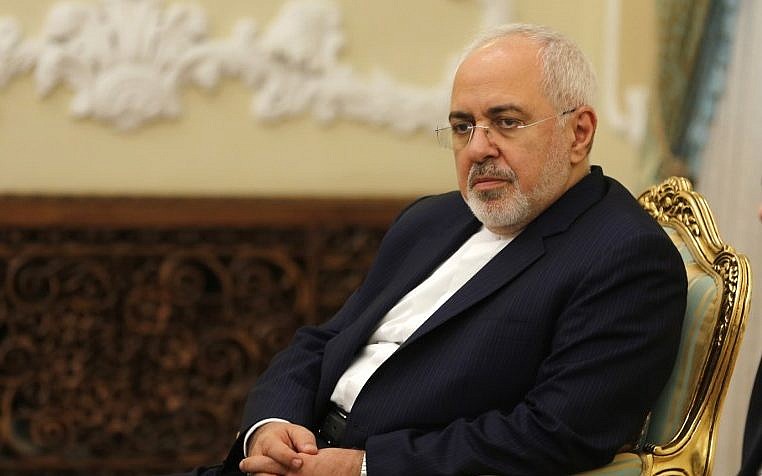
Iranian Foreign Minister Mohammad Javad Zarif seen during a meeting between the  Iranian president and the North Korean foreign minister in Tehran, Iran, on August 8, 2018. (AFP/Atta Kenare)

Iranian Foreign Minister Mohammad Javad Zarif seen during a meeting between the Iranian president and the North Korean foreign minister in Tehran, Iran, on August 8, 2018. (AFP/Atta Kenare)

Iran’s Foreign Minister Mohammad Javad Zarif said Saturday that the United States is selling weaponry to Middle Eastern countries beyond the region’s needs and turning the area into a “tinderbox,” Reuters reported, citing state news agency IRNA.

“The level of arms sales by the Americans is unbelievable and much beyond regional needs, and this points to the very dangerous policies followed by the Americans,” Zarif said.

The US has sizable arms deals with Iranian foes Israel and Saudi Arabia, as well as other countries in the region.

Israel has long accused Iran, which frequently urges the demise of Israel, of funneling weapons to Lebanon’s Hezbollah, and has carried out several air strikes across its northern border in recent years to prevent shipments of weapons from Syria to Hezbollah.

The Israel Defense Forces on Tuesday launched an operation to destroy a number of cross-border attack tunnels that it says were dug by the Iran-backed Hezbollah into northern Israel from Lebanon.

Attack tunnels were long rumored to have been dug from southern Lebanon into Israeli territory by the terror group, but in recent years Israeli defense officials repeatedly either denied their existence or refused to discuss the matter.

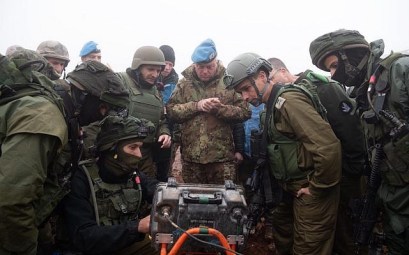
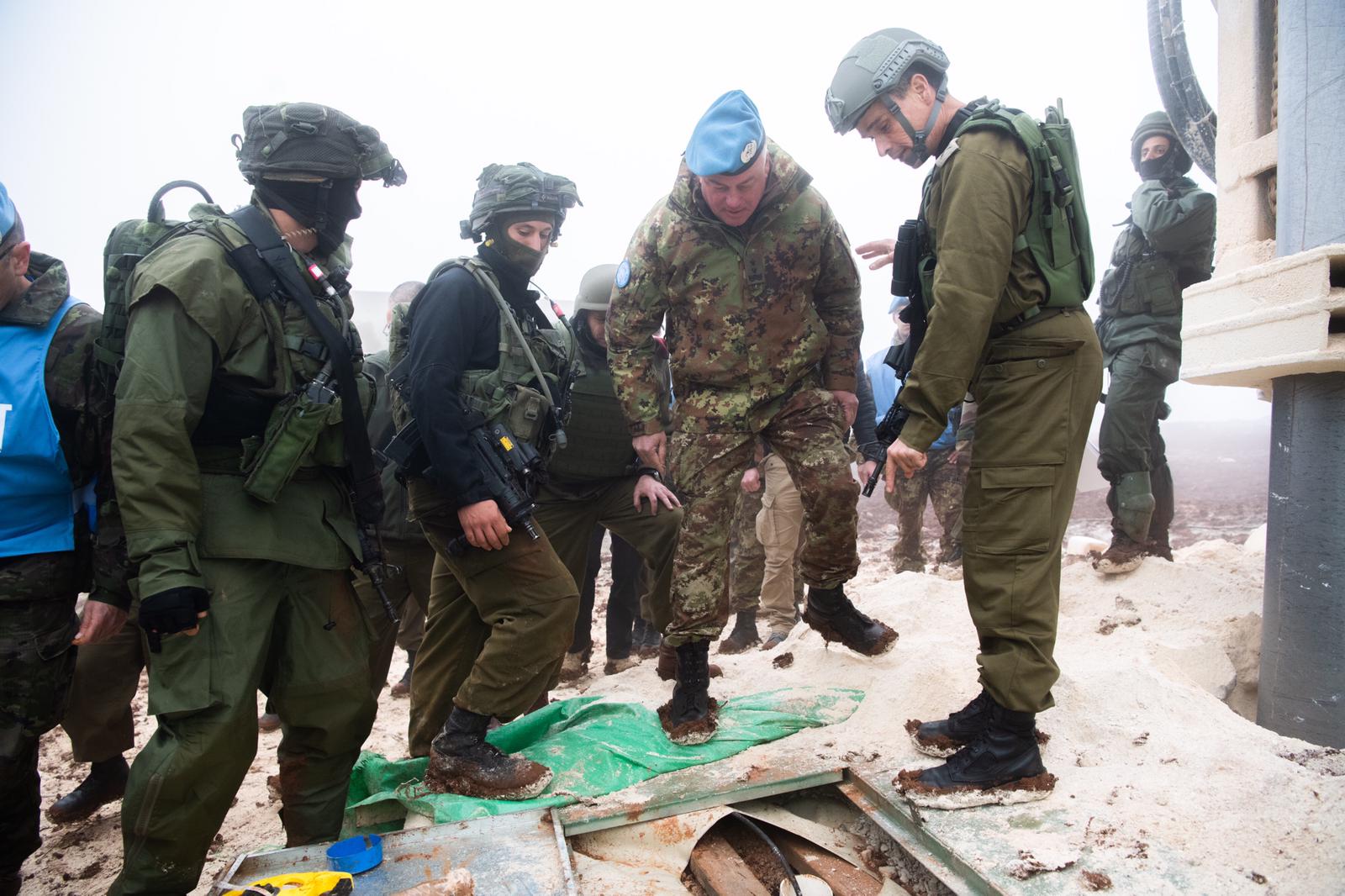
Israeli soldiers show UNIFIL commander Maj. Gen. Stefano Del Col a Hezbollah tunnel that penetrated Israeli territory from southern Lebanon on December 6, 2018. (Israel Defense Forces)

The IDF spokesperson accused Iran of providing the funding and support for Hezbollah’s tunnel program.

“We’ll be dealing with that in the next few days too,” the army said.

Israel fought a punishing war with Hezbollah in 2006, which has since given way to relative quiet along the frontier. However, Israeli officials have raised alarms over Iran arming Hezbollah, via Syria or directly into Lebanon, with precision missile technology.

Iran was accused of test-firing a medium-range, nuclear-capable missile last Saturday, which the US said was a violation of a UN resolution that endorsed the 2015 Iran nuclear deal, from which Washington has withdrawn.

That resolution calls on Iran to refrain from testing missiles capable of carrying a nuclear weapon.

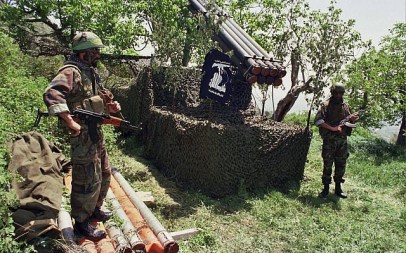
Two Hezbollah fighters stand near Katyusha rockets in the southern village of Ein Qana, Lebanon, April 1996. (AP/Mohammed Zaatari)

On Tuesday, Tehran’s air force chief insisted his country would continue to increase the range of its missiles.

Iran has long maintained that its missile program is defensive in nature and not aimed at ensuring the delivery of a nuclear weapon, a stance upheld by Russia at the Security Council. Western powers disagree.

Agencies contributed to this report.


Rouhani: US sanctions are ‘terrorism,’ will lead to deluge of drugs and bombs

December 8, 2018

Source: Rouhani: US sanctions are ‘terrorism,’ will lead to deluge of drugs and bombs | The Times of Israel

President also claims the number of people seeking asylum will increase as a result of penalties imposed by Washington

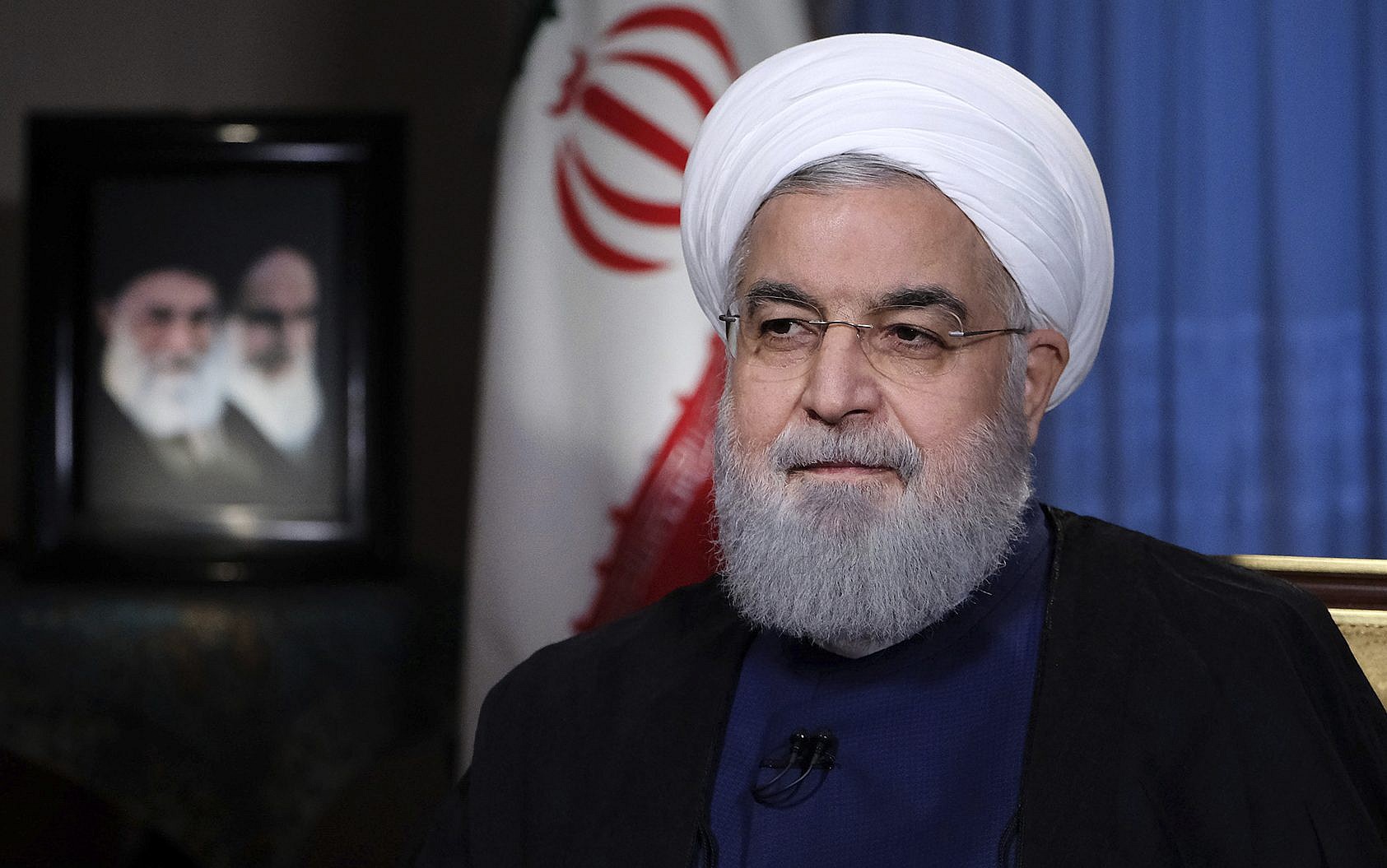
Iranian President Hassan Rouhani addresses the nation in a televised speech in Tehran, Iran, August 6, 2018. (Iranian Presidency Office via AP, File)

Iranian President Hassan Rouhani addresses the nation in a televised speech in Tehran, Iran, August 6, 2018. (Iranian Presidency Office via AP, File)

Iran’s President Hassan Rouhani on Saturday said US sanctions were “economic terrorism,” and would harm efforts to fight terror and drug-smuggling, as well as lead to an increase in the number of asylum seekers.

“I warn those who impose sanctions that if Iran’s ability to fight drugs and terrorism are affected… you will not be safe from a deluge of drugs, asylum seekers, bombs and terrorism,” he said, according to the Reuters news agency.

Washington has reimposed an oil embargo and other damaging sanctions on Iran since pulling out in May from a landmark 2015 nuclear deal between Tehran and major powers.

“America’s unjust and illegal sanctions against the honorable nation of Iran have targeted our nation in a clear instance of terrorism,” Rouhani said in a televised speech from a conference on terrorism and regional cooperation attended by parliament speakers from Afghanistan, China, Pakistan, Russia and Turkey.

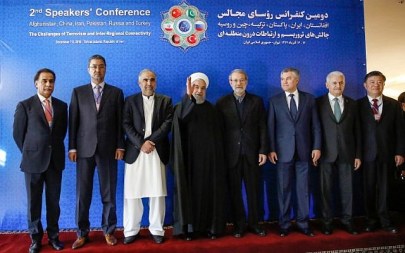
Iranian President Hassan Rouhani (center) gestures in a group photo with Abdul Rauf Ibrahimi (2nd left), Afghan Parliament Speaker Asad Qaiser (3rd left), Pakistan National Assembly Speaker Chen Zhu (right), vice chairman of the Standing Committee of China’s National People’s Congress Binali Yildirim (2nd right), Turkey’s Grand National Assembly Speaker; and Ali Larijani (4th right), Iran’s Parliament Speaker, during the 2nd Speakers’ Conference in Tehran, Iran, on December 8, 2018. (AFP)

“We are facing an all-out assault which is not only threatening our independence and identity, but also is bent on breaking our long-standing ties,” he added.

Rouhani drew parallels with the sanctions and other pressure faced by the countries attending the conference.

“When they put pressure on China’s trade, we are all  harmed… By punishing Turkey, we are all punished. Any time they threaten Russia, we too consider our security to be endangered,” he said.

“When they impose sanctions on Iran, they deprive all of us of the benefits of international trade, energy security and sustainable development. And in fact, they impose sanctions on everyone.

“We are here to say that we don’t intend to tolerate such insolence.”

Rouhani also warned Europe — which has strongly objected to the US withdrawal from the nuclear deal — that much is at stake in its efforts to bypass US sanctions and maintain trade with Iran.

“They should know that by sanctioning Iran, they would harm our ability to fight drugs and terrorism,” Rouhani said, referring to Iran’s efforts to combat smuggling, particularly from Afghanistan.

The European Union is working on a payment system, known as the “special purpose vehicle,” to keep money flowing into Iran, but has struggled to find a host since many countries fear repercussions from the Trump administration.

The conference in Tehran was the second regional meeting on terrorism — the first was held last December in Islamabad.

Foreign Minister Mohammad Javad Zarif said Saturday that the United States is selling weaponry to Middle Eastern countries beyond the region’s needs and turning the area into a “tinderbox,” Reuters reported, citing state news agency IRNA.

“The level of arms sales by the Americans is unbelievable and much beyond regional needs, and this points to the very dangerous policies followed by the Americans,” Zarif said.


In phone call, Putin tells Netanyahu military cooperation in Syria must improve

December 8, 2018

Source: In phone call, Putin tells Netanyahu military cooperation in Syria must improve | The Times of Israel

Russian leader stresses importance of maintaining regional stability after receiving update on IDF operation to uncover and destroy Hezbollah attack tunnels from Lebanon

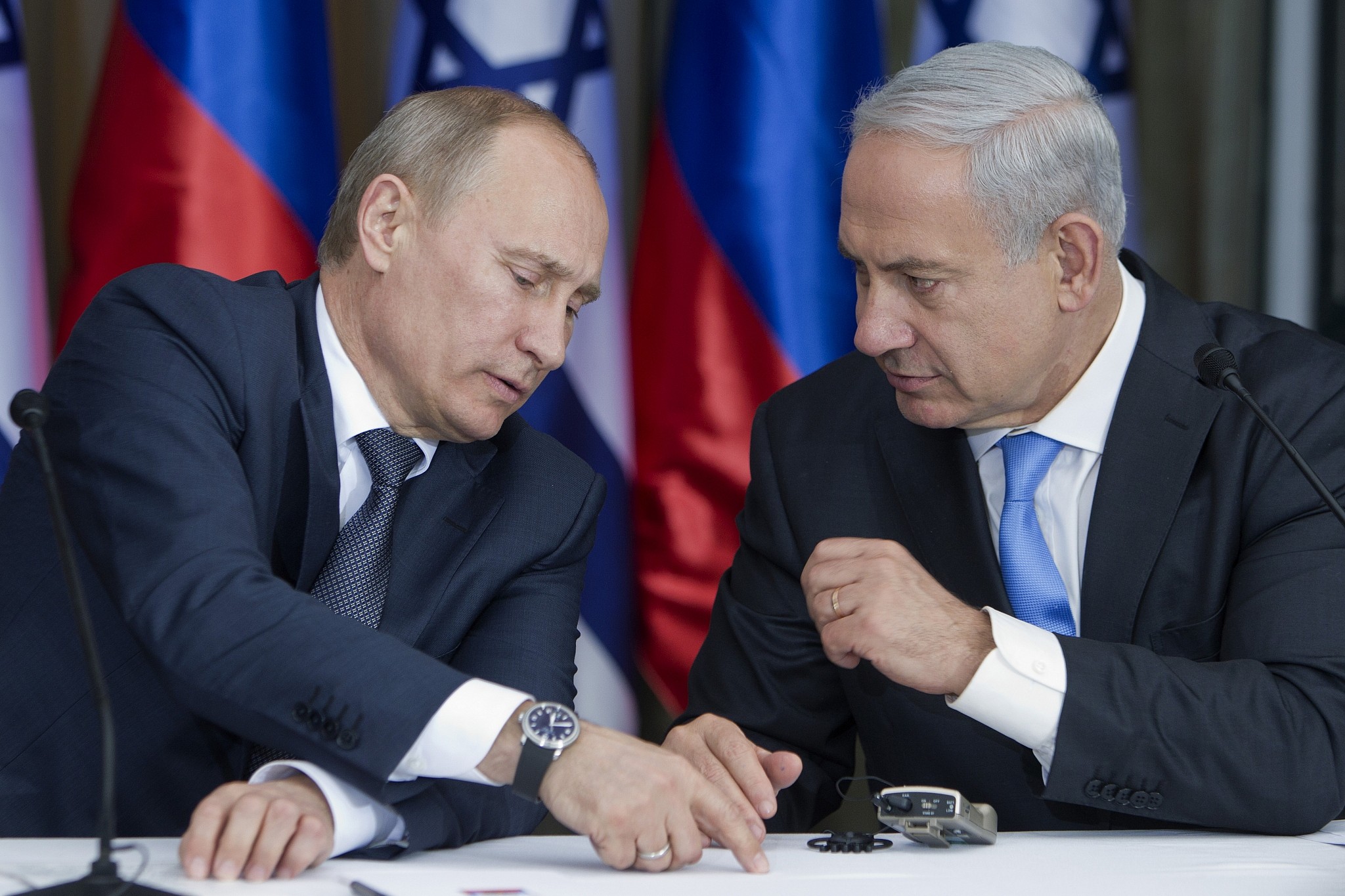
Russian President Vladimir Putin (left) with Prime Minister Benjamin Netanyahu as they prepare to deliver joint statements after a meeting and a lunch in the Israeli leader’s Jerusalem residence, June 25, 2012. (AP/Jim Hollander, Pool)
Russian President Vladimir Putin told Prime Minister Benjamin Netanyahu that the two countries must improve their military cooperation in Syria, the Kremlin said in a statement Saturday.

Putin emphasized the importance of upcoming consultations between defense experts from the two countries during the conversation, which was held at the initiative of Netanyahu, the Kremlin said.

The two leaders were said to be considering holding a meeting in person.

Ties between the two countries have been strained since Russia’s delivery of the the S-300 missile defense system to Syria following the September 17 downing of a Russian spy aircraft by Syrian forces, which were responding to an Israeli strike over Syrian airspace.

Russia has blamed Israel for the incident, which killed 15 Russian crew members. Israel has emphatically denied responsibility.

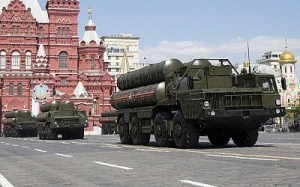
Russian S-300 air defense missile systems drive by during the Victory Day military parade marking 71 years after the victory in WWII in Red Square in Moscow, Russia, on May 9, 2016. (AP/Alexander Zemlianichenko, File)

Although Putin initially told reporters that the incident was due to a “chain of tragic accidental circumstances,” the Russian defense ministry later declared Israel was responsible, saying the Israeli Air Force jets used the Russian plane as cover. Israel rejected the accusation.

Israel has repeatedly said it will not allow Iran, or its Shiite proxies, to establish a permanent presence in postwar Syria. It has launched numerous attacks on targets it says are a threat to its security.

Russia, which is a main backer of Syrian President Bashar Assad, has maintained a deconfliction hotline with Israel, allowing the Jewish state to carry out the attacks as long as it is informed beforehand.

Putin and Netanyahu also discussed Israeli operations on the border with Lebanon, according to the statement.

On Tuesday the Israel Defense Forces announced the start of Operation Northern Shield to find and destroy cross-border attack tunnels dug by the Lebanese Hezbollah terrorist group. It has said it has found two such tunnels thus far.

Israeli soldiers show UNIFIL commander Maj. Gen. Stefano Del Col a Hezbollah tunnel that penetrated Israeli territory from southern Lebanon on December 6, 2018. (Israel Defense Forces)

Putin “stressed the importance of ensuring stability in the region in strict accordance with Resolution 1701 of the UN Security Council,” the statement read, referring to the 2006 UN Security Council resolution calling for Hezbollah to withdraw from southern Lebanon following the Second Lebanon War, the last major conflict between the IDF and the Iran-backed Hezbollah terror group.

A senior Israeli minister said Friday that Israeli forces may need to go into Lebanon to deal with the tunnels.

“If we think that, in order to thwart the tunnels, one needs to operate on the other side, then we will operate on the other side of the border,” Israel Katz, who holds the Intelligence and Transport ministries, told Radio Tel Aviv, according to Reuters.

An IDF incursion into Lebanon would likely spark a major confrontation with Hezbollah.

Russia on Wednesday expressed tacit support for the efforts to expose Hezbollah’s cross-border attack tunnels, while calling on both sides to show restraint lest the volatile situation on the Lebanese border escalate.

Russia does not consider Hezbollah a terrorist organization.


Israel using ‘passive seismic’ technology to expose Hezbollah’s attack tunnels

December 8, 2018

Source: Israel using ‘passive seismic’ technology to expose Hezbollah’s attack tunnels | The Times of Israel

IDF says its sophisticated sensors are able to monitor Hezbollah tunnel drilling throughout the northern border area

Israeli soldiers show UNIFIL commander Maj. Gen. Stefano Del Col a Hezbollah tunnel that penetrated Israeli territory from southern Lebanon on December 6, 2018. (Israel Defense Forces)

Israeli soldiers show UNIFIL commander Maj. Gen. Stefano Del Col a Hezbollah tunnel that penetrated Israeli territory from southern Lebanon on December 6, 2018. (Israel Defense Forces)

The Israeli army on Friday revealed that it has been using “passive seismic” technology to locate the attack tunnels Hezbollah has been digging under the border into Israel.

The IDF this week launched an ongoing operation to locate and destroy the tunnels, and has so far announced that two have been identified. On Tuesday, it released footage from inside the first of the two, with alleged Hezbollah members still inside, and on Thursday asked UNIFIL, the UN force in Lebanon, to deal with the second.

The IDF’s Chief of Staff Gadi Eisenkot announced Tuesday that Israel has “in its possession” Hezbollah’s tunnel plans. Military sources have said Israel believes several other cross-border tunnels have yet to be exposed.

An officer in the IDF’s Engineering Corps, Col. Ziv Nimni, told Israel’s Hadashot TV news Friday that the IDF, aware for years of Hezbollah’s tunnel ambitions, utilizes “passive seismic technology” throughout the northern border area in order to locate the tunnels.

The technology enables the IDF to identify where tunnel drilling is taking place — not only in limited, specific areas, but throughout the Israel-Lebanon border area, he said.

The sensors in the ground relay information to sensors at the border fence, as well as to receptors in patrol vehicles along the border, Nimni added.

He said locating and dealing with the tunnels “could take weeks or longer,” but that the IDF was operating as quickly as possible.

Nimni said he felt a tremendous sense of pride that the IDF was proving capable of grappling with the threat. It was “a once in a generation” event, he said, when, hours after the operation began, a camera placed by the IDF in a Hezbollah tunnel — which was being dug toward the northern Israeli town of Metulla — filmed Hezbollah operatives inside the tunnel. The camera was protected by a small explosive device, which detonated when a Hezbollah operative approached it, sending him hurriedly backwards.

Nimni assessed that Hezbollah had not reached the stage where it could utilize the tunnels. Prime Minister Benjamin Netanyahu said this week that Hezbollah planned to send “entire battalions” into Israel, to seize territory and kill and kidnap Israeli civilians and soldiers. Netanyahu noted that the tunnels were far wider than tunnels dug by the Hamas terror group under the border into Israel from Gaza.

Nimni said Hezbollah, which has remained silent since Tuesday on the Israeli counteraction, “is watching what we’re doing,” and that there was potential for military confrontation. Israeli ground, air, and sea forces have been deployed to the north as the IDF engineers and related teams tackle the tunnels, but military sources have indicated they see a low potential for escalation at the moment.

This could change if Israel decides it needs to tackle the tunnels inside Lebanese territory, which it has not done so far, or if Israel decides to tackle Hezbollah’s large arsenal of missiles, which some analysts believe could be a next step.

Senior Likud Minister Tzachi Hanegbi told Hadashot on Friday night that Sheikh Hassan Nasrallah, the head of the Hezbollah terror group, was “embarrassed” by the intelligence breakthrough that has seen Israel expose his “audacious” cross-border tunneling aggression.


IDF fires toward 3 suspected Hezbollah fighters who approach border

December 8, 2018

Source: IDF fires toward 3 suspected Hezbollah fighters who approach border | The Times of Israel

Army says men use weather cover to advance on digging operations to uncover attack tunnels, flee after shots fired

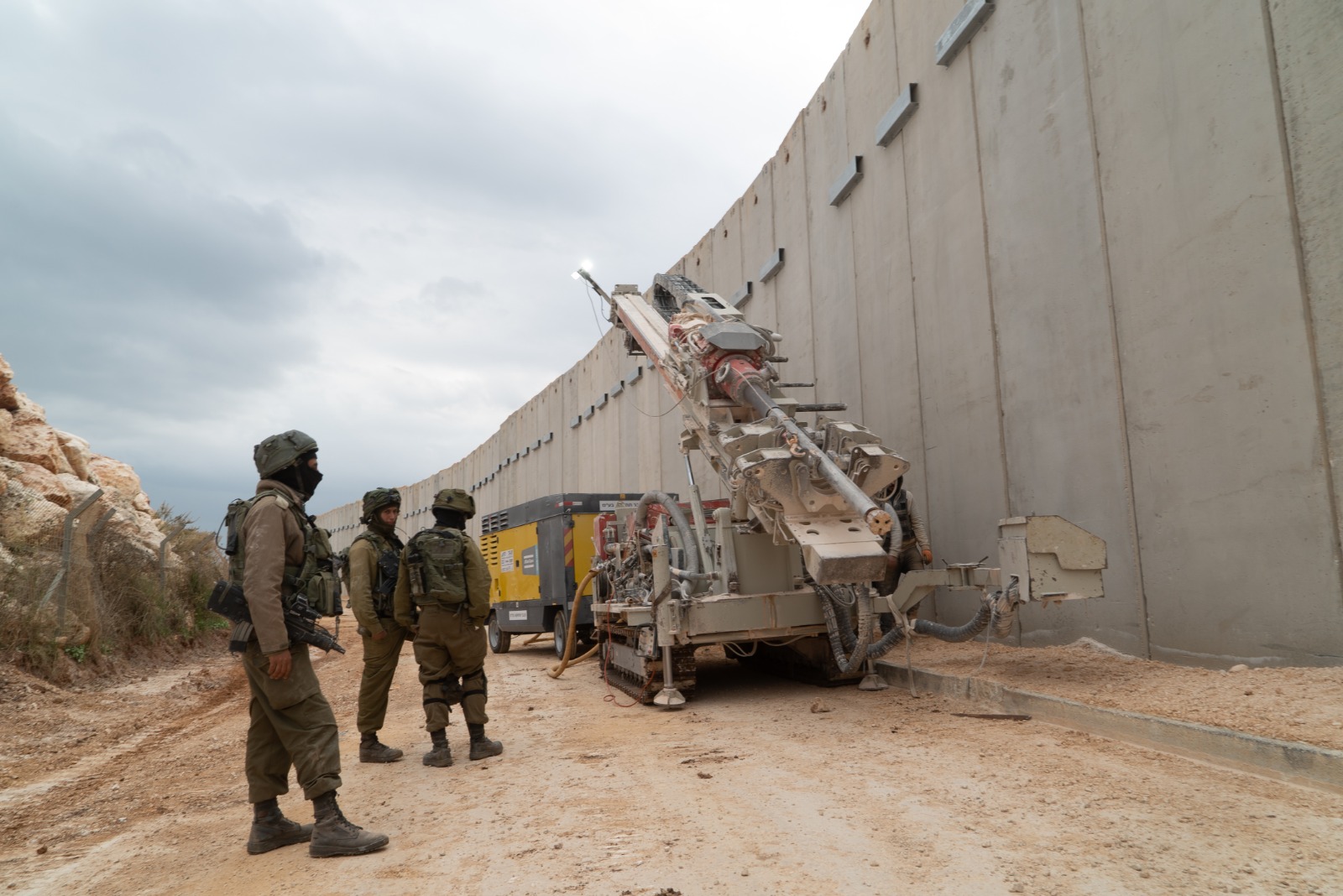
The Israeli military drills into the soil south of the Lebanese border in an effort to locate and destroy Hezbollah attack tunnels that it says entered Israeli territory, on December 5, 2018. (Israel Defense Forces)

The Israeli military drills into the soil south of the Lebanese border in an effort to locate and destroy Hezbollah attack tunnels that it says entered Israeli territory, on December 5, 2018. (Israel Defense Forces)

Israeli soldiers on Saturday opened fire at three suspected Hezbollah fighters on the Israeli-Lebanese border, the army said.

The military said the three men attempted to approach an “area of technological work” in an enclave north of the security fence, as the IDF continues Operation Northern Shield to destroy Hezbollah attack tunnels dug under the border.

The army said it believed the three attempted to use the cover of stormy weather to approach the Israeli forces.

Troops fired towards the three “in accordance with the standard operating procedures” and they fled the scene.

“Work in the area continues as usual,” it said.

Israel announced on Tuesday that it had launched an operation dubbed Northern Shield to uncover and destroy subterranean passages dug by Hezbollah into Israel.

The Israeli military said it believes the tunnels were meant to be used by Hezbollah as a surprise component of an opening salvo in a future war, alongside the mass infiltration of operatives above ground and the launching of rockets, missiles and mortar shells at northern Israel.

The army has so far uncovered two tunnels and is working to reveal a third.

A senior Israeli official on Thursday said the tunnels discovered inside Israel were large enough to be used by “entire battalions” to enter Israeli territory in order to “carry out killing sprees and kidnappings and to capture Israeli towns and villages.”

The number of tunnels the IDF believes the Lebanese terror group has dug into Israel, as well as other information connected to the army’s tunnel-busting operation, cannot be published by order of the military censor.

The army on Thursday called for assistance from the peacekeeping force UNIFIL and the Lebanese Armed Forces in neutralizing the threat of one of the tunnels from within Lebanon as it was struggling to locate an opening to the underground passage on the Israeli side of the border.

An army spokesperson said the military was confident that the tunnel existed and had penetrated into Israeli territory, but the IDF had thus far been unable to locate a specific opening to it due to the rocky earth and recent inclement weather.

A senior Israeli minister said Friday that Israeli forces may need to go into Lebanon to deal with some of the tunnels.

“If we think that in order to thwart the tunnels that one needs to operate on the other side, then we will operate on the other side of the border,” Israel Katz, who holds the intelligence and transport ministries, told Radio Tel Aviv, according to Reuters.

An IDF incursion into Lebanon could spark a major confrontation with Hezbollah.

On Thursday, Prime Minister Benjamin Netanyahu warned that Hezbollah seeks to send “entire battalions” into Israel, including via the tunnels Israel is now tackling, in order to seize land, and kidnap and kill Israelis.

Netanyahu warned that Hezbollah seeks to infiltrate “several battalions” into Israel — to seize territory, “murder and kidnap.” Hezbollah’s tunnels are “broader” than those of the Gaza-based Hamas terror group, the prime minister said.

“If you look at the Hamas tunnels, they’re very narrow, basically for one person. The Hezbollah tunnels are broad. They enable several people to come at one and also to put motorcycles, I’m pretty sure tractors and so on,” Netanyahu told a group foreign envoys as they toured the area.

This, he elaborated, was “in order to bring in many forces, simultaneously, which means several battalions into our territory, with the purpose of cutting off communities here, towns, kibbutzim, and then going into a campaign of murder and kidnapping, which could happen simultaneously.”

Netanyahu urged the foreign diplomats to condemn and sanction the Shiite terror group for its aggressive actions.

“Israel expects an unequivocal condemnation of Hezbollah, the imposition of additional sanctions on Iran, a condemnation from the Lebanese government and a demand that it stop giving its approval for the use of its territory for these attacks against Israel,” he told the group of senior ambassadors from across the globe.

Judah Ari Gross and Michael Bachner contributed to this report.


Hamas: Failure of US resolution will boost ‘resistance’ against Israel 

December 8, 2018

Source: Hamas: Failure of US resolution will boost ‘resistance’ against Israel – Arab-Israeli Conflict – Jerusalem Post

Hamas, Fatah and other Palestinian factions said that the failure of the UN to support the resolution was a “slap in the face of America” and a “victory for the Palestinian resistance.”

BY KHALED ABU TOAMEH
 DECEMBER 8, 2018 16:36
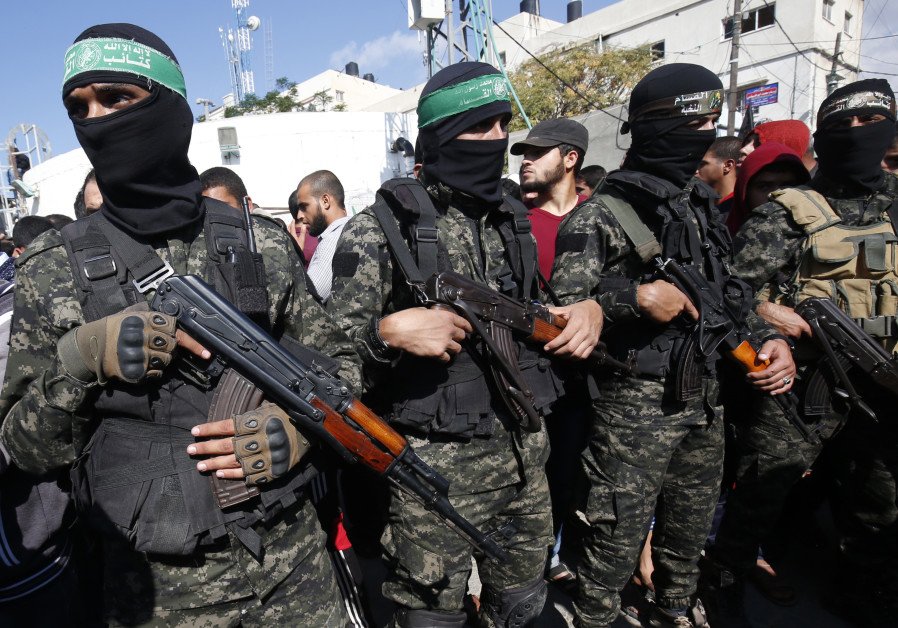
Palestinian militants of the Islamist movement Hamas' military wing Al-Qassam Brigades

Palestinian factions have expressed deep satisfaction over the failure of a US-sponsored resolution condemning Hamas for “repeatedly firing rockets at Israel and for inciting violence.”

A procedural vote at the UN General Assembly calling for the US resolution to be decided on a two-thirds majority passed before the main vote. Although 87 voted in favor, 58 voted against, with 32 abstentions, the resolution failed under the two-thirds ruling.

Hamas, Fatah and other Palestinian factions said that the failure of the UN to support the resolution was a “slap in the face of America” and a “victory for the Palestinian resistance.”

Hamas’s senior official, Khalil al-Haya, said that the failure of the US resolution was an “uplift for the Palestinian resistance.” Hamas, he said, “will remain committed to the option of resistance, which has been endorsed by the Palestinians.”

The failure of the US resolution, he added, is a “victory for the Palestinian resistance in spite of American bullying.” The Hamas official thanked the countries that opposed the US resolution and “prevented the US administration and Israel from crimializing the Palestinian resistance.” Addressing the countries that voted in favor of the anti-Hamas resolution, he said: “Shame on you for supporting the executioner against the victim.”

In a statement issued in the Gaza Strip last Thursday, Hamas said that the UN should be condemning Israel, and not Hamas, for terrorism. It called on the countries that supported the US and Israel at the UN General Assembly to reconsider their position and “correct this historical and dangerous mistake against the Palestinian people.”

Hamas said that the failure of the US resolution was a “big victory for the Palestinians and a terrible failure for the American policy of hegemony and domination.”

Hamas leader Ismail Haniyeh hailed the failure of the US resolution as an “important achievement for all Palestinians, including the resistance groups.” He thanked the Palestinian Authority and its envoy to the UN for their efforts to thwart the resolution.

Islamic Jihad spokesman Daoud Shehab said that the failure of the US resolution was a “severe blow” to the US and Israel. He said that all those who voted in favor of the resolution “should feel ashamed of their hypocrisy and ignorance of the reality.”

The PLO’s Popular Front for the Liberation of Palestine and Democratic Front for the Liberation of Palestine also expressed joy over the failure of the US resolution condemning Hamas. They too described the result of the UN General Assembly vote as a “slap in the face of the US administration” and a “huge victory for the Palestinian resistance.”

PLO Secretary-General Saeb Erekat pointed out that Palestinian Authority President Mahmoud Abbas and his ruling Fatah faction had played a role in thwarting the US resolution. The failure of the resolution is “conclusive evidence of the international community’s firm rejection of the Israeli occupation and the decisions taken by the US administration,” Erekat said. Abbas, he added, was not waiting for Hamas to thank him, but rather wants it to implement the 2017 “reconciliation agreement that was singed with Fatah in Cairo.

PLO Executive Committee member Hanan Ashrawi welcomed the failure of the resolution, which, she said, “targeted our people, the national movement and the Palestine national struggle.”

The PA government in Ramallah also welcomed the outcome of the UN General Assembly vote and said it should that the world supports the right of the Palestinians and rejects the US administration’s “hegemony and arrogance.”

The Palestinian daily Al-Quds called on Hamas and Fatah to seize the opportunity to end their differences and achieve “national unity.” In an editorial, the paper praised Abbas and the PA leadership for their stance against the anti-Hamas resolution.


UNIFIL Chief asks Lebanese army for permission to enter tunnel villages – DEBKAfile

December 8, 2018

Source: UNIFIL Chief asks Lebanese army for permission to enter tunnel villages – DEBKAfile

At a meeting on Friday, Dec. 7, UNIFIL’s Maj. Gen. Stefano del Col asked Lebanese Chief Gen. Joseph Aoun to allow his inspectors to enter South Lebanese villages and verify Israel’s complaint that they housed the starts of cross-border tunnels.

On Thursday, the Italian general received detailed information on the Hizballah tunnels excavated in those villages from the IDF’s OC Northern Command Maj. Gen. Yoel Strick.

The international monitors are precluded from entering these villages without Lebanese army consent and escort. Neither party has released the content of the conversation between the generals and so Gen. Aoun’s reply to the UNIFIL request is not known. It is surmised in Jerusalem and IDF General Command that the Gen. Aoun promised to look into the request and then let the UN force have his answer.
Until then, the IDF is continuing to dig on the Israeli side of the border in areas marked out for Hizballah’s cross-border tunnels, despite the stormy weather, DEBKAfile’s military sources report. The operation is safeguarded by large-scale military forces. The face the Hizballah forces placed on alert on the Lebanese side of the border since Thursday, as earlier reported in this space.

Hizballah has placed its forces on combat readiness in nine regions of southern Lebanon in response to Israel’s demand that UNIFIL and the Lebanese Army dismantle a tunnel. DEBKA Weekly’s military sources report that Hizballah did not mobilize reserves but canceled leaves in all its military units and placed them at the ready for action, including the organization’s southern command at Ma’arub, whose 7,000 troops were moved north up to the Litani River.

This was Hizballah’s first response to the IDF’s Operation Northern Shield since it was launched on Tuesday, Dec. 4, for locating and disabling the cross-border tunnels which Hizballah had secretly run from Shiite villages into northern Israel.

On Thursday, OC IDF Northern Command Maj. Gen. Yoel Strick met with the UNIFIL commander, Italian Maj. Gen. Stafano Del Col, to deliver a strong protest against Hizballah’s flagrant violations of UNSC Res 1701 by digging terror tunnels under the border. He gave him an aerial photo of a tunnel running from the Lebanese village of Ramaia up to Moshav Dovev in Western Galilee. The first tunnel was uncovered by the IDF two days earlier. Gen. Strick demanded that a UNIFIL force meet up with Lebanese army personnel at the tunnel’s opening without delay and disable it. Otherwise, the IDF would perform this task.

Hizballah chiefs are watching to see whether UNIFIL takes up the Israeli challenge and waiting even more tensely to see if the Lebanese army meets Israel’s demand. UNIFIL personnel will not enter Ramaiah village without a Lebanese military escort. Hizballah is poised to stall that event.

Earlier on Thursday, Prime Minister Binyamin Netanyahu told a group of 25 ambassadors invited to the scene of the IDF’s tunnel operation, “There is a “reasonable possibility Israel will have to “operate in Lebanon” to neutralize Hizballah’s attack tunnels.