Source: The unknown at the end of the tunnel – Israel Hayom
Exposing Hezbollah’s terror tunnels under the Israel-Lebanon border means Israel faces an operational dilemma going forward • Military aspects aside, Israel has to leverage this achievement diplomatically, all while bracing for Hezbollah’s response.
|
Israeli soldiers near the border with Lebanon, Tuesday
| Photo: IDF Spokesperson’s Unit
|
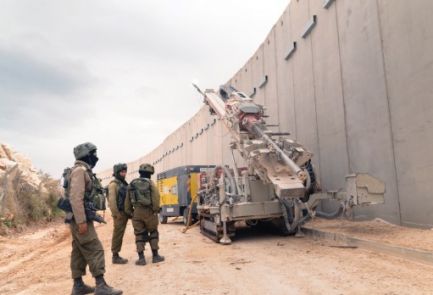
Let’s make something clear: This week’s countertunnel operation on the northern border did not defeat Hezbollah but rather was another round in the complex, long and tumultuous battle the parties have been waging for decades.
This round seems to go to Israel, but things are far from over. Hezbollah may have lost a significant strategic asset but it is far from giving up, and this setback will not be what decides the next military campaign. In fact, this is not even a tie-breaker – at most this is another important marker in a long line of events that date back to the early 1980s, which has no end in sight.
From the IDF’s point of view, Operation Northern Shield is just that – a full-scale operation in every respect, from intelligence gathering and employing engineering technology, to the deployment on the ground and dealing with any military, diplomatic and operational implications; all seeking to inflict maximum damage on Hezbollah and create maximum leverage for Israel, and all flawlessly executed thus far.
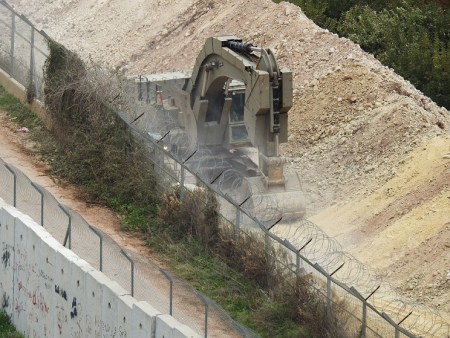
Keeping things in perspective is important, and calling military engineering activities on the Israeli side of the border an “operation” may be a bit of a stretch – to Israeli ears, the word “operation” conjures up images of something daring and heroic, not those of bulldozers excavating a tunnel – but the attempts by politicians to dwarf the IDF’s achievement are nonetheless very strange.
 Reuters
One may criticize the broader contexts of the operation, from the decision to avoid a more severe response to the violence in Gaza to the decision not to neutralize the tunnels’ end on Lebanese soil, but the contempt for the operation itself was odd, and proved that in 2018 Israel, even matters of security are all about politics.
Hezbollah’s tunnel project can be traced back to 2014. Reeling from Operation Protective Edge in Gaza, Hamas decided to accelerate its terror tunnels’ project. The information gathered by them was eventually handed over to Hezbollah – through Iran, no doubt – which decided to begin a tunneling project of its own.
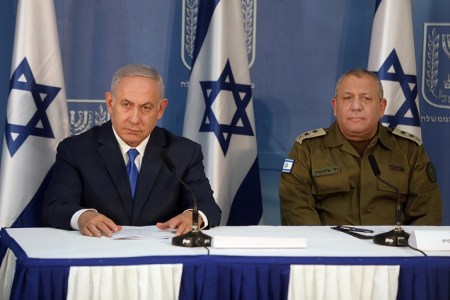
The IDF understood the challenge and especially its lacking ability to meet it. When IDF Chief of Staff Lt. Gen. Gadi Eizenkot took office in February 2015, he made the tunnel threat a top priority and set up technological-intelligence-operational teams to find a holistic solution to the problem.
It is likely that Eizenkot’s insistence to launch Operation Northern Shield at this time despite the recommendations of several General Staff officers, stemmed from his desire to see this through and not leave the problem for his successor, Aviv Kochavi, who will take office in mid-January.
At the time, the IDF’s decision to form a special task force to tackle the tunnel issue was oblivious to the fact that Hezbollah had embarked on a tunneling project near the Lebanon-Israel border. Even within the Shiite terrorist group, the project was top secret and only a handful of senior officials knew about it. Hezbollah leader Hassan Nasrallah wanted to keep the information on a need-to-know basis precisely to avoid the kind of intelligence breach that stunned the group this week.
The military began gathering actionable intelligence on Hezbollah tunneling project two years ago. The village of Kafr Kila in south Lebanon, where the IDF identified digging operations, was placed under 24/7 surveillance, revealing the slow but steady progress made by Hezbollah.
And slow and steady progress it was: Unlike in Gaza, the ground near the northern border is rocky and tough, not sandy and yielding. This allowed Hezbollah maximum progress of about six feet a week, which in turn, allowed the IDF’s seismic detection systems time to pinpoint the areas where the excavation took place.
The harsh terrain also explains the nature of Hezbollah’s tunnels, which are straighter and shorter than their Gazan cousins. Their advantage lies with the fact that, being carved out of solid rock and not sand, like in Gaza, Hezbollah’s tunnels did not require any cement lining.
The fact that Hezbollah had no idea that Israel had exposed its secret project made it possible for the IDF to focus its activities and reach the point where it could launch a surprise countertunnel operation and announce it had mapped Hezbollah’s grid of tunnels in its entirety.
 Gideon Markowicz
This was a dramatic statement not only because of the blow it dealt Hezbollah, but also because it allowed the military to pinpoint the operation to neutralize and destroy the tunnels instead of spending months on a futile search along the border.
Prudence must prevail
The suggested timetable for Operation Northern Shield ran counter to the escalation in Gaza. The IDF consistently claims that it can take on two sectors simultaneously, but when push came to shove, the northern sector was prioritized. This decision stemmed not only from the desire to effectively focus the military effort but also from a consensus between Eizenkot and Prime Minister Benjamin Netanyahu that tensions in Gaza were manageable even without a full-scale military campaign that would do little to resolve the enclave’s problems.
Members of the Diplomatic-Security Cabinet were red in on the IDF’s intelligence on Nov. 7 and were asked to greenlight a countertunnel operation on the Israel-Lebanon border at a time of the military’s choosing.
Four days later, IDF special forces embarked on a covert mission in Khan Yunis, in southern Gaza, which went awry and triggered one of the worst border flare-ups the south has seen since 2014. Emotions in Israel ran high and the public and ministers alike demanded something be done about Gaza “right now,” but Netanyahu and Eizenkot did not falter, insisting in a Nov. 13 cabinet meeting that the northern sector must remain the top priority.
The cabinet agreed, with the exception of then-Defense Minister Avigdor Lieberman, who resigned in protest, triggering political turmoil that nearly toppled the government. Netanyahu hinted at “something big” brewing in the north and called on all coalition partners to act responsibly in what he called a “highly sensitive time, security-wise.”
Incidentally, the timing of the operation was not chosen solely over military considerations: The days leading up to it were clouded by a well-founded suspicion that the plans were leaked to the media by a senior politician, and there was concern that Hezbollah will learn of them and Israel would lose the element of surprise.
The disappointment by some in Israel may have stemmed from the fact that the expectation for a spectacular strike on Lebanese soil gave way to clouds of dust stirred up by bulldozers and rather exaggerated media hype. It is doubtful, however, that Hezbollah shares this disappointment – it lost a valuable strategic asset, in which much thought, resources and efforts were invested.
We should not make light of this. Hezbollah is plagued by a serious economic crisis that is expected to worsen in 2019 given the impact of new U.S. sanctions in Iran, which is expected to slash its proxy’s budget.
Unlike Hezbollah’s armament efforts, which can be presented as a defensive measure, cross-border tunnels that snake into Israeli territory are a clearly offensive move that exposes its aggression. Worse still, the tunnel enterprise refutes Hezbollah’s claims that it has no present south of the Litani, as stipulated in Security Council Resolution 1701 that ended the 2006 Second Lebanon War.
Exposing Hezbollah’s tunnels has made it abundantly clear to everyone, especially to the U.N. peacekeeping force stationed in Lebanon – which for the past few years has insisted it sees no evil, hears no evil and speaks no evil with respect to the Shiite terrorist group – that Hezbollah has pulled the wool over everyone’s eyes.
 Reuters
Still, Israel would be wise not to expect the U.N. to revise Resolution 1701. The U.S. will likely support such revisions, but Russia will veto such a move.
The tunnels’ exposure is, however, a golden opportunity for Israel to call out Hezbollah on the international stage, as they are a unique public diplomacy asset that illustrates clearly what Israel has been saying about Hezbollah’s extensive web of lies, its operational plans and its ties to Iran.
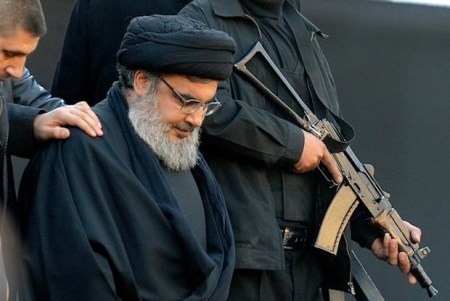
This may also explain why Hezbollah has remained mum. A speechless Nasrallah is a rarity but the organization has been stunned silent by Israel’s feat, and its officials will likely prefer to keep a low profile until the dust settles.
Leverage is key
Hezbollah is busy licking its wounds and performing damage control. It is unclear to it what Israel knows, and how seriously it has been compromised from intelligence and operational standpoints. Hezbollah’s investigation will probably lead to Tehran, whose officials were co-conspirators to the project. At some point, Hezbollah will also have to retaliate, both because it is in Nasrallah’s nature and because it wants to keep Israel deterred.
The first test of deterrence will present itself after Israel will expose all the tunnels and turn its attention to their destruction. The IDF will have to decide whether to destroy only the parts that infringe on Israeli territory or step over the border and eliminate their origins in Lebanon as well. This means infringing on Lebanese sovereignty, which Hezbollah could use as a pretext to respond.
For now, Israel is being extremely careful about infringing on Lebanese sovereignty. The guidelines are clear: Do not cross the Blue Line, i.e., the border demarcation between Lebanon and Israel set by the U.N. This is a prudent decision, but it raises an important question: If Israel is so concerned about stepping only a few hundred feet into Lebanese territory to destroy terror tunnels infringing on its own sovereignty, how does it plan to destroy the precision-missile production facilities Hezbollah is trying to build in Beirut?
This dilemma will be the next chief of staff’s to resolve, and he will have to do so against the backdrop of Iran’s continued attempts to do everything in its power to upgrade Hezbollah’s arsenal.
Operation Northern Shield will take several weeks. The main effort now is an engineering one and about 200 reservists, experts in their field, have been called up for it. The military’s Commando Brigade is securing the work and not by chance, as its presence on the border will allow the IDF to mount a rapid response to any flare-up if need be. The tactical threat is palpable and all it would take is a sniping attempt by Hezbollah, for example, to trigger a conflict.
It is doubtful the Hezbollah will do that. The tunnels were a strategic asset but their strength lies in the (now defunct) element of surprise, while Hezbollah’s real strength lies with its sizeable missile arsenal and tens of thousands of operatives. In other words, the fact that Hezbollah lost its tunnels will do little to dramatically change the course of the next war. Hezbollah is a mini-army of highly motivated terrorists, and it can still cross the border relatively easy.
Meanwhile, Israel will try to leverage its military achievement into a diplomatic one not only in Washington but in other capitals as well, especially Paris, which wields significant clout in Beirut, but also in London and Moscow. After all, small victories are still victories.





 anneinpt
 artaxes
 danmillerinpanama
 davidking1530
 Peter Hofman
 Joseph Wouk
 Peter
Peter Louisiana Steve
 WarSclerotic
Recent Comments