Archive for December 5, 2018

Hezbollah isn’t ready for a fight

December 5, 2018

Source: Hezbollah isn’t ready for a fight – Israel Hayom

Daniel Siryoti

Despite the fiery declarations emanating from Hezbollah’s stronghold in southern Beirut, senior Arab pundits believe the terrorist organization will have to swallow the IDF’s activities along the border without responding in an escalatory manner.

This, as long as Israel stays on its side of the border and doesn’t violate Lebanese sovereignty.

Even though Hezbollah says it will retaliate harshly for any perception of Israeli aggression, the last thing it wants right now is a military clash with the IDF and to give the Israeli air force legitimacy to attack the missile and weapons factories Iran is constructing in Lebanon, in addition to other infrastructure and strategic targets belonging to Hezbollah and its allies in Lebanon and Syria.

Despite the tens, if not hundreds of thousands of long-range precision missiles in Hezbollah’s possession, which can cover all of Israel and precisely hit almost any target, Hezbollah is not prepared for war with Israel. The majority of its armed force, which consists of around 40,000 fighters, is located in Syria. While the civil war there has given them more combat experience, Hezbollah’s fighting force has also been exhausted; many of its fighters have been killed or badly wounded in battle.

Today, less than 15% of the organization’s fighting force is ready and available for a military conflict with Israel. Within the framework of its preparations for war with Israel, Hezbollah established an elite unit – the Sheikh Radwan Battalions – whose entire purpose is to infiltrate Israeli territory to conquer land and towns in the Galilee.

It’s clear to Hezbollah leader Hassan Nasrallah that shooting missiles at strategic targets and cities in Israel, or a disproportionate response against IDF forces operating to thwart the tunnel threat, will trigger a devastating wave of aerial strikes – and not just against Hezbollah and Iranian targets in Lebanon, but civilian infrastructure as well.


Hezbollah dealt a painful blow 

December 5, 2018

Source: Hezbollah dealt a painful blow – Israel Hayom

Lilach Shoval

The disclosure of Hezbollah’s attack tunnels is an impressive achievement for the Israel Defense Forces from a technological, operational and intelligence standpoint, in that the military succeeded in discovering the details of Hezbollah’s top secret and highly classified project.

Although aware of Hezbollah’s efforts for a long time, it was the IDF’s ability to keep it under a cloak of secrecy for such a long time that allowed the military to take the terrorist organization to our north by surprise on Monday morning.

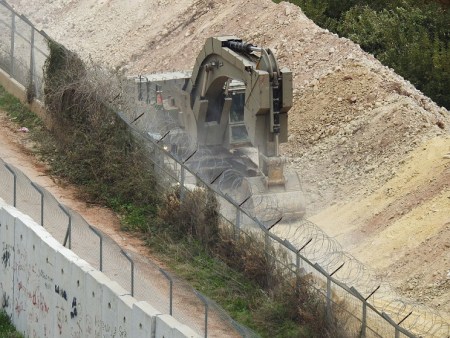
The cross-border tunnel exposed by the IDF is just the beginning. The operation to clear the tunnels is set to take a few weeks and the most difficult part most likely remains ahead. The assessment in Israel is that as long as IDF activity is constrained to Israeli territory, Hezbollah will be hard-pressed to find international legitimacy for military action against Israel. The IDF has already insinuated that, even if the operation to neutralize the terrorist threat is carried out from inside Israeli territory, its activities may spill over into Lebanese territory. This is one of the reasons the IDF is on high alert in the north.

Hezbollah was dealt a painful blow to both its operations and morale on Monday. Israel embarrassed the organization when it exposed Hezbollah’s blatant violation of U.N. Security Council Resolution 1701, which ended the Second Lebanon War, before the international community. The publicity also embarrassed the Lebanese government, the supposed sovereign power in the area, and in all likelihood the U.N., whose peacekeeping forces, the Interim Force in Lebanon, have been stationed in southern Lebanon in an effort to enforce the resolution and prevent such a flagrant violation of Israeli sovereignty.

Along with the continuation of the operation and the neutralization of the attack tunnels, the next stage must also see Israel leverage its operational success on the international front. Netanyahu began to do this on Monday, when he asked the United States to impose additional sanctions on Hezbollah and called for an urgent meeting of the U.S. Security Council on the subject.

But Israel must also take advantage of the exposure of Hezbollah’s project to contend with another burning issue on an international level, and that is the Iranian-led efforts to improve the precision of Hezbollah’s rocket arsenal. It would be fair to assume heavy international pressure on Lebanon would serve to slow down this project and ultimately prevent the need for possible Israeli military action inside Lebanon with the potential to spark an all-out war.

PM: Hezbollah tunnels built with direct support, funding from Iran

December 5, 2018

Source: PM: Hezbollah tunnels built with direct support, funding from Iran – Israel Hayom


Hizballah will not be deterred – only gain self-assurance – from the IDF’s tunnel-blocking operation – DEBKAfile

December 5, 2018

Source: Hizballah will not be deterred – only gain self-assurance – from the IDF’s tunnel-blocking operation – DEBKAfile

Prime Minister Binyamin Netanyahu’s principle, that action against an aggressor must not be allowed to trigger full-scale war, was applied to Operation Northern Shield launched by the IDF on Dec. 4 against Hizballah tunnels, say DEBKAfile’s analysts.
The operation for locating and neutralizing Hizballah’s cross-border assault tunnels has two outstanding features:

1. The IDF high command and government have known about the tunnels since late 2015. However, since Hamas and Islamic Jihad terrorist outbreaks from the Gaza Strip peaked in the past eight months, they determined after interminable debating that the time had come for Israel to reach a conclusion on one of its two fronts: either in the south against Gaza or the north against Hizballah, or else be in danger of being squeezed by both.

2. But  Operation Northern Shield Defense resolves nothing on either of the two fronts – certainly not against Hizballah. It was a typical move by the prime minister and IDF chief of staff Lt. Gen. Gady Eisenkot in keeping with the principles governing their conduct of Israel’s military operations, namely –

  • Preventing full-scale war.
  • The message conveyed to Hizballah by this operation is that Israel is not going to war.
  • Neither is Israel striking Hizballah’s strategic assets – only cautioning the Lebanese terrorist group against sending any more branches of its bunker/tunnel network across the border.
  • To make this point crystal clear, the IDF spokesman reiterated that the operation against the tunnels would be confined to Israeli territory, conveying an implicit pledge to refrain from combat outside the country.
  • The Netanyahu-Eisenkot strategy for the Gaza Strip is mirrored on the Lebanese border. Operation Northern Shield is confined to the Israeli side of the Lebanese border, just as in the south, Israeli troops are pinned down to defensive positions on the Israeli side of the Gaza border and restrained from tackling the Palestinian Hamas.
  • The counter-tunnel operation was moreover used cynically to distract from the delivery on Tuesday of the second $15m instalment of Qatari cash to Gaza, a widely criticized sop to the Palestinian terrorists.

This strategy, which Netanyahu carries forward in his newly added job of defense minister, has boosted the self-assurance of Hamas and the pro-Iranian Islamic Jihad in the Gaza Strip . It will have the same effect on the belligerent leaders of Iran’s Lebanese proxy.


New Netflix Series Shines Light on Israel’s Counter-Terror Expertise

December 5, 2018

New Netflix Series Shines Light on Israel’s Counter-Terror Expertise

Israel’s use of targeted killings during the Second Intifada is the focus of an episode of a new Netflix docuseries.

While controversial, the practice of assassinating Palestinian terror leaders helped Israel quell the surge of violence it faced between 2001-2005.

In an interview with The Algemeiner this week, Jon Loew — the chairman of Big Media and an executive producer of “Terrorism Close Calls,” which delves into the details of major thwarted attacks across the globe — talked about the episode — titled “The Israel Honey Trap” — and what he learned about the Jewish state’s counter-terror expertise during its making.

A transcript of the interview follows:

Why did you think it was important to include an episode on Israel?

“To many people, including me, it’s clear that Israel is on the front lines of the West’s war on terrorism. It became obvious throughout the production of the series that many other countries law enforcement and intelligence agencies felt the same, and capitalized off of Israel’s decades of experience fighting the same enemies. Many media companies seemed to be afraid of including positive stories about Israel for fear of a backlash of some sort. We are not afraid of speaking the truth.”

What were the top challenges you faced when creating the Israel episode?

“Surprisingly, while we met with some hesitation — I would not call it resistance — from our international buyers, the greatest hurdle was actually getting the Israeli security services to believe that our documentary would be objective, and not just another anti-Israel hit piece. Oddly, I think the Israelis were surprised that a foreign company like ours would remain so objective, and they were almost unclear as to how to cooperate so closely with us.”

Looking at how various countries deal with terror threats, is there anything you would say is unique about Israel‘s approach?

“Israel is operating so close to its enemies, including enemies within, that it became obvious that the Israelis had a very compassionate view on how to fight terrorism. While some Westerners, including me, would wonder why Israel would continue providing electricity to Gaza during a war against Hamas, it was important to the Israelis that they not lose their humanity — even if the rest of the world did not take notice. They were more worried about the ‘one pregnant Gazan who couldn’t get help at a local hospital’ than they were about public opinion.”

In the episode, some of Israel‘s best counter-terror minds speak with you very openly about strategy and specific cases they were involved in. Were you surprised by the frankness?

“Our company has a reputation for being fair and honest, so the people we were interviewing understood they could trust us from the get-go. I think our great experts were happy to have a fair and welcoming environment to really share how they felt. We were very luck to have access to great agents in Israel and so many other countries.”

Israel’s experience in counter-terror operations is so extensive, how did you come to chose the specific instance — involving the first female Hamas suicide bomber — that you centered your attention on?

“We worked very closely with Fauda co-creator Avi Issacharoff on the Israel episode, and after Avi suggested this case it became obvious that we had to choose this one. As a proud American Jew from New York, it gave me great pleasure to simultaneously showcase Israel’s counter-terror proficiency and humiliate Hamas at the same time.[ha ha ha!]

“In the case of the ‘suicide bomb mother,’ it turned out that she was not a ‘selfless martyr’ willing to give up her wonderful motherhood for the cause. She was caught having an affair with her Hamas husband’s commander. The only way the Hamas guys could save face was having her kill herself. There is nothing noble about this and it was important to us as a team that we expose this.”

The ten-part “Terrorism Close Calls” docuseries, including the Israel episode discussed above, is available for viewing on Netflix now.

IDF footage from attack tunnel shows alleged Hezbollah members still inside

December 5, 2018

Go to the article to see the (short) video, plus another video.

https://www.timesofisrael.com/idf-footage-from-attack-tunnel-shows-alleged-hezbollah-members-still-inside/

Israeli military robot films within cross-border tunnel 25 meters below ground, detonates small charge next to suspected terror operative, scaring him away

Hezbollah operatives were working inside a cross-border tunnel when it was exposed by the Israeli military on Tuesday morning, the IDF spokesperson said at a press conference, showing footage he said was filmed mere hours earlier inside the underground passage.

In the video, which was filmed by a small Israeli military robot, two men could be seen walking into the tunnel from the entrance inside Lebanon on Tuesday morning, hours before the army announced that the tunnel had been located and would soon be destroyed.

One of the men can be seen approaching the robot, which sets off a small explosive device, scaring them away.

The Israel Defense Forces said the tunnel, which extended some 40 meters into Israel, was the “first of what are sure to be many” attack tunnels dug by Hezbollah across the border from southern Lebanon discovered as part of a newly launched operation, known as Northern Shield.

According to the Israeli military, the operation is expected to last several weeks and is being led by the head of the IDF Northern Command Maj. Gen. Yoel Strick.

“The operation will continue until the outcome is achieved, however long that may take,” Prime Minsiter Benjamin Netanyahu said at the same press conference addressed by the IDF spokesperson at the Defense Ministry in Tel Aviv.

Speaking after Netanyahu, IDF Chief of Staff Gadi Eisenkot said Northern Shield was launched before Hezbollah’s tunnels were made operational and “became an immediate and direct threat to northern communities and army bases.”

The military deployed reinforcements to northern Israel as a precaution in case the Iran-backed Hezbollah launches retaliatory strikes or raids in response to the operation.

The army also called up a small number of reservists, from combat engineering, air defense, and administrative units.

“This morning we initiated action to thwart Hezbollah’s intrusion into our territory, to improve our security reality in the north… to strike and to continue to strike Iranian entrenchment in the north,” Eisenkot said.

According to the IDF spokesperson, Brig. Gen. Ronen Manelis, the tunnel that was uncovered on Tuesday originated under an ostensibly civilian building, meters away from a position controlled by the UN peacekeeping force UNIFIL, which is meant to ensure that armed groups other than the Lebanese military stay away from the border zone under UN Resolution 1701.

Israel has long been critical of what it describes as UNIFIL’s failure to rein in the powerful, Iran-backed Hezbollah terrorist group, which the IDF says maintains a large arsenal in the area despite Resolution 1701.

Manelis also presented footage captured by the IDF from above Lebanon, which he said showed Hezbollah using civilian trucks to hide the dirt and rocks from the excavation of the tunnels.

According to the IDF, the tunnel originated in the Lebanese village of Kafr Kila, near the Israeli border, and was approximately 200 meters (650 feet) long. It was dug some 25 meters (80 feet) below ground and was approximately two meters (six feet) tall by two meters (six feet) wide, which would easily make it large enough for heavily armed to pass through it.

The tunnel contained a ventilation system, electricity, and communication lines, the army said.

Eisenkot said that in the wake of the 2014 Gaza war, in which the threat of Hamas tunnels was a major issue, the Israeli military “built a highly advanced operational, technological engineering and intelligence capability to neutralize attack tunnels, both in the north and in the south.”

The army chief said the heads of communities in northern Israel were informed of the operation ahead of time and lauded them for showing “responsibility” by not revealing that it was poised to take place.

He said that the IDF was “in possession of Hezbollah’s offensive tunneling plans” and called on Israelis to “feel safe, to continue their daily routines and to continue traveling to the north.”

Hamas: Israeli special forces posed as medical workers to get into Gaza for raid

December 5, 2018

Apologies for the absence of postings from myself recently, I have been on leave and travelling a bit (weak excuse, I know).

Good to see Joseph and co have been manning the barricades, I am now back into the fray!

In addition to the article copied into this post, also see these other articles related to the commando raid inside Gaza from a little while back.

https://www.timesofisrael.com/hamas-claims-idf-officers-installed-spying-equipment-near-secret-gaza-hq/

https://www.timesofisrael.com/hamas-fears-israeli-special-forces-operating-base-inside-gaza-tv/

https://www.timesofisrael.com/hamas-on-hunt-for-collaborators-after-israeli-special-forces-operation-in-gaza/

Hamas: Israeli special forces posed as medical workers to get into Gaza for raid

https://www.timesofisrael.com/hamas-israeli-special-forces-posed-as-medical-workers-to-get-into-gaza-for-raid/

Palestinians stand next to the remains of a car said to be destroyed following an Israeli airstrike, in Khan Younis in the southern Gaza Strip on November 12, 2018 (SAID KHATIB / AFP)

Palestinians stand next to the remains of a car said to be destroyed following an Israeli airstrike, in Khan Younis in the southern Gaza Strip on November 12, 2018 (SAID KHATIB / AFP)

Terror group tells UK’s Independent daily that IDF soldiers used fake IDs to enter Strip in November, were caught because of their accents

Hamas officials have told a British news outlet that Israeli special forces troops posed as medical workers for a non-governmental organization during a raid inside the Gaza Strip last month that went awry.

On the night of November 11, the Israeli unit was exposed inside the southern Gaza city of Khan Younis following a search at a Hamas checkpoint, resulting in a firefight in which an Israeli lieutenant colonel was killed, along with seven Palestinian gunmen.

After the special forces operation and subsequent gun battle, Hamas and the Iran-backed Palestinian Islamic Jihad terror group launched the largest-ever bombardment against Israel from the Gaza Strip, lobbing some 500 rockets and mortar shells mostly at Israeli communities surrounding the coastal enclave — pushing Israel and terror groups to the brink of war.

Most details of the operation remain under a strict gag order by the military censor, and all articles about it must be approved, including this one.

According to a report Monday in the Independent newspaper, the Israeli troops used “detailed but fake” identity cards with the names and personal information of Palestinians living in the Gaza Strip.

“Those who the Israelis were posing as were detained but they had no idea their names had been used,” Hazem Qassem, a Hamas spokesman, told the British paper from Gaza City. The Palestinians whose names were found to have been unwittingly used were later released, he said.

According to the Hamas officials, the Israeli troops posed as medical workers, ferrying patients around the area.

“[The Israeli unit] were posing as NGO workers, there were women in the car as well. They used this to justify why they were stealing into Gaza and had a story prepared should they be questioned,” one official said.

Palestinian officials have claimed the Israeli troops were installing surveillance equipment in the Gaza Strip in order to listen in on Hamas’s internal communications.

The Independent acknowledged that it was unable to corroborate much of the information provided by the Hamas officials about the Israeli raid. The Israel Defense Forces has confirmed that special forces soldiers conducted an operation on the night in question but would not provide any details besides that it was of great importance to national security.

During the raid on the night of November 11, the troops were stopped at a Hamas checkpoint and questioned. During their interrogation, the Hamas gunmen noticed that the alleged Israeli soldiers’ accents did not match the addresses listed on their ID cards.

“They told the fighters at the checkpoint that they were delivering patients back from clinics to their homes and had a wheelchair in the back of the van. They presented their ID cards but the [fighters] manning the checkpoint were suspicious as their accents and voices did not match the areas where they said they were from,” a Hamas official said.

According to the Palestinian officials, when a more senior Hamas commander decided to bring in the suspects for additional questioning, the Israeli special forces soldiers opened fire, killing the senior commander, Nour Barakeh, and his deputy.

During the firefight and dash to the border, the Israeli lieutenant colonel — who can only be identified by the first Hebrew letter of his name, “Mem” — was killed and another officer was wounded. Five other Palestinian gunmen were also killed.

A Hamas official said the Gaza-ruling group had significantly tightened security throughout the Strip — a development confirmed by journalists and NGO workers in the coastal enclave.

“We are concerned that we want foreigners to keep coming in. They are helping with the humanitarian situation. We are dedicated to facilitating people coming in and out of Gaza. Any tightened security measures – which are applied to everyone – will be temporary,” said the official, speaking to the British newspaper on condition of anonymity.

The massive flareup that followed last month’s raid ended with an Egyptian-brokered ceasefire that remains in effect some three weeks later.

Members of Hamas and the Palestinian Islamic Jihad said the groups are prepared to go to war with Israel again, but will for now maintain the calm.

“If the Israelis launch a new attack, the Palestinian [fighters] are ready to deal with this attack,” Walid al-Qottati, a member of Islamic Jihad’s political wing, told The Independent.

“We are not lowering our guard yet,” a Hamas official agreed. “We do think the Israelis might do a sudden strike but for the moment, for now, at least things are moving [in] the right direction.”

Since the raid, Hamas officials have released details about the operation to the public, apparently in an attempt to fish for additional information about the nature of the Israeli operation and potentially in order to embarrass the IDF.

Last month, Hamas published the photographs of eight suspected Israeli special forces soldiers, calling on members of the public to contact its military wing if they had any information about them and their activities.

Though freely available on the internet, the photographs could not be published by Israeli media by order of the military censor.

In a highly irregular public statement, the censor also called on Israelis not to share any information they have about the raid, even if they think it benign.

The IDF has launched two investigations into the raid.

According to the army, one investigation will be conducted within Military Intelligence. The findings will be presented to Military Intelligence head Maj. Gen. Tamir Hyman and IDF Chief of Staff Gadi Eisenkot.

The military said an initial probe was expected to be completed within the coming weeks.

In addition, Maj. Gen. Nitzan Alon — the former head of IDF Operations — was charged with a wider investigation into how the army conducts such raids.

Alon was instructed to lead a team to “examine and study the challenges and [make] recommendations at the level of the General Staff, of multiple army branches and of the inter-organizational cooperation between different special forces,” the army said.


Haley tells UN Washington takes vote on Hamas ‘very seriously’

December 5, 2018

Source: Haley tells UN Washington takes vote on Hamas ‘very seriously’ | The Times of Israel

Ahead of GA vote on resolution condemning terror group, US ambassador urges countries to ‘vote against any amendments or other efforts to undermine adoption of the text’

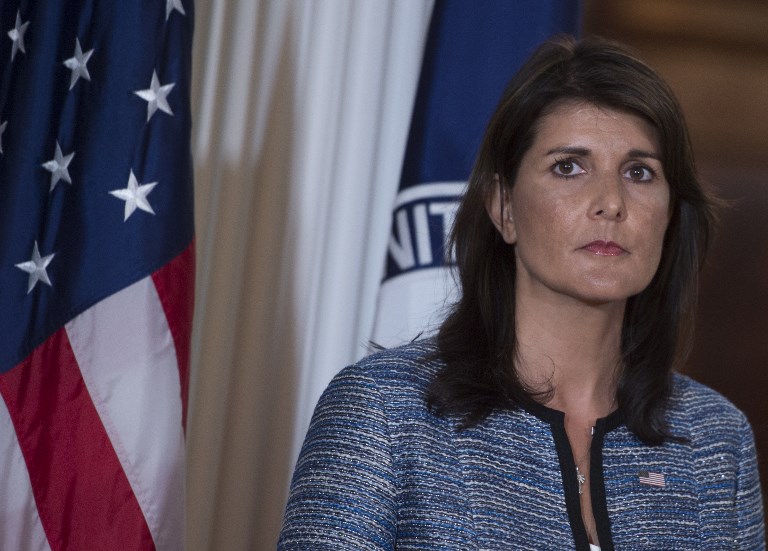
US Ambassador to the United Nation Nikki Haley speaks at the US Department of State in Washington DC on June 20, 2018 (AFP PHOTO / Andrew CABALLERO-REYNOLDS)

United States Ambassador to the United Nations Nikki Haley has urged countries to back a US-drafted resolution condemning the Palestinian Hamas terror group, warning in a letter that the United States takes the vote “very seriously.”

The UN General Assembly is scheduled to vote Thursday on the draft resolution that would condemn Hamas for firing rockets into Israel and demand that it end the violence.

If adopted, it would mark the first time that the assembly has taken aim at Hamas, the Islamist terror organization that has ruled the Gaza Strip since 2007.

In a letter sent to UN diplomatic missions, Haley warned that there could be attempts by some countries to introduce amendments to the text and urged ambassadors to vote against any such proposed changes.

“The United States takes the outcome of this vote very seriously,” Haley wrote in the letter dated Monday and obtained by AFP.

“The resolution has been carefully-crafted to address a specific problem, and it reflects consultations with many stakeholders to ensure balance.

Illustrative: UN Secretary-General Antonio Guterres addresses the 73rd United Nations General Assembly on September 25, 2018, in New York. (AFP Photo/Timothy A. Clary)

“That is why we are asking that you not only vote in favor of the resolution but that you also vote against any amendments or other efforts to undermine adoption of the text,” she added.

Haley, who steps down as UN ambassador in January, has steadfastly supported Israel in its confrontation with Hamas in Gaza and chastised the United Nations for criticizing both sides.

The influential UN ambassador has not shied away from pressuring countries to support the US stance at the United Nations.

Arab countries are expected to put forward amendments to the resolution and push for a ruling at the General Assembly that would specify that the measure must be adopted by a two-thirds majority, instead of a simple majority.

The US has won crucial backing for the measure from the European Union after it agreed to add a mention of relevant UN resolutions. The text does not however refer specifically to the two-state solution.

The EU, like the US, considers Hamas a terror group, but the 28-nation bloc is divided over how to support peace efforts.

The vote on Thursday follows the adoption in the assembly of about a dozen resolutions on the Israeli-Palestinian conflict that condemn Israeli settlements and call for progress toward the two-state solution.

Resolutions adopted by the General Assembly are non-binding, but they carry political weight and are seen as a barometer of world opinion.

Hamas politburo chief Ismail Haniyeh has reached out to a number of Arab and foreign leaders to stymie the US-drafted resolution.

“Haniyeh contacted a number of leaders and foreign ministers in the region and beyond to abort the American efforts to pass a resolution condemning the Palestinian resistance and Hamas,” the terror group said in a statement posted to its website Sunday.

Haniyeh called Arab League Secretary-General Ahmed Aboul Gheit, Qatari Foreign Minister Mohammed bin Abdulrahman al-Thani, and officials in the Egyptian General Intelligence Services, according to the statement.

He also sent letters to UN Secretary-General Antonio Guterres and a number of other regional and international leaders, Hamas said.

In the letters, Haniyeh defended the “right” of the Palestinian people “to resist the occupation with all possible means including armed resistance,” according to the statement.

The American efforts to pass a resolution in the UN General Assembly condemning Hamas comes weeks after a major flare-up in cross-border violence between Israel and terrorist groups in the Gaza Strip that saw hundreds of rockets fired at Israel and retaliatory airstrikes in the Strip.

The draft resolution “condemns Hamas for repeatedly firing rockets into Israel and for inciting violence, thereby putting civilians at risk” and demands that “Hamas and other militant actors including Palestinian Islamic Jihad cease all provocative actions and violent activity.”

The draft resolution also calls on all parties to fully respect international humanitarian law, “including in regards to the protection of the civilian population.”

In recent days, Ramallah-based Palestinian officials have come out against the American-sponsored draft resolution.

On Saturday, Fatah spokesman Osama Qawasma said his party “totally rejects” the draft resolution and vowed it would make efforts to defeat it.

Last month, Saeb Erekat, the secretary-general of the Palestine Liberation Organization’s Executive Committee, lashed out at the draft resolution, calling it an “attempt to turn facts on their head.”

Adam Rasgon contributed to this report.


Pompeo tells Netanyahu US committed to confronting ‘Iranian regime’s threats’ 

December 5, 2018

Source: Pompeo tells Netanyahu US committed to confronting ‘Iranian regime’s threats’ | The Times of Israel

PM meets with US secretary of state on ‘curbing Iranian aggression,’ amid increasing tensions over Iranian missiles and Tehran arming Lebanese terror group

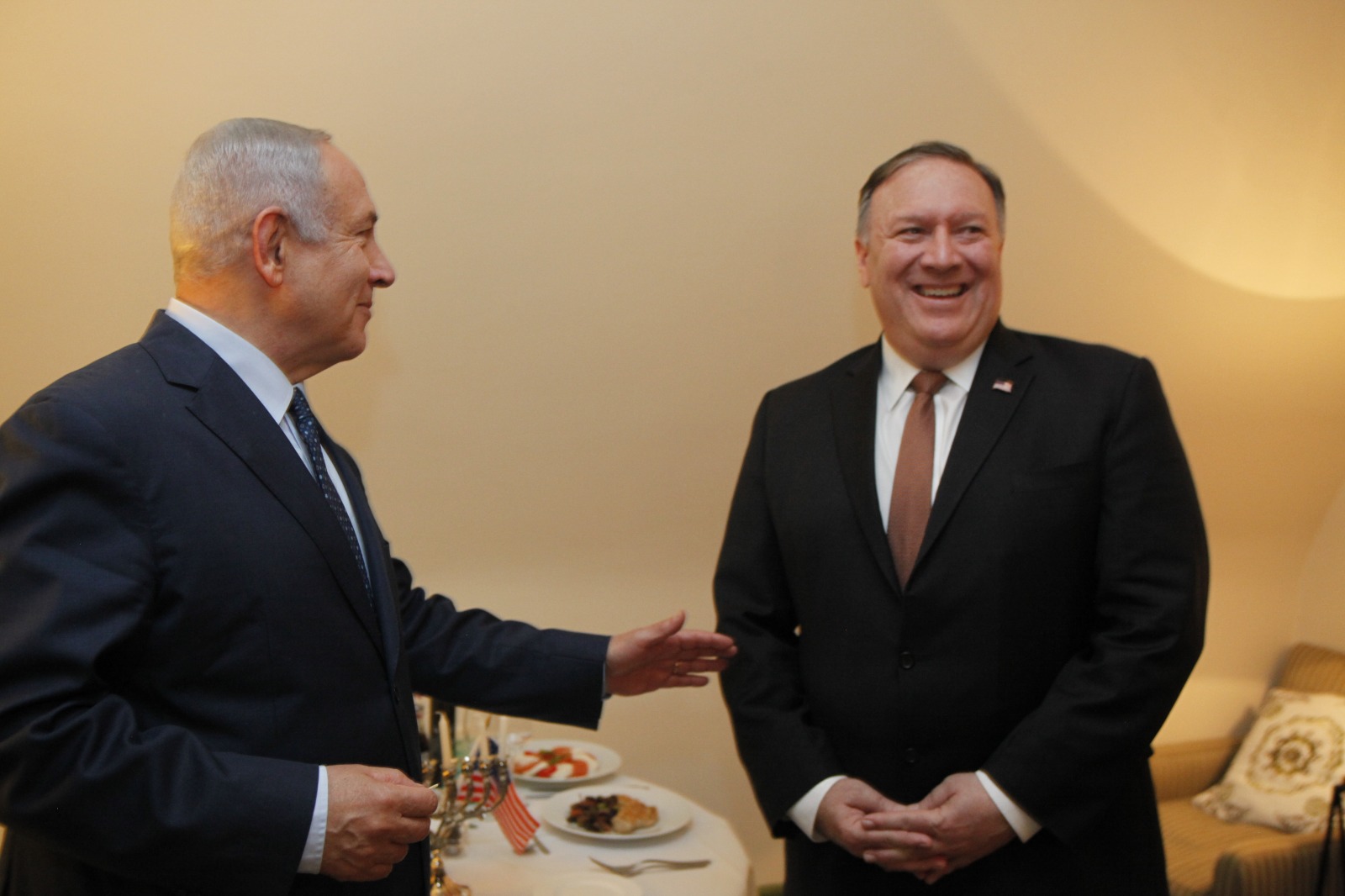
Prime Minister Benjamin Netanyahu (left) and US Secretary of State Mike Pompeo pictured in front of a menorah on the second night of the Hanukkah festival, during their meeting on the sidelines of a NATO conference in Brussels, Belgium, on December 3, 2018. (Gaby Farkash/GPO)

Prime Minister Benjamin Netanyahu (left) and US Secretary of State Mike Pompeo pictured in front of a menorah on the second night of the Hanukkah festival, during their meeting on the sidelines of a NATO conference in Brussels, Belgium, on December 3, 2018. (Gaby Farkash/GPO)

US Secretary of State Mike Pompeo told Prime Minister Benjamin Netanyahu on Monday that the US was committed to “confronting the totality of the Iranian regime’s threats through maximum pressure,” during talks in Brussels on joint efforts to curb Iranian aggression in the region, including by reining in Lebanon’s Hezbollah terror group.

As well as reiterating the United States’ “commitment to Israel’s security and absolute right to self-defense,” Pompeo also pledged that the US would continue “fighting anti-Israeli bias at the United Nations,” according to a State Department statement released after the meeting.

Netanyahu made an unexpected trip to Brussels on Monday afternoon for the meeting with Pompeo, who is in Belgium for talks with NATO counterparts.

In a public statement before the closed-door talks, Netanyahu thanked Pompeo for the administration’s “strong” stance on Iran, and said he looked forward to discussing joint Israeli-US efforts to “curb Iran’s aggression in the region, in Syria, in Iraq, in Lebanon and elsewhere.”

Netanyahu was reported to be telling Pompeo that Israel could take military action if Beirut does not clamp down on Hezbollah, amid concerns that Tehran has begun shipping advanced arms directly to the terror group in Lebanon.

According to Hadashot news, in a report shortly before the meeting, Netanyahu was planning to tell Pompeo to convey a warning to Beirut that Israel would take action if Lebanon does not work to keep Hezbollah from arming itself.

“Secretary Pompeo noted the strength of the US-Israel alliance and our multifaceted cooperation. He reiterated America’s resolve in confronting the totality of the Iranian regime’s threats through maximum pressure,” the State Department statement added.

Reports in recent weeks have pointed to Iran shipping arms directly to its proxy terror group in Lebanon, and not via Syria, as had been done until recently. Israel has repeatedly targeted Iranian arms consignments in Syria en route to Hezbollah. On Thursday, a flight from Tehran to Beirut on an ostensibly civilian cargo carrier was widely reported to contain arms meant for Hezbollah.

Without specifically mentioning the flight, the army’s Arabic-language spokesperson Lt. Col. Avichay Adraee tweeted Thursday that Lebanon should stop allowing Iranian planes to bring war materiel into the country, along with a black-and-white satellite photograph of Rafik Hariri International Airport.

View image on Twitter

افيخاي ادرعي

@AvichayAdraee

التي تسمح بهبوط طائرات إيرانية تحاولون من خلالها نقل أسلحة من

Israel has carried out hundreds of airstrikes in Syria, many of them to keep advanced missiles from being transferred to Hezbollah, which fought a devastating war with Israel in 2006. But it has refrained from carrying out strikes in Lebanon.

Though the northern border has seen relative quiet for the past 12 years, tensions have remained high and Israeli officials have recently sounded alarms over Hezbollah’s acquisition of precision missiles that can hit anywhere in Israel.

Before taking off for Belgium on Monday, Netanyahu said in a statement that he would be discussing “a series of developments in our region as well as the measures we are taking together to curb the aggression of Iran and its proxies in the north.”

Officials in the Prime Minister’s Office told the pro-Netanyahu Israel Hayom daily that the sit-down with Pompeo was “urgent.”

Netanyahu was joined on the trip by Mossad chief Yossi Cohen, National Security Adviser Meir Ben Shabbat, and military secretary Col. Avi Blot.

Officials said meeting had been scheduled last week and set for Wednesday, but was moved up to Monday because Pompeo will be flying back from Europe early in order to attend the funeral of former US president George H.W. Bush.

The meeting comes at a time of heightened tensions with Iran amid reimposed US sanctions, and after Pompeo accused Tehran of testing missiles that could carry warheads to anywhere in the Middle East and parts of Europe, in violation of a United Nations resolution prohibiting tests of nuclear-capable ballistic missiles.

Iran said Sunday that it would continue to develop its missile program after Pompeo’s accusations.

Traveling with Pompeo, US special envoy for Iran Brian Hook rejected Iran’s insistence that its missile program is defensive.

Hook said US discussions with the Europeans about missile sanctions are gaining traction. Those talks center on slapping penalties on companies and people involved in Iran’s program.

“It is a grave and escalating threat, and nations around the world, not just Europe, need to do everything they can to be targeting Iran’s missile program,” Hook said.