To all the readers of this site…
Joseph Wouk
To all the readers of this site…
Joseph Wouk
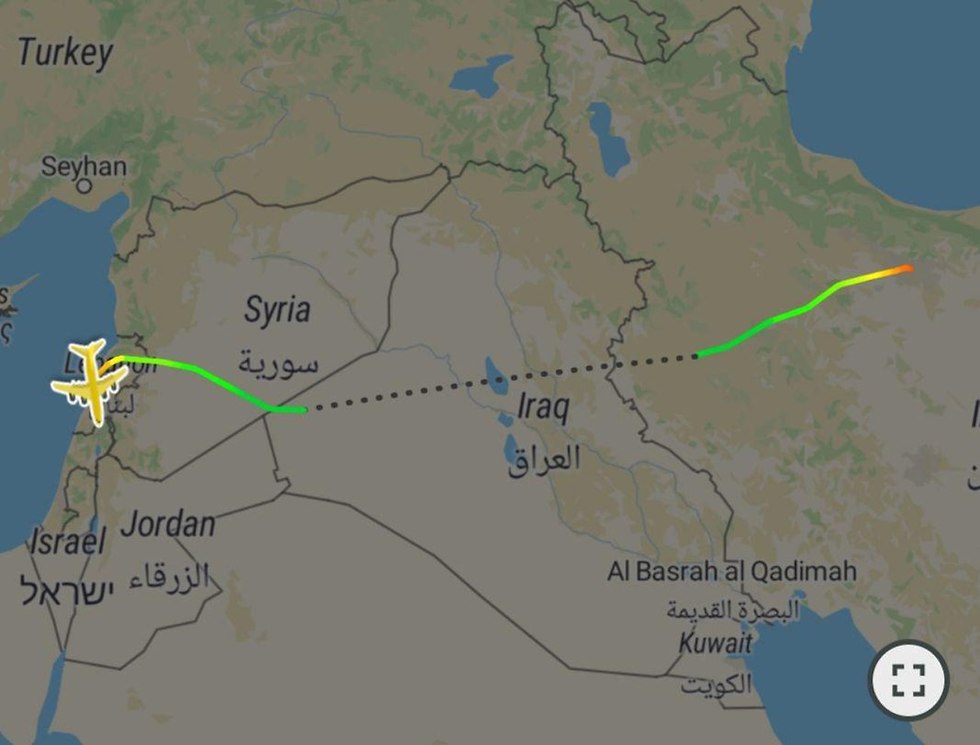
The 27-year-old Jumbo jet, registered as EP-FAB, took off on Thursday morning at 8:02am from Tehran to Beirut on flight QFZ9964, and landed in Lebanon at 10:19am. In the past, the jet has been in service of Japanese, Afghan, Armenian and Russian airlines.
Suspicions first arose that Iran uses the cargo airline to smuggle advanced weapons two months ago after reports emerged that the Israel Air Force (IAF) carried out an attack on targets at the Damascus airport.
“The Iranians are trying to find new ways to smuggle weapons to their allies in the Middle East … They are exploring the West’s ability to locate the smuggling sites,” said a Middle Eastern intelligence source, who chose to remain anonymous.
Prime Minister Benjamin Netanyahu revealed two months ago, during a speech at the United Nations General Assembly (UNGA), that over the past year, Hezbollah—guided by Iran—has attempted to build an infrastructure for the conversion of surface-to-surface missiles into precision-guided missiles near an airport in Beirut.
“I have a message for Hezbollah today: Israel also knows what you’re doing. Israel knows where you are doing it and Israel will not let you get away with it,” Netanyahu stressed during the speech.
Source: 148 nations disavow Jewish ties to Jerusalem, Temple Mount – Arab-Israeli Conflict – Jerusalem Post
“The international community must stop participating in such a blatant denial of history. You must not permit these blatant attempts to delegitimize Israel,” Furman said.
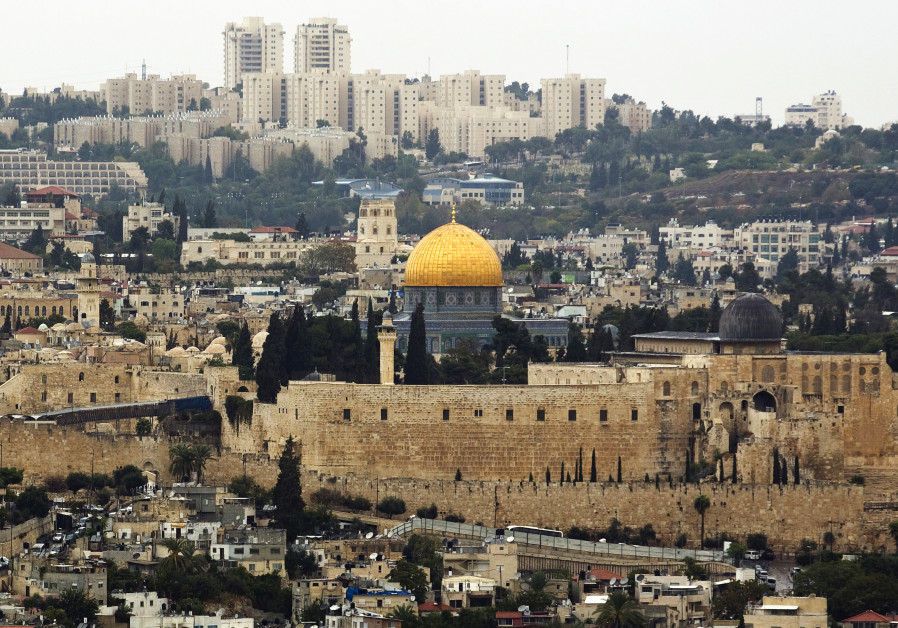
The UN General Assembly in New York on Friday approved six anti-Israel resolutions including two that ignored Jewish ties to the Temple Mount.
The primary resolution on Jerusalem, that passed 148-11 with 14 abstentions, also disavowed Israeli sovereignty in Jerusalem.
Both that text and a second more global one on the Israeli-Palestinian conflict, which passed 156-8, with 12 abstentions, spoke of Judaism’s most holy site – The Temple Mount – solely by its Muslim name of al-Haram al-Sharif.
The votes comes as Israel is working to shore up international support for its sovereignty in Jerusalem.
A third text, which was approved 99-10 with 66 abstentions, called on Israel to withdraw from the Golan Heights.
The United States, Canada and Australia voted against all six resolutions, which are the first batch of some 20 resolutions that the UNGA annually passes against Israel.
“We live in a time of many crises, crises that are raging around the Middle East and around the world. It is a shame that rather than addressing these crises, the UN passes so many biased resolutions,” said Israeli Deputy Permanent Representative Noa Furman.
She said she was particularly concerned by the two resolutions that ignored Jewish and Christian ties to the Temple Mount.
“This omission was deliberate. It shows yet another instance of the Palestinian refusal to recognize the proven historical connection between Judaism, Christianity, the Temple Mount and Jerusalem as a whole.
“The international community must stop participating in such a blatant denial of history. You must not permit these blatant attempts to delegitimize Israel,” Furman said.
The European Union, which supported both texts, warned it could stop doing so unless more include language was used to reference holy sites in Jerusalem.
Speaking on behalf of the EU, the Austrian representative said the EU stresses “the need for language on the holy sites of Jerusalem to reflect the importance and historical significance of the holy sites for the three monotheistic religions.”
It added, “future choice of language may affect the EU’s collective support for the resolutions.”
PLO Ambassador to the UN Riyad Mansour thanked UN member states for their support of texts that reference a two-state resolution to the conflict based on the pre-1967 lines with east Jerusalem as the capital of a Palestinian state.
This “global consensus, which all of us have worked for, is still the cornerstone of finding a just and lasting peace to the conflict.”
US representative Leslie Ordeman, who is deputy political coordinator, also spoke out against the texts.
“We are disappointed that despite messages of support for reform, member states continue to single out Israel with these resolutions.
“As the United States has repeatedly made clear, this dynamic is unacceptable. Again, we see resolutions that are quick to condemn all manner of Israeli actions, but say almost nothing about Palestinian terrorist attacks against innocent civilians. This is particularly acute now, when the rocket attacks on November 12 saw more projectiles fired on a single day than on any day since 2014.”
Both Israel and the US took issue in particular with the two resolutions passed Friday that continued to support the work of the “Committee on the Exercise of the Inalienable Rights of the Palestinian People” and the “Division for Palestinian Rights.”
“The Palestinians are the only actor in the UN system with a dedicated division within the UN Secretariat. The message that it sends is that the Palestinians never need to come back to the negotiating table – they can rely on flawed and biased mechanisms, such as these, to push their agenda,” he said.
Source: Pompeo: Iran tested missile that can carry multiple warheads – Israel Hayom
Iran testing a medium-range ballistic missile violates U.N. Security Council Resolution 2231, U.S. Secretary of State Mike Pompeo says, urging Iran to “cease these activities” • Meanwhile, Iran’s navy launches destroyer with alleged stealth capabilities.
|
U.S. Secretary of State Mike Pompeo
| Photo: Reuters
|
U.S. Secretary of State Mike Pompeo on Saturday condemned what he described as Iran’s testing of a medium-range ballistic missile capable of carrying multiple warheads, saying the test was a violation of the international agreement on Tehran’s nuclear program.
Amid mounting tensions between Washington and Tehran over ballistic missiles and other points of contention, Pompeo warned in a statement that Iran is increasing its “testing and proliferation” of missiles and called on the Islamic republic to “cease these activities.”
Earlier this year, U.S. President Donald Trump pulled out of an international nuclear agreement, reached by his predecessor Barack Obama, and reimposed sanctions on Tehran. Trump fiercely criticized the deal for not including curbs on Iran’s development of ballistic missiles or its support for proxies in Syria, Yemen, Lebanon and Iraq.
Iran says its missile program is purely defensive but has threatened to disrupt oil shipments through the Strait of Hormuz in the Gulf, if the U.S. tries to strangle Iranian oil exports. Last month, an Iranian Revolutionary Guards commander said U.S. bases in Afghanistan, the UAE and Qatar, as well as U.S. aircraft carriers in the Gulf, were within missile range.
Pompeo’s statement, issued on Twitter, provided few details about the latest Iranian missile test.
“The Iranian regime has just test-fired a medium range ballistic missile that’s capable of carrying multiple warheads,” he wrote in the tweet.
“This test violates UNSCR 2231,” he added, citing the United Nations Security Council’s endorsement of the international nuclear agreement.
“We condemn this act,” he concluded.
U.S. Defense Secretary Jim Mattis, addressing a security forum in California, said the Iranian launch was significant and was a reminder that Tehran was unlikely to be deterred from pursuing missile technology or supporting militant proxies.
“It shows that our best efforts to try to talk them out of their aggressive support of terrorism is probably going to be as unsuccessful as the U.N.’s effort to stop them from launching missiles,” Mattis said.
He added that while the strategic threat from Iran was less significant globally than the one from North Korea, it was still regionally significant.
“And it could grow beyond that if it’s not dealt with,” Mattis said.
The regime in Tehran has ruled out negotiations with Washington over its military capabilities, particularly its missile program, which is run by the country’s Revolutionary Guards Corps.
On Tuesday, the head of the Atomic Energy Organization of Iran warned the European Union that Tehran’s patience was running out on the bloc’s pledge to keep up oil trading despite U.S. sanctions. He said Iran could resume enriching uranium to 20% purity if it fails to see economic benefits from the 2015 deal that curbed its nuclear project.
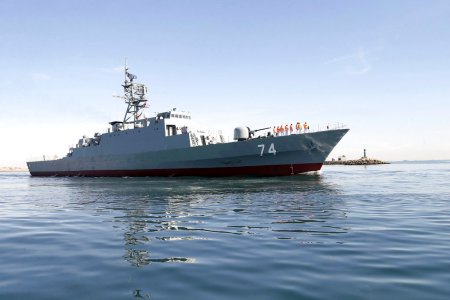
Meanwhile, on Saturday, Iran’s navy launched a domestically made destroyer, which state media said has radar-evading stealth properties.
 AP
APIn a ceremony broadcast live on state television, the 1,300-ton Sahand destroyer – which can sail on voyages lasting five months without resupply – joined Iran’s regular navy at a base in Bandar Abbas in the Persian Gulf.
The Sahand has a helicopter landing pad, is 96 meters (105 yards) long and can cruise at 25 knots. It is armed with surface-to-surface and surface-to-air missiles as well as anti-aircraft batteries and sophisticated radar and radar-evading capabilities, the report said.
“This vessel is the result of daring and creative design, relying on the local technical knowledge of the Iranian Navy… and has been built with stealth capabilities,” Rear-Admiral Alireza Sheikhi, head of the navy shipyards that built the destroyer, told Iranian state news agency IRNA.
Iran’s navy has extended its reach in recent years, launching vessels in the Indian Ocean and the Gulf of Aden to protect Iranian ships from Somali pirates operating in the area.
Iran added the first domestically made destroyer to its fleet in 2010 in the Persian Gulf. Iran reportedly has five other destroyers.
On Thursday, Iran’s navy announced the acquisition of two mini-submarines designed for operation in shallow waters such as the Persian Gulf, including one new sub and one overhauled one.
The chief of staff of the Iranian armed forces said in 2016 that Iran may seek to set up naval bases in Yemen or Syria in the future, raising the prospect of distant footholds perhaps being more valuable militarily to Tehran than nuclear technology.
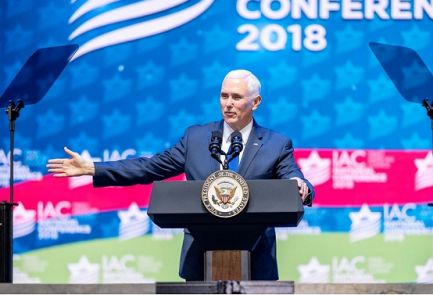
Source: Vice President Mike Pence: World should know US stands with Israel – Israel Hayom
Addressing Israeli-American Conference in Florida, U.S. vice president says, “If the world knows nothing else, let the world know this: America stands with Israel” • U.S. sanctions increasingly cutting off Iran’s ability to support terrorism, he says.
|
U.S. Vice President Mike Pence addresses the annual IAC conference in South Florida, Saturday
Photo: Elliot La-Mer
|
U.S. Vice President Mike Pence called Israel America’s “most cherished ally” in an address to the annual conference of the Israeli American Council on Saturday.
Pence’s attendance at the conference, which kicked off Nov. 29 in South Florida, was a highlight for the organization, which now serves as a national framework for building an engaged and united Israel-American community that strengthens Israeli and Jewish identity and the bond between Americans and the State of Israel.
“Today on behalf of [U.S.] President [Donald] Trump and our entire administration, it’s my great honor to say as a trumpet among the nations: If the world knows nothing else, let the world know this: America stands with Israel.”
Pence said the U.S. stands with Israel “because her cause is our cause, her values are our values and her fight is our fight. We stand with Israel because we believe in right over wrong, good over evil, liberty over tyranny. We stand with Israel because support for the Jewish state is not a partisan issue, it is an American issue.
Noting Trump’s firm stance on Iran, Pence said, “President Trump promised to stand with Israel against all those who seek to destroy her… President Trump promised to take the fight on radical Islamic terrorists on our terms, on their soil. President Trump also promised to stand up to the leading state sponsor of terror. And he took decisive action and kept his word when President Donald Trump withdrew the United States of America from the disastrous Iran nuclear deal. And this month, we reimposed every last sanction that the previous administration had lifted.
Blasting ant-Israel bias at the U.N., Pence said, “This president also promised to confront anti-Semitism on the world stage. And this summer, he directed our ambassador at the United Nations to withdraw the United States from the so-called ‘Human Rights Council’ at the United Nations. We will no longer allow the U.N. to be a forum for invective against Israel.”
Pence also expressed publicly for the first time the Trump administration’s opposition to the decision by home-rental company Airbnb to remove its listings in Israeli settlements in Judea and Samaria.
“In the wake of Airbnb’s decision to ban listings of Jewish homes in eastern Jerusalem and the West Bank, we’ve made it clear: The boycott, divestment and sanctions movement is wrong and it has no place in the free enterprise of the United States of America.
Pence also talked about Trump’s historic decision to move the U.S. Embassy to Jerusalem.
“As we all know, while every president for the past two decades had promised to do so, this president did more than promise when one year ago next week, he delivered on that promise and in May of this year, the United States of America opened our embassy in Jerusalem, the capital of the State of Israel.
“Our president made that decision I want to assure you, in the best interest of the United States, but he also made it clear that we believe that decision is in the best interest of peace. And peace can only be built on a foundation not of fiction but of fact, of recognizing what is negotiable and what is not.
He also stressed the U.S.’s commitment to Israel’s security, noting, “while any peace will undoubtedly require compromise, you can be confident of this: The United States of America will never compromise the safety and security of the Jewish State of Israel.”
“As we continue to hope and work toward peace, we continue to stand without apology with Israel.”
 Perry Bindelglass
He said, “The two great threats to a brighter future in the Middle East are radical Islamic terrorism and the Islamic Republic of Iran. Together with Israel, we’ve made great strides against the menace of terrorism. But as we’ve seen in recent weeks, the terrorist threat still festers at Israel’s borders.
“Hamas has sent a stream of rockets into Israel, including more than 300 rockets and mortars in a single 36-hour span earlier this month. These attacks against Israel must end and they must end now.”
Turning again to Iran, Pence said, “We recognize terrorists across the region, from Hamas to Hezbollah, are really, truth be told, nothing more than proxies of a vile regime. They are the pawns of Iran and its ayatollahs who devoted more than $16 billion to spreading violence, to sowing chaos and bloodshed across the Middle East and the wider world. … This administration has now reimposed all sanctions that were lifted on Iran in the last administration that disastrous nuclear deal. But we’ve also imposed strong, new sanctions as well and American sanctions on Iran have never been stronger. As we speak, our actions are already cutting off the regime’s ability to support its terrorist minions across the region on an increasing basis. And while Iran continues to pursue its evil aims, let me make a solemn promise to you, to Israel and to the world. The United States of America will never allow Iran to obtain a nuclear weapon.”
Pence also spoke about the deadly shooting attack on the Tree of Life synagogue in Pittsburgh, which he said “broke the heart not just of that community but of this nation. What happened that day was not just criminal. It was evil. The 11 members of the Jewish community who perished were victims of one of the oldest hatreds known in the human race. In the days that followed, President Trump and I made clear that this anti-Semitic attack was an assault not just on the Jewish community, it was an assault on all of us in America and we stand together. There is no place in America for anti-Semitism and violence. And we will confront and condemn it everywhere it rears its ugly head.”
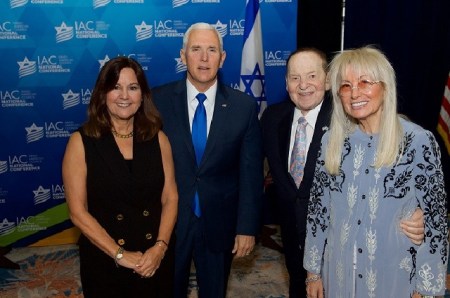
Dr. Miriam Adelson, who introduced Pence on stage, called him “the best friend that Israel and the Jewish people could have because his friendship has been most evident when times have been tough. Decades before he became the No. 2 to President Trump, well before this terrific pro-Israel administration, Mike has been there for us. Standing for what is right often means standing alone and Mike has never been deterred from doing so for Israel’s sake even as so much of the world gangs up on the Jewish state. He has defended us faithfully on every front, against the Iran nuclear deal, against Palestinian terror funding, against anti-Semitism, against BDS and forever in favor of the U.S. recognizing Jerusalem as the eternal capital of Israel and moving the embassy, and inspired by his Christian faith, he has enriched the natural alliance between Israel and the United States through religious and commercial outreach.”
“Welcome, Mr. Vice President. Shalom, shalom, Mike,” she said. “Thank you so much for being a friend, an ally, a brother and special thanks also to your wife, Karen.”
Upon taking the stage, Pence said that “in our day and in our age, few know better how to encourage others to do what is right than the incomparable Miriam Adelson. Miriam has proven that in everything she’s done – as a scientist, a physician, a philanthropist and even now, Miriam Adelson leads by example every single day. … And in recognition of all that she’s done in philanthropy, and in medicine and her tireless work to support America’s most cherished ally, two weeks ago, President Donald Trump bestowed Miriam Adelson the highest civilian award in the United States of America, the Presidential Medal of Freedom and Miriam, I offer you my and our congratulations.”
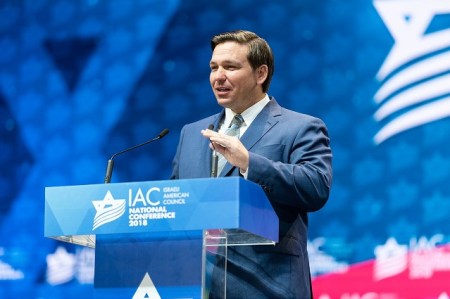
Florida Governor-elect Ron DeSantis also took the stage, where he reiterated his threat to take action against Airbnb.
“If we’re not the most pro-Israel state in the country, we will be on Jan. 8 when I take office,” he said.
“I’ve already warned companies like Airbnb that if you single out Jews in Judea and Samaria for disfavored treatment, we are going to be reviewing our BDS statures, we’re going to be reviewing our relationship and we’re going to act.
 Elliot La-Mer
We need to be fighting anti-Semitism on all fronts and BDS is nothing more than a cloak for anti-Semitism. … We have some of the strongest BDS legislation in the country. And that’s something that as more companies take actions like this, we need to add them to our list very quickly … and so people will know that if you want to do business … with the state of Florida, we welcome that, but if you’re going to join forces with BDS, that’s a red line for us. And you’re just going to forfeit being able to do business with the state of Florida.”
Also addressing the conference was Knesset Speaker Yuli Edelstein, who said it was thanks to U.S. support for Israel, “the atmosphere in the region – including in Arab states, was changing. He said these countries understand that the alliance between the U.S. and Israel was stronger than ever and that they have no other option but to cooperate with Israel.
The excitement was tenable among IAC members ahead of Pence’s scheduled appearance at the annual conference.
IAC CEO Shoham Nicolet recalled how, five years ago, the IAC had been nothing more than a dream.
“I was there when it was just a bunch of Israelis in a living room,” he told Israel Hayom. “And here, now the American vice president is here. Who would have believed it? It is difficult to comprehend that now the secret service has taken over my conference.
He said, “It’s a dream, a crazy achievement for the community. Israeli-Americans have transformed from a group of invisible people to a group that hosts the vice president of the United States. It is a great honor and a big deal for all of us and the State of Israel.”
The Adelson family owns the company that is the primary shareholder in Israel Hayom.
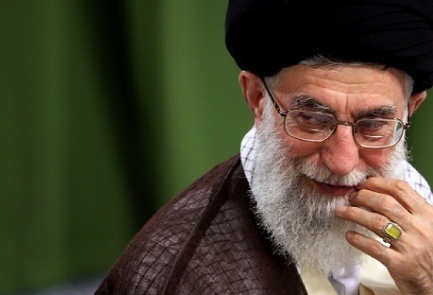
Source: How Iran spreads disinformation around the world – Israel Hayom
Investigation finds over 70 websites disseminating Iranian propaganda in 15 countries, with one site fooling a Pakistani minister into issuing a nuclear threat against Israel • Former CIA Director John Brennan: Iranians are “sophisticated cyber players.”
|
Iran’s Supreme Leader Ayatollah Ali Khamenei
| Photo: Reuters
|
Website Nile Net Online promises Egyptians “true news” from its offices in the heart of Cairo’s Tahrir Square, with the aim of expanding “the scope of freedom of expression in the Arab world.”
Its views on America do not align with those of Egypt’s state media, which consistently celebrates U.S. President Donald Trump’s warm relations with Cairo. In one recent article, Nile Net Online derided the American president as a “low-level theater actor,” who “turned America into a laughing stock” when he attacked Iran in a speech at the United Nations.
Until recently, Nile Net Online had more than 115,000 followers across Facebook, Twitter and Instagram. But its contact telephone numbers, including one listed as 0123456789, don’t work. A Facebook map showing its offices’ location features a pin in the middle of the street, rather than on any building. Regulars at the square, including a newspaper stallholder and a policeman, say they have never heard of the website.
The reason: Nile Net Online is part of an influence operation based in Tehran.
It’s one of more than 70 websites found by Reuters to be promoting Iranian propaganda in 15 countries, in an operation that cybersecurity experts, social media firms and journalists are only now starting to uncover. The sites, which are visited by more than half a million people every month, have been propped up by social media accounts with over a million followers.
The sites reveal how political actors worldwide are increasingly circulating distorted or false information online to influence public opinion. The discoveries follow allegations that Russian disinformation campaigns swayed voters in the United States and Europe.
Myanmar’s military and advisers to Saudi Arabia’s crown prince are also among those using social media to distribute propaganda and attack their enemies. Moscow has denied the charges; Saudi Arabia and Myanmar have declined to comment on them.
Former CIA Director John Brennan told Reuters that “countries around the globe” are now using such information warfare tactics.
“The Iranians are sophisticated cyber players,” he said of the Iranian campaign. “There are elements of the Iranian intelligence services that are rather capable in terms of operating [online].”
Traced using research from cybersecurity firms FireEye and ClearSky, the sites in the campaign have been active at various times since 2012. While they look like normal news and media outlets, a couple of the sites disclose Iranian ties.
Reuters could not determine whether the Iranian government was behind the sites; Iranian officials in Tehran and London did not reply to questions.
But all the sites are linked to Iran in one of two ways: Some carry stories, videos and cartoons supplied by an online agency called the International Union of Virtual Media, which according to its website is headquartered in Tehran. Others have shared online registration details with IUVM, such as addresses and phone numbers. In total, 21 of the websites do both.
Emails sent to IUVM bounced back and telephone numbers the agency provided in its web registration records did not work. Documents available on the main IUVM website say its objectives include “confronting remarkable arrogance, Western governments and Zionism front activities.”
Nile Net Online did not respond to questions sent to the email address on its website. Its operators, as well as those of the other websites identified by Reuters, could not be located. Previous owners identified in historical registration records could not be reached. The Egyptian government did not respond to requests for comment.
Some of the sites in the Iranian operation were first exposed in August by companies including Facebook, Twitter and Google’s parent company, Alphabet, after they were discovered by FireEye. The social media companies have closed hundreds of accounts that promoted the sites or pushed Iranian messaging. Facebook said last month it had taken down 82 pages, groups and accounts linked to the Iranian campaign, which had garnered over one million followers in the U.S. and Britain.
But the sites uncovered by Reuters have a much wider scope. Operating in 16 different languages, from Azerbaijani to Urdu, they target internet users in less developed countries. The fact that they have reached people in such tightly controlled societies as Egypt, which has blocked hundreds of news websites since 2017, highlights the campaign’s reach and efficacy.
The Iranian sites include:
• A news site called Another Western Dawn which purports to focus on “unspoken truth.” The site fooled the Pakistani defense minister into issuing a nuclear threat against Israel.
• Ten outlets targeting readers in Yemen, where Iran and U.S. ally Saudi Arabia have been fighting a proxy conflict since civil war broke out there in 2015.
• A media outlet offering daily news and satirical cartoons in Sudan that could not be reached by Reuters.
• A website in Russian called Realnie Novosti, or “Real News” that offers a downloadable mobile phone app – its operator could not be traced.
But it’s not all fake news on these sites, in which authentic stories appear alongside pirated cartoon and speeches from Iran’s Supreme Leader Ayatollah Ali Khamenei. The sites clearly support Iran’s government and amplify antagonism toward countries opposed to Tehran – particularly Israel, Saudi Arabia and the U.S. Nile Net’s “laughing stock” piece was copied from an Iranian state TV network article published earlier the same day.
Some of the sites are slapdash. The self-styled, misspelled “Yemen Press Agecny” carries a running update of Saudi “crimes against Yemenis during the past 24 hours.” Emails sent to the agency’s listed contact, Arafat Shoroh, bounced back. The agency’s address and phone number led to a hotel in the Yemeni capital, Sanaa, whose staff said they had never heard of Shoroh.
The identity or location of the past owners of some of the websites is visible in historical internet registration records: 17 of 71 sites have in the past listed their locations as Iran or Tehran or provided an Iranian telephone or fax number. But information as to their current owner is often hidden, and none of the Iranian-linked operators could be reached.
More than 50 of the sites use American web service providers Cloudflare and OnlineNIC, which provide website owners tools to shield themselves from spam and hackers. Such services often also serve to effectively conceal who owns the sites or where they are hosted. Cloudflare and OnlineNIC both declined to tell Reuters who operates the sites.
Under U.S law, hosting and web service companies are not generally liable for the content of sites they serve, according to Eric Goldman, co-director of Santa Clara University’s High Tech Law Institute. Still, since 2014, U.S. sanctions on Iran have banned “the exportation or re-exportation, directly or indirectly, of web-hosting services that are for commercial endeavors or of domain name registration services.”
Douglas Kramer, general counsel for Cloudflare, said the services it provides do not include web-hosting services. “We’ve looked at those various sanctions regimes, we are comfortable that we are not in violation,” he said.
A spokesman for OnlineNIC said none of the sites declared a connection to Iran in their registration details, and the company was in full compliance with U.S. sanctions and trade embargoes.
The U.S. Treasury’s Office of Foreign Assets Control declined to comment on whether it planned to open an investigation into the matter.
The Kremlin is widely seen as the superpower in modern information warfare. From what is known so far, Russia’s influence operation – which Moscow denies – dwarfs Iran’s. According to Twitter, nearly 4,000 accounts connected to the Russian campaign posted over 9 million tweets between 2013 and 2018, against over 1 million tweets from fewer than 1,000 accounts believed to originate in Iran.
Even though the Iranian operation is smaller, it has had an impact on volatile topics. AWDnews, the site purporting to focus on “unspoken truth,” ran a false story in 2016 that prompted Pakistan’s defense minister to warn on Twitter that he had the weapons to nuke Israel. It was only when he was contacted by Reuters that he learned the hoax had been part of an Iranian operation.
“It was a learning experience,” said the deceived politician, 69-year-old Khawaja Asif, who left Pakistan’s government earlier this year. “But one can understand that these sorts of things happen because fake news has become something huge. It’s something anyone is capable of now, which is very dangerous.”
Israeli officials did not respond to a request for comment.
The bogus report claimed that “Defense Minister Moshe Ya’alon,” who had left the position at the time, said: “If Pakistan sends ground troops into Syria on any pretext, we will destroy this country with a nuclear attack.”
Following the AWDnews report, Pakistani Defense Minister Khawaja Asif tweeted, “Israeli def min threatens nuclear retaliation presuming Pak role in Syria against Daesh [ISIS]. Israel forgets Pakistan is a nuclear state too.”
The Israeli Defense Ministry responded with two tweets of its own, stressing the AWDnews report was fictitious: “The statement attributed to fmr Def Min Yaalon re Pakistan was never said,” and “Reports referred to by the Pakistani Def Min are entirely false.”
AWDnews publishes in English, French, Spanish and German and, according to data from web analytics company SimilarWeb, receives around 12,000 unique visitors a month. Among those who have shared stories from AWDnews and the other websites identified by Reuters were politicians in Britain, Jordan, India, and the Netherlands; human rights activists; an Indian music composer and a Japanese rap star.
FireEye originally named six websites as part of the Iranian influence operation. After examining those sites, Reuters learned their content led to the Tehran-based IUVM.
IUVM is an array of 11 websites with names such as iuvmpress, iuvmapp and iuvmpixel. Together, they form a library of digital material, including mobile phone apps, items from Iranian state media and pictures, video clips and stories from elsewhere on the web that support Tehran’s policies.
Tracking usage of IUVM content across the internet led to sites that have used its material, registration details, or both. For instance, 22 of the sites have shared the same phone number, which has also been listed for IUVM and which does not work. At least seven sites have used the same address, which belongs to a youth hostel in Berlin. Staff at the hostel told Reuters they had never heard of the sites in question. The site operators could not be reached to explain their links with IUVM.
Two sites even posted job advertisements for IUVM, which said it was seeking women with the “ability to work effectively and with knowledge in dealing with social networks and [the] internet.”
One of IUVM’s most popular users is a site called Sudan Today, which SimilarWeb data shows receives almost 150,000 unique visitors each month. On Facebook, its 57,000 followers are informed Sudan Today operates without political bias. Its 18,000 followers on Twitter have included the Italian Embassy in Sudan, and its work has been cited in a report by the Egyptian Electricity Ministry.
The office address registered for Sudan Today in 2016 covers a whole city district in north Khartoum, according to archived website registration details provided by WhoisAPI Inc and DomainTools LLC. The phone number listed in those records does not work.
Reuters could not trace staff members named on Sudan Today’s Facebook page. The five-star Corinthia Hotel in central Khartoum, where the site says it hosted an anniversary party last year, told Reuters no such event took place and an address listed on one of its social media accounts is a demolished home.
Sudan used to be an Iranian ally but has since aligned itself with Saudi Arabia, costing Tehran a foothold in the Horn of Africa just as it becomes more isolated by the West. It is against this background that Iran sees itself as competing with Israel, Saudi Arabia and the United States for international support, and is acting to take the fight online, said Ariane Tabatabai, a senior associate and Iran expert at the D.C.-based Center for Strategic and International Studies.
Headlines on Sudan Today’s homepage include a daily round-up of stories from local newspapers and Ugandan soccer results. It also features reports on the price of bread, which doubled in January after Khartoum eliminated subsidies, triggering demonstrations.
Ohad Zaidenberg, senior researcher at Israeli cybersecurity firm ClearSky, said this mixture of content provides the cover for narratives geared at influencing a target audience’s attitudes and perceptions.
The site also draws attention to Saudi Arabia’s military actions in Yemen. Since Sudanese President Omar al-Bashir ended his allegiance with Iran, he has sent troops and jets to join Saudi-led forces in the Yemeni conflict.
One cartoon from IUVM published by Sudan Today in August shows Trump astride a military jet with an overflowing bag of dollar bills tucked under one arm. The jet, draped in traditional Saudi dress, is shown dropping bombs on a bloodstained map of Yemen littered with children’s toys and shoes.
Turkish cartoonist Mikail Çiftçi drew the original and told Reuters he did not give Sudan Today permission to use his cartoon.
Alnagi Albashra, a 28-year-old software developer in Khartoum, said he likes to read articles on Sudan Today in the evenings while waiting for his baby to fall asleep. But he and three other Sudan Today readers reached by Reuters had no idea who was behind the site.
“This is a big problem,” he said. “You can’t see that they are not in Sudan.”
Government officials in Khartoum, the White House, the Italian Embassy and the Egyptian Electricity Ministry did not respond to requests for comment.
It is unclear who is responsible for responding to online disinformation campaigns like Iran’s, or what if any action they should take, said David Conrad, chief technology officer at ICANN, a non-profit that helps manage global web addresses.
Social media accounts can be deleted in bulk by the firms that provide the platforms. But the Iranian campaign’s backbone of websites makes it harder to dismantle than social media because taking down a website often requires the cooperation of law enforcement, internet service providers and web infrastructure companies.
Efforts by social media companies in the U.S. and Europe to tackle the campaign have had mixed results.
Shortly after being contacted by Reuters, Twitter suspended the accounts for Nile Net Online and Sudan Today. “Clear attribution is very difficult,” a spokeswoman said, but added that the company would continue to update a public database of tweets and accounts linked to state-backed information operations when it had new information.
Google did not respond directly to questions about the websites. The company has said it identified and closed 99 accounts that it says are linked to Iranian state media. “We’ve invested in robust systems to identify influence operations launched by foreign governments,” a spokeswoman said.
Facebook said it was aware of the websites and had removed five more Facebook pages. But a spokesman said that based on company user data, the company was not yet able to link all the websites’ accounts to the Iranian activity found earlier. “In the past several months, we have removed hundreds of pages, groups and accounts linked to Iranian actors engaging in coordinated inauthentic behavior. We continue to remove accounts across our services and in all relevant languages,” he said.
Accounts linked to the Iranian sites remain active online, especially in languages other than English. Last week, 16 of the Iranian sites were still posting daily updates to Facebook, Twitter, Instagram or YouTube – including Sudan Today and Nile Net Online. Between them, the social media accounts had more than 700,000 followers.
Source: From Hezbollah’s perspective, Israel is ready to attack – Israel Hayom
Israel’s avoidance of an operation in Gaza; Netanyahu’s hints of secret activity in the north; the extension of the IDF chief of staff’s term – Hezbollah is connecting the dots and making its own conclusions: Israel may be planning a strike in Lebanon.
|
Hezbollah launched a campaign titled “defend our skies” in response to perceived Israeli efforts
| Photo: Reuters
|
There was a lot of noise over nothing on Israel’s northern front over the weekend; while the media was abuzz over a number of incidents and reports, nothing significant actually changed on the ground.
The commotion began on Thursday when it was revealed that an Iranian aircraft had landed in Beirut. In the past, many such flights involved weapons shipments to Hezbollah, and the Lebanese terrorist organization may well believe that this latest report was an intentional Israeli move.
In the wake of these reports, Hezbollah launched an online campaign titled “defend our skies,” in which it called on the Lebanese government to act against the Israeli air force, which Hezbollah said was operating in Lebanese airspace in violation of United Nations Resolution 1701.
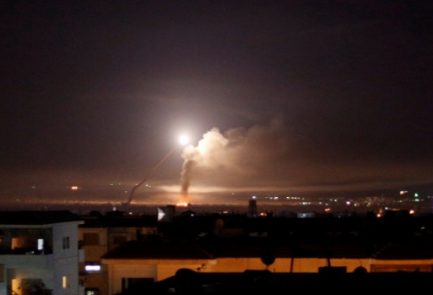
Israel responded in kind, launching its own online campaign. Shortly thereafter, reports emerged of an Israeli airstrike in Syria. And while the attack, if it even occurred, appeared relatively minor in scope, it drew a lot of attention. Not just because it was reported in real time – and was the first known Israeli strike since the downing of a Russian plane on September 17 – but also because of the hysterical Syrian response, which included the firing of over 20 surface-to-air missiles. Debris from one of these missiles landed in Israeli territory. The Syrians even issued a false report that an Israeli plane had been shot down – which an IDF spokesperson summarily refuted.
On Friday night, Hezbollah aired a menacing video, complete with satellite images and precise locations of IDF headquarters in Tel Aviv and several air force bases. The message was clear: We are tracking you and have the capability to hit any target in Israel with precision. The IDF spokesperson issued a mocking response and warned that “those who live in glass houses should not throw stones.”
This behavior appears to indicate immense pressure building in the northern arena – in Syria and especially in Lebanon. Hezbollah is busy trying to connect the dots: Israel evades a military campaign in Gaza amid Prime Minister Benjamin Netanyahu’s intimations that something big is on the horizon in the north; the term of outgoing IDF Chief of Staff Gadi Eizenkot is extended by two weeks and he cancels a trip to Germany; the numerous mentions of precision missile facilities in Lebanon; and also the Israel Hayom report exposing Hezbollah’s efforts to rehabilitate its terrorist infrastructure in the Syrian Golan Heights.
From Hezbollah’s perspective, all these dots form one solid line pointing to a possible Israeli attack – which it is trying to prevent through its online intimidation campaign. In this regard, Hezbollah was the first to blink, although it must be said truthfully: Israel is also deterred and does not want a war. The actions it has recently taken were intended to stave off a conflagration. We can, therefore, expect the tense quiet to also hold in the near future.
The Merkava is also one of the first armored vehicles to be equipped with the Trophy Active Protection System (APS).
Israel’s Merkava Mark IV tank has been crowned one of the five deadliest tank in the world by the conservative American magazine National Interest alongside Russia’s T40 and the American M1 Abrams.
Conceived by Maj.-Gen. Israel Tal followed the Yom Kippur War, the Merkava is the IDF’s first indigenous main battle tank. The first Merkava I entered service in 1978 and first saw action in the First Lebanon War in 1982.
The Merkava is also one of the first armored vehicles to be equipped with the Trophy Active Protection System (APS), the only fully operational and combat-proven APS against anti-tank guided missiles in the world.
“Combined with a tiny general population in which even minor personnel losses were felt across society, the Israeli military envisioned a tank which prioritized defensive capabilities and firepower above all else,” read the report, stating that “the construction of an entirely new class of main battle tank by Israel, a tiny country, is certainly a major achievement.”
Praising the Merkava’s hybrid modular armor, National Interest said the tank has “excellent protection” with it’s turret and frontal hull area “sharply faceted to present maximum armored protection at all angles, giving the turret a knifelike edge.”
The Trophy system, developed by Israel’s Rafael Advanced Defense Systems and Israel Aircraft Industries’ Elta Group, was praised by The National Interest as being one of the most important aspect of the Merkava.
Designed to detect and neutralize incoming projectiles, the Trophy system has four radar antennas and fire-control radars to track incoming threats such as anti-tank-guided-missiles (ATGMs), and rocket propelled grenades. Once a projectile is detected the Trophy system fires a shotgun-type blast to neutralize the threat.
The Trophy has been installed on Israel’s Merkava tanks since 2009 and received its “baptism by fire” on March 1rst 2011 when it neutralized an RPG antitank rocket which had been fired from a short range toward an IDF Merkava Mark-IV tank close to the border with the Gaza Strip.
The system has since proved its efficacy in several operations, especially during Operation Protective Edge where IDF tanks were able to operate in the Gaza Strip without suffering any losses.
The Trophy system has not only been installed on the IDF’s Namer heavy infantry fighting vehicle and the new Eitan armoured personnel carrier. In June the US Army awarded a contract worth close to $200 million for the system to shield its Abrams tanks “in support of immediate operational requirements.” A new and lightweight version of the system neutralized over 95 percent of munitions fired at it in tests conducted this summer ahead of testing for the US Army’s Stryker armored vehicle.
Israel has built over 2,000 Merkavas and is currently developing the latest generation of the tank, the Merkava IV Barak, which is expected to be ready for trial runs by the IDF in 2020.
The new Merkava 4 Barak tank is designed as a “smart tank” with dozens of sensors and a task computer which will present all information to both the crew inside the tank as well as the other tanks and vehicles present in the field.
The new tank’s computer-controlled fire control system will also be able to acquire and lock onto moving targets, including airborne platforms, while the tank itself is moving. The sensors along with a 360 degree camera fitted outside the tank, will also allow troops to remain in the tank at all times and a new smart helmet designed by Elbit will allow the commander of the tank to see exactly what is outside the tank such as approaching terrorists or other threats.
The PA denounced Greenblatt as an “arrogant colonist” and an “ally of settlements.”
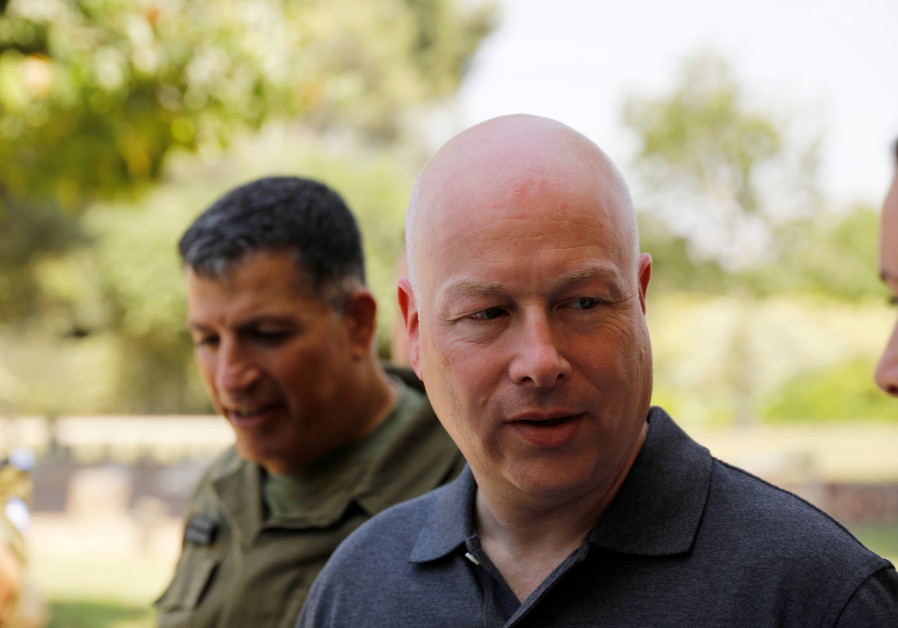
The Palestinian Authority on Saturday accused US presidential envoy Jason Greenblatt of promoting the ideas and positions of Prime Minister Benjamin Netanyahu concerning the Israeli-Palestinian conflict.
The PA denounced Greenblatt as an “arrogant colonist” and an “ally of settlements.”
The PA’s renewed attack on Greenblatt came in response to an article he published in the Palestinian daily Al-Quds.
The PA leadership has been boycotting Greenblatt and other US administration officials since December 2017, when President Donald Trump recognized Jerusalem as Israel’s capital.
“Palestinians deserve more from their leadership than political statements and bargaining positions,” Greenblatt, who serves as Trump’s Special Representative for International Negotiations, wrote. “While waiting for a possible political solution, it is high time to build the Palestinian economy and provide Palestinians with the opportunities they deserve.”
Greenblatt accused Palestinian leaders of preventing their people from “getting too comfortable.” These leaders, he said, “believe that if Palestinians get too comfortable economically, they would lost interest in the Palestinian cause. And so, year after year, Palestinians suffer and are unable to live comfortable lives.”
Greenblatt revealed that he was continuing to meet with ordinary Palestinians in spite of the PA’ decision to boycott the Trump administration. “What is striking is that, although they complain about the Trump administration’s policies, they remain focused on their economy,” he said.
In a statement published in Ramallah, the PA Foreign Ministry lashed out at Greenblatt for his “indignant, fragmented and guided weeping over the Palestinian economy.”
The statement said that the “only economic option that Greenblatt is promoting is one that asks the Palestinians to surrender, thus making the Palestinian economy, expertise, competencies, and capital more subordinate to the Israeli economy.”
According to the PA ministry, it was Netanyahu who “invented” the idea of economic peace “as a form of Palestinian and Arab normalization with the occupation and as a means to avoid a political solution to the conflict.”
In his “ominous article, Greenblatt was unable to get out from the cloak of the occupation and settlements despite his attempt to cover up his absolute bias to the ruling right-wing on Israel and the settlers through his configurable and frivolous talk about an ostensible and comprehensive plan for solving the Israeli-Palestinian conflict,” the PA ministry added.




 anneinpt
 artaxes
 danmillerinpanama
 davidking1530
 Peter Hofman
 Joseph Wouk
 Peter
Peter Louisiana Steve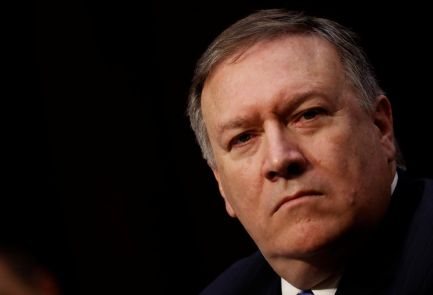

 WarSclerotic
Recent Comments