
Prime Minister Benjamin Netanyahu and his wife Sara met in Rio de Janeiro with Brazilian Christian friends of Israel.
( This Brit gives the best defense of the 1st amendment that I’ve ever heard… – JW )
Published on Dec 31, 2018
“Iran could use its growing clout in Iraq to turn the Arab country into a springboard for attacks against Israel.”
Iran could use its growing clout in Iraq to turn the Arab country into a springboard for attacks against Israel, the top Israeli intelligence official said on Monday.
Israel sees the spread of Tehran’s influence in the region as a growing threat, and has carried out scores of air strikes in civil war-torn Syria against suspected military deployments and arms deliveries by Iranian forces supporting Damascus.
Iraq, which does not share a border with Israel, is technically its enemy but was last an open threat in the 1991 Gulf war. After a US-led invasion in 2003 toppled Iraqi dictator Saddam Hussein, a Sunni Muslim, Israel has worried that the country’s Shi’ite majority could tilt to Tehran.
“Iraq is under growing influence of the (covert Iranian foreign operations unit) Qods Force and Iran,” Major-General Tamir Hayman, the chief of Israeli military intelligence chief, told a conference in Tel Aviv.
With US President Donald Trump signaling he sought to disengage from the region, Hayman said, the Iranians may “see Iraq as a convenient theater for entrenchment, similar to what they did in Syria, and to use it as a platform for a force build-up that could also threaten the State of Israel.”
Citing Iranian, Iraqi and Western sources, Reuters reported in August that Iran had transferred short-range ballistic missiles to Shi’ite allies in Iraq. Baghdad denied the findings.
The following week, Israel said it might attack such sites in Iraq, effectively expanding a campaign now focussed in Syria.
Hayman predicted 2019 would bring “significant change” to Syria, whose President Bashar al-Assad has beaten back rebels with the help of Russia, Iran and Lebanese Hezbollah reinforcements, and where Trump this month ordered a pullout of US troops.
“This presence of Iran, with Syria’s return to stabilization under a Russian umbrella, is something we are watching closely,” he said.
Israel has also been monitoring Iranian conduct since Trump quit the 2015 nuclear deal with Tehran in May and reimposed US sanctions. The deal placed caps on nuclear projects with bomb-making potential, though Iran denied having such designs. Trump, with Israeli support, deemed the caps insufficient.
“We assess that Iran will strive to stay within the deal but will do everything in order to find ways of circumventing the American sanctions,” Hayman said.
Source: Why eastern Syria matters to everyone in the Middle East – Middle East – Jerusalem Post
Why is the area the U.S. is leaving in eastern Syria is neatly separated from the rest of Syria by the Euphrates river so influential?

US President Donald Trump’s announcement that the US is withdrawing from Syria has left many questions. Eastern Syria is a large and strategic area sandwiched between Turkey and Iraq. Historically it was also a neglected area of Syria. As the US leaves, threats of conflict hang over the millions of residents who wonder what will come next.
The area the US is leaving in eastern Syria is neatly separated from the rest of Syria by the Euphrates River. This includes the Syrian governorate of Hasakah, and parts of the governorates of Raqqa and Deir ez-Zor. The only exception is a small area over the Euphrates River where Manbij is located in northern Syria. This is an area of Syria that was deeply affected by the rise of ISIS in 2013. Prior to that, the Kurdish parts of this region had been neglected by the Assad government. Syria stripped 120,000 Kurds of citizenship after 1962. The Assad government has suppressed the Kurdish population with its brand of Arab nationalism, depriving many not only of citizenship, but also pushing them off their lands and seeking to settle Arabs in their place. Kurdish towns were renamed with Arabic names. The suppression created resentment that led to riots in 2004 in Qamishli.
Baghdad complained to Damascus about the fighters streaming across the border but Syria didn’t stem the flow, either out of a desire to confront the Americans, or hoping that some of the Islamist extremists increasingly making up the rank and file of insurgents would go to Iraq and not bother the Assad regime. Blowback came Syrian civil war began, when these networks of extremists, using the Euphrates valley to move back and forth began to attack the Syrian regime. ISIS exploited this instability and rose to power in Raqqa in 2013 because of it.
Eastern Syria is a large area, more than twice the size of Israel, almost the size of West Virginia. Resource rich, it has oil in the south near the Euphrates River, and wheat and agriculture in the north along the Turkish border. But it is sparsely populated in many areas, which are desert. Overall the population is several million. It has undergone extreme change during the war with ISIS. Raqqa, liberated in the fall of 2017, still lies in ruin and bodies continue to be discovered from the conflict. OCHA, for instance, identified hundreds of thousands of people in need in eastern Syria in 2018.
Drought also struck some areas. A US AID map of the area in 2017 shows that people needed everything from basic nutrition to shelter and clean water. This was true across the Kurdish areas as well as across the areas liberated from ISIS in 2016-2017. In Hasakah province, NGOs from the FAO helped thousands of families by providing seeds to grow cereals.
The relative security and stability with which this could be provided was made possible by the Syrian Democratic Forces (SDF) on the ground and their partnership with the US-led Coalition. Together they had defeated ISIS across a huge swath of eastern Syria. Prior to the intervention of the US in 2014, mostly Kurdish areas had been under siege by ISIS which was had conquered a huge area of Syria and Iraq, ruling over millions. Eventually the SDF, which grew out of the Kurdish People’s Protection (YPG) units, became a larger armed force with Arabs, Kurds and other groups. In never shed claims that it was primarily connected to the YPG and thus linked to the Kurdistan Workers Party (PKK). Turkey argued that the YPG was the Syrian version of the PKK, which it and the US view as terrorists.
Eastern Syria was one area in the Middle East that didn’t fit into the alliances being formed in the region. One alliance is led by Iran and includes the Syrian government, Hezbollah, Shi’ite militias in Iraq and the Houthis in Lebanon. Another alliance consists of Turkey, Qatar and Syrian opposition factions. A third alliance consists of Saudi Arabia, the UAE, Bahrain and Egypt. Not every country in the Middle East is closely affiliated with these three sides. But most of the Arab countries, such as Jordan, Oman, Kuwait, the Palestinian Authority and others are more closely connected to Riyadh than Doha or Ankara.
As the US role in eastern Syria grew in 2017 and 2018, some in the Trump administration saw it as a leverage against Iran’s role in Syria. Officials indicated the US would stay for several years to rebuild and stabilize the area so ISIS wouldn’t return and so Iran wouldn’t extend its influence into the area. But Trump saw US involvement in eastern Syria through the lens of US involvement in the Syrian conflict going back to 2011. He said in his speech in Iraq on December 25 that the US was supposed to be in Syria for three months but had stayed for almost 8 years. It was widely thought the US would be in eastern Syria until at least 2021 when the US decided to leave on December 19.
This has left a whole area of eastern Syria seemingly “up for grabs” by the powerful states in the region. The phenomenon of eastern Syria being run by the SDF had grown out of the instability of the Arab spring. It was one of those ungoverned spaces, like areas in Yemen and Libya. The Syrian regime had melted away and the YPG had been able to seize parts of Hasakah in 2012 and 2013. It embarked on a unique political experiment, applying its far-left governing principles to eastern Syria, which opponents deride as a form of Marxism. Some of this had been accomplished through quiet discussions with the Syrian regime and even Iran. Turkey, the Kurdish region of northern Iraq, the US, Russia, and even Saudi Arabia all sought to play a role in the eastern Syria region. Each saw different things to gain. This is because the area has become a strategic hinge between Turkey, Iran and areas in Iraq. The extremism that grew out of the Euphrates valley that fed ISIS threatened Syria and Iraq, and became a destination for 50,000 foreign fighters. That makes it a strategic asset for the whole region.
The Kurdish success in eastern Syria is also seen as a threat. Turkey views the area as a center of PKK activity which matters to Ankara because since 2015 Turkey has been fighting against a PKK insurgency. Turkey has sought to strike at PKK members in northern Iraq, to reach around behind eastern Syria and cordon off the area. Turkey also intervened in northern Syria and Afrin in northwestern Syria to prevent the YPG from expanding. Turkey now wants to intervene in eastern Syria as a final part of its campaign against the PKK. The US prevented this with its presence.
For Russia, eastern Syria is important because it is one more area that it can help the Syrian regime return to Damascus control and a place it can play a role as a mediator, which increases Moscow’s prestige in the region. Russia helped mediate between Iran and Turkey at Astana, Sochi, Geneva and Idlib. In each place, Russia grew in influence as the one country everyone can go to, replacing the role the US used to play in the region. Eastern Syria would be another feather in Moscow’s cap.
For Iran, eastern Syria may also be important. It has militias that it backs along the Euphrates river. It would like to have influence and also to prevent an ISIS-resurgence. Already Humam al-Hamoudi, a member of the Islamic Supreme Council of Iraq has claimed the US withdrawal will fuel ISIS resurgence. He didn’t say this to encourage the US to stay, but rather to encourage Iraq and Iran to play a greater role. Press TV in Iran highlighted this. Soon Iran’s media will be pushing for more involvement, via Iraq, part of its desire to carve out a corridor of influence across Syria.
The US appears to be walking away, but there are voices in the US who want to continue to wield US influence in eastern Syria. In addition US allies such as the UAE, Saudi Arabia and the Kurdish region in northern Iraq will want to play a role. The Gulf countries are re-establishing relations with Damascus, which might lead them to play a financial role in rebuilding eastern Syria. It’s clear that media in the UAE and Saudi Arabia are concerned about what might happen as Turkey, Russia and Iran angle for control.
For Syria the end game is clear. It wants eastern Syria back. Initially in some kind of agreement with the SDF or YPG, it will seek to slowly gobble up the area after being surprised by the speed with which the US appears to be leaving. This doesn’t mean the SDF or other entities, such as the YPG, connected to it are finished. The area is of great importance and these groups have had almost half a decade to put down roots openly, after years of living in the shadows under the Assad regime. It also doesn’t mean the extremist networks of ISIS or the networks of the Syrian rebels are finished. ISIS still holds territory and many of these areas have lived free of the regime for almost eight years. None of this will go quietly into the night.
Source: Lethality intact, ISIS builds on global threat – Middle East – Jerusalem Post
The Islamic State still has hundreds of battle-hardened fighters and supporters operating freely in Northern Syria.

Deir-ez-Zor Province, SYRIA — The Islamic State remains highly active in northeastern Syria despite recent claims by US President Donald Trump that the Islamist terror group has been defeated, according to local commanders fighting on the ground.
“ISIS has hundreds of fighters around Hajin and along the Euphrates…and these are the most dedicated, the most experienced of the ISIS fighters in Syria, ” Havel Ronnie, a top commander in Deir-ez-Zor province explains.
He adds, “And among the locals tribes and villages ISIS also has many more active supporters as well.”
The jihadist group’s presence in Syria has been severely diminished since they were driven out of Raqqa, their de-facto capital, in late 2017 by the Syrian Democratic Forces, a predominantly Kurdish and Arab alliance fighting for a secular democratic state.
Following the SDF victory there, the coalition then launched operation “Jazira storm” in mid-2018 against the terrorist group – aimed at liberating Hajin, Susah, and other ISIS controlled villages along the Euphrates in eastern Syria.
However, the battle here, in Deir-ez-Zor province, has been particularly difficult.
“Those here are the worst of the worst, they are the ones, who have survived Kobani, Raqqa and other battles, ” Havel Ronnie, who is heading up the operation explains.
“And they have had five years to prepare so they have dug many tunnels and planted many IEDs [Improvised Explosive Devices],” he adds.
An amalgamation of Kurds and local anti-ISIS tribes backed by the Americans – the SDF has recently dealt a blow to the jihadists by succeeding in capturing the town of Hajin from ISIS.
However, according to Marwan Qamishli, the media spokesperson for the operation, this came at a heavy cost.
“In our new strategy – we [the SDF] decided to attack Hajin directly,” Qamishli told The Media Line. “The fighting was intense – like nothing before – we liberated the town, but there are still clashes going on nearby.”
This, according to the spokesman, is contrary to President Trump’s recent claim about the defeat of ISIS in Syria.
“He [President Trump] says ISIS has been defeated, but that is not true,” Marwan counters. “Around Hajin they still control a lot of territory… they are very active in Northern Syria and we are facing and fighting them every day.”
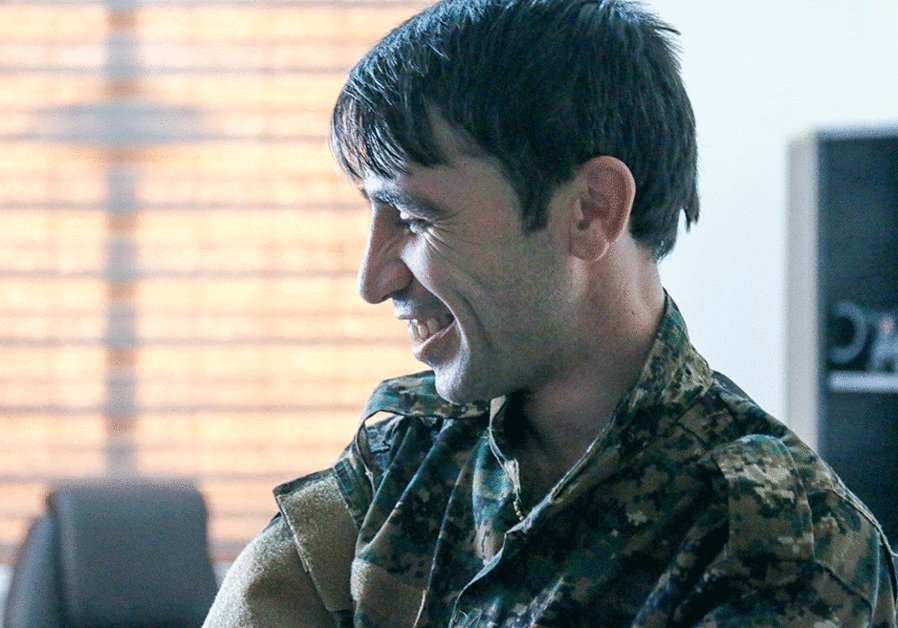
According to Havel Ronnie, even if the terror group loses its territory along the Euphrates, it will still pose a threat.
“Many of these [villagers] here [in Deir-ez-Zor] lived under ISIS a long time and it is hard to know what is in their mind,” the commander states, adding, “you have to remember ISIS is not like other groups – it is an ideology – it is Islamic fascism – and that cannot be defeated on the battlefield alone.”
President Trump has also called for the withdrawal of all US troops in Syria, something his Defense Secretary, James Mattis, citied as a key reason for his resignation from the administration.
As of now, though, the SDF has seen no departure by the Americans.
“At the moment nothing has changed – we are still receiving support from the coalition – including American air strikes,” Qamishlo reports.
“However, Trump’s announcement has created a lot of confusion, not just with us, but also with other coalition members, as we are not sure [yet] when, how or if, the Americans are going to leave.”
If the 2,000 so Americans stationed in Syria do leave it would have serious implications for finding the remaining ISIS fighters and their supporters inside of Syria.
According to Qamishlo, “ISIS has not been defeated, and I think the Pentagon with all their military, air and intelligence resources know this. [And] even if ISIS looses its territory they [ISIS] still have sleeper cells that can [continue to] attack…so vigilance is still needed.”
Indeed, the SDF believes that dealing with both ISIS fighters still on the battlefield and their supporters is a generational battle.
“This battle will continue for years if not decades,” Havel Ronnie, the alliance’s senior military commander opines. And even if it is defeated here [in Hajin], it is not the end. ISIS is an ideology and can recruit more supporters.”
Source: Iran’s Khamenei: Palestinians will soon establish government in Tel Aviv | The Times of Israel
Hosting incoming head of Islamic Jihad in Tehran, supreme leader predicts ‘ultimate victory in the near future’
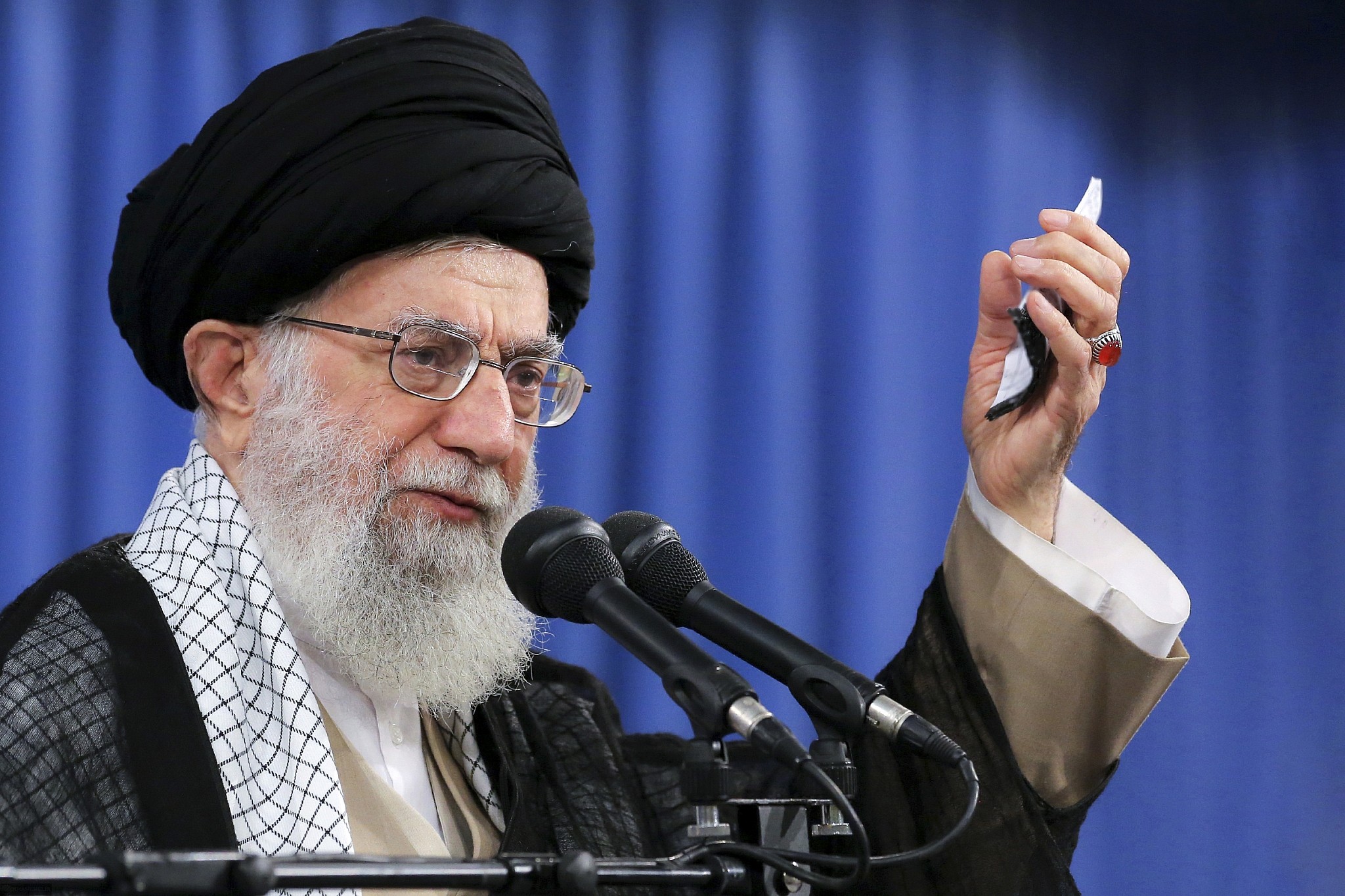
Iran’s Ayatollah Ali Khameini predicted on Monday that the Palestinians would soon be able to “establish a government in Tel Aviv.”
Hosting the head of the Palestinian Islamic Jihad in Tehran, the Iranian supreme leader also hailed the Palestinian “resistance” against Israel, arguing that the most recent exchange of violence between Israel and terrorists groups in Gaza, which ended with a ceasefire, heralded Israel’s imminent demise.
“Palestine will strongly persist, and by the grace of God, the Palestinian nation’s ultimate victory will come true in the near future,” the ayatollah told Ziad al-Nakhala, who became PIJ’s leader in October.
“As for the recent years, the victory of the Palestinian people has not meant being able to establish a government in Tel Aviv;— of course that will come true by God’s help,” Khameini added, according to a readout of the meeting posted on his official website.
“However, the main victory has been the fact that the Zionist regime — which Arab armies failed to defeat — was brought to its knees by the Palestinian people and the resistance; and by God’s will, you will achieve greater victories.”
Khameini chose to refer to Tel Aviv, when the seat of Israel’s government is Jerusalem. Many in the international community refuse to recognize the city as Israel’s capital, but expect it to become the shared capital of Israel and a future Palestinian state.
The Palestinian Authority has never expressed interest in establishing a government in Tel Aviv, which it acknowledges will remain part of the State of Israel. However, Iran and radical Palestinian groups, including PIJ and Hamas, refuse to recognize Israel in any borders, vowing to “liberate” all of historical Palestine.
Speaking to al-Nakhala, Khamenei hailed the “victories of Palestinian resistance groups” against Israel, citing the decreasing number of days of fighting compared to previous military confrontations as a harbinger of the Palestinians’ ultimate victory.
“During the two last wars against the Resistance groups, the Zionist regime begged for ceasefire after 22 days in one case and after 8 days in another instance; in the most recent conflict, the Zionist regime asked for ceasefire after only 48 hours,” he said. “This means the Zionist Regime has been brought to its knees.”
 Khamenei.ir@khamenei_ir
The Palestinian nation’s victory didn’t mean establishing a government in Tel Aviv—of course that will happen, too. The main victory was the fact that Palestinian people and resistance groups defeated the Zionist regime, which Arab armies failed to defeat.
Khamenei.ir@khamenei_irThe Zionist regime—which begged for ceasefire after 22 days in one case and after 8 days in another case of war against resistance groups— was brought to its knees in recent attacks and asked for truce after only 48 hours: this means defeating usurper Zionist regime.
These important events were “divine blessings,” he went on, positing that the reason for the Palestinians’ “consecutive victories in recent years lies in resistance.”
He added: “Thus, in the future, as far as the resistance exists, the decline of the Zionist Regime will continue.”
On November 13, after 460 rockets and mortar shells were fired at southern Israel over the course of 25 hours, the Israeli government agreed to an informal Egyptian-brokered ceasefire with Hamas. It was the worst flareup since the 2014 war, which also ended with an ceasefire.
Al Nakhala, who is based in Syria and is said to be close to Iran and its Lebanese proxy Hezbollah, told Khameini that the “people of Gaza are standing up to the Zionist Regime and the so-called Deal of the Century plot,” according to the readout.
“Today, the abilities and power of the Islamic resistance in Palestine is stronger than ever, hence if war breaks out, Tel Aviv and all other cities and settlements of the Zionist regime will be within the reach of thousands of missiles of the Resistance,” he threatened.
Nakhala, who was born in Gaza in 1953, in late September was named PIJ’s first new leader in 20 years.
The group is considered a terrorist organization by the United States and the European Union, and the US labeled Nakhala himself a “global terrorist” in 2014.
It opposes the peace agreements signed between Israel and the internationally recognized Palestinian leadership.
Agencies contributed to this report.
Issam Akel, a resident of East Jerusalem, holds a blue Israeli national identification card; US ambassador has called for his release
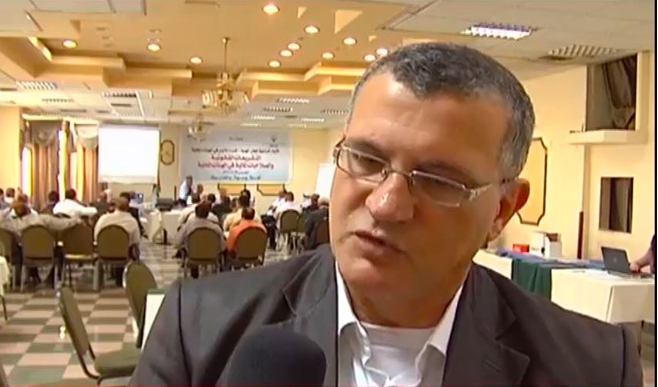
A Palestinian Authority court in Ramallah on Monday sentenced Issam Akel, a Palestinian American and a resident of East Jerusalem, to life in prison for attempting to sell land to Jewish Israelis in Jerusalem, an official in the PA judiciary’s media office said.
Akel “was sentenced on Monday, but he can appeal the ruling,” the official, who asked to remain unnamed, told The Times of Israel.
A report on the PA judiciary’s website said an individual with the same initials as Akel was sentenced to life in prison for attempting “to annex part of the Palestinians’ lands to an alien state.”
The official confirmed that the report on the PA judiciary’s website was referring to Akel.
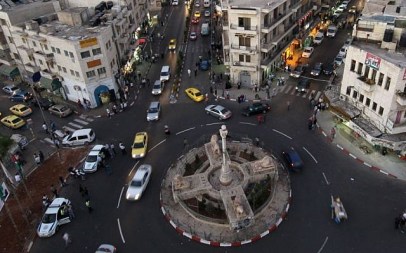
Akel, a resident of Jerusalem’s Beit Hanina neighborhood, is a holder of a blue Israeli identification card. Since October, he has been in the PA’s custody.
The PA rarely arrests and carries out judicial proceedings against residents of Jerusalem who hold Israeli ID cards.
Asked about Akel’s sentencing, a US official said the American government had knowledge of reports about it.
“We are aware of reports that a US citizen has been sentenced by a Palestinian court. When a US citizen is incarcerated abroad, the US government works to provide all appropriate consular assistance,” the official said in a statement.
Palestinian law considers attempting to sell or selling land to Israeli Jews a punishable offense.
According to the law, possible punishments for trying to sell or selling land to Jewish Israelis include various degrees of hard labor and imprisonment as well as execution.
However, the law requires that PA President Mahmoud Abbas approve any death sentence, and he has not signed off on any executions since 2006.

Akel’s father, Jalal, denied in late November that his son had sold land to Israeli Jews.
“There is no evidence my son sold anything to Israelis, all charges are void,” Jalal told Reuters at the time.
Jalal did not answer phone calls Monday afternoon.
In November, US Ambassador to Israel David Friedman called on Ramallah to release Akel.
“The Pal Authority has been holding US citizen Isaam Akel in prison for ~2 months,” Friedman tweeted on November 28. “His suspected ‘crime’? Selling land to a Jew. Akel’s incarceration is antithetical to the values of the US & to all who advocate the cause of peaceful coexistence. We demand his immediate release.”
Following Akel’s arrest, security coordination between Israel and the PA in parts of the West Bank adjacent to Jerusalem was halted, the Kan public broadcaster reported last Thursday.
Security coordination allows for the PA to operate in villages adjacent to Jerusalem, where it does not have a permanent security presence.
Raphael Ahren contributed to this report.
Source: Assad authorizes Iraqi forces to strike Islamic State in Syria – Israel Hayom
Syrian leader’s announcement highlights close ties between Syria and Iraq, both allies of Iran • Iraqi PM Abdul-Mahdi writes to Assad, calling for coordination in “fighting terrorism” • Iran, Syria sign long-term strategic and economic cooperation deal.
|
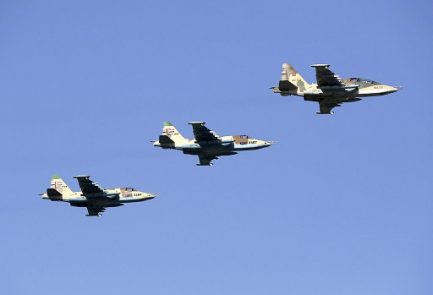
Iraqi Air Force jets take part in a military show in Baghdad, 2016
| Photo: AP
|
Syrian President Bashar Assad on Sunday authorized Iraqi forces to attack the Islamic State group inside Syria without waiting for permission from Damascus, state news agency SANA reported.
The announcement, which comes as the region prepares for the planned U.S. withdrawal from Syria, highlights the close relations between the two neighboring Arab countries, both of which are allied with Iran. The Islamic State group once controlled large parts of both countries and declared a caliphate there in 2014.
Iraqi warplanes and artillery have in the past pounded Islamic State positions inside Syria after receiving permission from Syrian authorities.
The extremists have been defeated in Iraq but still hold a small area in eastern Syria close to the Iraqi border.
On Saturday, Assad received a letter from Iraqi Prime Minister Adil Abdul-Mahdi calling for coordination between the two countries in “fighting terrorism.”
Earlier this month, U.S. President Donald Trump made a surprise announcement that the U.S. will withdraw all its 2,000 troops from Syria. The U.S.-backed Kurdish-led Syrian Democratic Forces have expressed concerns that the U.S. pullout could lead to the revival of Islamic State, saying that the extremists have not been defeated yet in Syria.
Meanwhile, as the war in Syria begins to wind down, Iran and Syria signed a long-term strategic and economic agreement in Tehran on Sunday.
Iran and Russia have been the main backers of Assad’s government since the civil war there began nearly eight years ago, and together with some Arab countries, including the oil-rich United Arab Emirates, have helped the Assad regime regain control of large parts of the country.
SANA news agency quoted Syrian Economy and Foreign Trade Minister Mohammed Samer al-Khalil, who signed the agreement, as saying that the deal includes “full cooperation on the financial and banking levels.” He said this would allow Iranian companies to be present through investments in Syria.
The Syrian government estimates that reconstruction of the war-torn country will cost some $200 billion and take 15 years.
Al-Khalil said that “priority in the reconstruction of Syria will be given to Iranian public and private companies,” according to SANA.
SANA also reported that a technical delegation from the UAE visited Damascus International Airport to evaluate it in preparation for the resumption of flights between the UAE and Syria.
Source: ’We had an opportunity to assassinate Assad,’ top Israeli official reveals – Israel Hayom
Saudi media quotes an unnamed Israeli official as saying cabinet opted against toppling President Bashar Asaad’s regime as it prefers dealing with a known adversary • Still, “Assad’s regime as we know it will come to an end,” the official predicts.
|
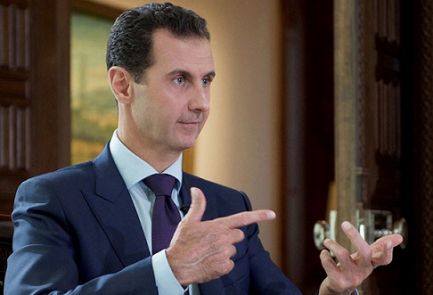
Syrian President Bashar Assad
| Photo: Reuters
|
Israel has targeted dozens of Iranian and Hezbollah assets in Syria during the seven-year civil war there but has intentionally refrained from any action that could seriously undermine Syrian President Bashar Assad’s regime, including targeting him directly, Saudi media reported on Sunday.
Saudi daily Elaph quoted an unnamed senior Israeli official as saying that the government had rejected recommendations by Military Intelligence to topple the Syrian regime, potentially by assassinating Assad, because it preferred dealing with a known adversary – someone it could use back channels to communicate with if need be.
The report further said that then-Director of Military Intelligence Maj. Gen. Aviv Kochavi, who is slated to assume the position of IDF chief of staff in mid-January, was in favor of toppling Assad’s regime over its support of Lebanon’s Hezbollah, an Iranian-backed Shiite terrorist group.
According to the report, the “prolong conflict in Syria saw Israel often hold negotiations with the regime in Damascus in order to reach an agreement in Syria.”
The Israeli official was also quoted as confirming that the Diplomatic-Security Cabinet “held extensive discussions on the situation in Syria and decided that Israel would not allow an Iranian military presence there. Since then, Israel has invested considerable efforts in preventing Iran and Hezbollah from establishing themselves in Syria, while making sure it [Israel] inflicts minimal damage to the Damascus regime.”
The senior Israeli official refused to comment on the decision by some Arab states, such as Bahrain and the United Arab Emirates, to reopen their embassies in Damascus, saying only that the rapprochement between Arab states and Syria was ”less dangerous for Israel because these Arab states also want to see Iran out of Syria.”
According to the report, the Israeli official said he believes that “Assad’s regime as we know it will come to an end,” adding that Israel and Russia both see Iranian presence in the war-torn country as ”highly problematic.”
Moscow seeks to be the only dominant force in the region, the Israeli source was quoted as saying.




 anneinpt
 artaxes
 danmillerinpanama
 davidking1530
 Peter Hofman
 Joseph Wouk
 Peter
Peter Louisiana Steve

 WarSclerotic
Recent Comments