Accordingly, Nearat concluded that Washington will be outraged by Iraq’s maneuvering, however, he does not believe that the US retains enough leverage to alter Baghdad’s course.
BY DIMA ABUMARIA/ THE MEDIA LINE
NOVEMBER 22, 2018 04:26
Iranian rials, U.S. dollars and Iraqi dinars at a currency exchange shop in Basra, Iraq, November 3, 2018. Picture taken November 3, 2018.. (photo credit: REUTERS/ESSAM AL-SUDANI)
The Iraqi government is refusing to comply with a second round of United States economic sanctions targeting Iran’s crucial energy, shipping and banking sectors. “The decision isn’t international, Iraqi, or part of a United Nations resolution—it’s an American one,” Iraq’s Prime Minister Adel Abdul Mahdi explained in reference to Baghdad’s position to not “respect” the financial penalties. He added that Iraq “does not accept dictates” and is not obligated to fall in line with US foreign policy or any “aggression” against another country.
The announcement comes after Iraqi President Barham Salih over the weekend visited Tehran, where he discussed with his counterpart Hassan Rouhani ways to enhance bilateral ties as well as the potential establishment of free trade zones along the shared border. The trip raised eyebrows in Washington, which fears growing Iranian influence over Baghdad could offset a fifteen-year military and diplomatic effort to rebuild Iraq in its image.
“Tehran is a key player in Iraq in terms of ideology,” Raed Nearat, a Professor of International Relations at al-Najah University in the West Bank city of Nablus, conveyed to The Media Line. “In recent days the Iraqi-Iranian coziness is obvious, which explains the public shift in rhetoric and now policies.”
Moreover, he elaborated, US President Donald Trump has upended his predecessor Barack Obama’s courtship of the Islamic Republic, which has caused confusion Baghdad. In this respect, the Trump administration in May nixed the 2015 nuclear deal and subsequently ratcheted up the pressure by nurturing a coalition of Sunni Arab nations, in addition to Israel, whose aim is to roll back Iran’s expansionism and prevent its nuclearization.
Accordingly, Nearat concluded that Washington will be outraged by Iraq’s maneuvering, however, he does not believe that the US retains enough leverage to alter Baghdad’s course.
Indeed, the White House is walking a tightrope, having previously granted Iraq a 45-day waiver to wean itself off of Iranian energy products. Presently, the US has thousands of troops in Iraq that recently played an instrumental role in liberating major cities from the Islamic State terror group. The situation on the ground is complicated by the existence of Shiite fighting groups loyal to Tehran that likewise took part in the battle. Some of these forces have since been incorporated into the Iraqi national army, thus providing Iran with leverage over security issues.
“Iran is a malicious neighbor,” asserted Taybeh, an Iraqi commentator who spoke to The Media Line on condition of anonymity. “Our political arena is extremely unstable because of the external interference experienced every time when forming a government.” This, in turn, has left the country “vulnerable to Iran’s power, which in many cases goes against the will of the people.
“Let’s not forget how angry the Iranian reaction was when Baghdad showed acceptance of the American sanctions at the beginning,” Taybeh noted.
Iraq imports gas from Iran as part of the country’s plan to secure fuel for power plants, in addition to a wide range of goods that includes food, agricultural products, household appliances, air conditioners and auto parts. The volume of trade exchange between the two countries reached $12 billion in 2017.
It would be viewed as a major geopolitical defeat for the US if Baghdad were to be pulled deeper into the Islamic Republic’s orbit.
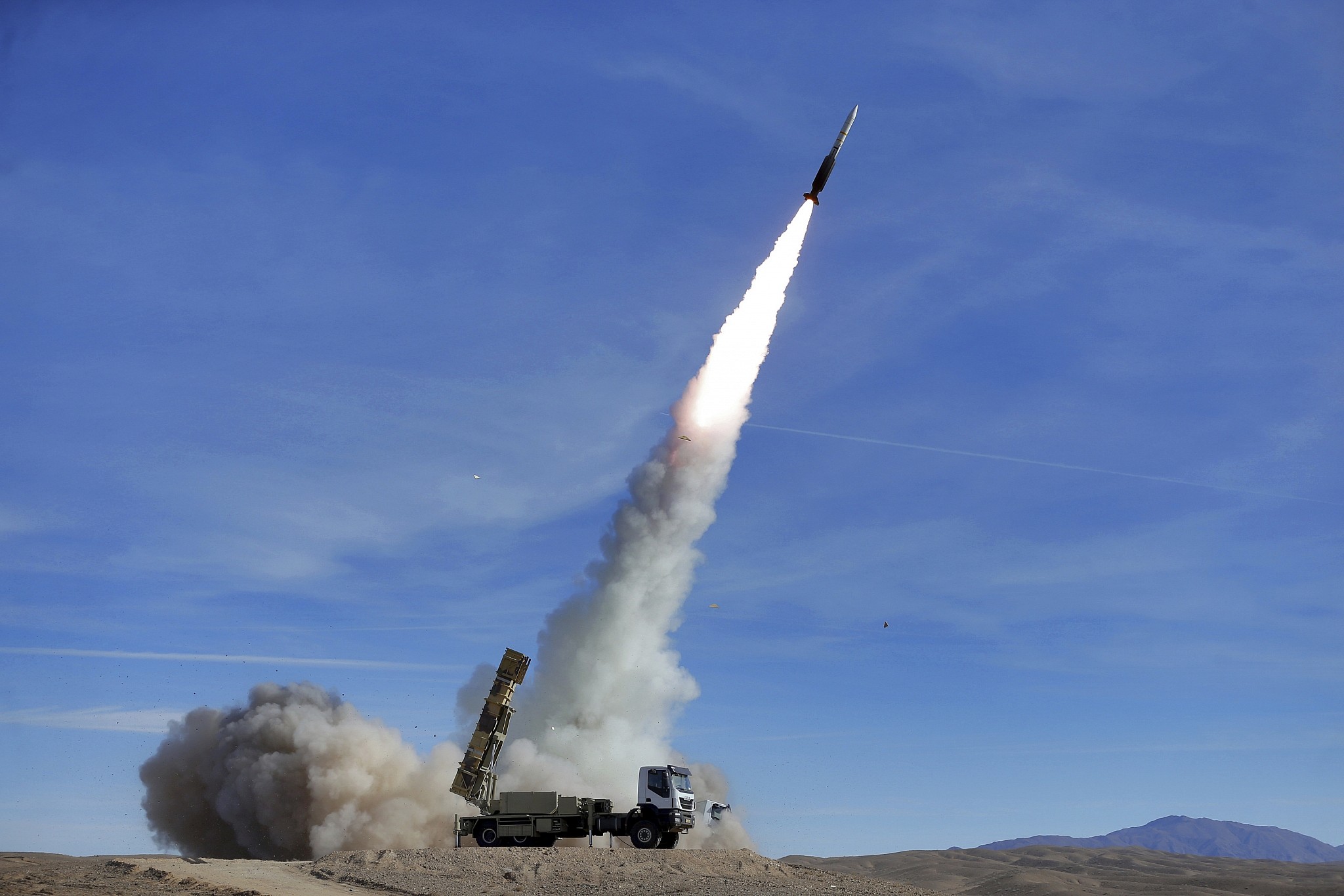
In this photo provided Monday, Nov. 5, 2018, by the Iranian Army, a Sayyad 2 missile is fired by the Talash air defense system during drills in an undisclosed location in Iran. (Iranian Army/ AP)
A top Iranian general claimed US military personnel and assets in the Middle East were within range of his country’s missiles Wednesday, amid ongoing tensions between Tehran and Washington.
Amirali Hajizadeh, the head of the air division for the hard-line Islamic Revolutionary Guards Corps, said improvements to Iran’s missile arsenal had put US bases in Qatar, the UAE and Afghanistan within reach, as well as US aircraft carriers stationed in the Persian Gulf, according to Iran’s Tasnim news agency.
“They are within our reach and we can hit them if the [Americans] make a move,” he said, according to a translation of his remarks carried by Reuters.
Hajizadeh said the missiles had been outfitted with improved precision capabilities, making it possible to hit targets over 500 kilometers away to within 30 meters accuracy.
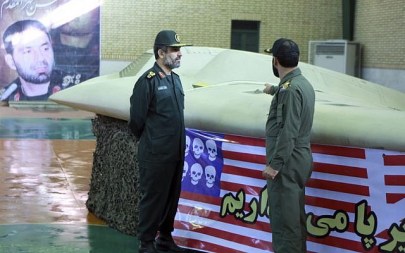
Chief of the aerospace division of Iran’s Revolutionary Guards Amir Ali Hajizadeh (left), near a captured US RQ-170 Sentinel drone in April 2012. (photo credit: AP/Sepahnews)
The threat came a day after US President Donald Trump used tensions with Iran to justify his decision to not punish Saudi Arabia over the death of writer Jamal Khashoggi.
“Iran states openly, and with great force, ‘Death to America!’ and ‘Death to Israel!’ Iran is considered ‘the world’s leading sponsor of terror,’” he wrote in a statement that drew ire from allies and Tehran alike. ” The United States intends to remain a steadfast partner of Saudi Arabia to ensure the interests of our country, Israel and all other partners in the region. It is our paramount goal to fully eliminate the threat of terrorism throughout the world!”
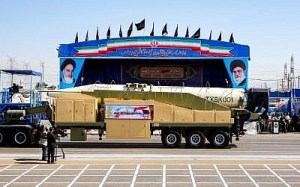
This picture taken on September 22, 2018 shows the long-range Iranian missile “Khoramshahr” being shown during the annual military parade marking the anniversary of the outbreak of the devastating 1980-1988 war with Saddam Hussein’s Iraq, in the capital Tehran. (AFP PHOTO / STR)
Trump earlier this year pulled the US out of the 2015 nuclear agreement with Iran, putting sanctions back in place. The US administration had cited a lack of curbs on Iranian missile development as one of the flaws of the agreement.
After punishing sanctions went back into effect on November 5, Iranian President Hassan Rouhani described said the country had entered a “war situation.”
Israel has repeatedly warned of the dangers of Iranian precision missile technology, particularly what is says are attempts by Tehran to supply rockets with pinpoint accuracy to the Hezbollah terror group in Lebanon.
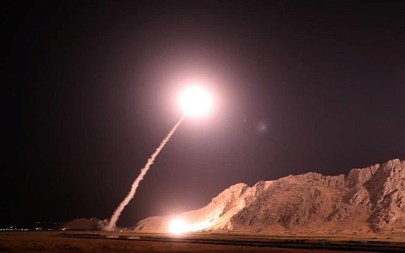
In this photo released on October 1, 2018, by the Iranian Revolutionary Guard Corps, a missile is fired from city of Kermanshah in western Iran targeting the Islamic State group in Syria. (Sepahnews via AP)
In October, Iran fired ground to ground missiles at what it said were Islamic State terrorists in Eastern Syria in retaliation for an attack on a military parade weeks earlier. It said the missile traveled some 570 kilometers (350 miles)
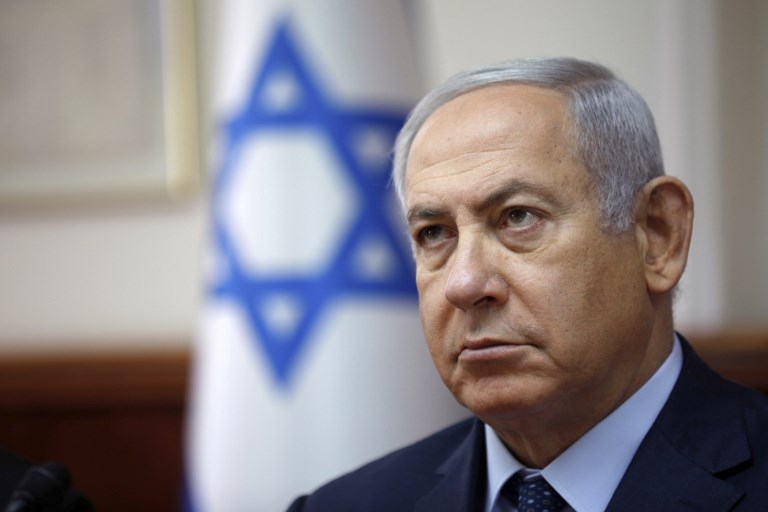
Prime Minister Benjamin Netanyahu attends the weekly cabinet meeting at the Prime Minister’s Office in Jerusalem on October 14, 2018. (Amir COHEN/AFP)
WASHINGTON (JTA) — Saudi Arabia is in hot water because its agents murdered a journalist, but Prime Minister Benjamin Netanyahu is asking the West not to throw away the kingdom’s prince.
It’s a major ask — one that could get Netanyahu and his nation in their own tepid tub.
The problem facing Israel was evident in a piece published Sunday in The Washington Post by Jackson Diehl, a columnist whom Israeli officials have in the past trusted to be fair and sensitive to the country’s concerns.
“Why is Israel tossing a lifeline to Jamal Khashoggi’s killers?” the headline read for an essay that ripped Netanyahu.
“The spectacle of an Israeli leader lobbying to excuse an Arab dictator for murder will only compound the damage he has done to his country’s relationship with the United States,” Diehl wrote.
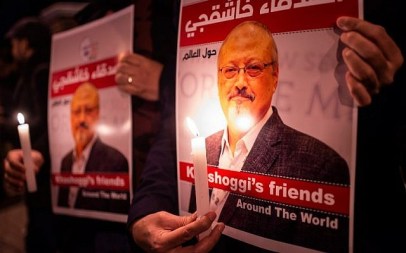
People hold posters picturing Saudi journalist Jamal Khashoggi and lightened candles during a gathering outside the Saudi Arabia consulate in Istanbul, on October 25, 2018. (Yasin Akgul/AFP)
Khashoggi, who was assassinated last month in the Saudi consulate in Istanbul, voiced his dissent with the Saudi regime as a Washington Post columnist. Diehl, like others at the paper, would be more naturally inclined than others to express outrage at any attempt to whitewash the Saudi regime.
But Diehl’s warning was substantive: JTA has learned that Democrats in Congress — the party has just wrested control of the US House of Representatives from the Republicans — are furious with Netanyahu for being among the few leaders to publicly defend the regime as evidence mounts that Khashoggi was killed on orders from above.
“What happened in the Istanbul consulate was horrendous and it should be duly dealt with,” Netanyahu said Nov. 2 at an event in Varna, Bulgaria. “Yet the same time I say it, it is very important for the stability of the world, for the region and for the world, that Saudi Arabia remains stable.”
The question at the heart of the Khashoggi murder is whether the country’s effective ruler, Crown Prince Mohammed bin Salman, directly ordered the hit. The prince has denied it vehemently to US President Donald Trump, who has tended to give bin Salman the benefit of the doubt. Middle East hands wonder how such a sophisticated assassination could have been carried out without bin Salman’s OK.
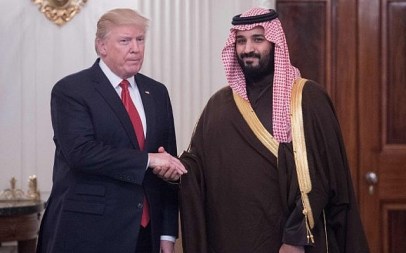
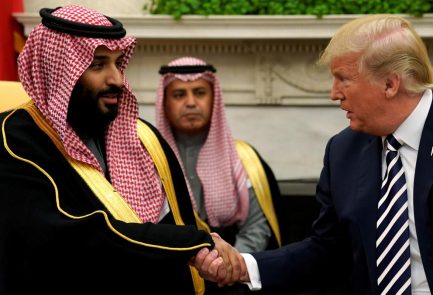
US President Donald Trump and Saudi Deputy Crown Prince, left, and Saudi Defense Minister Mohammed bin Salman, who later that year became Crown Prince of Saudi Arabia, shaking hands in the State Dining Room before lunch at the White House in Washington, DC, March 14, 2017. (NICHOLAS KAMM/AFP)
On Tuesday, The New York Times reported that one of the alleged hitmen instructed a superior to “tell your boss” that the job was done; the “boss” is assumed to be bin Salman.
Netanyahu’s investment in Saudi Arabia goes beyond the country’s stability. He is particularly close to bin Salman, as is Trump.
“I think the administration, when they know all the facts, are going to have to decide how can they on the one hand make clear that this action is unacceptable, but also not throw out the prince with the bathwater, let’s put it that way,” Israeli Ambassador to the US Ron Dermer, perhaps Netanyahu’s closest adviser, said earlier this month at a synagogue event in Houston.
The key to understanding Netanyahu’s positioning is the enemy that Israel and the Saudis share: Iran.
“It’s a tightrope act for Netanyahu right now,” Jonathan Schanzer, the vice president of the Foundation for Defense of Democracies, said in an interview. “For him and for Israel, there is a question of who will fight Iran’s regional aggression other than Israel. The Saudis have assumed that role. They have the eastern flank of the Middle East, Israel has the west.”
Another factor is Netanyahu’s strategy of seeking broader acceptance in the Middle East absent substantive progress in any peace deal with the Palestinians, Schanzer said.
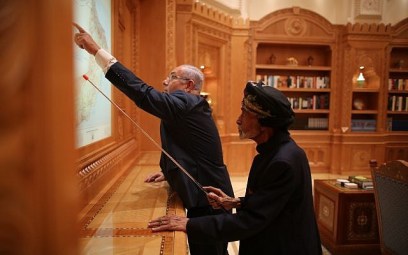
Prime Minister Benjamin Netanyahu (L) talks with Sultan Qaboos bin Said in Oman on October 26, 2018 (Courtesy)
“This is an opportunity for him to publicly come out and not overtly state that there are ties between Israel and the Saudis, but certainly to imply it, and to show the Arab world Israel can be an ally,” he said.
The cost, said Aaron David Miller, a top Middle East negotiator under Republican and Democratic presidents, is to Israel’s reputation.
“The Israelis have to be very careful that they should not become MbS’s lawyer in Washington,” said Miller, using bin Salman’s nickname. Miller is now the vice president of The Woodrow Wilson International Center for Scholars.
While Netanyahu and his predecessors naturally tended toward an interests-based foreign policy, Miller said, “It’s very bad for Israel’s image and credibility to be cavorting with a regime that is killing and murdering its dissenters on the streets of Arab capitals or European capitals.”
The immediate cost may be in how responsive the new Democratic House is to the pro-Israel agenda. In the immediate future, defense assistance will remain untouched, but Democrats would likely be less inclined to back the feel-good declarative statements that are often the bread and butter of pro-Israel lobbyists. That, in the long run, could erode overall support in the party for Israel.
An accelerant to the bad will among Democrats is that Netanyahu appears to be propping up Saudi Arabia as a means of pleasing Trump, who is the bete noir of the party and of liberals more than any other Republican leader.
“They’re looked at as if they’re coming out in support of a Trump ally,” said Schanzer.
U.S. will remain a “steadfast partner of Saudi Arabia to ensure the interests of our country, Israel and all other partners in the region,” Trump says • He declares he will not further punish Saudi Arabia for the murder of journalist Jamal Khashoggi.
Eli Leon, News Agencies and Israel Hayom Staff
U.S. President Donald Trump with Saudi Crown Prince Mohammed bin Salman at the White House, March 20
|Photo: Reuters
U.S. President Donald Trump declared Tuesday he would not further punish Saudi Arabia for the murder of columnist Jamal Khashoggi – making clear in an exclamation-filled statement that the benefits of good relations with the kingdom outweigh the possibility that its crown prince ordered the killing.
“The United States intends to remain a steadfast partner of Saudi Arabia to ensure the interests of our country, Israel and all other partners in the region,” Trump said in the statement.
The U.S. needs a “counterbalance” to Iran, “and Israel needs help, too,” Trump said. “If we abandon Saudi Arabia, it would be a terrible mistake.”
Khashoggi, a Saudi columnist for The Washington Post who had criticized the royal family, was murdered inside the Saudi consulate in Istanbul on Oct. 2.
The president condemned the murder of as a “horrible crime … that our country does not condone.”
But he rejected calls by many in Congress, including members of his own party, for a tougher response, and also dismissed reports from U.S. intelligence agencies that Saudi Crown Prince Mohammed bin Salman must have at least known about such an audacious and intricate plot.
“It could very well be that the crown prince had knowledge of this tragic event,” the president said. “Maybe he did and maybe he didn’t.”
In many ways, the statement captured Trump’s view of the world and foreign policy, grounded in economic necessity. It began with the words “America first!” followed by “The world is a very dangerous place!”
It came after weeks of debate over whether Trump would or should come down hard on the Saudis and the crown prince in response to the killing.
The U.S. sanctioned 17 Saudi officials suspected of being responsible for or complicit in the killing, but members of Congress have called for harsher actions, including canceling arms sales.
Trump said “foolishly canceling these contracts,” which are worth billions of dollars, would benefit only Russia and China, which would be next in line to supply the weapons. Critics denounced Trump’s statement, saying he was ignoring human rights and granting Saudi Arabia a pass for economic reasons.
Representative Eliot Engel, who has the power to block arms deals as the top Democrat on the House Foreign Affairs Committee, said Washington should use its ability to sell weapons to the Saudis as leverage to influence Riyadh’s behavior.
“The reality is that the Saudis couldn’t simply buy their weapons somewhere else,” Engel said in a statement. “It would take years for the Saudi military to re-equip with Russian or Chinese weapons.”
When Trump mentions the $110 billion package with Saudi Arabia reached last year, he often adds that “it’s 500,000 jobs.”
But arms manufacturer Lockheed Martin predicts the deal could create nearly 10,000 jobs in Saudi Arabia, while keeping up to 18,000 existing U.S. workers busy if the whole package comes together – an outcome that industry experts say is unlikely.
Asked by a reporter if he was saying that human rights are too expensive to fight for, Trump responded, “No, I’m not saying that at all.”
But then he switched the subject to the “terrorist nation” of Iran rather than any actions by Saudi Arabia.
The mistake was Trump’s, said Republican Sen. Rand Paul of Kentucky, contending the administration has “blinders on” in comparing Iran and Saudi Arabia.
“It’s a sign of weakness not to stand up to Saudi Arabia,” Paul said in an interview. “Sometimes when you have two evils, maybe you don’t support either side.”
South Carolina Republican Sen. Lindsey Graham, who is close to Trump, also disagreed with the president’s statement, saying America must not lose its “moral voice” on the international stage.
“It is not in our national security interests to look the other way when it comes to the brutal murder of Mr. Jamal Khashoggi,” Graham said.
Likewise, Rep. Adam Schiff, ranking Democrat on the House intelligence committee, said that to suggest that U.S. silence can be bought with arms sales “undermines respect for the office of the presidency, the credibility of our intelligence community and America’s standing as a champion of human rights.”
Trump’s statement, issued just before he issued the traditional pardon of the Thanksgiving turkey at the White House and left for the long holiday weekend in Florida, underscored his world view of putting U.S. interests – both financial and geopolitical – above all else.
He told reporters on the South Lawn that oil prices would “skyrocket” if the U.S. broke with the Saudis, and he was not going to “destroy” the world’s economy by being “foolish with Saudi Arabia.”
Asked about any personal financial involvement, he said, “Saudi Arabia has nothing to do with me. What does have to do with me is putting America first.”
Trump said that King Salman and Crown Prince Mohammed both “vigorously deny” any knowledge of the planning or execution of the killing. He also said the CIA has not made a conclusive determination about whether the crown prince ordered it.
A U.S. official familiar with the case told The Associated Press last week that intelligence officials had concluded that the crown prince, the kingdom’s de facto leader, did order the killing. Others familiar with the case, however, have cautioned that while it is likely the crown prince had a role, there continue to be questions about the degree.
“We may never know all of the facts surrounding the murder of Mr. Jamal Khashoggi,” Trump said. “In any case, our relationship is with the Kingdom of Saudi Arabia. They have been a great ally in our very important fight against Iran.”
Saudi prosecutors say a 15-man team sent to Istanbul exceeded its authority when the lead negotiator in the team decided to kill Khashoggi for refusing orders to return. The Saudis say the agents dismembered his body, which has not been found.
Democrats on Capitol Hill called on the CIA and other top intelligence agencies to publicly report what they have learned about the killing.
The CIA had no comment on the president’s statement.
However, former director John Brennan, a frequent Trump critic, tweeted: “Since Mr. Trump excels in dishonesty, it is now up to members of Congress to obtain and declassify the CIA findings on Jamal Khashoggi’s death. No one in Saudi Arabia – most especially the crown prince – should escape accountability for such a heinous act.”
Trump said he knew some members of Congress would disagree with his decision. He said he would listen to their ideas, but only if they were focused on U.S. national security.
Late last week, a bipartisan group of senators introduced legislation that calls for suspending weapons sales to Saudi Arabia, for sanctions on people who block humanitarian access in Yemen or support the Houthi rebels, and mandatory sanctions on those responsible for Khashoggi’s death.
Democrats harshly criticized Trump’s decision Tuesday and called on Congress to cut off arm sales to Saudi Arabia and end support for Saudi Arabia’s war against the Iran-backed Houthi rebels in neighboring Yemen, which is facing a humanitarian crisis.
“Standing with Saudi Arabia is not ‘America First!'” said Democratic Sen. Tim Kaine of Virginia, where Khashoggi lived.
“President Trump has sided with a murderous regime over patriotic American intelligence officials.”
Democrat Dianne Feinstein of California, a member of the Senate intelligence committee, said Khashoggi was killed by agents of the Saudi government in a “premeditated murder, plain and simple.” She said she would introduce legislation requiring intelligence agencies to release an unclassified public assessment.
Secretary of State Mike Pompeo defended Trump’s decision, saying, “We are determined to ensure that we continue to make sure that we take care of the American people in all of the strategic decisions we make about with whom we work with around the world.”
The president opened his eight-paragraph statement chastising Iran for its proxy war against Saudi Arabia in Yemen, its activities in Iraq, its backing of the Syrian government of Bashar Assad and its support of terrorist groups, which Riyadh has pledged billions to fight.
Turkish Foreign Minister Mevlut Cavusoglu said in Washington on Tuesday that Turkey was not entirely satisfied with the level of cooperation it was receiving from the Saudis on Khashoggi’s murder and may seek a formal United Nations inquiry.
On Twitter, Iranian Foreign Minister Mohammad Javad Zarif wrote, “Mr. Trump bizarrely devotes the first paragraph of his shameful statement on Saudi atrocities to accuse Iran of every sort of malfeasance he can think of.”
Iranian forces are in Syria to carry out their own long-term regional hegemonic program and subvert the authority of the state, says U.S. envoy for Syrian conflict James Jeffrey • Syrian refugees must return to Syria to ensure regional security, he says.
Ariel Kahana
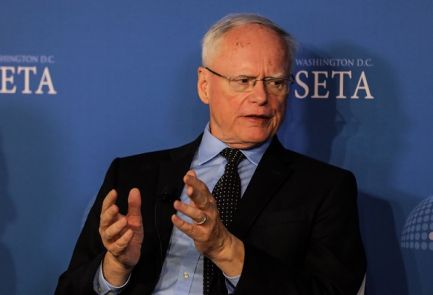
U.S. Special Representative for Syrian Engagement Ambassador James Jeffrey
|Photo: Anadolu Agency
Iranian forces are in Syria not just to support the regime of Syrian President Bashar Assad, “but to carry out their own long-term regional hegemonial program and to in some respects subvert the authority of the Syrian state just like they have done in Lebanon, just like they have done in Yemen, just like they’ve attempted to do in Iraq,” U.S. Special Representative for Syrian Engagement James Jeffrey said on Tuesday.
In a teleconference briefing with reporters from across the Middle East, Jeffrey mentioned U.N. Security Council Resolution 2254, which “lays out a political process forward that would allow half the Syrian population, 12 million people, to return to their homes, because these people have either fled abroad or they fled to other areas of Syria. That is critical to bringing this conflict to an end. It is critical to preserving security in the region.”
Jeffrey’s remarks are consistent with growing reports of extensive Iranian efforts to turn Syria, ruled by Alawite Assad and largely Sunni Muslim, into a Shiite-majority country. Last week, Iran announced it was opening another university in Syria, which was set to join the list of schools it already operates in the country.
Jeffrey said that although many in the international community believe the war in Syria has come to an end, a flare-up is possible any minute.
He emphasized that Israel-Iran tensions are the most cause for concern, followed by Jordan and Iran.
“For the moment, Jordan’s major concern, as Jordanian officials talk to us, is both Iran’s movement into regions close to Jordan and of course the remnants of terrorist forces along the Jordanian border. Jordan has suffered terribly from terrorist attacks and we are committed to its security,” he said.
“In terms of Israel, it is even more dramatic because of the deployment of long-range Iranian weapon systems into Syria and they are used over Israeli territory twice in this past year and the Israeli response to that that led to the set of events culminating in the shoot down of a Russian plane by Syrian missiles and this is the kind of perhaps accidental, perhaps deliberate escalation that we are working night and day to prevent by trying to again de-escalate the conflict and revitalize the political process.”
Meanwhile, the European Union is said to be weighing sanctions on Iran over foiled attacks Tehran planned to carry out in Denmark and France after representatives from both Copenhagen and Paris briefed EU ministers on their findings.
According to the European Council’s website, EU foreign ministers on Tuesday “expressed their full solidarity to those member states which witnessed unacceptable behavior from Iranian actors on European soil, and affirmed their readiness to consider a targeted appropriate response.”
Denmark recalled its ambassador to Iran in late October after it accused Tehran of plotting to kill three Iranian dissidents living in the Scandinavian country.
A Norwegian citizen of Iranian descent was arrested Oct. 21 on suspicion of helping an unspecified Iranian intelligence service “to act in Denmark” and of alleged involvement in the assassination plot, Danish Security and Intelligence Service Director Finn Borch Andersen said.
Earlier that month, French authorities on Tuesday froze the assets of the internal security section of Iran’s Intelligence Ministry as well as those of two Iranians, and all but pointed a finger at Tehran as the force behind an alleged plot to bomb an Iranian exile group’s rally near Paris in June.
Although Israel took part in drafting global immigration treaty, PM Netanyahu says Israel will not sign pact that grants labor migrants the same legal status as refugees • “We’re committed to protecting our borders from illegal infiltrators,” he says.
Akiva Bigman
Prime Minister Benjamin Netanyahu
|Photo: AP
Prime Minister Benjamin Netanyahu on Tuesday announced that Israel will not join a global immigration pact that grants labor migrants the same legal status as refugees.
“I have instructed the Foreign Ministry to announce that Israel will not join and will not sign the immigration treaty,” Netanyahu said. “We are committed to protecting our borders from illegal infiltrators. That is what we have done and what we will continue to do.”
Netanyahu made the decision after Deputy Foreign Minister Tzipi Hotovely brought the issue to his attention.
Under the recently negotiated Global Compact for Safe, Orderly and Regular Migration, U.N. member states tentatively agreed to cement the rights of refugees under the U.N. Charter. The document is set to be officially adopted in December at an intergovernmental conference in Morocco.
According to the Foreign Ministry website, Israeli officials took part in the formulation of the draft, participated in meetings of the forum that compiled it and presented the forum with relevant materials.
Unlike other agreements and conventions, the agreement will grant labor migrants as well as “climate migrants” the same legal status under international law as asylum seekers and refugees who flee tyrannical regimes. This would essentially make all migrants, legal or not, eligible for economic benefits.
The pact strives to “develop national short-, medium- and long-term policy goals regarding the inclusion of migrants in societies, including on labor market integration, family reunification, education, non-discrimination and health, including by fostering partnerships with relevant stakeholders” and to “provide newly arrived migrants with targeted, gender-responsive, child-sensitive, accessible and comprehensive information and legal guidance on their rights and obligations, including on compliance with national and local laws, obtaining of work and resident permits, status adjustments, registration with authorities, access to justice to file complaints about rights violations, as well as access to basic services.”
If adopted, the compact would not be legally binding, but its ambiguous wording could result in some parts of it being incorporated into international law, particularly if it is adopted by an overwhelming majority of member states.
It also uses phrases such as “we commit” and “collective commitment.”
For this reason, the United States, Australia, Austria and Hungary have refused to be parties to the compact. The Czech Republic, Poland and Croatia have also indicated they will not join it, while in Canada and Germany there have been campaigns against its adoption.
Last Friday, while most pundits in Israel were placing their bets in favor or against early elections, a revolution took place at the U.N. General Assembly in New York. During the annual vote on a resolution calling on Israel to return the Golan Heights to Syria, the United States, for the first time ever, voted against it.
Outgoing U.S. Ambassador Nikki Haley’s reasoning for the vote showed that there is no denying that the Americans have taken a significant step toward adopting the Israeli position. The U.S. will no longer abstain when the U.N. engages in pointless votes on the Golan Heights, Haley said. This stance obligates Israel to help the Americans take the next steps on this path, until Israeli sovereignty in the Golan Heights is formally recognized.
From Israel’s perspective, the future of the Golan Heights is a matter of consensus. Ever since the Menachem Begin government first began applying Israeli sovereignty in 1981, it has been a foregone conclusion that the Golan is an inseparable part of Israel. That ensuing leftist governments toyed with the lunatic idea of giving the Golan back to the despotic Assad dynasty only served to solidify the deep understanding of most Israelis that such a withdrawal would be completely illogical.
Israel has every possible reason to object to concessions on the Golan. As a matter of justice (when Syria controlled the area it shelled and beleaguered the residents of the Jordan Valley); history (it is an ancient Jewish region); strategic considerations and even legal ones – all these factors assure Israel’s eternal presence on the Golan.
With that, the welcome change to the U.S. position will have tremendous influence in the international arena. Over the decades, the U.N.’s annual resolution condemning Israel helped reinforce Syria’s image as a “victim” and augmented the libelous discourse painting Israel as an aggressor and occupier. The reality, of course, is the opposite, and the atrocities perpetrated by the warring parties in Syria’s civil war have only illustrated the true nature of those who still wish to wipe the Zionist enemy from the map. It would be wise to exploit the world’s increasingly sober view of Syria and the regime ruling it, and promote recognition of the Israeli annexation of the Golan. Israel will still be fine without this recognition from other countries, but American recognition could officially flip the narrative.
In essence, all the considerations that led the Trump administration to remove the Jerusalem question from the agenda in favor of Israel apply to the Golan as well. There are also other reasons, such as the absence of a large hostile population and the fact that the area is not holy for Muslims or Christians, that make it easier for the U.S. to do so.
To realize the goal, Israel must take steps to promote recognition on the diplomatic and practical levels. On the diplomatic front, Israel should maintain its public relations course and continue forming alliances, which Prime Minister Benjamin Netanyahu is doing successfully. On the practical front, the time is ripe for steps to establish facts on the ground. Application of sovereignty must be visible across the entire Golan Heights, including the Druze villages. To this end, it is necessary to accelerate development and significantly augment the Jewish population in the area.
Ariel Bolstein is the founder of the Israel advocacy organization Faces of Israel.
Public Security Minister Gilad Erdan, a member of the Diplomatic-Security Cabinet, says Israel may have to retake Gaza “until we eliminate terrorist infrastructure” • Minister Yoav Gallant says Hamas military leader Yahya Sinwar is “on borrowed time.”
Israel Hayom Staff
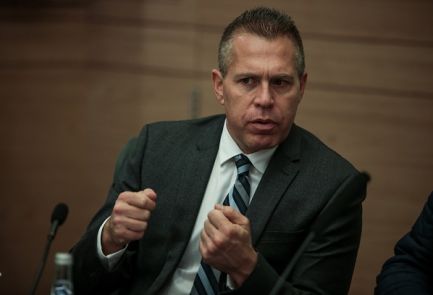
Public Security Minister Gilad Erdan
|Photo: Oren Ben Hakoon
Two Israeli ministers have warned that Israel’s patience with Hamas leaders is wearing thin and that any future Israeli military campaign is likely to include the targeted assassination of terrorist leaders and potentially seizing control of the Gaza Strip.
Public Security Minister Gilad Erdan, a member of the decision-making Diplomatic-Security Cabinet, said Tuesday that “a shift from a defensive to an offensive policy against Hamas means the targeted assassinations of terrorist leaders who are members of Hamas’ military wing.”
He added that Israel is “closer than ever to seizing control of the Gaza Strip.”
“This means taking and maintaining control of Gaza until we eliminate its terrorist infrastructure,” Erdan said. “We’re closer than ever – since the devastating [2005] disengagement – to having no other choice but to take control over parts or all of Gaza.”
Fellow cabinet member Housing and Construction Minister Yoav Gallant told the audience that after the latest round of violence in Gaza, the worst since 2014, Hamas military leader Yahya Sinwar “is at a dramatic crossroads and has to rethink his course.”
“They [Hamas] have to decide whether they want to fight us or preserve the calm,” he said.
Gallant, formerly the IDF’s GOC Southern Command, stressed that “war is the last resort. There will be a [military] campaign in Gaza, but we will be the ones to determine the circumstances and the timing.”
He said that “Sinwar is living on borrowed time. He won’t end his life in a retirement home.”
Heads were scratched in many security circles on Monday, Nov. 20, when IDF Chief of Staff Lt. Gen. Gady Eisenkot was heard to declare that the fact that “Iran and terrorist groups were very far from the place they hoped to attain” was down to “continuous quality operations.”
The IDF would continue to foil their efforts, he said, while keeping one eye on the security situation in the north and keeping to its commitment to protect Israel’s civilians.
Speaking during a tour of the Bashan Division on the Golan, Eisenkot did not specify the place that Iran “hoped to attain” or the place it had reached in consequence of IDF operations.
The general typically calls on this sort of vague, bombastic rhetoric for obscuring shortcomings or blunders. He has been caught using it to misrepresent the balance of strength in the Gaza standoff with Hamas, although some colleagues have urged him to drop it. The trouble with the chief of staff is that, on the one hand, he invites his officers to freely express their opinions, while, on the other, he is deaf to criticism or any opinion that conflicts with his own.
This personality defect has persuaded more and more military officers on active duty and in the reserves to determine in recent months that the IDF is not ready for the next war, especially on the northern front.
Eisenkott has clearly made up his mind that Tehran is planning to deploy a large Iranian military force in Syria on the scale of a division and-a-half which the IDf must be geared to combat. Tehran – i.e. its Mid-East war commander, the Al-Qods chief Gen. Qassem Soleimani (whose remit also includes the Gaza Strip).
But this perception misses the facts. Contrary to Eisenkot’s evaluation, the Iranians never depart from their proxy strategy. Soleimani is accordingly putting together a Syrian army of local, pro-Iranian militias for the conduct of synchronized operations on multiple fronts. This strategy replicates the Shiite militia model which works for Tehran in Lebanon and Iraq. There are no Iranian troops in either country, only surrogate militias, some of them stronger and better armed than the national armies of Iraq and Lebanon. The most notorious example being Hizballah.
Although Hizballah is making good progress in planting those militias in southern Syria, Eisenkot has not ordered the IDF to thwart the project – or even strike their training camps and command centers. Some 2,000 recruits have joined up in the Daraa region, many of them former rebels, who fought with the US and Israeli armies before the Daraa and Quneitra regions (opposite the Jordanian and Israel Golan borders) were captured by the Syrian army with Russian help in June. The Iranian Revolutionary Guards pays each a generous $250 per month, to buy their combat experience and priceless knowledge of IDF methods of operation on Israel’s northern border from years of exposure and personal acquaintance with its commanders.
Soleimani plans to deploy these militias opposite Israel’s Golan lines. It was to this plan which Maj. Gen Yoel Strick, OC of the IDF’s Northern Command referred when he commented on Sunday, Nov. 18, that the Israeli military is well aware of Hizballah’s actions for establishing “a terrorist structure on the Golan” and the Lebanese terrorist group will not be allowed to go through with it. Strick’s words have not so far been backed by deeds.
Gen. Eisenkot displayed his tendency to fudge on serious security issues when he stated that the IDF had hampered Iran’s effort to arm Hizballah with precision-guided rockets. He was backed by Prime Minister Binyamin Netanyahu (who is now also defense minister) who reported a “slowdown in Iranian arms shipments to Syria” to account for the pause in Israeli air strikes in Syria.
However, according to the Western military observers tracking Iran’s steps in Syria and Lebanon, this major upgrade of Hizballah’s surface rocket arsenal is still ongoing undisturbed, after Israel and its air force refrained from interfering. Still, Eisenkot’s missed perspective is shared by some IDF officers.
A new bombshell report based on a secret trove of seized Iranian nuclear documents shows the Islamic Republic had concrete plans to manufacture and build at least five nuclear weapons and that it was much further along in this scheme than previously known by the international community.
Iran’s contested nuclear weapons program was much further along than the international community thought, according to a report based on scores of secret Iranian plans seized by Israel and publicly disclosed for the first time earlier this year.
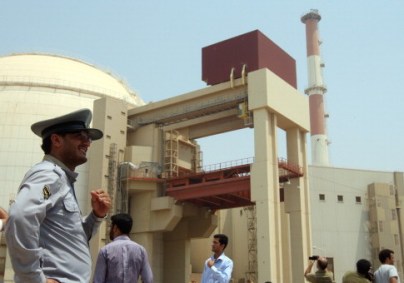
Information obtained in this raid on Iran’s secretive nuclear files has revealed that Tehran was well along the path to building several nuclear weapons by around 2003, including the complex infrastructure needed to produce such weapons, according to a new report from the Institute for Science and International Society, a nuclear watchdog group that has exposed in the past the extent of Iran’s nuclear works.
The report is being viewed as a bombshell revelation on Capitol Hill and is seen as validating critics of the Obama administration who alleged the former White House has underestimated the extent of Iran’s nuclear weapons progress.
“Iran intended to build five nuclear warheads, each with an explosive yield of 10 kilotons and able to be delivered by ballistic missile,” the group disclosed in a new report that shows Iran has retained much of its nuclear infrastructure and could continue using it to clandestinely conduct weapons work in violation of the landmark nuclear accord.
“Iran’s initial plans show that it had achieved much more than feasibility and scientific studies relating to nuclear weapons, as the IAEA assessed in late 2015, as the Iran nuclear deal was being implemented,” according to the group, which based its report on access it was granted to the seized Iranian nuclear documents, which show the regime allocated millions of dollars to the purchase of nuclear materials, including uranium, the key component in a bomb.
“Iran had put in place by the end of 2003 the infrastructure for a comprehensive nuclear weapons program,” according to the report. “The evidence supports that Iran was preparing to conduct an underground test of a nuclear weapon, if necessary. The end goal was to have tested, deliverable nuclear weapons, and Iran made more progress toward that goal than known before the seizure of the archives.”
Iran hawks on Capitol Hill say the report confirms warnings from many that the Obama administration downplayed Iran’s nuclear activities in a bid to ink the nuclear pact with Iran.
“Republicans have long known that the Obama administration lied to the country about the Iran deal,” said one senior Republican congressional official familiar with the report. “Just a few months ago PSI published documents showing they lied to Congress about enforcing sanctions and giving dollar access.”
The latest disclosures are fueling the push in Congress for the Trump administration to reimpose greater economic sanctions on Iran, a portion of which went back into effect earlier this month. Some in Congress have called on the Trump administration to go further in its actions, including by fully cutting off Iran’s oil exports and access to international financial markets.
“Now this report shows they also lied about Iran’s nuclear weapons work,” the source said. “You can expect congressional Republicans to increase pressure on the Trump administration to implement maximum pressure on Iran, which they still aren’t doing.”
Iran was poised to construct at least five nuclear warheads based on its weapons work at the time, according to the new report, which also found that Tehran’s nuclear infrastructure was far more sophisticated than previously believed.
“Iran made far more progress toward its goal of manufacturing five nuclear weapons than known before the seizure of the archives,” according to the watchdog group.
Information about Iran’s nuclear activities, although far less complete, was kept hidden from the public as the Obama administration pressed the international community to support the nuclear agreement.
“It must be acknowledged that at that time, the IAEA and the JCPOA parties, appeared to be downplaying the Iranian nuclear weapons program so as not to stand in the way of starting the implementation of the JCPOA in January 2016,” the report found, noting that international nuclear inspectors have yet to take a stance on the new information.
“Today, the IAEA has in its possession much of the content from the Iranian archive; it should be expected to act on this information, something that is not yet visible, after six months of examining the new information.
This nuclear infrastructure remains intact, further fueling concerns about what Iran has been hiding from nuclear inspectors, who must give Iran advance notice of any inspections and refrain from entering the country’s contested military sites.
“The continued existence of the Iranian nuclear archive and warehouse reinforces that the Iranian nuclear program’s remains, and likely some activities, may have continued up to today,” the group said.







 anneinpt
 artaxes
 danmillerinpanama
 davidking1530
 Peter Hofman
 Joseph Wouk
 Peter
Peter Louisiana Steve
 WarSclerotic
Recent Comments