The Jewish state is on the precipice of major diplomatic breakthroughs across the globe.
BY CHARLES BYBELEZER/THE MEDIA LINE
NOVEMBER 27, 2018 06:33
Miri Regev (C) visits Abu Dhabi’s Sheikh Zayed Grand Mosque, October 29, 2018. (photo credit: Courtesy)
News of the surprise two-years-in-the-making visit to Israel by the president of Muslim-majority Chad broke on the same day that the Czech head of state announced in Jerusalem the intention to move Prague’s embassy to the holy city. This came on the backdrop of reports that the Jewish state is seeking to establish full diplomatic ties with Mali, Niger and even Sudan. Jerusalem is also purportedly eyeing Bahrain and Oman, the latter of which just reiterated that “the Arab states need to come to terms with the reality that Israel is a fact of life in the region.”
For its entire history, the state of Israel has been widely viewed as a pariah, a status quo many proffered would persist for as long as its conflict with the Palestinians—and perhaps thereafter. According to conventional wisdom, it would languish forever in a sort of diplomatic purgatory with only the Americans in its corner.
Yet, a simple glance at the world map reveals a growing landscape dotted with countries clamoring for Israeli expertise in fields ranging from defense and counter-terrorism to agriculture and medicine. It seems that the Jewish state is on the precipice of a major, over-arching and perhaps redefining diplomatic breakthrough.
After seventy years, Israel may be on the verge of joining the so-called “community of nations.”
To this end, Prime Minister Binyamin Netanyahu revealed Sunday that he would soon travel to other Arab countries; this, after his October trip to Muscat which immediately preceded Culture and Sport Minister Miri Regev’s visit to the United Arab Emirates. Intelligence Minister Yisrael Katz this month likewise attended a conference in Oman, while Economy Minister Eli Cohen reportedly received an invitation to visit Manama in early 2019 to participate in a high-tech summit organized by the World Bank.
All of this follows Netanyahu’s alleged secret trip to Cairo in May, which came on the heels of his high-profile public meeting last year with Egyptian President Abdel al-Fattah al-Sisi at the United Nations General Assembly in New York. Despite Jordanian King Abdullah’s oft-harsh rhetoric, Amman maintains close security and economic ties with Israel and recognizes the important role Jerusalem plays in ensuring continued Hashemite rule Jordan.
The evolution of this Sunni Arab-Jewish state alliance undoubtedly has been accelerated by the emergence of Saudi Crown Prince Mohammad bin Salman, who was the first Gulf leader to publicly express support for Israel’s right to exist. Notably, Netanyahu has backed the young Saudi ruler amid a firestorm over the murder of journalist Jamal Khashoggi, evidencing the importance Jerusalem places on burgeoning ties with Riyadh as well as the advent of a foreign policy based principally on realpolitik.
“It is abundantly clear that Arab and Muslim nations would love to establish bilateral relations,” Dr. Chuck Freilich, a former deputy national security adviser in Israel and currently a Senior Fellow at Harvard’s Belfer Center, explained to The Media Line. “The reasoning is threefold: A common interest in curbing Iran; fatigue with the Palestinian issue; and the knowledge that Israel is the only dynamic and hi-tech economy, especially in the cyber field, in the region.
“Despite this, the cup-half-empty side of the story is that Israel’s international image is at a nadir, as the overall level of delegitimization is increasing. Even in many countries with which Israel has good working relations public opinion is horrible. This is most apparent in Europe and making inroads into the United States.
“To offset the potential severe consequences, Israel will need to change its policies vis-a-vis the Palestinians, as this is the only major substantive issue of disagreement. It is unclear if anything can be done to end the conflict—and people forget the Palestinians previously were offered comprehensive peace proposals—but Jerusalem could halt settlement activity and publicly reiterate support for the two-state solution. This might not fully solve the problem but it would help.”
While the stalemated peace process continues to cause friction with Western European countries, Netanyahu nevertheless has over the past six months received German Chancellor Angela Merkel and was welcomed in both London and Paris. Moreover, to counter what the premier has described as the European Union’s “hostile” attitude towards the Jewish state, efforts have been made to strengthen ties with lesser powers on the continent.
For example, Netanyahu recently was the first-ever foreign leader to partake in a summit of the Craiova Forum, consisting of Bulgaria, Romania, Serbia and Greece. In August, he met in Vilnius with the heads of Lithuania, Latvia and Estonia. Before that the prime minister attended a meeting of the Visegrad Group, made up of Poland, Hungary, Slovakia and the Czech Republic. Over the summer, Netanyahu hosted Austrian Chancellor Sebastian Kurz.
A further examination of the West shows relations with the United States—which along with Israel’s technological and military prowess form the bedrock of its global standing—have never been better than under President Donald Trump; whereas the strong ties greatly advanced and promoted by former Canadian prime minister Stephen Harper continue to thrive. In Australia, there is increasing chatter about relocating Canberra’s mission to Jerusalem.
Moving forward, Netanyahu is expected to travel to Brazil for the inauguration of president-elect Jair Bolsonaro, who vowed to make the Jewish state the destination of his first trip abroad. Last year, the premier became the first sitting Israeli leader to visit Latin America, making stops in Argentina, Paraguay, Colombia and Mexico. Israel’s ties to Honduras and Guatemala also appear to be at all-time high levels.
Concurrently, Israel has focused on deepening its connection to many states in Africa, to which Netanyahu has traveled three times in the past two years. Ghana’s foreign minister recently announced that her government is assisting Jerusalem in its bid to gain observer status at the African Union, a potentiality publicly backed by Kenya and Ethiopia. Representatives from Angola, Cameroon, Republic of the Congo, the Democratic Republic of the Congo, Ivory Coast, South Sudan, Rwanda and Zambia reportedly attended the opening in May of the American Embassy in Jerusalem. Ties have been re-established with the Republic of Guinea and Tanzania.
“Netanyahu during the past half-decade has made an effort to reach out to governments that in the past have not been approached,” Dr. Ofer Israeli, a Lecturer and Senior Research Fellow at the Institute for Policy & Strategy at the Lauder School of Government, Diplomacy & Strategy of the Interdisciplinary Center, Herzilya, conveyed to The Media Line. “These are smaller countries in the international arena but when it comes to the United Nations every vote is equal. So Israel has tried to make as many ‘friends’ as possible.
“This policy is partially the product of ‘liberal’ states like Britain, France and Germany not supporting Israel because of the Palestinian issue. Jerusalem has no other option but to look elsewhere, including to those less democratic in Eastern Europe, Africa and the Gulf. Israel also is trying to create ties with nations such as Brazil, where the leadership [has shifted to the right]. Another main objective is to target whoever might move their embassy to Jerusalem.”
This more-the-merrier attitude has not inhibited Israel from attracting the attention of traditional and emerging powers including Russia, as evidenced by ongoing military coordination in Syria despite the recent crisis over the accidental downing of a Russian reconnaissance plane. Meanwhile, bilateral relations are budding with China, whose most influential vice premier last month spent four days in Israel. The bond between Netanyahu and his Indian counterpart Narenda Modi is well-documented.
Overall, this expanding network of government-government relationships is reshaping Israel’s geopolitical standing, albeit this success has not fully extended to the level of populations. While a concern that needs to be addressed, a country that has what to offer will invariably be courted, respected, and, by extension, accepted. Israel has become a model for this type of modern diplomacy, which has opened up to it potentialities once thought unimaginable.
And I find it kinda funny, I find it kinda sad
The dreams in which I’m dying are the best I’ve ever had
I find it hard to tell you, I find it hard to take
When people run in circles it’s a very very
Mad world, mad world
The haunting Gary Jules version of the Tears for Fears’ Mad World speaks to me in these tumultuous mad times. It must speak to many others, as the music video has been viewed over 132 million times. The melancholy video is shot from the top of an urban school building in a decaying decrepit bleak neighborhood with school children creating various figures on the concrete pavement below. The camera pans slowly to Gary Jules singing on the rooftop and captures the concrete jungle of non-descript architecture, identical office towers, gray cookie cutter apartment complexes, and a world devoid of joy and vibrancy.
The song was influenced by Arthur Janov’s theories in his book The Primal Scream. The chorus above about his “dreams of dying were the best he ever had” is representative of letting go of this mad world and being free of the monotony and release from the insanity of this world. Our ego fools us into thinking the madness of this world is actually normal. Day after day we live lives of quiet desperation. Despite all evidence our world is spinning out of control and the madness of the crowds is visible in financial markets, housing markets, politics, social justice, and social media, the level of normalcy bias among the populace has reached astounding levels, as we desperately try to convince ourselves everything will be alright. But it won’t.
The opiate of the masses is not just religion, but the propaganda, misinformation, lies and technological distractions designed by the invisible government ruling class to provide the masses with pleasant illusions about their country, society, and material situation. If the masses were to wake up and realize they are being manipulated, oppressed, and corralled like sheep, revolution would sweep the land. People are being driven mad by an overwhelming feeling of cognitive dissonance.
The mental masturbation required by a vast swath of the population who see the evidence of decline, created by excessive use of debt and systematic corruption of government, finance, and the media, has created a society of mentally stressed zombies. They know things aren’t right, but to admit the truth would shatter their delusions and require them to act. It’s easier to self-medicate with drugs, alcohol and losing themselves in their technological fantasy world of social media. They would rather believe comforting lies than deal with uncomfortable truth. They go along with the lies because to do otherwise would produce tremendous mental discomfort.
All around me are familiar faces
Worn out places, worn out faces
Bright and early for their daily races
Going nowhere, going nowhere
Their tears are filling up their glasses
No expression, no expression
Hide my head, I want to drown my sorrow
No tomorrow, no tomorrow
The lyrics can be interpreted differently by different people, but the lyrics above paint a clear panorama of our mad world for me. We are running in circles, getting up early every morning, following the same routine, dutifully going to our work cubicles, seeing the same people, doing the same thing, and pretending it matters, for a paycheck worth less each day. We do this because we are trained like animals to believe buying shit we don’t need on credit is the way to get ahead in life.
Materialism, consumerism, greed, and keeping up with the Joneses has been embedded in our brains through years of government school indoctrination and media propaganda. Very few people succeed in getting ahead. They are just running on a hamster wheel and going nowhere. This is why there is so much depression, anger, and misplaced priorities in our lives.
Walking along a street in any crumbling urban area in this country you see miserable faces staring blankly as they trudge through their lives on the road to nowhere or wasting time absorbed by trivialities and bullshit emanating from their iGadgets. The lives of so many are a meaningless march of misery and mindless repetition of daily chores. There is an overwhelming cloud of sadness permeating the lives of the masses as our repulsive culture, built on fulfilling desires, consumerism, selfishness and greed, ultimately results in delusional, disappointed and desperate human beings.
This dysfunctional culture has resulted in soaring levels of suicide, drug overdoses, depression, and the formation of mentally unstable people who periodically go on shooting rampages for no foreseeable reason. Turn on the 24 hour news and try not realizing the world has gone mad.
Children waiting for the day, they feel good
Happy birthday, happy birthday
Made to feel the way that every child should
Sit and listen, sit and listen
Went to school and I was very nervous
No one knew me, no one knew me
Hello teacher, tell me what’s my lesson
Look right through me, look right through me
Our society did not become so ludicrous, misguided and defective overnight. It has been decades in the making. And it can be attributed to the purposeful effort by those in control of the government in destroying our educational system and replacing it with a social indoctrination system. Children are no longer taught how to think, but how to feel. Children are being raised by the state as nothing more than cogs in the machine.
The family unit has self-destructed as millions of children are raised in fatherless households, broken households, or dysfunctional households. They are not taught how to act and think by loving parents at home, so they are easily susceptible to the social justice dogma jammed down their throats by low IQ government robots inhabiting the classrooms of our public schools. As Frank Zappa pointed out years ago, you need to educate yourself and not let government schools rot your mind. We didn’t heed his advice.
“Drop out of school before your mind rots from exposure to our mediocre educational system. Forget about the Senior Prom and go to the library and educate yourself if you’ve got any guts. Some of you like Pep rallies and plastic robots who tell you what to read.” ― Frank Zappa
Children who question authority or do not act in a subservient manner are immediately diagnosed with ADD and drugged into submission. The public-school system doesn’t want high performers, critical thinkers or anyone questioning their government mandated orthodoxy. The ruling class (aka Deep State) wants controllable, malleable, non-thinking automatons to do the menial low paying jobs, buy cheap foreign crap with their credit cards, and be dependent upon the state for their miserable existence. George Carlin figured it out many years ago:
“They want obedient workers. People who are just smart enough to run the machines and do the paperwork, and just dumb enough to passably accept all these increasingly shittier jobs with the lower pay, the longer hours, the reduced benefits, the end of overtime, and the vanishing pension that disappears the minute you go to collect it.It’s a big club. And you ain’t in it. You and I are not in the big club. By the way, it’s the same big club they use to beat you over the head with all day long when they tell you what to believe. All day long, beating you over the in their media telling you what to believe — what to think — and what to buy. The table is tilted, folks. The game is rigged. And nobody seems to notice. Nobody seems to care.”
Unhappy, drugged up, deluded children, who have been treated like a number, grow up to be unhappy, overly medicated, easily manipulated adults, creating the mad world we are experiencing. Children are waiting for the day they will feel good – like their birthday – but the day will never come. They grow up and do as they are told – going into massive debt to get a worthless college education – learning how to be offended – graduating as special snowflakes seeking safe spaces. After being protected and propagandized during their entire youth they are entirely unprepared for the real world of low wages, menial labor, and thinking for themselves. Multiple generations have experienced this despicable process, implemented by those in power.
They enter adulthood just as their keepers desire – enslaved in debt, dependent upon the mass media to tell them how to think – and dependent upon the state for their health and welfare. They don’t know how to think critically as their technological toys and endless absorption of trivialities on social media platforms makes them dumber by the minute. Frank Zappa understood the danger of mass media 45 years ago with his song “I’m the Slime”.
He realized the government and mega-corporations used TV as a tool for their propaganda, molding the minds of our youth, manipulating them into conforming to the ideas, opinions, habits and tastes desired by those pulling the strings of society. Zappa had no idea how much more control the corporate fascists could seize once the internet and social media proliferated around the world. Combining the power of the surveillance state with the devious underhanded methods of Google, Facebook and Twitter has created a social concentration camp with government armed guards and social justice warrior corporations providing the propaganda.
“I’m vile and perverted.
I’m obsessed and deranged.
I’ve existed for years but very little has changed.
I’m the tool of the government and industry too.
For I’m destined to rule and regulate you.
You may think I’m pernicious, but you can’t look away.
I’ll make you think I’m delicious with the stuff that I say.
I’m the best you can get… have you guessed me yet?
I’m the slime oozing out of your TV set….”― Frank Zappa
The detrimental impact of social media has been documented in a recent study at an Ivy League university. Those who reduced their usage of social media saw a significant decrease in depression and loneliness. The data proved spending hours per day on Facebook, Instagram, Twitter and other social media is damaging to the mental health of college students.
Social media is nothing more than virtue signaling and peacocking by people trying to pump up their own egos. The incessant narcissism broadcast by the “beautiful” people results in others comparing their lives to these shallow egocentric elitists. When normal people spend their days comparing their plain lives to the fake awesome lives of strutting egomaniacs, they become depressed and unhappy with their own lives.
Until people put down their gadgets, spend time living in the real world with real people and stop idolizing shallow faux icons, they will become even more mentally unstable. This seems unlikely, as young children are handed tech gadgets while they are still in their designer cribs. The masses will never willingly put down their addictive devices and deal with real issues in a real way.
Until this selfie society undergoes a drastic reversion to reality, likely spurred by a debt implosion and civil or global conflict, people will continue to mindlessly wander the earth staring down at their smart phones, getting dumber by the minute. This madness will stop when daily survival becomes more important than Kanye and Trump’s latest tweet. Until people are more concerned with where they are going to obtain their next meal than the number of likes they are getting from posting a picture of their latest trendy restaurant meal, the madness will continue.
If you think the general public and our youth are acting madly, the supposedly brilliant Ivy League educated financial minds are saying “hold my beer”. The Intellectual Yet Idiot central banker academic puppets of Wall Street have done what they do best – blow bubbles and create madness in the markets. Their debt creation (aka money printing) since the crisis they created in 2008, due to their easy money/no regulation policies, has created the largest debt bubble in world history.
When you create the biggest bubble in history you will ultimately have biggest bust in history. They created the Dot.com bubble and the housing bubble in the space of eight years. They have triple downed and created a stock, bond and real estate (aka Everything Bubble) bubbles. It boggles my mind watching the feckless financial world go mad, believing they’ve made billions based on their investing prowess when it has clearly been handed to them by recklessly incompetent corrupt central bankers and government apparatchiks.
As Charles MacKay found throughout history, men go mad in herds, and will only regain their sanity individually based upon their ability to grasp reality when it clubs them over the head with a baseball bat. The recklessness of the highly educated is built upon a false belief they are smarter than markets and have rigged the system in a way that insures they will never lose.
The arrogance and hubris of these delusional masters of the universe during their mad pursuit of riches always leads to their downfall. These are truly mad times when millions of people can fix their minds on provably ridiculous conspiracy theories of Russians throwing a presidential election to the candidate of their choice. So many people are so easily convinced of the most ridiculous ideas (aka socialism works), that folly has become the national sport. This level of idiocracy will surely end badly for this nation.
“In reading The History of Nations, we find that, like individuals, they have their whims and their peculiarities, their seasons of excitement and recklessness, when they care not what they do. We find that whole communities suddenly fix their minds upon one object and go mad in its pursuit; that millions of people become simultaneously impressed with one delusion, and run after it, till their attention is caught by some new folly more captivating than the first.” ― Charles MacKay, Extraordinary Popular Delusions and the Madness of Crowds
As a born skeptic, I feel uncomfortable living in this land of delusions, illusions and confusions. I don’t fit in. I don’t want to fit in. Does that make me abnormal or normal? I don’t want to be part of any team. I will not blindly cheer for Democrats or Republicans. I intensely dislike the worldviews and ideas of Obama, McCain, Romney, and Clinton. I have found Trump to be endlessly entertaining and agree with his pushback on the press, the GOPe, and left wing open border lunatics. The only politicians I’ve ever had any real respect for were from the Paul family.
I’m all for lower taxes, but Trump’s tax cuts for mega-corporations and the rich did little for the plight of the average American, while allowing corporations to buy back billions of their stock at market highs to keep the market bubble inflating. Cutting taxes while drastically increasing government spending nine years into an economic recovery is pure lunacy. Trump created a one year reprieve on the recession with this debt financed adrenaline injection, making this Potemkin economy appear strong, when in fact it is on the verge of collapse.
Driving deficits past the trillion dollar level at this point in the economic cycle is a recipe for disaster, but talking heads on the TV screen act like it is perfectly normal. Keeping real interest rates below zero nine years into a supposed economic recovery is insane, but the intellectual yet idiot central bankers and their criminal banking cartel owners, who profit from this insidious policy, act as if this is normal. It’s not normal. It’s about as abnormal as you can possibly get.
This madness and abnormality is clear to me. I can’t understand why it isn’t clear to others. Am I mad? Am I the one who is abnormal? How can so many millions of people be oblivious to the facts and reality of our situation? They just seem to sleepwalk through life believing what they are told, thinking the way their keepers want them to think, doing what they are told to do, not questioning authority figures, and fulfilling their infinite appetite for distractions with their technological gadgets. As Huxley predicted in the late 1950s, the fact people have adjusted to this profoundly abnormal society is a measure of their mental sickness. Being normal today is considered abnormal.
“The real hopeless victims of mental illness are to be found among those who appear to be most normal. “Many of them are normal because they are so well adjusted to our mode of existence, because their human voice has been silenced so early in their lives, that they do not even struggle or suffer or develop symptoms as the neurotic does.” They are normal not in what may be called the absolute sense of the word; they are normal only in relation to a profoundly abnormal society. Their perfect adjustment to that abnormal society is a measure of their mental sickness. These millions of abnormally normal people, living without fuss in a society to which, if they were fully human beings, they ought not to be adjusted.” ― Aldous Huxley, Brave New World Revisited
I refuse to accept the ideology perpetuated by the Deep State and their collaborators in the media, financial industry, academia and corporate board rooms. I would rather be estranged from the general population than sacrifice my integrity by adapting my thinking to a pathology of lies, delusions, and denial. I already feel like an outcast among family and friends. Meeting old friends for drinks and seeing how they have been brainwashed by the media and political class is depressing.
Sometimes I’ve doubted my own sanity when watching the stock market soar, year after year, to the most overvalued level in history. Shouldn’t I have gone along with the crowd and ignored facts and reality? Groupthink has enriched millions of lemmings. But, I’m a stubborn bastard and will never go along with the crowd. I believe my facts are right and expect to watch millions of lemmings get slaughtered over the next year or so. It’s already begun, but they are too brainwashed and will be paralyzed as their faux wealth evaporates once again.
I feel I’ve psychologically and emotionally suffered from being a sane man in an insane world. I’ve been alienated and shunned, but I’ve retained my dignity and self-respect. I’ve got my family and preserve my ability to think critically, question everything, and refuse to go along with the crowd. It’s a sometimes lonely position, but I’ve made this decision with my eyes wide open and a willingness to accept the consequences.
I will not adapt myself to a sick society where vices are considered virtues, lies are considered truth, feeling overrides thinking, fiction passes for fact, enemies are created to instill fear, and insanity is considered sane. It’s a mad mad world, but I choose not be overcome by the madness. What is your choice?
“The fact that millions of people share the same vices does not make these vices virtues, the fact that they share so many errors does not make the errors to be truths, and the fact that millions of people share the same form of mental pathology does not make these people sane.” ― Erich Fromm, The Sane Society
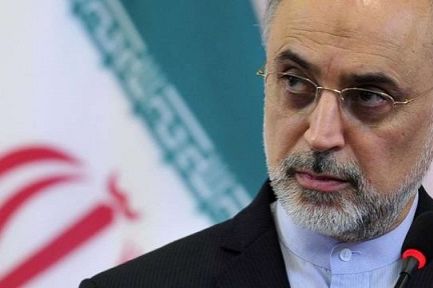
Iran’s vice president and head of the Atomic Energy Organization Ali Akbar Salehi (left) and European Union Climate Action and Energy Commissioner Arias Canete during a joint news conference at the European Commission headquarters in Brussels, November 26, 2018. (Francisco Seco/AP)
BRUSSELS — The European Union and Iran affirmed their support for the international nuclear deal and said they aim to keep it alive despite US President Donald Trump’s decision to abandon the landmark pact.
Ahead of EU-Iran talks on civil nuclear cooperation in Brussels Monday, EU Energy Commissioner Arias Canete said the deal is “crucial for the security of Europe, of the region and the entire world.”
He said the agreement curbing Iran’s nuclear ambitions is working and that “we do not see any credible peaceful alternative.”
Iranian Vice President Ali Akbar Salehi said: “I hope that we can enjoy the niceties of this deal and not let it go unfulfilled.”
Should the deal break down, he said, it would be “very ominous, the situation would be unpredictable.”
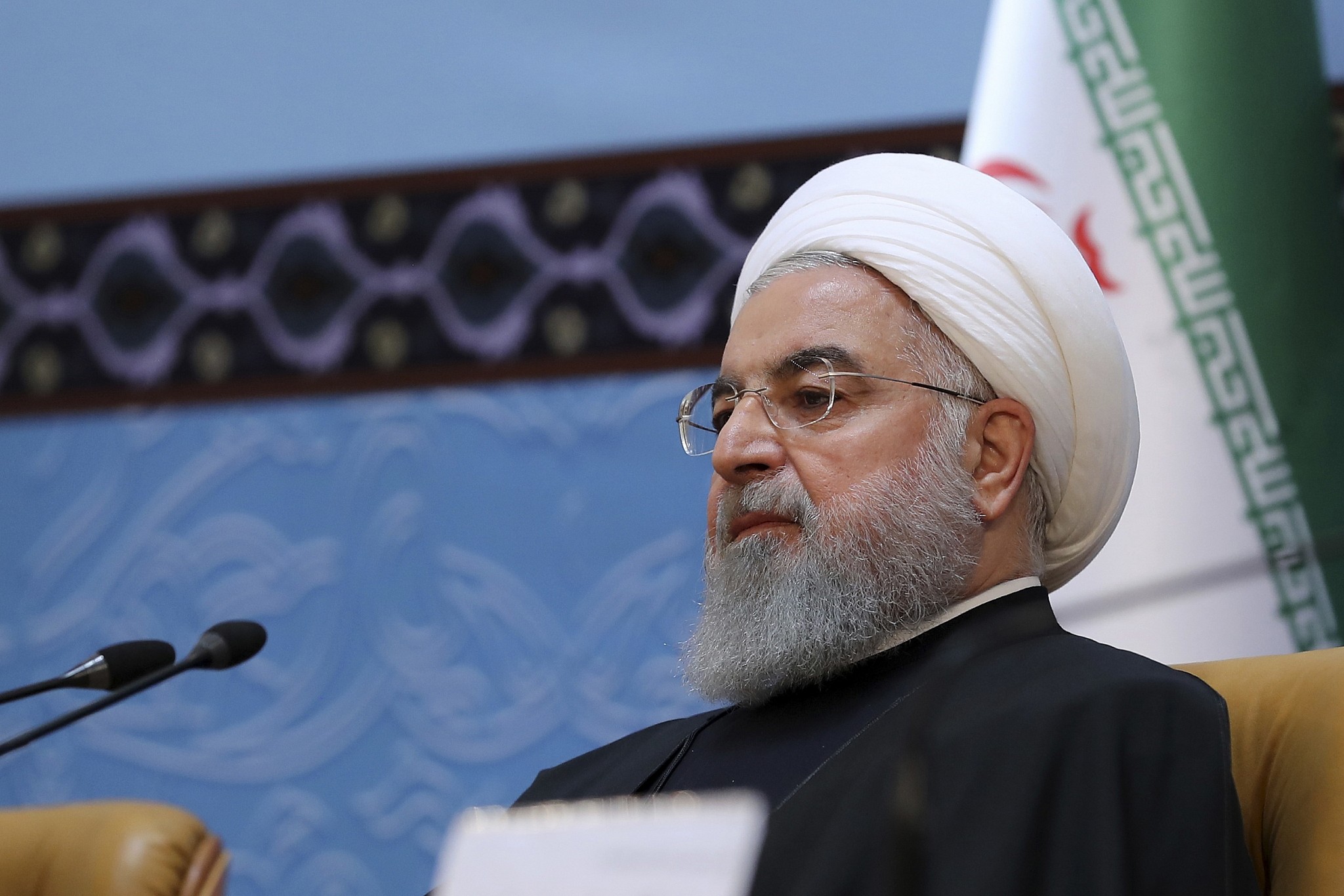
In this photo released by official website of the office of the Iranian Presidency, President Hassan Rouhani attends an annual Islamic Unity Conference in Tehran, Iran, November 24, 2018. (Iranian Presidency Office via AP)
The United States on Monday joined the European Union in denouncing remarks by Iranian President Hassan Rouhani, who, on Saturday, called Israel a “cancerous tumor” established by Western countries to advance their interests in the Middle East.
“We condemn the outrageous comments by Iran’s Rouhani,” Jason Greenblatt, US President Donald Trump’s envoy to the Middle East peace process, said in a tweet.
“Rouhani continues to spread the Iranian regime’s hateful & destructive ideology instead of improving Iranian lives,” Greenblatt added.
Addressing an annual Islamic Unity Conference on Saturday, Rouhani said, “One of the ominous results of World War II was the formation of a cancerous tumor in the region.”
He went on to refer to Israel as a “fake regime” set up by Western countries.
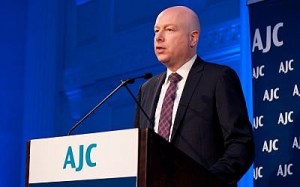
US President Donald Trump’s Mideast envoy Jason Greenblatt addresses the American Jewish Committee’s Women’s Leadership Board Spring Luncheon in New York on April 24, 2018. (Courtesy / Ellen Dubin Photography)
Iran’s leaders frequently condemn Israel and predict its demise, but Rouhani, who is cast as a relative moderate, rarely employs such rhetoric.
Prime Minister Benjamin Netanyahu responded the same day, saying in a statement that “Israel knows very well how to defend itself from the murderous Iranian regime.”
“Rouhani’s slander, which calls for the destruction of Israel, proves yet again why the nations of the world need to join in the sanctions against the Iranian terrorist regime which threatens them,” charged the prime minister.
On Monday, Iran’s Supreme Leader Ali Khamenei lashed out at Israel and the US, saying, “to hell with the US and Zionist regime for threatening the Iranian nation.”
Khamenei.ir@khamenei_ir
Today, to hell with the U.S. and Zionist regime for threatening the Iranian nation. Their threats and atrocities have so far failed and will continue to fail; the sanctions will also be defeated by the grace of resistance.
A day earlier, Khamenei said Israel was now “weaker” than it was 10 or 20 years ago, listing a number of military “defeats” he said the Jewish state had suffered over the years.
In a tweet, Khamenei claimed that Israel was defeated by Hezbollah in the 2006 Second Lebanon War, and that it had been beaten by Hamas in 2008’s Operation Cast Lead, 2012’s Operation Pillar of Defense, as well as the recent flareup in violence on the Gaza border.
All of those conflicts ended with both sides claiming victory.
Khamenei.ir@khamenei_ir
The Zionist regime is clearly weaker than 10, 20 years ago. A few years ago they fought Hezbollah for 33 days and were defeated. They were defeated 2 years later in the 22-day war on Palestinian resistance; in 8-day war on oppressed people of Gaza and recently in the 2-day war.
Khamenei routinely calls Israel a “cancer” in the region that must be removed. He has previously branded Israel as “barbaric,” “infanticidal,” and the “sinister, unclean rabid dog of the region.” Recently, he blamed “Zionists” for the anti-government demonstrations held across Iran earlier this year.
The European Union on Sunday slammed Rouhani’s “cancer” remark, with a spokesperson calling it “totally unacceptable” and “incompatible with the need to address international disputes through dialogue and international law.”
“The European Union reiterates its fundamental commitment to the security of Israel, including with regard to current and emerging threats in the region,” the 28-nation bloc said.
Austrian Chancellor Sebastian Kurz similarly condemned Rouhani on Saturday, likening his comments to anti-Semitism.
“I strongly condemn the recent unacceptable statements by President Rouhani relating to Israel. It is absolutely unacceptable when Israel’s right to exist is questioned or Israel’s destruction is being urged,” he tweeted.
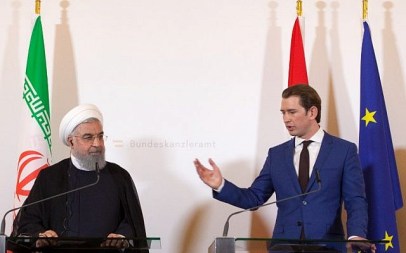
Austria’s Chancellor Sebastian Kurz and Iranian President Hassan Rouhani (L) give a joint press conference at the Chancellery in Vienna on July 4, 2018. (AFP Photo/Alex Halada)
“Because of our historical responsibility, the decisive combat against all forms of anti-Semitism and the support for Israel are especially important to us. For Austria, Israel’s security is non-negotiable,” Kurz added.
The EU has trod cautiously on Iran as it seeks to save the beleaguered nuclear deal with Tehran, after the US withdrew from it earlier this year and reimposed sanctions.
Iran supports terror groups like Lebanese Hezbollah and Palestinian Hamas that are pledged to Israel’s destruction.
Netanyahu has long identified Iran as Israel’s greatest threat, pointing to its nuclear program, calls for Israel’s destruction and support of terrorist groups.
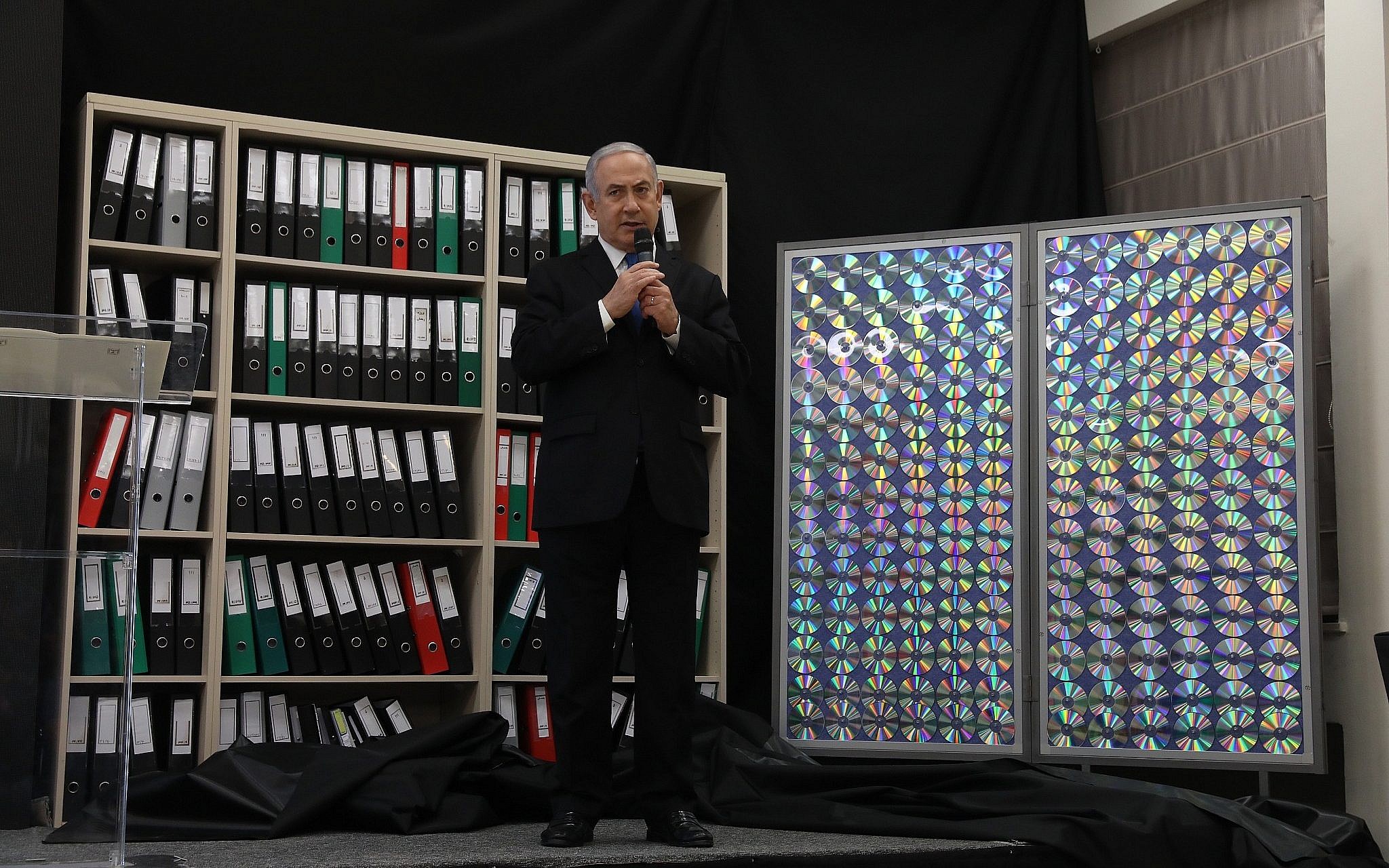
Prime Minister Benjamin Netanyahu gives a speech on files obtained by Israel he says proves Iran lied about its nuclear program, at the Defense Ministry in Tel Aviv, on April 30, 2018. (Miriam Alster/Flash90)
WASHINGTON — The Trump administration has reportedly told Israel that it will lean on the International Atomic Energy Agency (IAEA) to examine findings Prime Minister Benjamin Netanyahu presented to the world earlier this year that outline Iran’s attempts to build a nuclear arsenal.
US Special Envoy Brian Hook visited Israel two weeks ago and, in a meeting with Israeli officials, was told that the IAEA was “dragging its feet” over Israel’s revelations, Axios reported.
Moreover, the political director of the foreign ministry, Alon Ushpiz, was angry that Israeli intelligence was not being taken seriously.
A warehouse in Shorabad, south Tehran, where Mossad agents discovered and extracted tens of thousands of secret files pertaining to Iran’s nuclear weapons program (Prime Minister’s Office)
Hook reportedly responded by saying the Trump administration would pressure the agency to look into the disclosures, with State Department officials saying that America’s new ambassador to the IAEA, Jackie Wolcott, would “work aggressively to make sure the IAEA seriously addresses all information provided by Israel, the US and other countries regarding the Iranian nuclear program.”
A State Department official contacted by The Times of Israel neither confirmed nor denied the Axios report. “We don’t comment on the details of diplomatic conversations,” that official said.
The Islamic Republic has never admitted to seeking a bomb, but Netanyahu attempted to ignite outrage and galvanize the international community into action when he said “Iran lied” to the world, while revealing that Mossad agents had unearthed Iran’s nuclear archives, which showed a long history of trying to build a bomb, going as far back as 2003.
Proponents of the Iran deal were unmoved by the documents, which they said affirmed the assumption behind the landmark pact — that Iran had sought nuclear weapons and an agreement was needed to curtail its path to the bomb.
Netanyahu’s presentation came as US President Donald Trump faced a deadline to keep America as a party to the Joint Comprehensive Plan of Action, as the deal is formally known.
Both Trump and Netanyahu had harshly criticized the deal, taking aim at its “sunset” clauses and saying it did not address Iran’s ballistic missile program or involvement in numerous regional conflicts.
Trump, days later, withdrew the United States from the accord.
Prime Minister Benjamin Netanyahu speaks to a group of new recruits at the army’s Tel HaShomer induction center outside of Tel Aviv on November 26, 2018. (Ariel Hermoni/Defense Ministry)
Prime Minister Benjamin Netanyahu on Monday defended his decision not to launch a large-scale military campaign in the Gaza Strip in response to a massive barrage of rocket and mortar attacks earlier this month, saying that doing so would be too costly for the country.
The prime minister, who also serves as defense, foreign, health and absorption ministers, made his remarks to a group of new recruits to the Israel Defense Forces at the military’s main induction center, Tel Hashomer base, near Tel Aviv.
“As prime minister, what preoccupies me is the fact that I know there’s no ‘free’ wars or ‘free’ casualties. There’s always a price to pay, and the price is very high, and I always thinks about this price,” he said.
The prime minister faced harsh criticism for the government’s decision not to launch a larger military campaign in the Gaza Strip after terrorist groups in the coastal enclave fired some 500 rockets and mortar shells at nearby Israel cities and towns, killing one person and injuring scores more.
In response, the Israeli military bombed some 160 targets connected to the Hamas and Palestinian Islamic Jihad terror groups, killing seven people, most of whom were later identified as members of terrorist groups, some in the process of launching projectiles at Israel at the time they were killed.
Avigdor Liberman announces his resignation from the defense portfolio during a Jerusalem press conference, November 14, 2018. (Yonatan Sindel/Flash90)
Then-defense minister Avigdor Liberman resigned a day after a de facto cease-fire went into effect, specifically citing the government’s policies toward Gaza and its Islamist rulers — Hamas — as the reason.
Prior to this month’s flareup, Netanyahu told reporters that he saw another war in the Gaza Strip — what would be the fourth in 10 years — as unnecessary and that he preferred reaching a long-term cease-fire agreement with Hamas.
However, speaking to new recruits for the Israel Defense Forces’ Armored Corps, the prime minister stressed that Israel also had to be prepared to attack.
“When a war is unpreventable, we will use all of our force and all of our power and do so in the best way possible,” Netanyahu said. “We know that the ultimate goal of the military is first and foremost to defend our country and if we are required to do so — to win in war,” he continued. “Ultimately, you win not just by defense, but rather we win by attacking.”
Prime Minister Benjamin Netanyahu meets a group of new recruits at the army’s Tel Hashomer induction center near Tel Aviv, November 26, 2018. (Ariel Hermoni/Defense Ministry)
As of Monday, the de facto cease-fire reached on November 13 appeared to be holding, with only comparatively small-scale violent incidents occurring along the border.
The Egyptian military, as well as the United Nations and Qatar, has played a key role in these negotiations.
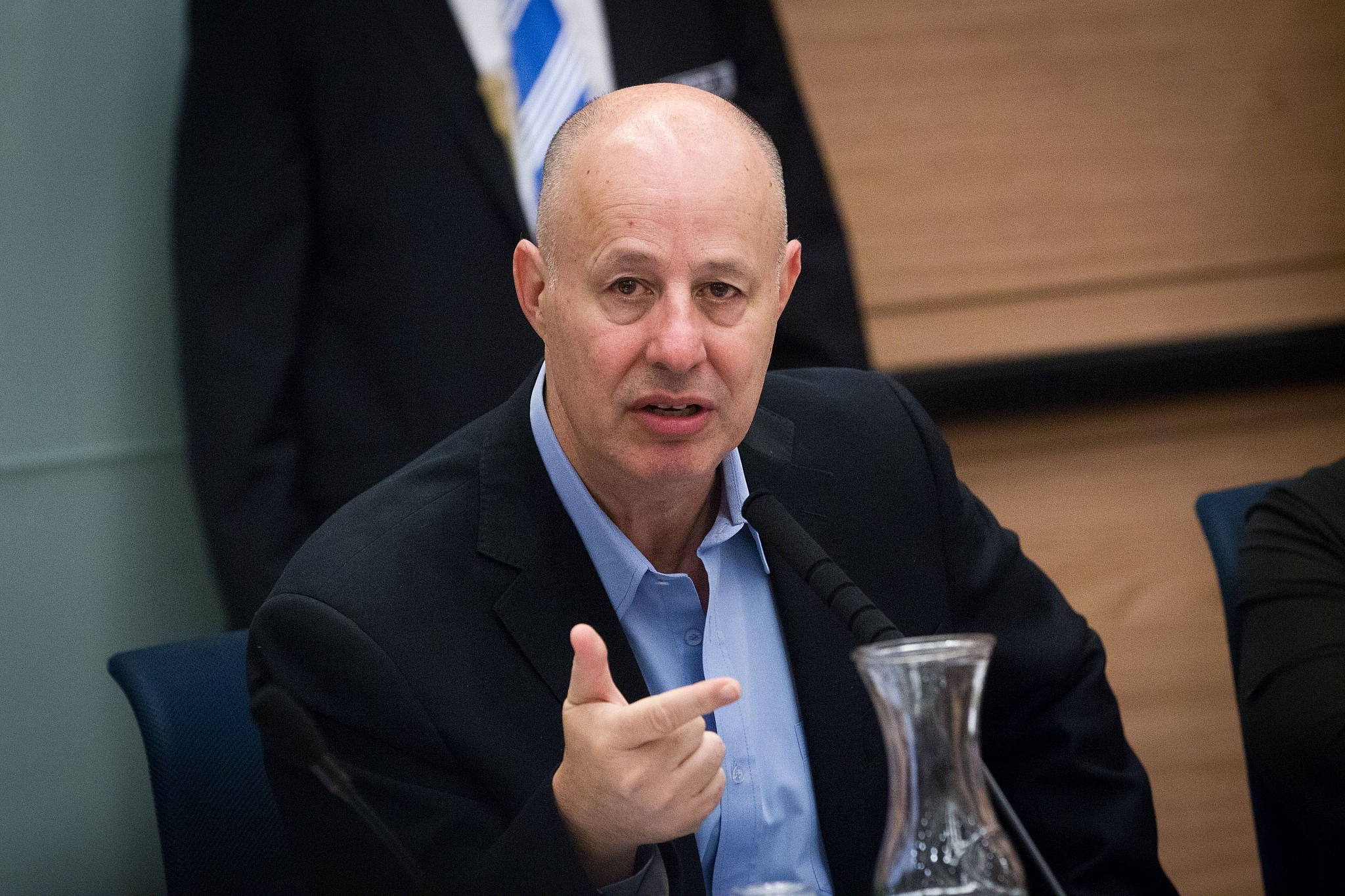
Likud MK Tzachi Hanegbi at a meeting of the Defense and Foreign Affairs Committee in the Knesset. November 19, 2015. (Miriam Alster/Flash90)
Netanyahu’s Likud ministerial colleague, Tzachi Hanegbi, indicated last week that a major offensive in Gaza would cost 500 soldiers’ lives.
When it was put to him, in an Army Radio interview, that one Hamas rocket hit an empty kindergarten, Hanegbi replied: “The empty kindergarten — that’s always talked about. But those 500 coffins — of the Israeli youths that would come back if we sent them into [Gaza’s] Jabalaya [refugee camp] — would not be empty.”
Amid visits of friendly leaders and reports of new diplomatic channels with Arab countries, Netanyahu says country’s strength means deal with Palestinians no longer prerequisite
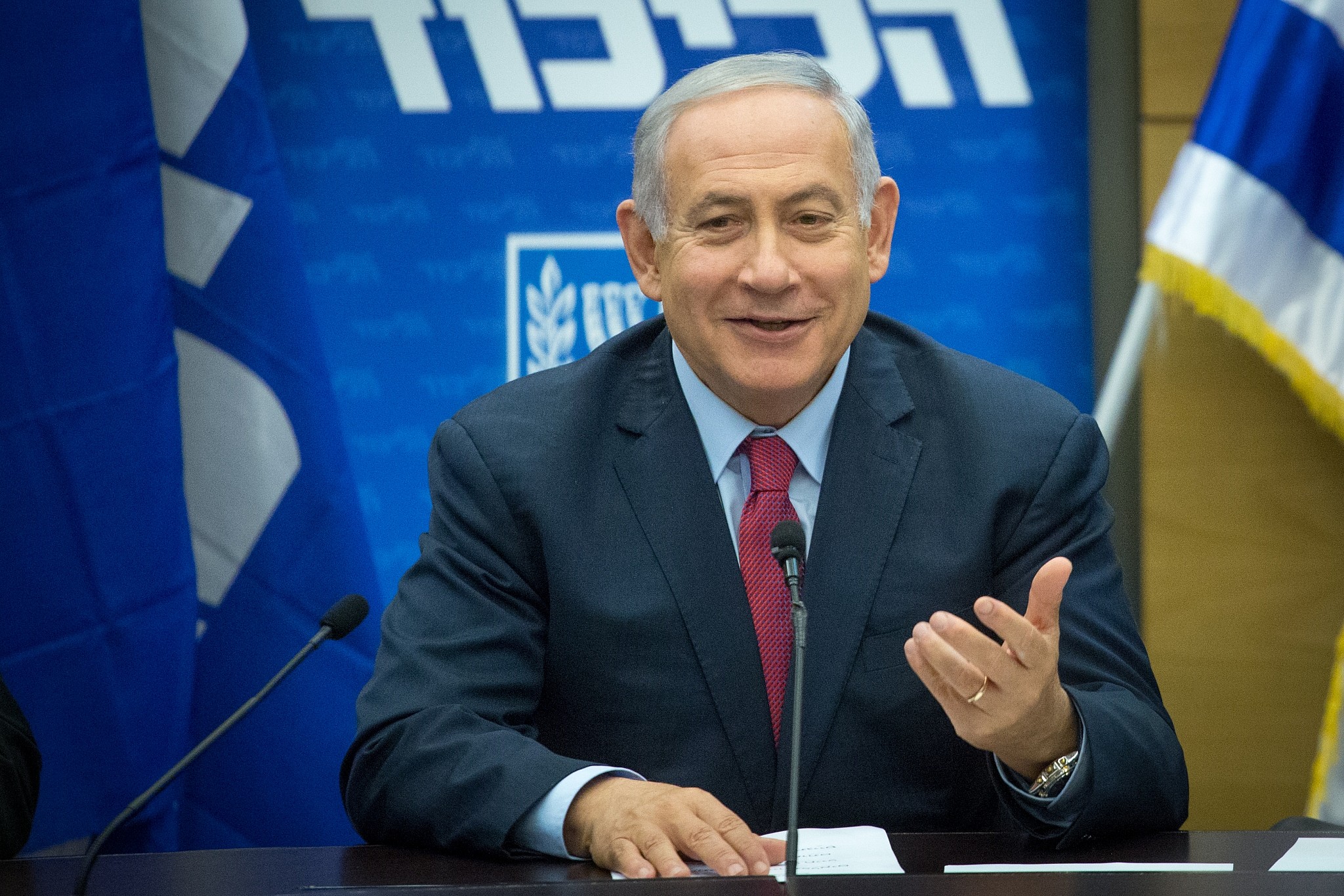
Prime Minister Benjamin Netanyahu leads a Likud faction meeting in the Israeli parliament on November 26, 2018. (Miriam Alster/Flash90)
Prime Minister Benjamin Netanyahu on Monday said recent signs of a diplomatic flourishing for Israel were occurring without Jerusalem having to make any concessions on West Bank settlements, as he celebrated the visit of Chad’s leader after decades of ruptured ties.
Israel has also recently ramped up contacts with a number of Arab countries that, until recently, had shunned any appearance of even informal ties with the Jewish state. Reports Sunday indicated Israel was working toward establishing diplomatic channels with Sudan and Bahrain.
Most Arab countries insist Israel must reach a peace deal with the Palestinians before any normalization can take place. But in recent years attitudes in some parts of the region have seemingly shifted, and Netanyahu said Israel was forging ahead with the ties despite West Bank settlements continuing to grow and peace talks being stagnant.
“We are opening up the world,” he told his Likud faction in public remarks Monday. “Israel is enjoying unprecedented diplomatic flourishing, including in the Arab world… and the Muslim world.”
View of the Israeli settlement of Ma’ale Hever, in the Har Hebron Regional Council, April 19, 2015. (Nati Shohat/Flash90)
Netanyahu stressed that previous leaders had attempted to strengthen Israel’s international standing with “dangerous concessions, including uprooting communities,” referring to the 2005 disengagement plan by former prime minister Ariel Sharon, in which all settlements in the Gaza Strip were dismantled.
“That hasn’t happened — and won’t happen — with me,” Netanyahu continued. “The exact opposite is happening. We are getting the world’s support, including by many in the Arab world, through our strong and steadfast standing.
“We believe in peace out of strength, we believe in alliances born out of Israel’s value as a technological, financial, defense and intelligence powerhouse,” he added. “That’s what we will continue doing, and that’s also how we’ll achieve peace.”
Netanyahu opened his public remarks by hailing visiting Czech President Milos Zeman, for pledging to move his country’s embassy to Jerusalem; and Chadian President Idriss Déby, who, on Sunday, told Israeli leaders in Jerusalem that he wishes to restore diplomatic relations.
The premier said that Déby had invited him to visit Chad and that he had “happily” accepted the invitation.
Déby’s historic visit is part of a campaign to lay the groundwork for normalizing ties with the Muslim-majority countries of Sudan, Mali and Niger, according to a report on Israel’s Channel 10 News Sunday.
Other reports said Israel was also working to normalize relations with Bahrain, as Jerusalem ramps up its drive to forge more open relations with the Arab world amid shifting alliances in the Middle East driven by shared concerns over Iran.
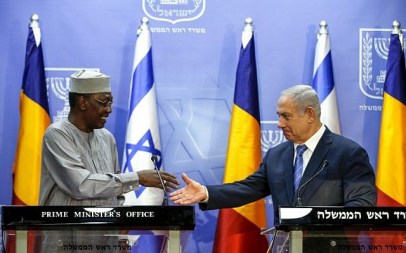
Prime Minister Benjamin Netanyahu (right) prepares to shake hands with Chadian President Idriss Déby as they deliver joint statements in Jerusalem, November 25, 2018. (Ronen Zvulun/Pool/AFP)
Netanyahu has for years spoken about the warming of ties between Israel and the Arab world, citing not only Iran as a common enemy, but also many countries’ interest in cooperating with Israel on security and defense matters, as well as Israel’s growing high-tech industry.
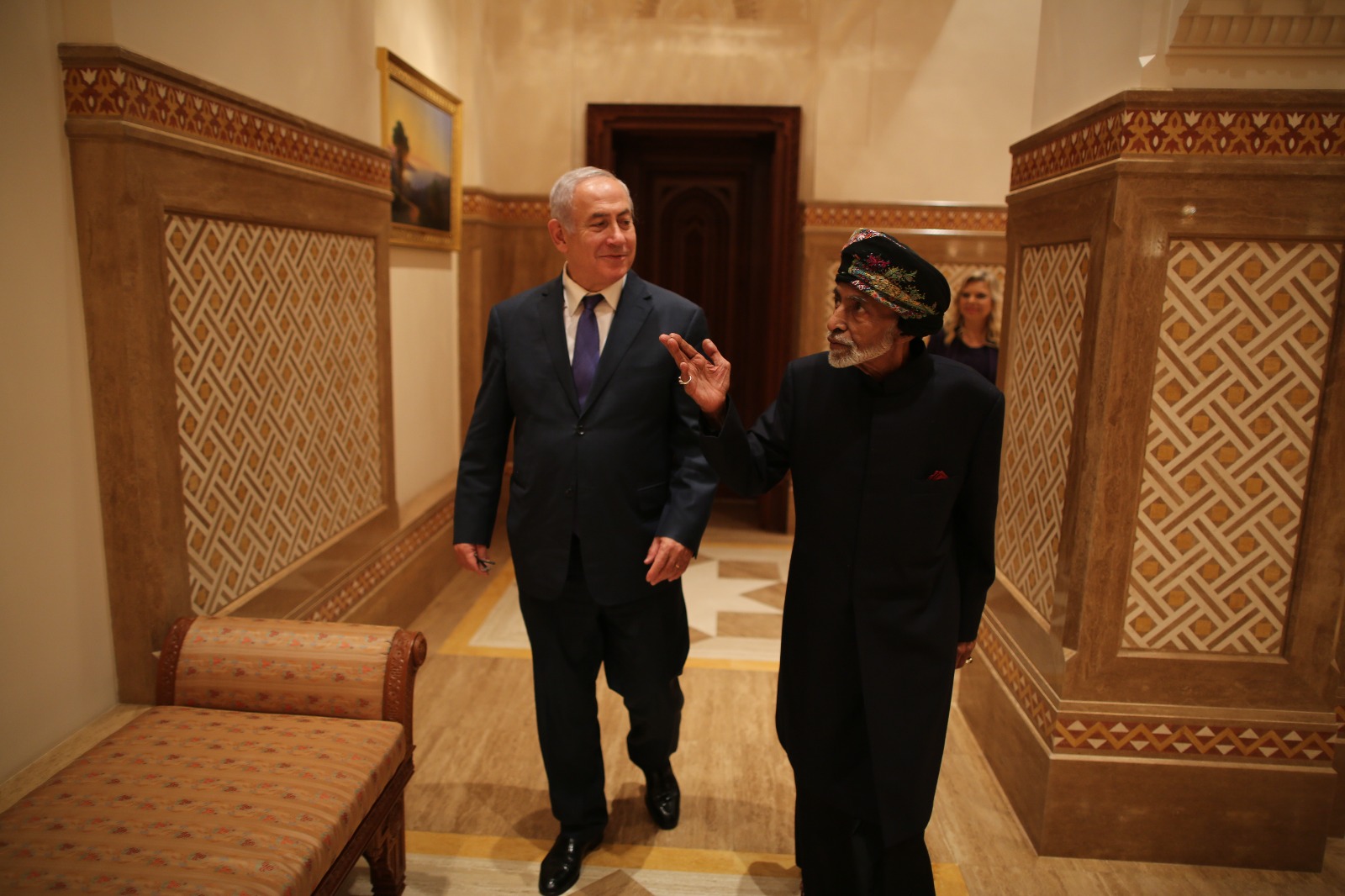
Prime Minister Benjamin Netanyahu (left) talks with Sultan Qaboos bin Said in Oman, October 26, 2018. (Courtesy)
Oman last month welcomed the Israeli premier in a surprise visit, an apparent sign of Israeli progress in improving ties with the Gulf states.
At a security conference in Bahrain following the visit, Omani foreign minister also offered rare words of support for the Jewish state.
“Israel is a state present in the region, and we all understand this. The world is also aware of this fact, and maybe it is time for Israel to be treated the same and also bear the same obligations,” Yussef bin Alawi bin Abdullah said, according to Reuters.
During a press conference with Déby on Sunday, Netanyahu remarked that “there will be more such visits in Arab countries very soon,” without providing details.
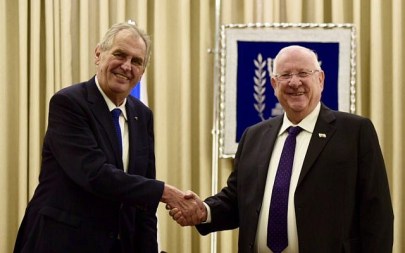
President Reuven Rivlin (right) meets with his Czech counterpart, Milos Zeman, in Jerusalem, November 26, 2018. (Czech Presidency/Twitter)
Earlier Monday, during his visit to Israel, Czech President Zeman expressed skepticism over the possibility of a two-state solution. He told President Reuven Rivlin he was interested in learning more about alternative approaches to solving the Israeli-Palestinian conflict.
Zeman, an outspoken supporter of Israel, arrived on Sunday evening for a three-day state visit, during which he will inaugurate the so-called “Czech House” in Jerusalem, an office space billed by Prague as a “first step” toward moving the country’s embassy to the city.
In April, Zeman announced the beginning of a process that will move the country’s diplomatic mission from Tel Aviv to Jerusalem, though it remains unclear if and when Prague will actually open an embassy in the holy city.
Raphael Ahren and Times of Israel staff contributed to this report.
PA seeks emergency sessions of Arab League and Organization of Islamic Cooperation as Chad’s president visits Jerusalem amid thawing of relations with Bahrain and Saudi Arabia
Prime Minister Benjamin Netanyahu (left) with Sultan Qaboos bin Said of Oman on October 26, 2018 (Courtesy)
Israel’s ongoing thawing of relations with various Arab and Muslim countries in the Middle East and Africa is said to be sending Palestinian Authority officials scrambling, concerned that support for their cause is waning among allies.
PA President Mahmoud Abbas’s senior adviser Nabil Shaath told the Haaretz daily Monday that Ramallah is seeking to convene emergency sessions of the Arab League and Organization of Islamic Cooperation as it worries that countries such as Chad, Sudan, Bahrain, Oman and Saudi Arabia are moving closer toward normalization with Jerusalem — relations that would counter resolutions passed by the two umbrella bodies.
“There are a number of Arab and Islamic resolutions and declarations stating explicitly that there will be no process of normalization with Israel without a resolution of the Palestinian issue based on the Arab Peace Initiative and decisions of the international community,” Sha’ath told Haaretz.
At the most recent summit of the Arab League in April, member countries signed off on a statement vowing not to make reconciliation agreements without an agreed-upon solution to the Palestinian issue.
Nabil Shaath speaks to reporters in the West Bank city of Ramallah, October 1, 2011. (Issam Rimawi/Flash 90)
“What we have been seeing in recent weeks — beginning with Netanyahu’s visit to Oman and the visit to Israel by the president of Chad, and now there is talk of Bahrain and Sudan and ties of one kind or another with Saudi Arabia — raises question marks, and there is therefore a need to clarify the Arab and Islamic position,” Shaath said.
On Sunday, Prime Minister Benjamin Netanyahu welcomed Chadian President Idriss Déby for a historic visit to the Jewish state, laying the groundwork for normalizing ties with the Muslim-majority countries of Sudan, Mali and Niger, according to a report on Israel’s Channel 10 News Sunday.
Déby told Israeli leaders in Jerusalem that he wishes to restore diplomatic relations.
Other reports said Israel is also working to normalize relations with Bahrain, as Jerusalem ramps up its drive to forge more open relations with the Arab world amid shifting alliances in the Middle East driven by shared concerns over Iran.
Netanyahu has for years spoken about the warming of ties between Israel and the Arab world, citing not only Iran as a common enemy, but also many countries’ interest in cooperating with Israel on security and defense matters, as well as Israel’s growing high-tech industry.
Oman last month welcomed the Israeli premier in a surprise visit, which marked an apparent sign of Israeli progress in improving ties with the Gulf states.
Prime Minister Benjamin Netanyahu (R) prepares to shake hands with Chadian President Idriss Déby as they deliver joint statements in Jerusalem November 25, 2018. (RONEN ZVULUN / POOL / AFP)
During a press conference with Déby on Sunday, Netanyahu remarked that “there will be more such visits in Arab countries very soon,” without providing details.
Netanyahu said Monday that recent signs of a diplomatic flourishing for Israel were occurring without Jerusalem having to make any concessions on West Bank settlements.
“We are opening up the world,” he told his Likud faction in public remarks Monday. “Israel is enjoying unprecedented diplomatic flourishing, including in the Arab world… and the Muslim world.”
Netanyahu stressed that previous leaders had attempted to strengthen Israel’s international standing with “dangerous concessions, including uprooting communities,” referring to the 2005 disengagement plan by former prime minister Ariel Sharon, in which all settlements in the Gaza Strip were dismantled.
“That hasn’t happened — and won’t happen — with me,” Netanyahu continued. “The exact opposite is happening. We are getting the world’s support, including by many in the Arab world, through our strong and steadfast standing.
“We believe in peace out of strength, we believe in alliances born out of Israel’s value as a technological, financial, defense and intelligence powerhouse,” he added. “That’s what we will continue doing, and that’s also how we’ll achieve peace.”
While Shaath noted that the thawing of Israel’s relations with Ramallah’s traditional backers has yet to reach the level of full diplomatic relations, he referred to “the beginning of a worrisome process that needs to be stopped.”
Shaath argued that these regional developments come against the backdrop of the Trump administration’s ongoing rift with the PA, which the PA claims Washington seeks to further isolate by encouraging various Arab and Muslim countries to improve their ties with Israel. The PA has been boycotting the Trump Administration since it recognized Jerusalem as Israel’s capital last year and moved its embassy to the city in May.
The PA official said he hopes to convene emergency conferences on these issues, but admitted that most of the efforts of regional powers are being used to deal with the issue of reconciliation between Abbas’s Fatah and the Hamas terror group in Gaza, which have long been at odds.
Paper with Hezbollah ties says terror group is prepared to implement reconciliation deal brokered by Egypt last year, in exchange for sanctions lift, new general election
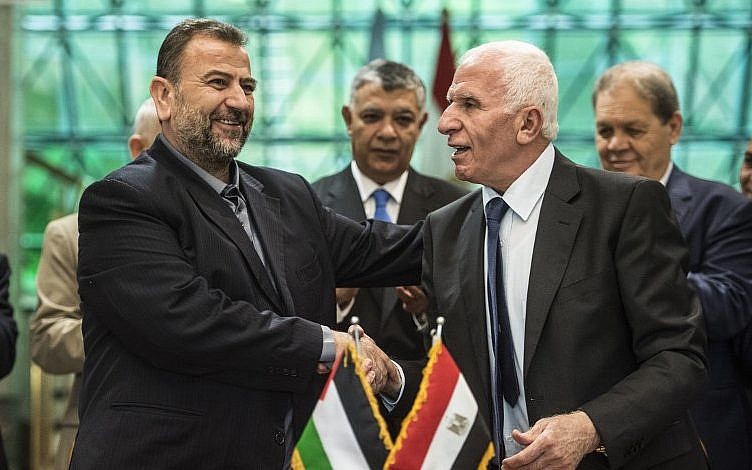
Fatah’s Azzam al-Ahmad, right, and Saleh al-Arouri, left, of Hamas shake hands after signing a reconciliation deal in Cairo on October 12, 2017, as the two rival Palestinian movements ostensibly ended their decade-long split following negotiations overseen by Egypt. (AFP/Khaled Desouki)
The Hamas terrorist group has agreed to implement a reconciliation agreement with the Palestinian Authority that would see the rulers of the Gaza Strip return control of the territory to its West Bank rivals, the Lebanese al-Mayadeen outlet reported Tuesday.
Sources close to Hamas told the Hezbollah-affiliated newspaper the group would implement the agreement brokered by Egypt last year on the condition that civil servants in Gaza be paid their salaries and all PA sanctions be removed.
The report said Hamas is demanding that a Palestinian unity government be formed within 45 days, and called for general elections to be held within six months.
The sources said Hamas officials made the offer to Egyptian officials during a recent visit to Cairo.
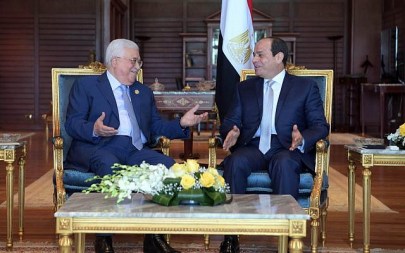
Egypt has been working to revive the reconciliation process between Hamas and Fatah, meeting with leaders from the rival parties for separate talks in recent months.
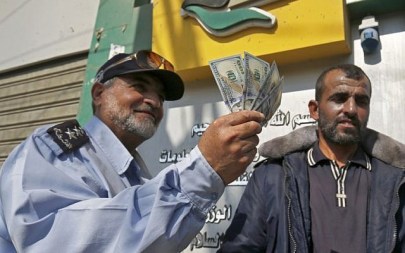
A Palestinian man shows his money after receiving his salary in Rafah in the southern Gaza Strip November 9, 2018. (Photo by SAID KHATIB / AFP)
In October 2017, Hamas and Fatah signed an Egyptian-brokered deal to bring the West Bank and Gaza under one Palestinian government, but they failed to implement it. Disputes over civil services and the fate of Hamas’s 25,000-strong military wing have remained thorny issues between the sides.
Hamas has controlled Gaza since ousting the Fatah-dominated Palestinian Authority from the territory in 2007.
Last year, Palestinian Authority President Mahmoud Abbas vowed to take “painful and unprecedented” measures against Hamas to force the terror group to dismantle its de facto government and cede power back to his Western-backed PA.
Abbas’s threat was followed up by a series of sanctions that included drastic cuts in the salaries of PA employees in the Gaza Strip, the suspension of social assistance to hundreds of families, and the forced retirement of thousands of civil servants. In addition, the PA stopped paying Israel for electricity and fuel supplies to the coastal enclave.
Palestinian Authority President Mahmoud Abbas and Egyptian President Abdel Fattah el-Sissi meeting in Sharm al-Sheikh on November 3, 2018. (Wafa)
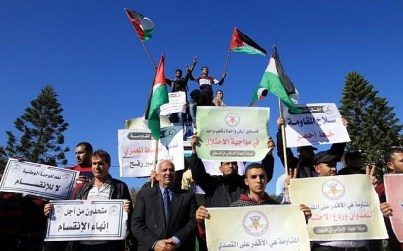
Hamas had hoped Abbas would lift the sanctions after signing the reconciliation agreement in Cairo last year, but since then, a number of deadlines for the transfer of power were missed, and the PA sanctions on Gaza have remained.
Earlier this month, Qatar began paying the salaries of Palestinian civil servants in Gaza in a bid to ease tensions in and around the impoverished territory. A total of $90 million is to be distributed in six monthly installments of $15 million, according to authorities, primarily to cover salaries of officials working for Hamas.
The Israeli-authorized money transfer appeared to be part of a deal that would see cash-strapped Hamas end months of often violent protests along the border, in exchange for Israel easing parts of its blockade of Gaza.
But days after the first cash Qatari transfer was made, one of the biggest flare-ups in violence erupted in and around Gaza, when over 460 rockets and mortar shells were fired at southern Israel.
Palestinians wave the national flag during a demonstration in Gaza City on December 3, 2017, in support of the reconciliation talks between Hamas and Fatah. (AFP/Mohammed Abed)
The Iron Dome missile defense system intercepted over 100 of them. Most of the rest landed in open fields, but dozens landed inside Israeli cities and towns, killing one person, injuring dozens and causing significant property damage. Israel responded with extensive airstrikes in the Strip before calm returned.
Deadly clashes have accompanied the major protests along the Gaza border with Israel that began on March 30. Israel has accused Hamas of leading the protests and using them as cover to carry out attacks against troops stationed at the border.
Iran’s nuclear chief warned the European Union on Monday of “ominous” consequences if it did not follow through with action to keep the economic benefits of the 2015 nuclear agreement alive.
But Salehi, the head of Iran’s Atomic Energy Organization, told reporters in Brussels: “If words are not turned into deeds, then … it is very ominous, the situation would be unpredictable.”
The EU and other remaining parties to the accord – China and Russia – hope to convince Tehran to respect the curbs that the deal placed on its nuclear program, despite Washington’s withdrawal and imposition of sanctions that aim to force the rest of the world to stop buying Iranian oil.
Striving to circumvent those sanctions, EU nations plan to facilitate non-dollar transactions with Iran. A so-called Special Purpose Vehicle would act as a barter system offsetting Iranian exports with purchases of EU goods.
Speaking on the sidelines of talks on civilian nuclear cooperation, EU diplomats admitted they could only do so much to urge firms to brave the risk of U.S. penalties and do business with Iran.
“What we are doing now is a lot of symbolism,” said one EU diplomat involved in talks with Iran.
“The SPV isn’t going to be a game changer,” said another EU official. “The prospects are pretty grim.”
No EU country has yet agreed to host the SPV and progress in creating it is likely to be slow, despite the political will in Paris, Berlin and London.
“This is a hugely complex and unique undertaking. Technical work has been advancing,” Europe’s Climate and Energy Commissioner Miguel Arias Canete said at a joint briefing with Salehi.
“Nobody should have any doubt on the level of political ambition and determination by the member states involved, in particular France, Germany and the United Kingdom to swiftly operationalize the SPV.”

/https://public-media.smithsonianmag.com/filer/4f/9b/4f9bad96-304a-4451-85a7-c9fa56f4cc53/screen_shot_2017-10-04_at_54310_pm.png)

















 anneinpt
 artaxes
 danmillerinpanama
 davidking1530
 Peter Hofman
 Joseph Wouk
 Peter
Peter Louisiana Steve
 WarSclerotic
Recent Comments