Archive for November 23, 2018

Shin Bet foils Hamas-planned bombing in Israel

November 23, 2018

Source: Shin Bet foils Hamas-planned bombing in Israel

Hamas military wing recruited militants in the West Bank and taught them how to build bombs to carry out attacks within the Green Line; Gazan cancer patient and her sister, who got entry permit to Israel, were used to pass on messages from the strip.

The Shin Bet has thwarted an attempt by the heads of Hamas in Gaza to establish terror infrastructure in the West Bank to plan and carry out bombings in Israel, the agency said on Thursday.

According to the Shin Bet, members of Hamas’s military wing recruited fighters in the West Bank, taught them how to build bombs and instructed them to find crowded places within the Green Line to target—such as a large building, mall, restaurant, hotel, train or bus.

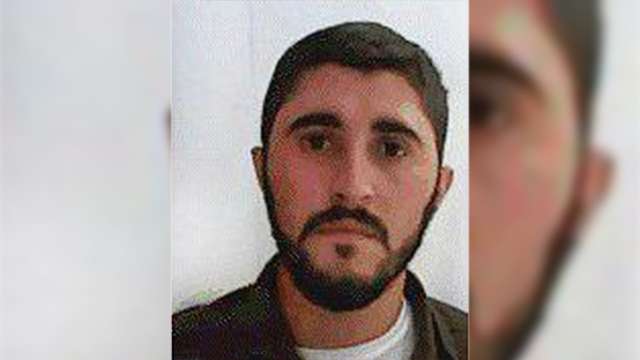
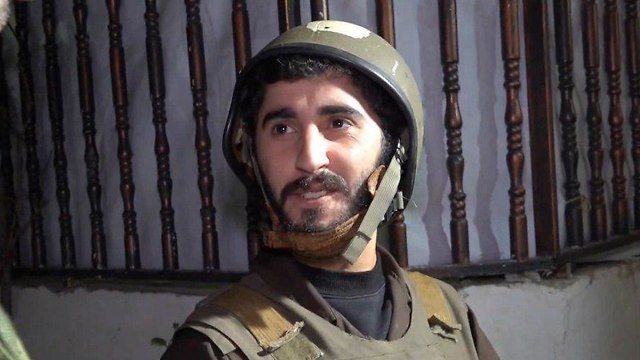
Awis Rajoub, Hamas militant arrested two months ago (Photo: Shin Bet media)

Awis Rajoub, Hamas militant arrested two months ago (Photo: Shin Bet media)

The Shin Bet noted this plot was at a much larger scope and posed far greater danger than similar attempts in the past, as it was directed by Hamas’s high command in Gaza and not by former Palestinian security prisoners expelled from the West Bank, as previous attempts had been.

The Hamas leadership put pressure on the militants in the West Bank to carry out the planned attacks as soon as possible in an effort to escalate the security situation in both Gaza and the West Bank.

Awis Rajoub, Hamas terrorist from West Bank (Photo: Shin Bet media)

Awis Rajoub, Hamas terrorist from West Bank (Photo: Shin Bet media)

Hamas communicated with the militants in the West Bank through messages passed on by Gaza patients allowed into Israel to undergo life-saving medical treatments, as well as other Gaza residents who had business contacts in the West Bank. The Shin Bet noted this was not the first time Hamas was exploiting humanitarian cases to carry out military operations in the West Bank.

The terror infrastructure was uncovered following the September 23 arrest of Awis Rajoub, a 25-years-old Hamas militant from Dura, near Hebron. The Shin Bet learned of Rajoub’s actions on behalf of Hamas’s military wing after he told some of his relatives and friends about it and asked for their help in purchasing materials to build bombs.

Rajoub was recruited by a Hamas militant from Gaza, who approached him close to the end of Ramadan and offered him to join the Izz ad-Din al-Qassam Brigades, the terror group’s military wing.

 Awis Rajoub, a 25-years-old Hamas militant from Dura (Photo: Shin Bet media)

Awis Rajoub, a 25-years-old Hamas militant from Dura (Photo: Shin Bet media)

On August 11, Rajoub was sent to a medical warehouse in Ramallah to pick up a cellphone for his communications with his operators in Gaza.

Several days later, he met with a Gazan woman who was accompanying her sister to Israel for medical treatments. She was sent by Hamas to provide him with a password for his phone and instructions on how to use the device.

The Gaza operators sent videos to this cellphone instructing Rajoub how to build remotedly-detonated bombs. Rajoub also had video chats with an explosives expert who is part of the terror infrastructure.

Rajoub recruited two Hamas members from Battir, Yazan and Sayyaf Asafra, and instructed them to find suitable targets for the attack in Israel and to prepare the explosives for the bomb, while he worked on the detonator.

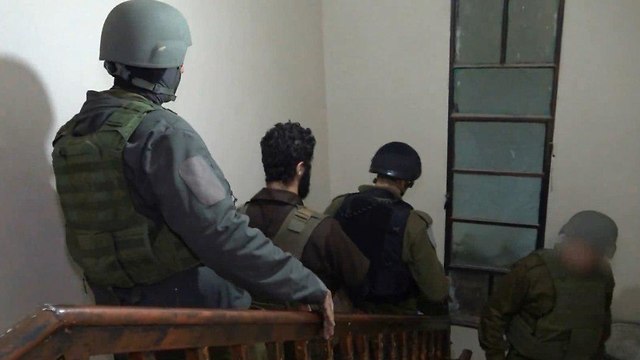
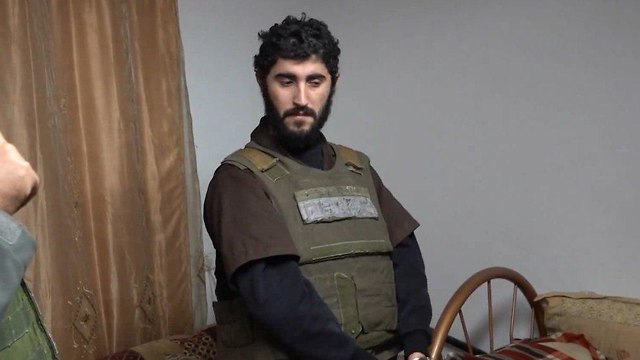
IDF arrest Rrajoub (Photo: Shin Bet media)

IDF arrest Rrajoub (Photo: Shin Bet media)

Rajoub was ordered to finish preparing the bomb by the end of September and carry out the attack in early October, but was stopped by the Shin Bet before that.

The Gazan woman who provided Rajoub with password and instructions for his phone was identified as 53-year-old Naama Miqdad, while her sister, a cancer patient, was identified as 47-year-old Samira Smot.

The two women also met with Hamas terrorist Fuad Dar Khalil, who spent 14 years in Israeli prison for his involvement in a shooting attack and in planning other terror attacks. He was released from prison in 2016. The women gave him a suitcase containing a hidden letter from the Gaza operators.

The two women were sent by their relative Muhammad Abu Kwaik, 36, a member of Hamas’s military wing, who is known to be in contact with terrorists and to assist them in their operations.

Also on Thursday, the IDF censor barred the publication of new photos Hamas released from a botched military operation last week in which Lt. Col. M. was killed and another officer was wounded. The IDF censor is concerned the new photos would be posted on social media, posing a risk to both the soldiers who took part in the mission and national security.


Irans great nuclear deception

November 23, 2018

Source: Irans great nuclear deception

New details are revealed about the Mossad’s special operation to seize Iran’s nuclear archive, including a rare glimpse into Tehran’s classified documents: secret tests, a plan to manufacture the first 5 nuclear bombs, and even a photo of proud Iranian scientists outside a nuclear facility. This is the story of how Iran tried to deceive the world… and almost got away with it.
“We found a lot of CDs there, what should we do with them? Should we bring them with us?”

In the middle of the last night of January 2018, Mossad agents broke into a secret vault on the outskirts of Tehran, while their commanders watched from afar. The agents encountered an unexpected problem, a “rich people problems,” according to a person familiar with the details of the operation.

The large room contained 32 huge Iranian-made safes, each 2.7 meters in height. The safes were loaded onto heavy container-like installations, on wheels that can carry massive weight.
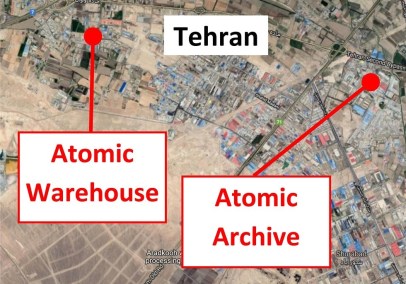
The documents were secreted behind two different doors—a heavy iron door inside the facility and another iron door equipped with an alarm system and cameras at the facility’s exterior wall.

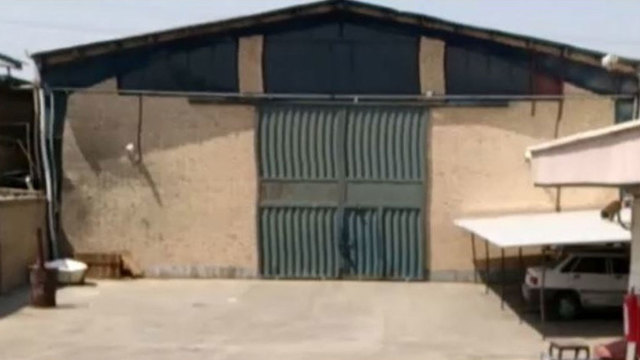
This is where the Iranian Ministry of Defense decided to keep one of the greatest secrets of the Islamic Republic. In fact, only a handful of people in Iran even knew that the Iranian nuclear archive was inside this warehouse, in the heart of a sleepy suburb in the capital.
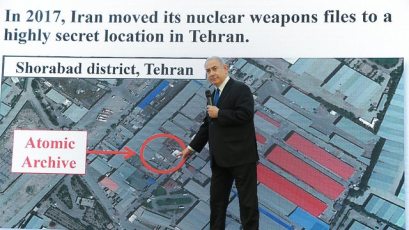
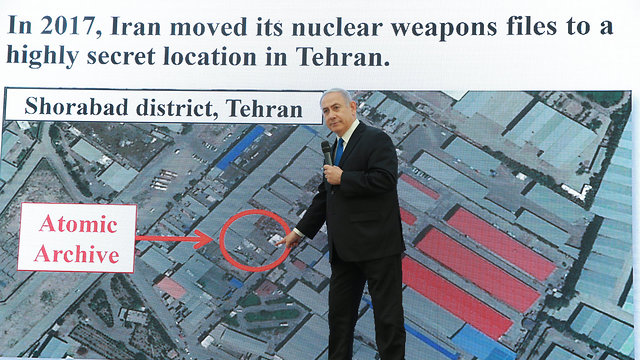
Prime Minister Netanyahu revealing the location of the nuclear archive (Photo: Orel Cohen)

Prime Minister Netanyahu revealing the location of the nuclear archive (Photo: Orel Cohen)

But it did not remain a secret.

The agents knew how to disable the alarm system and break through the iron doors, but they also knew they did not have time to break into all the safes. They would have to make do with less than ten, and look for three types of folders: those containing Iran’s correspondence with the International Atomic Energy Agency (IAEA); those detailing the construction of nuclear sites and acquisition of nuclear equipment; and most importantly, those detailing the design and production of the nuclear warhead (which has never been completed).

The safes in the Iranian nuclear archive

The safes in the Iranian nuclear archive

But then, inside the safes’ room, agents found something else, besides folders: CDs, piles of them—a massive amount of DVDs and computer discs, most of them unmarked.

So what the hell were they going to do now? Should they ignore the potential secrets these CDs may hold? Or take a calculated risk with a new variable that might complicate the operation? The agents received an explicit order from the command room: take everything, including the CDs.

At one minute to five in the morning, the agents left the warehouse. When the break-in was discovered, about 12,000 Iranian security personnel went on the pursuit in an attempt to figure out who stole the nuclear archive from under their noses.

In the end, despite the unexpected piles of CDs, all of the material was extracted from Iran, and no one got caught. The Iranians could only guess who was behind the heist, but until Prime Minister Benjamin Netanyahu’s famous press conference on April 30, they didn’t know for sure what really happened to “the filthy secrets of the Iranian regime,” as dubbed by Mossad director Yossi Cohen.

A few weeks later, when the material arrived in Israel, dozens of translators, experts and analysts—assisted by Persian speakers from Israel’s Military Intelligence Directorate’s (MID) Unit 8200—started digging through the piles of material. It was then that it became clear how important was the decision to risk everything and take the CDs.

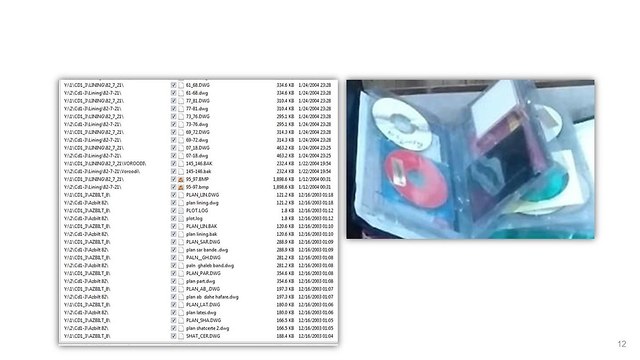
CDs seized by Mossad from Iran's nuclear archive

CDs seized by Mossad from Iran’s nuclear archive

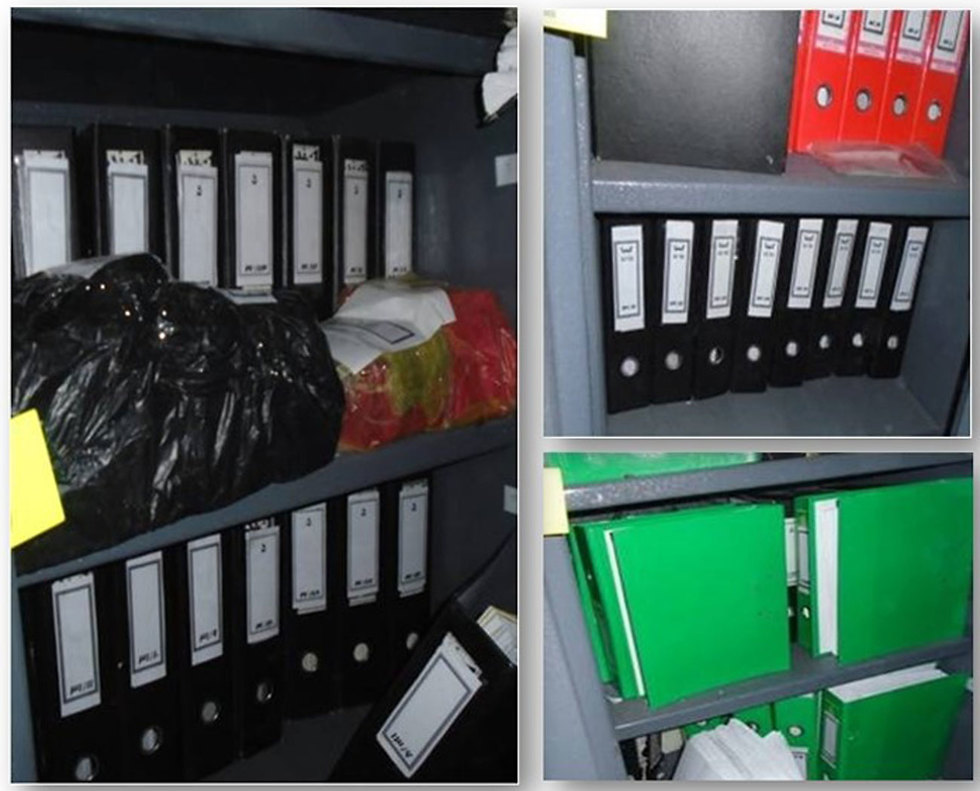
The written material comprises of 114 folders, containing more than 55,000 pages, of which 8,500 were handwritten documents, many of them authored by senior government officials, and some by nuclear personnel who died in operations attributed to the Mossad.

But the biggest surprise was the massive amount of information stored in the 182 disks. A Mossad case officer told me he would have paid hundreds of thousands of dollars for one CD like this.

The Iranians documented everything: the equipment, the construction of secret plants and sites, the experiments, detailed presentations on the project’s progress, goals and stages, and even themselves, during nuclear experiments.

The bottom line is clear: it was a mega-scam, a state-level deception, in which senior Iranian officials and hundreds of others have taken part for years.

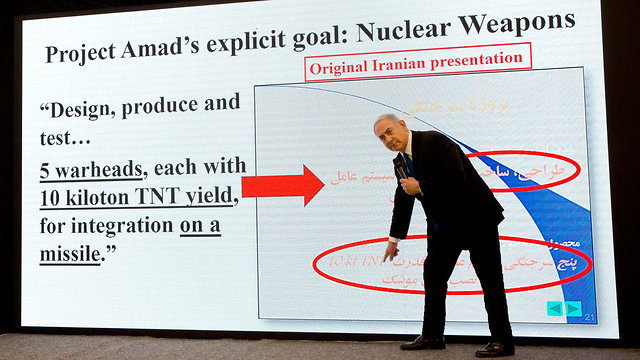
For two decades, Iran denied having a military nuclear program. But the contents of the safes tell a different story, a completely different and undeniable account: for years, Iran has been engaged in a covert nuclear project aimed at producing five nuclear bombs, with a yield of 10 kilotons each. And this was only stage one.
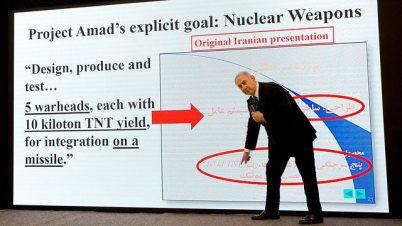
Prime Minister Netanyahu revealing documents from Iran's nuclear archive (Photo: AP)

Prime Minister Netanyahu revealing documents from Iran’s nuclear archive (Photo: AP)

According to a Western intelligence source, “over the years, we have seen all sorts of programs, but we have not always understood their overall context. Until we saw these documents, we didn’t really understand how projects that were part of AMAD (the secret project’s code name—RB) were translated into secret projects under the Ministry of Defense, or open projects with a hidden agenda within SPAND (the later, public name, of the project—RB). The material Israel had obtained solved these mysteries.”

“The sweeping Iranian denial “is really comical at this point,” the source added.

The documents don’t just expose the Iranians’ deceit. It also demonstrates the weakness of the Treaty on the Non-Proliferation of Nuclear Weapons (NPT), which Iran signed and the IAEA failed to enforce.

The archives show that under the UN agency’s nose—despite repeat warnings, the information obtained by the Mossad and other espionage agencies, and media exposés—Iran has succeeded in conducting a secret military nuclear program over a long period of time (and Israel claims Tehran continues to do so even today).

Iran continues to deny everything even now; claiming the entire story of the seized archive is fabricated and serves an Israeli-American agenda aimed at canceling the nuclear agreement. This response was to be expected. What might have been less predictable is the lukewarm international response to the material uncovered in the Israeli operation.

The reactions ranged from claims the material was “old news” to assertions it does not uncover any “smoking guns” to prove Iran is currently violating the nuclear agreement.
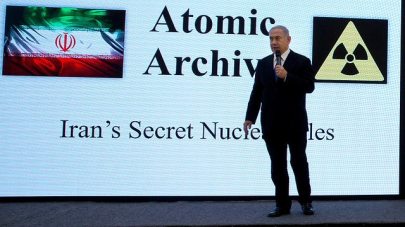
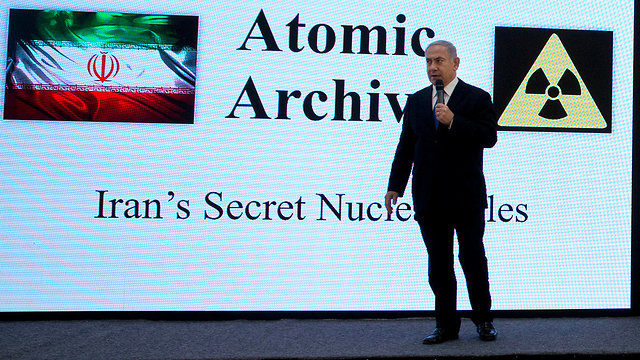
Prime Minister Benjamin Netanyahu presenting Iran's nuclear archive to the world (Photo: AP)

Prime Minister Benjamin Netanyahu presenting Iran’s nuclear archive to the world(Photo: AP)

But if the Islamic Republic is not violating or planning to violate the agreement, why keep such a detailed archive allowing Iran to resume its nuclear effort from where it left off (assuming they actually stopped)?

For many years Israel, the United States, France, Britain and Germany have been collecting intelligence about the Iranian nuclear project. Some of this material has been handed to the IAEA over time in the hopes it would provoke an appropriate response. The intelligence gathered was classified by the IAEA into 12 different topics— referred to as “the PMD,” the acronym for “Possible Military Dimensions”— each depicting research, production or other experiments related to the bomb.

Over the years, Iran has vehemently denied dealing with any of these topics. The condition for signing the nuclear agreement was that Iran would make a full disclosure of its progress in each of the 12 PMD issues. Before signing the agreement, Yukiya Amano, the Japanese diplomat who heads the IAEA, promised senior Israeli officials, according to their testimony, that “he will never sign the deal” before receiving satisfactory answers on all 12 topics.

At the end of 2015, Amano published a report practically accepting the Iranian denial of ever having a military nuclear project. Now, in light of the material discovered by the Mossad, it appears his report was based on false information.

The intelligence uncovered in the operation was revealed to the Americans, the Chinese, the Russians, the French, the British, the Germans, and of course to IAEA officials.

With the exception of the US (and, of course, Israel), it seems the world wasn’t floored by the discoveries, and Amano himself has kept quiet.

This is despite the fact that the sensitive material includes documentation of advanced stages of practical field research, experiments and timetables for the production of an atomic bomb and its adaptation to the warhead of the long-range Shahab ballistic missile.

Core for a nuclear warhead

Core for a nuclear warhead

Holger Stark, the deputy editor of the German Die Zeit newspaper, contacted the IAEA in Vienna for a response. The agency refused to comment.

Quite a lot has been written about the Mossad operation. However, media reports in Israel and abroad dealt less with the archive itself, and more with the difficult questions it poses.

Here is a glimpse into the secret intelligence gathered from Iran’s safes room. These are the facts; the questions they raise are for the world to answer.

The scientists

So what is this “Iranian nuclear archive” that Mossad agents managed to transport thousands of kilometers, all the way to Israel?

Iran’s secret military nuclear program began to take shape in 1992 or 1993, when the Iranians became interested in acquiring technologies for the production and operation of centrifuges for uranium enrichment. Tehran acquired much of its knowledge from Pakistan’s nuclear project director, Abdul Qadeer Khan, and later from other elements, some of them Chinese.

The first centrifuges were designed at a site called Damāwand. Israel warned the international community about the construction of the nuclear enrichment facility, so Iran decided to dismantle it and build another one in its stead.

This was the site that would later become well known, the Natanz nuclear facility. In internal Iranian documents, the site was called “Kashan,” and it houses an increasing number of centrifuges.

At first, Israel was alone in its intelligence campaign against Iran. The intelligence it brought to the attention of IAEA and Western countries was greeted with indifference. Even the United States failed to act at first, and didn’t recognize the authenticity or the importance of the material the Mossad collected on Iran. Only at a later stage, when intelligence ties with Israel strengthened and additional information about Kashan was brought to their attention did the Americans start to act.
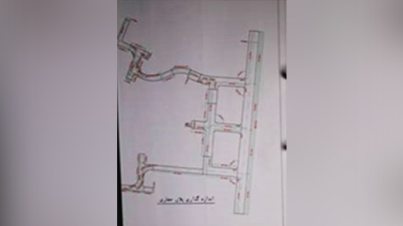
A sketch of the Fordow nuclear facility

A sketch of the Fordow nuclear facility

Meanwhile, the Iranians secretly set up their military program to produce an atomic bomb, entitled “The AMAD Project.”

Who gave the orders? This is one question the archive answers unequivocally: the Iranian leadership. The material does not include direct instructions from Supreme Leader Ayatollah Ali Khamenei, who, after strongly denying that Iran has a nuclear program, apparently made sure his name will not be tied to the project. Nevertheless, the archive contains, without doubt, documents signed by the defense minister at the time and current Secretary of the Supreme National Security Council, Ali Shamkhani.

And he’s not alone. “The plan was approved by the Cognitive Sciences and Technologies Council,” the header of one document states. This is a codename for the senior group of executives who manage Project AMAD, which included the president at the time, Mohammad Khatami; then-head of the Supreme National Security Council, Hassan Rouhani (the current Iranian president); then-Defense Minister Ali Shamkhani; and the head of the Atomic Energy Organization of Iran (AEOI) at the time, Gholam Reza Aghazadeh.

So what is the purpose of the AMAD Project? The answer to this question too can be found in the archive. According to the material obtained in the Mossad operation, the Iranian plan is to produce five warheads with a yield of 10 kilotons each, and develop the ability to assemble these warheads on the Iranian-made Shahab 3 missile.
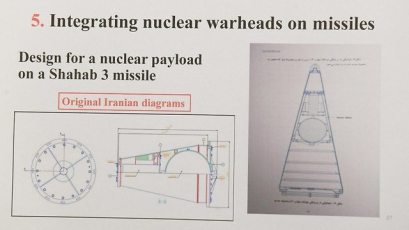
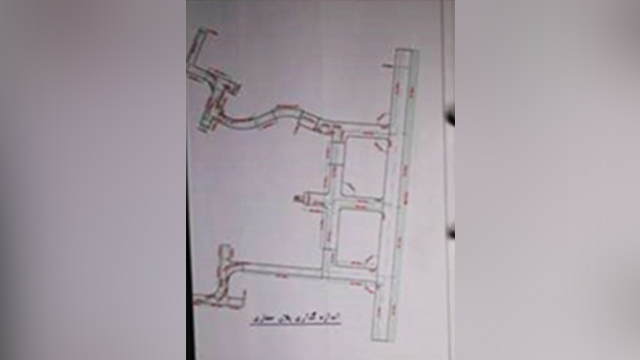
Diagrams from Iran's nuclear archive

Diagrams from Iran’s nuclear archive

Incidentally, nuclear experts who examined the documents say that the Iranian leaders’ plan lays out far more extensive infrastructure than what is needed to produce “only” five bombs.

The making of a nuclear bomb and the ability to launch it is a very complex project that requires a state effort and coordination between all Iranian army and intelligence forces.

One particularly colorful presentation, which was discovered in one of the CDs, shows the complexity of the Iranian nuclear project. According to the presentation, the plan is based on a joint effort of various Iranian bodies: the Intelligence Ministry, the Islamic Revolutionary Guard Corps (including its Aerospace Force), and the Quds Force—the Guards’ secret unit, which is currently waging war with Israel at the Syrian border.

The documents mention time and again the person who is both the manager and the brains behind the nuclear program—Prof. Mohsen Fakhrizadeh. The nuclear archive includes countless documents with Fakhrizadeh’s signature, including documents addressed to him, or approved by him.

For example, one letter addressed to Fakhrizadeh, dated January 19, 2001, and written by the director of the explosive mechanism developing team, delineates a long list of features needed to fit the mechanism to the rest of the nuclear bomb (which is comprised of numerous parts). Fakhrizadeh thanked the director at the bottom of his letter and gave him further instructions.

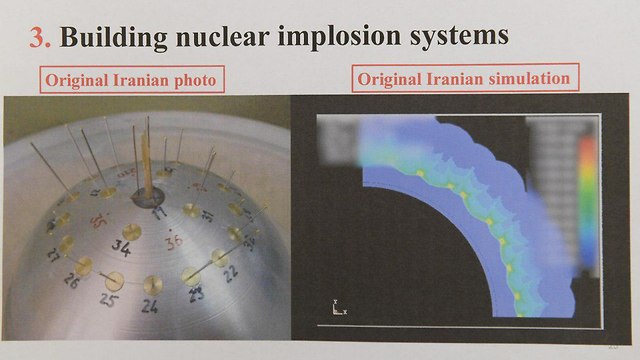
Images from Iran's nuclear archive

Images from Iran’s nuclear archive

According to foreign media reports, Israel considered Fakhrizadeh as a preferred target for intelligence gathering, and even seriously considered harming him, especially during the tenure of former prime minister Ehud Olmert and the late Mossad director Meir Dagan. Since Fakhrizadeh is still alive, the assassination plan has yet to materialize. It appears Olmert decided to halt the operation, and so Fakhrizadeh’s life was spared. If the former prime minister is indeed behind such a decision, there are those who to this day believe it was a mistake.

However, someone—Iranian intelligence sure it was the Mossad—was able to reach various Iranian nuclear scientists whose names appear in the seized documents.

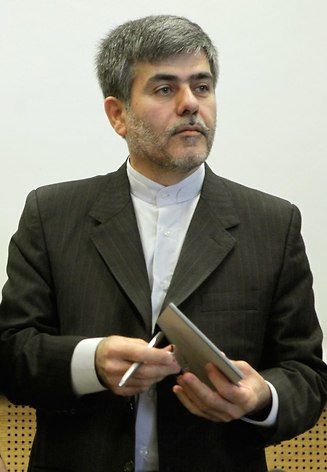
In his handwriting, Dr. Fereydoon Abbasi-Davani, a senior nuclear program official, inscribes a long technical document to Fakhrizadeh, who replied at length.
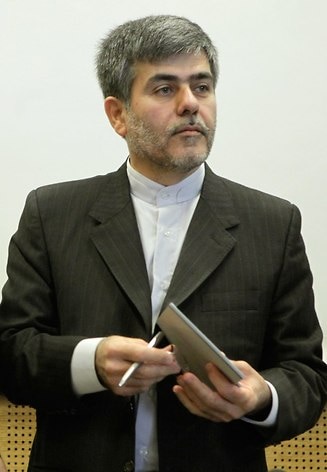
Dr. Fereydoon Abbasi-Davani (Photo: Reuters)

Dr. Fereydoon Abbasi-Davani (Photo: Reuters)

Dr. Abbasi-Davani is the Chair of the physics department at Tehran’s Imam Hossein University and a key figure in Iran’s nuclear program. On November 29, 2010, his colleague Majid Shahriari was assassinated.

An assassin on a motorbike tried to kill Davani as well by attaching a bomb to his car window while he was driving, but Davani managed to escape at the last minute and survived. Iran’s president at the time, Mahmoud Ahmadinejad, appointed Davani as his deputy to show his appreciation for the doctor’s “contribution to the Islamic Republic and for his courage.”

One may feel some discomfort when diving into the piles of Iranian documents, since there’s something eerie about them. For example, the radical state’s dream of creating weapons of mass destruction becomes an orderly and meticulous timeline in Microsoft Project, including information on the program’s budgets, personnel, experiments, and more.

At times, the nuclear documents receive a more personal flair. For instance, in one of the archive’s CDs, agents found “selfie” photos of an Iranian nuclear expert, the heavyset Dr. Mahdi Tranchi, wearing protective goggles and posing for the camera at the “Taleqan 1” nuclear test site.

What happened to all this effort? All those people, information, and experience gathered? Did they all just disappear?

The nuclear sites

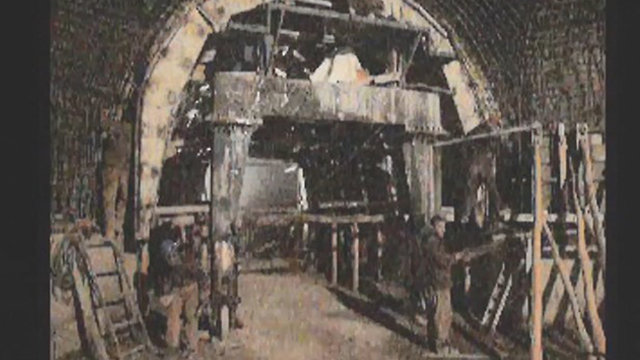
It was not only the people who worked on the Iranian nuclear project that the documents expose. They also expose the places and sites where the nuclear plot was devised, some of which were new discoveries for the Israeli intelligence community (“I wish I had this information in real time,” said a former Israeli intelligence chief when exposed to the material), including nuclear experiment sites, uranium mines located across the country, tunnels (dug to cover up their real purpose), and more.

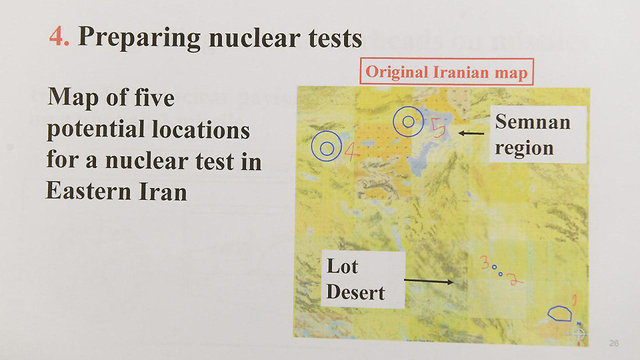
According to the material, the Iranians were looking for an underground nuclear testing site. It goes without saying that to conduct such an experiment, they needed to first build a bomb, which the Iranians have not yet done.
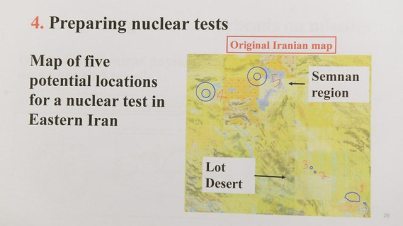
 

Images from Iran's nuclear archive

Images from Iran’s nuclear archive

Furthermore, a nuclear experiment does not depend solely on scientific ability, but mostly on the decision of the political leadership. An underground experiment would have certainly been detected by the West. Such a test would essentially constitute a declaration by Tehran that it had indeed developed a bomb.

In the meantime, until the Iranians develop a nuclear bomb, the Iranians are getting ready, and according to the documents they have already examined various possible sites and even attempted to detonate small explosives deep underground to test the ground, its durability and their own ability to record the measurements of the explosion at that location.

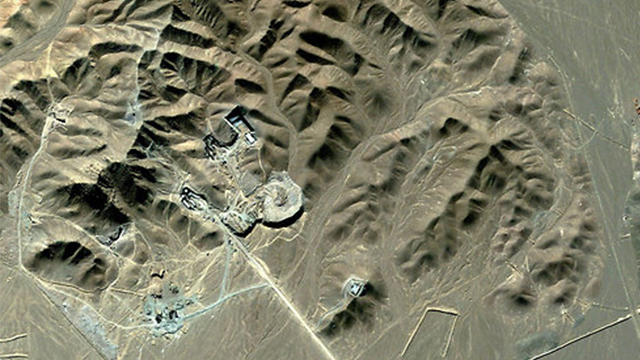
The Israeli intelligence community also discovered new information about some known nuclear sites. For example, the site in Fordow, near the city of Qom, is well hidden at the heart of the mountain, and is extremely resistant to bombs.
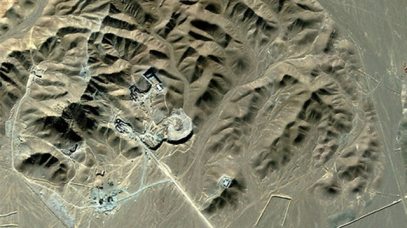
Aerial images of the Fordow facility

Aerial images of the Fordow facility

The Israeli, French, and American intelligence communities exposed it in 2010, but the archive’s documents established its importance as part of the Ghadir Project (another code name for the Iranian secret nuclear program).
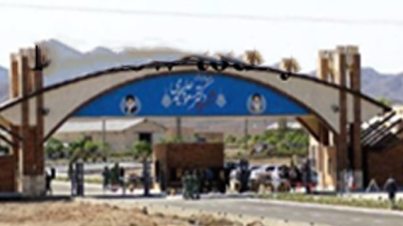
The entrance to the Fordow facility

The entrance to the Fordow facility

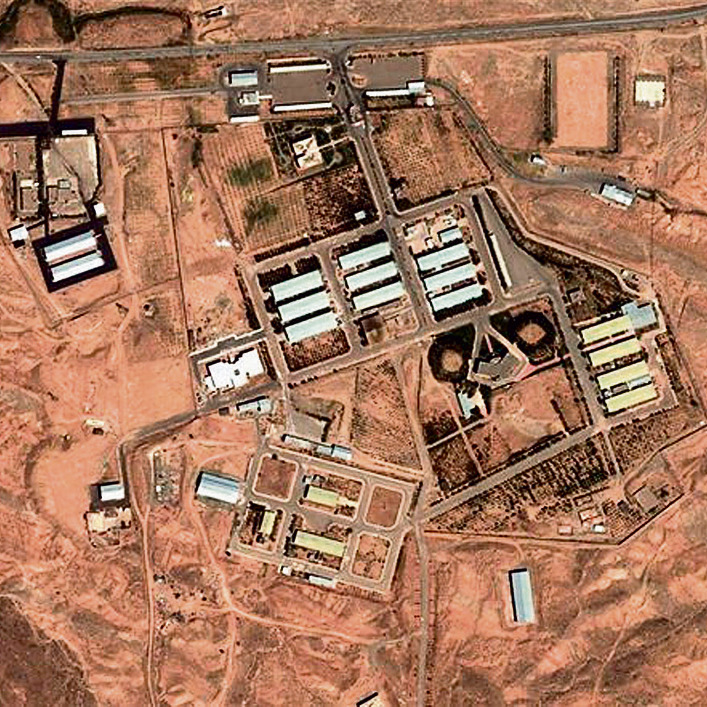
Another example of the scale of the Iranian fraud can be found in the Taleqan testing facility, located in an area called Parchin. IAEA reports raised serious suspicions about the site, but Iran’s denials made it difficult to substantiate these suspicions.
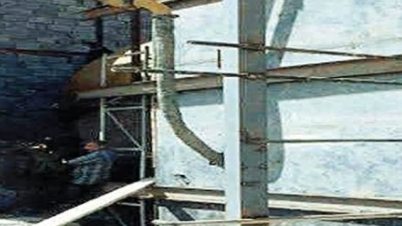
Parchin nuclear facility

Parchin nuclear facility

The IAEA demanded that its inspectors be allowed to visit the site, but the agency’s requests have been repeatedly denied. When the IAEA threatened to accuse Iran of violating the Nuclear Non-Proliferation Treaty, its inspectors were allowed to enter Parchin months later, only to discover that the site had been cleared, and everything in it was carefully removed from the area.
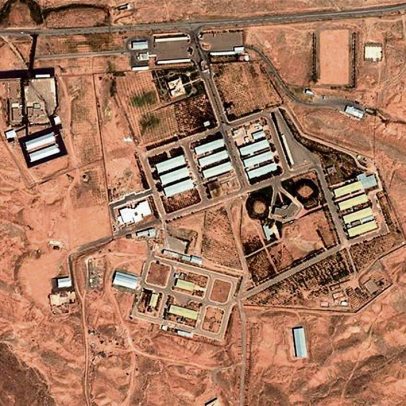
Aerial photo of the facility in Parchin

Aerial photo of the facility in Parchin

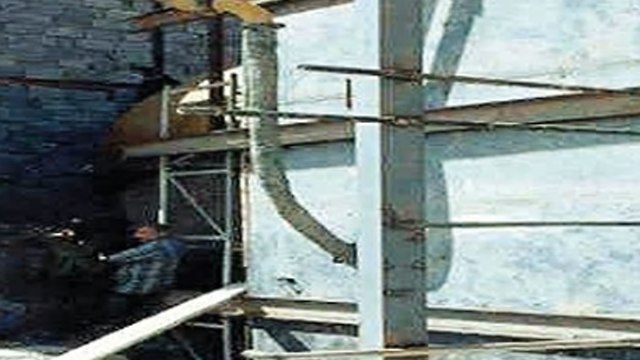
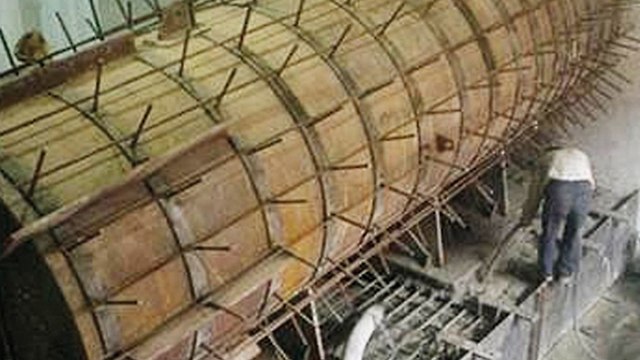
What was there before? One of the crucial steps to building a nuclear bomb is the development of an explosion mechanism that will create critical mass. In the past, Western intelligence agencies circulated sketches of the experiment sites used to build the explosion mechanism. Photos of the site taken by the Iranian scientists look exactly like the sketches.

The Iranian nuclear archive proved how much these sketches were in line with reality: it was an accurate record of the sites, bunkers, test tanks, and equipment that Iran has denied, and still denies using in Parchin / Taleqan, or anywhere else in Iran for that matter.

The experiments

The archive material contains many drawings, presentations, written documents, and photographs. Not just technical images, but also photographs of the nuclear scientists themselves. The scientists must have felt they were a part of Iranian history. Most probably none of them imagined that his pictures would ever find their way to Israel.

Many of these photographs record the nuclear experiments. Iran has denied for years that it is conducting experiments on all PMD topics. For instance, Iran has claimed it did not have any neutron detection equipment, but an archive presentation shows otherwise (with colorful text explaining its uses). Apparently the equipment is located next to the Parchin explosives test site.

The Parchin nuclear facility

The Parchin nuclear facility

In the next slide, dated February 2002, there is a description of the nuclear experiment with an exact record of the DU3, the scientific term for the neutrons’ source, whose collision with nuclear fuel atoms creates a chain reaction that ends with an atomic explosion.

The archive’s documents also reveal that at a nearby site, the Iranians built another tank for testing high explosives; this time with flash X-ray equipment surrounding it. This equipment made up of a sophisticated camera of sorts that can record, with a precision of nanoseconds, the moment of detonation to guarantee that all explosives go off at the same time. This is critical for making explosive lens: a simultaneous explosion of several charges around the fissile material—for example, enriched uranium at a level of 90%—will start a nuclear fission chain reaction.

Tank for testing high explosives, with flash X-ray equipment

Tank for testing high explosives, with flash X-ray equipment

A special contract signed by the Atomic Energy Organization of Iran and Tehran’s Defense Ministry lays out the transfer of part of the enrichment project from the organization to the ministry, in order to produce highly-enriched uranium at a military level of 90%.

The cover-up: the Dark Side of SPND

In 2003, the United States invaded Iraq, and Tehran feared they were next in line; at the same time, the “National Council of Resistance of Iran,” an Iranian opposition group, published material on the Natanz nuclear facility that led to harsh criticism and sanctions against Iran.

The Iranians were worried and so the Scientific Council decided to make some changes and close the AMAD Project, only to reopen it under a different name. This development was interpreted differently by Israel and the United States. The latter determined that closing the AMAD Project brought the nuclear program to a halt. Israel, on the other hand, claimed that it’s an Iranian scam, and that the two projects are one and the same.

The documents from the archive show that Israel was right. These documents record how the general decision to close one project and reopen another became a complex bureaucratic process in August and September 2003.

The purpose of all this was to deceive the world and develop a project that will continue where the AMAD Project left off. The new project was titled “the SPND Project,” and unlike its father, AMAD, which was entirely secret, SPND has two sides: the overt and public side, which allows the Iranians to claim the nuclear program is meant for peaceful purposes (medicine, etc.), and the covert side, which allows Iran to continue developing nuclear weapons.

SPND, by the way, is still active today.

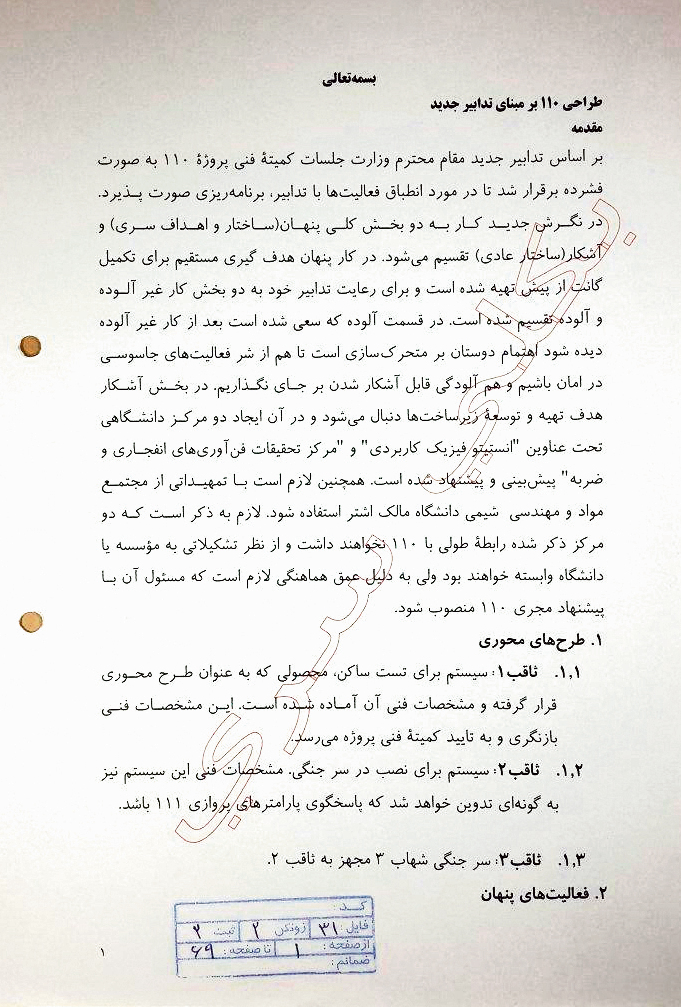
“Following new instruction by the honorable Minister of Defense (Ali Shamkhani—RB), intensive meetings of Project 110 technical committee (one of the main projects of AMAD—RB) were held in order to accommodate the activities to the instructions. In the new outline, the work would be divided in two: covert (secret structure and goals) and overt (regular structure),” reads one Iranian document.
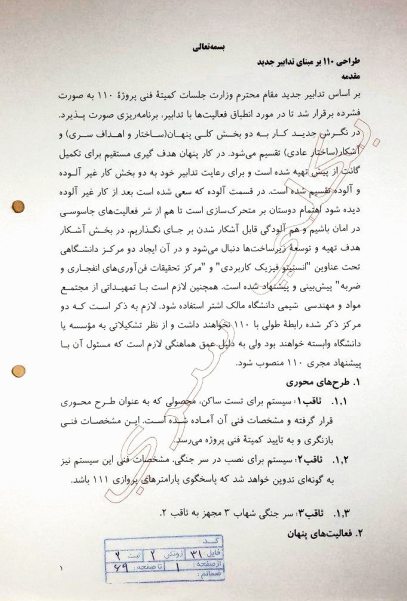
Document determining the new plan, SPND, will have an overt aspect and a covert one

Document determining the new plan, SPND, will have an overt aspect and a covert one

What would the covert part include? For example, the documents show that the secret SPND project will include the nuclear testing facility Sareb-1, the warhead integration facility Sareb-2, and Sareb-3, the facility for the production of a nuclear warhead for Shahab 3 missiles.

According to the documents, all management personnel and 70% of the entire workforce are to transfer from “AMAD” to “SPND.” The scheme was meticulously planned: the documents include a letter written by Abbasi-Davani, to the project’s chief, Fakhrizadeh, on March 3, 2003: “We must make a distinction between overt and covert activities.”

One of their colleagues wrote on January 9, 2003: “Overt activities are those that can be explained as part of something else, and not as part of the project (to produce an atomic bomb) itself, so we have an excuse to do them.”

Dr. Masoud wrote in March 2003: “Neutron research cannot be considered ‘overt’ and must be covert. We have no way of rationalizing this activity (neutron research) as related to defensive measures. Neutron operations are very sensitive and we cannot explain them.”
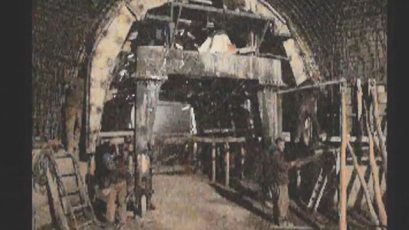
The construction of a core for a nuclear warhead

The construction of a core for a nuclear warhead

Dr. Mahdi Tranchi, the ‘selfie’ enthusiast, wrote: “Let there be no mistake—the manpower of the overt and covert parts will not be reduced. The whole operation will not be reduced, and every sub-project will oversee both the overt and covert parts.”

And so the Iranian project continued from 2004, under SPND, until the signing of the nuclear agreement in the summer of 2015.

At some point, a senior American source told Yedioth Ahronoth, the countries negotiating the nuclear agreement with Tehran decided to “let the past go, even though everyone knew very well that the Iranians were lying, and focus on the future. It was clear to everyone that after the spiritual leader said there was no military project, he would never take it back and admit he lied. The risk was losing the entire deal because insisting on the 12 PMD topics would have led to the collapse of the negotiations.”

After the nuclear agreement was signed, two parallel axes were in play. In one, Iran submitted some material, which led to an IAEA report on the PMD in December 2015. This report, which in effect ignores the questions left open, enables implementation of the nuclear agreement.

In the other, Tehran began to do everything in its power to hide everything it had on its nuclear program. This was unlike other cases of complete nuclear disarmament. Both South Africa and Libya, for example, truly ended their nuclear programs: they either destroyed all the information, so there was nothing left of their archives, or deposited everything they had—their knowledge, documents, and experience, to IAEA inspectors.

The Iranians did the exact opposite: they collected information from countless sites, including private archives and all the material of the AMAD Project, and gathered it it in the Defense Ministry’s archive.

Since the agreement gives the IAEA the right to visit any suspicious site (Tehran currently denies that they have agreed to visits at military sites), the Iranians feared the Defense Ministry archive might also be a target for inspection. So in February 2016, the Iranians moved the archive to an obscure site in a remote suburb of Tehran. The facility is almost entirely unguarded, and therefore does not attract attention. Even the people guarding the facility don’t know what it is that they are protecting.

The break-in

Israeli intelligence had been tracked the “AMAD archive” closely, and had been meticulously planning the operation since early 2017. One Mossad agent responsible for planning the operation said it was “Ocean’s Eleven Style.”

In most Mossad operations of this type, the agents usually infiltrate a building, photograph the material inside, and leave unnoticed. This time, Mossad Director Yossi Cohen decided the material must be physically seized. The reason is twofold: to limit the time agents had to spend inside the building, and to prevent Iran from spreading disinformation and claiming the documents are forged. In this manner, Israel could expose the documents to the scrutiny of the international community.
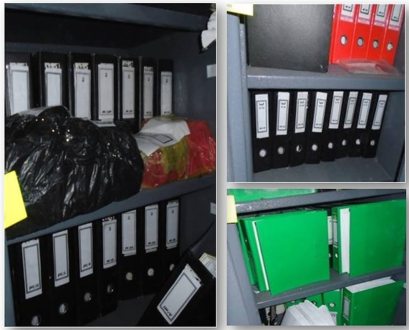
Some of the folders with documents from Iran's nuclear archive

Some of the folders with documents from Iran’s nuclear archive

Over the course of two years, hundreds of people from all branches of the Mossad participated in the operation, and fewer than two dozen agents took part in the break-in itself.

The operation team in Israel did not sleep for several nights, during which the agents gathered inside Iran to prepare the equipment and scope out the area.

Then, on the evening of January 31, the agents entered the vault. When the operation ended and all agents were out of danger, Cohen called Netanyahu and informed him of the operation’s success.

The entrance to the Iranian nuclear archive

The entrance to the Iranian nuclear archive

And it was, indeed, a success: The agents retrieved about half a ton of intelligence material that is worth its weight in gold. There has been very few times in the history of intelligence services since World War II when one agency has been able to obtain so much of the enemy’s secret intelligence material at once.

“Israel didn’t sign the JCPOA. The Mossad didn’t sign the nuclear agreement,” Mossad Director Cohen said in a closed forum. “I have one agreement, with the people of Israel, in which I commit not to allow the Iranians to have a nuclear bomb. That’s it.”

But like everything else, politics got in the way here as well. Since the operation, various claims were made in Israel and abroad against the way the material was presented.

Some believe the documents from the archive justify Netanyahu’s claim that the nuclear agreement is a bad deal based on lies.

A Western intelligence source that was exposed to the material summed it up thus: “The nuclear archive is in fact an effort made by the Iranian Ministry of Defense to preserve the knowledge achieved in the ‘AMAD Project’ from 1998 to 2003, and to hide it from the international community, especially from the IAEA, for possible future use.”

Others, on the other hand, claim these documents prove how close Iran was to producing a nuclear bomb, and so the existence of an agreement that freezes the program and puts the SPND Project under close supervision is a good idea.
 

U.N. calls on Israel to halt daily violations of Lebanese airspace

November 23, 2018

Source: U.N. calls on Israel to halt daily violations of Lebanese airspace – Arab-Israeli Conflict – Jerusalem Post

35% hike in IDF aerial activity in Lebanon due to Iranian concerns

BY TOVAH LAZAROFF
 NOVEMBER 22, 2018 11:40
Peacekeepers from the United Nations Interim Force in Lebanon (UNIFIL) and Lebanese army members are

The IDF increased its almost daily aerial actions in Lebanese airspace by 35% from July to October 24 in response to growing concerns over Hezbollah missiles and Iranian activity in the country and neighboring Syria.

The United Nations Interim Force in Lebanon “recorded 550 air violations, totaling 2,057 overflight hours,” according to a report written by UN Secretary General Antonio Guterres, which the Security Council in New York debated behind closed doors on Wednesday without any conclusions.

“Unmanned aerial vehicles accounted for 481 of these violations (87%), with the remaining violations involving fighter jets or unidentified aircrafts. UNIFIL protested all air violations to the Israel Defense Forces and urged their immediate cessation,” Guterres stated.

The report, which is submitted three times per year, recorded violations of UNSC Resolution 1701 of August 2006 that set out the ceasefire conditions for the end of the Second Lebanon War.

The previous report covering the period March 1 to June 19 “recorded 456 air violations, totaling 1,518 overflight hours. Unmanned aerial vehicles accounted for 368 (80.7%) of these violations.”

Guterres also called on Hezbollah to disarm, stating that possession of weapons by a non-state actor “is deeply troubling and poses a dangerous threat to the stability of Lebanon and the region.”

He added that “allegations of illegal arms transfers to non-state armed groups [Hezbollah] in Lebanon also continue and warrant serious concern.”

But, he said, “the United Nations is not in a position to substantiate them independently. Were these allegations to be proven correct, they would constitute a violation of resolution 1701 (2006).”

In its report, the UN said it was also unable to verify Israeli reports of three sites near Beirut’s International border which convert inaccurate projectiles into precision missiles. Nor did it confirm Israeli allegations that Iran has sent arm shipments to Lebanon on commercial flights to Beirut.

Late last month Israeli Ambassador to the UN Danny Danon called on the UNSC and Guterres to condemn Hezbollah actions in Lebanon, including the storage of weapons near the airport.

“Every minute of inaction breathes life into Hezbollah’s deadly terrorist ambitions,” Danon said.

“Any country whose citizens land at the airport in Beirut should be anxious about Hezbollah activity in the region,” he added. “Israel reserves the right to protect its citizens from the growing threat of Hezbollah, and will not tolerate Hezbollah’s use of Lebanon as a launching pad for attacks that threaten the lives of innocent Israelis.”

Hezbollah has more than 100,000 rockets and precision missiles in Lebanon, IDF Strategic Division Brig.-Gen. Ram Yavne told the The Jerusalem Post Diplomatic Conference on Wednesday.

He added that every third or fourth home in Lebanon was being used to store weapons.

Prominent Likud politician Gideon Sa’ar told the conference that Hezbollah had “significantly upgraded its capabilities in the last years.”

Sa’ar called for preemptive military strikes against Hezbollah’s precision guided missiles before it was too late, noting that the window of opportunity to mitigate Hezbollah’s military threat was closing.


IAEA: Iran adhering to nuclear deal, as renewed U.S. sanctions take effect

November 23, 2018

Source: IAEA: Iran adhering to nuclear deal, as renewed U.S. sanctions take effec – International news – Jerusalem Post

EU powers have been scrambling to prevent a collapse of the deal, under which international sanctions against Tehran were lifted in exchange for strict limits on Iran’s nuclear activities.

BY REUTERS
 NOVEMBER 22, 2018 14:28
IAEA: Iran adhering to nuclear deal, as renewed U.S. sanctions take effect

VIENNA- Iran is implementing its side of its nuclear deal with major powers, the U.N. atomic watchdog policing the pact reaffirmed on Thursday, two weeks after the latest wave of reimposed U.S. sanctions against Tehran took effect.

President Donald Trump said in May he was pulling the United States out of the 2015 nuclear deal for reasons including Iran’s influence on the wars in Syria and Yemen and its ballistic missile program, none of which are covered by the pact.

Germany, France and Britain have been scrambling to prevent a collapse of the deal, under which international sanctions against Tehran were lifted in exchange for strict limits being placed on Iran’s nuclear activities.

Many Western companies have cancelled plans to do business with Iran for fear of breaching the sanctions Washington has put back in place. That has raised fears that Iran will breach the deal’s nuclear limits, which are designed to keep it a year away from being able to build a nuclear weapon if it chose to.

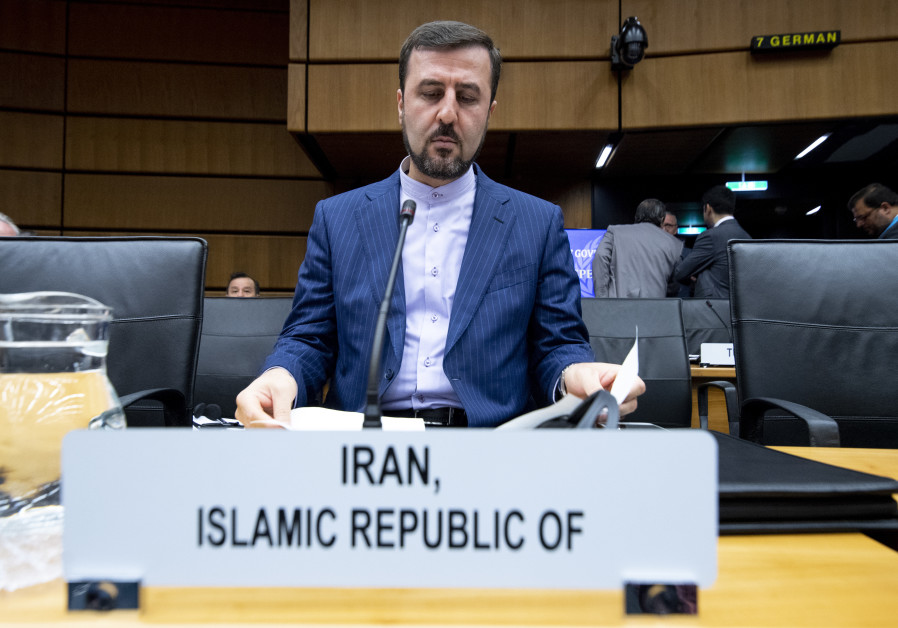
“Iran is implementing its nuclear-related commitments under the Joint Comprehensive Plan of Action,” International Atomic Energy Agency Director-General Yukiya Amano told a quarterly meeting of his agency’s 35-nation Board of Governors.

The JCPOA is the official name of the nuclear accord.

“It is essential that Iran continues to fully implement those commitments,” he added, confirming the findings of a confidential report to IAEA member states last week.

Amano did not comment on the broader impact of U.S. sanctions, the latest round of which took effect on Nov. 5. Iran has warned it could scrap the deal if signatories France, Britain and Germany and their allies fail to preserve the economic benefits promised by its terms.

The European powers have been working on setting up a so-called special-purpose vehicle that would act as a kind of clearing house matching Iranian exports with EU exports in what amounts to a barter arrangement to circumvent U.S. sanctions.

But the countries they have approached to host it have declined, diplomats say, delaying the project and deepening doubt as to whether Europeans can counteract the bulk of U.S. sanctions targeting oil and other vital sources of income.


Column One: Hamas and Fatah unmasked 

November 23, 2018

Source: Column One: Hamas and Fatah unmasked – Opinion – Jerusalem Post

Abbas was similarly blindsided by Prime Minister Binyamin Netanyahu’s visit to Oman, and Minister of Culture and Sports Miri Regev’s visit to Abu Dhabi for the world judo championships.

BY CAROLINE B. GLICK
 NOVEMBER 22, 2018 21:45
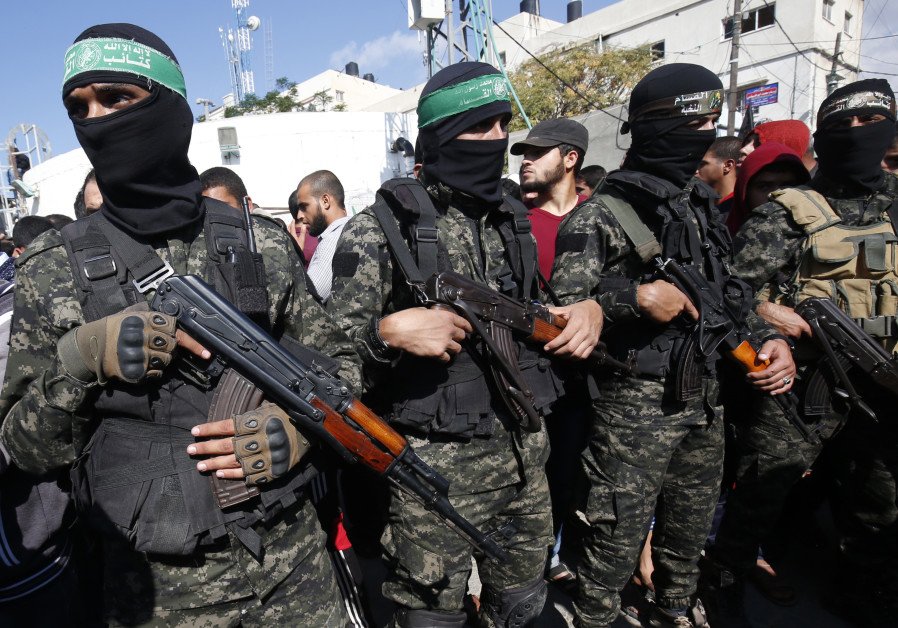
Palestinian militants of the Islamist movement Hamas' military wing Al-Qassam Brigades

The first thing we learned about Hamas is that its control over Gaza is all encompassing.

This week, the media published the communications between Hamas forces during their battle with IDF Special Forces in Gaza on November 11. From those communications we learned that Hamas forces detected the vehicle carrying the Israeli forces very quickly. While they didn’t know who was in the vehicle, they knew the vehicle was suspicious and dispatched a force to intercept it.

Hamas’s ability to detect the vehicle and act swiftly to intercept it demonstrated the terror regime’s ability to use both technological and physical assets to maintain its control over Gaza in a manner reminiscent of the Stasi in East Germany.

THE ALMOST-WAR with Hamas last week also taught us that contrary to the longstanding assessment of the IDF’s General Staff, Hamas is not at all interested in reaching a long-term ceasefire with Israel and therefore there is no point in trying to negotiate one.

For the past several months, various experts inside the Israeli government and military and in foreign countries have claimed that Hamas’s leadership in Gaza is split between two factions.

The first faction, led by Hamas Secretary General Ismail Haniyeh, works with Iran and Qatar to scuttle all efforts to reach a long-term ceasefire between Hamas and Israel. The second ostensible faction in this ostensible rivalry is led by Hamas terror boss Yahya Sinwar. The Sinwar faction, so the thinking goes, while dedicated to fighting Israel until it is destroyed, believes that the most urgent order of business is solving Gaza’s humanitarian crisis. Based on this assessment, Israel opted to permit Qatar to supply Gaza with gas to fuel its power stations and cash to fill its pockets. The day before Hamas’s largest rocket and mortar onslaught against southern Israel ever, Israel permitted Qatar to transfer $15 million in cash to Hamas.

The fact that right after receiving the cash Sinwar turned around and ordered the rocket assault on Israel shows that his purported interest in a long-term ceasefire with Israel, and the alleged breach between Haniyeh on the one hand and Sinwar on the other was a ruse. He didn’t want a ceasefire. He wanted to fight under optimal conditions – with the power plant purring, his pockets full of cash and his public ecstatic at his great success in bamboozling the bumbling Jews.

THE THIRD THING we learned about Hamas last week is that it is in the process of swallowing the PLO. Pinchas Inbari from the Jerusalem Center for Public Affairs reported that Hamas brought two PLO factions – the Popular Front for the Liberation of Palestine and the Democratic Front for the Liberation of Palestine – into its war room in Gaza. Both the PFLP and the DFLP have been outspoken in their condemnations of the main PLO faction Fatah and Fatah’s leader Mahmoud Abbas for his refusal to supply Hamas-controlled Gaza with money and electricity. By allowing them a seat at the table in its war room, Hamas is effectively replacing Fatah as the PLO ruling faction.

Last month, in the lead up to the PLO’s Palestinian National Council meeting in Ramallah, Abbas was threatening to stiffen his sanctions against Hamas. But Inbari revealed that ahead of the PNC meeting which took place three weeks ago, Fatah Tanzim terrorists warned Abbas that if he ordered more sanctions against Hamas, Hamas would go to war against Fatah forces in Judea and Samaria.

Like his Tanzim terror operatives, Abbas recognized that Fatah will lose such a war. So he stood down.
Fatah would lose a war with Hamas because as Hamas gets stronger, Fatah is falling apart.

TODAY, Fatah and the PA are beset by three crises which, together and separately, ensure that it will soon implode.

First, it is in a leadership crisis. Abbas is 83 years old. He suffers from multiple medical problems which reportedly include prostate cancer and heart disease. While a number of Fatah officials jockey to replace him, none has the backing of a significant enough cross section of Palestinian power brokers and outside powers to succeed Abbas without a fight that will leave the PA/Fatah bloodied, hollowed out and discredited in the eyes of its public and its foreign stakeholders.

Abbas’s waning power manifests itself almost daily. On May 15, the day the American Embassy opened in Jerusalem, his PA had ordered Arab Jerusalemites to hold a general strike. As Inbari notes, the initiative was a complete flop. It went largely unnoticed only because Hamas staged a massive, violent riot against Israel along the border fence with Gaza that day which captured all of the media’s attention.

In the recent Jerusalem municipal elections, Arab Jerusalemites tried to defy the PA’s order to boycott the poll. Several attempted to stand for election. In the end, the PA was able to force the would-be candidates to opt out of the race and keep Jerusalem’s Arabs away from the polls. But this showed that the local Arab population’s defiance of the PA is rapidly growing.

Rather than disassociate from Israel, increasing numbers of Jerusalem Arabs are applying for Israeli citizenship.

THE SECOND CRISIS afflicting the PA is economic. The US suspension of budgetary assistance to the PA and financial support for UNRWA has caused significant harm to the Palestinian economy. And the public is revolting.

While all eyes were glued to Gaza and Hamas’s rocket onslaught against southern Israel last week, tens of thousands of Palestinians were demonstrating in Ramallah against the PA’s decision to nationalize private pensions and insurance policies. The mass protests have continued this week.

Shortly after the PA was established in Gaza in 1994, Israel handed over the pension funds it set up for local employees of the Civil Administration. In a matter of months, the PA emptied the accounts leaving the administration’s pensioners penniless. Palestinian residents of Judea and Samaria are uninterested in having that happen to their savings.

The PA’s demand that Palestinians end their economic cooperation with Israel and stop working for Israeli companies is similarly being met with derision and fury. Inbari reported that Sahar Saed, chairman of the board of commerce in Nablus, attacked Boycott, Divestment and Sanctions groups for calling for Palestinians to stop working for Israeli companies. Saad said that so long as there are no alternative job opportunities for the Palestinians, the BDS groups and the PA which backs them need to stop bothering Palestinian workers at Israeli-managed industrial parks in Judea and Samaria.

THE THIRD CRISIS which is destroying Fatah and its Palestinian Authority is the Arab world’s decision, for the first time in 70 years, to effectively abandon the Palestinian cause as a unifying force for the Arab world.

Some Arab leaders openly express a desire to move beyond the Palestinians and rejection of Israel and concentrate the efforts of the Arab League on unifying against Iran and Turkey.
Saudi Arabia, for its part, has begun directly undermining the basis of PLO power.

Riyadh recently announced it would stop accepting laissez passes from Arab Jerusalemites and instead will require them to use real passports. In response, Arab Jerusalemites are applying for Israeli citizenship.

Equally, if not more significantly, the Saudis have begun pressuring the Lebanese government to naturalize the Palestinians who have lived in Lebanon for 70 years in UN refugee camps.

Ahead of his address before the UN General Assembly in September, Abbas was unable to secure meetings with Arab leaders. The only leaders willing to meet with him were the Europeans who have replaced the Arabs as the main supporter of the PLO specifically and the Palestinians more generally.

Abbas was similarly blindsided by Prime Minister Binyamin Netanyahu’s visit to Oman, and Minister of Culture and Sports Miri Regev’s visit to Abu Dhabi for the world judo championships.

For their part, both the IDF General Staff and the government have shown little awareness or ability to deal coherently with the unfolding realities revealed in Hamas-ruled Gaza and in the Fatah-controlled PA.

AS FAR AS Hamas is concerned, its complete control over Gaza and its across-the-board rejection of any significant cessation of hostilities with Israel shows that the IDF’s longstanding assessments of Hamas have been wrong. The IDF General Staff’s insistence on appeasing Hamas to achieve a long-term ceasefire was justified on the basis of an incorrect reading of Hamas’s interests and goals. The government’s decision to agree to sue for a ceasefire was predicated on the General Staff’s failure to understand or reconcile with Hamas’s interests and goals.

And if the General Staff failed to understand Hamas’s intentions and so misinformed the government, the government and the IDF have together failed to deal competently with the PA’s rapidly encroaching collapse. This failure was exposed in part in a document authored by Col. Alon Mednes, who served until recently as Operations Officer of Central Command. Mednes’s letter on the state of Central Command was written in the summer and leaked to the media earlier this week. Among the many worrying assessments included in his letter, one related to Central Command’s continued role as military commander of Judea and Samaria is of particular significance in light of Fatah’s disintegration.

Mednes wrote, “When you’re here [in Judea and Samaria], you understand that without a narrative about our present governance here, which is reinforced from time to time, the Command is liable to become irrelevant.”

THE MAIN reason that Central Command doesn’t have a narrative is because its continued military rule makes no sense. Israel transferred governing power from the Military Government to the PA 22 years ago. Ever since, the Military Government has been limited to Area C. The overwhelming majority of the residents of Area C are not Palestinians but Israelis. In other words, for 22 years, the Military Government has governed Israeli citizens.

Clearly, the IDF has no ready narrative to explain this absurd state of affairs. The IDF has little to contribute as a governing authority to the daily lives of half a million Israelis. Even worse, its continued political power diminishes the IDF’s coherence as a fighting force while harming the civil rights of Israelis who live in the area.

Israelis are divided over whether the PA’s coming collapse is a good or bad thing. But regardless of its potential value, it will blow up in Israel’s face if the government doesn’t decide now how it wants to deal with a post-Fatah/PA Judea and Samaria .

We learned a lot about the Palestinians over the past few weeks. The most urgent order of business for the government and the IDF is to deal realistically with what we now know.

http://www.CarolineGlick.com


Column One: Hamas and Fatah unmasked 

November 23, 2018

Source: Column One: Hamas and Fatah unmasked – Opinion – Jerusalem Post

Abbas was similarly blindsided by Prime Minister Binyamin Netanyahu’s visit to Oman, and Minister of Culture and Sports Miri Regev’s visit to Abu Dhabi for the world judo championships.

BY CAROLINE B. GLICK
 NOVEMBER 22, 2018 21:45
Palestinian militants of the Islamist movement Hamas' military wing Al-Qassam Brigades

The recent almost-war with Hamas taught us a lot about the terror regime. It also taught us a lot about Hamas’s rival, Fatah, and the Palestinian Authority it controls in Ramallah. Israel’s most urgent task is to understand the implications of what we now know.

The first thing we learned about Hamas is that its control over Gaza is all encompassing.

This week, the media published the communications between Hamas forces during their battle with IDF Special Forces in Gaza on November 11. From those communications we learned that Hamas forces detected the vehicle carrying the Israeli forces very quickly. While they didn’t know who was in the vehicle, they knew the vehicle was suspicious and dispatched a force to intercept it.

Hamas’s ability to detect the vehicle and act swiftly to intercept it demonstrated the terror regime’s ability to use both technological and physical assets to maintain its control over Gaza in a manner reminiscent of the Stasi in East Germany.

THE ALMOST-WAR with Hamas last week also taught us that contrary to the longstanding assessment of the IDF’s General Staff, Hamas is not at all interested in reaching a long-term ceasefire with Israel and therefore there is no point in trying to negotiate one.

For the past several months, various experts inside the Israeli government and military and in foreign countries have claimed that Hamas’s leadership in Gaza is split between two factions.

The first faction, led by Hamas Secretary General Ismail Haniyeh, works with Iran and Qatar to scuttle all efforts to reach a long-term ceasefire between Hamas and Israel. The second ostensible faction in this ostensible rivalry is led by Hamas terror boss Yahya Sinwar. The Sinwar faction, so the thinking goes, while dedicated to fighting Israel until it is destroyed, believes that the most urgent order of business is solving Gaza’s humanitarian crisis. Based on this assessment, Israel opted to permit Qatar to supply Gaza with gas to fuel its power stations and cash to fill its pockets. The day before Hamas’s largest rocket and mortar onslaught against southern Israel ever, Israel permitted Qatar to transfer $15 million in cash to Hamas.

The fact that right after receiving the cash Sinwar turned around and ordered the rocket assault on Israel shows that his purported interest in a long-term ceasefire with Israel, and the alleged breach between Haniyeh on the one hand and Sinwar on the other was a ruse. He didn’t want a ceasefire. He wanted to fight under optimal conditions – with the power plant purring, his pockets full of cash and his public ecstatic at his great success in bamboozling the bumbling Jews.

THE THIRD THING we learned about Hamas last week is that it is in the process of swallowing the PLO. Pinchas Inbari from the Jerusalem Center for Public Affairs reported that Hamas brought two PLO factions – the Popular Front for the Liberation of Palestine and the Democratic Front for the Liberation of Palestine – into its war room in Gaza. Both the PFLP and the DFLP have been outspoken in their condemnations of the main PLO faction Fatah and Fatah’s leader Mahmoud Abbas for his refusal to supply Hamas-controlled Gaza with money and electricity. By allowing them a seat at the table in its war room, Hamas is effectively replacing Fatah as the PLO ruling faction.

Last month, in the lead up to the PLO’s Palestinian National Council meeting in Ramallah, Abbas was threatening to stiffen his sanctions against Hamas. But Inbari revealed that ahead of the PNC meeting which took place three weeks ago, Fatah Tanzim terrorists warned Abbas that if he ordered more sanctions against Hamas, Hamas would go to war against Fatah forces in Judea and Samaria.

Like his Tanzim terror operatives, Abbas recognized that Fatah will lose such a war. So he stood down.

Fatah would lose a war with Hamas because as Hamas gets stronger, Fatah is falling apart.

TODAY, Fatah and the PA are beset by three crises which, together and separately, ensure that it will soon implode.

First, it is in a leadership crisis. Abbas is 83 years old. He suffers from multiple medical problems which reportedly include prostate cancer and heart disease. While a number of Fatah officials jockey to replace him, none has the backing of a significant enough cross section of Palestinian power brokers and outside powers to succeed Abbas without a fight that will leave the PA/Fatah bloodied, hollowed out and discredited in the eyes of its public and its foreign stakeholders.

Abbas’s waning power manifests itself almost daily. On May 15, the day the American Embassy opened in Jerusalem, his PA had ordered Arab Jerusalemites to hold a general strike. As Inbari notes, the initiative was a complete flop. It went largely unnoticed only because Hamas staged a massive, violent riot against Israel along the border fence with Gaza that day which captured all of the media’s attention.

In the recent Jerusalem municipal elections, Arab Jerusalemites tried to defy the PA’s order to boycott the poll. Several attempted to stand for election. In the end, the PA was able to force the would-be candidates to opt out of the race and keep Jerusalem’s Arabs away from the polls. But this showed that the local Arab population’s defiance of the PA is rapidly growing.

Rather than disassociate from Israel, increasing numbers of Jerusalem Arabs are applying for Israeli citizenship.

THE SECOND CRISIS afflicting the PA is economic. The US suspension of budgetary assistance to the PA and financial support for UNRWA has caused significant harm to the Palestinian economy. And the public is revolting.

While all eyes were glued to Gaza and Hamas’s rocket onslaught against southern Israel last week, tens of thousands of Palestinians were demonstrating in Ramallah against the PA’s decision to nationalize private pensions and insurance policies. The mass protests have continued this week.

Shortly after the PA was established in Gaza in 1994, Israel handed over the pension funds it set up for local employees of the Civil Administration. In a matter of months, the PA emptied the accounts leaving the administration’s pensioners penniless. Palestinian residents of Judea and Samaria are uninterested in having that happen to their savings.

The PA’s demand that Palestinians end their economic cooperation with Israel and stop working for Israeli companies is similarly being met with derision and fury. Inbari reported that Sahar Saed, chairman of the board of commerce in Nablus, attacked Boycott, Divestment and Sanctions groups for calling for Palestinians to stop working for Israeli companies. Saad said that so long as there are no alternative job opportunities for the Palestinians, the BDS groups and the PA which backs them need to stop bothering Palestinian workers at Israeli-managed industrial parks in Judea and Samaria.

THE THIRD CRISIS which is destroying Fatah and its Palestinian Authority is the Arab world’s decision, for the first time in 70 years, to effectively abandon the Palestinian cause as a unifying force for the Arab world.

Some Arab leaders openly express a desire to move beyond the Palestinians and rejection of Israel and concentrate the efforts of the Arab League on unifying against Iran and Turkey.
Saudi Arabia, for its part, has begun directly undermining the basis of PLO power.

Riyadh recently announced it would stop accepting laissez passes from Arab Jerusalemites and instead will require them to use real passports. In response, Arab Jerusalemites are applying for Israeli citizenship.

Equally, if not more significantly, the Saudis have begun pressuring the Lebanese government to naturalize the Palestinians who have lived in Lebanon for 70 years in UN refugee camps.

Ahead of his address before the UN General Assembly in September, Abbas was unable to secure meetings with Arab leaders. The only leaders willing to meet with him were the Europeans who have replaced the Arabs as the main supporter of the PLO specifically and the Palestinians more generally.

Abbas was similarly blindsided by Prime Minister Binyamin Netanyahu’s visit to Oman, and Minister of Culture and Sports Miri Regev’s visit to Abu Dhabi for the world judo championships.

For their part, both the IDF General Staff and the government have shown little awareness or ability to deal coherently with the unfolding realities revealed in Hamas-ruled Gaza and in the Fatah-controlled PA.

AS FAR AS Hamas is concerned, its complete control over Gaza and its across-the-board rejection of any significant cessation of hostilities with Israel shows that the IDF’s longstanding assessments of Hamas have been wrong. The IDF General Staff’s insistence on appeasing Hamas to achieve a long-term ceasefire was justified on the basis of an incorrect reading of Hamas’s interests and goals. The government’s decision to agree to sue for a ceasefire was predicated on the General Staff’s failure to understand or reconcile with Hamas’s interests and goals.

And if the General Staff failed to understand Hamas’s intentions and so misinformed the government, the government and the IDF have together failed to deal competently with the PA’s rapidly encroaching collapse. This failure was exposed in part in a document authored by Col. Alon Mednes, who served until recently as Operations Officer of Central Command. Mednes’s letter on the state of Central Command was written in the summer and leaked to the media earlier this week. Among the many worrying assessments included in his letter, one related to Central Command’s continued role as military commander of Judea and Samaria is of particular significance in light of Fatah’s disintegration.

Mednes wrote, “When you’re here [in Judea and Samaria], you understand that without a narrative about our present governance here, which is reinforced from time to time, the Command is liable to become irrelevant.”

THE MAIN reason that Central Command doesn’t have a narrative is because its continued military rule makes no sense. Israel transferred governing power from the Military Government to the PA 22 years ago. Ever since, the Military Government has been limited to Area C. The overwhelming majority of the residents of Area C are not Palestinians but Israelis. In other words, for 22 years, the Military Government has governed Israeli citizens.

Clearly, the IDF has no ready narrative to explain this absurd state of affairs. The IDF has little to contribute as a governing authority to the daily lives of half a million Israelis. Even worse, its continued political power diminishes the IDF’s coherence as a fighting force while harming the civil rights of Israelis who live in the area.

Israelis are divided over whether the PA’s coming collapse is a good or bad thing. But regardless of its potential value, it will blow up in Israel’s face if the government doesn’t decide now how it wants to deal with a post-Fatah/PA Judea and Samaria .

We learned a lot about the Palestinians over the past few weeks. The most urgent order of business for the government and the IDF is to deal realistically with what we now know.

http://www.CarolineGlick.com


Trump: CIA ‘Didn’t Conclude’ Saudi Prince Ordered Killing | Time

November 23, 2018

Source: Trump: CIA ‘Didn’t Conclude’ Saudi Prince Ordered Killing | Time

President Donald Trump disputed that U.S. intelligence officials have definitively concluded that Saudi’s crown prince ordered the murder of U.S.-based columnist Jamal Khashoggi, while continuing to tout the importance of maintaining economic ties with the Kingdom.

A confidential Central Intelligence Agency report on Khashoggi’s death says Crown Prince Mohammed bin Salman “might have done it,” Trump said Thursday, referring to a demand that the journalist be killed. But the CIA “didn’t conclude” that the prince made the demand, the president told reporters during a press conference at his Mar-a-Lago resort in Florida.

“You can conclude maybe he did or maybe he didn’t,” Trump said about the CIA report. “Whether he did or whether he didn’t, he denies it vehemently.”

Several news organizations including the Washington Post and New York Times have reported that the CIA concluded the crown prince ordered Khashoggi’s assassination in Istanbul last month, contradicting the Saudi government’s claim he wasn’t involved. CIA officials have high confidence in their conclusion, which is based on multiple sources of intelligence, the Post reported Nov. 16.

“They did not come to a conclusion,” Trump said Thursday. “They have feelings certain ways.”

The president added that he didn’t know if anyone will ever be able to conclude that the crown prince demanded the murder.

Trump’s comments come after days of affirming his support for Saudi Arabia. Trump reiterated his backing Thursday, praising the country for being a strong ally, purchasing military equipment from U.S. companies, and keeping oil prices low.

“Do people really want me to give up hundreds of thousands of jobs?” Trump said. “Frankly if we went by this standard, we wouldn’t be able to have anybody as an ally, because look at what happens all over the world.”

Congressional leaders have been more skeptical of the crown prince’s denials. Senate Foreign Relations Committee Chairman Bob Corker and the panel’s ranking Democrat, Bob Menendez, invoked a human rights-related law on Tuesday to require a formal U.S. determination of whether the prince is responsible for Khashoggi’s murder. Such a determination could trigger additional sanctions.

“If you want to see a global depression all you have to do is lift the oil price $50 a barrel,” Trump said. “We want low oil prices and Saudi Arabia’s really done a good job.”


Trump: Israel would be in big trouble without Saudi Arabia 

November 23, 2018

Source: Trump: Israel would be in big trouble without Saudi Arabia | The Times of Israel

Defending stance on Khashoggi killing, US president suggests that without Washington’s ‘strong ally’ Riyadh, Israel would be forced ‘to leave’ region

US President Donald Trump on Thursday suggested that Israel would face major regional difficulties in the Middle East if it were not for the stabilizing presence of Saudi Arabia.

“Israel would be in big trouble without Saudi Arabia,” Trump told reporters after a Thanksgiving Day telephone call with members of the military from his Mar-a-Lago resort home in Florida.

The US president was asked to comment on reports that the CIA had concluded that Saudi Arabia’s Crown Prince Mohammad Bin Salman ordered the brutal murder of US-based Saudi journalist Jamal Khashoggi in the Saudi consulate in Istanbul in October.

“If you look at Israel, Israel would be in big trouble without Saudi Arabia,” Trump said. “So what does that mean, Israel is going to leave? You want Israel to leave? We have a very strong ally in Saudi Arabia.”

“The fact is that Saudi Arabia is tremendously helpful in the Middle East, if we didn’t have Saudi Arabia we wouldn’t have a big base, we wouldn’t have any reason probably…” Trump said, without finishing the sentence.

Critics in Congress and high-ranking officials in other countries have accused Trump of ignoring human rights and giving Saudi Arabia a pass for economic reasons, including its influence on the world oil market.

Noting that Saudi Arabia helps keep oil prices down, Trump on Thursday argued that almost no country is without its faults.

“If we go by a certain standard we won’t be able to have allies with almost any country,” he said.

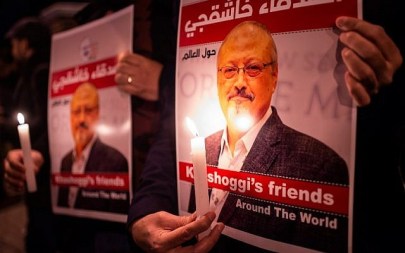
People hold posters picturing Saudi journalist Jamal Khashoggi and candles during a gathering outside the Saudi Arabia consulate in Istanbul, on October 25, 2018. (Yasin Akgul/AFP)

Citing vehement denials by the Saudi crown prince and king that they were involved in Khashoggi’s killing, which he termed “an atrocity,” Trump said, “maybe the world should be held accountable because the world is a vicious place. The world is a very, very vicious place.”

Trump said this week he would not impose harsher penalties on the crown prince over the death and dismemberment of Washington Post columnist Khashoggi.

On Tuesday, Trump also mentioned Israel in justifying why US-Saudi ties would not suffer over the Khashoggi scandal.

“The United States intends to remain a steadfast partner of Saudi Arabia to ensure the interests of our country, Israel, and all other partners in the region,” he said.

Earlier this month, in Israel’s first public comments on the murder of Khashoggi, Prime Minister Benjamin Netanyahu said that while the killing was “horrendous,” it was still necessary to preserve stability in the Arab kingdom.

Netanyahu’s comments came a day after the Washington Post reported that the Israeli leader had recently urged the White House to maintain its support for the crown prince amid growing criticism over the killing of Khashoggi. Netanyahu told Trump administration officials that the crown prince was a key strategic partner and a linchpin of the alliance against Iranian encroachment in the region, according to the Post.

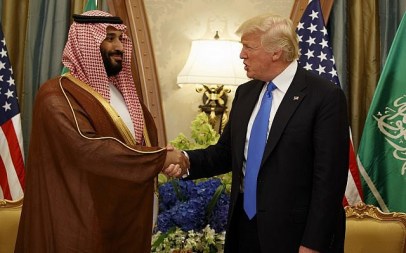
In this May 20, 2017, file photo, President Donald Trump shakes hands with Saudi Deputy Crown Prince and Defense Minister Mohammed bin Salman in Riyadh. (AP Photo/Evan Vucci)

Israel does not have diplomatic ties with Saudi Arabia although the two countries have found a common foe in Iran.

American intelligence agencies have concluded that the crown prince ordered the killing in the Saudi Consulate in Turkey, according to a US official familiar with the assessment. The official was not authorized to discuss the matter publicly and spoke on condition of anonymity.


US envoy: Iran has failed to declare all chemical weapons 

November 23, 2018

Source: US envoy: Iran has failed to declare all chemical weapons – Israel Hayom

U.S. is worried Iran is seeking “central nervous system-acting chemicals for offensive purposes,” Kenneth Ward tells Organisation for Prohibition of Chemical Weapons • Iran: Claims are groundless • Atomic agency: Iran meeting nuclear-related commitments.

After quitting, Lieberman slams government ‘capitulation to Hamas’ 

November 23, 2018

Source: After quitting, Lieberman slams government ‘capitulation to Hamas’ – Israel Hayom