Source: Trump says US will support Saudi Arabia despite murder controversy ‘for Israel’ – Israel Hayom
U.S. will remain a “steadfast partner of Saudi Arabia to ensure the interests of our country, Israel and all other partners in the region,” Trump says • He declares he will not further punish Saudi Arabia for the murder of journalist Jamal Khashoggi.
|
U.S. President Donald Trump with Saudi Crown Prince Mohammed bin Salman at the White House, March 20
| Photo: Reuters
|
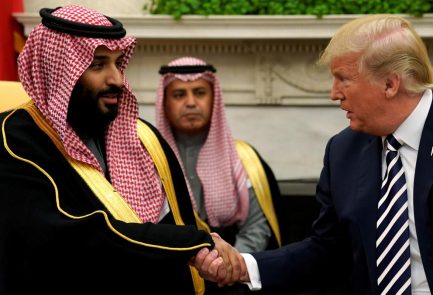
U.S. President Donald Trump declared Tuesday he would not further punish Saudi Arabia for the murder of columnist Jamal Khashoggi – making clear in an exclamation-filled statement that the benefits of good relations with the kingdom outweigh the possibility that its crown prince ordered the killing.
“The United States intends to remain a steadfast partner of Saudi Arabia to ensure the interests of our country, Israel and all other partners in the region,” Trump said in the statement.
The U.S. needs a “counterbalance” to Iran, “and Israel needs help, too,” Trump said. “If we abandon Saudi Arabia, it would be a terrible mistake.”
Khashoggi, a Saudi columnist for The Washington Post who had criticized the royal family, was murdered inside the Saudi consulate in Istanbul on Oct. 2.
The president condemned the murder of as a “horrible crime … that our country does not condone.”
But he rejected calls by many in Congress, including members of his own party, for a tougher response, and also dismissed reports from U.S. intelligence agencies that Saudi Crown Prince Mohammed bin Salman must have at least known about such an audacious and intricate plot.
“It could very well be that the crown prince had knowledge of this tragic event,” the president said. “Maybe he did and maybe he didn’t.”
In many ways, the statement captured Trump’s view of the world and foreign policy, grounded in economic necessity. It began with the words “America first!” followed by “The world is a very dangerous place!”
It came after weeks of debate over whether Trump would or should come down hard on the Saudis and the crown prince in response to the killing.
The U.S. sanctioned 17 Saudi officials suspected of being responsible for or complicit in the killing, but members of Congress have called for harsher actions, including canceling arms sales.
Trump said “foolishly canceling these contracts,” which are worth billions of dollars, would benefit only Russia and China, which would be next in line to supply the weapons. Critics denounced Trump’s statement, saying he was ignoring human rights and granting Saudi Arabia a pass for economic reasons.
Representative Eliot Engel, who has the power to block arms deals as the top Democrat on the House Foreign Affairs Committee, said Washington should use its ability to sell weapons to the Saudis as leverage to influence Riyadh’s behavior.
“The reality is that the Saudis couldn’t simply buy their weapons somewhere else,” Engel said in a statement. “It would take years for the Saudi military to re-equip with Russian or Chinese weapons.”
When Trump mentions the $110 billion package with Saudi Arabia reached last year, he often adds that “it’s 500,000 jobs.”
But arms manufacturer Lockheed Martin predicts the deal could create nearly 10,000 jobs in Saudi Arabia, while keeping up to 18,000 existing U.S. workers busy if the whole package comes together – an outcome that industry experts say is unlikely.
Asked by a reporter if he was saying that human rights are too expensive to fight for, Trump responded, “No, I’m not saying that at all.”
But then he switched the subject to the “terrorist nation” of Iran rather than any actions by Saudi Arabia.
The mistake was Trump’s, said Republican Sen. Rand Paul of Kentucky, contending the administration has “blinders on” in comparing Iran and Saudi Arabia.
“It’s a sign of weakness not to stand up to Saudi Arabia,” Paul said in an interview. “Sometimes when you have two evils, maybe you don’t support either side.”
South Carolina Republican Sen. Lindsey Graham, who is close to Trump, also disagreed with the president’s statement, saying America must not lose its “moral voice” on the international stage.
“It is not in our national security interests to look the other way when it comes to the brutal murder of Mr. Jamal Khashoggi,” Graham said.
Likewise, Rep. Adam Schiff, ranking Democrat on the House intelligence committee, said that to suggest that U.S. silence can be bought with arms sales “undermines respect for the office of the presidency, the credibility of our intelligence community and America’s standing as a champion of human rights.”
Trump’s statement, issued just before he issued the traditional pardon of the Thanksgiving turkey at the White House and left for the long holiday weekend in Florida, underscored his world view of putting U.S. interests – both financial and geopolitical – above all else.
He told reporters on the South Lawn that oil prices would “skyrocket” if the U.S. broke with the Saudis, and he was not going to “destroy” the world’s economy by being “foolish with Saudi Arabia.”
Asked about any personal financial involvement, he said, “Saudi Arabia has nothing to do with me. What does have to do with me is putting America first.”
Trump said that King Salman and Crown Prince Mohammed both “vigorously deny” any knowledge of the planning or execution of the killing. He also said the CIA has not made a conclusive determination about whether the crown prince ordered it.
A U.S. official familiar with the case told The Associated Press last week that intelligence officials had concluded that the crown prince, the kingdom’s de facto leader, did order the killing. Others familiar with the case, however, have cautioned that while it is likely the crown prince had a role, there continue to be questions about the degree.
“We may never know all of the facts surrounding the murder of Mr. Jamal Khashoggi,” Trump said. “In any case, our relationship is with the Kingdom of Saudi Arabia. They have been a great ally in our very important fight against Iran.”
Saudi prosecutors say a 15-man team sent to Istanbul exceeded its authority when the lead negotiator in the team decided to kill Khashoggi for refusing orders to return. The Saudis say the agents dismembered his body, which has not been found.
Democrats on Capitol Hill called on the CIA and other top intelligence agencies to publicly report what they have learned about the killing.
The CIA had no comment on the president’s statement.
However, former director John Brennan, a frequent Trump critic, tweeted: “Since Mr. Trump excels in dishonesty, it is now up to members of Congress to obtain and declassify the CIA findings on Jamal Khashoggi’s death. No one in Saudi Arabia – most especially the crown prince – should escape accountability for such a heinous act.”
Trump said he knew some members of Congress would disagree with his decision. He said he would listen to their ideas, but only if they were focused on U.S. national security.
Late last week, a bipartisan group of senators introduced legislation that calls for suspending weapons sales to Saudi Arabia, for sanctions on people who block humanitarian access in Yemen or support the Houthi rebels, and mandatory sanctions on those responsible for Khashoggi’s death.
Democrats harshly criticized Trump’s decision Tuesday and called on Congress to cut off arm sales to Saudi Arabia and end support for Saudi Arabia’s war against the Iran-backed Houthi rebels in neighboring Yemen, which is facing a humanitarian crisis.
“Standing with Saudi Arabia is not ‘America First!'” said Democratic Sen. Tim Kaine of Virginia, where Khashoggi lived.
“President Trump has sided with a murderous regime over patriotic American intelligence officials.”
Democrat Dianne Feinstein of California, a member of the Senate intelligence committee, said Khashoggi was killed by agents of the Saudi government in a “premeditated murder, plain and simple.” She said she would introduce legislation requiring intelligence agencies to release an unclassified public assessment.
Secretary of State Mike Pompeo defended Trump’s decision, saying, “We are determined to ensure that we continue to make sure that we take care of the American people in all of the strategic decisions we make about with whom we work with around the world.”
The president opened his eight-paragraph statement chastising Iran for its proxy war against Saudi Arabia in Yemen, its activities in Iraq, its backing of the Syrian government of Bashar Assad and its support of terrorist groups, which Riyadh has pledged billions to fight.
Turkish Foreign Minister Mevlut Cavusoglu said in Washington on Tuesday that Turkey was not entirely satisfied with the level of cooperation it was receiving from the Saudis on Khashoggi’s murder and may seek a formal United Nations inquiry.
On Twitter, Iranian Foreign Minister Mohammad Javad Zarif wrote, “Mr. Trump bizarrely devotes the first paragraph of his shameful statement on Saudi atrocities to accuse Iran of every sort of malfeasance he can think of.”






 anneinpt
 artaxes
 danmillerinpanama
 davidking1530
 Peter Hofman
 Joseph Wouk
 Peter
Peter Louisiana Steve
 WarSclerotic
Recent Comments