Archive for November 22, 2018

Iran says US bases, aircraft carriers within range of Iranian missiles 

November 22, 2018

Source: Iran says US bases, aircraft carriers within range of Iranian missiles – Israel Hayom


Off Topic: ‘European Jews pessimistic about their future,’ Jewish leader says 

November 22, 2018

Source: ‘European Jews pessimistic about their future,’ Jewish leader says – Israel Hayom


Report: US postpones unveiling Mideast peace plan amid Israeli political crisis 

November 22, 2018

Source: Report: US postpones unveiling Mideast peace plan amid Israeli political crisis – Israel Hayom


Lebanon has been warned 

November 22, 2018

Source: Lebanon has been warned – Israel Hayom

Itzhak Levanon

Prime Minister Benjamin Netanyahu’s vague statement in ‎Paris last week on is meeting with Russian President ‎Vladimir Putin indicated that Moscow’s ire over the Sept. 17 ‎downing of a Russian plane by Syrian air defenses trying to ‎counter and Israeli airstrike has yet to subside. ‎

It also indicated that Israel’s policy in Syria has become ‎more prudent, and to a great extent, the public threats ‎against Syria have been replaced with quiet threats against ‎Lebanon.

French National Security Adviser Orléan la-Chevalier visited ‎Israel two weeks ago, ahead of a visit to Beirut. According ‎to Lebanon’s al-Akhbar newspaper, which is affiliated with ‎Hezbollah, in his meetings with Lebanese officials, the ‎French envoy relayed Israeli warnings saying that unless ‎Beirut stops Hezbollah from getting Iranian weapons ‎shipments, Israel would have no choice but to target ‎Hezbollah assets in Lebanon.‎

Hezbollah learned of this almost immediately, which is not ‎surprising considering Lebanese President Michel Aoun’s ‎affinity with the Shiite terrorist group, and Hezbollah leader ‎Hassan Nasrallah was quick to respond with threats of his ‎own, saying any Israeli strike would meet a forceful ‎response. ‎

This is not the only example of the close ties Beirut ‎maintains with Hezbollah. Several Lebanese MPs and even ‎the country’s chief of staff have stated that if another war ‎breaks out between Hezbollah and Israel, Lebanon’s army ‎will fight alongside the Shiite terrorist group, which wields ‎considerable political power in the country. ‎

Moreover, Lebanon knows that Hezbollah strives to improve ‎the accuracy of its missiles and is doing nothing to stop it, ‎and in all honesty, Israel knows that the Lebanese ‎government or military cannot really prevent Hezbollah from ‎getting its hands on Iranian weapons, as even if all the ‎ethnic and political powers in Lebanon came together, they ‎would still be unable to counter Hezbollah’s military might.‎

Hezbollah has gained significant political clout in Lebanon, ‎even winning a majority in May’s parliamentary elections. ‎Add to that the fact that the Lebanese army no longer ‎bothers to conceal its collaboration with the group, and you ‎have an overtly hostile neighbor in the north.‎

All Israel can do at this point is follow through on the ‎warnings it conveyed via the French envoy. Strategically, ‎making things right with Russia outweighs engaging in a ‎limited conflict with Hezbollah. The latter is still deterred ‎enough to contain an Israeli strike, if one proves necessary.‎

Having relayed its message using back channels, Israel ‎must now make its position public so both official and ‎unofficial Lebanon understands – it has been warned.‎

Itzhak Levanon is the former Israeli ambassador to Egypt.

Hamas’ troubles could be Israel’s gain 

November 22, 2018

Source: Hamas’ troubles could be Israel’s gain – Israel Hayom

Daniel Siriyanti

In order to appreciate the unprecedented scope and severity of the rift between Hamas political bureau chief Ismail Haniyeh and the group’s Gaza leader Yahya Sinwar, we have to go back in time to when the terrorist organization’s political bureau was headquartered in Damascus, before the Syrian civil war.

Khaled Mashaal, who headed the political bureau at the time, was the strongest person in the organization and had ultimate say on matters, mainly due to the fact that he controlled the group’s financial assets. And because he was operating out of Syria, he was able to do something Haniyeh is not – travel the world, mostly to Arab and Persian Gulf countries who donated their money generously.

Senior Palestinian officials in Gaza and Ramallah attest that ever since Hamas’ inception in the late 1980s there has always been an atmosphere of structured tension between the group’s military and political wings. However, the chasm between the organization’s two strongest leaders has never been deeper.

The fact that both Haniyeh and Sinwar are based in Gaza is essentially unprecedented. Both are charismatic and persuasive – but their interests, whether public or personal, are different and they want to overshadow one another. The primary claim by Haniyeh’s cohort against Sinwar is that the latter has promoted and empowered members of the military wing at the expense of Haniyeh and the political bureau.

Mashaal and his predecessor, Moussa Abu Marzouk (who Mashaal appointed as his own deputy), worked in perfect harmony opposite the group’s representatives in Gaza and the West Bank. The fact that both spent the majority of their time abroad and couldn’t enter Gaza or the West Bank exacerbated the segregation between the political and military wings.

Hamas, as an offshoot of the Muslim Brotherhood, became the target of Arab regimes in the wake of the Arab Spring, and the presence of its most senior leaders in these countries went from being an asset to a burden. It was not for nothing that after Mashaal’s resignation and Haniyeh’s appointment to helm the political bureau, Haniyeh’s deputy, Saleh Arouri, established his headquarters in ethnically divided Lebanon. Arouri’s efforts to ensconce the political bureau’s main headquarters in Beirut, however, failed because most of its senior officials – those not in Gaza or the West Bank under constant fear of being killed by Israel or the Palestinian Authority – had already found convenient working environments in countries such as Turkey, Malaysia and Pakistan.

Despite Hamas’ efforts to project unity, it’s no secret that an epic struggle for control is raging within its ranks. Haniyeh, like his predecessor Mashaal, still controls the organization’s financial resources. Sinwar, however, who controls the military resources, was the one who ultimately enlisted Qatar to transfer nearly $15 million in cash per month to Gaza for the past six months.

Attempts by various elements within the organization, among them Mashaal and senior clerics, to mediate between Haniyeh and Sinwar have thus far been for naught, and only time will tell whether the current leadership crisis mostly serves Israel and plays into its hands, as many in Hamas claim.

Iran/Hizballah build new militias in Syria against northern Israel. What is Eisenkot missing? – DEBKAfile

November 22, 2018

Source: Iran/Hizballah build new militias in Syria against northern Israel. What is Eisenkot missing? – DEBKAfile

Heads were scratched in many security circles on Monday, Nov. 20, when IDF Chief of Staff Lt. Gen. Gady Eisenkot was heard to declare that the fact that “Iran and terrorist groups were very far from the place they hoped to attain” was down to “continuous quality operations.”
The IDF would continue to foil their efforts, he said, while keeping one eye on the security situation in the north and keeping to its commitment to protect Israel’s civilians.

Speaking during a tour of  the Bashan Division on the Golan, Eisenkot did not specify the place that Iran “hoped to attain” or the place it had reached in consequence of IDF operations.

The general typically calls on this sort of vague, bombastic rhetoric for obscuring shortcomings or blunders. He has been caught using it to misrepresent the balance of strength in the Gaza standoff with Hamas, although some colleagues have urged him to drop it. The trouble with the chief of staff is that, on the one hand, he invites his officers to freely express their opinions, while, on the other, he is deaf to criticism or any opinion that conflicts with his own. This personality defect has persuaded more and more military officers on active duty and in the reserves to determine in recent months that the IDF is not ready for the next war, especially on the northern front.

Eisenkott has clearly made up his mind that Tehran is planning to deploy a large Iranian military force in Syria on the scale of a division and-a-half which the IDf must be geared to combat. Tehran – i.e. its Mid-East war commander, the Al-Qods chief Gen. Qassem Soleimani (whose remit also includes the Gaza Strip).

But this perception misses the facts. Contrary to Eisenkot’s evaluation, the Iranians never depart from their proxy strategy. Soleimani is accordingly putting together a Syrian army of local, pro-Iranian militias for the conduct of synchronized operations on multiple fronts. This strategy replicates the Shiite militia model which works for Tehran in Lebanon and Iraq. There are no Iranian troops in either country, only surrogate militias, some of them stronger and better armed than the national armies of Iraq and Lebanon. The most notorious example being Hizballah.

Although Hizballah is making good progress in planting those militias in southern Syria, Eisenkot has not ordered the IDF to thwart the project – or even strike their training camps and command centers. Some 2,000 recruits have joined up in the Daraa region, many of them former rebels, who fought with the US and Israeli armies before the Daraa and Quneitra regions (opposite the Jordanian and Israel Golan borders) were captured by the Syrian army with Russian help in June. The Iranian Revolutionary Guards pays each a generous $250 per month, to buy their combat experience and priceless knowledge of  IDF methods of operation on Israel’s northern border from years of exposure and personal acquaintance with its commanders.

Soleimani plans to deploy these militias opposite Israel’s Golan lines. It was to this plan which Maj. Gen Yoel Strick, OC of the IDF’s Northern Command referred when he commented on Sunday, Nov. 18, that the Israeli military is well aware of Hizballah’s actions for establishing “a terrorist structure on the Golan” and the Lebanese terrorist group will not be allowed to go through with it. Strick’s words have not so far been backed by deeds.

Gen. Eisenkot displayed his tendency to fudge on serious security issues when he stated that the IDF had hampered Iran’s effort to arm Hizballah with precision-guided rockets. He was backed by Prime Minister Binyamin Netanyahu (who is now also defense minister) who reported a “slowdown in Iranian arms shipments to Syria” to account for the pause in Israeli air strikes in Syria. However, according to the Western military observers tracking Iran’s steps in Syria and Lebanon, this major upgrade of Hizballah’s surface rocket arsenal is still ongoing undisturbed, after Israel and its air force refrained from interfering.  Still, Eisenkot’s missed perspective is shared by some IDF officers.


Iran/Hizballah build new militias in Syria against northern Israel. What is Eisenkot missing? – DEBKAfile

November 22, 2018

Source: Iran/Hizballah build new militias in Syria against northern Israel. What is Eisenkot missing? – DEBKAfile

Heads were scratched in many security circles on Monday, Nov. 20, when IDF Chief of Staff Lt. Gen. Gady Eisenkot was heard to declare that the fact that “Iran and terrorist groups were very far from the place they hoped to attain” was down to “continuous quality operations.”
The IDF would continue to foil their efforts, he said, while keeping one eye on the security situation in the north and keeping to its commitment to protect Israel’s civilians.

Speaking during a tour of  the Bashan Division on the Golan, Eisenkot did not specify the place that Iran “hoped to attain” or the place it had reached in consequence of IDF operations.

The general typically calls on this sort of vague, bombastic rhetoric for obscuring shortcomings or blunders. He has been caught using it to misrepresent the balance of strength in the Gaza standoff with Hamas, although some colleagues have urged him to drop it. The trouble with the chief of staff is that, on the one hand, he invites his officers to freely express their opinions, while, on the other, he is deaf to criticism or any opinion that conflicts with his own. This personality defect has persuaded more and more military officers on active duty and in the reserves to determine in recent months that the IDF is not ready for the next war, especially on the northern front.

Eisenkott has clearly made up his mind that Tehran is planning to deploy a large Iranian military force in Syria on the scale of a division and-a-half which the IDf must be geared to combat. Tehran – i.e. its Mid-East war commander, the Al-Qods chief Gen. Qassem Soleimani (whose remit also includes the Gaza Strip).

But this perception misses the facts. Contrary to Eisenkot’s evaluation, the Iranians never depart from their proxy strategy. Soleimani is accordingly putting together a Syrian army of local, pro-Iranian militias for the conduct of synchronized operations on multiple fronts. This strategy replicates the Shiite militia model which works for Tehran in Lebanon and Iraq. There are no Iranian troops in either country, only surrogate militias, some of them stronger and better armed than the national armies of Iraq and Lebanon. The most notorious example being Hizballah.
Although Hizballah is making good progress in planting those militias in southern Syria, Eisenkot has not ordered the IDF to thwart the project – or even strike their training camps and command centers. Some 2,000 recruits have joined up in the Daraa region, many of them former rebels, who fought with the US and Israeli armies before the Daraa and Quneitra regions (opposite the Jordanian and Israel Golan borders) were captured by the Syrian army with Russian help in June. The Iranian Revolutionary Guards pays each a generous $250 per month, to buy their combat experience and priceless knowledge of  IDF methods of operation on Israel’s northern border from years of exposure and personal acquaintance with its commanders.

Soleimani plans to deploy these militias opposite Israel’s Golan lines. It was to this plan which Maj. Gen Yoel Strick, OC of the IDF’s Northern Command referred when he commented on Sunday, Nov. 18, that the Israeli military is well aware of Hizballah’s actions for establishing “a terrorist structure on the Golan” and the Lebanese terrorist group will not be allowed to go through with it. Strick’s words have not so far been backed by deeds.

Gen. Eisenkot displayed his tendency to fudge on serious security issues when he stated that the IDF had hampered Iran’s effort to arm Hizballah with precision-guided rockets. He was backed by Prime Minister Binyamin Netanyahu (who is now also defense minister) who reported a “slowdown in Iranian arms shipments to Syria” to account for the pause in Israeli air strikes in Syria. However, according to the Western military observers tracking Iran’s steps in Syria and Lebanon, this major upgrade of Hizballah’s surface rocket arsenal is still ongoing undisturbed, after Israel and its air force refrained from interfering.  Still, Eisenkot’s missed perspective is shared by some IDF officers.


Iraq refuses to comply with U.S. sanctions on Iran 

November 22, 2018

Source: Iraq refuses to comply with U.S. sanctions on Iran – Middle East – Jerusalem Post

Accordingly, Nearat concluded that Washington will be outraged by Iraq’s maneuvering, however, he does not believe that the US retains enough leverage to alter Baghdad’s course.

BY DIMA ABUMARIA/ THE MEDIA LINE
 NOVEMBER 22, 2018 04:26
Iranian rials, U.S. dollars and Iraqi dinars at a currency exchange shop in Basra, Iraq, November 3,

The Iraqi government is refusing to comply with a second round of United States economic sanctions targeting Iran’s crucial energy, shipping and banking sectors. “The decision isn’t international, Iraqi, or part of a United Nations resolution—it’s an American one,” Iraq’s Prime Minister Adel Abdul Mahdi explained in reference to Baghdad’s position to not “respect” the financial penalties. He added that Iraq “does not accept dictates” and is not obligated to fall in line with US foreign policy or any “aggression” against another country.

The announcement comes after Iraqi President Barham Salih over the weekend visited Tehran, where he discussed with his counterpart Hassan Rouhani ways to enhance bilateral ties as well as the potential establishment of free trade zones along the shared border. The trip raised eyebrows in Washington, which fears growing Iranian influence over Baghdad could offset a fifteen-year military and diplomatic effort to rebuild Iraq in its image.

“Tehran is a key player in Iraq in terms of ideology,” Raed Nearat, a Professor of International Relations at al-Najah University in the West Bank city of Nablus, conveyed to The Media Line. “In recent days the Iraqi-Iranian coziness is obvious, which explains the public shift in rhetoric and now policies.”

Moreover, he elaborated, US President Donald Trump has upended his predecessor Barack Obama’s courtship of the Islamic Republic, which has caused confusion Baghdad. In this respect, the Trump administration in May nixed the 2015 nuclear deal and subsequently ratcheted up the pressure by nurturing a coalition of Sunni Arab nations, in addition to Israel, whose aim is to roll back Iran’s expansionism and prevent its nuclearization.

Accordingly, Nearat concluded that Washington will be outraged by Iraq’s maneuvering, however, he does not believe that the US retains enough leverage to alter Baghdad’s course.

Indeed, the White House is walking a tightrope, having previously granted Iraq a 45-day waiver to wean itself off of Iranian energy products. Presently, the US has thousands of troops in Iraq that recently played an instrumental role in liberating major cities from the Islamic State terror group. The situation on the ground is complicated by the existence of Shiite fighting groups loyal to Tehran that likewise took part in the battle. Some of these forces have since been incorporated into the Iraqi national army, thus providing Iran with leverage over security issues.

“Iran is a malicious neighbor,” asserted Taybeh, an Iraqi commentator who spoke to The Media Line on condition of anonymity. “Our political arena is extremely unstable because of the external interference experienced every time when forming a government.” This, in turn, has left the country “vulnerable to Iran’s power, which in many cases goes against the will of the people.

“Let’s not forget how angry the Iranian reaction was when Baghdad showed acceptance of the American sanctions at the beginning,” Taybeh noted.

Iraq imports gas from Iran as part of the country’s plan to secure fuel for power plants, in addition to a wide range of goods that includes food, agricultural products, household appliances, air conditioners and auto parts. The volume of trade exchange between the two countries reached $12 billion in 2017.

It would be viewed as a major geopolitical defeat for the US if Baghdad were to be pulled deeper into the Islamic Republic’s orbit.


Iran says US bases in Middle East within reach of missiles 

November 22, 2018

Source: Iran says US bases in Middle East within reach of missiles | The Times of Israel

IRGC commander claims Tehran has managed to up accuracy, and can hit US troops in Qatar, UAE and Afghanistan

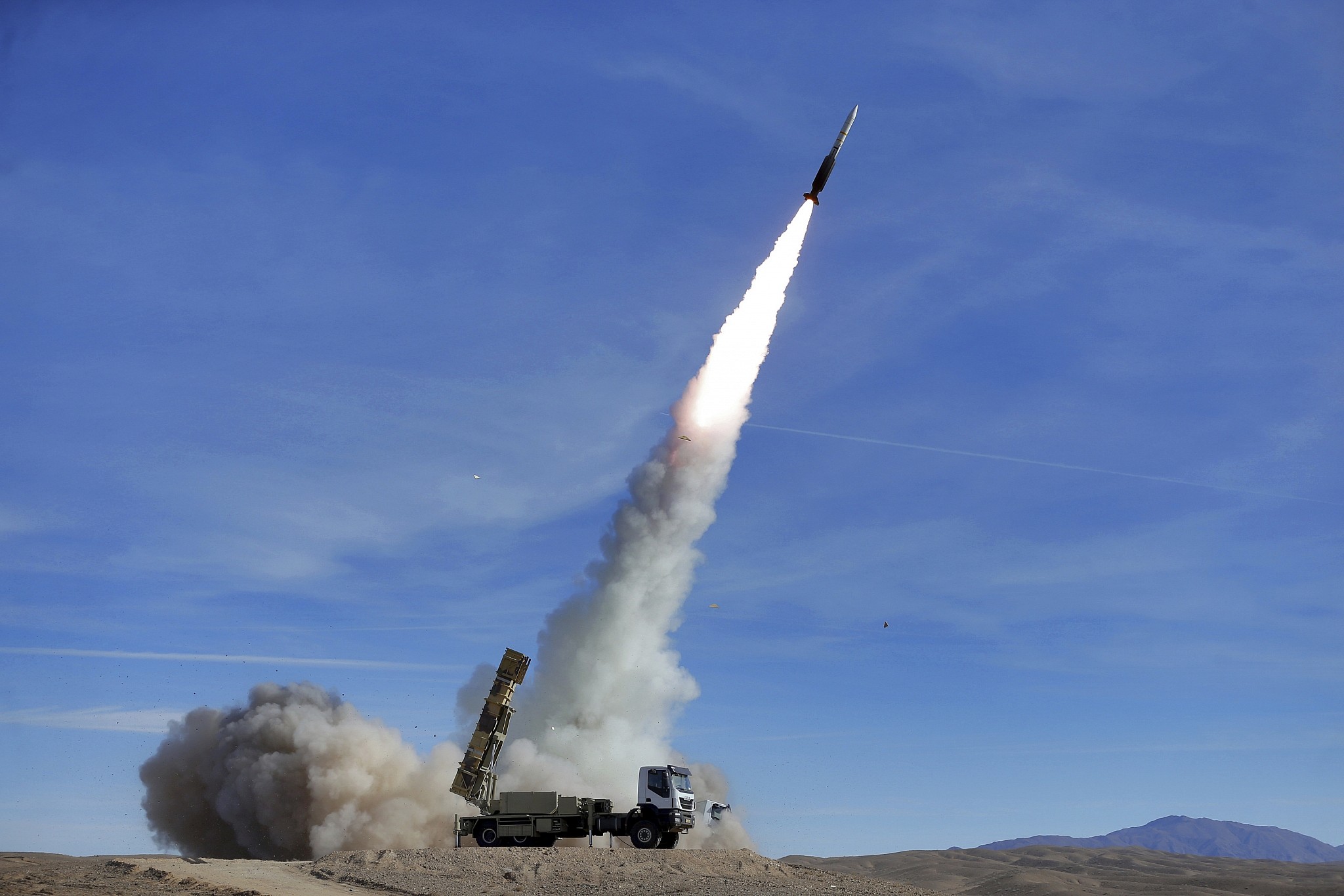
In this photo provided Monday, Nov. 5, 2018, by the Iranian Army, a Sayyad 2 missile is fired by the Talash air defense system during drills in an undisclosed location in Iran. (Iranian Army/ AP)

In this photo provided Monday, Nov. 5, 2018, by the Iranian Army, a Sayyad 2 missile is fired by the Talash air defense system during drills in an undisclosed location in Iran. (Iranian Army/ AP)

A top Iranian general claimed US military personnel and assets in the Middle East were within range of his country’s missiles Wednesday, amid ongoing tensions between Tehran and Washington.

Amirali Hajizadeh, the head of the air division for the hard-line Islamic Revolutionary Guards Corps, said improvements to Iran’s missile arsenal had put US bases in Qatar, the UAE and Afghanistan within reach, as well as US aircraft carriers stationed in the Persian Gulf, according to Iran’s Tasnim news agency.

“They are within our reach and we can hit them if the [Americans] make a move,” he said, according to a translation of his remarks carried by Reuters.

Hajizadeh said the missiles had been outfitted with improved precision capabilities, making it possible to hit targets over 500 kilometers away to within 30 meters accuracy.

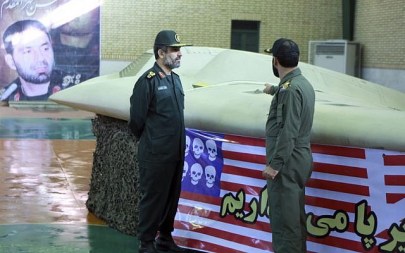
Chief of the aerospace division of Iran's Revolutionary Guards, Amir Ali Hajizadeh (left), near the captured US RQ-170 Sentinel drone in April 2012. (photo credit: AP/Sepahnews)

Chief of the aerospace division of Iran’s Revolutionary Guards Amir Ali Hajizadeh (left), near a captured US RQ-170 Sentinel drone in April 2012. (photo credit: AP/Sepahnews)

The threat came a day after US President Donald Trump used tensions with Iran to justify his decision to not punish Saudi Arabia over the death of writer Jamal Khashoggi.

“Iran states openly, and with great force, ‘Death to America!’ and ‘Death to Israel!’ Iran is considered ‘the world’s leading sponsor of terror,’” he wrote in a statement that drew ire from allies and Tehran alike. ” The United States intends to remain a steadfast partner of Saudi Arabia to ensure the interests of our country, Israel and all other partners in the region. It is our paramount goal to fully eliminate the threat of terrorism throughout the world!”

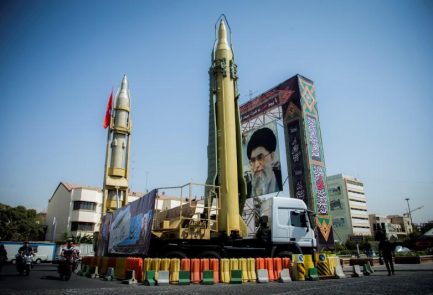
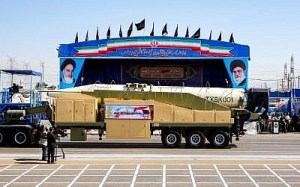
This picture taken on September 22, 2018 shows the long-range Iranian missile “Khoramshahr” being shown during the annual military parade marking the anniversary of the outbreak of the devastating 1980-1988 war with Saddam Hussein’s Iraq, in the capital Tehran. (AFP PHOTO / STR)

Trump earlier this year pulled the US out of the 2015 nuclear agreement with Iran, putting sanctions back in place. The US administration had cited a lack of curbs on Iranian missile development as one of the flaws of the agreement.

After punishing sanctions went back into effect on November 5, Iranian President Hassan Rouhani described said the country had entered a “war situation.”

Israel has repeatedly warned of the dangers of Iranian precision missile technology, particularly what is says are attempts by Tehran to supply rockets with pinpoint accuracy to the Hezbollah terror group in Lebanon.

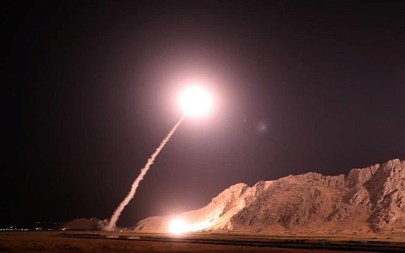
In this photo released on October 1, 2018, by the Iranian Revolutionary Guard Corps, a missile is fired from city of Kermanshah in western Iran targeting the Islamic State group in Syria. (Sepahnews via AP)

In October, Iran fired ground to ground missiles at what it said were Islamic State terrorists in Eastern Syria in retaliation for an attack on a military parade weeks earlier. It said the missile traveled some 570 kilometers (350 miles)


How Netanyahu‘s cozy relationship with the Saudi crown prince could cost Israel

November 22, 2018

Source: How Netanyahu‘s cozy relationship with the Saudi crown prince could cost Israel | The Times of Israel

PM’s defense of Mohammed bin Salman in the wake of the Khashoggi killing has angered many

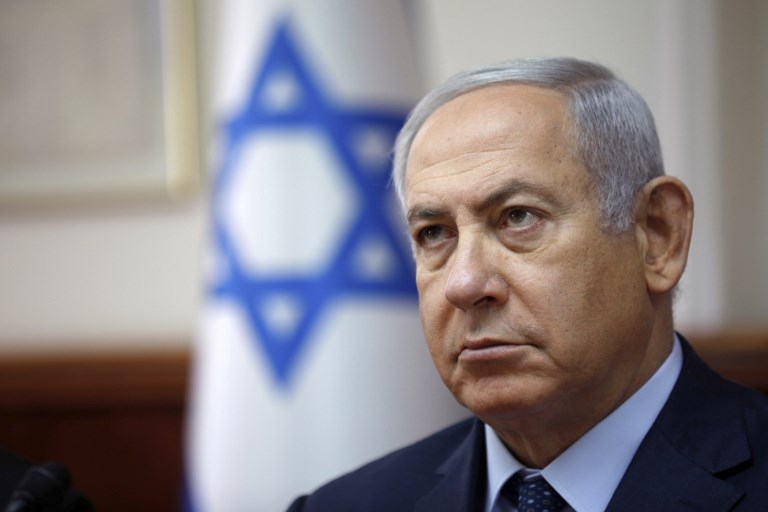
Prime Minister Benjamin Netanyahu attends the weekly cabinet meeting at the Prime Minister's Office in Jerusalem on October 14, 2018. (Amir COHEN/AFP)

Prime Minister Benjamin Netanyahu attends the weekly cabinet meeting at the Prime Minister’s Office in Jerusalem on October 14, 2018. (Amir COHEN/AFP)

WASHINGTON (JTA) — Saudi Arabia is in hot water because its agents murdered a journalist, but Prime Minister Benjamin Netanyahu is asking the West not to throw away the kingdom’s prince.

It’s a major ask — one that could get Netanyahu and his nation in their own tepid tub.

The problem facing Israel was evident in a piece published Sunday in The Washington Post by Jackson Diehl, a columnist whom Israeli officials have in the past trusted to be fair and sensitive to the country’s concerns.

“Why is Israel tossing a lifeline to Jamal Khashoggi’s killers?” the headline read for an essay that ripped Netanyahu.

“The spectacle of an Israeli leader lobbying to excuse an Arab dictator for murder will only compound the damage he has done to his country’s relationship with the United States,” Diehl wrote.
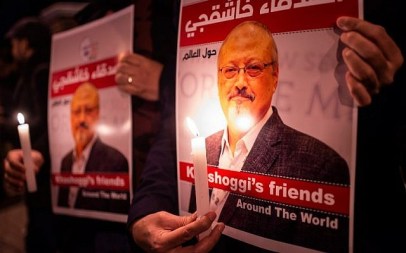
People hold posters picturing Saudi journalist Jamal Khashoggi and lightened candles during a gathering outside the Saudi Arabia consulate in Istanbul, on October 25, 2018. (Yasin Akgul/AFP)

Khashoggi, who was assassinated last month in the Saudi consulate in Istanbul, voiced his dissent with the Saudi regime as a Washington Post columnist. Diehl, like others at the paper, would be more naturally inclined than others to express outrage at any attempt to whitewash the Saudi regime.

But Diehl’s warning was substantive: JTA has learned that Democrats in Congress — the party has just wrested control of the US House of Representatives from the Republicans — are furious with Netanyahu for being among the few leaders to publicly defend the regime as evidence mounts that Khashoggi was killed on orders from above.

“What happened in the Istanbul consulate was horrendous and it should be duly dealt with,” Netanyahu said Nov. 2 at an event in Varna, Bulgaria. “Yet the same time I say it, it is very important for the stability of the world, for the region and for the world, that Saudi Arabia remains stable.”

The question at the heart of the Khashoggi murder is whether the country’s effective ruler, Crown Prince Mohammed bin Salman, directly ordered the hit. The prince has denied it vehemently to US President Donald Trump, who has tended to give bin Salman the benefit of the doubt. Middle East hands wonder how such a sophisticated assassination could have been carried out without bin Salman’s OK.
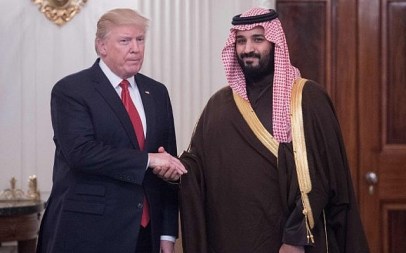
US President Donald Trump and Saudi Deputy Crown Prince, left, and Saudi Defense Minister Mohammed bin Salman, who later that year became Crown Prince of Saudi Arabia, shaking hands in the State Dining Room before lunch at the White House in Washington, DC, March 14, 2017. (NICHOLAS KAMM/AFP)

On Tuesday, The New York Times reported that one of the alleged hitmen instructed a superior to “tell your boss” that the job was done; the “boss” is assumed to be bin Salman.

Netanyahu’s investment in Saudi Arabia goes beyond the country’s stability. He is particularly close to bin Salman, as is Trump.

“I think the administration, when they know all the facts, are going to have to decide how can they on the one hand make clear that this action is unacceptable, but also not throw out the prince with the bathwater, let’s put it that way,” Israeli Ambassador to the US Ron Dermer, perhaps Netanyahu’s closest adviser, said earlier this month at a synagogue event in Houston.

The key to understanding Netanyahu’s positioning is the enemy that Israel and the Saudis share: Iran.

“It’s a tightrope act for Netanyahu right now,” Jonathan Schanzer, the vice president of the Foundation for Defense of Democracies, said in an interview. “For him and for Israel, there is a question of who will fight Iran’s regional aggression other than Israel. The Saudis have assumed that role. They have the eastern flank of the Middle East, Israel has the west.”

Another factor is Netanyahu’s strategy of seeking broader acceptance in the Middle East absent substantive progress in any peace deal with the Palestinians, Schanzer said.
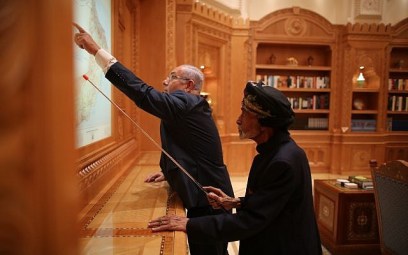
Prime Minister Benjamin Netanyahu (L) talks with Sultan Qaboos bin Said in Oman on October 26, 2018 (Courtesy)

“This is an opportunity for him to publicly come out and not overtly state that there are ties between Israel and the Saudis, but certainly to imply it, and to show the Arab world Israel can be an ally,” he said.

The cost, said Aaron David Miller, a top Middle East negotiator under Republican and Democratic presidents, is to Israel’s reputation.

“The Israelis have to be very careful that they should not become MbS’s lawyer in Washington,” said Miller, using bin Salman’s nickname. Miller is now the vice president of The Woodrow Wilson International Center for Scholars.

While Netanyahu and his predecessors naturally tended toward an interests-based foreign policy, Miller said, “It’s very bad for Israel’s image and credibility to be cavorting with a regime that is killing and murdering its dissenters on the streets of Arab capitals or European capitals.”

The immediate cost may be in how responsive the new Democratic House is to the pro-Israel agenda. In the immediate future, defense assistance will remain untouched, but Democrats would likely be less inclined to back the feel-good declarative statements that are often the bread and butter of pro-Israel lobbyists. That, in the long run, could erode overall support in the party for Israel.

An accelerant to the bad will among Democrats is that Netanyahu appears to be propping up Saudi Arabia as a means of pleasing Trump, who is the bete noir of the party and of liberals more than any other Republican leader.

“They’re looked at as if they’re coming out in support of a Trump ally,” said Schanzer.