Archive for November 13, 2018

Let the IDF win

November 13, 2018

Source: Let the IDF win

Op-ed: Although the death of an IDF soldier in Gaza Sunday might have changed the trajectory of events, lately it seems as though the roles of the country’s political Right and Left have switched with Netanyahu wanting to avoid an operation in Gaza at all costs, but the second intifada proves that terror can indeed be defeated through military intervention.
Prior to the tragic events of Sunday night that resulted in the death of an IDF soldierin Gaza, it seemed as if Peace Now has been reborn within Likud. The slogans remained the same: “Peace is made with our enemies,” “We must exhaust all possibilities,” and perhaps the most surprising argument of all is that there is “no point in fighting because we’ll just end up finding ourselves in the same spot.”On the other hand, the Israeli left is also suffering from a split personality disorder—supporters of peace and compromise suddenly endorsed a military operation with the possibility of having hundreds of dead on the Palestinian side, simply to spite Netanyahu; theoretically, of course. On Sunday evening things were already different. The reality here confuses everyone.

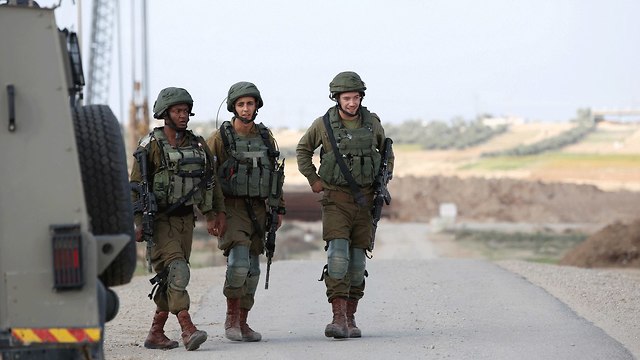
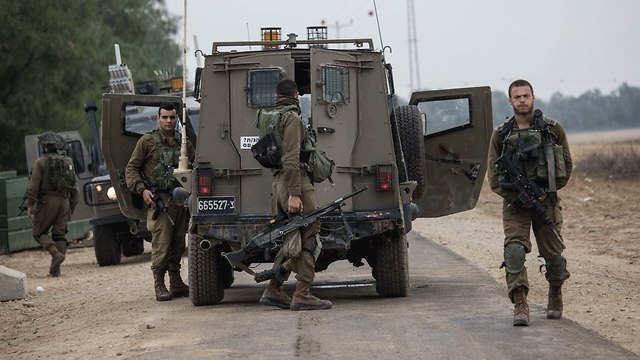
IDF forces on the Gaza border (Photo: AP)

IDF forces on the Gaza border (Photo: AP)
“Let the IDF win” was the slogan that Uri Ariel, who was Secretary General of the Yesha Council during the second intifada, coined in protest over the decision of the political echelon to behave with restraint in the face of terror. It was an ideological-philosophical battle at the heart of which stood a bloody experimental laboratory.Ten years ago, together with Prof. Zakai Shalom, I published a book titled Let the IDF win, a dull academic study full of data and quotations.

On the one side, there were statements by politicians, journalists and intellectuals from the left, who claimed that you can’t beat terrorism, and it’s been proven in practice many times around the world: The Americans in Vietnam, the Soviets in Afghanistan, the French in Algeria, and even in Israel when we withdrew from Lebanon because we had no choice.

On the other side, were those who called for a military intervention in order to defeat terror, one of whom was Uri Ariel, and they were right. The IDF entered the West Bank and defeated suicide terrorism. In those strange days, the left was the one who argued that there was no point in entering Gaza, Jenin or Nablus, because we would eventually return to the same point we departed from. Today the situation is reversed.

I am aware that it is no longer popular to have an opinion of your own because today’s ideology is that you are either with Netanyahu or you are against him. Still, I find it hard to free myself from the conclusions that I have drawn from the past. Those who do not want to resolve the situation militarily will find themselves in a military operation without a possible resolution; if not right now, then soon.

IDF forces on the Gaza border (Photo: EPA)

IDF forces on the Gaza border (Photo: EPA)

The Israeli government has had only two options since the end of Operation Protective Edge: the internationally funded Marshall Plan in the Gaza Strip with the subsequent demilitarization, or a well planned military operation intended to resolve the issue once and for all—destroying Hamas’s centers of gravity—a military language that at one time, everyone was able to understand.

There is no interim solution worth $15 million. It’s an illusion. The enemy state on our southern border must be restrained through deterrence, either by giving them something to lose or by eliminating the regime, in order to clarify the price they have to pay for their terror.

The introduction of Qatar is another ideological mystery. Not long ago, I joined my friends from the national camp in criticizing the construction of a stadium funded by Qatar’s money. Qatar is a state that sponsors the Hamas headquarters in Doha, provides refuge to leaders of the Muslim Brotherhood who fled Egypt, and a country with links to the Islamic State and other jihadist organizations that fought in Syria. We complained about them sponsoring our stadiums, now we are the couriers.

On Sunday, Netanyahu spoke openly about the issue for the first time. In the only democratic country in the region that has freedom of press, most of the updates on this strange ceasefire arrangement come from Hamas. The Cabinet has so far avoided admitting to have agreed to anything. Bennett and Lieberman claim they object—each in their own words, while Netanyahu claims that everyone has given their approval. And still no one is willing to tell us what the strategic goal is? What do you want to achieve?

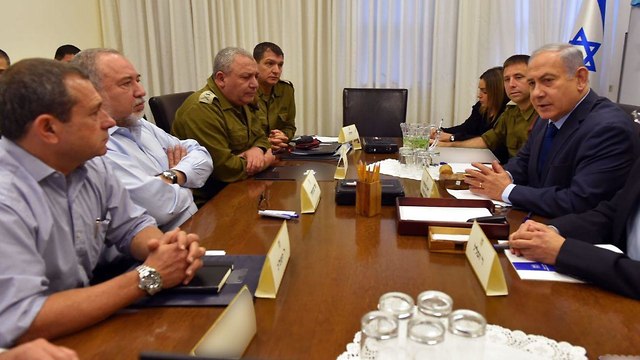
The Security Cabinet meeting (Photo: Ariel Harmoni, Ministry of Defense )

The Security Cabinet meeting (Photo: Ariel Harmoni, Ministry of Defense )

Even if the voters do not care whether it is forbidden or permitted to negotiate with a terrorist organization that infringes on Israeli sovereignty, the residents of the Gaza border region, the soldiers, and the civilians who will be called up for reserve duty, do care. What does the State of Israel seek?

My apologies to those who target everything that Netanyahu says, but to go back in time to last March is a goal that has no reasonable explanation or a chance of materializing. In March, we were on the cusp of a military operation just like we are right now. In March, the humanitarian problems were also similar.

The month of March has passed, $15 million dollars will not bring it back. It is the IDF’s turn to win—it is possible despite the defeatist statements, or simply explain to us what the alternative strategy is.


Egypt demands Israel halt ‘escalation’ as sides scramble for Gaza ceasefire

November 13, 2018

Source: Egypt demands Israel halt ‘escalation’ as sides scramble for Gaza ceasefire | The Times of Israel

UN mediator says he is working with Cairo and others to end massive breakout of border violence as both sides threaten to ratchet up fighting

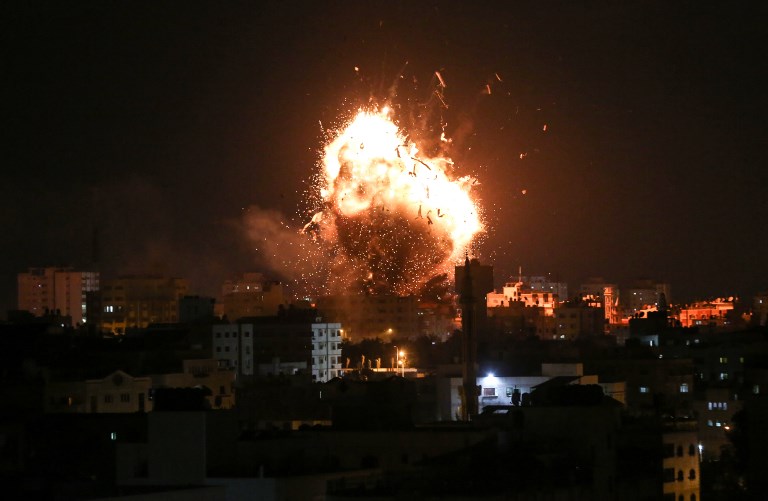
A picture taken on November 12, 2018 shows a ball of fire above the building housing the Hamas-run television station al-Aqsa TV in Gaza City during an Israeli air strike. ( Bashar TALEB / AFP)

A picture taken on November 12, 2018 shows a ball of fire above the building housing the Hamas-run television station al-Aqsa TV in Gaza City during an Israeli air strike. ( Bashar TALEB / AFP)

Egypt and the international community were attempting broker a ceasefire between Israel and Hamas as a massive flareup of cross-border fire continued past midnight Tuesday morning, with both sides being urged to step back from the brink of war.

The efforts came after a day that saw the heaviest fighting between the Israel Defense Forces and Gazans since 2014, puncturing previous efforts to bring quiet to the region, and sparking threats from both sides to ratchet up violence to the point of all-out war.

Egypt informed Israel that it must stop its “escalatory operations” in the Gaza Strip, the official PA news site reported, citing a high-level Egyptian source.

Earlier UN special envoy Nikolay Mladenov said he was working with Cairo and other parties to return calm to the region.

“The #UN is working closely with #Egypt & all concerned to ensure that #Gaza steps back from the brink. The escalation in the past 24hrs is EXTREMELY dangerous & reckless. Rockets must STOP, restraint must b shown by all! No effort must be spared to reverse the spiral of violence,” Mladenov wrote on Twitter.

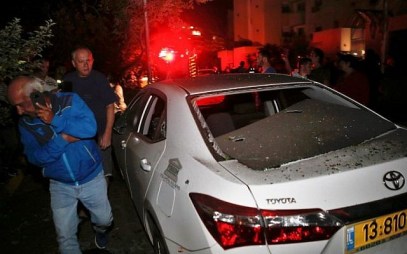
Two men walk past a vehicle that was hit by a rocket fired from the Gaza Strip, in the southern Israeli town of Ashkelon, on November 12, 2018. (GIL COHEN-MAGEN / AFP)

Palestinian Authority President Mahmoud Abbas condemned “the Israeli escalation” against the Gaza Strip and called on the international community to immediately and urgently intervene to stop it, the official PA news site Wafa reported.

Abbas, who is in Kuwait, was also in contact with regional and international officials to “stop Israeli aggression in the Gaza Strip,” Fatah Central Committee member Hussein al-Sheikh told official PA television.

Gazans terrorists shot over 300 rockets and mortars at Israeli communities near the Gaza Strip throughout the late afternoon and evening, hitting homes and buildings and injuring dozens of Israelis. The number was expected to rise as barrages continued throughout the night.

A spokesperson for Hamas’s armed wing said the terror group, the de facto ruler in the Gaza Strip, could expand the range of its rocket to the Tel Aviv region.

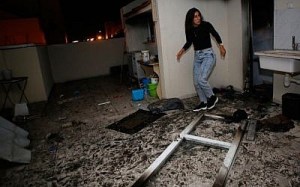
An Israeli woman inspects the damage in an apartment that was hit by a rocket fired from the Gaza Strip, in the southern Israeli town of Ashkelon on November 12, 2018. (GIL COHEN-MAGEN / AFP)

“Ashkelon is just the beginning. Approximately one million Zionists will be within the range of our missiles if the Zionist enemy’s decision is to continue its aggression,” the spokesman said.

The flareup began shortly after 4:30 p.m., when terrorists fired a Kornet anti-tank guided missile at an Israeli bus near the border, seriously injuring an IDF soldier who was on board at the time.

In response to the attacks, the Israeli military launched a series of strikes against dozens of targets inside the Gaza Strip, including some multi-story buildings deep inside populated areas in the Strip — a move the IDF typically foregoes in favor of attacks on facilities on the outskirts of cities in order to avoid potential collateral damage.

The army also said it targeted three attack tunnels operated by Hamas and the Palestinian Islamic Jihad, the two largest terror groups in the Strip.

Palestinian officials said at least three people, including two militants, were killed by Israeli fire and nine were wounded, and an Israeli airstrike destroyed the ruling Hamas group’s TV station.

As fighting continued late Monday, the Israeli military deployed additional troops and tanks to the Gaza border and was reportedly given a green light from policymakers to pummel terror groups in the Strip if they continued with the barrages.

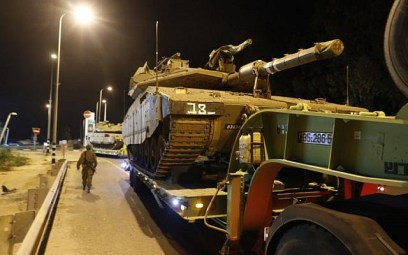
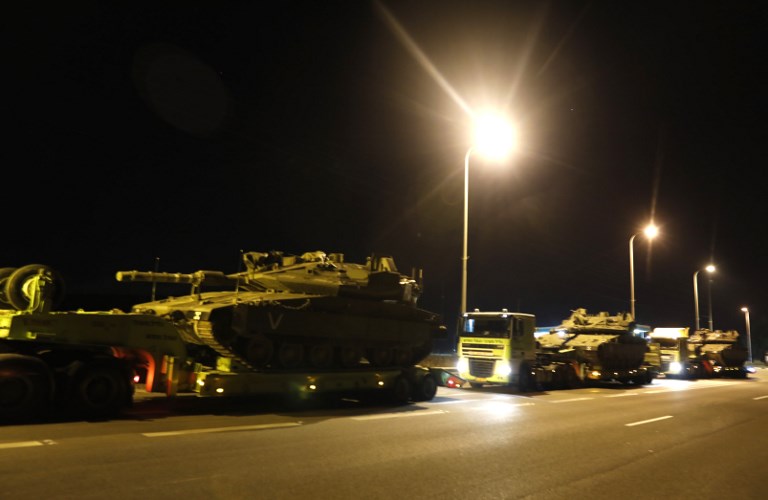
A picture taken on November 12, 2018 shows a convoy of Israeli tanks on the highway near the southern Israeli town of Sderot (Menahem KAHANA / AFP)

Egypt has been central to mediation efforts between Israel and Gaza over the past several months, brokering several short-term periods of calm amid increased tensions along the border.

On Friday, Israel allowed $15 million of Qatari cash to be brought into Gaza in order for Hamas to pay workers as part of reported intensive Egyptian led efforts to reach a calm between the sides.

Israel and Hamas do not recognize each other and have refused to negotiate directly.

On Sunday, Prime Minister Benjamin Netanyahu said Israel was doing its utmost to prevent “unnecessary wars” in the Gaza Strip, but maintained that diplomacy was futile with the Hamas leaders of the Palestinian enclave who are sworn to Israel’s destruction.

Hours later, an IDF special operations officer was killed in an operation gone awry that also killed seven Palestinian gunmen in the Strip.

The renewed clashes dashed hopes that Israel and Hamas would uphold a precarious ceasefire agreement recently brokered by Egypt and the United Nations and supported by Qatar.


IDF readies for heavier Gaza conflict as massive missile barrage persists 

November 13, 2018

Source: IDF readies for heavier Gaza conflict as massive missile barrage persists | The Times of Israel

Military moves more troops to border as policymakers said to give go-ahead for intensified strikes against Hamas, which vows to target a million Israelis

A convoy of Israeli tanks on the highway near the southern Israeli town of Sderot, on November 12, 2018. (Menahem KAHANA / AFP)

A convoy of Israeli tanks on the highway near the southern Israeli town of Sderot, on November 12, 2018. (Menahem KAHANA / AFP)

The Israeli military deployed additional troops and tanks to the Gaza Strip border on Monday following the largest barrage of rockets and mortar shells fired at Israel from the coastal enclave in a single day.

The army was reportedly given a green light from policymakers to pummel terror groups in the Strip if they continued with the barrages, as the terror organizations in the Strip vowed to do.

“The resistance factions’ joint command center is holding a serious conversation about expanding its range of fire. Ashkelon is just the beginning. Approximately one million Zionists will be within the range of our missiles if the Zionist enemy’s decision is to continue its aggression,” said Abu Obeida, a spokesperson for Hamas’s military wing.

According to the Israel Defense Forces, over 300 rockets and mortar shells were fired at southern Israel from the Gaza Strip as of 10 p.m. Monday — a number that was expected to rise as barrages continued throughout the night.

The attacks began shortly after 4:30 p.m., when terrorists fired a Kornet anti-tank guided missile at an Israeli bus near the border, seriously injuring an IDF soldier who was on board at the time. Dozens of other soldiers had previously been on the bus, parked near the Black Arrow memorial near Kibbutz Kfar Azza, and exited moments before the missile struck.

The IDF said dozens of incoming projectiles from Gaza were shot down by the Iron Dome air defense system. Most of the rest landed in open fields outside Israeli communities, but a number struck homes and buildings in cities and towns across the south.

A home and an apartment building were hit in the city of Ashkelon. In the rocket attack on the apartment building, shortly after midnight Monday, seven people were injured, including a woman in her 60s who was found unconscious and seriously wounded.

She was found unresponsive in one of the apartments, suffering from injuries throughout her body caused by shrapnel from the rocket, medics said.

A 40-year-old man was also moderately wounded by shrapnel; two women in their 20s were lightly injured by glass shards; and two men in their 40s and a women in her 90s were treated for smoke inhalation after a fire broke out at the scene, according to the Magen David Adom ambulance service.

Strikes on buildings in Netivot and Sderot caused significant damage and minor injuries to the occupants, and sparked fires in the surrounding area.

In Netivot, Hadashot TV news showed how a single piece of shrapnel from a rocket pierced the outer wall of one home, flew across the bedroom splintering a baby bed, passed through that wall into the kitchen, through the fridge, and finally smashed into the oven. The family had evacuated the home when rocket alarms sounded and were unhurt.

At least 22 other Israelis were injured in attacks from the Gaza Strip, either by shrapnel caused by rockets and mortar shells or in accidents while running to bomb shelters for cover, medical officials said.

Dozens of people also received treatment after they suffered panic attacks brought on by the rocket and mortar strikes.

In response to the attacks, the Israeli military launched a series of strikes against dozens of targets inside the Gaza Strip, including a number of multi-story buildings and houses belonging to senior Hamas officials deep inside populated areas in the Strip — a move the IDF typically foregoes in favor of attacks on facilities on the outskirts of cities in order to avoid potential collateral damage.

The army also said it targeted three attack tunnels operated by Hamas and the Palestinian Islamic Jihad, the two largest terror groups in the Strip.

Three Palestinians — each identified by terror groups as a member — were killed in the army’s initial strikes and three others were reportedly injured, but no casualties were reported in the IDF’s latest round of strikes inside Gazan cities.

In one case, the IDF bombed the headquarters of the Hamas-affiliated Al-Aqsa television station in Gaza City in the central Gaza Strip, which it said was “used by [Hamas] for military activities, including sending messages to terrorist operatives in the West Bank, calls for terror attacks and instructions on how to commit them.”

A former hotel in Gaza City used by Hamas as an internal security office was also hit in an Israeli strike, AFP journalists reported.

“This is an attack on a central government property for Hamas, which was conducted as part of additional attacks that the IDF carried out and as a response to the terror attack that the Hamas terror group is leading against Israeli citizens,” the army said.

The military also said the outlet broadcasts “incitement against the State of Israel and its citizens.”

“The IDF is determined to fulfill its mission of defending Israeli citizens, and is prepared and ready for a variety of scenarios, as necessary,” the army says.

On Monday evening, large numbers of tanks and other military vehicles were seen being moved down to the Gaza border on the backs of large trucks. Earlier in the day, before the barrages began, the army also ordered extra infantry battalions to the region.

Additional Iron Dome air defense batteries were also deployed in southern Israel on Monday morning.

The Israeli military threatened Hamas in the evening in response to the hours-long barrage, saying the terror group would “feel the power of the IDF’s response in the coming hours.”

“The Hamas terror group is responsible for everything that occurs in and emanates from the Gaza Strip, and it will bear the consequences of the terrorist activities conducted against Israeli citizens,” the military said in a statement.

“In addition, a number of rocket-launching cells were attacked,” the IDF said in a statement. “The IDF is continuing at this time to attack terror cites throughout the Strip.”

The military released footage of some of its attacks, which appeared to show strikes on Palestinian rocket-launching teams, military facilities and other sites in the coastal enclave.

The Hamas-run Gaza health ministry identified the three Palestinians killed by Israeli strikes as Muhammed al-Tatri, 27, Muhammed Oudeh, 22, and Hamad al-Nahal, 23. The military wing of the Popular Front for the Liberation of Palestine terror group claimed al-Tatri and Oudeh as its members. The Palestinian Islamic Jihad said al-Nahal was one of its fighters.

The barrages from Gaza came less than a day after an IDF special operations officer was killed in an operation gone awry that also killed seven Palestinian gunmen in the Strip. Following Sunday night’s incident, the Gaza-ruling terror group Hamas said “the blood of our righteous martyrs will not be wasted.”

The renewed clashes dashed hopes that Israel and Hamas would uphold a precarious ceasefire agreement recently brokered by Egypt and the United Nations and supported by Qatar.

Egyptian and UN officials scrambled on Monday evening to bring the two sides back to the negotiating table.

In light of the barrage from the Gaza Strip, the Israeli military ordered residents of communities near the Gaza Strip to remain inside bomb shelters until further notice. That included residents of the towns of Netivot and Ofakim, which are not typically as affected by Gaza rockets as communities closer to the border.

Residents of the cities of Beersheba, Ashkelon and Ashdod were told to stay within close proximity of bomb shelters and protected spaces.

The military also preemptively canceled school for Tuesday in the Gaza border region and in the central Negev and Lachish regions, including in Israel’s fourth largest city Beersheba.

In addition, businesses were ordered closed in the Gaza region, along with government offices, unless they are considered essential, the army said. No large gatherings were allowed in southern Israel on Monday night and Tuesday, it said.

In the central Negev and Lachish regions, which are farther from the Strip, businesses are only ordered shut if they do not have a bomb shelter nearby. Government services there were also scaled back.

In these regions, located dozens of kilometers from Gaza, only groups smaller than 300 would be allowed to gather on Tuesday, the army said.

Agencies contributed to this report.


One killed, two seriously hurt as rocket strikes Ashkelon apartment building

November 13, 2018

Source: One killed, two seriously hurt as rocket strikes Ashkelon apartment building | The Times of Israel

Man found under rubble of four-story building first fatality in Israel after over 300 missiles fired at cities and towns near Gaza; Gazan death toll rises to 4

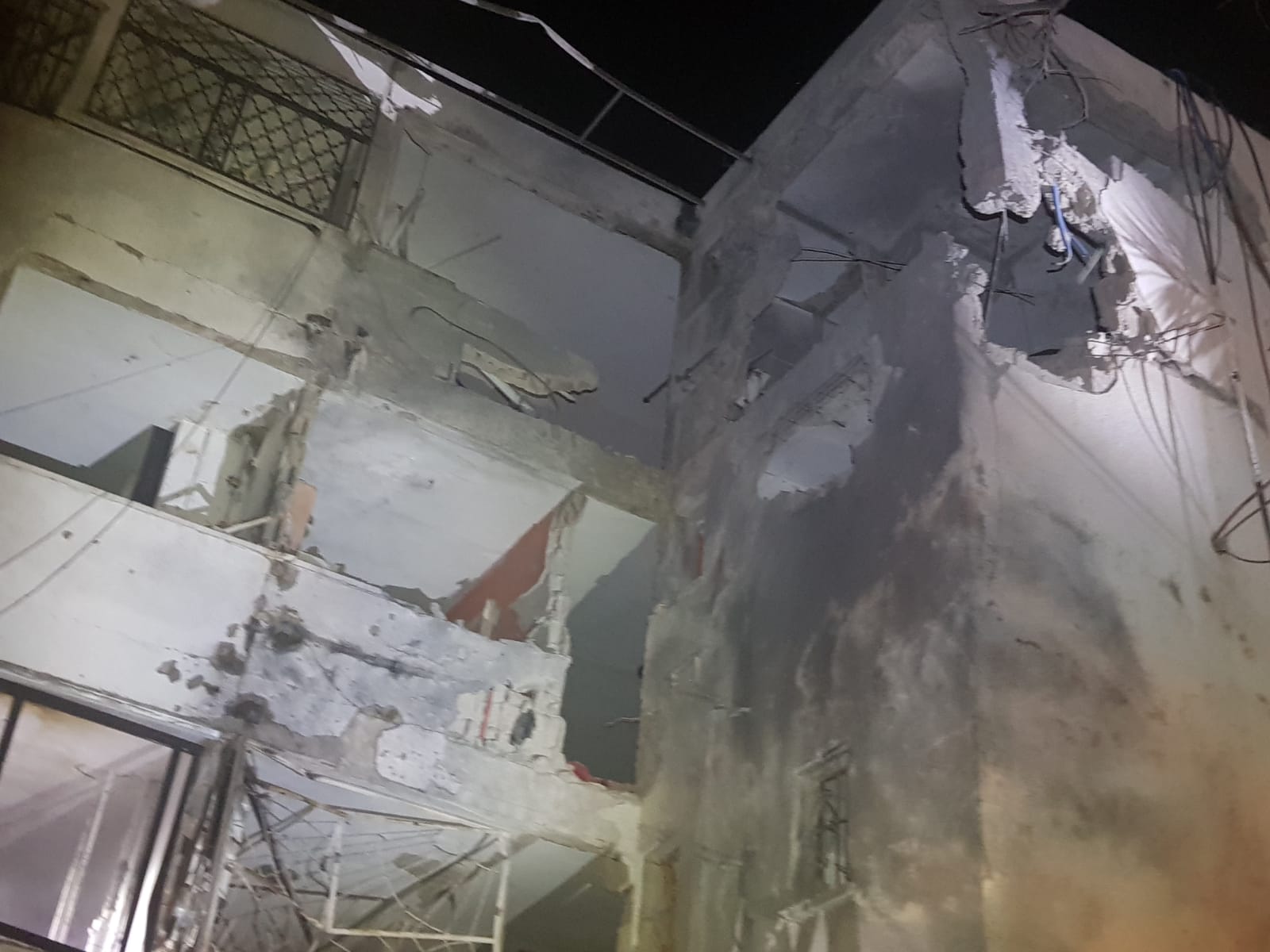
Damage to an apartment building in Ashkelon hit by a rocket on November 13, 2018. (United Hatzalah)

Damage to an apartment building in Ashkelon hit by a rocket on November 13, 2018. (United Hatzalah)

A man was killed and two women were seriously injured after a rocket fired from the Gaza Strip scored a direct hit on an apartment building in Ashkelon.

The fatality was the first in Israel after a day that saw more than 300 missiles and mortar rounds fired at Israeli communities near the Gaza Strip in a series of massive barrages that stretched past midnight Monday and into Tuesday morning.

The missile attacks appeared to taper off after 1 a.m., but were widely expected to resume in the morning, amid reports of continuing Israeli airstrikes in Gaza.

The man, in his 40s, was found dead under debris after an apartment building had been hit by a missile fired from Gaza shortly after midnight, according to the United Hatzalah rescue service.

The rocket appeared to have hit the upper floors of the four-story apartment building, leaving a gaping hole in its side.

A woman, also in her 40s, was found in serious condition near the man and was rushed to Barzilai hospital.

Unconfirmed reports in Hebrew media identified the man as a West Bank Palestinian living in Israel without documentation. The woman was identified as his wife.
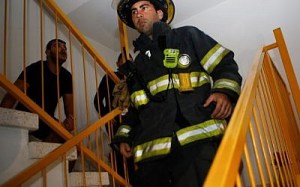
An Israeli firefighter evacuates a building following a rocket fired from the Gaza Strip, in the southern Israeli town of Ashkelon, on November 12, 2018. (GIL COHEN-MAGEN / AFP)

According to the Haaretz daily, the two were spotted by a photographer who had come to take pictures of the damage, about an hour after police and rescuers had left the building.

The photographer said the two were under a wall that had collapsed. Police told the daily that all the apartments in the building were checked four to five times, but that particular unit had sustained the most damage “and everything was destroyed.”

Rescuers earlier pulled out a 60-year-old woman in critical condition from the same building and six other more lightly injured people.

The woman was found unresponsive in one of the apartments, suffering from injuries throughout her body caused by shrapnel from the rocket, medics said.
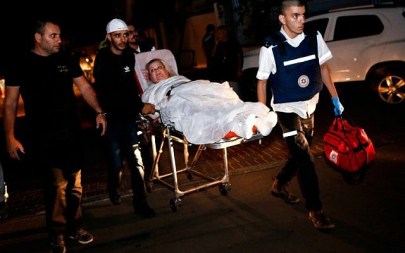
An Israeli injured woman, evacuated from her apartment that was set ablaze after it was hit by a rocket fired from the Gaza Strip, is escorted at the hospital on a stretcher, in the southern Israeli town of Ashkelon on November 12, 2018.(GIL COHEN-MAGEN / AFP)

A 40-year-old man was also moderately wounded by shrapnel; two women in their 20s were lightly injured by glass shards; and two men in their 40s and a woman in her 90s were treated for smoke inhalation after a fire broke out at the scene, according to the Magen David Adom ambulance service.

Ashkelon suffered several missile barrages late Monday, with a home also being hit. One person suffered light injuries from that attack.

Strikes on buildings in Netivot and Sderot caused significant damage and minor injuries to the occupants, and sparked fires in the surrounding area.

The rocket attacks, which began with several large barrages on small towns near the Gaza border in the afternoon, have threatened to ratchet up tensions in the restive region, casting a shadow over intensive ceasefire efforts.

The IDF said dozens of incoming projectiles from Gaza were shot down by the Iron Dome air defense system. Most of the rest landed in open fields outside Israeli communities, but a number struck homes and buildings in cities and towns across the south.
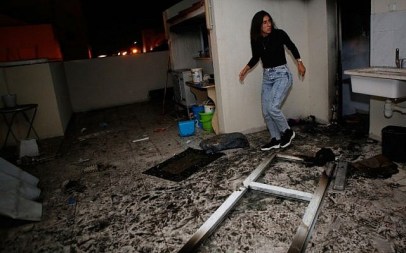
An Israeli woman inspects the damage in an apartment that was hit by a rocket fired from the Gaza Strip, in the southern Israeli town of Ashkelon on November 12, 2018. (GIL COHEN-MAGEN / AFP)

In response to the attacks, the Israeli military launched a series of strikes against dozens of targets inside the Gaza Strip, including multi-story buildings housing a hamas military intelligence center and the headquarters of al-Aqsa TV.

The army also said it targeted three attack tunnels operated by Hamas and the Palestinian Islamic Jihad, the two largest terror groups in the Strip.
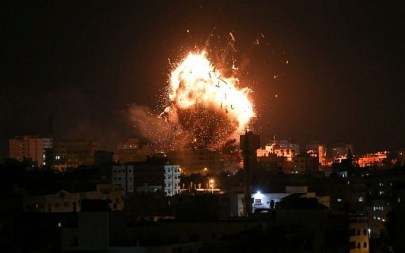
A picture taken on November 12, 2018 shows a ball of fire above the building housing the Hamas-run television station al-Aqsa TV in Gaza City during an Israeli air strike. ( Bashar TALEB / AFP)

At least three Palestinians — each identified by terror groups as a member — were killed in the army’s initial strikes and Gaza’s health ministry said early Tuesday that a fourth person succumbed to wounds sustained in a strike the day before.

The fatality, 22, was not immediately identified.

The United Nations said it was working with Egypt to broker a halt in the violence. “Rockets must STOP, restraint must be shown by all!” the UN Mideast envoy’s office tweeted.

UN Secretary-General Antonio Guterres, meanwhile, urged Israel and the Palestinians “to exercise maximum restraint,” according to a statement.

But both sides indicated they were ready to keep ramp up the violence if need be.

The military deployed additional troops and tanks to the border and was reportedly given a green light from policymakers to pummel terror groups in the Strip if they continued with the barrages.
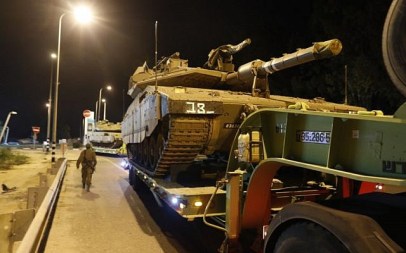
A picture taken on November 12, 2018 shows a convoy of Israeli tanks on the highway near the southern Israeli town of Sderot (Menahem KAHANA / AFP)

At the same time, Hamas threatened to fire rockets deeper into Israel, calling the attacks on Ashkelon a “warning.”

“Approximately one million Zionists will be within the range of our missiles if the Zionist enemy’s decision is to continue its aggression,” a spokesman said.

IDF Spokesman Brig. Gen. Ronen Manelis issued his own threat, tweeting that “Hamas knows well what our targets are and what the price of conflict with the IDF is.

The attacks began shortly after 4:30 p.m., when terrorists fired a Kornet anti-tank guided missile at an Israeli bus near the border, seriously injuring an IDF soldier who was on board at the time. Dozens of other soldiers had previously been on the bus, parked near the Black Arrow memorial near Kibbutz Kfar Azza, and exited moments before the missile struck.

Israeli security forces and firefighters gather near a bus set ablaze after it was hit by a rocket fired from the Palestinian enclave, at the Israel-Gaza border near the kibbutz of Kfar Aza, on November 12, 2018. (Menahem KAHANA / AFP)

On Monday evening, large numbers of tanks and other military vehicles were seen being moved down to the Gaza border on the backs of large trucks. Earlier in the day, before the barrages began, the army also ordered extra infantry battalions to the region.

Additional Iron Dome air defense batteries were also deployed in southern Israel on Monday morning.

The barrages from Gaza came less than a day after an IDF special operations officer was killed in an operation gone awry that also killed seven Palestinian gunmen in the Strip. Following Sunday night’s incident, the Gaza-ruling terror group Hamas said “the blood of our righteous martyrs will not be wasted.”

The renewed clashes dashed hopes that Israel and Hamas would uphold a precarious ceasefire agreement recently brokered by Egypt and the United Nations and supported by Qatar.

In light of the barrage from the Gaza Strip, the Israeli military ordered residents of communities near the Gaza Strip to remain inside bomb shelters until further notice. That included residents of the towns of Netivot and Ofakim, which are not typically as affected by Gaza rockets as communities closer to the border.
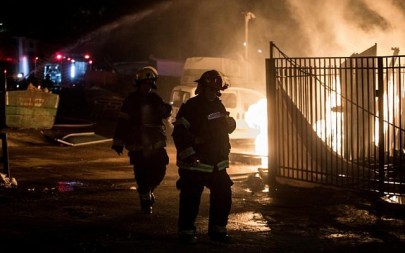
Firefighters near a building which was set ablaze by a rocket fired from the Gaza Strip, in the southern Israeli city of Sderot on November 12, 2018 (Hadas Parush/Flash90)

Residents of the cities of Beersheba, Ashkelon and Ashdod were told to stay within close proximity of bomb shelters and protected spaces.

A run-off election scheduled for Tuesday in the Hof Ashkelon region was postponed.

The military also preemptively canceled school for Tuesday in the Gaza border region and in the central Negev and Lachish regions, including in Israel’s fourth largest city Beersheba.

In addition, businesses were ordered closed in the Gaza region, along with government offices, unless they are considered essential, the army said. No large gatherings were allowed in southern Israel on Monday night and Tuesday, it said.

In the central Negev and Lachish regions, which are farther from the Strip, businesses are only ordered shut if they do not have a bomb shelter nearby. Government services there were also scaled back.

In these regions, located dozens of kilometers from Gaza, only groups smaller than 300 would be allowed to gather on Tuesday, the army said.

In Gaza, Hamas set up checkpoints across Gaza in a show of force. It also restricted movement through crossings with Israel, preventing foreign journalists, local businessmen and some aid workers from leaving the territory.

Hamas also canceled a weekly beach protest in northwestern Gaza along the border with Israel. The organizers cited “the ongoing security situation.”
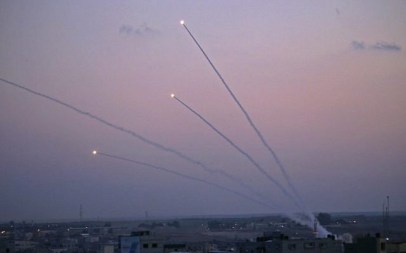
A picture taken from the Gaza Strip on November 12, 2018 shows missiles being launched toward Israel. (Said KHATIB / AFP)

In recent weeks, Egyptian and UN mediators had appeared to make progress in brokering informal understandings aimed at quieting the situation.

Last week, Israel allowed Qatar to deliver $15 million to Gaza to allow cash-strapped Hamas to pay the salaries of thousands of government workers. At the same time, Hamas has lowered the intensity of the border protests in recent weeks.

Israeli Prime Minister Benjamin Netanyahu cut short a visit to Paris because of the flare-up and returned to Israel on Monday for consultations with top security officials.

A meeting of top ministers in the security cabinet was scheduled for Tuesday afternoon.

On Sunday, Netanyahu defended his decision to allow through the Qatari cash to Gaza as a way to avert an “unnecessary war,” maintain quiet for residents of southern Israel and prevent a humanitarian catastrophe in the impoverished Gaza Strip.

The Associated Press contributed to this report.
 

Will Israel do what it takes to degrade Hamas after 400 rockets? – DEBKAfile

November 13, 2018

Source: Will Israel do what it takes to degrade Hamas after 400 rockets? – DEBKAfile

Israel’s deterrent strength is on the line after the Palestinian Hamas fired more than 400 rockets in 5 and-a-half hours on Monday, Nov. 12. After their massive barrage, Hamas and its terrorist allies threatened to expand their targets beyond the South if the Israel air force on missions in Gaza Monday night goes beyond its routine tit-for-tat reprisals against empty buildings in the Gaza Strip.

An escalation of violence is therefore unavoidable in the next hours.  It is up to the IDF to switch its tactics to attacks that cause the Palestinian terrorists real pain. Monday night, the IDF dropped small rockets on the Hamas Al Aqsa TV channel building in Gaza City as a warning of the coming bombardment. The building was evacuated before it was demolished and their were no casualties. Israeli jets and drones went on to strike more buildings in Gaza City and Rafah, still within the usual norms, while Hamas confined its rocket launches to the South, although an anti-tank missile on an Israeli bus in the afternoon occurred minutes after 50 soldiers debarked, and could have caused a massacre. One of the soldiers was critically hurt.

Prime Minister Binyamin Netanyahu and his security and military chiefs are convinced that if the air force starts seriously attacking Hamas’ missile stores and the residences of its leaders, then the rockets will start exploding in Tel Aviv.

At the end of a top-level security assessment of the Gaza crisis, led by the prime minister on Monday it was announced that “operational decisions had been reached” and the security cabinet would resume the discussion on Tuesday. DEBKAfile’s military sources deduced from this comment that no final decision had yet been reached for the IDF to embark on a serious ground operation to cut down the terrorist forces plaguing Israel from the Gaza Strip. It is hard to believe that they are still hesitating after  hundreds of thousands of civilians were hammered by 400 missiles, confined to small shelters with their children, and 50 soldiers escaped harm by a hair.
For a successful large-scale military operation of this kind, two things are essential:

  1. Firm resolve to achieve a clearly-defined target.
  2. Concentration of a sufficiency of armed military strength ready to go

Since all those in authority have been barred from making public statements, it is hard to estimate whether Netanyahu and Chief of Staff Lt. Gen. Gady Eisenkot have finally dropped their insistence on avoiding a major conflict in the Gaza Strip on the grounds that, after it is over, Israel will be back where it started. Countering this argument, critics say: Yes, but Israel will have regained the whip hand and be able to enforce a long period of calm. A former Deputy Chief of Staff, Maj. Gen (res) Yair Golan has dismissed the current Netanyahu-Eisenkot position as “unwillingness to win the battle.”

This unwillingness is challenged by a determined opponent. Yahya Sinwar is Hamas’ one-man decision-maker. It is he who runs the war on Israel. So long as he sees Israeli planes attacking empty buildings in the Gaza Strip, he will continue to turn the screw on the Netanyahu government for more concessions and a steady supply of cash and fuel against empty promises of calm. This strategy works perfectly. Last week, Qatar delivered $15m in cash to Hamas in the Gaza Strip and Israel began running convoys of fuel tankers into Gaza. And yet, on Friday, Hamas staged its regular mob assaults on the Israeli troops defending the Gaza-Israeli border fence and unleashed this incredible rocket barrage.

This situation is untenable. It can only be altered if the IDF changes its tactics and goes for targets of military value and hits Hamas armed wing’s actual locations without prior warning. If Israel is ready for a real showdown with Hamas on those lines, it has a good chance of winning the current round with the Palestinian terrorists, regaining its deterrence and achieving a lengthy period of calm for the battered population of the south.