A burnt out vehicle is surrounded by police tape on Bourke Street in central Melbourne, 2018.. (photo credit: AAP/JAMES ROSS/VIA REUTERS)
One person killed in stabbing attack in Melbourne, ISIS claims responsibility
One person was killed in a stabbing attack in Melbourne, Australia on Friday. ISIS claimed responsibility for the attack a few hours later.
One person was killed and two were wounded after being attacked by a man. The attacker was shot by the police after setting a truck filled with gas cylinders on fire and is currently in critical condition in the hospital.
Victoria Police Superintendent David Clayton said that “there are no known links to terrorism.”
However, a few hours later, ISIS took responsibility for the attack through the group’s Amaq news website. However, they did not provide evidence for the claim.
“The one who executed the ramming and stabbing operation in Melbourne… is one of the fighters of the Islamic State and he executed the operation in response to [a call] to target the citizens of the coalition,” the site announced.
It was referring to ISIS leader Abu Bakr al-Baghdadi’s call in August to ISIS members to “use bombs, knives or cars to carry out attacks” in countries united with the US in the coalition that ended the caliphate he declared in 2014 over parts of Iraq and Syria.
Opinion: Israelis were ecstatic over the renewal of sanctions on Iran, meanwhile, some measures taken by Washington seem to mitigate the negative effects. Ultimately, what Trump seeks is a deal. Israel must use this window of opportunity wisely.
The attitude in Israel toward renewed sanctions on Iran is that of an open miracle. An extraordinary case in which history took a U-turn when it seemed that al was lost. The Iranians, for the first time in more than three years, are moving from a period of momentum — an international certificate of kashrut to the regime and regional expansion of an amazing scope — to the defensive.
From an optimistic perspective, the new sanctions will require the Iranians to engage in domestic matters, essentially the survival of the ayatollahs’ regime, leaving less material and mental resources for the megalomaniacal moves of the kind we have seen in Syria, Yemen, Iraq and recently, even closer to home, on the Gaza front.
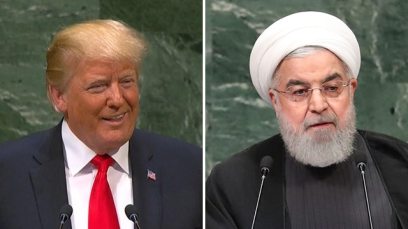
President Trump; Hassan Rouhani
While Israelis are completely satisfied, officials in Washington, especially among those who pushed for an American exit from the nuclear agreement and to restore the sanctions, are less satisfied.
The special permit issued to eight countries to buy gas and oil from Iran, permitting the operation of three civilian reactors in Iran, and other issues, give the impression that the Europeans have obtained enough from President Trump to maintain the framework of the agreement. Moreover, some elements of the administration itself are trying to reconcile with the Iranians.
It may not seem realistic at the moment, but it is a Trump we are talking about, and it is difficult to assess the direction of his next move, especially since he declared that he is interested in a deal and called on the Iranians to return to the negotiating table.
Twitter war over sanctions
It should also be noted that Trump maintains distance from the rhetoric regarding the overthrow of the Iranian regime. It reminds him of Bush-type complications in Iraq. Overall, he’s a man of deals.
One way or another, this is an opportunity window that will not return. In the coming months, the Iranian regime will become poorer and more vulnerable. The resources it had to invest in Syria, for example, but also in the Palestinian arena, will diminish. In the absence of international enthusiasm to invest hundreds of billions in rehabilitating Syria, they will not reap any benefits from their huge investment in this country in the foreseeable future.
Israel must use this time wisely, especially by determinedly removing from them the desire to establish themselves in Syria, and perhaps also with a different approach toward the military wings of Hamas and Islamic Jihad, both funded by the Revolutionary Guards’ al-Quds Force.
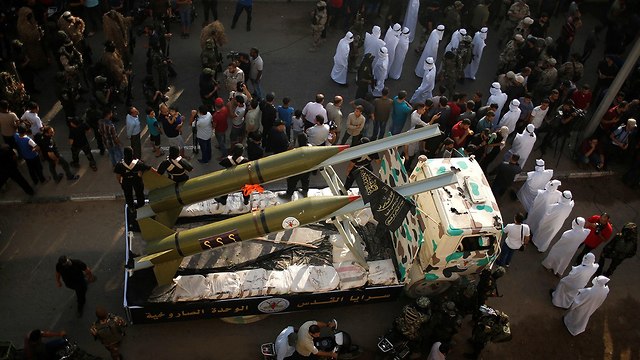
Islamic Jihad parade in Gaza (Photo: Reuters)
This is not the time to rest. We received a second, unbelievable opportunity, with the US withdrawal from the nuclear agreement, and we have to act on the assumption that there will be no third chance.
Not only the Iranians, but also the Palestinians, very much hope that they have only two years left with Trump, and not six years. As with the Iranian issue, here too, it should be ensured that Trump’s activity, in this case the “deal of the century” that the Palestinians rejected even before it came to light, does not become destabilizing.
While Netanyahu juggles remarkably well between the Gulf states mired in their own conflict — the Saudis on a day and the Qataris at night — things close to home look much bleaker. Not only in Gaza, which could erupt again at any moment, but also in the West Bank.
After two years during which Mahmoud Abbas turned the phrase “the deal of the century” into a kind of curse, second only to the Balfour Declaration in terms of the scope of the historic catastrophe for the Palestinians, there is a chance that a public display of such a peace plan would lead to a large-scale Palestinian campaign against it, with whose consequences we will have to deal with.
There is no deadline yet to present the deal outline, but it is assumed that after the results of the US midterm elections are clear and nearing New Year’s, the administration’s excuses will run out.
“The deal of the century” was supposed to enjoy the full support of the Arab countries, especially Saudi Arabia. But the unexpected entanglement of the crown prince in the Khashoggi murder case casts doubt on his ability to engage in such an effort, especially against the will of the Palestinians, at a time when the international image of Saudi Arabia is at its lowest ebb since the September 11 attacks.
The Saudis were supposed to bring two things to the table: legitimization of the process and money. Money is still not lacking, but in a situation where Ben Salman is still trying to stabilize his chair, it is difficult to ask him to put his position to the test.
Trump’s first two years were indulging for Israel. It is reasonable to assume that the administration’s pro-Israel line will continue for the next two years, but it will also have to put up with the implications of its major moves from Tehran, through Syria, to Gaza and Jerusalem.
Commercial Aircraft Corporation of China says pursuing deals with the Islamic republic is “off the table” • Tehran’s plans to buy 200 aircraft from major aviation firms Airbus, Boeing and ATR have all stalled after the U.S. reimposed sanctions on Iran.
Reuters and Israel Hayom Staff
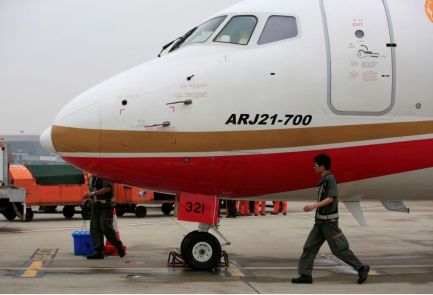
An ARJ21-700, China’s first domestically produced regional jet, arrives at Shanghai Hongqiao International Airport
|Illustration: Reuters
A Chinese state firm on Wednesday ruled out selling passenger planes to Iran to help the Islamic republic revive fleet renewal plans, while a Russian executive suggested Moscow would be wary of putting its own programs at risk of U.S. retaliation.
The move underscores the challenges Iran faces in rekindling plans to import planes after the U.S. reimposed sanctions, though Iran Air reiterated on Wednesday it would welcome offers from suppliers not subject to restrictions on the export of U.S. plane parts.
Deals to buy 200 aircraft from aviation giants Airbus, Boeing and European turboprop maker ATR have virtually all stalled after the United States withdrew from a 2015 nuclear agreement between Tehran and world powers and reimposed sanctions on firms including Iran Air.
Iran’s search for other suppliers was a talking point on the sidelines of Airshow China this week, where China promoted its growing aircraft industry as it looks to break into foreign markets for planes such as its long-delayed ARJ21 regional jet.
Asked whether Iran had shown interest in buying Chinese airplanes, Zhao Yuerang, general manager of manufacturer Commercial Aircraft Corporation of China, said, “No, we cannot sell to Iran. Iran is off the table.”
Pressed on China’s ability to sell the ARJ21 to Iran, he added, “We need to abide by regulations of both countries.”
In May, the U.S. Treasury’s Office of Foreign Assets Control revoked licenses to sell passenger jets to Iran that are required for any plane with more than 10% U.S. parts, regardless of where it is made.
Iran Air has said it is looking to buy planes from any company not requiring the U.S. permits and may consider Russia’s Sukhoi Superjet 100.
Asked at Airshow China in Zhuhai whether Moscow was in talks to sell the Superjet to Iran Air, a senior official with state holding company Rostec declined to comment in detail.
“This is a sensitive issue,” Viktor Kladov, Rostec’s director for international cooperation and regional policy, said. “You understand why, because we cannot endanger the whole Superjet program.”
Besides controlling exports for aircraft containing over 10% U.S. parts, analysts say the United States sets the tone for global aviation through its benchmark system of safety regulation and the widespread use of the dollar in plane deals.
Kladov said Russia’s industry would continue to follow international standards on regulation and aircraft safety but would strive to be independent commercially.
Rostec is already doing some deals in Russian and other currencies, he added.
Nation of Islam leader Louis Farrakhan says China, Russia, other nations will be dragged into a war that will “end America as you know it” • Earlier on his trip, Iranian media published a video clip of Farrakhan chanting “Death to Israel” in Farsi.
Associated Press and Israel Hayom Staff
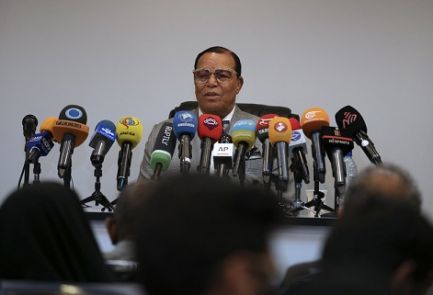
Nation of Islam leader Louis Farrakhan speaks at a press conference in Tehran, Thursday
|Photo: AP
Nation of Islam leader Louis Farrakhan warned U.S. President Donald Trump not to pull “the trigger of war in the Middle East at the insistence of Israel,” speaking Thursday while on a visit to Iran.
Farrakhan told journalists in Tehran that he is “begging our president and the government that supports him to be very, very careful.”
“The war will trigger another kind of war which will bring China, Russia, all of the nations into a war and … the war will end America as you know it,” he said.
Farrakhan leads the Nation of Islam, a black separatist African American political and religious movement. The NOI has been largely closed off to outsiders, making it impossible even for those who follow the movement closely to gauge its strength.
For Farrakhan, the height of his prominence came when he organized the 1995 Million Man March in Washington, a symbol of black pride and empowerment.
Earlier on his trip to Iran, state television published a short video clip of Farrakhan trying to say “Death to Israel” in Farsi, a common chant at rallies in the decades after Iran’s 1979 Islamic Revolution. He began to repeat it, but the crowd at Tehran University sitting at Farrakhan’s event then substituted “America” for “Israel,” drawing laughter.
After the video clip spread online, Farrakhan issued a statement saying, “I never led a chant calling for death to America.
“I asked a question about how to pronounce the chant in Farsi during my meeting with Iranian students and an examination of the video shows just that,” he said.
On Thursday, Farrakhan reacted angrily to an Iranian state television’s request to repeat the chant. However, he kept his harshest words for Trump.
“It is your policies that are eroding trust for you in the world, favor for you in the world, and now you are pulling apart, confused,” Farrakhan said, addressing Trump. “If you do this, you will bring about – not the Iranian chant – you will bring about the death of the greatest nation that has been on this Earth in the last 6,000 years.”
President-elect Jair Bolsonaro’s plans to move Brazil’s embassy from Tel Aviv to Jerusalem has already upset Egypt and could stir trouble with other Islamic nations • Turkish diplomat: We expect Brazil to act with reason and not confront the Muslim world.
Reuters and Israel Hayom Staff
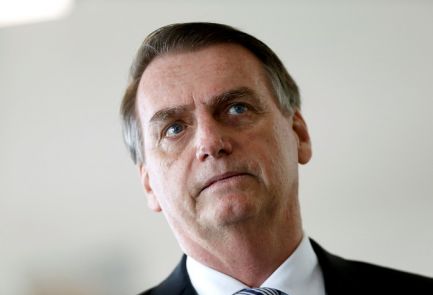
Brazil’s President-elect Jair Bolsonaro
|Photo: Reuters
A proposal by Brazil’s next president to relocate its embassy in Israel, following U.S. President Donald Trump’s lead, may set off a diplomatic storm in the Muslim world, threatening a key market for the world’s largest meat companies.
Brazil is by far the world’s largest exporter of halal meat, which complies with Muslim dietary rules. President-elect Jair Bolsonaro’s plans to move Brazil’s embassy from Tel Aviv to Jerusalem, strengthening relations with Israel, has already upset Egypt and could soon stir trouble with other Islamic nations.
“The reaction will be given not only as an individual country but on behalf of the whole Muslim world,” a Turkish diplomatic source said. “We are expecting Brazil to act with reason and not confront the Muslim world.”
Brazil exports $16 billion annually to the Middle East and Turkey, with just 3% going to Israel, according to government statistics.
More than a quarter of Brazil’s exports to the region are meat. Both Brazil’s JBS SA, the world’s top beef producer, and BRF SA, the No. 1 poultry exporter, have bet big on the growing demand for halal meat.
Brazil exports over $5 billion of halal meat per year, more than twice its nearest rivals, Australia and India, according to Salaam Gateway, a partnership between the Dubai Islamic Economy Development Centre and Thomson Reuters.
Bolsonaro’s proposal for the Israel embassy is part of his overhaul of Brazilian foreign policy, cozying up to major powers such as the United States and undoing what he calls leftist predecessors’ alliances based on “ideological bias.”
Trump’s decision to move the American Embassy in Israel to Jerusalem stirred a hornets’ nest in the Middle East, and the United States had few allies follow suit. Guatemala did so in the days afterward while Paraguay has since reversed a similar decision.
Israeli Prime Minister Benjamin Netanyahu praised Bolsonaro for the plan to move Brazil’s embassy, calling him a “friend.”
Bolsonaro has shown already he is not afraid to give an important trade partner a poke in the eye, following the example of the U.S. president, whom he openly admires and emulates in both political style and foreign policy.
Like Trump, Bolsonaro railed against China on the campaign trail. He has softened his stance since the election last month, however, amid lobbying from diplomats and executives keen to protect relations with Brazil’s largest trading partner.
The pressure from the Middle East may prove blunter.
BRF Chairman Pedro Parente said on Thursday that the Israel embassy issue was “cause for concern.”
“We have a very important trade with Arab and halal markets. We are confident that when a discussion of the matter involves the relevant areas – the farm, trade and foreign ministries – they will certainly reach the best solution.”
BRF’s halal business segment contributed a quarter of its operating revenue and nearly half of its operating profit in the third quarter.
Halal chicken represented nearly half of Brazil’s overall chicken exports of $7.1 billion last year, according to Brazil meatpacking group ABPA.
“There is a $2-billion trade between Egypt and Brazil, mainly in the food agricultural sector, and within that sector mainly in beef and poultry,” Egypt’s Ambassador to Brazil Alaa Roushdy said.
He declined to comment on a hypothetical move of the embassy or if it could have any impact on trade.
BRF has processing plants in Turkey and the United Arab Emirates to meet growing demand for halal meat. The company aims to double its output of processed products in the Gulf by 2023, its head of halal operations said at an October event.
JBS sent more than an eighth of its exports to the Middle East and Africa in 2017, second only to the Greater China region.
Representatives for JBS declined to comment on the fallout from a potential embassy move.
The Arab-Brazil Chamber of Commerce expects Brazil’s total exports to a grouping of 22 Arab countries, which excludes non-Arab Muslim nations such as Iran, to swell to $20 billion by 2022, up from $13.5 billion in 2017.
Rubens Hannun, the chamber’s president, added that Brazil also stands to benefit from infrastructure investment from Arab sovereign funds. UAE’s Mubadala Investment Company, for example, poured some $2 billion into Brazilian commodities empire EBX earlier this decade.
“We do not want any noise in this relationship,” Hannun said. “We are afraid that would open a door for the competition.”
The pressure the U.S. wants to exert on Iran will take its toll in the long run, but Tehran is already feeling the crunch • As the economy tanks, the regime will have to explain why it is investing billions in global terrorism instead of at home.
Yoav Limor
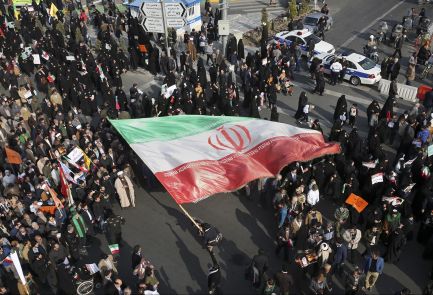
Anti-government protests in Tehran, January 2018
|Photo: AP
Were it not for the U.S. midterm elections, the public and media’s interest would likely have remained focused exclusively on the American sanctions that were reimposed on Iran this week. Both Washington and Tehran are still at the initial stage of trying to understand what this means, what changes will follow, and what impact these changes will have.
This uncertainty was evident in the Twitter blows Washington and Tehran exchanged this week, as the sanctions were about to come into force on Nov. 5.
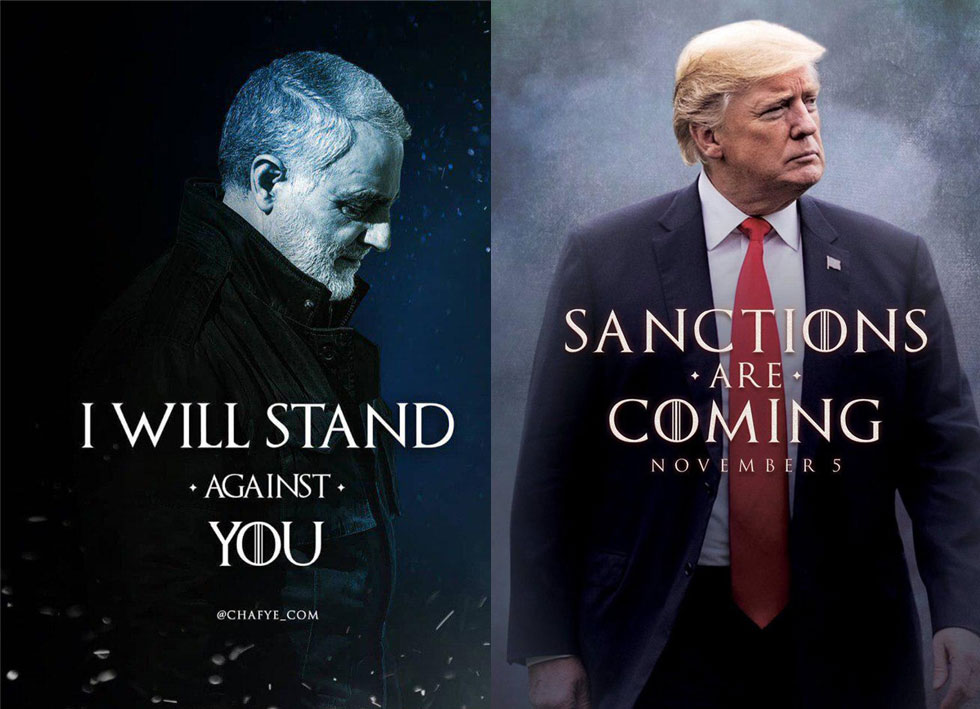
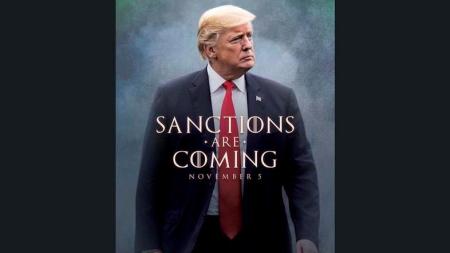
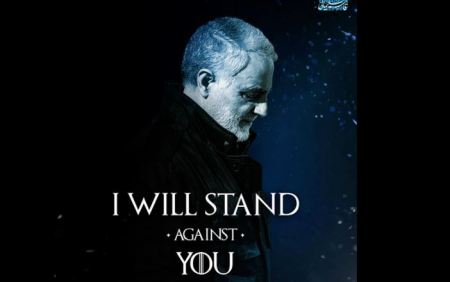
U.S. President Donald Trump tweeted a meme with the caption ”Sanctions are Coming” – playing off the catchphrase “Winter is Coming” from the popular TV show “Game of Thrones” and even using the same font used in the series – and Iran quickly responded, tweeting a meme of Maj. Gen. Qassem Soleimani, commander of the Quds Force, the black-ops arm of the country’s formidable Revolutionary Guard Corps, featuring the similar font, reading, “I will stand against you.”
U.S. President Donald Trump’s “Game of Thrones”-style meme
The sarcastic exchanges provided the desired social media buzz, but real life soon took over and winter has come to Iran. Those who follow Iranian media and its proxies could see a great deal of concern, at the very least, over what the future may bring, especially with respect to what the sanctions mean for ordinary Iranians, and in the larger sense, for Iran’s regional interests.
Domestically, Iran has been under pressure for a long time. Hopes that the 2015 nuclear agreement would significantly improve the dire economic situation have long shattered, and present sanctions have and will only make things worse.
This has yet to be expressed in a mass revolt, but the Iranian regime has had to face alarming sites this year: mass demonstrations in almost every city and district, with explicit social slogans that raise clear questions about the regime’s priorities, such as “Iran for Iranians” and “Enough interfering in Syria and Lebanon.”
Jerusalem and Washington’s express hope, as explicitly stated by U.S. National Security Adviser John Bolton, is that the sanctions will deepen this internal crisis to the point of actually threatening the ayatollahs’ regime. That, however, is doubtful: the regime in Tehran is strong and over the past decade it has succeeded in crushing larger waves of resistance, using demonstrative and deliberate violence aimed at generating deterrence.
Still, the dilemma will present itself quickly enough, as a clash between President Hassan Rouhani and Soleimani is only a matter of time.
Iran’s response to Trump’s meme, featuring Maj. Gen. Qassem Soleimani, commander of the Quds Force
Ideologically, they two are not too far apart as even moderates like Rouhani are still radical and support Iran’s aspirations to possess nuclear capabilities and expand its international influence. The difference is in their strategies: Rouhani believes that the regime needs to invest at home, bolster the foundations and venture outward only after the situation stabilizes, while Soleimani wants to continue as before, and as far as he is concerned, establishing Iran’s overseas interests is more important than the suffering of the Iranian people.
In the meantime, Iran is trying to have it both ways, postponing what is an inevitable decision. The pressure is felt not only on the Iranian street but also by its proxies, namely in Yemen, Iraq, Syria, Lebanon and the Gaza Strip. Lebanon’s Hezbollah, for example, has had to enact something of a “crisis economy” in recent months over the Iranian cuts to its budget. Hamas in Gaza, which is always in dire economic straits, also fears that the little Iranian aid it receives will soon dry up.
Soleimani is the one facing this external pressure and he is finding it increasingly more difficult to dispel the concerns expressed by Iran’s proxies. Domestically, he will soon have to explain not only where the money is going, but also what are the returns on Iran’s sizeable investments.
The Islamic republic has poured billions into its attempts to establish itself militarily in Syria and in arming Hezbollah, to partial success at best. Israel’s strategy in Syria has painted Iran into a corner that is very different from where it hoped to be at this point, and in an age of economic crunch, the logic of continuing to invest in expensive weapons shipments that time and again fail to reach their destination is bound to be questioned.
This does not mean that Iran will cease exporting hostilities and terrorism – that goes against its rationale and against the current domestic balance of power. The moderates may have the public’s ear, but they wield little political power, especially compared to Soleimani, who is ideologically and personally close to Supreme Leader Ayatollah Ali Khamenei. Nevertheless, Soleimani will also have to rethink his steps, even if only tactically, until such time as things improve.
These processes will take time and nothing will happen tomorrow morning. All parties will try to understand and prepare for what will happen next. The American sanctions in their final form are different than first estimated and are more far-reaching on some issues than on others. Iran still hopes that a mechanism can be devised to circumvent them, but that is doubtful given the speed in which Western companies doubled back on their desire to do business with Tehran so as not to lose their business with the U.S. If anything, this proved what we have always known – when money talks, bullshit walks.
Anyone who wants to know what will happen in the next systems needs to follow the money. Iran, which understands this, is searching for detours. For example, to have Russia sell its oil and transfer the proceeds to Tehran in cash. The main benefit here will be declarative, in the sense of defying the U.S. administration, even if it is not as pragmatic, as it is doubtful whether this money will save the Iranian economy. After all, Iran will need more than the support of China, Russia and Western European countries to weather the storm.
This means that sooner or later Iran will seek a solution. One option, which is not so subtly being hinted at is that Tehran will decide to go for broke and make a mad dash for nuclear weapons or launch a war against Israel in the north. The odds of these scenarios are very low, simply because the regime in Tehran may be radical, but it is not suicidal. The ayatollahs know that such moves would legitimize a stronger strike against them, both militarily and economically, and that they will alienate the few supporters Iran has.
It is more likely that Iran will try to be flexible and pursue some sort of negotiations with the United States, in hope of reaching a new agreement. In fact, rumors of such informal talks have been swirling for quite some time.
In such a case, Iran will have to compromise, accept additional restrictions on its nuclear and ballistic missiles program, as well as on its export of terrorism, in the hope that at some point in the future, this, too, shall pass.
For Israel, every alternative is good news, because it pushes Iran further away from going nuclear, even if only temporarily, all while diminishing the threat it poses from Syria and Lebanon, which in turn spells lower chances of a war in the northern sector.





 anneinpt
 artaxes
 danmillerinpanama
 davidking1530
 Peter Hofman
 Joseph Wouk
 Peter
Peter Louisiana Steve
 WarSclerotic
Recent Comments