Archive for September 2018

Rouhani says U.S. wants to cause insecurity in Iran but will not succeed 

September 23, 2018

Source: Rouhani says U.S. wants to cause insecurity in Iran but will not succeed – Middle East – Jerusalem Post

A day after an attack on a military parade that killed 12, Rouhani accused Gulf Arab states of providing financial and military support for anti-government ethnic Arab groups.

BY REUTERS
 SEPTEMBER 23, 2018 09:21
Rouhani says U.S. wants to cause insecurity in Iran but will not succeed

DUBAI – Iranian President Hassan Rouhani accused the United States of being a “bully” that wants to create insecurity in the Islamic Republic, a day after an attack on a military parade that killed 25 people, including 12 members of the country’s elite Revolutionary Guards.

Speaking before leaving Tehran to attend the U.N. General Assembly in New York, Rouhani accused U.S.-backed Gulf Arab states of providing financial and military support for anti-government ethnic Arab groups.

“The small puppet countries in the region are backed by America, and the United States is provoking them and giving them the necessary capabilities,” said Rouhani.

The attack was one of the worst ever against the Guards – the most powerful military force in the country – and is bound to ratchet up tensions with Iran’s regional rival Saudi Arabia.

“Iran’s answer (to this attack) is forthcoming within the framework of law and our national interests,” said Rouhani, adding that the United States will regret its “aggressiveness.”

An Iranian ethnic Arab opposition movement called the Ahvaz National Resistance, which seeks a separate state in oil-rich Khuzestan province, claimed responsibility for the attack.

“The Persian Gulf states are providing monetary, military and political support for these groups,” said Rouhani.

Islamic State militants also claimed responsibility. Neither claim provided evidence. All four attackers were killed.

The assault, which wounded at least 70 people, targeted a viewing stand where Iranian officials had gathered in the city of Ahvaz to watch an annual event marking the start of the Islamic Republic’s 1980-88 war with Iraq, state television said.

“Hopefully we will overcome these sanctions with the least possible costs and make America regret its aggressiveness towards other countries, and particularly Iran,” said Rouhani.

The Islamic Revolutionary Guards Corp (IRGC) has been the sword and shield of Shi’ite clerical rule in Iran since its 1979 Islamic Revolution.

Hardliners such as the Republican Guards have gained standing at the expense of pragmatists in Iran’s multi-tiered leadership since President Donald Trump decided in May to pull the United States out of the 2015 international nuclear deal with Tehran and re-impose sanctions on the Islamic Republic.


Space: Israel’s final frontier 

September 23, 2018

Source: Space: Israel’s final frontier – Israel News – Jerusalem Post

Opher Doron of Israel Aerospace Industries’ Space Division talks moon missions and nanosatellites with the ‘Magazine’ on the 30th anniversary of Israel’s first satellite launch.

BY SETH J. FRANTZMAN
 SEPTEMBER 23, 2018 08:55
SpaceIL's lander - SpaceIl is an Israeli nonprofit, established in 2011, that was competing in the G

‘Space is exciting,” says Opher Doron, when describing the look on the faces of kids who visit Israel Aerospace Industries to learn about how Israel is pioneering in the great unknown. “It’s a big wow,” for them. “They are talking about Mars nowadays and exploration, comets, landings. So space is exciting. It is the ultimate technology. It brings together everything in tech – from physics, engineering and launchers and loaders, you name it and it’s there.”

Today Israel is aiming to be the fourth country to get to the moon. It is also developing nano-satellites – little satellites the size of a milk carton – and Israel is pioneering high-resolution photos from satellites designed specifically to aid environmental research. In an era when space programs in some Western countries seem to be ossifying, Israel is doing what it tends to do best: being innovative and self-sufficient.

Today IAI is celebrating 30 years in space. The origins of the space program begin in the 1980s when Menachem Begin was prime minister. The Israel Space Agency was created in January 1983 under the Science Ministry, which was itself a fledgling ministry. IAI built Israel’s first satellite, the Ofeq-1. The 157-kg. satellite was launched on a Shavit rocket at Palmahim, south of Tel Aviv. It was launched westward because of Israel’s hostile neighbors to the east and entered a low earth orbit, circling the earth every 90 minutes. Israel became the eighth country to put its own satellite into space.

“Thirty years is a long time for everything and a good time to look back and forward,” says Doron. Israel has achieved a lot since then. The space sector is booming, he says.

“We have launched a large number of satellites and we have some of the best satellites in the world up in space, providing amazing resolution and fantastic coverage of large areas.” These can provide sharp high-quality images and they are cost effective. In terms of cost and weight, Israel is a world leader, he says.

The satellites Israel has launched have outlived their expected life spans. Some were designed for four years and survived for 15 years. “So Israel can now look with great detail wherever it needs to look and that is an important part of national strategy. The program achieved not only the goals set out for it in the large picture but also surpassed expectations in quality and number.”

The Ofeq line of reconnaissance satellites that first entered service some 30 years ago is still providing Jerusalem with the best available intelligence. For instance, when the Ofeq-10 entered orbit in April 2014, then-defense minister Moshe Ya’alon said that it was a testimony to the “impressive ability of the State of Israel to develop and lead on the technological front.” It would improve the State of Israel’s intelligence capabilities, he said, “and enable the defense establishment to better deal with threats that are near and far at any time of the day, in all types of weather.”

In September 2016, the Ofeq-11 became the latest of these reconnaissance satellites to enter orbit.

These satellites have had very important real- world implications. When Ofeq-7 blasted into the night sky from Palmahim in June 2007, Reuters noted that the “spy satellite would provide high-quality surveillance over enemies such as Syria and Iran, rivaling the capabilities of the United States.” Soon after its launch, according to the Sunday Times (London), the satellite was diverted from covering Iran to looking at Syria.

“High quality images of a northeastern area every 90 minutes” were soon coming back. It made it “easy for air force specialists to spot the facility.” The facility in question was the al-Kibar site, the nuclear reactor that the Syrian regime was developing. Based on North Korea’s Yongbyon reactor 1 the site was bombed on September 6, 2007, destroying Syria’s plans. On September 7, an Israeli satellite photographed the damaged site. The photos were published only 10 years later, in September 2017, but show clearly the importance of Israel building and launching its own satellites to defend against threats.

IAI’s space division and much of the cutting-edge technology that Israel is working on is housed in a complex in Yehud, not far from Ben-Gurion International Airport. To enter the warehouse where the satellites are housed, one must don a white smock, a head covering and sterile fabric to cover the shoes. Inside an air conditioned room are a variety of satellites, some of them mock-ups or models. Some of the little nano-satellites, which look like a toy a kid could play with, sit in a case. At the far end of the room, one sees a group of people huddling next to what looks like a lunar lander from the 1960s. And indeed, it is part of Israel’s SpaceIL program at IAI, which, if it reaches the moon, will make Israel the fourth country (after the US, China and Russia) to get there.

It is supposed to be launched at Cape Canaveral aboard a SpaceX Falcon 9 rocket. Weighing only 600 kilograms, it is not as large as the Apollo 11 Lunar Module, which weighed 4,000 kg. The SpaceIL mission began as part of the Google Lunar XPrize, which was announced in 2007. For a prize of $30 million, a privately funded team had to land a robot on the moon and have it travel 500 meters and transmit back images. But by January 2018, it became clear that no team had been able to launch a mission to the moon by the March 2018 deadline and the cash prize offer appeared to be ended.

But SpaceIL decided to keep moving forward. In a July press conference, Morris Kahn, president of the non-profit organization SpaceIL, said that after eight challenging years, “I am filled with pride that the first Israeli spacecraft, which is in its final construction and testing phases, will soon be making its way to the moon.” SpaceIL founders Yariv Bash, Kfir Damari and Yonatan Weintraub will hopefully fulfill their dream of reaching the moon. The project has grown far beyond the initial competition. According to IAI, it has “ignited the imagination of about 900,000 children nationwide, with the help of a broad network of volunteers.” It has also brought together a wide range of donors, from Kahn to Dr. Miriam and Sheldon Adelson, Sammy Sagol, Lynn Schusterman and Steven Grand.

FOR DORON, who served in the navy in the 1980s when Israel first went to space, the history of Israel’s space program is made up of visionaries.

“It came from young visionaries who said we can do this; they may have sounded crazy, but they were right and the leadership picked it up. For our safety, we need to be able to look at what is going on over the fence; from that strategy they collected together the best around, those who specialized in military systems, to start learning space. Lo and behold, years later we were looking down and taking pictures and we had our own launcher. Very few countries do that.”

However, Israel can’t rest on its laurels; it must keep running forward.

Israel has put seven Amos communications satellites into space and earlier this month said it would seek to construct Amos-8. One of these satellites, Amos-6, was destroyed in a fire in 2016 in Florida.

“I am very happy that the government decided this was an important national strategic asset and decided to ensure that the next communication satellite is built in Israel. The next Amos will be an amazing satellite,” says Doron. Israel has invested heavily in bringing technology to Israel so that the satellite will have a “sophisticated payload to give users more than they have with Analog satellites. We hope that program will get under way in the next couple of months. It will be by far the most advanced ever built in Israel and one of the more advanced ones in the world.”

One of the hurdles Israel faces, besides being a small country, is that because satellites have generally been a security issue, civilian investment has lagged behind. Israel’s civilian space program has a tiny budget compared to others around the world.

“And I’m not talking about absolute budgets,” says Doron. “We’d love to have a $20 billion NASA budget, but even per capita budget, where NASA gets about $60 a year per capita and in the EU $10 to $20 per capita, Israel is doing $2 to $3 a year per capita.” That means Israel isn’t putting up a lot of research satellites, the way other countries are.

Things changed in August last year, when the Venus agricultural monitoring environmental research satellite was launched in cooperation with the French space agency.

“Venus is further proof of Israel’s immense technological capabilities,” said Technology and Science Minister Ofir Akunis. “We’re a science, technology and space superpower that the entire world seeks to collaborate with. Many countries will enjoy Venus’s findings in the very near future for the purposes of environmental, agricultural, water and food research.”

Doron hopes Israel will begin to invest more in these kinds of endeavors more in the future.

IN THE film Apollo 13, there is a scene where the men in the stricken service module heading for the moon realize that America wasn’t even tuning in to the mission in 1970. Space had already lost its allure. The moon seemed boring. The final US space shuttle retired in 2011. Space has seemed less interesting and inspiring. But Doron says that Israel’s space program and projects like SpaceIL are inspiring a new generation.

“I see it in the kids and I see it in myself – it’s exciting. Is it as exciting as 1969? Probably not, but it’s still a big wow, they are talking about it.” Nothing is more complicated than space and people from age five to 95 are excited. “Wow, we can do anything,” is the spirit among younger people. “The technology is neat. Let’s not all go be lawyers, let’s study engineering.”

When those graduating today with degrees that might lead them to Israel’s space program choose what to work on, they will have a series of projects at their fingertips. Beyond the Amos and Ofeq series, IAI is also working on nano-satellites. This would reduce the weight of the satellite to less than 100 kg. and beyond, down to even only several kilos.

“There are many interesting things that can be done when you put a large number of small satellites in earth observation or communication,” says Doron. “When you have a lot circling the earth, the frequency they will be able to see and communicate is suddenly much greater.” For instance, a normal orbit might mean the satellite passes once or twice a day, but when you have numerous small satellites as part of a kind of array, then you could be monitoring things constantly.

But even when they are small, it’s still expensive propelling them up there. The “operation costs money, so you want them to live a long time, and to make them cheaper – from hundreds of millions to tens of millions of dollars, including the launch costs and they should live a few years, so it’s a big step forward in design methodologies,” he says.

This whole system of building smaller satellites could be called the next frontier or “new space.” It’s “exciting,” says Doron. “We are not standing in place. We have had a fantastic run and we are sprinting on in new directions.”


In a rare moment Israel gains UN win

September 23, 2018

Source: In a rare moment Israel gains UN win – Israel News – Jerusalem Post

Ambassador to the UN Danny Danon looks at a turbulent year with some hope.

BY HERB KEINON
 SEPTEMBER 23, 2018 05:12
 Ambassador Danny Danon, Permanent Representative of Israel to the UN at the 7th Annual JPost Confer

A peculiar thing happened on the way to the passage of a routine anti-Israel resolution in the UN in June condemning Israel for the violence along the border fence with Gaza: Israel actually won a vote in the General Assembly.

That’s right, in the General Assembly, that body of 193 nations that will formally open its 73rd session next week with its annual general debate and parade of world leaders taking the podium to address the globe’s pressing problems.

And with all of the world’s pressing problems, you can count on leaders of countries such as Algeria, Belize and South Africa to take at least some of their allotted 15 minutes to slam Israel. It’s as much a New York rite of autumn as leaves changing colors and the Yankees making the baseball playoffs.

The General Assembly is a forum where the Palestinians enjoy an automatic majority of Muslim and developing countries that reflexively votes with them and against Israel.

But in June, a plurality of countries in the General Assembly – 62 to 58 – voted for a US-sponsored amendment to a resolution on the Gaza border fence violence that actually condemned Hamas. Because of the procedural necessity for a two-thirds majority, this amendment to the resolution slamming Israel was not adopted, and the anti-Israel resolution passed by a huge margin. But still, that an amendment blaming Hamas mustered a plurality in this forum was an eye-rubbing moment that marked a change of sorts.

Ambassador to the UN Danny Danon, who is entering his fourth year as Israel’s envoy to the world body, looks at that moment as one of Israel’s most significant victories last year in the UN.

Danon, in an interview with The Jerusalem Post, said another small victory – one indicative of a more aggressive Israeli policy in tackling anti-Israel resolutions at the UN – came in July at the UN Economic and Social Council (ECOSOC), a body he described as the second-most important body – after the Security Council – in the UN.

In response to an anti-Israel resolution on the “social and economic consequences of the Israeli occupation” that included a line accusing Israel of withholding the return of the bodies of terrorists, Israel proposed a counter amendment that called “for the immediate release of the civilians and soldiers being held in Gaza by Hamas.”

According to Danon, the Palestinians – concerned the Israeli amendment might actually pass – went to the European Union, which he said “turned cartwheels in the sky” to propose compromise language that mentioned neither Hamas nor Israel, but rather deplored “the practice of withholding the bodies of those killed, and called for the release of the bodies that have not yet been returned to their relatives.”

What was significant, Danon said, is that both in the General Assembly and at ECOSOC, the Palestinians did not just walk in and get their way. They had to fight. In both cases Israel acted in coordination and conjunction with the US delegation at the UN.

“Together with US Ambassador Nikki Haley, we are in a very active and proactive mode – and the Palestinians know we will not sit back and wait for their initiatives with our arms folded. We succeeded in embarrassing them twice in votes in forums that in the past were very comfortable for them,” he said.

These small successes have provided an impetus and momentum to take such actions in the future, he said, adding that the votes have forced the Palestinians to think twice before every proposal, realizing that they are not ensured an automatic victory, and that they must coordinate their moves closely with the EU.

“They still have a majority in the General Assembly, but they understand that they will now have to sweat and pay a price for every initiative, so they are choosing their battles,” he said.

BUT CHOOSING battles is quite different from avoiding them, and Danon said that in the coming weeks – soon after next week’s speeches by the world’s leaders – the Palestinians will bring additional measures to the UN in an attempt to diplomatically isolate and embarrass Jerusalem.

He said that the Palestinians are considering putting forward a resolution in the General Assembly that would condemn Israel for plans – recently given a green light by the High Court of Justice – to remove the Khan al-Ahmar Bedouin encampment near Kfar Adumim.

“This issue is very much in the press, and the Palestinians have a great deal of support in the EU against the eviction,” Danon said. He characterized the EU position, despite the court’s decision on the matter, as “hypocritical.”

“When there is a judgment by the court regarding the eviction of settlements or Jews, they support it and praise it, but when it deals with someone who is not Jewish, they question the legal system and democracy in Israel,” he said. “They know Israel has a strong legal system, and question it only when the decisions are not comfortable for them.”

He said that while a General Assembly resolution on this matter would have no real practical significance, it would be a public relations victory for the Palestinians.

So, too, he said, would be another resolution the Palestinians are considering: slamming the US for cutting funds to UNRWA.
“Here, too, there is no significance to the resolution, because you cannot obligate any country to give money,” Danon said. “But they will get public relations points, get attention, and set the public agenda, not only be on the defensive.”

As was the case over the summer, if the Palestinians decide to go through with either measure, they should expect pushback that could prove embarrassing for them, the ambassador warned.

Though Danon would not spell out what Israel might do, he said “there are issues that need to be discussed, such as the payment of money to terrorists, something that is being addressed by the US, Australia and some countries in Europe. We need to weigh whether to bring this to the international community for discussion.”

Danon said that in light of the tension between the Palestinian Authority and the Trump administration, and before the presentation of the long-awaited US peace plan, the Palestinians feel “they have to do something at the UN” to keep their issue alive and set the agenda. He dismissed reports that US President Donald Trump will present an outline of the principles of his plan during his speech to the UN on Tuesday, saying that the information he has is that the plan will not be rolled out before the beginning of 2019.

One way for the Palestinians to grab attention, he said, would be to go forward with an idea he said had been raised in internal Palestinian deliberations: a request to suspend Israel from the UN in the wake of the recently passed nation-state law.

Although any effort to evict Israel from the UN would surely come up against a US veto in the Security Council and not pass, it “would be a way of making things difficult for us.”

But, Danon said, the message that he is passing inside the UN is that if the Palestinians go through with such a maneuver, “there will be a response.”

Israel has in its toolbox appropriate ways to respond, “not only in the UN, but elsewhere,” he said.

Though the General Assembly can expel a country only upon getting a recommendation from the Security Council, it can suspend a country’s participation in the General Assembly, meaning that the country is unable to vote, speak or propose resolutions. This was done to South Africa in 1974.

Danon said he did not think the Palestinians could muster the necessary votes for this. “This is the type of issue where even countries that support the Palestinians realize there are boundaries beyond which they cannot go,” he said.

Another upcoming challenge, Danon said, will be the Palestinians taking over the chairmanship at the beginning of the year of the Group of 77, a group of developing countries formed in 1964 by 77 countries to promote common economic interests.

Danon said the Palestinians are sure to use this position to further upgrade their position in the UN. Presently they have the status of an observer state, which means they can’t vote and can speak only on issues relating directly to them. Danon said that from this perch they will try to continuously jab at Israel.

“I know that some of the countries in the group are also concerned about this, because this group generally tries to promote common concerns of all the countries in the group, not individual issues relating to different members,” he said.

He said that decisions in the group, which since 1964 has expanded to include 134 states, are taken by consensus, and that Israel does have some friends inside who would prevent the entire agenda being hijacked with anti-Israel resolutions. Among those friends are India, Singapore, Rwanda, Guatemala and others.

DANON, WHOSE tenure has been extended until April by Netanyahu, speaks warmly of the cooperation that exists with Haley and her office, saying that the messages of the two countries on a variety of issues are similar, even without a need to formally coordinate or trade drafts of speeches.

And that is a marked contrast to the situation that existed with the previous administration. According to Danon, the anti-settlement Security Council Resolution 2334 that the US enabled in December 2016 in the waning days of the Obama administration has influence and continues to create headaches for Israel in the UN.

“It was a horrible decision, and we have to deal with its ramifications,” he said. “There are reports that it mandates which we have to relate to every three months. And in every discussion, our adversaries try to insert language that makes reference to this resolution, and that forces us to have to use leverage and work with the US every time. It is being used as a club to hit us with, and we are dealing with it – but it takes time and energy.”


Iran blames Israel, US for military parade attack as death toll climbs to 29 

September 22, 2018

Source: Iran blames Israel, US for military parade attack as death toll climbs to 29 | The Times of Israel

Islamic State, anti-government Arab group both claim responsibility; army spokesman says attackers trained in 2 Gulf states; Rouhani orders security forces to find perpetrators

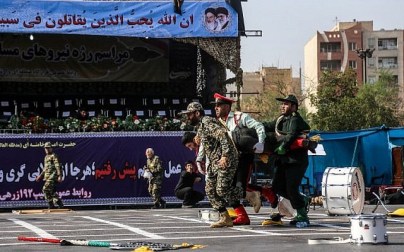
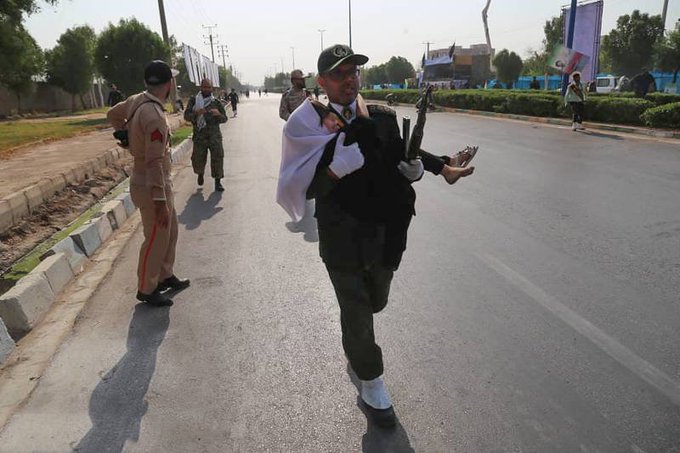
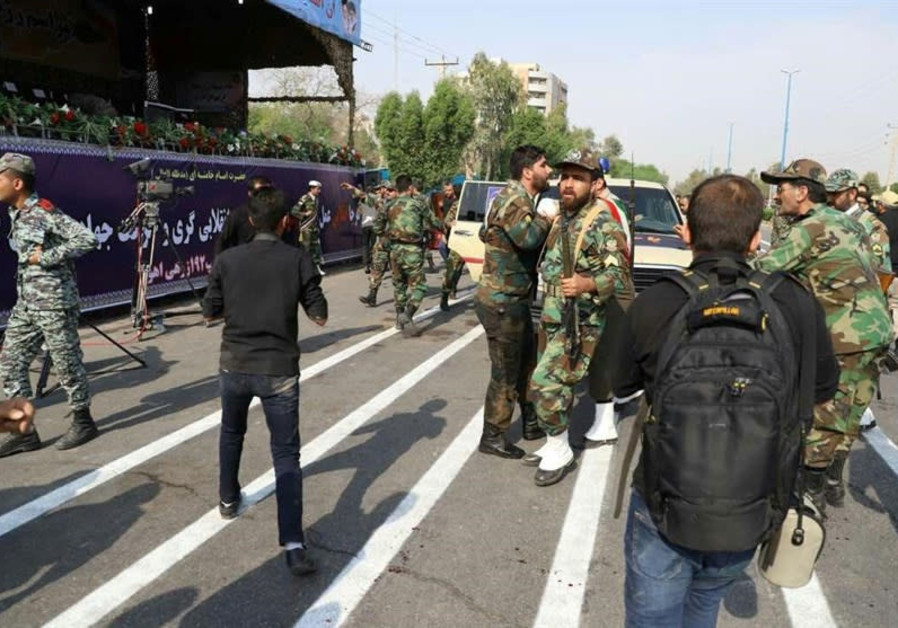
  • This picture taken on September 22, 2018 in the southwestern Iranian city of Ahvaz shows Iranian soldiers carrying away an injured colleague at the scene of an attack on a military parade that was marking the anniversary of the outbreak of its devastating 1980-1988 war with Saddam Hussein's Iraq. (AFP/ ISNA / MORTEZA JABERIAN)
    This picture taken on September 22, 2018 in the southwestern Iranian city of Ahvaz shows Iranian soldiers carrying away an injured colleague at the scene of an attack on a military parade that was marking the anniversary of the outbreak of its devastating 1980-1988 war with Saddam Hussein’s Iraq. (AFP/ ISNA / MORTEZA JABERIAN)
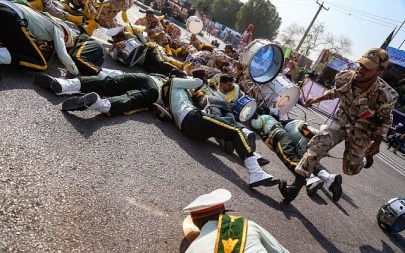
  • An Iranian soldier runs past injured colleagues lying on the ground at the scene of an attack on a military parade in Ahvaz, September 22, 2018. (AFP/ ISNA / MORTEZA JABERIAN)
    An Iranian soldier runs past injured colleagues lying on the ground at the scene of an attack on a military parade in Ahvaz, September 22, 2018. (AFP/ ISNA / MORTEZA JABERIAN)
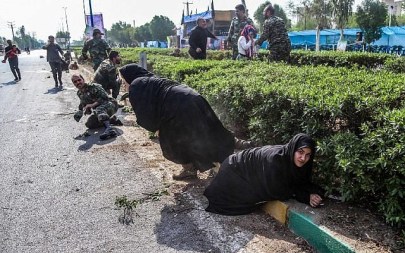
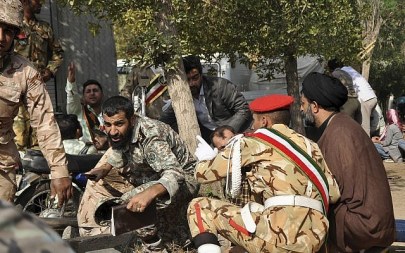
  • This picture taken on September 22, 2018 in the southwestern Iranian city of Ahvaz shows Iranian women and soldiers taking cover next to bushes at the scene of an attack on a military parade in the southwestern Khuzestan province on September 22, 2018. (AFP/ ISNA / MORTEZA JABERIAN)
    This picture taken on September 22, 2018 in the southwestern Iranian city of Ahvaz shows Iranian women and soldiers taking cover next to bushes at the scene of an attack on a military parade in the southwestern Khuzestan province on September 22, 2018. (AFP/ ISNA / MORTEZA JABERIAN)
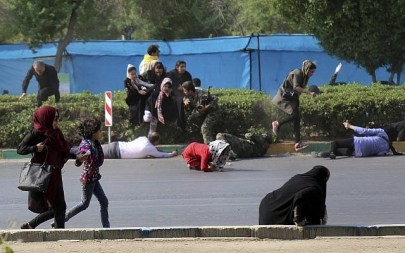
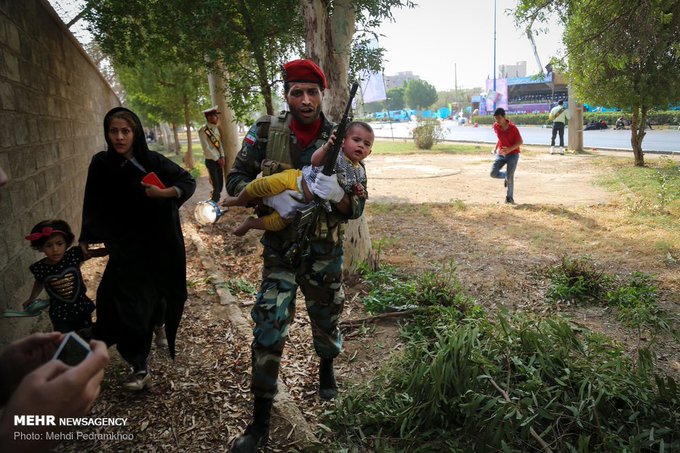
  • In this photo provided by Mehr News Agency, civilians try to take shelter in a shooting scene, during a military parade marking the 38th anniversary of Iraq's 1980 invasion of Iran, in the southwestern city of Ahvaz, Iran, Sept. 22, 2018 (AP Photo/Mehr News Agency, Mehdi Pedramkhoo)
    In this photo provided by Mehr News Agency, civilians try to take shelter in a shooting scene, during a military parade marking the 38th anniversary of Iraq’s 1980 invasion of Iran, in the southwestern city of Ahvaz, Iran, Sept. 22, 2018 (AP Photo/Mehr News Agency, Mehdi Pedramkhoo)
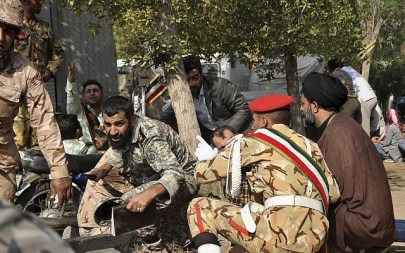
  • In this photo provided by the Iranian Students' News Agency, ISNA, Iranian armed forces members and civilians take shelter in a shooting during a military parade marking the 38th anniversary of Iraq's 1980 invasion of Iran, in the southwestern city of Ahvaz, Iran, Sept. 22, 2018 (AP Photo/ISNA, Behrad Ghasemi)
    In this photo provided by the Iranian Students’ News Agency, ISNA, Iranian armed forces members and civilians take shelter in a shooting during a military parade marking the 38th anniversary of Iraq’s 1980 invasion of Iran, in the southwestern city of Ahvaz, Iran, Sept. 22, 2018 (AP Photo/ISNA, Behrad Ghasemi)
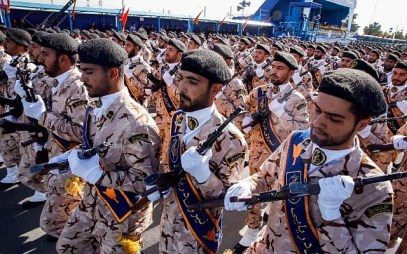
  • Members of Iran's Revolutionary Guard Corps (IRGC) march during the annual military parade marking the anniversary of the outbreak of the devastating 1980-1988 war with Saddam Hussein's Iraq, in the capital Tehran on September 22, 2018. (AFP / STR)
    Members of Iran’s Revolutionary Guard Corps (IRGC) march during the annual military parade marking the anniversary of the outbreak of the devastating 1980-1988 war with Saddam Hussein’s Iraq, in the capital Tehran on September 22, 2018. (AFP / STR)
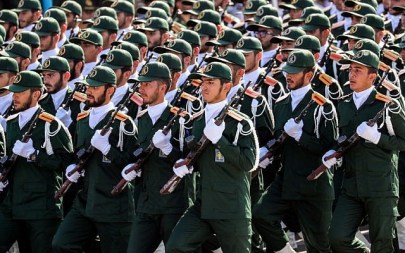
  • Members of Iran's Revolutionary Guard Corps (IRGC) march during the annual military parade marking the anniversary of the outbreak of the devastating 1980-1988 war with Saddam Hussein's Iraq, in the capital Tehran on September 22, 2018. (AFP / STR)
    Members of Iran’s Revolutionary Guard Corps (IRGC) march during the annual military parade marking the anniversary of the outbreak of the devastating 1980-1988 war with Saddam Hussein’s Iraq, in the capital Tehran on September 22, 2018. (AFP / STR)

A spokesman for the Iranian army on Saturday blamed Israel and the US for an attack that has killed at least 29 people and wounded over 60 at a military parade in the southwestern city of Ahvaz.

The death toll continued to climb on Saturday and is expected to rise further as some victims, including women and children, were critically injured in the armed assault.

Brigadier General Abolfazl Shekarchi told the state news agency IRNA, that the gunmen who opened fire at the parade, marking the anniversary of the start of its 1980-1988 war with Saddam Hussein’s Iraq, were “not from Daesh [Islamic State] or other groups fighting [Iran’s] Islamic system … but are linked to America and [Israel’s intelligence agency] Mossad.”

Shekarchi also claimed “the terrorists have undergone training in two countries in the Persian Gulf.”

The Islamic State terrorist group had earlier claimed responsibility for the deadly attack. Citing a security source, its propaganda agency Amaq said: “Islamic State fighters attacked a gathering of Iranian forces in the city of Ahvaz in southern Iran.”

In a further claim, Yaghub Hur Totsari told Reuters the Ahvaz National Resistance umbrella organization of Arab anti-government armed movements was behind the attack, but did not specify which particular group carried it out.

Iranian President Hassan Rouhani, meanwhile, ordered the country’s security forces to identify those behind the attack, according to the semi-official ISNA news agency, and warned of an aggressive response.

“The response of the Islamic Republic of Iran to the smallest threat will be crushing”, Rouhani said on his official website. “Those who give intelligence and propaganda support to these terrorists must answer for it.”

Iran’s foreign minister on Saturday had earlier blamed an unnamed foreign country and its “US masters” for the deadly assault.

View image on TwitterView image on TwitterView image on Twitter

Javad Zarif

@JZarif

Terrorists recruited, trained, armed & paid by a foreign regime have attacked Ahvaz. Children and journos among casualties. Iran holds regional terror sponsors and their US masters accountable for such attacks. Iran will respond swiftly and decisively in defense of Iranian lives.

Mohammad Javad Zarif said the gunmen were “terrorists recruited, trained, armed and paid by a foreign regime,” further raising regional tensions as Tehran’s nuclear deal with world powers is in jeopardy after President Donald Trump withdrew the United States from the accord.

“Iran will respond swiftly and decisively in defense of Iranian lives,” Zarif wrote on Twitter after the attack.

The gunmen, said to be dressed as Islamic Revolutionary Guard Corps (IRGC) members, opened fire on the large crowd of spectators watching the parade in Ahvaz and then attempted to attack the viewing stand for official dignitaries before being shot and wounded by security forces, the semi-official Fars news agency said.

Shekarchi said the dead included a young girl and a former serviceman in a wheelchair.

“Of the four terrorists, three were sent to hell at the scene, while the fourth who had been wounded and arrested went to hell moments ago due to his severe wounds,” Shekarchi told state television.

Khuzestan deputy governor Ali-Hossein Hosseinzadeh told the semi-official ISNA news agency that “eight to nine” troops were among those killed, as well as a journalist.

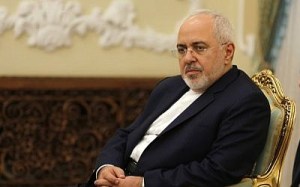
Iranian Foreign Minister Mohammad Javad Zarif listens during a meeting between the Iranian president and the North Korean foreign minister in the capital Tehran on August 8, 2018 (AFP Photo/Atta Kenare)

The Revolutionary Guard is a paramilitary force answerable only to Supreme Leader Ayatollah Ali Khamenei. The Guard also has vast holdings in Iran’s economy.

Guard spokesman Gen. Ramazan Sharif told ISNA that an Arab separatist group funded by Sunni arch-rival Saudi Arabia carried out the attack, However, those groups in the past previously have only attacked unguarded oil pipelines at night.

“Those who opened fire on civilians and the armed forces have links to the Ahvazi movement,” Guards spokesman Ramezan Sharif told ISNA.

“They are funded by Saudi Arabia and attempted to cast a shadow over the Iranian armed forces,” he said.

State television immediately described the assailants as “takfiri gunmen,” a term previously used to describe the Islamic State group. Iran faced a bloody assault last year from the Islamic State group and Arab separatists in the region have attacked oil pipelines there in the past.

The rare attack targeted Khuzestan, a province bordering Iraq that has a large ethnic Arab community, many of them Sunni, and was a major battleground of the devastating 1980-88 conflict between Iran and Saddam Hussein’s Iraq.

Attacks by Kurdish rebels on military patrols along the border in mainly ethnic Kurdish areas further north are relatively common.

Saturday’s rally was one of many in cities across Iran held to mark the anniversary of the launch of the war with massive Iraqi air strikes.

In this photo provided by the Iranian Students’ News Agency, ISNA, Iranian armed forces members and civilians take shelter in a shooting during a military parade marking the 38th anniversary of Iraq’s 1980 invasion of Iran, in the southwestern city of Ahvaz, Iran, September 22, 2018 (AP Photo/ISNA, Behrad Ghasemi)

State television showed images of the immediate aftermath. In them, paramedics could be seen helping someone in military fatigues lying on the ground. Other armed security personnel shouted at each other in front of what appeared to be a viewing stand for the parade.

The ISNA news agency also published photographs of the attack’s aftermath, with bloodied troops in dress uniforms helping each other walk away. The attack struck on Ahvaz’s Quds, or Jerusalem, Boulevard.

Saturday’s attack comes after a coordinated June 7, 2017 Islamic State group assault on parliament and the shrine of Ayatollah Ruhollah Khomeini in Tehran. That attack had at that point been the only one by the Sunni extremists inside of Shiite Iran, which has been deeply involved in the wars in Iraq and Syria where the militants once held vast territory.

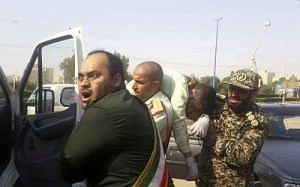
In this photo provided by the Iranian Students’ News Agency, ISNA, Revolutionary Guard members carry a wounded comrade after a shooting during their parade marking the 38th anniversary of Iraq’s 1980 invasion of Iran, in the southwestern city of Ahvaz, Iran, September 22, 2018 (AP Photo/ISNA, Shayan Haji Najaf)

At least 18 people were killed and more than 50 wounded in the 2017 attack that saw gunmen carrying Kalashnikov assault rifles and explosives storm the parliament complex where a legislative session had been in progress, starting an hours-long siege. Meanwhile, gunmen and suicide bombers also struck outside Khomeini’s mausoleum on Tehran’s southern outskirts. Khomeini led the 1979 Islamic Revolution that toppled the Western-backed shah to become Iran’s first supreme leader until his death in 1989.


Dozens killed in Iran terror attack, official blames US and Mossad 

September 22, 2018

Source: Dozens killed in Iran terror attack, official blames US and Mossad – Middle East – Jerusalem Post

“Shooting began by several gunmen from behind the stand during the parade. There are several killed and injured,” a correspondent told state television.

BY REUTERS, SAMUEL THROPE
 SEPTEMBER 22, 2018 09:55
A general view of the attack during the military parade in Ahvaz, Iran, 2018

A senior spokesman for Iran’s armed forces blamed Israel and the United States for an attack that killed 24 people, including military personnel and a four-year-old child, and wounded more than 60 when gunmen opened fire on a military parade in the southwestern Iranian city of Ahvaz Saturday.

“These terrorists are not affiliated with Daesh [the Islamic State], nor with other groups fighting [Iran’s] Islamic system,” Brigadier General Abolfazl Shekarchi told the Islamic Republic News Agency (IRNA). “These individuals were trained and equipped by two extremist Persian Gulf states… they are linked to the United States and the Mossad.”

At least five members of the elite Iranian Revolutionary Guards Corps and two regular army soldiers were among those injured, according to the BBC’s Persian-language service.

All four of the attackers died, according to Shekarchi. Three were killed by security personnel at the scene, and the fourth died from his wounds after being taken to a local hospital.

Eyewitnesses reported that the attackers were wearing military dress and that the shooting lasted for several minutes, according to the Iranian media. Participants and spectators of the parade threw themselves to the ground at the sound of the gunfire.

BBC NEWS فارسی

@bbcpersian

تصاویری از لحظه حمله به رژه اهواز؛ سپاه می‌گوید حمله توسط گروه الاهوازیه صورت گرفته.
گفته می‌شود هیچ یک از مسئولان حاضر آسیب ندیده است.

A video distributed to Iranian media showed soldiers crawling on the ground as gunfire blazed in their direction. One soldier picked up a gun and got to his feet as women and children fled for their lives.

Ali Hosein Hoseinzadeh, deputy governor in Khuzestan province, was quoted as saying the death toll was expected to rise. One of those killed was a journalist.

A local Arab group claimed responsibility for the attack. Yaghub Hur Totsari, spokesman for one of the two groups that identify themselves as the Arab Struggle Movement for the Liberation of Ahvaz, said the Ahvaz National Resistance, an umbrella organization of all armed movements, claimed responsibility for the attack, but did not specify which group carried out the operation.

“This action was part of our legitimate resistance and no civilians were targeted in the attack,” said a statement released by the group, which describes itself as devoted to protecting the rights of Khuzestan province’s ethnic Arab minority, according to the BBC.

The Islamic State also claimed responsibility for the attack, according to a statement released by the group’s Amaq news agency, but did not provide any evidence of its involvement.

Iranian Foreign Minister Mohammad Javad Zarif held “regional terror sponsors and their US masters” responsible in a statement on Twitter.

View image on TwitterView image on TwitterView image on Twitter

Javad Zarif

@JZarif

“Terrorists recruited, trained, armed and paid by a foreign regime have attacked Ahvaz. Children and journos among casualties,” Zarif wrote. “Iran holds regional terror sponsors and their US masters accountable for such attacks. Iran will respond swiftly and decisively in defense of Iranian lives.”

An unnamed spokesman for the Iranian Revolutionary Guard Corps likewise claimed that the attackers had the backing of Iran’s regional rival Saudi Arabia.

The spokesman also said that the attackers directed their fire at civilians in the crowd as well as members of the armed forces participating in the parade, Iranian media reported.

In response, Iran has is increasing security at the Shalamcheh border crossing with Iraq in Khuzestan province, according to the BBC.

Yahya Rahim Safavi, a senior Revolutionary Guards official, vowed retaliation for the attack. “Enemies should not imagine that they can gain dignity with this sinister move. The Iranian people and the armed forces will respond to this,” he said, according to IRNA

Russian President Vladimir Putin expressed his condolences to Iranian President Hassan Rouhani, RIA news quoted the Kremlin as saying.

This is not the only recent terrorist incident on Iranian soil. Last June, Islamic State suicide bombers and gunmen attacked Iran’s parliament and the Mausoleum of Ayatollah Khomeini in Tehran, killing 18. Recent years have also seen attacks by armed militias affiliated with Kurdish and Balochi separatist movements.

Kurdish militants killed 10 Revolutionary Guards in an attack on an IRGC post on the Iraqi border in July, Iran’s semi-official Tasnim news agency reported, the latest bloodshed in an area where armed Kurdish opposition groups are active.

The parade in Ahvaz, and others held around the country over the weekend, marked the 37th anniversary of the beginning of the Iran-Iraq War, the longest and bloodiest conflict in Iran’s modern history.


Pompeo warns Iran against using proxies to target US: ‘We’ll go to the source’ 

September 22, 2018

Source: Pompeo warns Iran against using proxies to target US: ‘We’ll go to the source’ | The Times of Israel

US secretary of state says Tehran ‘will be held accountable’ for any assaults by its allies on US interests in the Middle East, does not rule out military response

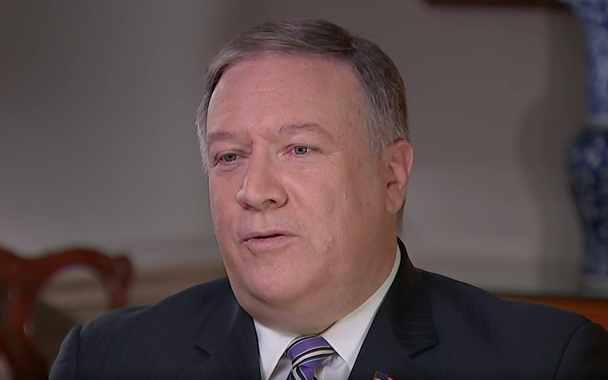
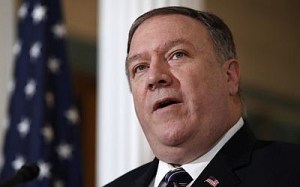
US Secretary of State Mike Pompeo speaks to CNN, September 21, 2018 (CNN screenshot)

US Secretary of State Mike Pompeo speaks to CNN, September 21, 2018 (CNN screenshot)

The US will “go to the source” if Iranian proxies attack American targets and interests in the Middle East, Secretary of State Mike Pompeo warned Friday.

“We have told the Islamic Republic of Iran that using a proxy force to attack an American interest will not prevent us from responding against the prime actor,” he told CNN. “That is, we will not let Iran get away with using a proxy force to attack an American interest. Iran will be held accountable for those incidents.”

Asked if this included a military response, he repeated: “They’re going to be held accountable. If they’re responsible for the arming and training of these militias, we’re gonna go to the source.”

Washington has blamed an Iran-backed militia for a mortar attack earlier this month near the US embassy in Baghdad. But Pompeo stresses that Tehran’s influence on anti-American operations was felt throughout the region.

“Iran has been confronting the world as the world’s largest state sponsor of terror for quite some time,” he said. “They have armed militias, the Lebanese Hezbollah, Makateeb Hezbollah — militias in Iraq, they’re arming the Houthis in Yemen, launching missiles into the Gulf states.”

He said the US, which in May pulled out of the 2015 nuclear deal between Iran and world powers, “has begun to apply economic and diplomatic pressure on Iran to prevent them from doing this, that’s our mission.”

On Friday Iran’s air force held a drill near the strategic Strait of Hormuz in the Persian Gulf, the passageway for nearly a third of all oil traded by sea, the country’s official IRNA news agency said.

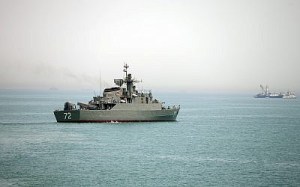
Illustrative: The Iranian warship Alborz, foreground, prepares to leave Iran’s waters at the Strait of Hormuz, in this photo released by the semi-official Fars News Agency, Tuesday, April 7, 2015. (AP/Fars News Agency, Mahdi Marizad)

IRNA said the maneuver was a warning to Iran’s enemies that they face a “stern response” if they threaten Iran. The exercise was part of annual demonstrations on the anniversary of the start of the eight-year Iran-Iraq War that began in 1980.

But it also came after Tehran’s recent threat to shut down the Strait of Hormuz if the country was blocked from exporting its crude because of US pressure and renewed sanctions.

Crushing US oil sanctions on Iran will resume in early November and American allies in Asia are already cutting back on their purchases of Iranian crude.

In July, Iran’s President Hassan Rouhani said that if renewed sanctions threatened Iran’s crude oil exports, the rest of the Mideast’s exports would be threatened as well.

AP contributed to this report.


Rouhani vows to boost Iran’s missile capabilities

September 22, 2018

Source: Rouhani vows to boost Iran’s missile capabilities | The Times of Israel

Iranian president says missiles are the regime’s ‘most effective weapons’; threat comes after Trump’s Iran adviser says future treaty will cover nuclear, ballistic missile programs

Iranian President Hassan Rouhani speaks during a press conference in Tehran, September 7, 2018. (AFP/Kirill Kudryavtsev/Pool)

President Hassan Rouhani vowed on Saturday to boost Iran’s ballistic missile capabilities despite Western concerns that were cited by his US counterpart Donald Trump in May when he abandoned a landmark nuclear deal with Tehran.

“We will never decrease our defensive capabilities… we will increase them day by day,” Rouhani said at a military parade. “The fact that the missiles anger you shows they are our most effective weapons,” he said, referring to the West.

Iran has ballistic missiles with a range of up to 3,500 kilometers (2,200 miles), enough to reach both Israel and US bases in the Middle East.

On Wednesday the Trump administration’s new special representative for Iran said the United States wants to negotiate a treaty with Iran that will cover both its nuclear and its ballistic missile efforts.

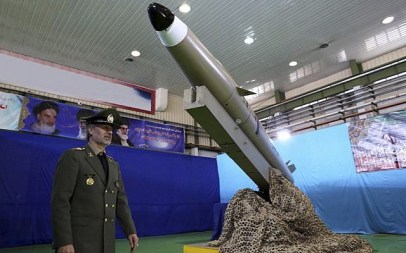
In this picture released by the official website of the Iranian Defense Ministry on Aug. 13, 2018, Defense Minister Gen. Amir Hatami walks past the missile Fateh-e Mobin, or Bright Conqueror, during inauguration of its production line at an undisclosed location, Iran (Iranian Defense Ministry via AP)

Such a deal, said Brian Hook, would be more binding than the 2015 agreement from which the Trump Administration has withdrawn. If the Iranian leadership did not want to negotiate, however, he indicated, it would face stepped up pressure from the US.

Trump withdrew in May from the P5+1’s 2015 deal with Iran, negotiated during the Obama administration, which was designed to freeze and inspect Iran’s nuclear program. The deal was bitterly opposed by Israel’s Prime Minister Benjamin Netanyahu, who insists the regime continues to seek a nuclear weapons arsenal, and derided by Trump as “the worst deal ever.”

Trump and Rouhani will both be in New York next week for the United Nations General Assembly. While Rouhani will hold talks with his French counterpart Emmanuel Macron, no US-Iranian meeting has been announced.

The US re-imposed sweeping sanctions against Iran last month, and a new round of even harsher sanctions is set to go into effect November 5 targeting Iran’s vital oil sector.

Trump plans to lead a meeting of heads of state of the United Nations Security Council on Iran on September 26, his UN envoy Nikki Haley announced earlier this month. Haley said the aim is to further pressure Tehran over its alleged violations of council resolutions, including support for terror.

Secretary of State Mike Pompeo makes a statement to the media, Sept. 17, 2018, at the State Department in Washington. (AP Photo/Jacquelyn Martin)

US Secretary of State Mike Pompeo last month formed a group to coordinate and run US policy toward Iran as the Trump administration moved ahead with efforts to force changes in the Islamic Republic’s behavior after withdrawing from the 2015 Iran nuclear deal.

Accusing Iran of unleashing “a torrent of violence and destabilizing behavior against the United States, our allies, our partners and, indeed, the Iranian people themselves,” Pompeo announced the creation of the Iran Action Group, which he said would drive administration policy in Washington and overseas.

Since withdrawing, the administration has re-imposed sanctions that were eased under the deal and has steadily ramped up pressure on Iran to try to get it to stop what it describes as “malign activities” in the region. In addition to its nuclear and missile programs, the administration has repeatedly criticized Iran for supporting Syrian President Bashar Assad, Lebanon’s Hezbollah terror movement, Shiite rebels in Yemen, and anti-Israel groups.


Iran dismisses talks with US

September 22, 2018

Source: Iran dismisses talks with US

After special envoy Brian Hook says US wants to negotiate treaty including Tehran’s ballistic missile program, regional behavior, Iran’s FM Iranian Zarif rejects his characterization of 2015 deal as ‘personal agreement’; Islamic Republic denies requesting meeting with Trump.


US President Donald Trump pulled out of that nuclear accord—which curbed Iran’s atomic activities in return for sanctions relief—in May, saying it did not go far enough.

President Hassan Rouhani (L) and US President Donald Trump (Photo: AFP, AP)

President Hassan Rouhani (L) and US President Donald Trump (Photo: AFP, AP)

The US special envoy for Iran, Brian Hook, said on Wednesday that Washington now wanted to negotiate a treaty that included Tehran’s ballistic missile program and its regional behavior.Hook said the new deal that Washington hoped to sign with Iran, would not be a “personal agreement between two governments like the last one, we seek a treaty.”

Iranian Foreign Minister Mohammad Javad Zarif took to Twitter to dismiss the characterization of last deal as a “personal agreement”, saying it was “an int’l accord enshrined in a UN (Security Council resolution)”.”US has violated its treaty obligations too… Apparently, US only mocks calls for peace,” he added in the message that was attached to a video of a protester who took to the stage after Hook’s speech, shouting that sanctions were hurting Iranian people.

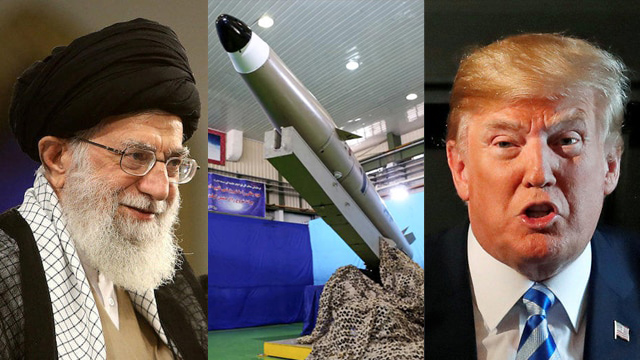
Ayatollah Ali Khamenei (L) and President Trump (Photo: Reuters, AFP)

Ayatollah Ali Khamenei (L) and President Trump (Photo: Reuters, AFP)

The five other world powers that signed the 2015 accord with Iran—France, Germany, Britain, China and Russia—have been trying to salvage it, saying it offers the best chance to stop Iran developing a nuclear bomb. Tehran says its nuclear work is for electricity generation and other peaceful purposes.

Iran denies requesting meeting with Trump

Iran has not requested a meeting with US President Donald Trump, foreign ministry spokesman Bahram Qassemi said on Friday, according to the Islamic Republic News Agency (IRNA).

A foreign news agency reported that Iran requested such a meeting during the United Nations General Assembly which began this week, citing US Ambassador to the United Nations Nikki Haley, according to IRNA.

IRNA did not identify the foreign news agency.

Iranian President Hassan Rouhani is scheduled to address the General Assembly next week, according to Iranian state media.

“The Islamic Republic of Iran has never put forth a request for a meeting with Trump,” Qassemi said.


DEMOCRATS EXPRESS ‘CONCERN’ OVER TRUMP PRESSURE ON PALESTINIANS

September 22, 2018

Source: “We are deeply concerned that your strategy… is misguided.” – American Politics – Jerusalem Post

“I’d say, you’ll get money, but we’re not paying you until we make a deal. If we don’t make a deal, we’re not paying,” Trump said.

BY MICHAEL WILNER
 SEPTEMBER 22, 2018 05:58
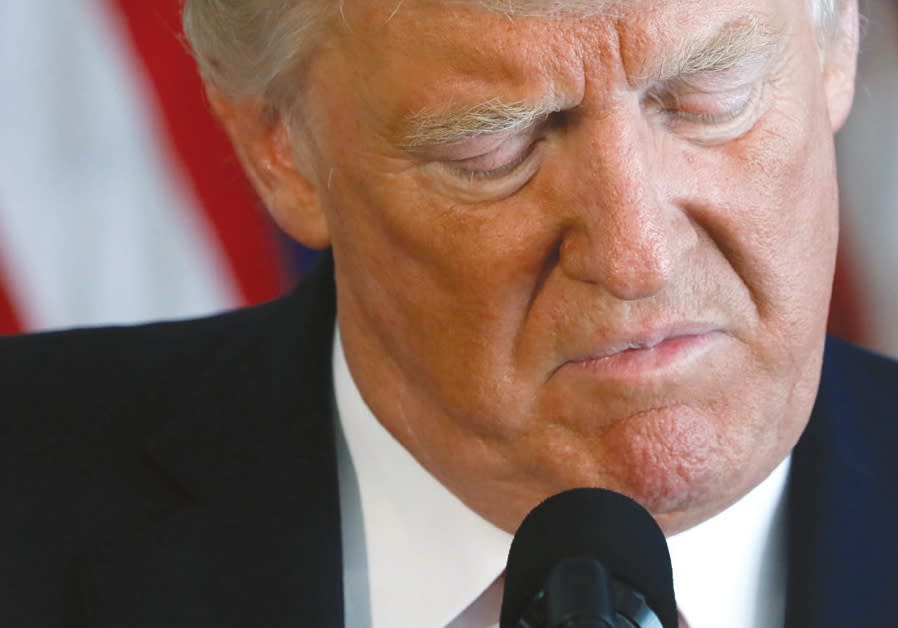
US President Donald Trump delivers remarks about the protests in Charlottesville, Virginia, in 2017

Over 30 Democratic lawmakers on Capitol Hill have sent a letter to US President Donald Trump expressing “concern” over his slew of cuts to Palestinian interests.

The letter, spearheaded by Senator Chris Van Hollen of Maryland, warns that Trump’s apparently strategy of pressuring the Palestinians to the negotiating table with Israel would prove counterproductive.

“We are deeply concerned that your strategy of attempting to force the Palestinian Authority to the negotiating table by withholding humanitarian assistance from women and children is misguided and destined to backfire,” the Democrats wrote. “Your proposed cuts would undermine those who seek a peaceful resolution and strengthen the hands of Hamas and other extremists in the Gaza Strip, as the humanitarian crisis there worsens.”

On a high holy days call with Jewish leaders last week, Trump hinted at a pressure campaign on the PA designed to jumpstart the moribund peace process.

“I’d say, you’ll get money, but we’re not paying you until we make a deal. If we don’t make a deal, we’re not paying,” Trump said.

And Nikki Haley, who serves as the US ambassador to the UN and who has consulted closely with the peace team, also said that Palestinian rhetoric critical of the president contributed to the aid cuts. “Our job is not to take the beatings that you give us, saying we’re not kind to Palestinians and then turn around pay for them,” the envoy explained last month.

Over the course of a few short weeks, the administration has slashed aid to the UN agency for Palestinian refugees, for east Jerusalem hospitals, for Palestinian-Israeli cooperation programs and direct assistance to the Gaza Strip and the West Bank itself. It also shuttered the PLO’s offices in Washington and revoked visas for its top envoy and his family.

Palestinian officials insist that any pressure campaign will fail, and continue to dismiss Trump as a fair arbiter of peace ever since he recognized Jerusalem as Israel’s capital last year, moving the US embassy there from Tel Aviv in May.

Trump’s top aides are preparing a peace plan for Israelis and Palestinians that is said to include enterprising, detailed proposals for a comprehensive settlement to the conflict.

While they have not seen the plan, Palestinian leaders have already cast the plan aside as “dead on arrival” and warn that Trump’s peace team is attempting to change the “terms of reference” upon which negotiations would be based.

US officials responded to this criticism by cautioning all parties to wait to see their plan before judging it.


Palestinian Authority President Abbas to French leader:’We can resume negotiations’

September 22, 2018

Source: Palestinian Authority President Abbas to French leader:’We can resume negotiations’ – Israel News – Jerusalem Post

“We have not rejected negotiations, as the Israelis say, but [Benjamin] Netanyahu always refused,” Abbas told reporters.

BY RINA BASSIST
 SEPTEMBER 22, 2018 02:54
PA President Abbas to French leader: 'We can resume negotiations'

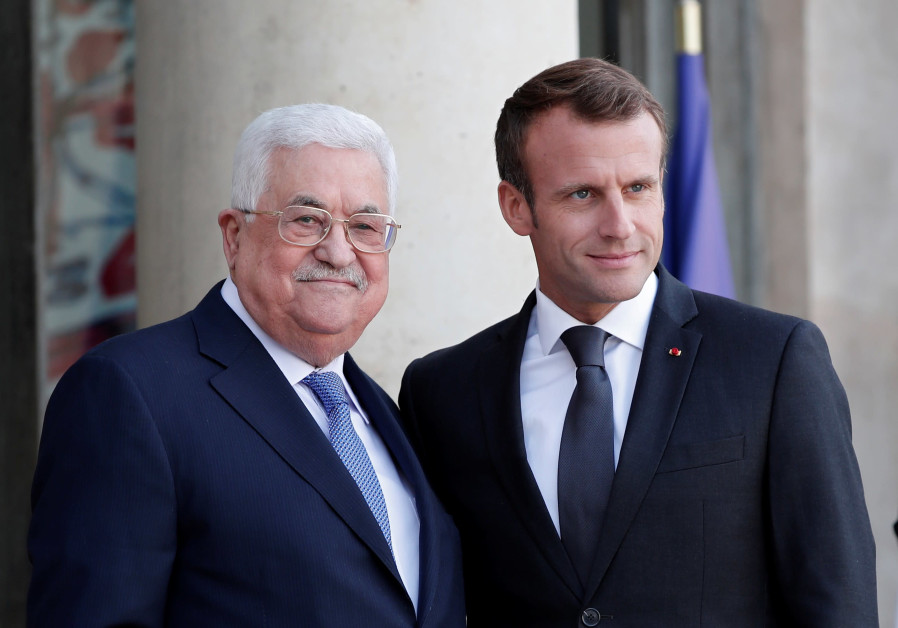
Palestinian Authority President Mahmoud Abbas met on Friday evening with French President Emmanuel Macron at the Élysée Palace in Paris. The two men first met privately, and were later joined by their respective advisors and with French Foreign Minister Yves le Drian.

Palestinian News Agency WAFA reports that the Palestinian leadership is willing to begin confidential or public peace negotiations with Israel.

“We have not rejected negotiations, as the Israelis say, but [Benjamin] Netanyahu always refused,” Abbas told reporters outside the Elysee Palace.

Abbas is expected to continue from France to Ireland, before heading to New York, for the UN General Assembly.

Following the meeting, the office of President Macron stated that the lengthy discussion between the two men and between the two delegations focused on the complicated situation of the Palestinian Authority at present.

According to the statement. ‘’The President of the Republic reiterated the full commitment of France to resume the thread of dialogue between Palestinians and Israelis and confirmed to President Abbas the willingness of France to mobilize on the diplomatic field, in order to change a situation that is no longer tenable.’’

Both leaders discussed the humanitarian crisis in Gaza, with President Macron urging President Abbas and Hamas to fully participate at the Egypt-mediated talks, in order to allow the return of the Palestinian Authority to Gaza and the holding of Palestinian elections in the coming months.

In the statement, Macron condemns Israel’s settelment policy ‘’which has continued and accelerated in recent months.’’

In this context, the two leaders discussed the emblematic situation of the West Bank Palestinian village of Khan al-Ahmar slated by Israel for demolition. Macron reiterated the European call to Israel not to proceed with the demolition, ‘’which would constitute a very serious violation of international law.’’

Finally, Macron warns of ‘’other decisions that are dangerous for the security of all, including Israel,’’ that have jeopardized the United Nations system providing relief to Palestinian refugees.

Macron and Abbas last met in July in Moscow, when they both attended the Soccer World Cup final game between Croatia and France. The two leaders were scheduled to meet for a discussion after the game, but Following France’s victory President Macron was unavailable for such an encounter. Macron then extended an invitation to Abbas for a meeting in Paris this fall.

Diplomatic sources confirmed to the Jerusalem Post after the meeting, that Macron does not intend to recognize a Palestinian independent state for the moment, and that he will not make such a decision as a reaction to an action taken by any the sides; a position he has expressed on several occasions in the past.

Macron has refused, so far, to engage in a new European initiative on the Middle East, stressing that he would wait for the Trump administration to publish its Mideast peace proposal first.

Associates of Macron have urged both Palestinian and Israeli decision-makers not to reject off-handedly the Trump proposal, and to address it positively when presented. About one month after the December 2017 recognition by President Donald Trump of Jerusalem as capital of Israel, President Macron sent to Ramallah his diplomatic advisor Aurélien Lechevallier, to persuade the Palestinians not to rule out the American peace plan.

On Thursday, the Élysée confirmed that Macron would meet separately with President Donald Trump and with Iranian President Hassan Rouhani during the UN General Assembly meeting next week.

He is expected to raise with President Trump the Palestinian issue.

Paris has been active in recent weeks, alongside Turkey and Jordan, in organizing the upcoming meeting in New York of the Ad Hoc Liaison Committee (AHLC) – the framework for donor states to the Palestinians, which will also take place on the margins of the General Assembly. A forum which has become crucial for the Palestinians ever since President Trump decided to slash UNRWA funds.

Macron has met with PM Benjamin Netanyahu last in June, in Paris. So far, no meeting has been officially scheduled for the two of them in NY, though according to one diplomatic source they might meet there next Tuesday, the same day Macron is expected to meet with Trump.

WAFA reports that former prime minister Ehud Olmert met with Abbas during his stay in Paris.

The French President was expected to arrive to Israel this fall, for the closing of the cross-cultural season between France and Israel, but had canceled his visit this summer. At the time, his office cited internal matters as the cause for the cancelation, though sources at the Élysée told the Jerusalem Post that the decision to cancel the visit was taken on the backdrop of the Gaza border demonstrations.