Archive for September 2018

Iran warns Israel will face ‘sorrow, penitence’ for striking its forces in Syria

September 27, 2018

Source: Iran warns Israel will face ‘sorrow, penitence’ for striking its forces in Syria | The Times of Israel

Tehran’s national security official’s comments come after IDF targeted arms depots in strike that led to Syria downing Russian plane, crisis in Israel-Russia ties

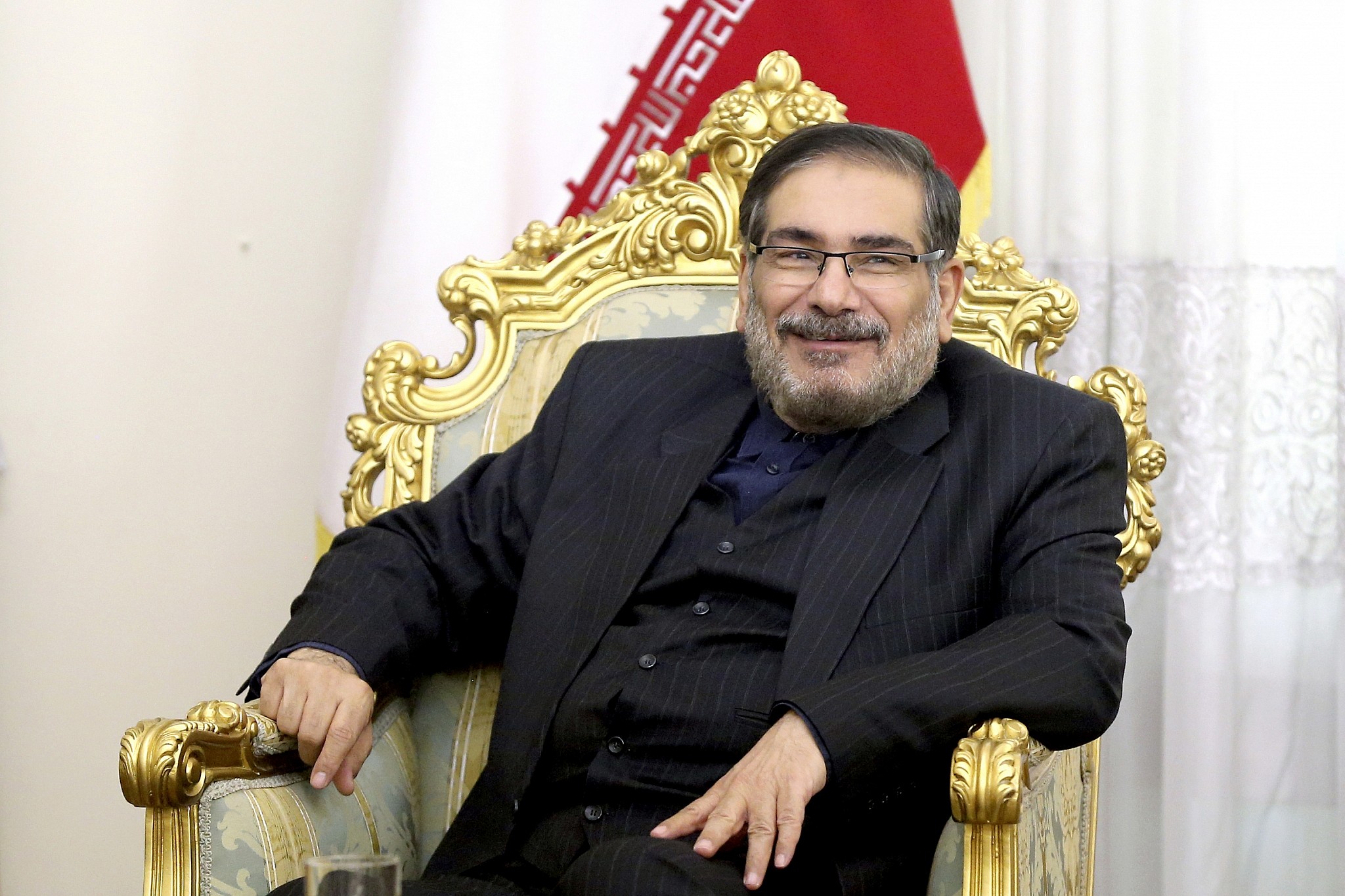
Secretary of Iran's Supreme National Security Council Ali Shamkhani,in a meeting in Tehran, Iran, January 17, 2017.  (Ebrahim Noroozi/AP)

Secretary of Iran’s Supreme National Security Council Ali Shamkhani,in a meeting in Tehran, Iran, January 17, 2017. (Ebrahim Noroozi/AP)

TEHRAN — A senior Iranian security official threatened Israel with harsh “reactions” if the Jewish state “continues to attack” Iranian and government forces in Syria.

The semi-official Fars news agency quotes Ali Shamkhani, of Iran’s Supreme National Security Council, as saying that in case of further airstrikes, Israel “will face reactions that would cause sorrow and penitence.”

Earlier in September, Israel attacked the airport in the Syrian capital, Damascus, with missiles that are believed to have targeted arms depots there of Iranian forces and/or the Lebanese terror Hezbollah group — both allies of Syrian President Bashar Assad’s troops in the civil war.

The airstrike led to an incident in which Syria shot down a Russian spy plane, killing 15 soldiers. Moscow has blamed the incident fully on Jerusalem.

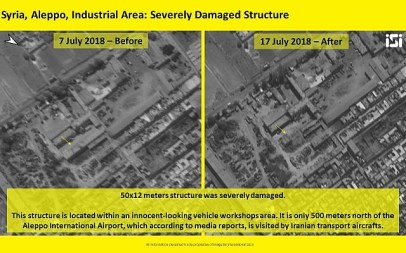
Satellite images from July 7 and 17, 2018, showing the results of an alleged Israeli airstrike on an airfield in Aleppo, Syria, which is said to be a base for Iranian forces. ImageSat International ISI)(

Iran has maintained that its forces in Syria play an advisory role to the Syrian army in its war on Islamic State jihadists and armed opposition groups.

In his speech in front of the United Nations General Assembly on Wednesday, Iranian President Hassan Rouhani said that Iran would stay in Syria for as long as the Assad regime wanted it there, but said Tehran was not seeking conflict with the United States in the Middle East.

Israel has repeatedly warned that it would not tolerate an Iranian military presence in Syria and has repeatedly hit Iranian bases in airstrikes, seeking to prevent the transfer of advanced weapons to the Lebanese terror group Hezbollah.

Israel has also extensively lobbied Washington and Moscow, another key ally of Syria and Iran, to ensure Iranian forces and Iranian-backed militias are kept as far away from the Israeli border as possible.

Despite the crisis in Israel-Russia ties over the downing of the plane, Israel has restated that it would continue to act in Syria to prevent Iran’s entrenchment there, and to thwart transfers of advanced weaponry to Hezbollah.


Trump and Netanyahu skipped the Israeli-Russian crisis until after an early PM-Putin encounter – DEBKAfile

September 27, 2018

Source: Trump and Netanyahu skipped the Israeli-Russian crisis until after an early PM-Putin encounter – DEBKAfile

President Donald Trump and Prime Minister Binyamin Netanyahu performed a neat double act for stepping around the issue of the Israeli-Russian crisis when they faced reporters at UN Center on Wednesday, Sept. 27. Trump said, “The US stands behind Israel” while Netanyahu said he had received from the president “everything he asked for.”  So what did he ask for? The answer is: Nothing. DEBKAfile’s sources reveal exclusively that the agenda for this meeting was pre-set. When Netanyahu set off for New York, after an urgent security cabinet meeting on the crisis, he knew that Russian President Vladimir Putin was expecting to see him in the coming days, after the furor in Moscow and Tel Aviv over the Il-20 crash had abated somewhat.  Netanyahu was able to inform Trump that he and Putin had already agreed on certain matters for defusing the crisis:

  1. The deconfliction agreement covering Russian-Israeli military coordination for Israel’s operations in Syria must be amended.
  2. The current arrangements would be observed until the Russian and Israeli leaders’ meeting.
  3. The two would also decide how – and if – the delivery of Russian S-300 air defense missiles to Syria fit in with the new coordination arrangements.

The issue of the Israeli-Russian crisis was therefore left outside their agenda when Trump and Netanyahu sat down on the sidelines of the UN General Assembly, pending the latter’s interview with Putin.   Both were optimistic about Putin making the right decision to call off the delivery of S-300 missiles to Syria and removing it as an issue. But since on Wednesday, all the balls were still up in the air, a distraction was needed to put the reporters off the scent. “I like a two-state solution,” the US President said half-jokingly, in reference to the Israeli-Palestinian dispute. This served the purpose. The reporters hared  off with a new headline on familiar ground without asking awkward questions about the fresh crisis still hanging over the Middle East.

Iran will dominate Netanyahu’s speech at the UN later Thursday, after his meetings with several world leaders. Palestinian leader Mahmoud Abbas speaks earlier, following a major effort to draw international attention back to the Palestinian issue.


Netanyahu: Trump gave me guarantees about freedom of Israeli operations in Syria

September 27, 2018

Source: Netanyahu: Trump gave me guarantees about freedom of Israeli operations in Syria | The Times of Israel

Amid dispute with Moscow, PM says Israel will act whenever necessary to prevent Iranian military entrenchment and efforts to transfer advanced arms to Hezbollah

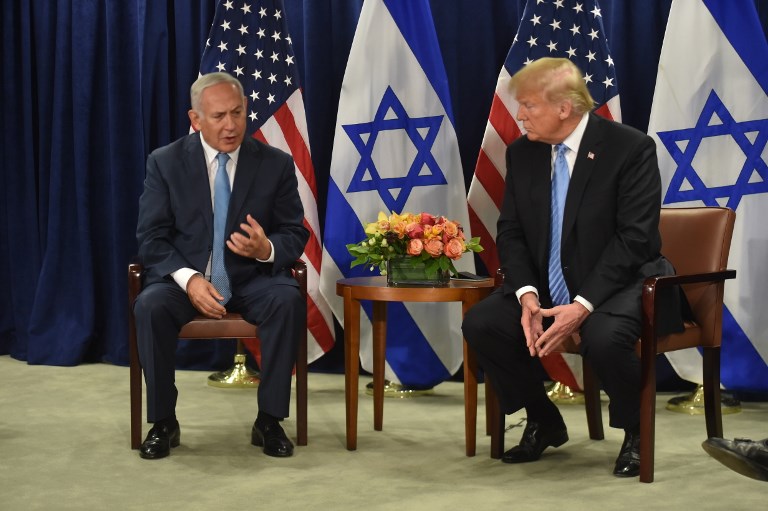
US President Donald Trump meets with Israeli Prime Minister Benjamin Netanyahu on September 26, 2018 in New York on the sidelines of the UN General Assembly. (AFP PHOTO / Nicholas Kamm)

US President Donald Trump meets with Israeli Prime Minister Benjamin Netanyahu on September 26, 2018 in New York on the sidelines of the UN General Assembly. (AFP PHOTO / Nicholas Kamm)

NEW YORK — Israel managed to obtain several guarantees from US President Donald Trump regarding its freedom of operation in Syria, Prime Minister Benjamin Netanyahu said Wednesday.

“I received what I asked for. I came with specific points and I got them,” he told reporters in a briefing following his meeting with Trump earlier during in the day.

He declined to specify what he had asked for. 

Netanyahu’s comments came amid a severe diplomatic crisis with Moscow following the downing of a Russian spy plane last week by Syrian air defenses during an Israeli airstrike.

Russia announced this week that in wake of the incident, which it blames on the Israeli Air Force, it would provide Syria with the advanced S-300 anti-aircraft missile defense system.

The prime minister added that Israel’s deconfliction mechanism with Russia will continue, as will Israel’s determination to act whenever necessary to prevent Iran’s military entrenchment in Syria and its efforts to transfer advance arms to Hezbollah in Lebanon.

Netanyahu said he had discussed the downing of the Syrian plane with Trump.

“We have a goal, and it is as follows: On one hand, to maintain the security coordination with Russia, and second, to allow Israel to defend itself against” the threats emanating from Iran’s effort to establish military bases in Syria.

Still, he maintained, “The greatest threat to Israel does not come from Syria, nor does it come from Lebanon or from what Iran does in Syria, or even from what Iran does inside Iran. Rather, Israel’s number one worry continues to be the Islamic Republic’s ambition to acquire nuclear weapons.

“Iran wants to create nuclear weapons with the declared goal to destroy us,” he said, adding that the issue was discussed at great length with Trump during their meeting.

Also on Wednesday, a senior Israeli official countered media reports that Russian President Vladimir Putin had turned down a meeting with Netanyahu to discuss the incident in Syria, saying instead that Israel had asked for such a meeting, and the Kremlin had neither rejected nor accepted the proposal.

It is likely that the two leaders will meet in the coming weeks to discuss the matter, the official said.


PM rejects invite to UNESCO anti-Semitism event, confirms Israel will leave body

September 27, 2018

Source: PM rejects invite to UNESCO anti-Semitism event, confirms Israel will leave body | The Times of Israel

Netanyahu says Israel will be honored to rejoin ‘if and when UNESCO ends its bias against Israel, stops denying history, and starts standing up for the truth’

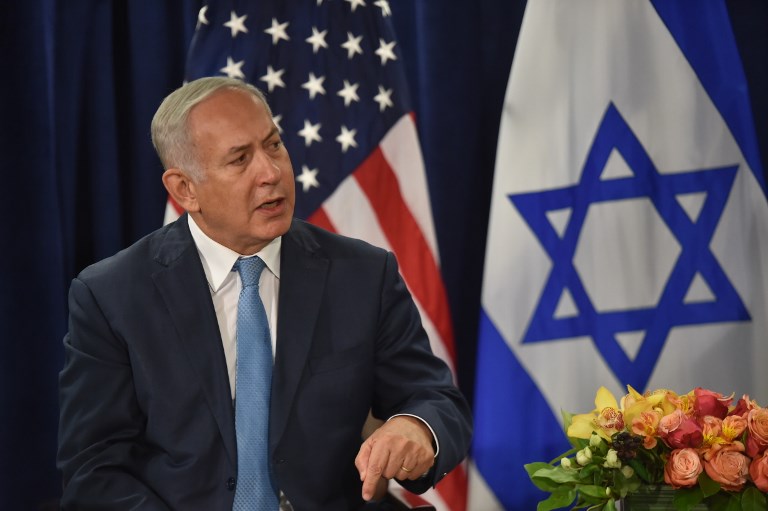
Prime Minister Benjamin Netanyahu speaks during a meeting with US President Donald Trump (out of frame) on September 26, 2018 in New York on the sidelines of the UN General Assembly. (AFP PHOTO / Nicholas Kamm)

NEW YORK — Prime Minister Benjamin Netanyahu on Wednesday harshly criticized UNESCO, shunning an event organized by the organization, and making it plain that Israel will not reconsider last year’s decision to withdraw from it.

Netanyahu, who is currently in New York to attend the UN General Assembly, was invited to participate in a UNESCO-sponsored event on anti-Semitism. He initially considered attending and meeting UNESCO Director-General Audrey Azoulay there, but eventually decided to boycott the event.

“While I commend all efforts to combat anti-Semitism, I have decided not to participate in this week’s UNESCO conference on anti-Semitism due to the organization’s persistent and egregious bias against Israel,” he said in a statement.

“Since 2009, UNESCO has passed 71 resolutions condemning Israel and only two resolutions condemning all other countries combined,” he said. “This is simply outrageous.”

In this November 10, 2017 picture, UNESCO’S new elected director-general France’s Audrey Azoulay attends a press conference at the United Nations Educational, Scientific, and Cultural Organisation headquarters in Paris, France. (AP Photo/Christophe Ena)

Azoulay reportedly had told the premier earlier this year she was making big efforts to change UNESCO’s treatment of Israel, and added she would like to meet him at the sidelines of the UN session to discuss a possible postponement of Israel’s exit from the agency.

However Netanyahu’s statement was issued three hours before the conference was due to open at the UN headquarters in New York.

“The mark of anti-Semitism was once singling out the Jewish people for slander and condemnation. The mark of anti-Semitism today is singling out the Jewish state for slander and condemnation,” he said.

View image on Twitter

UNESCO

@UNESCO

At , join UNESCO’s commitment to & all forms of intolerance through education!

Learn how we help countries deliver education programmes that help build learners’ resilience to .

ℹ️ https://on.unesco.org/2xNeslL 

If UNESCO wants to remove “this mark of shame,” the prime minister said, “it must do more than host a conference on anti-Semitism. It must stop practicing anti-Semitism. And it must stop the absurdity of passing resolutions that deny the connection between the Jewish people and the Land of Israel, between the Jewish people and our eternal capital, Jerusalem.”

Last year, Israel followed the US in announcing its withdrawal from the United Nations Educational, Scientific, and Cultural Organization. Jerusalem reportedly considered remaining in the organization on condition that several changes were made in the way it deals with politicized matters, such as the status of Jerusalem’s Old City or the Cave of the Patriarchs in Hebron.

The Cave of the Patriarchs in the divided West Bank city of Hebron. (Gershon Elinson/Flash90)

“No matter what UNESCO says, the Western Wall is not occupied Palestinian territory and the Cave of the Patriarchs — the burial site of Abraham and Sara, Isaac and Rebecca, Jacob, and Leah — is not a Palestinian Heritage Site,” Netanyahu said.

“In withdrawing from UNESCO in 2017, Israel and the United States made a clear moral statement that UNESCO’s anti-Semitism will no longer be tolerated,” he went on.

“If and when UNESCO ends its bias against Israel, stops denying history and starts standing up for the truth, Israel will be honored to rejoin. Until then, Israel will fight anti-Semitism at UNESCO and everywhere else,” he said.

Danny Danon speaks to the media prior to the Security Council meeting on the Middle East on May 11, 2017. (Mark Garten/UN Photo)

Speaking to The Times of Israel, Israel’s Ambassador to the UN Danny Danon also said it was unlikely Israel would remain in UNESCO in the foreseeable future as it does not seem as though the organization’s leadership is willing or able to make the necessary changes.

“If UNESCO stops passing ridiculous resolutions against Israel and uses the funds for its original purpose, not only Israel but also the US will consider returning to the activities of UNESCO,” he said.

“We have nothing against the organization or the goals of UNESCO, but when you look at what they’re actually doing there it’s frustrating. So why should we be paying for that and giving credibility to such an organization?” he went on.

UNESCO is best known for its World Heritage program to protect cultural sites and traditions, but it also works to fight violent extremism, improve education for girls, promote Holocaust understanding, defend media freedoms, and encourage science on climate change.

In recent years, however, Israel has been infuriated by resolutions that ignore and diminish its historical connection to the Holy Land and that have named ancient Jewish sites as Palestinian heritage sites.

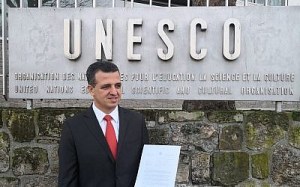
Israel’s envoy to the UNESCO, Carmel Shama-Hacohen, attempts to deliver official papers announcing Israel’s withdrawal from the cultural organization, December 28, 2017. (Courtesy)

In June, Israel’s ambassador to UNESCO, Carmel Shama-Hacohen suggested a rethinking of Israel’s planned exit from the world cultural body, citing a “new spirit” in the organization after two resolutions critical of the Jewish state, regarding the old cities of Jerusalem and Hebron, were delayed by one year at the agency’s World Heritage Committee.

In August it was reported by Channel 10 news that Netanyahu had called Azoulay and thanked her for her efforts to stop what he called the discrimination against Israel in the UN agency.

A senior Israeli official was quoted as saying one of the ideas being examined in Jerusalem was not to cancel the withdrawal, but instead delay it by several months to check on the changes in the organization.

Netanyahu reportedly praised Azoulay for the fact that no anti-Israel resolutions had been passed at UNESCO for nearly a year.

At the UN headquarters in Turtle Bay, Israel launched its own anti-Semitism-related pavilion earlier this week.

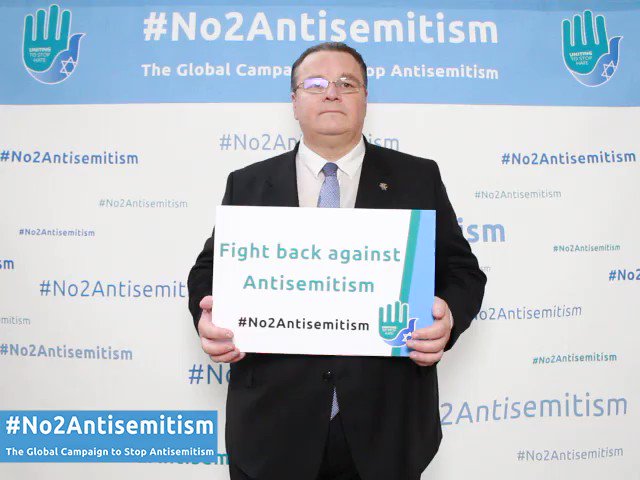
“At the pavilion, countries’ leaders and ambassadors will be photographed with the #No2Antisemitism campaign slogan. They will then publish the images on social networks, leading to the campaign receiving a broad, international distribution in order to spread the message and stop the rise of Antisemitism in the world,” Israel’s mission to the UN said Tuesday in a statement.

Located in the Sputnik area of the lobby at the entrance to the UN headquarters, many world leaders attending the General Assembly stopped by the pavilion and had their photos taken, including the foreign ministers of Austria and Lithuania.


Rouhani says Iran will stay in Syria, wants to avoid conflict with US 

September 27, 2018

Source: Rouhani says Iran will stay in Syria, wants to avoid conflict with US | The Times of Israel

Iranian president says Tehran will keep its forces in Syria for as long as Assad wants them there; Israel repeatedly vows not to let Iran entrench itself on the northern border

Iranian President Hassan Rouhani meets with UN Secretary General Antonio Guterres(not shown) in New York on September 26, 2018, on the sidelines of the United Nations General Assembly.  ( AFP PHOTO / Don EMMERT)

Iranian President Hassan Rouhani meets with UN Secretary General Antonio Guterres(not shown) in New York on September 26, 2018, on the sidelines of the United Nations General Assembly. ( AFP PHOTO / Don EMMERT)

UNITED NATIONS — Iranian President Hassan Rouhani said Wednesday that Iran would stay in Syria for as long as the Assad regime wanted it there, but said Tehran was not seeking conflict with the United States in the Middle East.

Attending the UN General Assembly, Rouhani defended Iran’s military support for the regime of Syrian President Bashar Assad, claiming Iranian help was needed as a bulwark to defeat the Islamic State terror group.

“Our presence in Syria will continue for such time that the Syrian government requests our presence,” Rouhani told a news conference.

Israel has repeatedly warned that it will not tolerate an Iranian military presence in Syria and has repeatedly struck Iranian bases in air strikes, seeking to prevent the transfer of advanced weapons to the Lebanese terror group Hezbollah.

Satellite images from July 7 and 17, 2018, showing the results of an alleged Israeli airstrike on an airfield in Aleppo, Syria, which is said to be a base for Iranian forces. ImageSat International ISI)(

Israel has also extensively lobbied Washington and Moscow, another key ally off Syria and Iran, to ensure Iranian forces and Iranian-backed militias are kept as far away from the Israeli border as possible.

But Rouhani directed his comments toward the US, which has not yet directly confronted Iran in Syria, but has withdrawn from a nuclear deal with Iran, slapped back sanctions and vowed to roll back the Shiite power’s role in the region including in Syria, Yemen and Iraq.

“We do not wish to go to war with American forces anywhere in the region. We do not wish to attack them; we do not wish to increase tensions.

“But we ask the United States to adhere to laws and to respect national sovereignty of nations,” he said.

The Trump administration enjoys close relations with Iran’s regional rivals Saudi Arabia and Israel and has warned Tehran that it is closely watching its actions.

US Secretary of State Mike Pompeo, addressing a pressure group on Tuesday, vowed to act “swiftly and decisively” to any Iranian action that damages US interests in the region.

Prime Minister Benjamin Netanyahu meets US Secretary of State Mike Pompeo at the UN in New York on September 26, 2018 (Avi Ohayon/GPO)

Rouhani quipped: “When the secretary of state says we will be held to account, why have they gone to Iraq in the first place?”

Earlier Rouhani predicted that that the United States would eventually rejoin the international nuclear deal that it backed out of earlier this year, saying talks this week at the United Nations showed his counterpart Donald Trump’s isolation.

“The United States of America one day, sooner or later, will come back. This cannot be continued,” Rouhani told a news conference.

“We are not isolated; America is isolated,” he said.

Rouhani pointed to a session of the Security Council chaired by Trump earlier Wednesday, where the leaders of Britain and France backed the nuclear deal, as well as a statement by European powers that say they will find ways to continue business with Iran and evade impending sanctions.

“We do hope with all the law-abiding and multilateral-oriented countries that we can ultimately put this behind us in an easier fashion than it was earlier anticipated,” Rouhani said.

President Donald Trump addresses the United Nations Security Council during the 73rd session of the United Nations General Assembly, at UN headquarters, Sept. 26, 2018. (AP Photo/Craig Ruttle)

The elected Iranian leader said that his government would stay in the 2015 agreement, under which Tehran scaled back its nuclear program in return for sanctions relief.

“Until such time that we keep reaping the benefits of that agreement for our nation and people, we shall remain in the agreement,” he said. “Should the situation change, we have other paths and other solutions that we can embark upon.”

Rouhani downplayed the sharp words from the US administration, including a warning Tuesday by Trump’s national security adviser, John Bolton, that Iran would have “hell to pay” if it crosses the US.

“During the past 40 years we have been subjected to that type of language many times,” he said. “In this American administration, unfortunately, the language has been said to be somewhat unique and they speak with a different style, presumably because they are new to politics.”

Rouhani on Tuesday said Israel was the greatest threat to world peace, and responded to a fiery speech by Trump by claiming the United States was plotting to overthrow Tehran’s regime.

“The innumerable crimes of Israel against the Palestinians would not have been possible without the political and military assistance” of the US, Rouhani charged in a speech to the United Nations General Assembly.

He accused Israel of “blatantly threatening others with nuclear annihilation” and said the Jewish state constitutes “the most daunting threat to regional and global peace.”

Trump had earlier in the day urged the international community to isolate Iran, accusing the Tehran regime of sowing “chaos, death, and destruction,” ahead of the administration’s plans to reimpose harsh sanctions against the Islamic Republic on November 5.

“We cannot allow the world’s leading sponsor of terrorism to possess the planet’s most dangerous weapons,” Trump said, citing Iran’s “threatening Israel with annihilation” and chants of “death to America.”

“We ask all nations to isolate Iran’s regime as long as its aggression continues and we ask all nations to support Iran’s people as they struggle to reclaim their religious and righteous destiny,” he said.

US President Donald Trump addresses the 73rd session of the General Assembly at the United Nations in New York September 25, 2018. (AFP PHOTO / Nicholas Kamm)

Trump withdrew in May from the nuclear deal, which was forged under his predecessor, Barack Obama, in 2015. The administration scolded the deal for its sunset clauses that allow certain restrictions on Iran’s nuclear program to expire, its failure to prevent Iranian ballistic missile testing, and the degree of access it provides for inspectors into Iran’s military sites.

Trump’s pullout from the deal was met with intense criticism from world leaders, especially those of the other countries — Britain, France, Germany, China, and Russia — that brokered the accord.

Rouhani also rejected Trump’s offer to hold bilateral talks with Tehran, saying, “On what basis and criteria can we enter into an agreement with an administration misbehaving like this?”

He went on to charge that the US was plotting regime change in Iran.

“It is ironic that the US government doesn’t even conceal its plan for overthrowing the same government it invites to talks,” he said.
 

Erdogan vows Turkey to continue buying Iranian oil despite U.S. sanctions 

September 26, 2018

Source: Erdogan vows Turkey to continue buying Iranian oil despite U.S. sanctions – General Assembly – Jerusalem Post

Erdogan said Turkey will continue to buy natural gas from Iran in line with its long-term supply contract despite Trump’s threats to punish countries doing business with Iran.

BY REUTERS
 SEPTEMBER 26, 2018 10:58
Turkey's President Recep Tayyip Erdogan addresses the 73rd session of the United Nations General Ass

NEW YORK – Turkish President Recep Tayyip Erdogan said Turkey will continue to buy natural gas from Iran in line with its long-term supply contract despite Trump’s threats to punish countries doing business with Iran.

“We need to be realistic… Am I supposed to let people freeze in winter? … Nobody should be offended. How can I heat my people’s homes if we stop purchasing Iran’s natural gas?” he said.

Trump pulled the United States out of a 2015 multinational nuclear deal with Iran and in August Washington reimposed sanctions on Tehran, lifted in 2016 under the pact. US sanctions on Iran’s energy sector are set to be re-imposed in November.

In an effort to boost the economy and attract investors, Erdogan will travel on September 28 to Germany, a country that is home to millions of Turks.

“We want to completely leave behind all the problems and to create a warm environment between Turkey and Germany just like it used to be,” Erdogan said, adding that he will meet Chancellor Angela Merkel during his visit.

Erdogan also said it was impossible for Syrian peace efforts to continue with President Bashar Assad in power.

Earlier this month, Turkey and Russia reached an agreement to enforce a new demilitarized zone in Syria’s Idlib region from which “radical” rebels will be required to withdraw by the middle of next month.

But Erdogan said the withdrawal of “radical groups” had already started.

“This part of Syria will be free of weapons which is the expectation of the people of Idlib… who welcomed this step,” he said. The demilitarized zone will be patrolled by Turkish and Russian forces.

Close to 3 million people live in Idlib, around half of them displaced by the war from other parts of Syria.

The two NATO members have differed over Turkey’s crackdown on suspected opponents of Erdogan after a failed coup in 2016 and over its detention of German citizens.

Trump says upcoming sanctions on Iran ‘tougher than ever before’ 

September 26, 2018

Source: Trump says upcoming sanctions on Iran ‘tougher than ever before’ – International news – Jerusalem Post

“The United States will pursue additional sanctions tougher than ever before to counter the full range of Iran’s malign conduct,” Trump told the council.

BY MICHAEL WILNER
 SEPTEMBER 26, 2018 17:28
US President Donald Trump, representing the United States as current President of the United Nations

NEW YORK — US President Donald Trump warned Iran on Wednesday that his administration will soon go beyond previous sanctions regimes by imposing the “toughest” financial penalties ever designed.

Chairing a session of the UN Security Council on nonproliferation in New York, the president continued his rhetorical broadside of the Islamic Republic for a second day after undressing Tehran the day before in a speech to the General Assembly.

“The Iranian regime exports violence, terror and turmoil. It illicitly procures sensitive items to advance its ballistic missile program,” Trump said, calling on international partners to pressure Iran to end its missile work. The president once again criticized a nuclear deal with Iran endorsed by the council three years ago as a “horrible, one-sided deal allowed Iran to continue its path to a bomb and gave Iran a financial lifeline when they needed it the most.”

Trump withdrew the US from the deal, formally known as the Joint Comprehensive Plan of Action, back in May, freeing his administration to reimpose nuclear-related sanctions on Iran that had been lifted by the deal. Those sanctions were once considered the toughest of their kind and targeted Iran’s oil and gas sector, its access to the dollar, to automobiles and aviation parts and its ability to conduct foreign transactions.

But Trump said his team is preparing additional sanctions on top of those.

“The United States will pursue additional sanctions tougher than ever before to counter the full range of Iran’s malign conduct,” he told the council, warning companies of “severe consequences” if they fail to comply.

Other permanent Security Council members – France, Britain, Russia and China – criticized the administration for pulling out of the agreement and seeking to reimpose sanctions on their companies conducting business in Iran that was encouraged by the agreement.

The 2015 deal traded sanctions relief on Iran in exchange for caps on Iran’s nuclear work that fade out over time. Trump criticized the deal for failing to permanently end Iran’s nuclear ambitions and for providing Iran with money at a critical time.

“They needed cash,” he said. “We gave it to them.”

The president’s national security team has focused their attention on Iran in recent days, offering speeches and publishing explanatory papers on Iran’s “destructive activities” to coincide with UN week in New York.

Iran’s president, Hassan Rouhani, responded in several media interviews and in his own General Assembly with derision, characterizing the US under Trump as “authoritarian” and with a “Nazi disposition.”

He questioned why Trump would seek a meeting with him while, in his words, seeking to overthrow him at the same time. The Trump administration denies it is working toward regime change in Tehran.


Netanyahu responds to Trump: Will Palestine be Costa Rica or Iran? 

September 26, 2018

Source: Netanyahu responds to Trump: Will Palestine be Costa Rica or Iran? – International news – Jerusalem Post

I told the president that what is important is that the Palestinians won’t be able to threaten us, and for that reason there must be complete Israeli security control.”

BY JERUSALEM POST STAFF
 SEPTEMBER 26, 2018 19:16
Netanyahu Trump

Speaking with reporters Wednesday after his meeting with US President Donald Trump at the United Nations General Assembly meeting in New York, Prime Minister Benjamin Netanyahu said that he does not know the timeline of the publication of Trump’s Israeli-Palestinian peace plan.

“I am not in charge of the time-line of the United States,” Netanyahu said. “They will publish the plan when they decide to do so. I presume that they are also discussing it with Arab states.”

Speaking to reporters before his meeting with Netanyahu, Trump backed a two-state solution to the Israeli-Palestinian conflict.

“I think that’s what works best,” Trump told the prime minister, repeating his support several times.

The president had previously equivocated on the two-state solution, which has long been the preferred end state for the Israeli-Palestinian conflict. His Middle East peace team, which was present, has yet to use the term in public or in private to describe the framework of their plan.

That plan, Trump said, should be ready in “two to three to four months.”

In his remarks to reporters, Netanyahu said that he was not surprised at Trump’s statement in support of the two-state solution. “I told the president that what is important is that the Palestinians won’t be able to threaten us, and for that reason there must be complete Israeli security control.”

Netanyahu also said that he had discussed Russia’s pledge to supply Syria with S-300 anti-aircraft missiles with the president.

“I received everything that I asked for regarding the recent events vis a vis Russia,” Netanyahu said. “The President immediately gave detailed directions to his advisors. I am very pleased with the meeting, and received his unmitigated support for Israel.”

Russian Defense Minister Sergei Shoigu said on Monday that Moscow will supply an S-300 anti-missile system to Syria within two weeks. The announcement came a week after the ministry accused Israel of indirectly causing the downing of a Russian military plane in Syria that killed 15 servicemen.

During his address to the Security Council earlier in the day, Trump warned Iran on Wednesday that his administration will soon go beyond previous sanctions regimes by imposing the “toughest” financial penalties ever designed.

“The Iranian regime exports violence, terror and turmoil. It illicitly procures sensitive items to advance its ballistic missile program,” Trump said, calling on international partners to pressure Iran to end its missile work. The president once again criticized a nuclear deal with Iran endorsed by the council three years ago as a “horrible, one-sided deal allowed Iran to continue its path to a bomb and gave Iran a financial lifeline when they needed it the most.”

Michael Wilner contributed to this report.


Bartering – An Act of Desperation

September 26, 2018

“Special Purpose Vehicle aims to keep Iran in 2015 nuclear deal with barter system


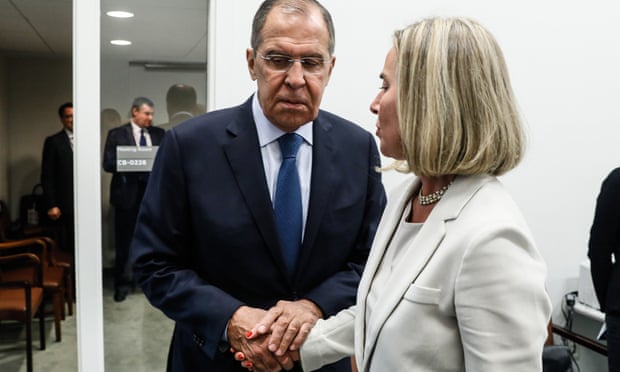
Russian foreign minister Sergey Lavrov with EU external affairs chief Federica Mogherini in New York on Tuesday. Photograph: Alexander Shcherbak/TASS

By Patrick Wintour Diplomatic editor Wed 26 Sep 2018 01.00 EDT The Guardian

Source Link: EU, China and Russia in move to sidestep US sanctions on Iran

{What’s next, wampum? – LS}

The European Union, Iran, China and Russia have set out a plan to sidestep unilateral US sanctions designed to cripple the Iranian economy and force the Iranians to renegotiate the nuclear deal signed in 2015.

European diplomats hope the proposed measure – known as a special purpose vehicle (SPV) – will help persuade an increasingly reluctant Iran to stay inside the deal in the hope of rescuing its economy.

Speaking on the sidelines of the UN general assembly in New York, Federica Mogherini, the EU external affairs chief, said the SPV was designed to facilitate payments related to Iran’s exports – including oil – and imports, so long as the firms involved were carrying out legitimate business under EU law.

The aim is to make the SPV available not just to EU firms but to others, she added.

In his address to the United Nations general assembly, Iran’s president, Hassan Rouhani, stressed Tehran’s continued commitment to the deal and accused the US of pressurising other countries into violating the nuclear agreement.

“Confronting multilateralism is not a sign of strength,” he said. “Rather, it is a symptom of the weakness of intellect. It betrays an inability in understanding a complex and interconnected world.”

But the US president Donald Trump’s secretary of state, Mike Pompeo, addressing an anti-Iran pressure group, said he was “disturbed and indeed deeply disappointed” by the EU plan.

“This is one of the of the most counterproductive measures imaginable for regional and global peace and security,” Pompeo said.

Versions of the SPV floated by thinktanks suggest it could underpin a sophisticated barter system that can avoid US Treasury sanctions. For example, Iran could ship crude oil to a French firm, accumulating credit that could then be used to pay an Italian manufacturer for goods shipped the other way, without any funds traversing through Iranian hands or the banking system.

A multinational European state-backed financial intermediary would be set up to handle deals with companies interested in Iran transactions and with Iranian counter-parties. Any transactions would not be transparent to the US, and involve euros and sterling rather than dollars.

The proposal is additional to a blocking statute passed by the EU in August that theoretically makes EU companies immune from sanctions imposed by the US in pursuit of its Iran policy. In theory, the statute empowers EU firms to seek compensation from US Treasury for trying to impose extra-territorial sanctions in breach of the statute. So far this statute has not been tested in court.

Richard Nephew, a former Barack Obama official and author of The Art of Sanctions, expressed scepticism on Twitter, saying that for the SPV to be taken up, European firms – many with either US employees, or US subsidiaries – must still be prepared to take the risk of being sanctioned by the US.

He also suggested US sanctions could be applied to the traded good as much as to the cash to fund the trade. He predicted few firms would take that risk, outside some SMEs [small and medium-sized enterprises] heavily dependent on Iran for their income.

Jarrett Blanc, another former Obama staffer for the Iran deal, broadly agreed with Nephew, but was more sympathetic, writing that “the symbolism here is probably Europe’s most important contribution, and it may be sufficient depending on what China, India, Turkey do on oil”. He added: “The payment mechanism move opens the door to a longer-term degradation of US sanctions power.”

Either way, Europe needs a solution soon after months of railing against US economic imperialism. The vast majority of European firms are planning to pull out.

Trump announced two sets of US secondary sanctions in May, and other sanctions imposed in August cover shipping and insurance. The other more important sanctions – aimed at ending Iranian oil exports, still the heart of the faltering Iranian economy – do not bite until 5 November.

In advance of the oil sanctions, Iran’s crude sales to China fell 21% between May and August, according to Eurasia Group. But it is unclear how long China will stick to that trend.

The assumption is that many countries like India and Russia will continue to trade with Iran and challenge the US to try to impose sanctions, pointing out that in reality it is the US, by tearing up the agreement and not them, that is in breach of UN resolutions.

Trump says ‘two-state solution works best’

September 26, 2018

Source: Trump says ‘two-state solution works best’

In meeting on sidelines of UN General Assembly between Netanyahu and Trump, US president states publicly for first time that he ‘likes the two-state solution’, says it’s his drream to strike peace deal before end of his first term.

The remarks, which were made during a meeting with Prime Minister Benjamin Netanyahu on the sidelines of the UN General Assembly in New York, shed light on the possible basis of a long-awaited peace initiative to be launched by the US administration between Israel and the Palestinians.

“I like a two state solution. That’s what I think works best … That’s my feeling,” said Trump.

Trump also said he wanted to unveil a peace plan in the next two to three months.

“It is a dream of mine to get that done prior to the end of my first term,” Trump said.

Concluding his opening statement, Trump said “We are with you. We are with Israel 100%.”

Netanyahu has said that any future Palestinian state must be demilitarized and must recognize Israel as the state of the Jewish people.

“I really believe something will happen. They say it’s the toughest of all deals,” Trump said.

He added that Israel will have to do something good for the other side without elaborating.

Trump gave his endorsement of the two-state solution moments after Netanyahu praised the American-Israeli alliance as never being stronger “under your leadership.”

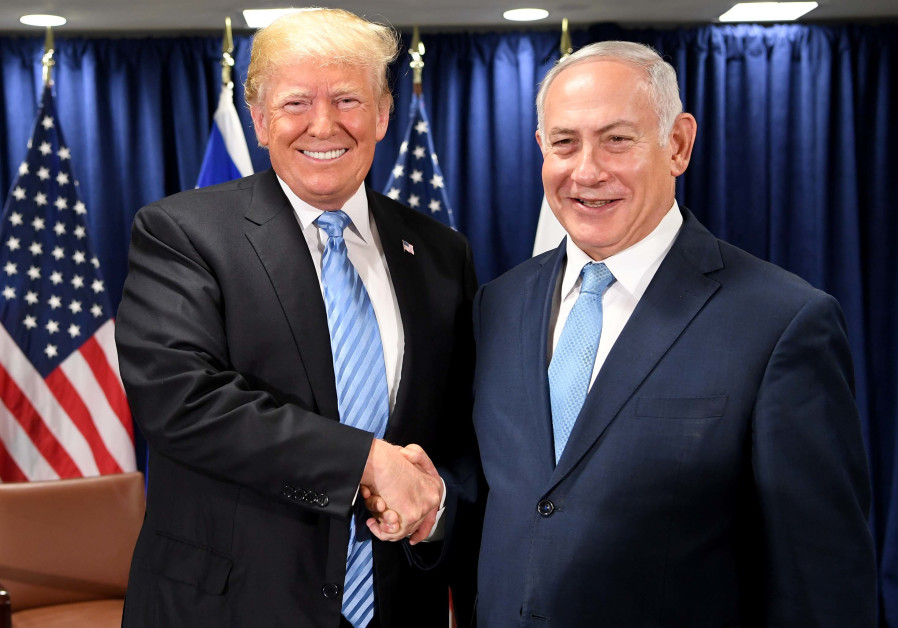
President Trump and PM Netanyahu (Photo: Reuters)

President Trump and PM Netanyahu (Photo: Reuters)

“I want to thank you for the extraordinary support that you have shown for Israel in this building in the UN. No one has backed Israel like you do and we appreciate it,” Netanyahu told the president in his opening remarks.

“This it the first that time we after the American Embassy has been moved to Jerusalem,” he added. “You’ve changed history and you’ve touched our hearts.”

Trump’s statement also comes in stark contrast to the response given to whether he supports the two-state solution during a meeting between the two leader in Washington in February 2017 during which he avoided explicitly backing the idea.

“I’m looking at two-state and one-state and I like the one that both parties like. I’m very happy with the one that both parties like,” he said at the time.

Doubts have mounted over whether Trump’s administration can secure what he has called the “ultimate deal” since December, when the US president recognized Jerusalem as Israel’s capital and then moved the US Embassy there.

“It is a dream of mine to get that done prior to the end of my first term,” Trump said of an agreement on the conflict.

Jerusalem is one of the major issues in the Israeli-Palestinian conflict. Both sides claim it as a capital. Trump’s move outraged the Palestinians, who have since boycotted Washington’s peace efforts, led by Trump’s son-in-law and advisor, Jared Kushner.

Reuters contributed to this report.