Archive for September 21, 2018

PM warns Nasrallah of ‘crushing blow’ Hezbollah cannot even imagine

September 21, 2018

Source: PM warns Nasrallah of ‘crushing blow’ Hezbollah cannot even imagine – Israel Hayom


Common objectives, separate interests

September 21, 2018

Source: Common objectives, separate interests – Israel Hayom


Forcing Iran out of Syria 

September 21, 2018

Source: Forcing Iran out of Syria – Israel Hayom

David M Weinberg

Israel has fully joined the battle against Iran in Syria, but it is not clear it can achieve any of its goals there. It will be very hard to force the complete withdrawal of Iranian forces and their proxies from Syria.

According to Dr. Jonathan Spyer, a fellow at the Jerusalem Institute for Strategic Studies, Iran has invested between $30 billion and $100 billion in propping up the Assad regime and building its own military infrastructure in Syria over the last seven years. The Iranian investment in Syria is deep, formally based, and longstanding.

Iran has done so for its own good strategic reasons: to create a hegemonic land bridge under Iranian sway from the Persian Gulf to the Mediterranean Sea and to establish a new front against Israel. The ayatollahs are not going to reverse course, write off that investment and decamp back to Iran just because the Israel Air Force occasionally strikes a missile shipment to Hezbollah or a few anti-aircraft batteries. Iran is in this fight for the long term.

If Israel seeks to prevent the consolidation of an independent network of military and political bases by Iran’s Islamic Revolutionary Guard Corps on Syrian soil, like those Iran already has in Lebanon and Iraq, Israel is going to have to gear up for more sustained conflict.

“The IDF will continue to act with full determination and strength against Iran’s attempts to station forces and advanced weapons systems in Syria,” Prime Minister Benjamin Netanyahu said in an especially tough speech in Dimona last month.

But this raises a series of difficult questions: Is broad and perhaps direct ground warfare against the increasingly entrenched Iranian forces in Syria coming, and is it worth the costs and risks? Is the IDF ready for such a sustained military campaign? Is the Israeli public ready to absorb the cost this will entail? Does Israel have not only the declarative backing of the United States for such an effort, but also its guaranteed active involvement, including confrontation with Russian forces if necessary?

The answer to the critical first question is a resounding yes, according to Netanyahu’s former national security adviser, Maj. Gen. (res.) Yaakov Amidror (who is also the Anne and Greg Rosshandler senior fellow at the Jerusalem Institute for Strategic Studies).

In a major study published online by the institute this week, titled “The Logic of Israel’s Actions to Contain Iran in Syria and Lebanon,” Amidror explains in stark terms why Israel must act forcefully against Iran even if this leads to full-scale war. In Hebrew, the study caused a stir at Israel’s defense and intelligence headquarters. The English version is now reverberating through Western capitals.

Amidror views the Iranian beachhead in Syria and Iraq not only as a conventional threat to Israel (especially if Iran bases accurate and advanced missiles closer than ever to Israel’s population centers) but, even worse, as a cover for Iran’s nuclear weapons program.

Iran aims to have Hezbollah and the other Shiite forces it is building up in Syria (and as far as possible in the West Bank and Gaza Strip too) acquire the capability to strike Israel so severely that no responsible Israeli leader would dare attack the nuclear weapons infrastructure being constructed in Iran, says Amidror. He calls this Iran’s attempt to create a “deterrence barrier” to protect its nuclear program, which he says has been thinly and only temporarily mothballed, if at all.

Amidror compares the Iranian strategy to the one on the Korean Peninsula. North Korea’s conventional threat against South Korea is so overwhelming that it has left South Korean leaders paralyzed and has prevented any action against the North’s nonconventional threat. Amidror says Iran is building up Hezbollah and its own forces in Syria because it aspires to achieve a similar state of affairs and deter Israel from acting against Iran’s nuclear program.

“If Iran acquires the capability to attack Israel with a high degree of precision using missiles from Syria and Lebanon, Israel’s strategic situation would significantly worsen,” Amidror writes.

“And given that the construction of an Iranian force in Syria is intended to deter Israel from acting to prevent Iran’s progress in the military nuclear sphere, impeding this undertaking justifies an Israeli preventive attack if the need arises or a suitable opportunity presents itself.

“Israel must prevent the creation of an Iranian deterrence barrier at any cost, even if an Israeli attack will lead to war – that is, a large-scale operation involving fierce hostilities in Syria and Lebanon, as well as massive and painful assaults on the Israeli homefront.”

This leaves Israel with quite a few challenges. On the diplomatic front, Israel must secure the freedom of action it needs to operate in Syria despite the presence of Russian forces. This may have become more difficult following the incident this week that downed a Russian transport aircraft, killing 15 Russian military personnel.

Simultaneously, without undermining the first element, Israel must enlist a reluctant U.S. to take an active part in operations alongside it, and not only as a supportive observer from the sidelines.

“Without such diplomatic backing, Israel will find it difficult to use its armed forces in the region, in a situation where the two superpowers have a military presence,” Amidror says.

Iran poses one of the most complicated and dangerous challenges Israel has faced over the 70 years of its existence.

But “Israel must win this struggle against Iran, one way or another,” Amidror declares.

David M. Weinberg is vice president of the Jerusalem Institute for Strategic Studies, jiss.org.il. His personal website is davidmweinberg.com.

Israel’s insurance policy

September 21, 2018

Source: Israel’s insurance policy ‎ – Israel Hayom

Ariel Kahana

One of Israel’s most important strategic assets was ‎severely rattled earlier this week. ‎

Nearly three years after its founding, the ‎Israeli-Russian deconfliction channel – an ‎operational hotline set up to prevent either side ‎from making a lethal mistake while operating in ‎Syrian airspace – sustained a serious blow in the ‎form of the downing of a Russian reconnaissance ‎plane by Syrian fire off the coast of Latakia. The ‎incident, in which all 15 Russian crew members were killed, took place on the heels of an Israeli ‎strike on Iranian assets there. ‎

Prime Minister Benjamin Netanyahu found this ‎incident especially troubling. The military ‎coordination mechanism is something he spared no ‎effort to establish, and the downing of the Russian ‎plane has proven a strenuous test for it, prompting ‎Netanyahu to burn the midnight oil in an effort to ‎salvage it. ‎

In a world of absolute truths, Israel cannot be held ‎responsible for the downing of a Russian plane by ‎Syrian anti-aircraft fire. In a hypocrisy-free global ‎arena, it would be up to Damascus to send ‎apologetic delegates to Moscow to explain to the ‎Russians why a plane making a scheduled landing was ‎shot down, and it would be up to Syrian Air Force ‎Commander Gen. Issam Hallaq – not Israeli Air Force ‎Commander Maj. Gen. Amikam Norkin – to appease the ‎Russians. ‎

Israel, however, is far too familiar with just how ‎relative truth is in international politics. In a ‎world where Russia is a global power and ‎President Vladimir Putin is a key player, facts take ‎a back seat to interests. ‎

For this reason, Syrian President Bashar Assad and ‎his troops, pathetic and foolish as they may be, ‎will not be made to pay a price for the tragedy they ‎caused. ‎

It is this world of power players and hypocritical ‎politics through which Netanyahu and the IDF must navigate.‎

Netanyahu, who understood quicker than most the ‎implications of the Russian involvement in the ‎Syrian civil war, was wise enough to come up with ‎the concept of the deconfliction channel and as time ‎went by, he was also wise enough to forge a unique ‎relationship with Putin that, from a security ‎standpoint, has proven exceptionally beneficial for ‎Israel.‎

Many Israeli pundits mocked the prime minister’s ‎frequent trips to the Kremlin and were quick to ‎criticize the deconfliction channel, but now, when ‎imminent danger has reared its head, they must ‎acknowledge Netanyahu’s accomplishments, which he is now trying to salvage.‎

This effort ‎does not pit tiny Israel against powerful Russia ‎but positions the two as almost equal. ‎Israel and Russia have maintained a pretty simple, and  ‎secret, deal: Israel will not harm one hair on ‎Assad’s head, as he is Putin’s ally, and in ‎exchange, Putin will turn a blind eye to Israeli ‎strikes on Iranian assets in Syria. ‎

Monday’s incident is testing this deal and the ‎trouble is, Israel is meeting this challenge at a ‎time when the threat – theoretical as it may be – of ‎harming Assad is far less relevant, as the end to ‎the Syrian civil war is almost here. ‎

As things stand, when even the international ‎community has come to terms with the fact that Assad ‎will remain in power, Israel would find harming him ‎difficult to justify. ‎Moreover, Israel may find that its hands are getting ‎increasingly tied with respect to its operations in ‎Syria. One can assume this is the complex dilemma ‎Netanyahu is now trying to resolve, but only time ‎will tell what solution he can devise. ‎

Is Israel in Putin’s sights, as its air force chief is cross-examined in Moscow? – DEBKAfile

September 21, 2018

Source: Is Israel in Putin’s sights, as its air force chief is cross-examined in Moscow? – DEBKAfile

Maj. Gen. Amikam Nurkin, Israel’s Air Force chief, endured hour after hour of quizzing in Moscow Thursday, Sept. 20 about the Russian plane shot down by Syria on Monday.

At home, Israeli officials and army chiefs made an effort to cool the crisis which sprang up in Russian-Israeli relations over the incident. In Moscow, the Israeli officers produced electronic and other evidence showing Syrian air defense missile fire to be haphazard and unfocused. “It’s a wonder that the Syrians have not accidentally shot down other airplanes before,” they said. One of the key points which emerged was that Syria teams habitually let loose with their anti-air missiles against any incoming missiles, whether or not they are airborne – even if they are ground-to-ground or ship-to-shore weapons. However, how Syria conducts its air defenses has nothing to do with Israel.

DEBKAfile’s sources report that the Israeli officers answered the endless Russian interrogation professionally and to the point, although the interviews went on all day and appear to be continuing into the night. The Israeli officers had the unpleasant sense of being put on the carpet and expected to provide answers on the spot. The decision to send an Israel officer to Moscow with the high rank of the air force chief has therefore been widely criticized in many circles in Israel.

A full picture of the Israeli delegation’s experience will be available only when they return home and Gen. Nurkin reports to the Prime Minister and Chief of Staff. Even then, there will be gaps in his impressions of the next turn in the crisis that was triggered by the Syrian downing of the Russian reconnaissance plane. Kremlin policy in military affairs and relations with Israel are not up to the Russian air force chief, but the personal province of President Vladimir Putin, and he will soon indicate which way the wind is blowing from Moscow to Jerusalem.

Israel hopes the unpleasantness will soon blow over and relations will return to normal. But it is certainly realized that Putin is an exceptionally cool pragmatist, and if he decides it is in his interest to level his aim against Israel, he will not hesitate to do so.

He has two important decisions to make:

  1. To block Israel’s continued aerial attacks on Iranian targets in Syria. or perhaps curtail them. This response would win him points in Tehran.
  2. Or to allow Israel to continue to clobber Iranian targets to ward off the risk of rousing President Donald Trump to action in support of his Israeli ally; and his responses are hard to predict. In this regard, the US administration announced on Thursday that Trump would be meeting Prime Minister Binyamin Netanyahu next week in New York. The announcement was released in Washington at the moment that the Israeli delegation was still locked in tough interviews with Russian officers in Moscow.


Israel airstrike left Syria arms warehouse in ruins, satellite images show

September 21, 2018

Now you see it, now you don’t…

https://www.timesofisrael.com/israel-airstrike-left-syria-arms-warehouse-in-ruins-satellite-images-show/

Syrian soldiers reportedly arrested in connection with downed spy plane; IAF commander to fly to Moscow to present the findings of Israel’s investigation into the incident
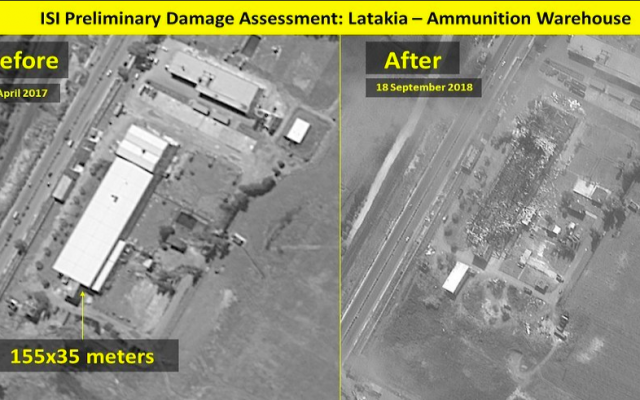
A before and after photo of an ammunition warehouse which was destroyed in an Israeli airstrike on a Syrian base in Latakia, September 18, 2018 (ImageSat International (ISI/Ynet)

A munitions warehouse in a Syrian military facility appears to have been completely obliterated in an Israeli airstrike in the Syrian port city of Latakia late on Monday, satellite images released Wednesday show.

A Russian military reconnaissance plane was shot down by Syria during the Israeli strike, killing all 15 crew members.

On Wednesday Syria released video footage from the site of the attack, reiterating its claim that Israel targeted an aluminium factory, not a weapons warehouse in Monday’s strike, according to the Ynet news site. The veracity of the footage could not be independently verified.

On Monday, Syria accidentally shot down the Russian reconnaissance plane when its air defenses swung into action against the Israeli strike on Latakia. The Russian defense ministry initially blamed Israel, saying the IAF jets used the Russian plane as cover.

However, Russian President Vladimir Putin later told reporters that the downing of the plane by Syrian air defenses was a “chain of tragic accidental circumstances.”
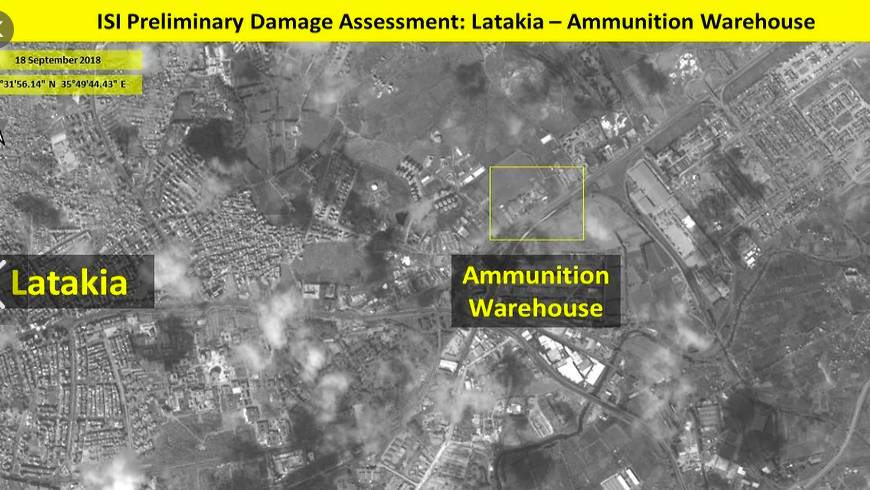

The remains of a Syrian ammunition warehouse which was destroyed in an Israeli airstrike on a base in Latakia, September 18, 2018. (ImageSat International (ISI/Ynet)

On Wednesday, the Russians approved Prime Minister Netanyahu’s proposal to fly air force commander Major General Amiram Norkin to Moscow to present the findings of Israel’s investigation into the incident.

Syrian media and opposition sources reported Wednesday that several Syrian soldiers who were involved in the downing of the Russian spy plane were arrested and interrogated.

The fighters from the air force base in Latakia were reportedly arrested by members of the Russian military police. A Syrian unit was also reported to have taken part in the arrest, according to Hadashot TV.

Meanwhile, the remains of another plane, a Boeing 747 aircraft that was destroyed in an earlier alleged Israeli strike at Damascus airport on Saturday, and believed to be in the use of the Iranian Revolutionary Guard, can be seen in separate images provided by ImageSat International (ISI).
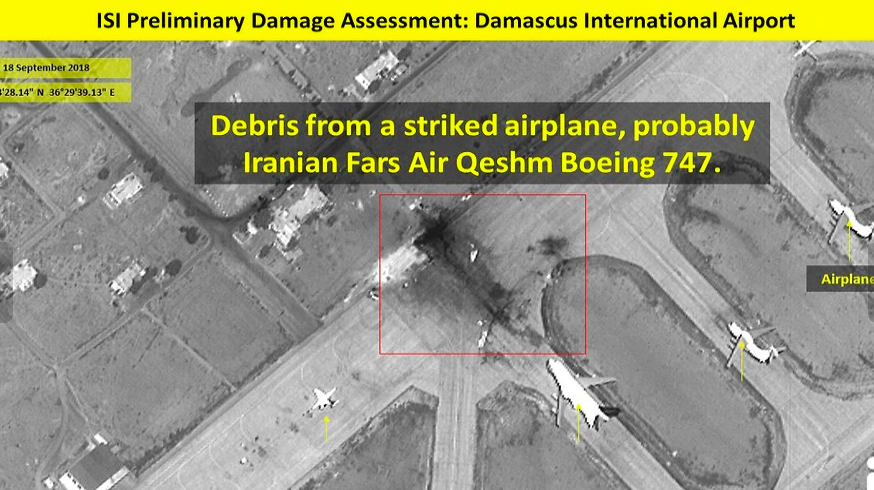

The remains of a suspected Iranian aircraft which was hit in an Israeli airstrike, Damascus, September 18, 2018. (ImageSat International (ISI/Ynet)

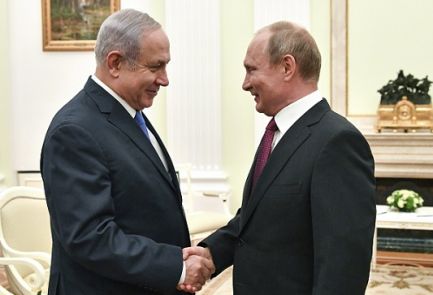
Prime Minister Benjamin Netanyahu spoke Tuesday with Russian President Vladimir Putin amid the rising tensions between the two countries in the wake of Monday’s airstrike.

In the call, the Israeli leader “noted the importance of the continued security coordination between Israel and Syria that has managed to prevent many casualties on both sides in the last three years,” a statement from Netanyahu’s office said.

The Kremlin said that Putin emphasized that the Israeli attack violated Syria’s sovereignty and also breached the Russian-Israeli agreements on avoiding clashes in Syria. The Russian leader urged Netanyahu “not to allow such situations in the future.”

Israel said its jets had attacked a Syrian military facility that manufactured “accurate and lethal weapons,” which were “about to be transferred, on behalf of Iran, to Hezbollah in Lebanon.”

Netanyahu told Putin that Israel was “determined” to prevent Iranian military entrenchment in Syria, and the attempts by Iran, which calls for the destruction of Israel, to transfer to Hezbollah lethal weaponry to be used against Israel.

Netanyahu also reiterated that Israel would completely share all the information it had on the circumstances of the raid and suggested sending Israel’s air force chief to Moscow to “deliver all the needed information.”

The conversation came on Tuesday evening just before Israel began observing Yom Kippur, the holiest day of the Jewish year.

Earlier Tuesday, Putin confirmed that Israel did not shoot down the plane, rejecting any comparisons with the downing of a Russian jet by Turkey in 2015.

“An Israeli jet did not shoot down our plane,” the Russian leader said.

The Russian defense ministry on Tuesday morning had blamed Israel for the accident and warned of reprisals.

Putin said he had signed off on the defense ministry statement. “No doubt we should seriously look into this,” Putin said, speaking at a news conference after talks with Hungarian Prime Minister Viktor Orban.

Israel said its deputy ambassador in Moscow Keren Cohen-Gat was summoned to the Russian foreign ministry. The Israeli Foreign Ministry said there would be no comment on what was discussed.

Putin also said Moscow would beef up security for Russian military personnel in Syria as a priority response. “These will be the steps that everyone will notice,” he said, without providing further details.

He expressed condolences to the families of the victims, calling the accident a “tragedy for us all.”

The incident was the worst case of friendly fire between the two allies since Russia’s game-changing military intervention in September 2015.

The Russian plane was downed by a Russian-made S-200 air defense supplied to Syria.

The Israeli military on Tuesday acknowledged conducting the airstrike the night before and “expressed sorrow” for the deaths of the 15 Russian airmen.

In a statement, however, the IDF denied all responsibility for the downing of the Russian spy plane, saying that Syria, Iran, and Hezbollah were the ones at fault.

“Israel expresses sorrow for the death of the aircrew members of the Russian plane that was downed tonight due to Syrian anti-aircraft fire,” the IDF said, and noted that the Russian plane that was hit “was not within the area of the operation.”

The Israeli strike was conducted at approximately 10 p.m. by four F-16 fighter jets, according to the Russian military.

Syrian air defenses opened fire at the incoming missiles, at the attacking aircraft and — according to Israel — at nothing in particular. The Russian Il-20 was shot down in the air battle.

“The Syrian anti-air batteries fired indiscriminately and, from what we understand, did not bother to ensure that no Russian planes were in the air,” the army said.

According to the IDF, the target of its Monday night strike was a Syrian military facility that manufactured “accurate and lethal weapons,” which were “about to be transferred, on behalf of Iran, to Hezbollah in Lebanon.”

The target of the Israeli strike was identified by Syria as a subsidiary of its defense ministry, known as the Organization for Technical Industries, which has suspected ties to the country’s chemical weapons and missile programs.

“These weapons were meant to attack Israel, and posed an intolerable threat against it,” the army said.

Though Israeli officials have said, generally, that the military conducts operations inside Syria against Iranian and Hezbollah targets, the IDF rarely acknowledges specific airstrikes, preferring instead to adopt a formal policy of neither confirming nor denying the attacks attributed to it.

The military said its initial investigation found that its strike was completed before the Russian plane entered the area of the operation and that the reconnaissance aircraft was shot down after the Israeli fighter jets had returned to Israeli airspace.

“Israel holds the Assad regime, whose military shot down the Russian plane, fully responsible for this incident. Israel also holds Iran and the Hezbollah terror organization accountable for this unfortunate incident,” the army added.

This appeared to refute the claim made by Moscow that the Israeli pilots used the surveillance plane as cover for their attack.

Russian Defense Minister Sergei Shoigu also accused Israel of failing to inform the Russian military of its plans, which he said would have been in the “spirit” of Israeli-Russian coordination in Syria. The Russian defense ministry said Israel warned them of the impending strike “less than a minute” before it began, which left them insufficient time to clear their personnel from the area.

The Israeli and Russian militaries maintain what they call a “deconfliction mechanism,” which is meant to coordinate their activities in Syria in order to avoid incidents like this one. Until Monday night, these efforts had largely succeeded in preventing direct or indirect clashes since Russia became more deeply involved in the Syrian civil war three years ago.

The Israeli military said it had coordinated with Russia ahead of the attack, though it did not address Moscow’s specific claims about the amount of time between the notification and the airstrike itself.

The IDF also said it would “share all the relevant information with the Russian government to review the incident and to confirm the facts in this inquiry.”
 

Is Israel in Putin’s sights, as its air force chief is cross-examined in Moscow? – DEBKAfile

September 21, 2018

Source: Is Israel in Putin’s sights, as its air force chief is cross-examined in Moscow? – DEBKAfile

Maj. Gen. Amikam Nurkin, Israel’s Air Force chief, endured hour after hour of quizzing in Moscow Thursday, Sept. 20 about the Russian plane shot down by Syria on Monday.

At home, Israeli officials and army chiefs made an effort to cool the crisis which sprang up in Russian-Israeli relations over the incident. In Moscow, the Israeli officers produced electronic and other evidence showing Syrian air defense missile fire to be haphazard and unfocused. “It’s a wonder that the Syrians have not accidentally shot down other airplanes before,” they said. One of the key points which emerged was that Syria teams habitually let loose with their anti-air missiles against any incoming missiles, whether or not they are airborne – even if they are ground-to-ground or ship-to-shore weapons. However, how Syria conducts its air defenses has nothing to do with Israel.

DEBKAfile’s sources report that the Israeli officers answered the endless Russian interrogation professionally and to the point, although the interviews went on all day and appear to be continuing into the night. The Israeli officers had the unpleasant sense of being put on the carpet and expected to provide answers on the spot. The decision to send an Israel officer to Moscow with the high rank of the air force chief has therefore been widely criticized in many circles in Israel.

A full picture of the Israeli delegation’s experience will be available only when they return home and Gen. Nurkin reports to the Prime Minister and Chief of Staff. Even then, there will be gaps in his impressions of the next turn in the crisis that was triggered by the Syrian downing of the Russian reconnaissance plane. Kremlin policy in military affairs and relations with Israel are not up to the Russian air force chief, but the personal province of President Vladimir Putin, and he will soon indicate which way the wind is blowing from Moscow to Jerusalem.

Israel hopes the unpleasantness will soon blow over and relations will return to normal. But it is certainly realized that Putin is an exceptionally cool pragmatist, and if he decides it is in his interest to level his aim against Israel, he will not hesitate to do so.

He has two important decisions to make:

  1. To block Israel’s continued aerial attacks on Iranian targets in Syria. or perhaps curtail them. This response would win him points in Tehran.
  2. Or to allow Israel to continue to clobber Iranian targets to ward off the risk of rousing President Donald Trump to action in support of his Israeli ally; and his responses are hard to predict. In this regard, the US administration announced on Thursday that Trump would be meeting Prime Minister Binyamin Netanyahu next week in New York. The announcement was released in Washington at the moment that the Israeli delegation was still locked in tough interviews with Russian officers in Moscow.


White House sends warning shot to Palestinians over ‘pay for slay’ 

September 21, 2018

Source: White House sends warning shot to Palestinians over ‘pay for slay’ – Israel News – Jerusalem Post

BY MICHAEL WILNER IN WASHINGTON, HERB KEINON, KHALED ABU TOAMEH
 SEPTEMBER 20, 2018 21:24
Relatives and friends mourn during the funeral of Ari Fuld, 45, at the Kfar Etzion cemetery, 2018

The Trump administration is warning the Palestinian Authority that severe US aid cuts to Ramallah may be in the offing unless it ends its compensation program for the families of murderers and terrorists convicted by Israel.

Responding to reports that the family of the killer of Ari Fuld, an American citizen, would receive official compensation for the terrorist act, a White House official noted that recent congressional legislation compels the administration to “restrict the use of Economic Support Funds that directly benefit the Palestinian Authority” unless the State Department “certifies that the PA has taken steps to end the practice of providing payments to individuals, and families of individuals, who committed acts of terrorism.”

“As we’ve seen from today’s announcement by the Palestinian Prisoner Affairs Commission with respect to the terrorist who killed Ari Fuld, the practice continues,” said Edgar Vasquez, a White House spokesman. “This is unconscionable and must stop if there is to be any hope for peace.”

Vasquez said the administration “strongly supports” the bill signed into law in March of this year, called the Taylor Force Act, named after the US Army veteran and Vanderbilt graduate student killed in a terrorist attack in Jaffa in 2016. The law would halt funding the PA– except for three exceptions– unless the State Department reports an end to the payment scheme.

“The United States condemns the Palestinian Authority’s payments to terrorists and their families,” Vasquez stated. “We strongly oppose any program that incentivizes acts of violence and terrorism. We continue to demand that the Palestinian Authority stop payments related to perpetrators of political violence.”

Earlier on Thursday, US Ambassador David Friedman condemned the practice in similarly strong terms in a Twitter post.

“The Palestinian Prisoner Affairs Commission has confirmed that the family of the terrorist who murdered Ari Fuld is ‘eligible to receive a monthly salary’ as compensation for his incarceration,” Friedman wrote of the practice, which he also characterized as “unconscionable.”

Two days earlier, US Mideast envoy Jason Greenblatt tweeted a link to a Jerusalem Post story reporting that the family of Khalil Yusef Ali Jabarin, the terrorist who murdered the 45-year-old Fuld on Sunday, would receive a NIS 1,400 monthly stipend for the next three years from the Palestinian Authority.

Greenblatt termed this “outrageous.”

“Some people are complaining about US cutting funds to the Palestinian Authority. But the PA continues to pay terrorists – in this case the terrorist who on Sunday murdered in cold-blood Ari Fuld, an Israeli-American father of four,” he wrote.

In July, Israel followed the US lead and passed the “pay for slay law,” which mandates that the government must deduct the money the PA pays to terrorists and their families from the tariffs it collects for and transfers to the PA.

The PA has acknowledged that in 2017 and 2018 its annual budget for these payments was NIS 1.2 billion. But Palestinian officials in Ramallah on Thursday denied that the PA had paid any money to the family of Khalil Jabarin.

The officials said the reports in the Israeli media that claimed that the PA had paid NIS 12,000 to the terrorist’s family were “blatant lies.”

A senior PA official claimed that the reports were in the context of Israeli “incitement” against the PA leadership and its president, Mahmoud Abbas.

Another official said he did not rule out the possibility that Jabarin’s family would be entitled in the future to financial support from the PA. “If the family applies for financial aid, we will consider it positively,” the official said. “But this is a process that could take several weeks or months.” He said that so far the family has not requested financial aid from the PA. ‭


Netanyahu to Nasrallah: Want a fight? You’ll get ‘unimaginable’ response 

September 21, 2018

Source: Netanyahu to Nasrallah: Want a fight? You’ll get ‘unimaginable’ response – International news – Jerusalem Post

Jerusalem trades barbs with Hezbollah as IAF head tries to convince Moscow that Israel can’t be blamed for loss of plane.

BY HERB KEINON, ANNA AHRONHEIM
 SEPTEMBER 21, 2018 05:52
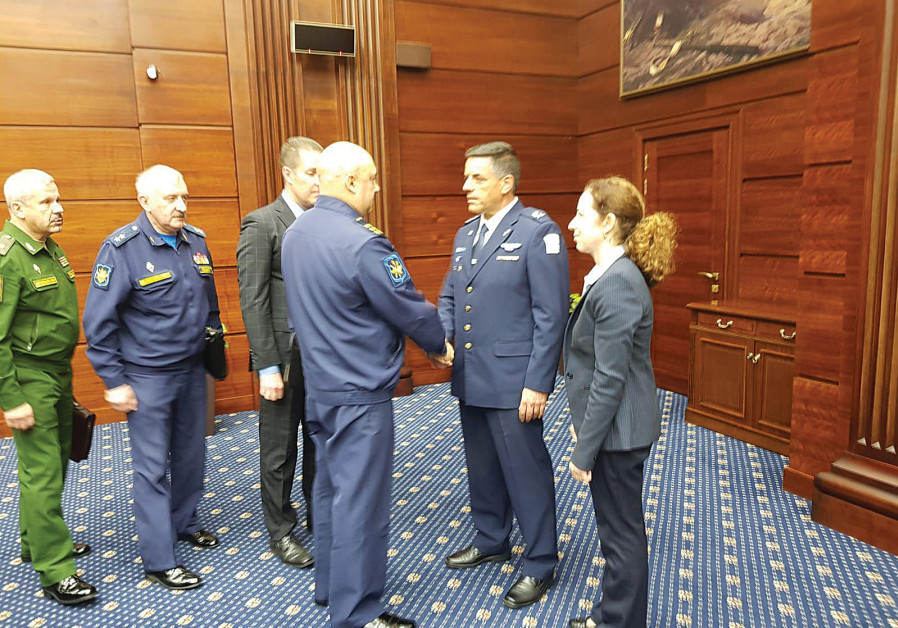
ISRAEL AIR FORCE Commander Maj.-Gen. Amikam Norkin (second right) meets with senior Russian official

ISRAEL AIR FORCE Commander Maj.-Gen. Amikam Norkin (second right) meets with senior Russian officials in Moscow yesterday. (photo credit: IDF)

If Hezbollah dares confront Israel it will receive an unimaginable blow, Prime Minister Benjamin Netanyahu said as Jerusalem’s crisis with Moscow over Syria’s downing of a Russian plane triggered an unusual “war of words” with terrorist leader Hassan Nasrallah.

Speaking on Thursday at a Bible study group that he holds a several times a year at his residence, Netanyahu referred to comments Nasrallah made earlier in the day that Hezbollah already has the precision missiles Israel is trying to prevent Iran from transferring via Syria.

“I heard the words that came from the direction of Hezbollah, and they came from the same person who said after [the Second Lebanon War in] 2006 that if he knew what Israel’s response would have been to the kidnapping of our soldiers [Ehud Goldwasser and Eldad Regev], he would have considered twice whether to do so. So today I recommend he think not twice, but 20 times, because if he confronts us, he will get a blow that he cannot even imagine.”

Nasrallah claimed on Thursday that the balance of power between the Lebanese Shi’ite terrorist group and Israel has “changed,” and that the group has accurate missiles that would be used in the next conflict.

“All your attempts to prevent Hezbollah from possessing accurate missiles are foiled,” Nasrallah said in a speech via video to Beirut’s Dahiyeh suburb to mark the Shi’ite holiday of Ashura. “We have accurate missiles that if used in any future war will change the entire equation.

“No matter what you do to cut the route, the matter is over and the resistance possesses precision and non-precision rockets and weapons capabilities,” he said.

While Nasrallah frequently boasts of what he claims is his organization’s potential, it is rare – though not unprecedented – for Netanyahu to respond to his remarks.

Intelligence Minister Israel Katz said in a Kan Bet interview that the downing of the Syrian plane has caused concern for Hezbollah that it will now be pressured by Russia to curb the transfer of strategic weapons via Syria because this is endangering Russian troops.

But Israel is also worried that as a result of Monday’s incident Russia may work to curtail Israel’s ability to act over Syria. To curb that possibility, Netanyahu dispatched Israel Air Force Commander Maj.-Gen. Amikam Norkin to Moscow on Thursday to convince Russian military leaders that Israel was in no way responsible for Monday’s incident, and also to underline that Israel is acting in self-defense against Iranian and Hezbollah targets in Syria.

Netanyahu said that in his conversation with Russian President Vladimir Putin on Tuesday he stressed that the “root of the problem was Iran’s attempt to use Syrian territory for attacks against Israel and to arm our enemies like Hezbollah.”

The premier added that he told the Russian president that Israel “had the right to self-defense, and yet it was very important to maintain the security coordination” between the two countries.

Norkin and the IDF delegation, according to the IDF spokesman, held several meetings with the commander of the Russian air force and other senior air force officials at the Russian military command headquarters in Moscow.

In a statement, the IDF said the meetings were held in “good spirit” and there was a professional, open and transparent discussion on the various issues, emphasizing the importance of the interests of the two countries and the continued implementation of the deconfliction mechanisms in place to prevent similar incidents from occurring again.

The Israeli officers briefed the Russians on the preliminary and main findings of the IDF investigation, and also showed how Iran is continuing to entrench itself in Syria and smuggle strategic weapons to Hezbollah.

Before the meeting, however, the Russian Foreign Ministry took a less conciliatory tone than the one Putin took on Tuesday when he called the incident a “tragic mistake,” with the Russian Embassy in Tel Aviv issuing a statement that “Moscow views as irresponsible and unfriendly actions of the Israel Air Force, which exposed Russian IL-20 aircraft to danger and lead to the death of 15 servicemen.”

Russia, the statement said, “would take all necessary measures to eliminate threat to life and security of our military fighting against terrorism.”

But Defense Minister Avigdor Liberman, in an Army Radio interview, deflected any Israeli culpability, saying Syrian President Bashar “Assad’s army is to blame.”

The lack of professionalism of the Syrian military “led to the Russian planes being shot down,” he said, adding that they opened fire in an indiscriminate manner.

“We will do anything to stop the consolidation of Iran’s presence in Syria and the transferring of weapons from Syria to Hezbollah,” he said.

Liberman also addressed reports that Russia closed air, land and sea routes near the Syrian coast for a military exercise until next Wednesday, saying “this is not the first time” this has happened and that “we will continue as normal.”

Former national security adviser Yaakov Amidror said in a telephone briefing organized by The Israel Project that Russia’s closure should not be seen as a signal that Moscow had begun curtailing Israel’s freedom of action.

Rather, he said, this type of closure was aimed at “freezing the situation in the area to prevent any such mistakes in the coming days” and to learn what happened.

“I think this decision is natural,” he said.

Amidror said Israel has allocated considerable resources over the last three years to identify where Russian forces and assets were located in Syria so that they are not harmed in Israeli attacks.

He said Norkin’s mission has two goals. The first is to convince the Russians that the incident was not the result of an Israeli mistake, not deliberate and that Israel did what was needed to prevent harm to the Russian forces, and the second goal is to recommend ways to improve the deconfliction mechanism “so we have the ability to continue our preventive defensive attacks, and they will feel they are safer than in the past.”

Tamar Beeri contributed to this report