Archive for September 21, 2018

Israel: Russia accepts our take on Syrian downing of plane, coordination goes on

September 21, 2018

Source: Israel: Russia accepts our take on Syrian downing of plane, coordination goes on | The Times of Israel

Delegation to Moscow ‘debunked’ claim Israeli jets hid behind spy plane, stressed jets had left area before Syrians fired fatal missile; Russia was notified ahead of strike

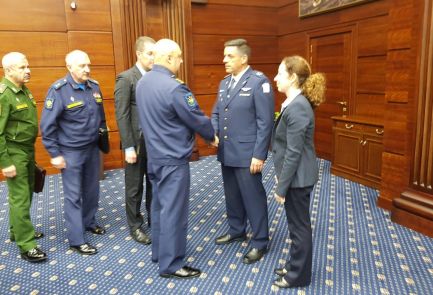
Israeli Air Force chief Amikam Norkin, left, leads a military delegation to Moscow on September 20, 2018. (Israel Defense Forces)

Israeli Air Force chief Amikam Norkin, left, leads a military delegation to Moscow on September 20, 2018. (Israel Defense Forces)

“Improvements” may be made to the Israeli military’s coordination with Russia over its operations in Syria in light of the downing of a Russian spy plane earlier this week, a senior Israeli army official said Friday. For now, he stressed, the deconfliction mechanism used by the two countries to coordinate activities was continuing to function effectively.

The official said an Israeli military delegation had answered Russia’s questions over Monday’s incident, including debunking the false notion that the Israeli jets had hidden behind the Russian plane. Israel also clarified that its attack planes had left the area before the Syrians fired the missile that downed the Russian plane.

He also said Israel notified the Russians ahead of the strike, and not a minute before as Moscow had originally claimed. And he dismissed a pro-Hezbollah newspaper’s claim Friday that Russia had refused to accept Israel’s explanations over the incident, for which Israel firmly blames Syria.

On Thursday, an Israeli delegation led by Air Force chief Maj. Gen. Amikam Norkin visited Moscow in order to brief Russian officials on Israel’s initial investigation of the incident, in which a Russian reconnaissance plane, with 15 crew members on board, was shot down by Syrian air defenses following an Israeli missile strike on a Syrian weapons facility on Monday night.
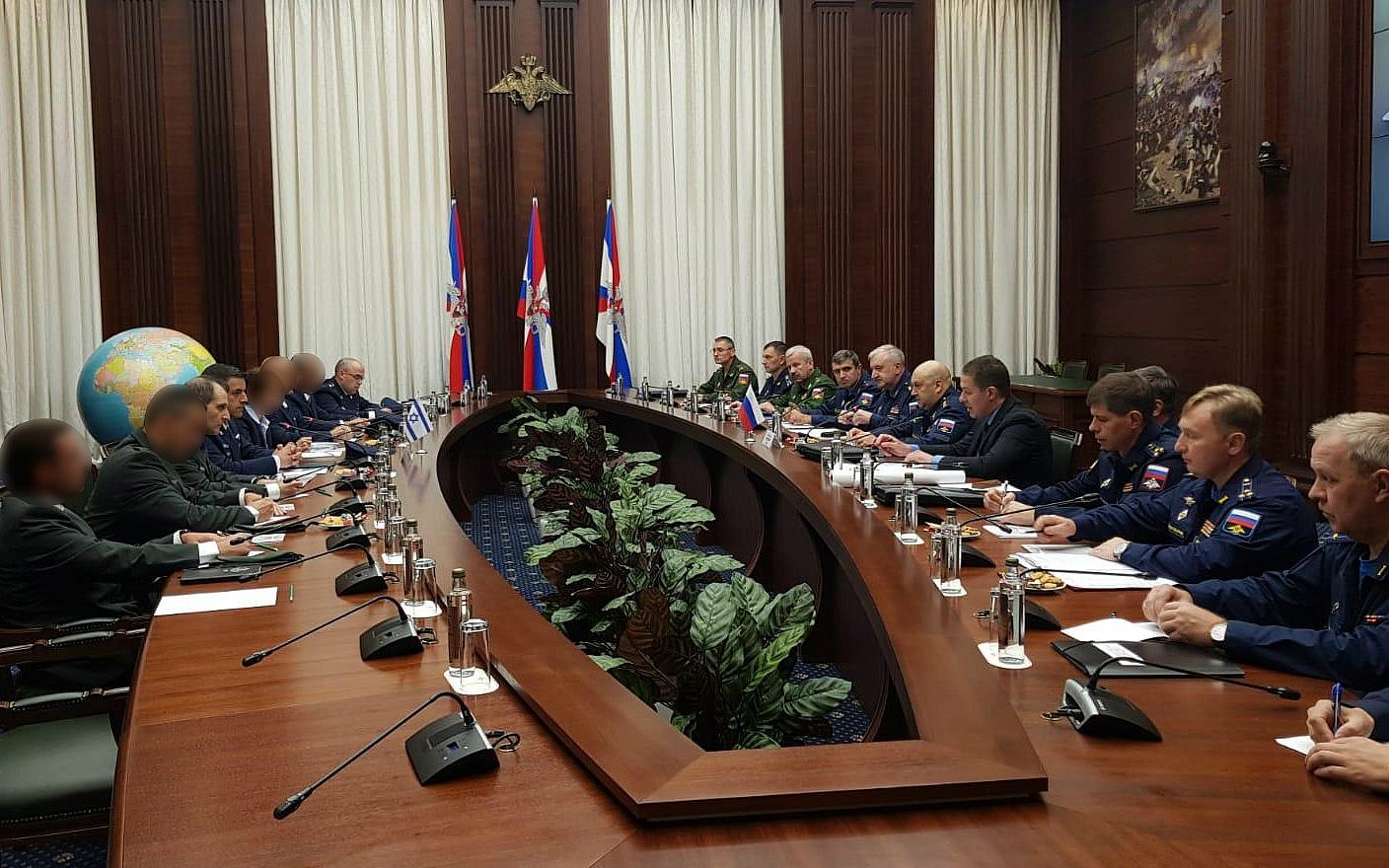
An Israeli military delegation meets with Russian officials in Moscow on September 20, 2018. (Israel Defense Forces)

During their meetings in Moscow, Norkin’s delegation told their Russian counterparts that the Syrian military fired more than 20 anti-aircraft missiles in response to the Israeli attack — a comparatively large number for this type of scenario. Four Israeli F-16 fighter jets were said to have taken part in the airstrike.

In addition, the senior military officer said the majority of the surface-to-air missiles fired by the Syrians — including the missile that hit the Russian spy plane — were fired after the Israeli jets had left the area.

“Most of those 20 were fired while all of our planes were already in Israeli airspace and on their way to land. We proved how the Syrians’ reckless anti-air fire was the direct cause of hitting the Russian aircraft,” the officer said.

The delegation also refuted the Russian military’s initial claim that the Israeli pilots used the Russian Il-20 spy plane as a “shield” during their attack.

“We emphasized that there is no merit to the theory that this was an Israeli provocation or that Israeli airplanes made any use of the Russian airplane as cover. We debunked that false story,” the officer said.

A photo taken on July 23, 2006 shows an Russian IL-20M (Ilyushin 20m) plane landing at an unknown location. (AFP/Nikita Shchyukin)

The senior official added that the Israeli jets were “nowhere near the Russian plane when it was shot down.”

He also refuted a claim made by the Russian military and defense minister that the IDF gave less than a minute’s notice before carrying out the attack.

The officer would not say when the Russians were notified, but said it was “much longer than one minute.”

Despite the IDF’s insistence on its innocence, the incident initially threatened Israel’s coordination efforts with Russia — known as the deconfliction mechanism — which is meant to prevent such clashes and inadvertent casualties.

However, the senior official, speaking on condition of anonymity, said the hotline between the Israeli and Russian militaries has continued to operate as normal, though some “improvements” may be made in the future.

For now, there are “no changes to the deconfliction mechanism,” the officer said, adding “but both sides will use this opportunity to make adjustments.”

According to the officer, the deconfliction mechanism was used as recently as Friday afternoon. He refused to comment on the nature of the operation that required the coordination, saying only that it was not an airstrike.

“It is of paramount importance to us that we continue to use the deconfliction mechanism, which has proven over the past two-and-a-half to three years to be effective,” the officer said.
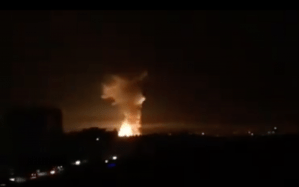
Explosions seen in the Syrian city of Latakia after an attack on a military facility nearby on September 17, 2018. (Screen capture: Twitter)

Israel routinely conducts operations against Iran-linked targets in Syria. Were Moscow to refuse to cooperate with Jerusalem, these efforts could become far more difficult and complicated for the Israeli Air Force.

“Our freedom of movement is paramount,” the officer said.

The senior official denied a report in a Hezbollah-linked Lebanese news outlet Friday, which claimed that Russian officials refused to accept the Israeli delegation’s findings.

“Our impression is that the discussions were professional and that the information was accepted,” the officer said.

The Israeli military delegation, made up of officers from the Air Force, Military Intelligence, international cooperation unit, Operations Directorate and the General Staff, returned from Moscow on Friday morning.
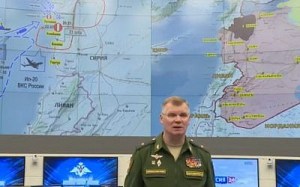
A Russian military official gives a briefing on the downing of an IL-20 military plane near Syria on September 18, 2018. (screen capture: Sputnik)

“We presented our data and findings. They were received. Our Russian counterparts had questions; those questions were answered,” he said.

The officer said the presentations focused on three main points: expressing sympathy for the loss of life; sharing intelligence on Iran’s activities in Syria; and presenting the findings of the military’s after-action review.

In addition to the Israeli delegation’s meetings in Moscow, the IDF also briefed the Russian military attaché in Israel on the matter.

“The Russians were also invited to come to Israel if there are any future questions,” the senior official said.

Upon landing back in Israel, the delegations briefed the political upper echelon on their meetings, the senior officer said.

The Prime Minister’s Office confirmed that the premier met with Norkin’s delegation and the IDF’s top brass to hear about the Moscow meetings.

“The prime minister ordered that the constant contacts with Russia continue,” his office said.

The downing of the plane sparked a flurry of condemnation from Moscow, forcing Israel to go on a full diplomatic push to resolve the issue.

In a highly irregular move, the IDF acknowledged conducting the Syria strike. Senior Israeli ministers also held phone calls with their Russian counterparts, and Norkin’s delegation was dispatched to Moscow to present Israel’s version of events in person.
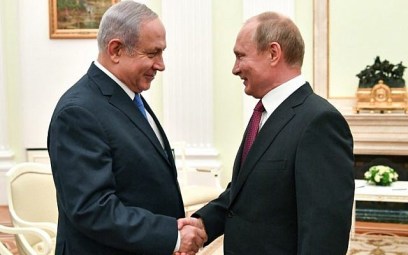
Russian President Vladimir Putin (R) shakes hands with Israeli Prime Minister Benjamin Netanyahu during their meeting at the Kremlin in Moscow on July 11, 2018. (AFP/Pool/Yuri Kadobnov)

Russian President Vladimir Putin said he did not directly blame Israel for the downing of the spy plane and instead credited it to a “chain of tragic accidental circumstances.”

However, he warned Prime Minister Benjamin Netanyahu in a Tuesday phone conversion that Israel should “not to allow such situations in the future,” and other parts of the Russian government have maintained a harsh line with Israel over the incident.

“Moscow views as irresponsible and unfriendly actions of Israeli Air Force, which exposed Russian Il-20 aircraft to danger and lead to death of 15 servicemen,” the Russian embassy in Tel Aviv wrote in a scathing statement on its Twitter account.

The Russian foreign ministry on Thursday urged “further inquiries and explanations from Israel,” according to the Russian Interfax agency.

Defense Minister Avigdor Liberman earlier on Thursday said, during an interview on Army Radio, that despite Russia’s ire over the incident, Israel would continue to operate in Syria in order to fight Iran’s activities in the country.

“We will do everything, everything that is required, in order to defend the security of Israeli citizens. On this issue we have no other alternative,” Liberman said.

 

Haley: Iran proxies reportedly developing missile production in Iraq 

September 21, 2018

Source: Haley: Iran proxies reportedly developing missile production in Iraq – International news – Jerusalem Post

“It is difficult to name a conflict in the Middle East that does not have Iran’s fingerprints on it,” said US Ambassador to the UN Nikki Haley.

BY TOVAH LAZAROFF
 SEPTEMBER 21, 2018 11:53
Nikki Haley speaks during news conference at UN headquarters, New York, 2018

Iranian proxies in Iraq are reportedly developing the capacity to produce missiles, US Ambassador to the UN Nikki Haley said on Thursday as she warned against the growing Iranian foothold in Iraq.

“In recent months, Iran’s aggression has escalated. Iranian proxies in Iraq operate openly, with funding, training, and weapons supplied by Tehran. The Iranian regime has reportedly begun over the last few months to transfer ballistic missiles to these proxies in Iraq. It is reportedly developing the capability for its proxy militias to produce their own missiles inside of Iraq,” Haley told the UN Security Council on Thursday.

She spoke at the UNSC’s monthly meeting on the Middle East, as Israel and the United States are increasingly concerned about the Iranian activity in Iraq and the subsequent dangers to both Israel and the United States. Last month, Reuters reported that Iran has given ballistic missiles to Shi’ite proxies in Iraq with the capacity to hit Israel. Defense Minister Avigdor Liberman has warned that the IDF, which has focused on preventing an Iranian foothold in Syria, could expand it activities against Iran to other areas of the Middle East.

All the council members who spoke at the UNSC meeting, however, focused the debate on Israeli actions against the Palestinians.

Haley, whose country holds the rotating UNSC presidency this month, chaired the meeting. On Wednesday, US President Donald Trump plans to chair a UNSC meeting of foreign minsters on global non-proliferation.

During her speech, Haley chastised the UNSC members for their focus on Israel over other Middle Eastern dangers such as Iran.

“If there is one country that is the source of conflict and instability in the Middle East – one country that merits a quarterly debate in the Security Council – that country is not Israel. It’s Iran.”

“It is difficult to name a conflict in the Middle East that does not have Iran’s fingerprints on it,” she added.

Iran has “trampled on the sovereignty of its neighbors” in Lebanon, Syria, Yemen and Iraq where they want to create an “Iranian controlled corridor for weapons and fighters from Tehran to the Mediterranean,” Haley said.

Iranian General and head of the IRGC Quds Force Soleimani, who is leading an effort to influence the composition of a new Iraqi government, has “practically taken up residence in Iraq” in defiance of UNSC resolution 2231, Haley said.

“Iran sees Iraq as merely a transit point for Iranian weapons and a training ground for Iranian proxies,” said Haley. Iran wants to see an economically weak and dependent Iraq, so that it can be a base by which to illicitly fund terrorist activities, Haley charged.

Iran has already attacked the US in Iraq, said Haley. “Two weeks ago, two Iranian proxy groups launched rocket attacks on the American Embassy in Baghdad and the U.S. Consulate in Basra,” she said.

She restated a White House warning to Tehran.

“We hold the Iranian regime fully accountable for its proxies’ attacks on U.S. facilities and personnel in Iraq. And we will not hesitate to vigorously defend American lives,” Haley said.


IDF chief: US steps could harm Israel, inflame West Bank

September 21, 2018

Source: IDF chief: US steps could harm Israel, inflame West Bank

Gadi Eisenkot warns Security-Cabinet that White House decision to halt funds to PA could foment outbreak of further violence in the West Bank, requiring larger deployments of IDF troops; security officials concerned of consequences of Abbas’s upcoming UNGA speech, accuse the aging leader of deliberately sabotaging ceasefire talks with Hamas.

IDF Chief of Staff Gadi Eisenkot warned the Security-Cabinet at the beginning of the week that there is a more than moderate chance that a violent conflagration could erupt in the West Bank, adding that the US decision to choke the Palestinian Authority (PA) of financial funds is counter productive for Israel and could inflame matters in the area.

Eisenkot was raising objections to the numerous measures being taken that he said would only push PA President Mahmoud Abbas into a corner and potentially create an intransigent leader unwilling to cooperate with Israel on security matters.Several factors, Eisenkot argued, were converging that risked imperilling overall security in the West Bank.

Among the factors raised was the recent American announcement that the White House would be halt funding for the last aiding source beneficial for the Palestinians.

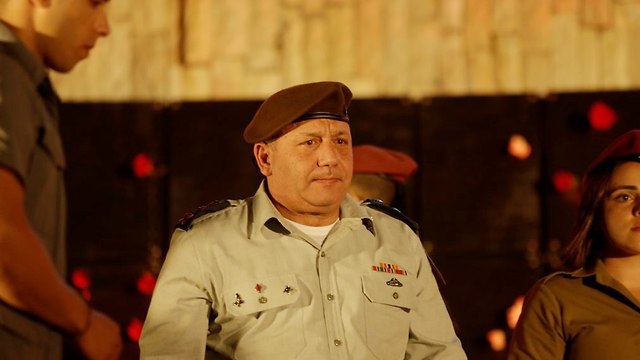
IDF Chief of Staff Gadi Eisenkot (Photo: Amit Sha'al)

IDF Chief of Staff Gadi Eisenkot (Photo: Amit Sha’al)

Eisenkot also lamented the failed reconciliation deal between the PA and the Hamas terror group in Gaza and noted that the aging Palestinian leader, beset by poor health, could lose control of the area as unrest remains in Gaza and anger reaches boiling point in the West Bank.

According to Eisenkot, these combined factors have created a concerning dynamic for the IDF which could be forced to face a rising tide of violent riots.

The IDF chief warned that in the event of a violent escalation, the army would be compelled to increase the number of troops on the ground.

For the army, Abbas’s upcoming speech in the UN General Assembly carries significance for how events will unfold in the West Bank.

The defense establishment believes that Abbas’s 2015 speech at the UN inspired the wave of terror that ensued, which was marked by daily car-ramming, stabbing and shooting attacks by lone wolf Palestinian terrorists throughout Israel.

With the US pressure mounting on the 82-year-old leader, the defense establishment attaches significance to his speech, which is expected to be a defiant declaration against US President Donald Trump and a tacit imprimatur for fresh terror attacks.

Amid the concerns, Eisenkot outlined a plan to mitigate the risks of an escalation of violence and to fill the void left behind by the US’s retreat from efforts to assist the PA.

The overarching conclusion set out by Eisenkot was the Trump is pushing Abbas onto the ropes despite the fact that Israel depends on him to keep a lid on violence and terrorism.

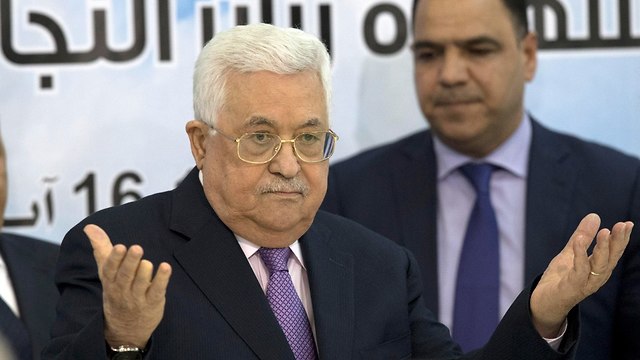
PA President Mahmoud Abbas (Photo: EPA)

PA President Mahmoud Abbas (Photo: EPA)

Other security officials have made clear that maintaining the PA’s stability was in Israel’s best interest. They have also noted that the US’s $60 million in funding for the Palestinian security services was not affected, but all civilian aid budgets were stopped.

The officials blamed Abbas for working to sabotage Israeli indirect negotiations with Hamas to put an end to the daily border violence in Gaza. According to the officials, Abbas is deliberately seeking to ensure an intensification of the humanitarian crisis gripping the strip.

Abbas, for example, has refused to transfer salaries to 75,000 PA workers in the strip and is refusing to fund a larger supply of electricity to the residents.

The officials have accused Abbas of choking the Gaza residents in order to foment further conflict between Hamas and Israel, hoping that Israel will attack the Hamas-ruled coastal enclave and deal a fatal blow to the terror movement, which competes with Abbas for power.

In addition, creating circumstances that will potentially provoke Israel into launching an offensive will enable him to continue his legal battle against Israel in international forums.


Iran launches air maneuvers near strategic Strait of Hormuz

September 21, 2018

Source: Iran launches air maneuvers near strategic Strait of Hormuz

Drill, intended to serve as warning against enemies that attacks will be met with ‘stern response’, involves army’s and Revolutionary Guard fighter jets including US-made F-4, French Mirage and Russian Sukhoi-22 planes.
Iran’s air force is carrying out a drill near the strategic Strait of Hormuz in the Persian Gulf, the passageway for nearly a third of all oil traded by sea, the country’s official IRNA news agency said Friday.
The drill involves the military’s and Revolutionary Guard fighter jets, including US-made F-4, French Mirage and Russian Sukhoi-22 planes, the report said, adding that five logistics and combat helicopters are also taking part in the exercise over the Persian Gulf waters and the Sea of Oman.IRNA said the maneuver is a warning to Iran’s enemies that they face a quick, “stern response” in case of any ill-will toward Iran.

File photo of Iranian jets

File photo of Iranian jets

The exercise is part of annual manifestations on the anniversary of the start of the eight-year war Iraqi dictator Saddam Hussein launched against Iran in 1980.

But it also comes after Tehran’s recent warnings that it would shut down the Strait of Hormuz if it’s blocked from exporting its crude because of US pressure and renewed sanctions on Iran.

Tehran feels increasingly under pressure after President Donald Trump pulled America out of the landmark nuclear deal between Iran and world powers in May.

Crushing US oil sanctions on Iran will resume in early November and already, American allies in Asia are cutting back on their purchases of Iranian crude.

In July, Iran’s Prsident Hassan Rouhani said that if renewed sanctions threatened Iran’s crude oil exports, the rest of the Mideast’s exports would be threatened as well.

Washington maintains a fleet in the Gulf that protects oil shipping routes.

“In addition to a show of strength, this ceremony is a message of peace and friendship for friendly and neighboring countries,” Colonel Yousef Safipour, the deputy commander of the army for public relations said, according to the Islamic Republic News Agency (IRNA).

“And if the enemies and arrogant powers have an eye on the borders and land of Islamic Iran they will receive a pounding reply in the fraction of a second.”


Iranian cleric says time for Israel to say goodbye

September 21, 2018

Source: Iranian cleric says time for Israel to say goodbye

Hassan Abu-Torabi Fard says at Friday prayers that the ‘resistance of Hezbollah and the people of Gaza’ is in a position of strength; in apparent warning to Israel, Iranian colonel says ‘enemies and arrogant powers … will receive a pounding reply in the fraction of a second’ if they hit Iran
A prominent Iranian cleric said Friday that the time had come for Israel to say goodbye. He did not give any further information on what that could mean.

“Mr. Netanyahu, you and your intelligence services know well that the time to say goodbye has arrived and what position of strength the resistance of Hezbollah and the people of Gaza are in,” Hassan Abu-Torabi Fard, the temporary Friday prayers leader in Tehran, said, according to Fars News.

The statements came in the wake of Iranian sabre-rattling with the Iranian Revolutionary Guards and army carrying out a joint aerial military drill in the Gulf on Friday in what official media said indicated the “pounding reply” that awaited the country’s enemies.

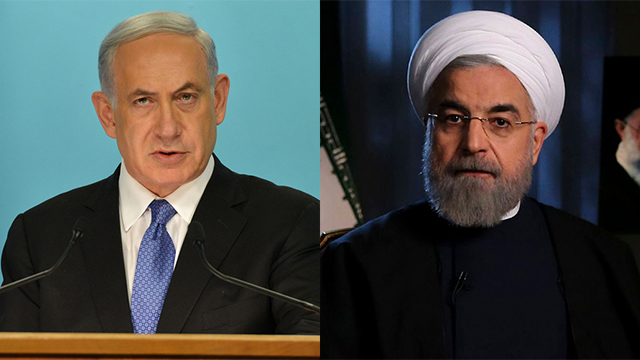
President Rouhani and PM Netanyahu (Photo: Kobi Gideon/GPO, AP)

President Rouhani and PM Netanyahu (Photo: Kobi Gideon/GPO, AP)

Tehran has suggested in recent weeks that it could take military action in the Gulf to block other countries’ oil exports in retaliation for US sanctions intended to halt its sales of crude.

Washington maintains a fleet in the Gulf that protects oil shipping routes.

“In addition to a show of strength, this ceremony is a message of peace and friendship for friendly and neighboring countries,” Colonel Yousef Safipour, the deputy commander of the army for public relations said, according to the Islamic Republic News Agency (IRNA).

“And if the enemies and arrogant powers have an eye on the borders and land of Islamic Iran they will receive a pounding reply in the fraction of a second.”

The statement comes a day after the leader of Lebanon’s Hezbollah terror group boasted that the group possesses “highly accurate” missiles despite Israeli attempts to prevent it from acquiring such weapons.

Hassan Nasrallah spoke in a televised speech to supporters commemorating Ashoura, one of the most important religious holy days for Shi’ite Muslims.

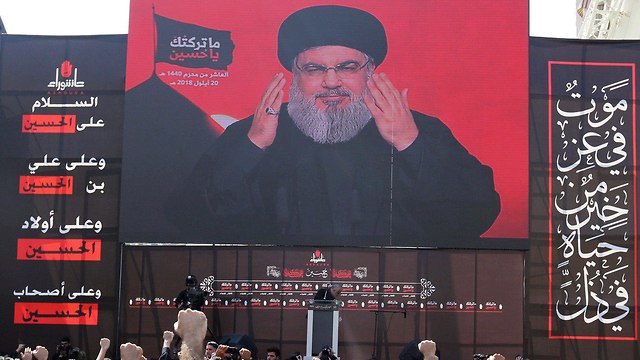
Hassan Nasrallah (Photo: Reuters)
Hassan Nasrallah (Photo: Reuters)

Nasrallah says Israel knows the regional balance of power has changed, and that recent Israeli strikes in Syria to prevent Hezbollah from acquiring those weapons failed because this “has already been achieved.”

Mirage, F-4 and Sukhoi-22 jets took part in the exercise on Friday, according to IRNA.


Forcing Iran Out of Iraq

September 21, 2018

“It is difficult to name a conflict in the Middle East that does not have Iran’s fingerprints on it,” said US Ambassador to the UN Nikki Haley.

By Tovah Lazaroff September 21, 2018 The Jerusalem Post

Source Link: Nikki Haley: Iran proxies reportedly developing missile production in Iraq

{Actually, they should be forced out of the Mideast. – LS}

Iranian proxies in Iraq are reportedly developing the capacity to produce missiles, US Ambassador to the UN Nikki Haley said on Thursday as she warned against the growing Iranian foothold in Iraq.

“In recent months, Iran’s aggression has escalated. Iranian proxies in Iraq operate openly, with funding, training, and weapons supplied by Tehran. The Iranian regime has reportedly begun over the last few months to transfer ballistic missiles to these proxies in Iraq. It is reportedly developing the capability for its proxy militias to produce their own missiles inside of Iraq,” Haley told the UN Security Council on Thursday.

She spoke at the UNSC’s monthly meeting on the Middle East, as Israel and the United States are increasingly concerned about the Iranian activity in Iraq and the subsequent dangers to both Israel and the United States. Last month, Reuters reported that Iran has given ballistic missiles to Shi’ite proxies in Iraq with the capacity to hit Israel. Defense Minister Avigdor Liberman has warned that the IDF, which has focused on preventing an Iranian foothold in Syria, could expand it activities against Iran to other areas of the Middle East.

All the council members who spoke at the UNSC meeting, however, focused the debate on Israeli actions against the Palestinians.

Haley, whose country holds the rotating UNSC presidency this month, chaired the meeting. On Wednesday, US President Donald Trump plans to chair a UNSC meeting of foreign minsters on global non-proliferation.

During her speech, Haley chastised the UNSC members for their focus on Israel over other Middle Eastern dangers such as Iran.

“If there is one country that is the source of conflict and instability in the Middle East – one country that merits a quarterly debate in the Security Council – that country is not Israel. It’s Iran.”

“It is difficult to name a conflict in the Middle East that does not have Iran’s fingerprints on it,” she added.

Iran has “trampled on the sovereignty of its neighbors” in Lebanon, Syria, Yemen and Iraq where they want to create an “Iranian controlled corridor for weapons and fighters from Tehran to the Mediterranean,” Haley said.

Iranian General and head of the IRGC Quds Force Soleimani, who is leading an effort to influence the composition of a new Iraqi government, has “practically taken up residence in Iraq” in defiance of UNSC resolution 2231, Haley said.

“Iran sees Iraq as merely a transit point for Iranian weapons and a training ground for Iranian proxies,” said Haley. Iran wants to see an economically weak and dependent Iraq, so that it can be a base by which to illicitly fund terrorist activities, Haley charged.

Iran has already attacked the US in Iraq, said Haley. “Two weeks ago, two Iranian proxy groups launched rocket attacks on the American Embassy in Baghdad and the U.S. Consulate in Basra,” she said.

She restated a White House warning to Tehran.

“We hold the Iranian regime fully accountable for its proxies’ attacks on U.S. facilities and personnel in Iraq. And we will not hesitate to vigorously defend American lives,” Haley said.


How Israel defeated the PLO 

September 21, 2018

Source: How Israel defeated the PLO – Opinion – Jerusalem Post

In the past 25 years, Israel’s economy has changed from a socialist command economy to a free-market economy and today Israel’s GDP per capita is higher than Japan’s.”

BY CAROLINE B. GLICK
 SEPTEMBER 20, 2018 22:47
World Climate Change Conference 2015

The so-called “Oslo process,” is really two processes. The first was the Oslo peace process. It began with secret negotiations between Israeli leftists with ties to then-foreign minister Shimon Peres in Oslo, Norway, in 1993. It led to Israel’s recognition of the Palestine Liberation Organization and the establishment of the PLO-controlled Palestinian Authority to run the Palestinian autonomy in Judea, Samaria and Gaza. It also led to a seven-year attempt by Israel to make peace with the PLO.

The peace process, was the brainchild of the Israeli Left. It was predicated on the notion that without the PLO there can be no peace. And without peace, based on territorial concessions, Israel has no hope of surviving, let alone prospering.
The Oslo peace process failed in July 2000 when the PLO rejected peace and statehood.

The failure of the Oslo peace process was followed quickly with the initiation of the Oslo terror war by the PLO-PA and its partners in Hamas and Islamic Jihad. Its goal was to demoralize Israeli society and foment a collapse of Israel’s national will to reject the PLO’s maximalist demands, which in turn would lead to the eventual destruction of Israel.

To a large degree, the Oslo war ended in 2004 when Israel secured its control over the Palestinian population centers in Judea and Samaria and killed Hamas’s senior leadership in Gaza.

The Israeli Left never accepted the failure of the Oslo peace process. And the PLO-PA never abandoned its efforts to destroy Israel – in the name of peace and justice.

The refusal of both the Israeli Left and the PLO-PA to own up to the failure of both Oslo processes, has engendered a strange symbiotic relationship between the two sides. No, of course the Left hasn’t joined or supported the PLO-PA’s terror war. To the contrary. There is little if any distinction in the positions of the Israeli Left and Right on the need to defeat Palestinian terrorism.

What the Left and the PLO-PA do share is an assessment of who is to blame for the absence of peace. Never accepting that the PLO-PA was disingenuous in its expressions of peaceful intentions, the Israeli Left has looked elsewhere for culprits to blame the Oslo peace process’s failure. Its chosen culprits have always been the Israeli Right and their American supporters. The PLO-PA for its part, has always happily agreed with the Israeli Left’s indictments.

The symbiosis between the two parties was very much in evidence in an interview Maariv’s Ben Caspit published last Friday with Saeb Erekat, PA President Mahmoud Abbas’s right-hand man and the chief Palestinian negotiator for peace talks with Israel.
The interview was both noteworthy and unoriginal. It was noteworthy because both men knew precisely whom to blame for the absence of peace – US President Donald Trump and Prime Minister Benjamin Netanyahu.

Erekat went straight for the kill and accused Trump of committing “genocide” against the Palestinians. How is Trump committing mass murder?

By ending US funding of two Palestinian hospitals in east Jerusalem.

As for Netanyahu, according to Erekat, Netanyahu “killed Rabin.” Once Netanyahu was done murdering his predecessor Yitzhak Rabin, according to Erekat, he proceeded to “kill the idea of peace. [He killed] the attempt to create a culture of peace.”

Caspit for his part, was far less extreme. But he shared Erekat’s basic conceits. In an attempt to convince his readers that we need to take heed of Erekat’s words, Caspit expressed scorn for Trump.

“Even after Trump is consigned to history and leaves behind his presidential library of pornography, they [the Palestinians] and us, we remain here together,” he wrote.

Caspit then attacked the normal Israeli suspects. He accused “the Israelis, particularly the Israeli Right of preparing themselves for the coming of the messiah,” in the face of Trump’s friendship.

While Erekat didn’t attack the Israeli public specifically, his demonization of Netanyahu was instrumental. Netanyahu after all did not seize power by force. He was elected prime minister four times. And in the next elections, he is expected to win a fifth term.

Erekat claimed that Netanyahu killed peace by rejecting the PLO’s demand to base all negotiations on the 1949 armistice lines. But Netanyahu isn’t a free agent when he rejects this demand. He is the loyal representative of the Israeli people, which keeps electing him.

This begins to bring us to the reason that the Oslo peace process was rejected and the reason the Oslo war also failed.

Both of these initiatives were launched first and foremost against the Israeli people.

From the time the Rabin-Peres government unveiled the Oslo peace process in late August 1993, until today, at its heart is an assumption that rejects the foundations of Zionism and Jewish identity more generally.

The Oslo peace process assumed that Israel’s prosperity, its survival and its morality were functions of its willingness and its success in making peace with the PLO by appeasing it. That assumption gave Yasser Arafat, Abbas and their comrades veto power over Israel’s success and survival. After all, it was up to them to decide if Israel gave enough.

Zionism and Jewish national identity have always placed the power to determine the fate of the Jewish people, its survival and its success on the Jews themselves. Jewish national identity has never been defined by other nations. It has always been defined by the Jews themselves.

Over the years, since the peace process failed, one of the things that the Israeli Left has been hard pressed to comprehend has been Israel’s high rankings on happiness indexes. Most recently, ahead of Rosh Hashanah, the Central Bureau of Statistics reported that 89% of Israelis say they are happy and satisfied with their lives.

This report, like all of its many predecessors, plunged the Israeli Left into a fit of despair. How can Israelis be happy when there’s no peace, nor even a peace process? How can Israelis be happy when the Palestinians in Gaza and Judea and Samaria reject them?

The explanations are always forthcoming. Then-secretary of state John Kerry said in 2014 that Israel’s economic prosperity – which was supposed to only come after peace was achieved – has made Israelis too rich to care about the Palestinians.

The problem with that view is that in the CBS’s 2002 survey – taken at the height of Israel’s economic recession and the darkest moments of the Oslo war – 83% of Israelis said they were happy and satisfied with their lives in Israel.

Israeli commentators like Ron Ben-Yishai have argued that the constant wars and security threats have strengthened social cohesiveness and unity, which serve ironically as the foundations for happiness.
The problem with this view is that happiness levels rise both when Israel is at war and when the security situation is stable.

The reason Israelis are so happy – despite Oslo’s failure – is unquestionably tied to the basic reason that the Oslo peace paradigm never won the sustained support of a majority of Israelis.

Israelis are a dynamic people. In the quarter-century since the handshake on the White House lawn, Israeli society has been transformed in every sphere. The percentage of Israelis with an academic degree rose to 47% from 20% between 1990 and 2012.

In the past 25 years, Israel’s economy has changed from a socialist command economy to a free-market economy and today Israel’s GDP per capita is higher than Japan’s. Israel’s annual GDP overall will likely reach a half trillion dollars within a decade.

Israel’s fertility rates dwarf those of every Western country.

Unemployment is at record lows.

All of this occurred as the Palestinians under the PLO have been robbed of their wealth by kleptocratic terrorists who run their autonomous governments like mafia bosses. To excuse their failures and mask their crimes, the PLO tells the Palestinians to blame their misfortune on the Jews and exhorts them to murder Jews at every opportunity.

One of the central narratives repeated ad nauseam over the past 25 years by the PLO and Israeli leftists alike is that the PLO is the only moderate and secular group in Palestinian society. If Israel fails to support it, then Israel will be forced to fight a war with Islam. In his interview with Erekat, Caspit gave prominent voice to this contention.

This would be an important insight, if were true.

But there isn’t.

Sunday morning, Khalil Jabareen, a 16-year-old from south of Hebron plunged a knife into 45-year-old Ari Fuld’s back outside a supermarket at Gush Etzion junction. Why did he do it? Secular, moderate Abbas.

Monday, Bassem Tawil reported at the Gatestone Institute’s website that, last Saturday – the day after Caspit’s interview with Erekat was published, Abbas gave a speech to the PLO’s Executive Committee in Ramallah. There the “secular, moderate” leader accused Israel of plotting to permit Jews to pray at al-Aqsa Mosque on the Temple Mount in Jerusalem.

Abbas provided no proof for his utterly false allegation. He did say that he is working with the Jordanian government to submit a complaint against Israel for its evil plot before the International Criminal Court at The Hague.

According to Tawil, the pan-Arab and Palestinian media picked up Abbas’s remarks immediately. They were the top story on the Hamas and Islamic Jihad websites.

After Jabareen murdered Fuld, the Palestinian media claimed that he killed him to defend al-Aqsa.

In other words, Abbas got Jabareen to go hunting for Jew to kill.

Abbas killed Fuld.

Erekat warned Caspit that at his speech before the UN General Assembly next Thursday, Abbas is planning to make a dramatic statement that will effectively burn down what’s left of the peace process. Caspit, for his part, warned his readers that we need to be very concerned that Abbas will follow through with his threat to dismantle the PA.

His warnings failed to alarm the public. And rightly so.

Fuld’s grotesque murder was just one more reminder that Oslo was wrong on all counts. The PLO was never interested in peace. And Israel’s right to exist, like its success, its security and its prosperity were never in the hands of anyone but the people of Israel.

The people of Israel’s rejection of Oslo’s central premise – that our happiness and success are in the PLO’s hands – and our insistence on carrying on and building their lives and country even in the face of massive suffering and persecution is a testament to two things: the absurdity of Oslo’s central assumption, and the resilience and strength of the Jewish people and Israeli society.

Israel defeated Oslo not by going to war against it, per se. Israel survived the Oslo peace process and defeated the Oslo war by remaining true to itself.


Analysis: Reality sets in for Trump on Iran, Korea 

September 21, 2018

Source: Analysis: Reality sets in for Trump on Iran, Korea – International news – Jerusalem Post

Pompeo said that the US was still pushing forward toward “rapid” denuclearization from North Korea. That is if you think of 2021 as rapid.

BY YONAH JEREMY BOB
 SEPTEMBER 21, 2018 08:40
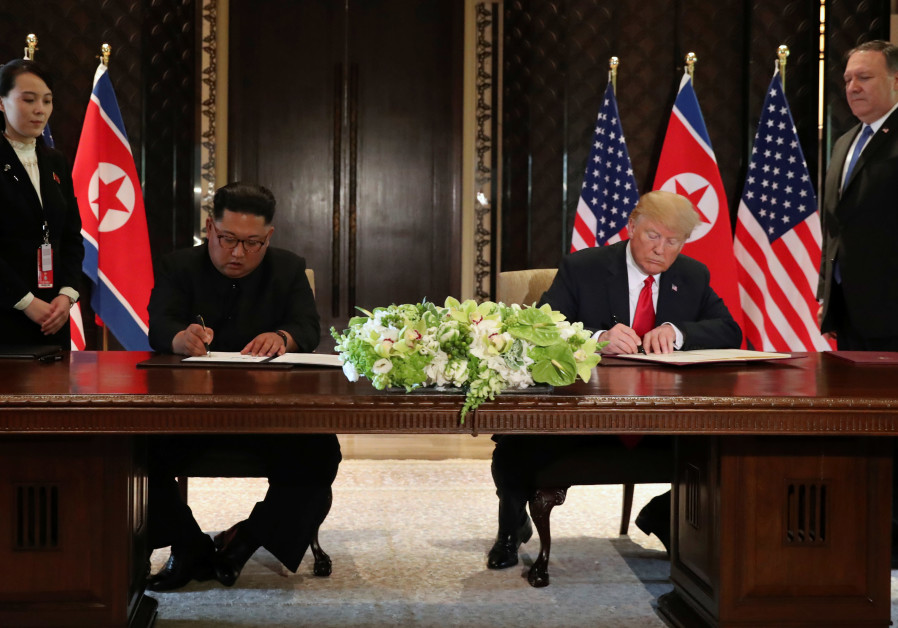
U.S. President Donald Trump and North Korea's leader Kim Jong Un sign documents that acknowledge the

Looking back, Wednesday may turn out to be the single most decisive day in understanding the future of the Trump administration’s policy on Iran and North Korea up to this point. And all of this in turn may have massive implications for Israeli security.

In the same 24 hours, Secretary of State Mike Pompeo permanently scrapped the “rapid” denuclearization of North Korea policy, and his Iran-policy czar Brian Hook signaled that imminent regime change in Tehran is not in the cards.

While not necessarily unexpected, these are staggering changes.

Neither Pompeo nor Hook made these crucial policy shifts explicitly.

If you look at actual wording, Pompeo said that the US was still pushing forward toward “rapid” denuclearization from North Korea. That is if you think of 2021 as rapid.

Leading into and immediately after US President Donald Trump’s summit with North Korean leader Kim Jong Un, Trump and others had alluded to a process which could start changing Pyongyang immediately.

Some spoke of getting full declarations of the North’s nuclear arsenal and of rolling back large portions of its nuclear program within 90 days.

Not only is 2021 more than two years from now, it is also after Trump’s re-election bid. That means he has given up on trying to present a deal before the next election. It also means that whatever the outcome of the November 2020 election, he or a new president will be free to ignore the 2021 deadline without any real political consequences.

Regarding Iran, Trump and Pompeo’s May speeches seemed to signal that they were going for regime change in Tehran and nothing less.

In July, within a period of a week, Trump appeared to both threaten nuking Iran into the stone age and meet to start nuclear diplomacy with no preconditions. But neither tactic got any sudden policy changes from the ayatollahs.

Further, while the Islamic Republic appears to be hurting economically – even worse than expected following the August 6 renewal of US sanctions – it also seems to be holding together politically far more than the Trump administration would like.

Enter Hook’s public announcement of a renewed attempt to get Iran back to the nuclear negotiating table, even as he acknowledged Tehran continues to give the Trump administration the cold shoulder.

There are technically still pressure campaigns against both North Korea and Iran – and the one against the Islamic Republic will intensify with another round of sanctions in November.

But you do not make a point of publicly re-offering negotiations to a regime that is ignoring you, if you expect it to disappear anytime in the near future.

What does this mean for Israel?

It means that Jerusalem will closely watch what new concessions the US may offer North Korea to keep negotiations running, or to get them kick-started with Iran.

Some concessions may not matter to Israel.

But others, such as Iran’s presence in Syria and whether Tehran gets to keep testing missiles that can reach Israel – even if it might need to make concessions on longer-range missiles at some point – could matter a lot.

Also, any concessions the US makes to North Korea could improve Iran’s hand in the nuclear standoff.

In short, the quick-fix phase of either North Korea or Iran is over – and the long slog, where the devil is in the details, has begun.

Trump, Netanyahu to meet next week at UN gathering 

September 21, 2018

Source: Trump, Netanyahu to meet next week at UN gathering – Israel Hayom


Report: Russia rejects Israeli findings on downed aircraft 

September 21, 2018

Source: Report: Russia rejects Israeli findings on downed aircraft – Israel Hayom

Israeli Air Force chief visits Moscow to brief officials on Russian plane shot down by Syrian forces in incident blamed on Israel • Lebanese report claims Russia wants new inquiry • PM Netanyahu: Problem is Iran’s attempt to use Syrian territory.