The song of the Yom Kippur war in memory of the thousands of youngsters who fell.
NEVER AGAIN ! – JW
The song of the Yom Kippur war in memory of the thousands of youngsters who fell.
NEVER AGAIN ! – JW
Source: Russia, Turkey to form buffer zone in Idlib as Syria vows to ‘liberate’ it – Israel Hayom
Offensive on rebel stronghold called off, they will have to leave Idlib by mid-October, Russian, Turkish officials say • Turkish leader says deal aims to avert humanitarian crisis • Syria’s U.N. envoy: Syrian government is prepared to fight rebels.
|
Smoke rising over Hobeit village, near Idlib, after a Syrian forces strike
|Photo: AP
|
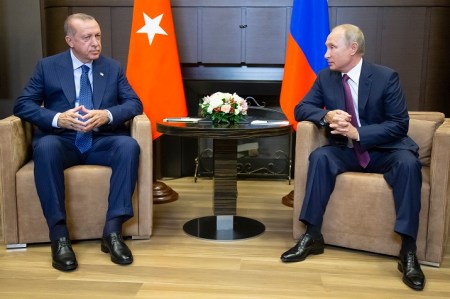
Russian and Turkish troops are to enforce a new demilitarized zone in Syria’s Idlib region from which “radical” rebels will be required to withdraw by the middle of next month, Russian President Vladimir Putin said on Monday after a meeting with his Turkish counterpart.
Russia, the biggest outside backer of Syrian President Bashar Assad in the seven-year conflict, has been preparing for an offensive on the city of Idlib, which is controlled by rebels and now home to about 3 million people.
But after Putin’s talks with Turkish President Tayyip Erdogan, who has opposed a military operation against the rebels in Idlib, Russian Defense Minister Sergei Shoigu said there would not be an offensive now.
Erdogan, who had feared another cross-border exodus of Syrian refugees to join the 3.5 million already in Turkey, said the deal would allow opposition supporters to stay where they were, and avert a humanitarian crisis.
Putin told a joint news conference with Erdogan: “We agreed that by Oct. 15 [we will] create along the contact line between the armed opposition and government troops a demilitarized zone of a depth of 15-20 kilometers [9-12 miles], with the withdrawal from there of radically minded rebels, including the Nusra Front.
“By Oct. 10, at the suggestion of the Turkish president, [we agreed] on the withdrawal from that zone of the heavy weapons, tanks, rockets systems and mortars of all opposition groups. The demilitarized zone will be monitored by mobile patrol groups of Turkish units and units of Russian military police,” Putin said, with Erdogan standing alongside him.
 EPA
EPANeither Putin nor Erdogan explained how they planned to differentiate “radically minded” rebels from other anti-Assad groups. It was also not immediately clear how much of the city of Idlib fell within the zone.
Idlib is held by an array of rebels. The most powerful is Tahrir al-Sham, an amalgamation of Islamist groups dominated by the Nusra Front, an al-Qaida affiliate until 2016.
Other Islamists, and groups fighting as the Free Syrian Army banner, are now gathered with Turkish backing under the banner of the National Front for Liberation.
“With this agreement, we have precluded experiencing a large humanitarian crisis in Idlib,” Erdogan said.
“The opposition will continue to remain in the areas where they are. In return, we will ensure that the radical groups, which we will determine with Russia, will not operate in the area under discussion,” he said.
Ahead of the trip to Russia, Erdogan had said Turkey’s calls for a cease-fire in Idlib region were bearing fruit after days of relative calm but that more work needed to be done.
Putin this month publicly rebuffed a proposal from Erdogan for a cease-fire there when the two met along with Iran’s president for a three-way summit in Tehran.
Syria’s U.N. ambassador said Monday that Damascus was committed to “liberate it [Idlib] from terrorism and foreign occupation,” adding that there is no de-escalation zone in rebel-held Idlib because “armed groups refused to dissociate themselves from terrorist groups.”
Bashar Ja’afari told the U.N. Security Council on Friday that “the situation is as it is now in Idlib because the countries sponsoring terrorism do not want to distinguish between terrorists and armed opposition.”
Ja’afari said, “Those who facilitated the entry of foreign terrorist fighters into my country, especially the Turkish government, still have a chance to remove them from Idlib province.”
But he warned that “in case the armed terrorist groups refuse to lay down weapons, refuse to leave Syrian territory to go back to where they came from, the Syrian government is prepared.”
Ja’afari said Syria is aware of the humanitarian consequences that might result and “we take all precautions and preparations to protect civilians, to provide safe passage for them to leave, just as we have done in similar situations.”
Source: Millions of Jews pause their lives to honor Yom Kippur traditions – Israel Hayom
As holiest day of the Jewish calendar begins Tuesday night, country grounds to a halt • Many set to observe holiday with 25-hour fast, others to enjoy calm atmosphere as cars stay off roads • Thousands arrive at Western Wall for prayers.
|
Jewish worshippers take part in the Tashlich ritual on Monday ahead of Yom Kippur
| Photo: Reuters
|
The holiest day in the Jewish calendar, Yom Kippur, was set to commence at sunset Tuesday. The holy day will see Israel come to a near complete pause.
Many Israelis observe a 25-hour fast and attend prayer services on this day. Children take to the streets by foot and bicycle to enjoy the near complete absence of cars on streets and highways. The atmosphere is calm, nearly silent.
Thousands of Jewish worshippers visited the Western Wall in Jerusalem’s Old City on Monday night for the culmination of Selichot penitential prayers. The services were led by Israel’s two chief rabbis and other prominent figures, and included the ritual of hatarat nedarim (the annulment of vows), in which people can walk back pledges they made during the past year.
Some 3,000 worshipers arrived at the tomb of Mishnaic sage Rabbi Meir in Tiberias on Monday. Among them was Culture and Sport Minister Miri Regev.
Meanwhile, in view of the volatile security situation, the Israel Defense Forces announced that the crossing points into Israel from the Gaza Strip and Judea and Samaria would be closed starting midnight on Tuesday. Despite this measure, passage will be permitted on humanitarian grounds and for emergencies.
Israelis will also mark the 45th anniversary of the Yom Kippur War on Monday with various memorial services at military cemeteries.
Emergency services have also stepped up preparations ahead of the holiday and its long fast. Authorities pleaded with the public not to interfere with emergency vehicles, as this could mean delay of lifesaving treatment.
Source: IAF targets Palestinian terror cell planting bombs near Gaza border – Israel Hayom
Palestinians report two fatalities in strike • Incident follows riots in northern Gaza, where hundreds of Palestinians tried to breach the security fence • Balloon carrying a fragmentation grenade launched into Israel from Gaza, neutralized safely.
|
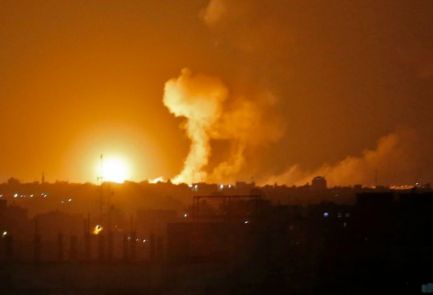
An IDF strike on terrorist targets in the Gaza Strip
| Illustration: AP
|
The Israeli Air Force on Monday targeted a Palestinian terrorist cell planting explosives on the Israel-Gaza Strip border.
Gaza’s Health Ministry said Tuesday that paramedics recovered two bodies from the scene of the strike.
”An IAF aircraft targeted terrorists who were spotted approaching the security fence and placing a suspicious-looking object next to it,” the IDF Spokesperson’s Unit said in a statement.
Palestinian sources said the strike followed a tense day on the border, as hundreds of Palestinians rioted in northern Gaza and attempted to breach the border fence.
The Palestinians said that dozens of protesters were hurt, mostly from tear gas inhalation.
Earlier Monday, a balloon carrying a fragmentation grenade was sent into Israel from Gaza.
The grenade landed in an open area and caused no harm, as it did not detonate. Police sappers were called to the scene and subsequently neutralized the grenade safely.
”This demonstrates that not only is arson terrorism not waning, they [the Palestinians] are taking it to the next level,” Eshkol Regional Council head Gadi Yarkoni said. “They are using explosives designed to maximize damage.”
”The balloon and grenade were found in a peanut field during a routine patrol by our security guards,” Yarkoni explained. “This field was slated to be harvested in the coming days. We averted a disaster.”
He further urged the government “to show zero tolerance for the terrorism that is rearing its head near our communities. We cannot allow this threat to become our daily routine.”
Source: Russia blames Israel after Syria downs plane while trying to repel attack | The Times of Israel
Russian defense chief tells Liberman that Israel wholly responsible for aircraft with 15 aboard being shot down by Syrian S-200 missile, says Moscow reserves right to respond

Russia on Tuesday blamed Israel while confirming that Syrian air defenses inadvertently shot down one of its military planes the night before, saying Israeli pilots used the reconnaissance aircraft as cover for an attack on a Syrian facility.
The Russian military said the Ilyushin IL-20, with 15 aboard, was downed by a Syrian S-200 missile, which had been triggered by an alleged Israeli airstrike on a Syrian facility near Latakia.
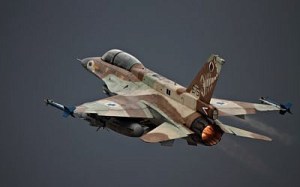
According to Russia, at approximately 10 p.m., four Israeli F-16 fighter jets approached western Syria from the sea and fired dozens of missiles at the facility, a Syrian defense ministry subsidiary with ties to the country’s chemical weapons and missile programs.
The Russian military accused the Israeli Air Force of deliberately using the Ilyushin IL-20 electronic surveillance plane, which was flying nearby, as a shield for its attack, putting the aircraft in the path of the incoming Syrian air defenses.
This account could not be immediately confirmed. The Israeli military refused to comment
 RT
RT✔@RT_com
Map of incident on September 17 in Syria provided by Russian MoD https://on.rt.com/9ehq
“We consider these provocative actions by Israel as hostile. Fifteen Russian military service members have died because of the irresponsible actions of the Israeli military. This is absolutely contrary to the spirit of the Russian-Israeli partnership,” the Russian military said in a statement, according to Russia Today, a Kremlin-linked news outlet.
The Israeli and Russian militaries maintain what they call a “deconfliction mechanism,” which is meant to coordinate their activities in Syria in order to avoid incidents like this one. Until Monday night, these efforts had largely succeeded in preventing direct or indirect clashes since Russia became more deeply involved in the Syrian civil war three years ago.
On Tuesday morning, Russian Defense Minister Sergei Shoigu told Defense Minister Avigdor Liberman that Israel had failed to warn Moscow of its plans in advance, informing them less than a minute before the strikes, which did not leave sufficient time to get the reconnaissance aircraft out of harm’s way.
In the phone call, Shoigu told Liberman that Russia “reserves the right to further countermeasures” against Israel, according to the state-run Interfax news outlet.
Shoigu added that the “actions of the Israeli Defense Ministry fail to match the spirit of Russian-Israeli partnership,” according to Interfax.
“Israel was repeatedly asked not to deliver strikes on Syria endangering Russian personnel,” Interfax quoted Shoigu as telling Liberman.
Liberman’s office confirmed that the minister had spoken with Shoigu, but said it “would not comment beyond that.”
One of the sole Israeli officials to comment on the matter was Likud MK and fighter pilot Yoav Kisch, who denied that Israel was culpable.
“The attempt by Russia to define Israel as responsible for the downing of the Russian plane must be opposed. The only person responsible is the one who pressed the button that fired the missile that shot down the plane,” he wrote on Twitter.
It was not immediately clear how the downing of the Ilyushin Il-20 plane would affect the ongoing cooperation between Israel and Russia in Syria.
A Kremlin spokesperson said the situation was being “analyzed” in light of the incident, according to Interfax.
The Russian government spokesperson refused to comment when asked if Russian President Vladmir Putin and Prime Minister Benjamin Netanyahu would speak about the matter.
On Tuesday, Russian officials displayed a rarely seen level of hostility toward the Israeli military.
Defense Ministry spokesman Igor Konashenkov told the state-run TASS news agency that Israel knew the reconnaissance plane was there and used it as cover to carry out the airstrike.
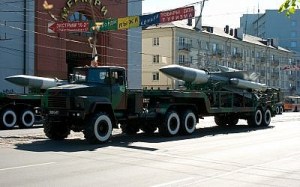
“By using the Russian plane as a cover the Israeli air pilots made it vulnerable to Syrian air defense fire. As a result, the Ilyushin-20, its reflective surface being far greater than that of F-16, was downed by a missile launched with the S-200 system,” Konashenkov said.
The S-200 air defense system is manufactured by Russia and sold to Syria. In February, the same type of system was used to shoot down an Israeli F-16 fighter jet that was taking part in airstrikes in Syria in response to an Iranian drone that was flown into Israeli airspace from a Syrian air base earlier in the day.
On Monday night, Syria’s state media reported that a state company for technical industries was bombed, likely by Israel, triggering Syrian air defenses.
Two people were killed in the strike and eight more were injured, according to the Britain-based Syrian Observatory for Human Rights.
 Qalaat Al Mudiq@QalaatAlMudiq
#Syria: SAA source claims it was a coordinated attack between #Israel|i Air Force & UK/US ships & 28 cruise missiles fired in total. 10 casualties reported in #Latakia so far. Video shows multiple strikes SE. of #Baniyas. pic.twitter.com/IKQ5vsscrG
Qalaat Al Mudiq@QalaatAlMudiq#Syria: powerful blast in #Tartus province & jet is clearly heard before. pic.twitter.com/ZRzMrPQoKE
Russian state news earlier said the IL-20 disappeared over the Mediterranean on Monday evening as it was returning to Latakia province at the same time as the suspected strike by Israel, and that concurrently France was also firing rockets nearby.
“Connection has been lost with the crew of a Russian Il-20 plane over the Mediterranean Sea 35 kilometers from the Syrian coast as it was returning to the Hmeimim airbase,” the Russian defense ministry said, adding that communications were lost at the time of the suspected Israeli attack.
A Pentagon spokesman said the United States was not involved and declined to provide further details.
“The missiles were not fired by the US military and we have nothing further at this time,” he said.
A French army spokesman also denied any involvement after Russia accused it of taking part in the strike.
Russia has until now mostly turned a blind eye to alleged Israeli strikes on Syrian and Iranian military facilities in the country, despite being allied with Damascus and Tehran.
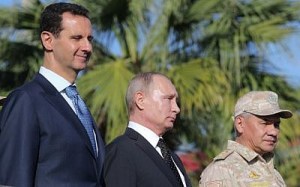
Israel is alleged to have been behind a series of airstrikes mainly targeting Iranian and Hezbollah forces in Syria that have joined the country’s war fighting alongside the government. Israel rarely acknowledges attacks inside Syria, but has said it will use military action to prevent weapons transfers to its enemies.
Earlier this month, an Israeli military official said the Jewish state has struck over 200 Iranian targets in Syria over the past 18 months.
Syrian military sources told SANA that the Monday attack came from the direction of the sea and targeted an Organization for Technological Industries center in Latakia.
The sources also claimed the country’s air defenses shot down a number of incoming missiles. The Syrian army has regularly been accused of exaggerating its interception capabilities.
The state-run Al-Ikhbariya TV reported loud explosions in the coastal Latakia province, saying they were likely from Israeli strikes.
Explosions continued for nearly a half hour, said state-run Al-Ikhbariya TV, which aired footage showing streaks of white light flashing across the sky. An unidentified military official was quoted as saying Syrian air defenses intercepted some missiles heading for the provincial capital of Latakia from the sea.
The attack caused a large explosion and knocked out power to the surrounding area, according to local media.
The Organization for Technological Industries is a subsidiary of the Syrian Ministry of Defense and has been tied to the developments of both missiles and chemical weapons.
The Britain-based Syrian Observatory for Human Rights reported the explosions, saying the target appeared to be an ammunition depot, part of the compound of the organization. The war monitoring group said it was not clear if the depot was for Iranian or Syrian forces.
The strikes followed a similar attack on Damascus International Airport late Saturday, which Syrian state media also blamed on Israel. A military official quoted then on state media said Syrian air defenses intercepted some missiles coming from the sea.
Other attacks were reported on September 4 that targeted sites in the coastal Tartus area and in Hama province. The Observatory said at the time that the attacks were believed aimed at Iranian military posts.
Hey Syrians, remember that plane of yours which was shot down a few months ago?
You know, the one that da Jooos shot down?
Well, it was shot down by a woman.
Bet that stings a whole heap, don’t it?
Captain Or Naaman says of the July incident, ‘You take deep breaths and you wait to hear and see that you knocked out the target’
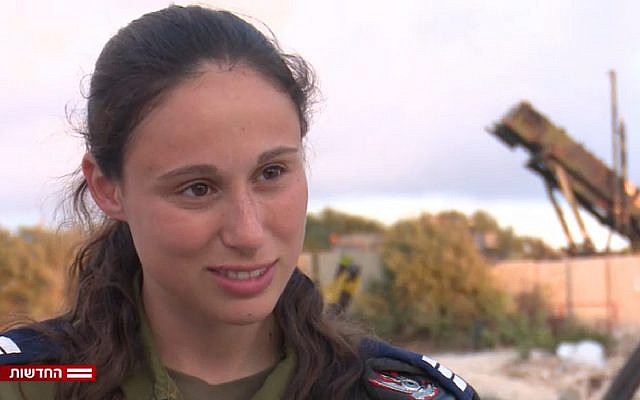
Captain Or Naaman, who commanded the team that shot down a Syrian plane, in an interview broadcast on September 17, 2018. (Screen capture: Hadashot news)
Captain Or Naaman, the IDF officer who commanded the unit that downed a Syrian plane after it entered Israeli airspace in July, described the tension in the control station during the operation, in an interview with Hadashot news shown Monday.
According to the Israeli military, a Syrian Sukhoi fighter jet entered Israeli airspace over the Golan Heights on July 24, traveling approximately two kilometers (one mile) before it was shot down by two Israeli Patriot interceptor missiles.
Naaman commanded the team who fired the missiles, and she said that during the operation the control station remained quiet.
“I can say it is a bit like the paratroopers’ course I did. There is that moment before you jump from the plane — you don’t know what will happen, whether the parachute will open, or if the helmet will fall off, or how you will land on the ground,” she told Hadashot. “This is fairly similar to the process of launching from the control station.”
She also described the palpable tension after the launch.
“You take deep breaths and you wait to hear and see that you knocked out the target,” she said. “When you hear the ‘boom’ outside of the missile, you… that’s… that’s something I never imagined I’d hear.”
The full interview with Naaman will be broadcast on Wednesday night.
The Israel Defense Forces said at the time it had repeatedly warned Syria against flying aircraft close to the border before shooting down the jet.
Syria confirmed that its aircraft had been shot down by Israel and said it crashed in the Yarmouk Basin in southwestern Syria.
One of the pilots, identified as Col. Amran Mara’e, was killed when the plane was shot down, a Syrian military source told the Russian Sputnik news outlet. The fate of the other airman was not immediately known. According to Israeli reports, however, there was only one pilot in the plane.
The plane was involved in Syrian dictator Bashar Assad’s offensive against the rebel-held Daraa and Quneitra provinces, near the Israeli border.
Minutes before the plane was shot down, Syria’s state-run Al-Ikhbariya TV was broadcasting footage from the fence demarcating the UN buffer zone between Syrian and Israeli forces inside the Golan Heights. A UN observer post could be seen just on the other side of the fence.
According to the IDF, the fighter jet took off from the Iran-linked T-4 air force base in central Syria, which Israel has bombed in the past, and traveled “at high speed” toward the Golan Heights.
Israel stressed that it will continue to enforce the 1974 Separation of Forces Agreement, which requires Syria to abide by a demilitarized zone between the two countries
This was the first time that Israel shot down a Syrian fighter jet since 2014, when another Russian-made Sukhoi fighter jet entered Israeli airspace and was targeted with a Patriot missile.
In February of this year, the Syrian military shot down an Israeli F-16 fighter jet as it was taking part in a bombing raid against an Iranian-linked airfield in central Syria after an Iranian drone penetrated Israeli airspace, according to the IDF. The F-16’s pilot and navigator were injured as they bailed out of the aircraft, which crashed to the ground in northern Israel.
Source: Report: US freezes all PLO bank accounts in country
The Palestinian envoy to the US Husam Zomlot also said on Sunday that his permit to stay in the US has been annulled, his families’ bank accounts have been closed and that he and his family have been requested by authorities to immediately leave the country.
The report comes shortly after President Donald Trump’s decision last week to close the PLO mission in Washington.
“The US administration also revoked the visas of Ambassador Husam Zomlot’s wife and two children despite their being valid until 2020,” a statement released on Sunday by the PLO said.
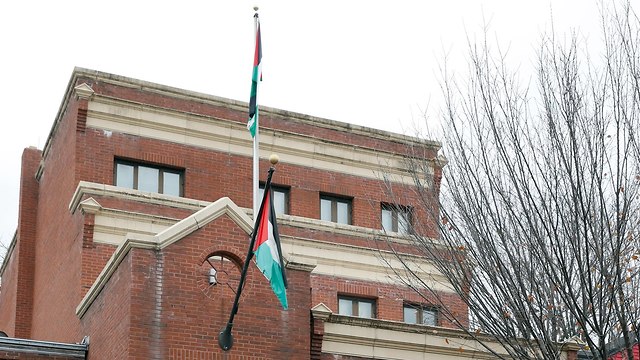
“Ambassador Zomlot’s son Said, 7, who is in second grade, and daughter Alma, 5, who is in kindergarten were pulled out of Horace Mann Elementary School in Washington DC last week and have since left the country,” the statement continued.
PLO Executive Committee Member Dr. Hanan Ashrawi said blasted the latest development.
“As if the announcement that the US would close our office in Washington DC was not enough, this vindictive action by the Trump administration is spiteful. The US has taken its attempts to pressure and blackmail the Palestinians to a new level,” she said.
“By deliberately targeting the family of Ambassador Zomlot, the US administration has gone from cruel punishment to revenge against the Palestinians and their leadership even to the point of causing hardship to their innocent children and families,” she added.
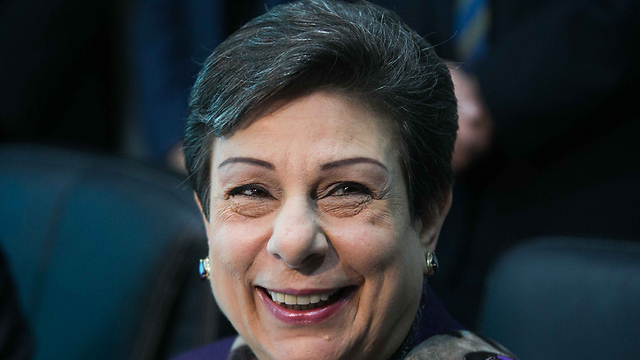
“This unconscionable move goes against all diplomatic protocol and constitutes an inhumane escalation on the part of the Trump administration to persist in their policy of pressure and extortion.
“It also comes in revenge of the Palestinian leadership’s firm and principled rejection of the Trump administration’s unilateral measures under the so-called ‘ultimate deal’ and subsequent blackmail,” Ashrawi continued.
“Instead of working for a genuine peace, the US administration is destroying the chances of peace and undermining its own credibility and standing on all levels.”
The move is believed to be part of Trump’s strategy to force the Palestinians back to the negotiating table with Israel in his bid to mediate a peace agreement, which he refers to as the “ultimate deal.”
On Friday, the New York Times reported that the Trump administration will halt funding for the last aiding source beneficial for the Palestinians.
US officials said Conflict Management and Mitigation Program would not receive further funding in addition to the aid which was already approved and is expected to end in September.
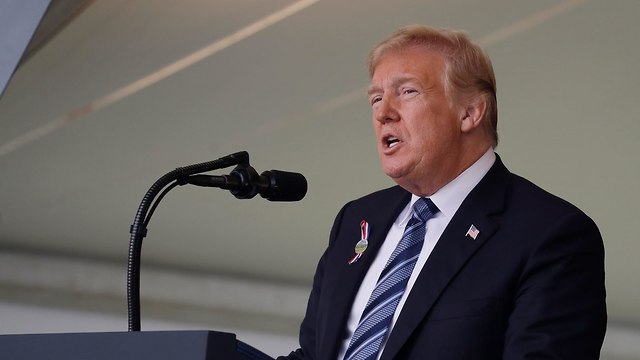
At the beginning of the month, the US announced that it was halting all funding to a UN agency that helps Palestinian refugees in a decision further heightening tensions between the Palestinian leadership and the Trump administration.
Trump also told a group of rabbis and Jewish leaders ahead of the new year festival of Rosh Hashanah that the US would not renew its transfer of funds to the Palestinians until they agreed to come to the negotiating table with Israel to end the decades-long conflict.
“What I will tell you is I stopped massive amounts of money that we were paying to the Palestinians and the Palestinian leaders,” Trump told the leaders.
Source: Report: Syria accidentally downs Russian plane following alleged IAF strike
The report was based on information provided by “a US official with knowledge of the incident”, who told the US news outlet that Assad’s forces were responding to a barrage of Israeli missiles.
Another official said that Israel was behind the strikes in Latakia. In keeping with protocol, Israel neither confirmed nor denied the report.
Russia’s defense ministry said early on Tuesday that one if its military aircraft with 14 people on board disappeared from radar screens over Syria at the same time that Israeli and French forces were mounting aerial attacks on targets in Syria.
A US official said Washington believed the aircraft, which is an Il-20 turbo-prop plane used for electronic reconnaissance, was inadvertently shot down by anti-aircraft artillery operated by Moscow’s ally, the Syrian government.
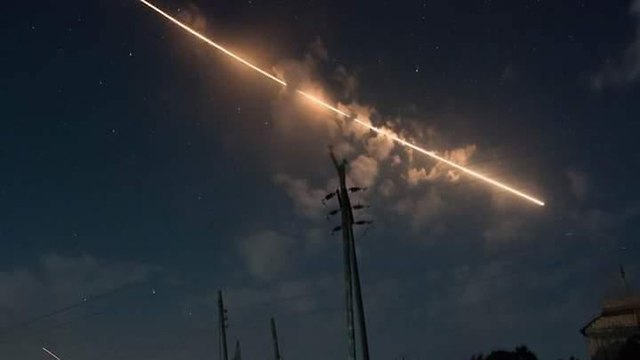
Around the time the plane disappeared, Latakia—near a Russian airbase to which the Il-20 was returning—came under attack from “enemy missiles”, and missile defence batteries responded, Syrian state media reported.
The defence ministry in Moscow said the aircraft was returning to the Russian-run Hmeymim airbase in Latakia province when, at about 11:00pm Moscow time (20:00 GMT) on Monday, it disappeared from radar screens.
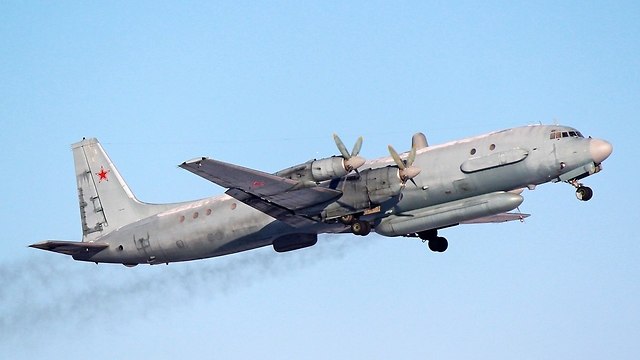
The plane was over the Mediterranean Sea about 35 km (20 miles) from the Syrian coastline, Russia’s TASS news agency quoted the ministry as saying in a statement.
“The trace of the Il-20 on flight control radars disappeared during an attack by four Israeli F-16 jets on Syrian facilities in Latakia province,” the statement was quoted as saying.
“At the same time Russian air control radar systems detected rocket launches from the French frigate Auvergne which was located in that region.”
The fate of the 14 people on board the missing plane is unknown, and a rescue operation has been organized out of the Hmeymim base, the ministry said.
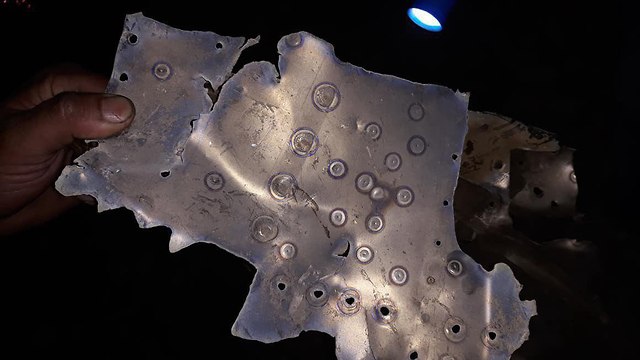
Russia’s military operation in Syria, which began in late 2015, has turned the tide of the conflict in favour of Moscow’s ally, President Assad, in his fight against rebels.
But it has come at a cost to Russia.
In December 2016, a Russian plane carrying dozens of Red Army choir singers, dancers and musicians crashed into the Black Sea on the way to Syria, killing all 92 people on board.
In March this year, a Russian military transport plane crashed when coming in to land at the Hmeymim base, killing all 39 people on board.
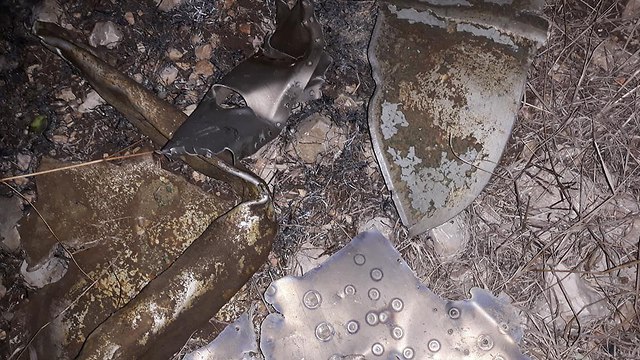
In some cases, those countries are backing opposing sides in the Syrian conflict.
Hotlines are in place for those countries to share operational information on their deployments, but diplomats and military planners say there is still a high risk of one state inadvertently striking another country’s forces.

Hours after a missile attack on Syrian and Iranian military targets in Latakia Monday night, the Russian Defense Ministry said that a military Il-20 spy plane with 14 aboard went off the radars. It was 35km off the Syrian coast when its air base air traffic control “lost contact.”
No word has come from Israel on the incident. Some Syrian and Russian sources earlier reported that unidentified missiles had struck a military industry facility which develops missiles and chemical weapons, very close to Russian assets. Other sources reported that Iranian forces had set up a base close to the Russian assets for protection against Israeli attack. DEBKAfile: If Israel was responsible for the missile attack in Latakia Monday night, this will be the closest its strikes on Iranian facilities has ever come to the Russian Khmeimim Air Base and command center in Syria.
Russian media noted in their reports that a large Israeli military delegation headed by National Security Adviser Meir Ben Shabat visited Moscow on Friday, Sept. 14. Our sources presume that Ben Shabat brought with him intelligence gathered by Israel about the contents of Iran’s Latakia facility.
The loss of the Russian plane is an unforeseen misfortune, which both Moscow and Jerusalem went to extreme lengths to prevent by setting up a de-confliction red line between their army commands two years ago. At the same time, it is also suggested that Israel may not have been responsible. American military sources estimate that it was shot down accidentally by Syrian air defense fire against incoming missiles. Syrian officials said the attack was “foreign” and came “from the sea,” and that its air defenses had intercepted the missiles, but could not initially confirm that Israel was behind it. If it was, then this would be the first combined Israeli air force-navy attack on an Iranian target in Syria.
The Russian MoD while explicitly stating the disappearance occurred during “an attack by four Israeli F-16 fighter jets” on Syria’s Latakia province” also referred to the “launch of missiles from a French frigate in the Mediterranean.” By revealing the loss of the spy plane and assigning the first missile attack of its kind to Israeli fighter jets, Moscow indicated Russian intentions regarding the episode.
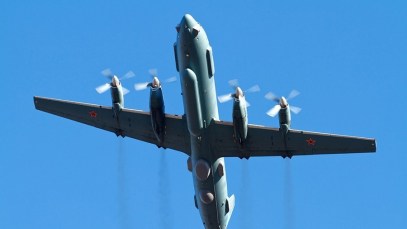
An intense search and rescue operation is underway for the vanished illyushin and the 14 Russian service personnel aboard.
Moscow was also unusually forthcoming about the equipment aboard the missing plane. “The Ilyushin 20 (IL-20) surveillance turboprop plane is an Electronic Intelligence (ELINT) platform, equipped with a wide range of antennas, infrared and optical sensors. The aircraft’s SLAR (Side-Looking Airborne Radar) and the plane’s satellite link allows the Russian military to monitor Syrian skies in real time.”
This relates to the attack mentioned in the previous post…
Woops!
Report: Syria mistakenly downs Russian plane as it repels alleged Israeli strike
Russia implies France or Israel responsible for missing aircraft; Syria claims 2 killed after Israel fires missiles from Lebanese airspace toward chemical weapons-linked facility
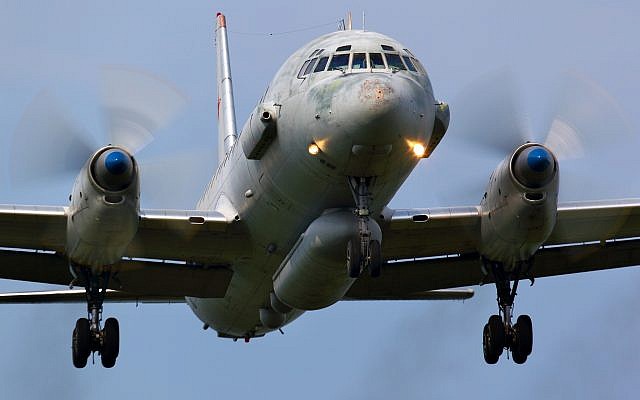
A Russian military Ilyushin IL-20 landing at Kubinka air base on June 3, 2011. (Artyom Anikeev/iStock/Getty Images)
A Russian military plane with 14 servicemen aboard was accidentally shot down by Syrian air defenses as they tried to repel an alleged Israeli strike on Monday, a US official told CNN.
The official added that the plane was downed by a Russian-made missile system which was sold to its Syrian ally. [Hahahahaha! Oh my, the irony!]
Russian state news TASS said the IL-20 disappeared over the Mediterranean on Monday evening was as it returning to Latakia province at the same time as the suspected strike by Israel, and that concurrently France was also firing rockets nearby.
“Connection has been lost with the crew of a Russian Il-20 plane over the Mediterranean Sea 35 kilometers from the Syrian coast as it was returning to the Hmeimim airbase,” the Russian defense ministry said, adding the communications were lost at the time of the suspected Israeli attack.
“At the same time Russian air control radar systems detected rocket launches from the French frigate Auvergne which was located in that region,” Russia’s TASS news agency quoted the defense ministry as saying, according to Reuters.
A rescue operation has been launched.
Israel does not regularly comment on alleged strikes in Syria.
An Israeli military spokeswoman when asked about both the reported Israeli strike and the Russian plane said: “We don’t comment on foreign reports.”
Syrian state media earlier reported that a Syrian facility linked to the country’s chemical weapons program was bombed on Monday night, triggering Syrian air defenses.
The state-run Al-Ikhbariya TV reported loud explosions in the coastal Latakia province, saying they were likely from Israeli strikes targeting a state company for technical industries.
Explosions continued for nearly a half hour, said state-run Al-Ikhbariya TV, which aired footage showing streaks of white light flashing across the sky. An unidentified military official was quoted as saying Syrian air defenses intercepted some missiles heading for the provincial capital of Latakia from the sea.
Al-Ikhbariya said 10 people were injured and two required hospitalization.
A Pentagon spokesman said the United States was not involved and declined to provide further details.
“The missiles were not fired by the US military and we have nothing further at this time,” he said.
A French army spokesman also denied any involvement.
Syrian military sources told SANA that the attack came from the direction of the sea and targeted an Organization for Technological Industries center in Latakia.
The sources also claimed the country’s air defenses shot down a number of incoming missiles. The Syrian army has regularly been accused of exaggerating its interception capabilities.
The attack caused a large explosion and knocked out power to the surrounding area, according to local media.
The Organization for Technological Industries is a subsidiary of the Syrian Ministry of Defense and has been tied to the developments of both missiles and chemical weapons.
The Britain-based Syrian Observatory for Human Rights reported the explosions, saying the target appeared to be an ammunition depot, part of the compound of the organization. The war monitoring group said it was not clear if the depot was for Iranian or Syrian forces.
The strikes followed a similar attack on Damascus International Airport late Saturday, which Syrian state media also blamed on Israel. A military official quoted then on state media said Syrian air defenses intercepted some missiles coming from the sea.
Other attacks were reported on September 4 that targeted sites in the coastal Tartus area and in Hama province. The Observatory said at the time that the attacks were believed aimed at Iranian military posts.
Israel is alleged to have been behind a series of airstrikes mainly targeting Iranian and Hezbollah forces in Syria that have joined the country’s war fighting alongside the government. Israel rarely acknowledges attacks inside Syria, but has said it will use military action to prevent weapons transfers to its enemies.
Earlier this month, an Israeli military official said the Jewish state has struck over 200 Iranian targets in Syria over the past 18 months.




 anneinpt
 artaxes
 danmillerinpanama
 davidking1530
 Peter Hofman
 Joseph Wouk
 Peter
Peter Louisiana Steve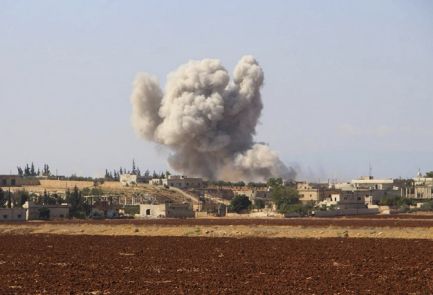



 WarSclerotic
Recent Comments