Archive for July 2018

Iran looking for ways to export oil despite US sanctions 

July 1, 2018

Source: Iran looking for ways to export oil despite US sanctions | The Times of Israel

Tehran sets up committee to seek potential buyers, as Trump calls on Riyadh to boost production to offset lost Iranian exports, stem price hikes
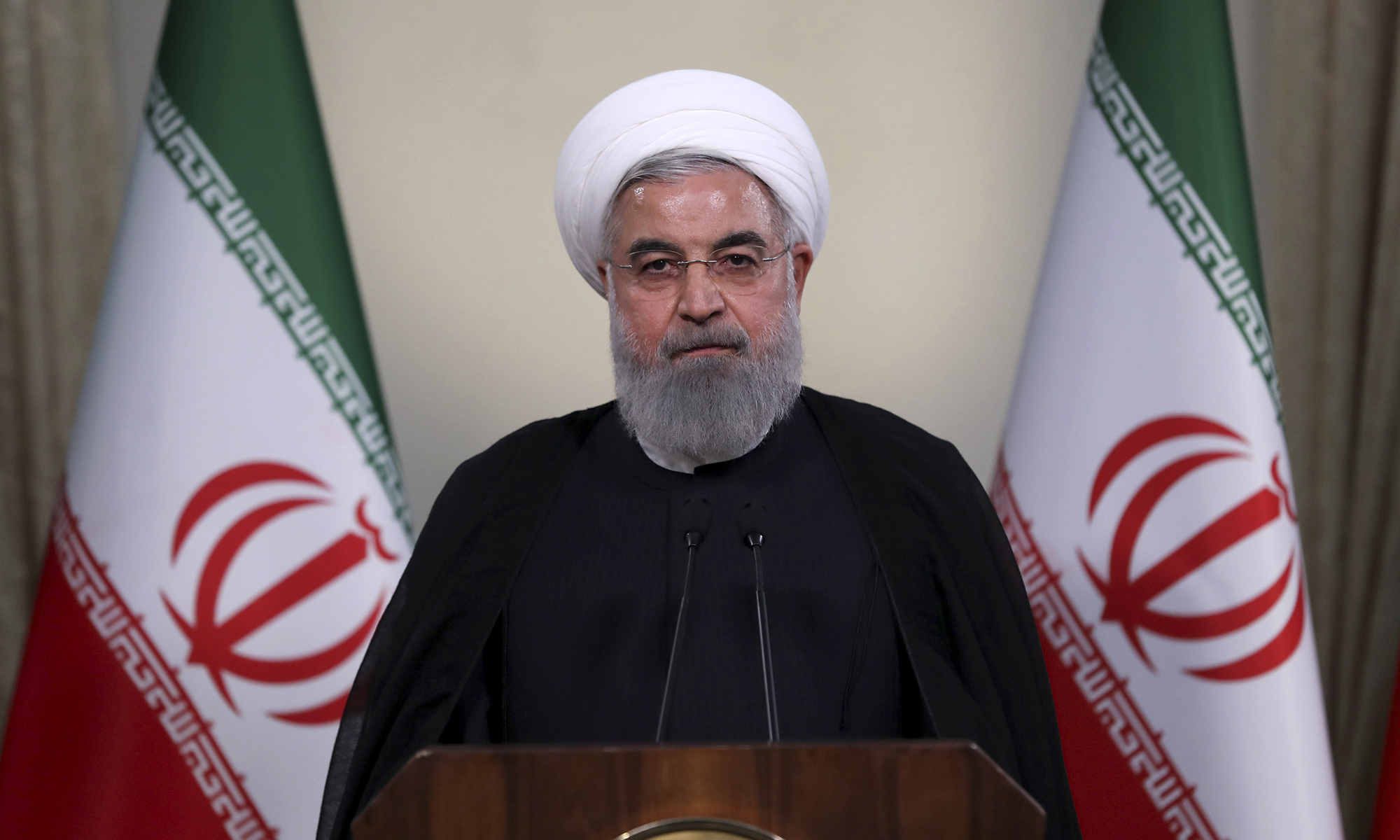
Iranian Presidency, President Hassan Rouhani addresses the nation in a televised speech in Tehran, Iran, May 8, 2018. (Iranian Presidency Office via AP)

Iranian Presidency, President Hassan Rouhani addresses the nation in a televised speech in Tehran, Iran, May 8, 2018. (Iranian Presidency Office via AP)

Iranian leaders held a meeting on Saturday to examine countermeasures to US economic sanctions, including ways to keep exporting oil, according to a report in the Iranian news agency IRNA.

In the meeting between Iranian President Hassan Rouhani and the heads of parliament and the judiciary, “various scenarios of threats to the Iranian economy by the US government were examined and appropriate measures were taken to prepare for any probable US sanctions, and to prevent their negative impact,” Reuters quoted IRNA as reporting.

Among the issues discussed were “suggestions to achieve self-sufficiency… in producing petroleum, and to prevent the vulnerability in the field of energy carriers,” the news agency wrote on its English-language site.

The Iranian government also set up a committee to look for potential oil buyers after US sanctions come into effect.

“Due to the possibility of US sanctions against Iran, the committee will study the competence of buyers and how to obtain proceeds from the sale of oil, safe sale alternatives which are consistent with international law and do not lead to corruption and profiteering,” Fereydoun Hassanvand, head of the parliament’s energy committee, was quoted as saying by IRNA, Reuters reported.
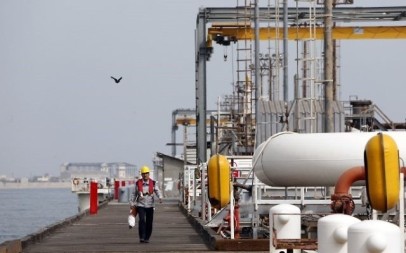
This photo taken on March 12, 2017, shows an Iranian laborer walking the platform of the oil facility in the Khark Island, on the shore of the Gulf. (AFP PHOTO / ATTA KENAR)

Iran has faced mounting economic woes since US President Donald Trump announced in May that Washington was withdrawing from the 2015 nuclear deal with world powers, negotiated under his predecessor president Barack Obama. The accord imposed controls on Tehran’s nuclear program, in exchange for a lifting of sanctions.

The country has also witnessed growing protests in recent months. On Saturday, Iran’s Supreme Leader Ayatollah Ali Khamenei accused the US of being behind the unrest.

In a series of tweets, Khamenei said the US formed a coalition with other “disgraceful states” in the region as it is unable to defeat Iran on its own. The Iranian leader didn’t name any specific nations in this so-called coalition, but alleged it was imposing economic pressure on Iran to “separate the nation from the system.”

View image on Twitter

Khamenei.ir@khamenei_ir

will definitely be freed.

“If the US was able to overpower the Islamic system, it would not have needed to form a coalition with notorious countries of the region to create chaos, unrest, and insecurity in Iran,” he said.

“Six previous US presidents made efforts against Iran but failed at their vicious goals,” the Iranian leader tweeted. “Today, after losing hope in other methods, the enemy’s plot is to create a rift between establishment and nation; that’s foolish: they don’t understand that establishment entirely represents nation.”

Over the past six months, Iran’s currency has lost almost 50 percent of its value, with the US dollar now buying around 85,000 rials on the open market.

Iranians have been hit by rising prices, and record levels of unemployment have left a third of under-30s out of work.

Slogans chanted by crowds of Iranians in the recent economic protests, which have leaked out to the world via social media, show that many blame their own government’s foreign policies for the downturn.
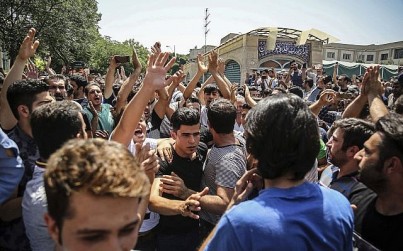
A group of protesters chant slogans at the main gate of old Grand Bazaar in Tehran, Iran, June 25, 2018. (Iranian Labor News Agency via AP)

The protests have seen unusual scenes of demonstrators chanting against continued Iranian spending of billions of dollars on regional proxy wars and support for terrorist groups, which many say has meant less investment in the struggling economy at home.

In recent years, Iran has provided financial aid to Palestinian terror groups Hamas and Islamic Jihad, Lebanon’s Hezbollah, Yemen’s Houthi rebels, and Shiite militias in Iraq. Since the start of the Syrian civil war in 2011, Tehran has poured a reported $6 billion into propping up President Bashar Assad’s government.

Earlier this week, Iranian President Hassan Rouhani sought to calm the growing discontent by assuring Iranians they would be able to withstand the new US sanctions. He blamed the spontaneous demonstrations that erupted across the country earlier that week on “foreign media propaganda,” and accused the US of waging “an economic war” against Tehran.

At the end of last year, similar economic protests roiled Iran and spread to some 75 cities and towns, becoming the largest demonstrations in the country since its 2009 disputed presidential election. The protests in late December and early January saw at least 25 people killed and nearly 5,000 arrested.

Saudi allies

Also on Saturday, Trump said he had received assurances from King Salman of Saudi Arabia that the kingdom will increase oil production, “maybe up to 2,000,000 barrels” in response to turmoil in Iran and Venezuela. Saudi Arabia acknowledged the call took place, but mentioned no production targets.

Trump wrote on Twitter that he had asked the king in a phone call to increase oil production “to make up the difference…Prices to (sic) high! He has agreed!”

Oil prices have edged higher as the Trump administration has pushed allies to end all purchases of oil from Iran, following the US pulling out of the nuclear deal between Tehran and world powers. Oil prices also have risen with the ongoing unrest in Venezuela, as well as with fighting in Libya over control of that country’s oil infrastructure.

In this June 29, 2018 photo, President Donald Trump gestures while speaking, during an event in the East Room of the White House in Washington. (AP/Jacquelyn Martin, File)

Saudi Arabia currently produces some 10 million barrels of crude oil a day. Its record is 10.72 million barrels a day. Trump’s tweet offered no timeframe for the additional 2 million barrels — whether that meant per day or per month.

However, Saudi Aramco CEO Amin Nasser told journalists in India on Monday that the state oil company has spare capacity of 2 million barrels of oil a day. That was after Saudi Energy Minister Khalid al-Falih said the kingdom would honor the OPEC decision to stick to a 1-million-barrel increase.

“Saudi Arabia obviously can deliver as much as the market would need, but we’re going to be respectful of the 1-million-barrel cap — and at the same time be respectful of allocating some of that to countries that deliver it,” al-Falih said then.

The Trump administration has been counting on Saudi Arabia and other OPEC members to supply enough oil to offset the lost Iranian exports and prevent oil prices from rising sharply.

The administration has threatened close allies such as South Korea with sanctions if they don’t cut off Iranian imports by early November. South Korea accounted for 14 percent of Iran’s oil exports last year, according to the US Energy Department.

China is the largest importer of Iranian oil at 24 percent, followed by India at 18 percent. Turkey stood at 9 percent and Italy at 7 percent.

The State Department has said it expects the “vast majority” of countries will comply with the US request.
Trump claims Saudi king promised to up oil production to offset Iran 

July 1, 2018

Source: Trump claims Saudi king promised to up oil production to offset Iran | The Times of Israel

Riyadh does not confirm that it will boost numbers by 2 million barrels after Trump tweet, seen as effort to maintain pressure on Tehran while keeping prices low

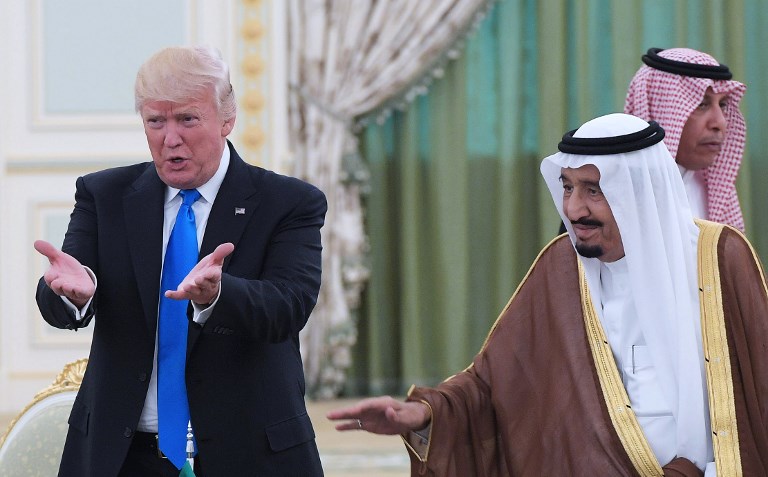
US President Donald Trump, left and Saudi Arabia's King Salman bin Abdulaziz al-Saud gesture during a signing ceremony at the Saudi Royal Court in Riyadh on May 20, 2017. (AFP Photo/Mandel Ngan)

US President Donald Trump, left and Saudi Arabia’s King Salman bin Abdulaziz al-Saud gesture during a signing ceremony at the Saudi Royal Court in Riyadh on May 20, 2017. (AFP Photo/Mandel Ngan)

BERKELEY HEIGHTS, N.J. — President Donald Trump said Saturday that he had received assurances from King Salman of Saudi Arabia that the kingdom will increase oil production, “maybe up to 2,000,000 barrels” in response to turmoil in Iran and Venezuela. Saudi Arabia acknowledged the call took place, but mentioned no production targets.

Trump wrote on Twitter that he had asked the king in a phone call to boost oil production “to make up the difference…Prices to (sic) high! He has agreed!”

A little over an hour later, the state-run Saudi Press Agency reported on the call, but offered few details.

“During the call, the two leaders stressed the need to make efforts to maintain the stability of oil markets and the growth of the global economy,” the statement said.

Donald J. Trump

@realDonaldTrump

Just spoke to King Salman of Saudi Arabia and explained to him that, because of the turmoil & disfunction in Iran and Venezuela, I am asking that Saudi Arabia increase oil production, maybe up to 2,000,000 barrels, to make up the difference…Prices to high! He has agreed!

It added that there also was an understanding that oil-producing countries would need “to compensate for any potential shortage of supplies.” It did not elaborate.

Oil prices have edged higher as the Trump administration has pushed allies to end all purchases of oil from Iran following the US pulling out of the nuclear deal between Tehran and world powers. Prices also have risen with ongoing unrest in Venezuela and fighting in Libya over control of that country’s oil infrastructure.

Last week, members of the Organization of the Petroleum Exporting Countries cartel led by Saudi Arabia and non-cartel members agreed to pump 1 million barrels more crude oil per day, a move that should help contain the recent rise in global energy prices. However, summer months in the US usually lead to increased demand for oil, pushing up the price of gasoline in a midterm election year. A gallon of regular gasoline sold on average in the US for $2.85, up from $2.23 a gallon last year, according to AAA.

If Trump’s comments are accurate, oil analyst Phil Flynn said it could immediately knock $2 or $3 off a barrel of oil. But he said it’s unlikely that decrease could sustain itself as demand spikes, leading prices to rise by wintertime.

“We’ll need more oil down the road and there’ll be nowhere to get it,” said Flynn, of the Price Futures Group. “This leaves the world in kind of a vulnerable state.”

Other analysts were more doubtful about immediate effects.

Trump appears to be trying to “talk the market down,” said Lawrence Goldstein, who directs the Energy Policy Research Foundation. He questioned whether Trump’s words would do anything to reverse the effects on the market of declining Iranian oil production. He also noted it always takes at least two months before a change in shipping commitments affects the market.

Trump’s aim may be to exert maximum pressure on Iran while at the same time not upsetting potential US midterm voters with higher gas prices, said Antoine Halff, a Columbia University researcher and former chief oil analyst for the International Energy Agency.

“The Trump support base is probably the part of the US electorate that will be the most sensitive to an increase in US gasoline prices,” Halff said.

Trump’s comments came Saturday as global financial markets were closed. Brent crude stood at $79.42 a barrel, while US benchmark crude was at $74.15.

Saudi Arabia currently produces some 10 million barrels of crude oil a day. Its record is 10.72 million barrels a day. Trump’s tweet offered no timeframe for the additional 2 million barrels — whether that meant per day or per month.

However, Saudi Aramco CEO Amin Nasser told journalists in India on Monday that the state oil company has spare capacity of 2 million barrels of oil a day. That was after Saudi Energy Minister Khalid al-Falih said the kingdom would honor the OPEC decision to stick to a 1-million-barrel increase.

“Saudi Arabia obviously can deliver as much as the market would need, but we’re going to be respectful of the 1-million-barrel cap — and at the same time be respectful of allocating some of that to countries that deliver it,” al-Falih said then.

The Trump administration has been counting on Saudi Arabia and other OPEC members to supply enough oil to offset the lost Iranian exports and prevent oil prices from rising sharply. But broadcasting its requests on Twitter with a number that stretches credibility opens a new chapter in US-Saudi relations, Halff said.

“Saudis are used to US requests for oil,” Halff said. “They’re not used to this kind of public messaging. I think the difficulty for them is to distinguish what is a real ask from what is public posturing.”

The administration has threatened close allies such as South Korea with sanctions if they don’t cut off Iranian imports by early November. South Korea accounted for 14 percent of Iran’s oil exports last year, according to the US Energy Department.

China is the largest importer of Iranian oil with 24 percent, followed by India with 18 percent. Turkey stood at 9 percent and Italy at 7 percent.

The State Department has said it expects the “vast majority” of countries will comply with the US request.
Several reported killed as Iranian forces open fire on protesters 

July 1, 2018

Source: Several reported killed as Iranian forces open fire on protesters | The Times of Israel

Gunshots heard on videos shared on social media of demonstrators in Khorramshahr, where residents have complained of a lack of water

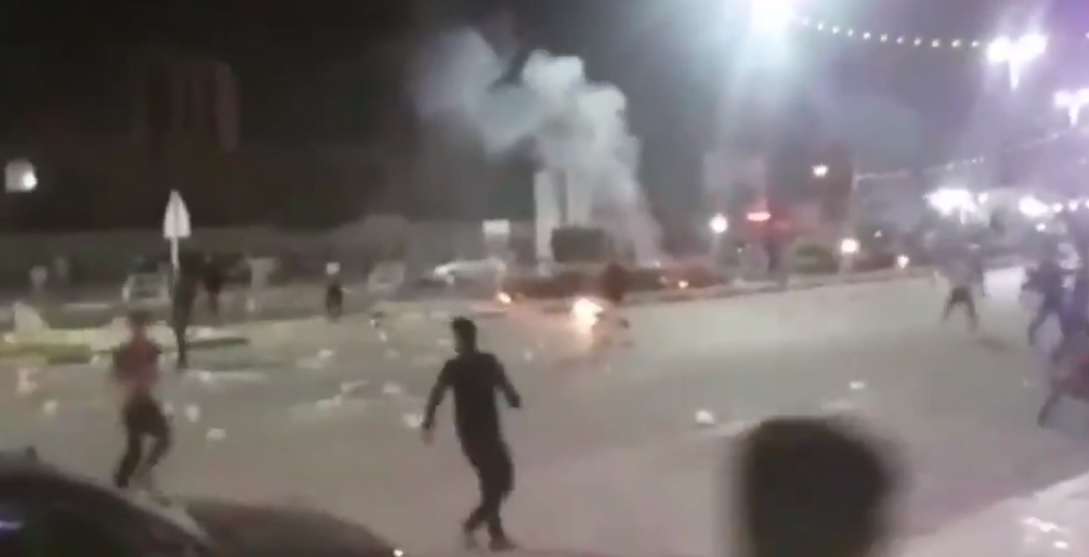
A still from video shared on social media showing protests in the Iranian city of Khorramshahr on June 30, 2018. (screen capture: Twitter/BBC)

At least four protesters were reported killed in Iran as regime forces opened fire on demonstrators rallying against a water shortage in the city of Khorramshahr.

Vidoes shared on social media late Saturday night appeared to show Iranian forces opening fire on protesters in the Arab-majority city, in the oil-rich southwestern Khuzestan region.

The reporters shooting comes after several days of unrest centered in Tehran where thousands have protested the country’s economic woes, including the collapse of the Iranian rial following the US withdrawal from the nuclear deal.

The Saudi-based al Arabiya news outlet reported four people had been killed in Khorramshahr Saturday.

There was no confirmation of the death toll.

The BBC’s Persian service reported one person had been killed, citing eyewitnesses.

Video circulated by the news outlet appeared to show automatic gunfire as people protested in the streets. Fire could also be seen as well as people fleeing after tear gas was fired.

The state-run IRNA news outlet reported that protesters were ordered to disperse after throwing stones and setting fires in Khorramshahr.

Protests in Khorramshahr and other surrounding towns have continued for several days over what residents say is a lack of clean drinking water.

Protesters have blamed mismanagement for exacerbating a drought in the area, leaving little desalinated water for drinking or agriculture.

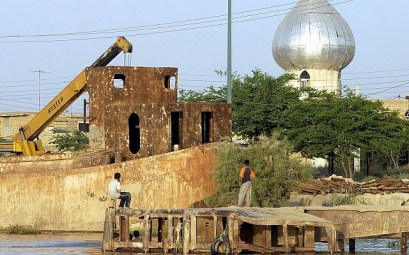
Two Iranian children look a the remains of a ship that was damaged during the Iran-Iraq war on the Karun river in the southern Iranian port city of Khorramshahr, on May 28, 2005. (AP/Hasan Sarbakhshian)

Protesters in Khoramshahr and nearby Abadan have reportedly begun chanting against the regime in the protests, including “death to Khamenei” joining demonstrators in Tehran and other towns angry over the country’s sinking financial fortunes.

Iranians have been hit by rising prices, and record levels of unemployment have left a third of under-30s out of work.

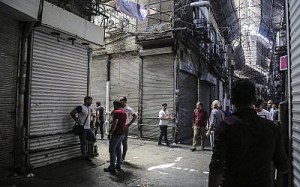
On Monday, traders at Tehran’s Grand Bazaar staged a rare strike.

People stand in the old grand bazaar where shops are closed after a protest, in Tehran, Iran, Monday, June 25, 2018. (Iranian Labor News Agency via AP)

At the end of last year, similar economic protests roiled Iran and spread to some 75 cities and towns, becoming the largest demonstrations in the country since its 2009 disputed presidential election. The protests in late December and early January saw at least 25 people killed and nearly 5,000 arrested.

Slogans chanted by the crowds in the recent economic protests, which have leaked out to the world via social media, show that many Iranians blame their own government’s foreign policies for the downturn.

The protests have seen unusual scenes of demonstrators chanting against continued Iranian spending of billions of dollars on regional proxy wars and support for terrorist groups, which many say has meant less investment in the struggling economy at home.

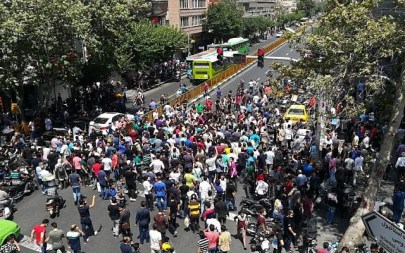
Iranian protesters in central Tehran on June 25, 2018. (AFP Photo/Atta Kenare)

In recent years, Iran has provided financial aid to Palestinian terror groups Hamas and Islamic Jihad, Lebanon’s Hezbollah, Yemen’s Houthi rebels, and Shiite militias in Iraq. Since the start of the Syrian civil war in 2011, Tehran has poured a reported $6 billion into propping up president Bashar Assad’s government.

This week’s protests in Tehran and around the country — including economically hard-hit cities like Kermanshah in western Iran — included shouts of “Death to Palestine,” “No to Gaza, no to Lebanon,” and “Leave Syria and think of us.” Chants of “We don’t want the ayatollahs” and “Death to the dictator” were also heard at some rallies.

Iranian shops closed at the ancient Grand Bazaar in Tehran on June 25, 2018. (AFP Photo/Atta Kenare)

The protests signaled growing domestic unease in the wake of Trump’s decision to withdraw America from Iran’s nuclear deal with world powers and restore sanctions on the country.

In the last six months, Iran’s currency has lost almost 50 percent of its value, with the US dollar now buying around 85,000 rials on the open market.

US believes North Korea planning to trick West, hide nukes — report

July 1, 2018

Source: US believes North Korea planning to trick West, hide nukes — report | The Times of Israel

Intelligence officials tell Washington Post that evidence points to plans by Pyongyang to keep secret sites hidden, lie about size of arsenal

In this undated file photo distributed on September 16, 2017 by the North Korean government, North Korean leader Kim Jong Un, right, celebrates what was said to be the test launch of an intermediate range Hwasong-12 missile at an undisclosed location in North Korea.  (Korean Central News Agency/Korea News Service via AP)

In this undated file photo distributed on September 16, 2017 by the North Korean government, North Korean leader Kim Jong Un, right, celebrates what was said to be the test launch of an intermediate range Hwasong-12 missile at an undisclosed location in North Korea. (Korean Central News Agency/Korea News Service via AP)

US officials believe North Korea has no intention of giving up its nuclear stockpile and will conceal at least some weapons despite agreeing to denuclearize last month, according to a reports over the weekend.

US intelligence has collected evidence pointing to plans by Pyongyang to deceive the West into thinking it has dismantled its nuclear program and push for sanctions relief, the Washington Post reported late Saturday.

Officials say North Korea plans to keep the US in the dark about how many warheads it has, how much fissile material is in its possession and where all of its nuclear facilities are located.

On Friday, NBC News reported that US intelligence officials believed the North had ramped up enrichment and was planning on keeping secret nuclear facilities hidden and operational.

The reports come on the heels of satellite images showing that North Korea is carrying out rapid improvements to its nuclear research facility.

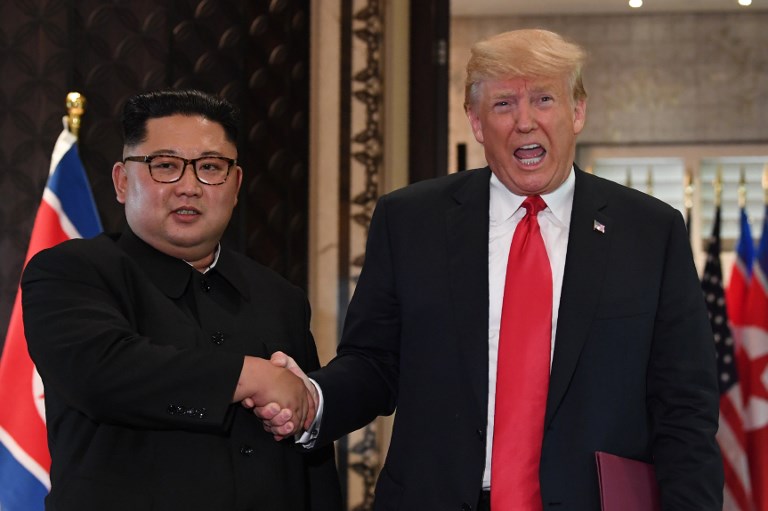
The nuclear-armed North’s leader Kim Jong Un promised to “work toward” nuclearization at a landmark summit in Singapore in June with US President Donald Trump.

But the Singapore meeting failed to clearly define denuclearization or produce a specific timeline towards dismantling the North’s atomic weapons arsenal.

US President Donald Trump (R) and North Korea’s leader Kim Jong Un shake hands following a signing ceremony during their historic US-North Korea summit, at the Capella Hotel on Sentosa island in Singapore on June 12, 2018. (AFP PHOTO / SAUL LOEB)

Intelligence official have expressed skepticism over whether Pyongyang is being sincere in its commitment, with a Defense Intelligence Assessment after the summit concluding that North Korea was unlikely to actually denuclearize, according to the Washington Post report.

The intelligence findings stand in contrast to optimism expressed by Trump during and since the summit.

Trump has claimed the process of dismantling the nuclear program would start quickly, saying late last month that “it will be a total denuclearization, which is already taking place.”

Immediately following the summit, he declared the nuclear threat over.

Donald J. Trump

@realDonaldTrump

Just landed – a long trip, but everybody can now feel much safer than the day I took office. There is no longer a Nuclear Threat from North Korea. Meeting with Kim Jong Un was an interesting and very positive experience. North Korea has great potential for the future!

US Secretary of State Mike Pompeo has been pushing for more follow-up talks to flesh out details over denuclearization, but no date has been set for when they would take place.

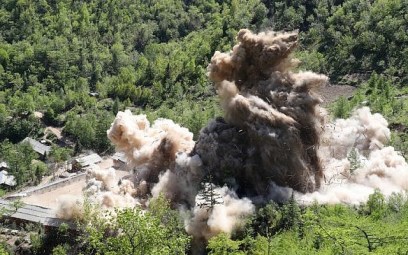
In May, the North blew up its aged but only nuclear test site at Punggye-ri — where it had staged six atomic tests — in a show of goodwill before the summit.

A photo taken on May 24, 2018 shows a general view of a dust cloud surrounding the area near the entrance to a tunnel at North Korea’s Punggye-ri nuclear test facility, during a demolition ‘ceremony’. (AFP/ Dong-A Iibo / News1)

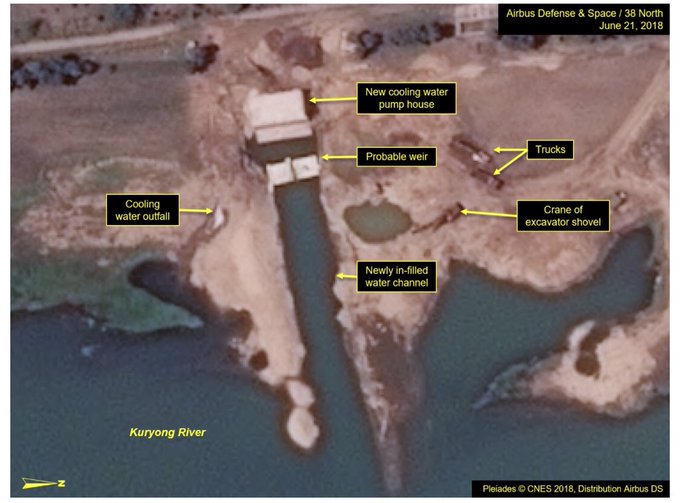
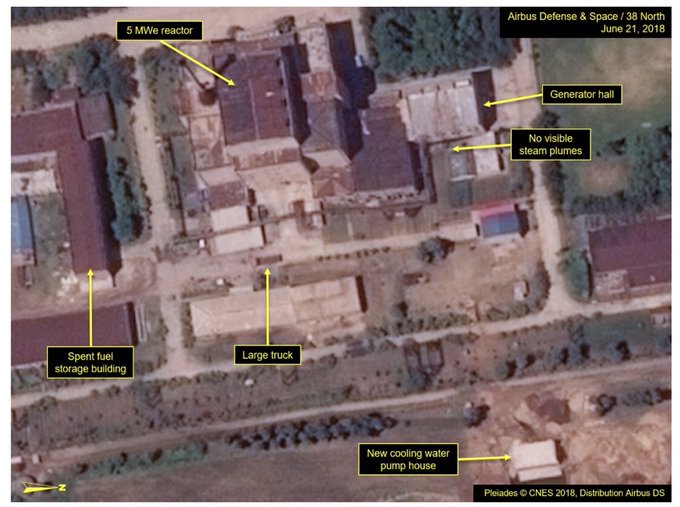
But the respected 38 North monitoring group said last week that not only were operations continuing at the North’s main Yongbyon nuclear site, it was also carrying out infrastructure works, citing recent satellite imagery.

“Commercial satellite imagery from June 21 indicates that improvements to the infrastructure at… Yongbyon Nuclear Scientific Research Center are continuing at a rapid pace,” it said.

View image on TwitterView image on TwitterView image on TwitterView image on Twitter

Will Ripley

@willripleyCNN

It noted “continued operations” at the North’s uranium enrichment plant and several new installations at the site — including an engineering office and a driveway to a building housing a nuclear reactor.

But continued operations at the site “should not be seen as having any relationship with North Korea’s pledge to denuclearize,” it added.

Nuclear officials could be “expected to proceed with business as usual until specific orders are issued from Pyongyang,” it said.

Trump lawyer Giuliani says the end is near for Iran’s rulers 

July 1, 2018

Source: Trump lawyer Giuliani says the end is near for Iran’s rulers – Middle East – Jerusalem Post

“We are the strongest economy in the world … and if we cut you off then you collapse.”

BY REUTERS
 JULY 1, 2018 03:32
Trump lawyer Giuliani says the end is near for Iran's rulers

Rudy Giuliani, former Mayor of New York City, delivers his speech as he attends the National Council of Resistance of Iran (NCRI), meeting in Villepinte, near Paris, France, June 30, 2018. (photo credit: REUTERS/REGIS DUVIGNAU)

VILLEPINTE, France – US President Donald Trump will suffocate Iran’s “dictatorial ayatollahs,” his close ally Rudy Giuliani said on Saturday, suggesting his move to re-impose sanctions was aimed squarely at regime change.

The former New York mayor who is now Trump’s personal lawyer, was addressing a conference of the Paris-based National Council of Resistance of Iran (NCRI), an umbrella bloc of opposition groups in exile that seek an end to Shi’ite Muslim clerical rule in Iran.

“I can’t speak for the president, but it sure sounds like he doesn’t think there is much of a chance of a change in behavior unless there is a change in people and philosophy,” Giuliani told Reuters in an interview.

“We are the strongest economy in the world … and if we cut you off then you collapse,” he said, pointing to protests in Iran. In May, Trump withdrew the United States from a 2015 international deal to curb Tehran’s nuclear program in exchange for lifting some sanctions.

Trump supporters have spoken at NCRI events in the past, including national security adviser John Bolton, who, before taking his post at the same conference last July, told the group’s members they would be ruling Iran before 2019 and their goal should be regime change.

Bolton said in May that the administration’s policy was to make sure Iran never got nuclear weapons and not regime change.

In Tehran, supreme leader Ayatollah Ali Khamenei said Trump would fail in any attempt to turn the Iranian peopleagainst the ruling system.

“They bring to bear economic pressure to separate the nation from the system … but six US presidents before him (Trump) tried this and had to give up,” Khamenei said on his website.

The fear of sanctions, which Giuliani said would be increased, has already seen major companies leave Iran despite Europe vowing to save the accord. Britain, France and Germany, which signed the Iran deal along with the United States, Russia and China say the agreement prevents Iran developing weapons-grade nuclear fuel.

But Giuliani said Europe should be “ashamed” of itself.

“Anybody who thinks the Ayatollahs are honest people is a fool. They are crooks and that’s what Europe is propping up … murderers and sponsors of terrorism. Instead of taking an opportunity to topple them they are now left propping them up,” Giuliani said.

The NCRI members joined the 1979 Islamic revolution but later broke from the ruling clerics. Based in Iraq in the early 1980s, their fighters clashed with U.S. forces during the 2003 Iraq war, but have since renounced violence.

“Regime change in Iran is within reach as never before … The wheels of change have started turning,” Maryam Rajavi, who heads the group, told reporters at the conference.

NCRI, also known by its Farsi name Mujahideen-e-Khalq, was once listed as a terrorist organization by the United States and the European Union but is no longer.Tehran has long called for a crackdown on the NCRI in Paris, Riyadh, and Washington. The group is regularly criticized in state media.