Archive for July 2018

Several DEAD as Iran opens fire on protesters for freedom

July 2, 2018

By – on

https://gellerreport.com/2018/07/several-dead-iran-opens-fire-protesters-freedom.html/

Will the notoriously leftwing mainstream media ignore this slaughter again, as they did in service to Obama?

In 2009, the only true freedom revolution in the Middle East was crushed by the murdering mullahs, sanctioned and supported by President Obama. The Iranian people rose up and were systematically massacred, with a wink and a nod from then-President Obama. It was an abomination made possible by an Obama-worshiping media that worked feverishly to polish and scrub his notorious deeds.

There were only a handful of us who covered this historic movement. Obama, on the other hand, rewarded propagandists for the murdering regime with a coveted spot in the White House press corps. That’s why the muckraking, smear machine, the Huffington Post, was the first blog to get White House credentials.

Neda Soltan, icon of the 2009 freedom revolution in Iran. She was shot down in cold blood on the street  as she stood with freedom marchers in 2009.

Several reported killed as Iranian forces open fire on protesters

Gunshots heard on videos shared on social media of demonstrators in Khorramshahr, where residents have complained of a lack of water

By TOI staff and Agencies Today, 1:42 am 9 q12Z
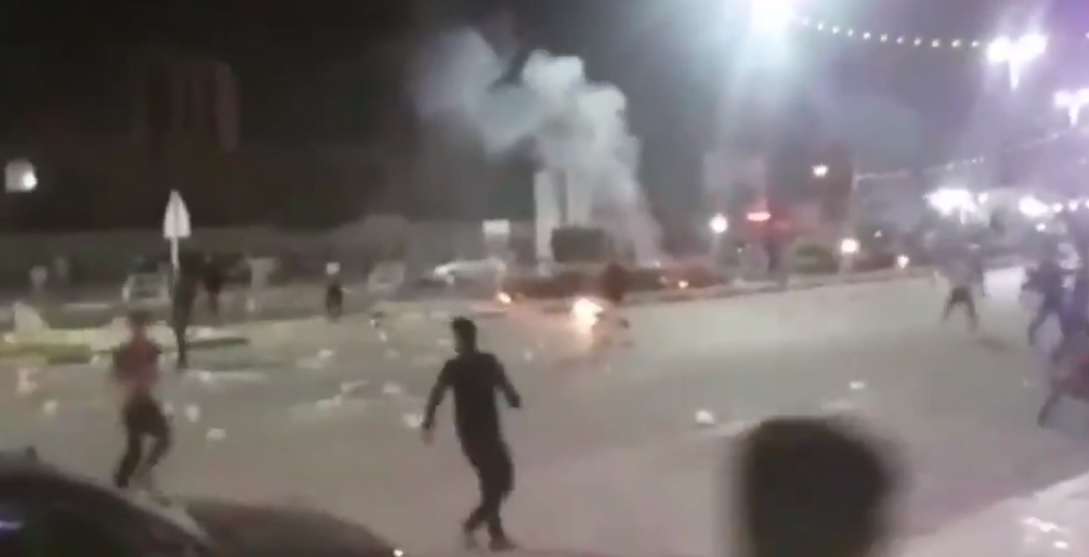
A still from video shared on social media showing protests in the Iranian city of Khorramshahr on June 30, 2018. (screen capture: Twitter/BBC)

A still from video shared on social media showing protests in the Iranian city of Khorramshahr on June 30, 2018. (screen capture: Twitter/BBC)

At least four protesters were reported killed in Iran as regime forces opened fire on demonstrators rallying against a water shortage in the city of Khorramshahr.

Vidoes shared on social media late Saturday night appeared to show Iranian forces opening fire on protesters in the Arab-majority city, in the oil-rich southwestern Khuzestan region.

The reporters shooting comes after several days of unrest centered in Tehran where thousands have protested the country’s economic woes, including the collapse of the Iranian rial following the US withdrawal from the nuclear deal.

The Saudi-based al Arabiya news outlet reported four people had been killed in Khorramshahr Saturday.

There was no confirmation of the death toll.

The BBC’s Persian service reported one person had been killed, citing eyewitnesses.

Video circulated by the news outlet appeared to show automatic gunfire as people protested in the streets. Fire could also be seen as well as people fleeing after tear gas was fired.

The state-run IRNA news outlet reported that protesters were ordered to disperse after throwing stones and setting fires in Khorramshahr.

Protests in Khorramshahr and other surrounding towns have continued for several days over what residents say is a lack of clean drinking water.

Protesters have blamed mismanagement for exacerbating a drought in the area, leaving little desalinated water for drinking or agriculture.

Protesters in Khoramshahr and nearby Abadan have reportedly begun chanting against the regime in the protests, including “death to Khamenei” joining demonstrators in Tehran and other towns angry over the country’s sinking financial fortunes.

Iranians have been hit by rising prices, and record levels of unemployment have left a third of under-30s out of work.

On Monday, traders at Tehran’s Grand Bazaar staged a rare strike.

People stand in the old grand bazaar where shops are closed after a protest, in Tehran, Iran, Monday, June 25, 2018.

At the end of last year, similar economic protests roiled Iran and spread to some 75 cities and towns, becoming the largest demonstrations in the country since its 2009 disputed presidential election. The protests in late December and early January saw at least 25 people killed and nearly 5,000 arrested.

Slogans chanted by the crowds in the recent economic protests, which have leaked out to the world via social media, show that many Iranians blame their own government’s foreign policies for the downturn.

The protests have seen unusual scenes of demonstrators chanting against continued Iranian spending of billions of dollars on regional proxy wars and support for terrorist groups, which many say has meant less investment in the struggling economy at home.

In recent years, Iran has provided financial aid to Palestinian terror groups Hamas and Islamic Jihad, Lebanon’s Hezbollah, Yemen’s Houthi rebels, and Shiite militias in Iraq. Since the start of the Syrian civil war in 2011, Tehran has poured a reported $6 billion into propping up president Bashar Assad’s government.

This week’s protests in Tehran and around the country — including economically hard-hit cities like Kermanshah in western Iran — included shouts of “Death to Palestine,” “No to Gaza, no to Lebanon,” and “Leave Syria and think of us.” Chants of “We don’t want the ayatollahs” and “Death to the dictator” were also heard at some rallies.

The protests signaled growing domestic unease in the wake of Trump’s decision to withdraw America from Iran’s nuclear deal with world powers and restore sanctions on the country.

In the last six months, Iran’s currency has lost almost 50 percent of its value, with the US dollar now buying around 85,000 rials on the open market.
Iran Diplomat Among Four Arrested Over Suspected Plot Against Iranian Opposition Meeting

July 2, 2018

Maryam Rajavi, head of the National Council of Resistance of Iran / Twitt

BY:

Iran Diplomat Among Four Arrested Over Suspected Plot Against Iranian Opposition Meeting

BRUSSELS (Reuters) – An Iranian diplomat has been arrested along with two people suspected of plotting a bomb attack on a meeting of an exiled Iranian opposition group in France, Belgian authorities said on Monday.

U.S President Donald Trump’s lawyer Rudy Giuliani and several former European and Arab ministers were among those attending the meeting of the Paris-based National Council of Resistance of Iran (NCRI).

The two suspects in Belgium were intercepted by Belgian police on Saturday, with 500 grams of TATP, a home-made explosive produced of easily available chemicals, as well as a detonation device found in their car, a joint statement by the Belgian prosecutor and the intelligence services said.

The 38-year-old man and a 33-year-old woman, identified only as Amir S. and Nasimeh N., were charged with attempted terrorist murder and preparation of a terrorist act, it said.

Two arrests linked to the Belgian case were made in France and Germany. The person arrested in Germany was a diplomat at the Iranian embassy in the Austrian capital Vienna, the Belgian statement said.

Staff at the embassy said the ambassador was not immediately available for comment. Iranian President Hassan Rouhani is due to visit Austria on Wednesday.

The Belgian statement gave no further details about the diplomat, other than saying they were suspected of having been in contact with the Belgian pair arrested. It gave no details about the fourth suspect, arrested in France.

NCRI is an umbrella bloc of opposition groups in exile that seek an end to Shi’ite Muslim clerical rule in Iran.

Its meeting, which attracted a crowd of thousands, took place on Saturday in Villepinte, just outside of Paris, a three-hour drive from Brussels.

“A plot by the religious dictatorship ruling Iran to carry out a terrorist attack against the grand gathering of the Iranian Resistance in Villepinte was foiled,” Shahin Gobadi spokesman for NCRI said in a statement.

NCRI, also known by its Farsi name Mujahideen-e-Khalq, was once listed as a terrorist organization by the United States and the European Union but is no longer.

Tehran has long called for a crackdown on the NCRI in Paris, Riyadh, and Washington. The group is regularly criticized in state media.

Following the arrests, Belgian authorities also conducted five raids in different parts of the country but did not elaborate on whether anything was found.

Belgian Prime Minister Charles Michel on Twitter thanked police and intelligence officers for their work.

“Once more the good cooperation between countries has borne fruit,” Michel wrote.

(Reporting by Robert-Jan Bartunek; Additional reporting by Francois Murphy in Vienna and John Irish in Paris; Editing by Alison Williams)


Macron replaces French envoy to Hungary for praising Orban’s ‘model’ policy towards migrants

July 2, 2018

Published time: 2 Jul, 2018 14:54

https://www.rt.com/news/431502-france-hungary-ambassador-replaced/

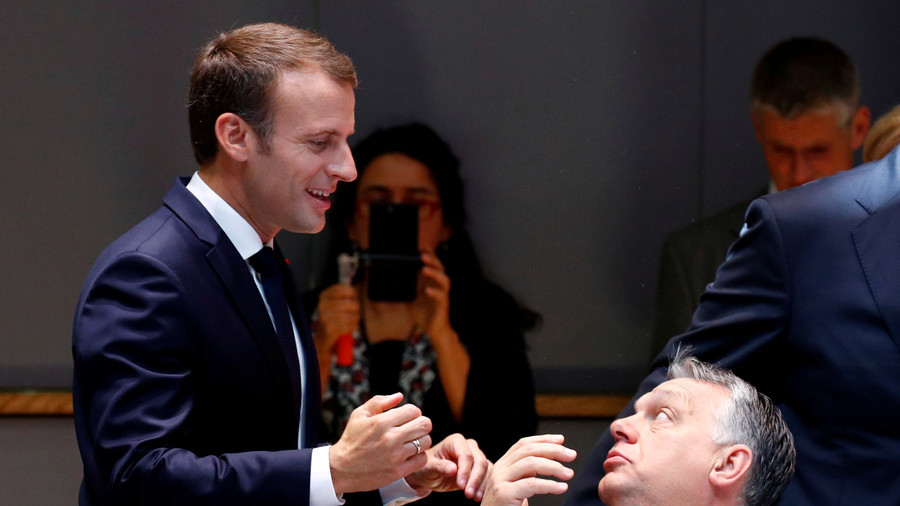
FILE PHOTO French President Emmanuel Macron talks to Hungarian Prime Minister Viktor Orban / Reuters

Emmanuel Macron replaced the French envoy to Hungary, who said that Budapest is “a model” for dealing with migrants and claimed that true anti-Semitism comes from French and German Muslims.

The Elysee was shaken after Mediapart investigative journal leaked a confidential note from Eric Fournier who served as French ambassador in Budapest since 2015, to Macron’s office.  In the note dating from June 18, the now former top envoy praised Viktor Orban’s policies and said Hungary is a “model” for dealing with “illegal migratory movements.” Fournier insisted that accusations of populism against Orban were merely “phantasmagorical.”

READ MORE: Le Pen, Orban, Wilders among Kremlin’s ‘5th column’ hell-bent on destroying Europe, says EU bigwig

Fournier lashed out at French media for its attempt to divert the attention from the “real anti-Semitism” coming from “Muslims in France and Germany.” He criticized ‘magyarophobia’ (the word ‘Magyar’ refers to the Hungarian people) in the media, adding that these attitudes are being fueled by campaigns of Hungarian-born US billionaire and philanthropist George Soros.

Read more

Migrants on an inflatable boat rescued boarding the 'Lifeline' sea rescue boat at sea on June 21, 2018. © Mission Lifeline

Macron hurried to state that the note doesn’t represent France’s policies and condemned Fournier’s remarks in the strongest terms. “Had this ambassador said this publicly, he would have been dismissed immediately,” he told a news conference in Brussels.

Pascale Andreani was quickly named as the new ambassador to Budapest to replace Fournier, Legifrance, an official website of the French government, stated. The Orban-praising official will “take on other functions,” the statement adds.

In summer 2017, Orban and pro-EU Macron – who was just then ascending to power – were engaged in a verbal slugfest over migrant policies. The French leader slammed Eastern Europe for a ‘lack of solidarity’ and ‘cynicism’ in dealing with the refugee crisis. The Hungarian prime minister reacted by saying that the Macron “thought that the best form of friendship [between the EU states] was to kick the Central European countries.”

Orban, a harsh critic of migration and mandatory migrant quotas, has repeatedly cast doubt on the validity of the migrants’ humanitarian plight. He once called asylum seekers “a Trojan horse for terrorism” and branded refugees as ‘Muslim invaders’ seeking better lives. He repeatedly slammed Germany and Chancellor Angela Merkel’s ‘open-door’ policy towards asylum seekers.

Australia ends direct aid to PA over payments to terrorists

July 2, 2018

Foreign minister says Canberra concerned money will be distributed to Palestinian prisoners in an ‘affront to Australian values,’ redirects funding to UN

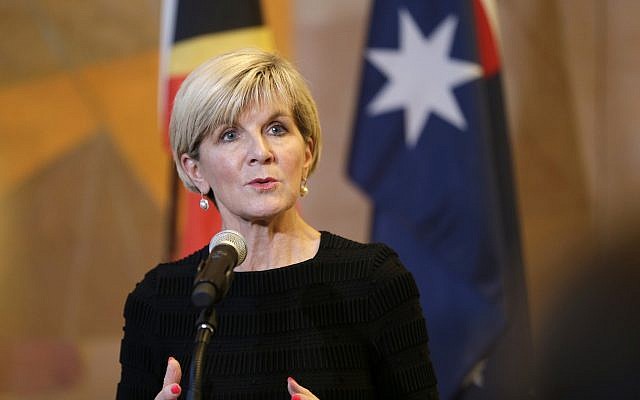
Australian Foreign Minister Julie Bishop at United Nations headquarters, March 6, 2018. (AP Photo/Seth Wenig)

Australia has ended direct aid to the Palestinian Authority over fears its donations will be used to pay Palestinians convicted of terrorism and their families.

Australian Foreign Minister Julie Bishop said Monday that funding to a World Bank trust fund was cut after she wrote to the Palestinian Authority in late May seeking assurance that Australian funding was not being misspent.

 In a statement, Bishop expressed concern that providing further aid would allow the PA to use the funds for activities that “Australia would never support.”

Israel has long accused the PA and its leader, Mahmoud Abbas, of encouraging terror attacks against Israelis by rewarding perpetrators and their families with monthly stipends. It has even withheld millions in tax revenues over the Palestinians’ unwillingness to change its policy. Israeli lawmakers are also advancing a law to slash funds to the PA by the same amount it uses to pay terrorists.

Palestinian Authority President Mahmoud Abbas in the West Bank city of Ramallah, June 27, 2018. (Alaa Badarneh/Pool Photo via AP)

“Any assistance provided by the Palestine Liberation Organization to those convicted of politically motivated violence is an affront to Australian values, and undermines the prospect of meaningful peace between Israel and the Palestinians,” Bishop said in a statement.

“I wrote to the Palestinian Authority on May 29, to seek clear assurance that Australian funding is not being used to assist Palestinians convicted of politically motivated violence,” she wrote.

“I am confident that previous Australian funding to the PA through the World Bank has been used as intended,” Bishop added. “However, I am concerned that in providing funds for this aspect of the PA’s operations there is an opportunity for it to use its own budget to activities that Australia would never support.”

Australia’s AUD 10 million ($7.4 million) donation to the trust fund will now be rerouted to the United Nations’ Humanitarian Fund for the Palestinian Territories, which provides Palestinians with health care, food, water, improved sanitation and shelter.

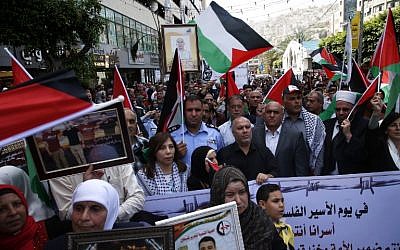
Palestinians hold portraits of relatives jailed in Israeli prisons as they protest to demand for their release during a demonstration to mark the Prisoners’ Day in the northern West Bank city of Nablus on April 17, 2018. (AFP PHOTO / JAAFAR ASHTIYEH)

Bishop said the UN body “helps 1.9 million people. Approximately 75 per cent of its funding will be spent in Gaza where the humanitarian situation continues to deteriorate.”

Australia allocated AUD $43 million for humanitarian assistance in the region for the current fiscal year, which began on July 1.

Australian government lawmaker Eric Abetz welcomed Bishop’s stance.

“Minister Bishop’s strong and decisive decision today to ensure that the Palestinian Authority can no longer use our aid to free up money in its budget for state-promoted terrorism is very positive,” Abetz said.

“It is vital that we ensure that our foreign aid is not being spent on, or making money available for, the promotion of terrorism and so funneling our aid to the Palestinian Territories through the United Nations will provide greater assurance that the Palestinian Authority’s clever accounting cannot occur,” he added.

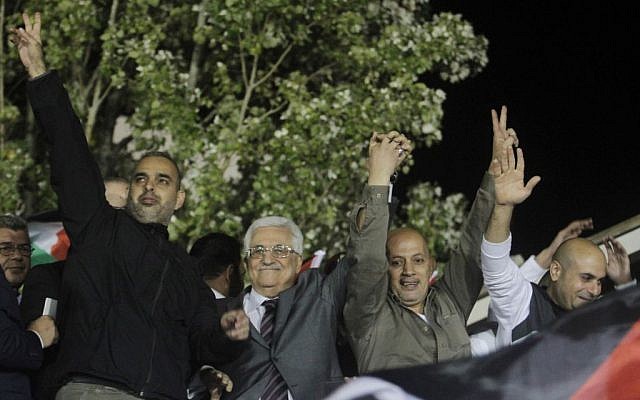
Palestinian Authority President Mahmoud Abbas, second from left, waves with released Palestinian prisoners coming from Israeli jails during celebrations at Abbas’s headquarters in the West Bank town of Ramallah, October 30, 2013. (Issam Rimawi/Flash90)

In March, Prime Minister Benjamin Netanyahu praised the US government for passing a law that suspended some financial aid to the Palestinians over the stipends paid to families of Palestinians killed or jailed in fighting with Israel.

The Taylor Force Act, named after an American killed in Israel by a Palestinian in 2016, was folded into a $1.3 trillion spending bill signed by President Donald Trump.

Netanyahu called the law a “powerful signal by the US that changes the rules” by cutting “hundreds of millions of dollars for the Palestinian Authority that they invest in encouraging terrorism.”

According to Israel’s Defense Ministry, the PA in 2017 paid NIS 687 million ($198 million) to the so-called “martyrs’ families fund” and NIS 550 million ($160 million) to the Palestinian Prisoners’ Club — some 7 percent of its overall budget.

Palestinian prisoners serving 20- to 30-year sentences for carrying out terror attacks are eligible for a lifetime NIS 10,000 ($2,772) monthly stipend, the Defense Ministry said last week, citing PA figures. Those prisoners who receive a three- to five-year sentence get a monthly wage of NIS 2,000 ($554). Palestinian prisoners who are married, have children, live in Jerusalem, or hold Israeli citizenship receive additional payments.

The Defense Ministry last month released figures alleging that some terrorists who killed Israelis will be paid more than NIS 10 million ($2.78 million) each throughout their lifetimes by the PA.

Last week, Israeli lawmakers gave the final go-ahead for a decisive vote on a bill that would slash funds to the Palestinian Authority by the amount Ramallah pays out to convicted terrorists, rejecting a request by Prime Minister Benjamin Netanyahu to give the top-level security cabinet the final say on whether to “freeze” the payments.

The bill, proposed by Yesh Atid MK Elazar Stern and Likud MK Avi Dichter, says that welfare payments paid out by the PA to Palestinian prisoners and their relatives must be deducted from tax revenues Israel transfers annually to the administrative body. The money withheld in this way would instead go into a fund designated to help victims of terror attacks.

The PA has refused to cease its payments to Palestinian prisoners.

In June 2017, PA President Mahmoud Abbas, in a speech read by his foreign affairs adviser Nabil Shaath, argued that “payments to support the families are a social responsibility to look after innocent people affected by the incarceration or killing of their loved ones.

“It’s quite frankly racist rhetoric to call all our political prisoners terrorists,” Abbas said. “They are, in actuality, the victims of the occupation, not the creators of the occupation.”


IDF boosts Golan lines with tank, artillery, rocket units, marks out security zone

July 2, 2018

Source: IDF boosts Golan lines with tank, artillery, rocket units, marks out security zone – DEBKAfile

The IDF Northern Command Sunday, July 1, upgraded the preparedness of the Golan Bashan Division with tanks, artillery and rocket units after evaluating the level of fighting on the Syria side of the border.

This was announced by the military spokesman. His announcement went on to stress “the high importance the IDF attaches to maintaining the disengagement of forces agreement on the Golan concluded in 1974 by Israel and Syria.” He added: “Israel abides by a policy of non-involvement in Syrian affairs, along with a firm response to violations of its sovereignty and possible harm to its citizens.”

DEBKAfile adds: This statement provides advance notice that Israel will not tolerate the entry of Hizballah and pro-Iranian Shiite forces to the Quneitra region opposite IDF Golan lines, and further emphasizes non-acceptance of their entry into the historic disengagement zone between Quneitra and the Israeli border.

While boosting its defensive stance on the Golan, Israel by this statement marks out a security zone based on the 1974 disengagement lines for accommodating the tens of thousands of Syrian refugees massing on its border, as well as rebel forces retreating from Quneitra.

This zone covers 235 sq.km between southern Golan and Mt Hermon. It is inside the disengagement line, which runs east of the Israeli border and is between a few meters wide at Nahal Roked in the southern Golan, up to 6 kilometers broad at its northern tip and widens out to 10km on Mt. Hermon.

The question is whether the Russian and Syrian forces taking part on the southwestern Syrian offensive will honor the security zone Israel has marked out, when the objective of their current offensive is to restore Syrian government authority to all the southern border regions.

Opening the Sunday cabinet session in Jerusalem, Prime Minister Binyamin Netanyahu said: “We shall persist in defending our borders and extending humanitarian aid, but will not let ‘anyone’ step across into our territory. I am in constant contact with the Kremlin and White House on this question.”

On Saturday, the IDF transferred 6 injured Syrians, four of them children whose parents were killed in the fighting, to Israel hospitals for treatment.

London fears losing ‘market’ and ‘influence’ if Trump makes ‘peace’ with ‘boogeyman’ Russia

July 1, 2018

Published time: 1 Jul, 2018 13:40

https://www.rt.com/news/431403-putin-trump-uk-nato/

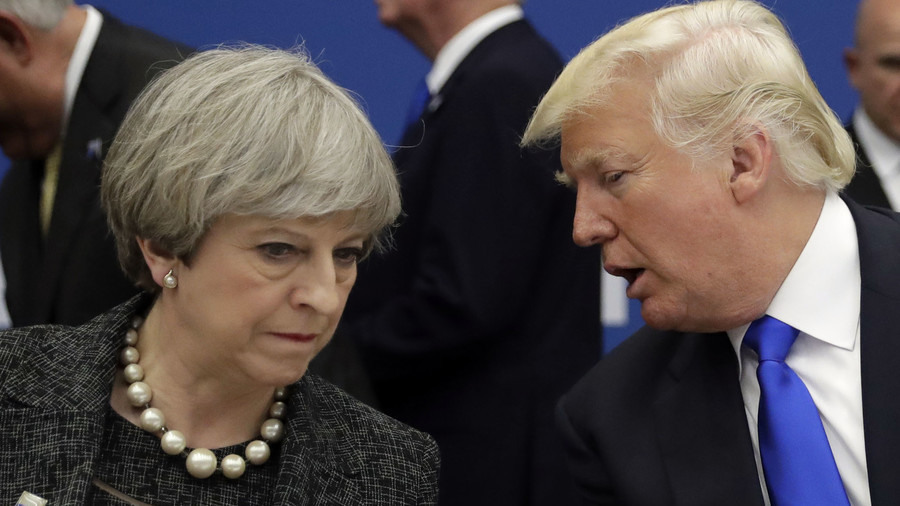
Donald Trump (R) speaks with British Prime Minister Theresa May at a working dinner meeting at the NATO in Brussels, on May 25, 2017. © Matt Dunham / AFP

The UK establishment is alarmed by a “peace deal” that Vladimir Putin and Donald Trump may reach at their upcoming meeting. London has used Moscow as a “boogeyman” to preserve its fading influence in Europe, experts told RT.

After the time and date of the meeting – that is, Helsinki, Finland on June 16 – was set this week, the Times laid out a piece conveying the fears of unnamed cabinet ministers that a “peace deal” will undermine NATO and compromise European security.

Ideas of “what can go wrong” ranged from the cancelation or downsizing of NATO drills in Eastern Europe to acknowledging Crimea as Russian territory and lifting sanctions against Moscow. One minister even predicted “further provocation by Moscow.”

Clear and present danger of “losing market”

“The UK has been one of the most active supporters of a hard line towards Russia,” and the “vigorous resistance” of its ruling circles to any positive shift in the stance of Washington towards Moscow shouldn’t be surprising, Alexander Bartosh, a military expert and former Russian diplomat, told RT.

Read more

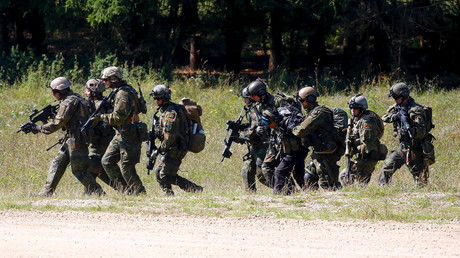
US Army's Global Response Force drill in Hohenfels, Germany. August 26, 2015 © Michael Dalder

“The UK, which quit the European Union, feels a certain loss of its weight in Europe and tries to turn Russia into a kind of boogeyman, seeing the ‘Russian threat’ as a unifying factor for nations, looking for closer ties with London,” he said.

British historian and author on international affairs John Laughland believes that “in the context of Brexit, Britain wants to talk up the Russian threat in order to be able to sell British military expertise, military capacity, and intelligence gathering expertise to the Europeans.

“The British are afraid [because] if the Russian threat is perceived to disappear they lose their market.”

There are all grounds for London to worry because “the common belief that America and Britain are such great friends isn’t really justified, as there are many in the US who support tougher and more pragmatic relations with the UK. The Americans don’t want to pull the chestnuts out of the fire for Britain as they used to do previously,” Bartosh said.

Friends and money

The paper also wrote about fears that US President Donald Trump, who has been bashing NATO allies for not chipping in enough to the organization’s budget, may accept the Polish offer to pay for the establishment of a permanent US base in the country in a bypass of NATO.

Read more

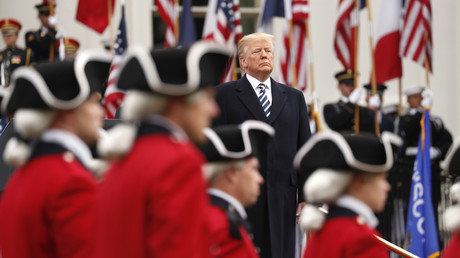
US President Donald Trump reviews the Old Guard Fife and Drum Corps, Washington, US, April 24, 2018 © Kevin Lamarque

Bartosh believes Poland is striving to replace the UK as America’s prime ally in the region.

“The Poles are using the decrease of the British influence in Europe to show the US that they should now put stakes on them,” he said.

Laughland also believes the proposed establishment of a US military base in Poland without NATO’s involvement “reduces Britain’s role and influence. It shows that it’s not NATO that’s important, but the US – which, of course, is the reality.”

Trump, who has been critical of NATO in the past, is only interested in the bloc “to the extent that he can get the Europeans to pay more money and buy more American weapons,” Laughland said.

By offering Washington a military base on its territory, Warsaw is “pursuing economic targets, in the first place, because it would increase the flow of funds into the Polish economy,” Bartosh said. “Poles are quite reasonable people and they are unlikely to really think that there’s some significant military threat coming from Russia towards Poland.”

So what about the meeting?

During their meeting, Putin and Trump will be trying to find a “unifying agenda for the US and Russia because the relations of the two countries affect not only their own wellbeing, but international security as a whole,” Bartosh said, adding that “none of the sides will be aiming to undermine the integrity of NATO.”

READ MORE: Trump to meet Putin regardless of ‘noise’ at home as it’s in US national interest – Bolton

NATO is jeopardized by internal problems, including Trump’s demands to members-states to increase military spending, divisions and differing views on threats within the EU, and the trade war between Europe and America, according to Bartosh.

It’s also “possible” that during their meeting, Putin and Trump will be able to “find the formulae to overcome the current situation” in relations between the West and Moscow,” Laughland said. The US sanctions can be lifted and the EU may follow suit shortly afterwards as “the European sanctions are coming under heavy questioning from Italy, Austria, Hungary, and other countries.”

Israel deploys tanks, artillery forces at Syria border 

July 1, 2018

Source: Israel deploys tanks, artillery forces at Syria border – Israel Hayom

Is Guilt Killing the West from Within?

July 1, 2018

Russian military downs unidentified drones near Khmeimim Air Base in Syria – MoD

July 1, 2018
https://www.rt.com/news/431393-russia-khmeimim-drones-downed/
Pantsir-S1 air defense system seen at Khmeimim airbase © Dmitry Vinogradov / Sputnik
A group of unidentified drones has been shot down by Russia’s Air Defense units near Khmeimim Air Base in Syria, the Russian MoD has announced. No damage to the facility was reported.

The objects were detected north-east from the military facility on Saturday, the base’s authorities said. “All aerial targets were destroyed,” they confirmed. The military, however, stopped short of naming exact weapon systems which were used to bring down the drones (UAVs).

Read more

FILE PHOTO © Global Look Press

This is not the first time Khmeimim Air Base, located south-east of the port of Latakia, has been targeted with unmanned aircraft this year. In May, the Russian MoD said its units also downed a drone near the military compound.

But the most large-scale assault on Khmeimim was launched in January with at least 10 drones attacking the site. Three others targeted the Russian maritime logistics point in the city of Tartus. The majority of the intruders were successfully downed by the Russian Pantsir-S1 anti-aircraft weapon system. The radio electronics warfare specialists also managed to override the operating systems of other drones.

After examining the devices and recovering the data, Russian specialists determined that the January attack was launched from an area near Idlib, controlled by various rebel forces.

Back then, the head of the UAV department of the Russian General Staff, Major General Aleksandr Novikov, warned that terrorists acquired advanced drone technology which raised the risks of potential attacks all over the world. “The research showed that the avionics equipment mounted on the drones facilitated their fully automated preprogrammed flight and bombing, ruling out any jamming,” Novikov said at the time.

READ MORE: Russian air defenses down drone in Syria’s Khmeimim in suspected air attack

The Russian military also noted that that detonators used in the militants’ Improvised Explosive Devices (IEDs) carried by the drones were “of foreign manufacture.” It suggested that preparing an attack with such aircraft required special skills, which the perpetrators may have received from a foreign party.

Iron Dome versus laser system missile interceptors? Israeli strategists are split 

July 1, 2018

Source: Iron Dome versus laser system missile interceptors? Israeli strategists are split – DEBKAfile

The IDF does not have enough Iron Dome anti-missile batteries to cover both the Gaza and northern fronts. The system would be further stretched if central Israel came under attack.

In two barrages on June 20 and June 27, Hamas launched up to 100 missile mortar shells from the Gaza Strip against Israel towns and villages. Timely alerts sent civilians to shelters in time to avoid casualties. But it had had become obvious that the south was short of Iron Dome batteries to ward off heavy rocket salvoes, because the bulk were deployed along Israel’s northern border where war tensions are rising. This deficiency would become critical if central Israel came under missile attack. This eventuality comes closer as Hizballah and Iraqi Shiite militias, under Iranian Revolutionary Guards command, become a strong component of the Russian-backed Syrian assault advancing in the Daraa province.

Israel’s generals and other strategists are painfully aware of the inadequacy of protection for North and for the national strategic facilities across the country from the new precision missiles, especially those in the Hizballah arsenal. Such missiles could be launched from Syria, Lebanon or the Gaza Strip.

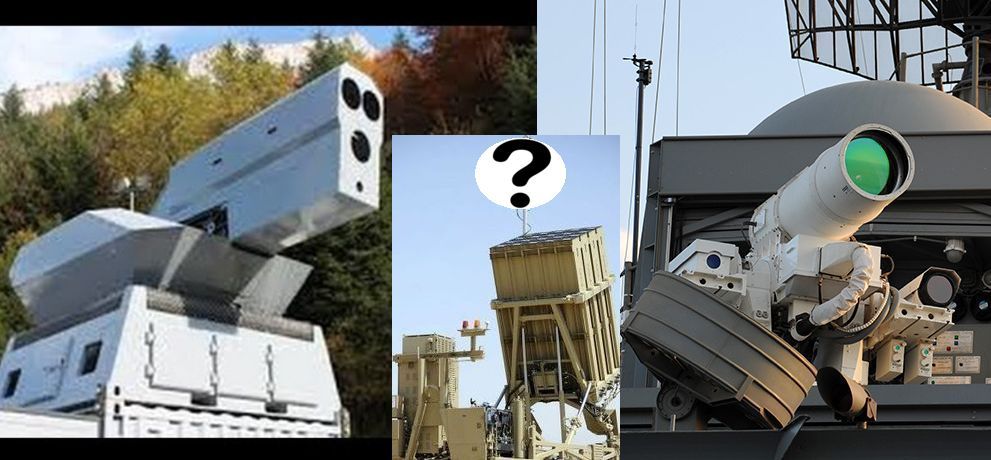
To address this rising threat, the Israel security cabinet is meeting urgently on Sunday night, July 1, to draw up plans for preparing the northern home front for an outbreak of hostilities. The ministers will need to resolve a hot debate taking place in recent weeks among Israel’s military leaders over whether to supplement Israel’s Iron Dome missile interception system with new US laser beam weapons. Israeli projects for developing these systems, partly in conjunction with US partners, were shut down in 2007, when it was decided to focus on the home-made Iron Dome. Then, too, some circles argued that the high cost of deploying the Israeli Iron Dome did not justify the large investment in its development. But after the last Gaza operation in 2014, Iron Dome was held as a national icon and no one talked about its high cost.

However, now the threat has exacerbated. Potentially ranged against Israel are at least 12,000 different kinds of advanced missiles, which pack are far deadlier and more precise punch than the Hamas projectiles of four years ago. And so the argument has revived. It is calculated that it will take at least three to four Iron Domes to intercept one these advanced enemy missiles, a prohibitive outlay that would come on top of the high expense of conducting a full-scale war. This is beyond Israel’s means. The arithmetic is simple: Downing an estimated number of 12,000 enemy missiles would take more than 30,000 Iron Dome missiles, at the astronomical cost of $5 billion. The preponderant rationale under consideration therefore is for Israel to stop paying for additional Iron Domes and instead buy SkyGuards, an anti-missile laser system developed from the US Nautilus, which is readily available or can be quickly assembled.

Fifteen SkyGuard batteries (at $75 million apiece) would come to around $1.125 billion, representing a saving of $3.75 billion compared to the cost of Iron Domes.

The pro-Iron Dome lobby is putting up a strong fight against introducing the laser interceptor to IDF service. Part of this argument is that replacing the Israel product would be detrimental to sales on world markets. Last week, as part of the Iron Dome campaign, reports of a laser beam’s effectiveness against the incendiary kites and balloons flying across the Gaza-Israeli border were hushed up. But as threats escalate on two fronts, the IDF may not have enough time to train field units in anti-missile laser warfare to meet the next conflagration.