Archive for July 2018

The ‘Nuts and Bolts’ of Iran’s Economic Troubles

July 5, 2018

Source: The ‘Nuts and Bolts’ of Iran’s Economic Troubles – International news – Jerusalem Post

In the past year, economic dissatisfaction is increasingly being expressed in terms of political dissatisfaction.

BY TERRANCE J. MINTNER/THE MEDIA LINE
 JULY 5, 2018 05:28
The ‘Nuts and Bolts’ of Iran’s Economic Troubles

As Iran decides the pathway forward after US President Donald Trump pulled out of the 2015 nuclear deal in May, economic pressures are beginning to weigh on the Islamic Republic.

In the last few weeks, Iran’s currency has been tanking rapidly against the dollar. Reports said it sank between 79,000 and 90,000 rials to the US dollar on the country’s unofficial market, according to the foreign exchange website Bonbast. At the end of last year, it stood at 42,890 to the dollar.

Furthermore, there has been a flare up of protests over economic concerns throughout the country. Vendors in Tehran’s central market staged a series of protests last week. They were upset about the rial’s collapse, which is havoc for businesses as the price of imports rises.

In the last few days, protests erupted around the southern city of Khorramshahr over a shortage of clean water. The problem has been exacerbated in the summer when temperatures in the southern region can reach up to 110 degrees Fahrenheit (43 Celsius). The protests were initially peaceful but became violent when police and protesters clashed, resulting in at least one death.

Last month, protesters in Tehran shouted surprising slogans as they decried the country’s economic malaise. Videos posted to social media showed them chanting: “Death to Palestine,” “No to Gaza, no to Lebanon,” and “Leave Syria and think of us.” Others chanted “We don’t want the ayatollahs.”

The unrest seems to have rattled the leadership. Last week, President Hassan Rouhani called on the nation to “remain calm” and united in the face of the economic pressure. The country’s Supreme Leader Ayatollah Ali Khamenei also addressed the Iranian public, urging the government “to confront those who disrupt economic security.”

Economists in the country are urging the leadership to take bold action on the sinking rial and rising prices. Beyond these concerns, they have also flagged Iran’s record levels of unemployment, a private sector starved of investment, and the country’s banking system, which is crippled by loans.

Suzanne Maloney, an expert on Iran and senior fellow at the Brookings Institution, told The Media Line that what is happening in Iran is a “continuation of the unrest that we’ve seen over the course of the last several years, but certainly on an intensified basis.”

She explained that there is a long history of economic protests and labor strikes in Iran. But in the past year, economic dissatisfaction is increasingly being expressed in terms of political dissatisfaction. “There is a willingness among Iranians to publicly embrace positions that are obviously quite dangerous in a system that relies continuously on repression.”

During the Iranian Revolution of 1978-79, she explained, there was an economic dimension to the unrest—a period of fast growth, inflation, and crackdowns on speculation. What began as individual economic protests became linked over time, amounting to a rejection of the system itself. “And I think that has to be of particular concern for the Iranian leadership.

“Those protesting in the streets are rejecting all elements of the leadership. They have been as critical of the reformists as are of hardliners.”

Maloney concluded by outlining Iran’s most pressing economic concerns. “The long-term challenge, which the Iranian government has failed to address, is how to generate sufficient opportunities for the post-revolutionary ‘baby boom’ which is now reaching maturity.”

She added that corruption and the perception that life has gotten harder are also driving the unrest. “Expectations were raised around the 2015 nuclear deal, and it didn’t produce the anticipated ‘peace dividends.’”

The other crucial issue for Iran is what European businesses will do after Trump’s withdrawal from the 2015 nuclear pact. Tougher US sanctions could greatly deter European companies from doing business or investing in Iran.

Mahdi Ghodsi, an expert on Iranian trade and industrial policy at The Vienna Institute for International Economic Studies, told The Media Line that “it is very difficult for European signatories of the deal to incentivize companies to stay in Iran, at least in terms of investment.”

He explained that there could be a procedure to support European countries trading with Iran, but not those that seek to invest in the country. Investment is problematic because of the lack of guarantees. “If my company wants to invest in Iran, and then the US prevents it from doing business with American companies as a penalty, then it will be difficult for the Europeans to pay back that penalty.”

But for trade issues, he concluded, they could take their case to the World Trade Organization to settle the dispute.

Tom Wilson, a Research Fellow in the Center for the New Middle East at London’s Henry Jackson Society, told The Media Line that “the Iran deal as we knew it from 2015 is dead – and nothing will concentrate European minds more on this than the re-imposition of US secondary sanctions on European companies that continue trading with Iran.

“If European businesses will not face the stark choice between maintaining their operations and being hit with sanctions or pulling out of Iran, then their governments must urgently engage with and address American concerns about the deal – not least Iran’s ballistic missile capability.”
PA whines about the Aussies taking action against “pay for slay”

July 5, 2018

Following on from this post by joop about the Aussie government taking action in regard to aid $ being put towards “pay for slay” payments….

Australia ends direct aid to PA over payments to terrorists

Australia ends direct aid to PA over payments to terrorists

… we now have the Palestinian response.

Can you guess their response?

Yep, that’s right, they do what they always do.

They whine.

And lie.

Boo. Hoo.

The Palo’s sickening response is below.

PA lambastes Australia for nixing aid, says decision ‘not grounded in facts’

https://www.timesofisrael.com/pa-lambastes-australia-for-nixing-aid-says-decision-not-grounded-in-facts/

Ramallah accuses Canberra of siding with Israeli ‘colonialism’ under US pressure, insists foreign aid was never used to pay stipends for Palestinian terrorists

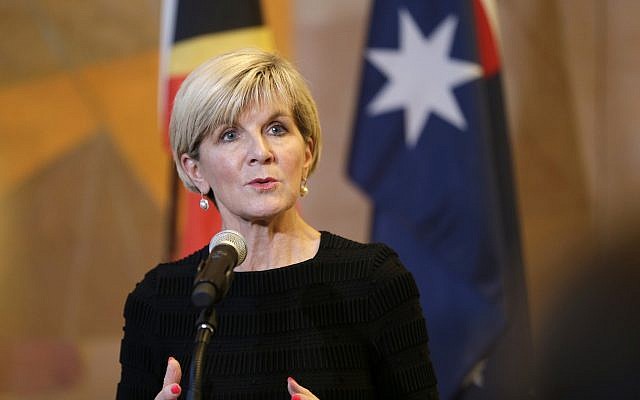
Australian Foreign Minister Julie Bishop at United Nations headquarters, March 6, 2018. (AP Photo/Seth Wenig)

The Palestinian Authority on Tuesday slammed Australia’s “cruel” decision to end its direct aid to the Ramallah government, calling the move politically motivated and saying it “has no grounding in facts.”

Foreign Minister Julie Bishop announced Monday that Australia had ended its direct government aid to the PA over fears its funds would be used to pay welfare stipends to families of Palestinians killed or jailed for attacks on Israel.

The funds will instead be provided to UN aid efforts to Palestinians.

In a statement, the Palestinian envoy to Australia, Izzat Abdulhadit, expressed the PA’s “deepest disappointment and concern” at the decision.

He asserted the Australian aid was never used to pay the stipends of convicted terrorists, and said the “stringent auditing procedures” of the governing World Bank trust fund could prove it.

“We have therefore concluded that this decision is political in nature, for its justification has no grounding in facts,” the statement said. “It has less to do with genuine concerns about terrorism and the stifled peace process than it does with domestic political expediency.”

Abdulhadit went on to say that by “ignoring Israel’s ever-expanding colonial project,” Australia had sided with the Jewish state, and “again apportioned all blame to only one side, the much weaker and disenfranchised one at that.”

PA official Hanan Ashrawi, a member of the PLO Executive Committee, said in a statement that Australia “seems to have succumbed to the US administration’s pressure in compounding the injustice of Israel’s military occupation by punishing its Palestinian victims.

“This unjustified and cruel move further targets the Palestinians who are already being held captive, while ignoring the persistent violations and war crimes being committed by the Israeli occupation.”

The statement insisted that the Palestinians are committed to nonviolent resistance, and urged Bishop to reverse the decision.

“We strongly urge the government of Australia to reconsider its decision and not embolden Israel in its unilateral and illegal policies,” Ashrawi said. “Bringing Israel to compliance with international law and international humanitarian law would be the most constructive action for governments interested in peace and justice.”

Israel has long accused the PA and its leader, Mahmoud Abbas, of encouraging terror attacks against Israelis by rewarding perpetrators and their families with monthly stipends, and on occasion has withheld millions of dollars in tax revenues over Ramallah’s unwillingness to change the controversial policy.

On Monday, Bishop announced that state funding to the World Bank trust fund for Palestinians had been cut after she requested assurances from the PA earlier this year that Australian funding was not being misspent.

The minister expressed concern that providing further aid would allow the PA to use the funds for activities that “Australia would never support.”

“Any assistance provided by the Palestine Liberation Organization to those convicted of politically motivated violence is an affront to Australian values, and undermines the prospect of meaningful peace between Israel and the Palestinians,” Bishop said in a statement. “I wrote to the Palestinian Authority on May 29, to seek clear assurance that Australian funding is not being used to assist Palestinians convicted of politically motivated violence.”

“I am confident that previous Australian funding to the PA through the World Bank has been used as intended,” Bishop added. “However, I am concerned that in providing funds for this aspect of the PA’s operations there is an opportunity for it to use its own budget to activities that Australia would never support.”

Australia’s AUD 10 million ($7.4 million) donation to the trust fund will now be rerouted to the United Nations’ Humanitarian Fund for the Palestinian Territories, which provides Palestinians with health care, food, water, improved sanitation and shelter.

Bishop said the UN body “helps 1.9 million people. Approximately 75 percent of its funding will be spent in Gaza where the humanitarian situation continues to deteriorate.”

Australia allocated AUD $43 million for humanitarian assistance in the region for the current fiscal year, which began on July 1.

According to Israel’s Defense Ministry, the PA in 2017 paid NIS 687 million ($198 million) to the so-called “martyrs’ families fund” and NIS 550 million ($160 million) to the Palestinian Prisoners’ Club — some 7 percent of its overall budget.

Palestinian prisoners serving 20- to 30-year sentences for carrying out terror attacks are eligible for a lifetime NIS 10,000 ($2,772) monthly stipend, the Defense Ministry said last week, citing PA figures. Those prisoners who receive a three- to five-year sentence get a monthly wage of NIS 2,000 ($554). Palestinian prisoners who are married, have children, live in Jerusalem, or hold Israeli citizenship receive additional payments.

The Defense Ministry last month released figures alleging that some terrorists who killed Israelis will be paid more than NIS 10 million ($2.78 million) each throughout their lifetimes by the PA.

Hours after the Australian announcement, Knesset lawmakers voted in favor of a bill that would officially see Israel deduct customs fees it collects on behalf of the PA by the amount Ramallah pays out to convicted terrorists each year.

The bipartisan bill, proposed by Yesh Atid MK Elazar Stern and Likud MK Avi Dichter, passed by 87 to 15 in a late-night vote.

The PA has refused to cease its payments to Palestinian prisoners.


Austria’s Kurz to Rouhani: ‘Unacceptable’ to question Israel’s right to exist

July 4, 2018

‘Austria is unconditionally committed to the security of Israel and its citizens,’ says chancellor as Iranian president visits to salvage nuclear deal

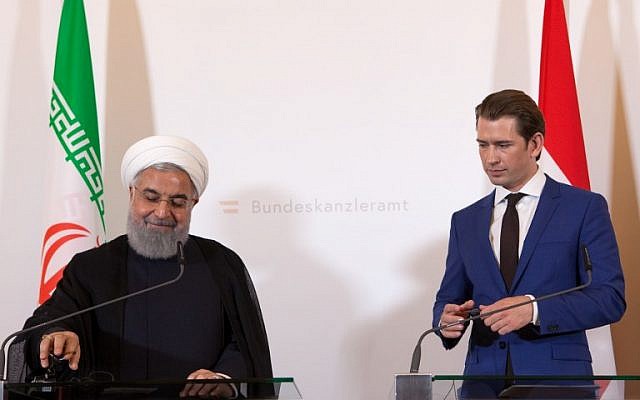
Austria’s Chancellor Sebastian Kurz (r) and Iranian President Hassan Rouhani give a joint press conference following a meeting on July 4, 2018 at the Chancellery in Vienna. (AFP/Alex Halada)

In a joint press conference with Iranian President Hassan Rouhani, Austrian Chancellor Sebastian Kurz on Wednesday said he considered it “absolutely unacceptable” to question the right of Israel to exist or call for the Jewish state’s destruction.

Ahead of the meeting in Vienna, Kurz had said he would speak plainly with Rouhani about Iran’s role in the Middle East, as Tehran continues to deny accusations it is destabilizing the region.

The Austrian leader also condemned those who trivialize the Holocaust, in comments apparently directed at Iranian behavior, and said Vienna was “unconditionally” committed to Israel’s security.

“The concerns of Israel have to be taken seriously. Austria is unconditionally committed to the security of Israel and its citizens,” said Kurz, according to a statement from an official spokesperson.

“During this memorial year we are particularly aware of our historic responsibility. We strongly condemn all forms of anti-Semitism as well as any form of downplaying or denial of the Holocaust,” he added.

The Austrian leader had visited Israel last month, during which he pledged to “raise awareness” of Israel’s special security needs in Europe. During that visit, Prime Minister Benjamin Netanyahu signaled Israel was stepping up contacts with Vienna, heaping praise on his counterpart and appearing to signal a thaw in Jerusalem’s freezing out of a far-right coalition party that has been accused of Nazi links.

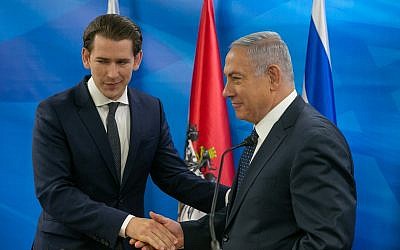
Prime Minister Benjamin Netanyahu, right, with Chancellor of Austria Sebastian Kurz at the Prime Minister’s Office in Jerusalem, June 11, 2018. (Ohad Zwigenberg/Pool)

The government headed by Kurz includes the far-right Freedom Party, which Israel boycotts due to its past as a haven for neo-Nazis and its current xenophobic policies.

Israel has forcefully opposed the 2015 nuclear deal between Iran, its arch-foe, and world powers. The Jewish state has also been lobbying world powers and acting to remove Iranian troops from southern Syria over fears Tehran could entrench militarily and launch attacks on the Jewish state from the neighboring country.

Rouhani was in Vienna on the second leg of his European tour to seek assurances over the 2015 nuclear deal. The trip was clouded by the arrest of an Iranian diplomat over an alleged bomb plot against opposition exiles in Paris.

Hoping to boost economic cooperation to help offset the return of US sanctions following Washington’s pullout from the historic deal, Rouhani arrived late Tuesday in Vienna — the city where it was signed.

“Insofar as it is possible for Iran, we shall remain party to the accord, we shall not quit the JCPOA (the Joint Comprehensive Plan of Action) on condition that we can also benefit from it,” Rouhani said.

“If the other signatories, apart from the United States, can guarantee Iran’s interests then Iran will stay in the JCPOA,” he insisted.

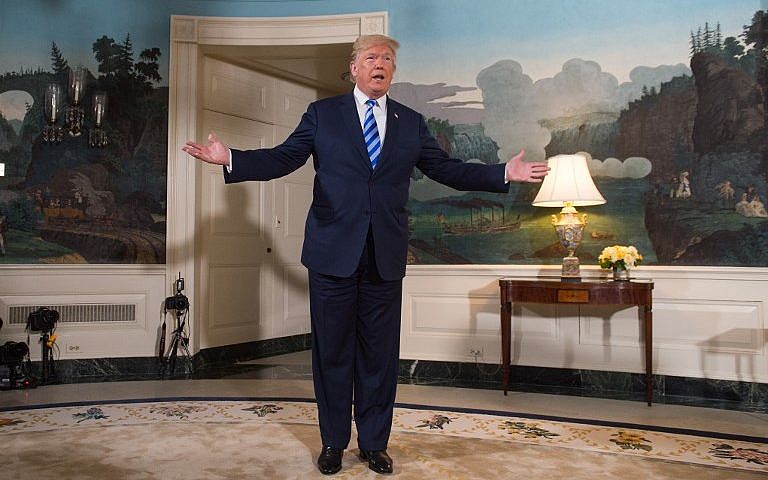
US President Donald Trump speaks to the press after announcing his decision to withdraw from the nuclear deal with Iran during a speech from the Diplomatic Reception Room at the White House on May 8, 2018. (AFP Photo/Saul Loeb)

In a move staunchly backed by Israel, US President Donald Trump unilaterally pulled out of the agreement nearly two months ago, to the ire of the other signatories — China, France, Germany, Britain and Russia — which along with the European Union have continued to back the accord.

“We need a balance between our duties and the hypothesis of restrictions…. We hope for decisive actions regarding trade and the economy,” added Rouhani in comments sending a message to the other deal signatories, whose foreign ministers are due to meet in Vienna on Friday for the first time since Trump’s decision to dump the deal.

Austria just took up the European Union’s six-month rotating presidency, while Vienna is the home of the UN nuclear watchdog, the IAEA, which monitors Iran’s compliance with the accord.

Rouhani’s European trip will be of “prime importance” as it could “provide a more precise picture of cooperation between Iran and Europe,” the Iranian foreign ministry spokesman said at the weekend.

The Iranian government has itself warned that it will not continue to abide by the nuclear agreement if doing so goes against its economic interests.

Rouhani, a moderate conservative re-elected in 2017, met Austrian President Alexander Van der Bellen on Wednesday, and with Kurz later in the day.

‘False flag ploy’

The nuclear deal has been the cornerstone of Rouhani’s policy of greater openness with the West, and the US departure has seen him severely criticized by ultra-conservatives at home.

Iran’s supreme leader, Ali Khamenei, has demanded Europe provide a number of economic guarantees in order for Tehran to continue its commitment.

Increasing the pressure on Iran’s European partners, he ordered preparations be made to quickly restart nuclear activities in case talks collapse.

Rouhani’s visit follows reports of the Iranian diplomat’s arrest along with five others over a purported foiled attack on a rally of thousands of Iranian opposition supporters in Paris.

Rouhani has not changed his program over what his foreign minister dismissed as a “false flag ploy” designed as a distraction.

“How convenient: Just as we embark on a presidential visit to Europe, an alleged Iranian operation and its ‘plotters’ arrested,” Mohammad Javad Zarif tweeted.

Just hours before welcoming Rouhani to Austria, Vienna summoned Iran’s ambassador and announced that the unnamed diplomat’s status would be withdrawn.

The diplomat attached to the Iranian embassy in Austria, who was detained in Germany, was believed to be a contact of a couple at the center of the alleged plot.

He may soon be extradited to Belgium, which is spearheading a probe into the alleged bomb plot, prosecutors told the German news agency DPA.

“We are waiting for full clarification” on the case, Kurz said at a press conference alongside Rouhani.

Zarif, who is accompanying Rouhani, will on Friday meet top envoys from the five powers for the first time since Washington’s withdrawal.

Slovakia declares it will move its embassy to Jerusalem 

July 4, 2018

Source: Slovakia declares it will move its embassy to Jerusalem – Israel Hayom

Putin To Meet Netanyahu Five Days Before Trump

July 4, 2018

PM calls on European leaders to stop appeasing Iran, especially after Iranian-backed bombing plot in Paris.

Lior Sharon
http://www.jerusalemonline.com/news/politics-and-military/politics/putin-to-meet-netanyahu-five-days-before-trump-36276

Prime Minister Benjamin Netanyahu (right) and Russian President Vladimir Putin in Jerusalem on June 25, 2012 Photo: Marc Israel Sellem/Pool/Flash90

Prime Minister Benjamin Netanyahu will travel to Moscow next week to meet Russian President Vladimir Putin, just five days before Putin is scheduled to meet in Helsinki with US President Donald Trump.

The issues that will dominate Netanyahu’s talks with Putin – Iran and Syria – are also expected to be high on the list of topics to be discussed when the Russian and US leaders hold their first summit.

Netanyahu’s meeting with Putin comes just two months after the prime minister last flew to Moscow to discuss the situation in Syria, and comes amid growing concerns in Jerusalem about the situation in southwestern Syria, where Syrian President Bashar Assad, together with Russian air support and Iranian backed Shi’ite militias, are poised to regain control of the area.

Netanyahu made clear Tuesday during a speech at the state memorial service for Theodor Herzl that Israel will strictly enforce the separation of forces agreement it has with Syria from 1974, and expects others to adhere to that agreement as well.

At a speech an hour later at a US Embassy party in Airport City to celebrate July 4th, Netanyahu praised Trump for withdrawing from the Iranian nuclear deal, formally known as the Joint Comprehensive Plan of Action (JCPOA), saying this was the “greatest thing for the security of the world and for the security of Israel.”

But, Netanyahu said, “this is not yet universally accepted.”

Netanyahu noted that the other world powers who were involved in the JCPOA – France, Germany, Britain, China and Russia – are to meet on Friday in Vienna with Iranian President Hassan Rouhani to discuss “how to go around the decision that President Trump and the United States made to leave this bad deal, which is funding Iran’s terrorism and aggression with billions of dollars.”

Israeli law cutting PA funds over terrorist ‎stipends ‘a declaration of war,’ PA official says 

July 4, 2018

Source: Israeli law cutting PA funds over terrorist ‎stipends ‘a declaration of war,’ PA official says – Israel Hayom

Iran set up terrorist infrastructure in Europe, ‎experts say

July 4, 2018

Source: Iran set up terrorist infrastructure in Europe, ‎experts say ‎ – Israel Hayom

Russia: Complete Iran pullout from Syria ‘unrealistic’

July 4, 2018
Moscow’s FM Lavrov says Tehran is one of the key powers in the region, and it would be ‘absolutely unrealistic’ to expect it to abandon its interests; however, he notes ceasefire agreement includes all non-Syrian forces withdrawal from border with Israel.
https://www.ynetnews.com/articles/0,7340,L-5303857,00.html
Russian Foreign Minister Sergey Lavrov said Wednesday that demands for Iran’s complete withdrawal from Syria are “unrealistic.”
After meeting with his Jordanian counterpart, Lavrov said that Iran is one of the key powers in the region, and that it would be “absolutely unrealistic” to expect it to abandon its interests. He said regional powers should discuss mutual complaints and negotiate a compromise.

Russian Foreign Minister Lavrov (Photo: AFP)

Russian Foreign Minister Lavrov (Photo: AFP)

Russia and Iran have provided crucial military support to Syrian President Bashar Assad’s forces, helping them turn the tide in the civil war.

Israel has said it will not tolerate an Iranian military presence in Syria and has launched military strikes against Iranian targets there in recent months.

Russia Foreign Minister Lavrov meets with Jordan Foreign Minister Ayman Safadi (Photo: AFP)

Russia Foreign Minister Lavrov meets with Jordan Foreign Minister Ayman Safadi (Photo: AFP)

Lavrov said Russian President Vladimir Putin and US President Donald Trump would discuss the situation in southern Syria, where government forces are waging a new offensive, at their July 16 summit.

He said a cease-fire in the region brokered by Russia, Jordan and the US had envisioned the withdrawal of non-Syrian forces and the deployment of Syrian troops along the frontier with Israel.

First published: 07.04.18, 14:53

Pause in Syria’s Daraa Offensive amid Putin-Trump impasse on its goals. Putin seeks Israeli flexibility 

July 4, 2018

Source: Pause in Syria’s Daraa Offensive amid Putin-Trump impasse on its goals. Putin seeks Israeli flexibility – DEBKAfile

The Syrian Daraa offensive has by and large fallen silent and preparations to attack Quneitra are on hold. The outflow of refugees has slowed.

DEBKAfile’s military sources disclose that the Syrian army’s Tigers Force and 4th Division, which spearheaded the Daraa thrust to impose Bashar Assad’s rule on southwest Syria, have downed arms for the moment, along with Hizballah’s elite Radwan fighters. Also suspended are Syrian preparations to go next for the Quneitra region opposite Israel’s Golan border.

Our sources disclose that the lull in fighting was ordered by the Russian commanders due to their low opinion of the Syrian-Hizballah forces’ ability to successfully conclude the Daraa-Quneitra operation in time for the Putin-Trump summit on July 16 in Helsinki.

This Syrian offensive was cut short for two reasons:

  1. Extraordinary military actions launched on the quiet by the US and Israel, as will be revealed in the coming DEBKA Weekly issue out on Friday, July 6. (click here to subscribe).
  2. Russian diplomatic feelers with Washington – and secret approaches to Israel and Jordan for an accommodation – have come to nothing. Neither was a breakthrough reached in the phone conversation on Tuesday, July between US Secretary of State Mike Pompeo and Foreign Minister Sergei Lavrov. The US is adamantly opposed to Putin’s drive to forcibly assert the Assad regime’s authority in the two southwestern provinces on the Jordanian and Israeli borders, knowing that this will open the door to Iranian and Hizballah forces. An attempt to achieve Israeli flexibility on Iran’s presence in Syria, in the hope of indirectly persuading the Trump administration, was also made on Tuesday in a conversation between Russia’s deputy foreign minister Sergei Ribakov and Israel’s ambassador to Moscow, Gary Koren. Putin invited Binyamin Netanyahu to Moscow on July 11, to try again. Meanwhile, the fate of the Syrian front hangs fire as an unsolved issue between Washington and Moscow – largely over Putin’s acceptance of the Iranian and Hizballah presence in Syria.

America the Beautiful by Ray Charles – Happy Independence Day 

July 4, 2018


Performed at game 2 of the World Series, one month after 9/11.