Archive for July 2018

Top Iranian general: Forces in Syria ‘awaiting orders’ to destroy Israel

July 9, 2018

Hossein Salami says Tehran also ‘creating might in Lebanon to fight our enemy from there with all our strength’ and eradicate ‘evil Zionist regime’
By Times Of Israel staff July 9, 2018

Source Link: Top Iranian general: Forces in Syria ‘awaiting orders’ to destroy Israel

{Somehow, I think Israel has already considered that possibility. – LS}

In a recent speech, the deputy commander of Iran’s Revolutionary Guards (IRGC) boasted that the “Islamic army in Syria” in the Golan Heights was awaiting orders to eradicate the “evil regime” of Israel.

He also said the Tehran-backed Hezbollah terror group had 100,000 missiles aimed at Israel.

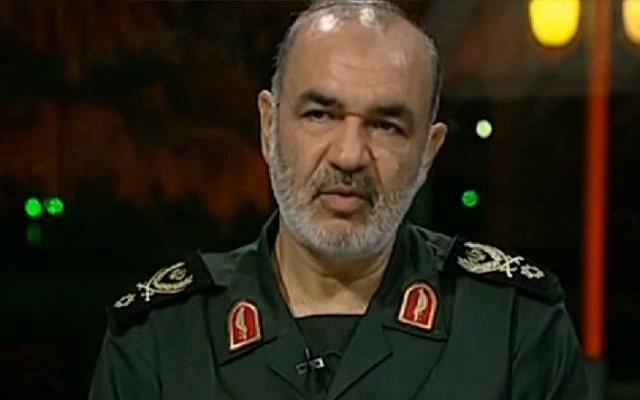
IRGC Deputy Commander Hossein Salami (YouTube screen capture)

In a recent speech, the deputy commander of Iran’s Revolutionary Guards (IRGC) boasted that the “Islamic army in Syria” in the Golan Heights was awaiting orders to eradicate the “evil regime” of Israel.

He also said the Tehran-backed Hezbollah terror group had 100,000 missiles aimed at Israel.

“We are creating might in Lebanon because we want to fight our enemy from there with all our strength,” he stated. “Hezbollah today has tremendous might on the ground that can on its own break the Zionist regime. The Zionist regime has no strategic-defensive depth.”

In the speech for the anti-Israel al-Quds Day in June, translated by the Middle East Media Research Institute (MEMRI), Hossein Salami said that the dangers Israel faces today are greater than at any time in history.

“Today an international Islamic army has been formed in Syria, and the voices of the Muslims are heard near the Golan,” he said. “Orders are awaited, so that… the eradication of the evil regime [Israel] will land and the life of this regime will be ended for good. The life of the Zionist regime was never in danger as it is now.”

Salami stressed that “the Zionist regime constitutes a threat… to the entire Islamic world. That is the philosophy of the establishment of this regime.”

He praised Ayatollah Ruhollah Khomeini, who led the 1979 Iranian revolution, for making the destruction of Israel a goal of the regime.

Khomeini “spread the rationale of eradicating Israel as a new notion in the world’s political discourse,” Salami said. “Since then, the Zionist regime is fearful, delusional, and worried.”

Israel has for years warned of Iran’s ongoing attempts to entrench itself in Syria, and has been waging a quiet campaign to prevent Tehran from establishing a new front on its border. That campaign came into the light and shifted into more open conflict in February, when an Iranian drone carrying explosives briefly entered Israeli airspace, before it was shot down. In response Israel launched a counterattack on an air base in Syria, hitting the mobile command center from which the drone had been piloted and killing at least seven members of the IRGC.

Tehran vowed revenge after the T-4 army base strike. On May 10, the IRGC’s al-Quds Force launched 32 rockets at Israel’s forward defensive line on the Golan Heights border. Four of them were shot down; the rest fell short of Israeli territory.

In response, over the next two hours, Israeli jets fired dozens of missiles at Iranian targets in Syria and destroyed a number of Syrian air defense systems. The operation was widely seen as a success in Israel.

But Salami boasted of Iran’s success in launching the rockets, claiming the barrage silenced Israel.

“When the Zionists bombed the T-4 base in Syria and killed some young men, they thought that they would get no reaction. They thought that America’s and England’s support could frighten the resistance front. They thought that no one would respond,” Salami said. “But the response came in the Golan, and dozens of missiles were fired, along with the message ‘If you respond, we will flatten the heart of Tel Aviv into dust.’ They were silent, and did nothing further.”

Iran has been accused by Israel, the Trump administration, Saudi Arabia and other Middle East countries of supporting terrorism and instability in the region.

Salami blamed Israel for all the Middle East’s troubles.

“All the problems of the Islamic world stem from the existence of the false, counterfeit, historically rootless, and identity-less regime named Israel,” he said.

On Sunday Syrian air defenses were activated near the T-4 air base, in response to an airstrike on the facility, which Syrian state media attributed to the Israeli military, although as a rule, the Israeli military does not comment on its operations abroad.

Europe cannot cope with any further armed conflict on the continent

July 9, 2018

Europe cannot cope with any further armed conflict on the continent

European leaders are not only unable to counteract the demographic crisis on the Old Continent, but also lose ground in terms of defense. President Trump’s skepticism and reservation about the military ideas of European bureaucrats Ankara’s increasingly aggressive actions towards Cyprus and Greece, and the rapprochement between Turkey and Russia highlight NATO’s weakness on the eve of its summit in Brussels.

Europe stands no chance if forced to face conflict on three fronts. Two of them are of conventional character: on the eastern flank, where there are continuous tensions with Russia, and in the Balkans near the border with Turkey. The third concerns the Mediterranean area, where young and strong men from Africa and Central Asia cross European borders with the support of a thousand people from the continent’s heartland. Europeans are also militarily involved in Afghanistan, Syria and take part in the growing conflict in Mali.

While Europe is losing its allies, Russia and Turkey are looking for alternative directions of cooperation. Turkey has ceased to be a credible member of NATO, and there are growing fears of the US’s non-engagement in European conflicts. The Gefira team compares the capabilities of the North Atlantic Alliance, without taking into account the American and Turkish armed forces, with those of Moscow and Ankara. The conclusion is clear: the European potential is too weak to deal with any dispute on NATO’s eastern and south-eastern borders.

The comparison shows that European NATO countries spend more than four times on armaments than the Kremlin and Ankara. Despite the fact that the size of the Alliance’s European troops is greater by more than 350,000 people, the advantage of Russian and Turkish ground and air forces is noticeable. NATO’s Navy seems to be stronger, as evidenced by the ratio of nine aircraft carriers to one Russian, but Russia has three times more nuclear submarines. An important element is nuclear equipment: in total, European NATO countries only have 515 nuclear warheads, while Russia has 7,000.

An additional obstacle to the European part of the Alliance is that their troops do not have uniform command. Actions taken by Italy, Poland and Hungary, as well as the euro crisis and migration issues show that Berlin is not able to lead Europe in the face of external threats. France is also trying to take control of European troops, but this has led to the destruction of Libya, while military adventures in Mali are doomed to disaster.

The lack of command procedures without Washington participation is one problem. Logistics is another. Although there are plans to transfer the Alliance forces to the eastern flank, the distance is too large to respond to an unexpected attack. However, given the increasing risk of conflict between Greece and Turkey, NATO countries should reconsider organizational issues that will allow their armies to move more efficiently not only to the east, but also to the south of Europe. Instead of focusing on deterrents, Europe should determine the appropriate logistical procedures that are the basis for a smooth response to an attack on one of the Alliance members.

Although NATO troops are more numerous than Russian and Turkish, even if Article 5 has come into force, no country will sacrifice all of its armed forces. The North Atlantic Treaty gives freedom to members in choosing the means and methods of military defense of a NATO member. Even if each state allocates 10-20% of its soldiers and military equipment (which we consider as a limit anyway), it will not be able to oppose Russian or Turkish troops.

Drawing on the Global Firepower ranking, in the table below, we have compiled the data related to the number of military personnel and items of equipment for three types of armed forces as well as NATO’s and Russia’s budget expenditures.1)Numbers apart, also technological issues are important i.e. a state’s ability to modernize its military equipment. The Turkish and Russian weapons are regularly tested in operations in the Middle East, which makes it possible to improve them. Most European armies use their equipment only on the training ground and during maneuvers.

First border: USA and Europe
Diplomats admit it openly: Transatlantic relations have been deteriorating for years.2)Washington is less willing to finance European defense, which is not to the liking of European decision makers who have become accustomed to the United States’ sponsorship to such an extent that many countries are not increasing defense spending to reach the agreed 2% of GDP in 2024. Washington spends USD 647 billion a year on defense, while the military expenditures of other NATO states amount to USD 268 billion. The American president announces that he he is sick and tired of funding European defense.3)On the other hand, European leaders state that this new American doctrine “has no friends but enemies.”4)The rejection of the climate change conference provisions by the United States as well as Washington’s withdrawal from the nuclear agreement with Iran, resulting in the re-imposition of sanctions on Tehran, is a bone of contention that brought about a rise in oil prices by hitting importers of this raw material, including Europe.

The trade war waged between the EU and the United States negatively affects transatlantic relations as demonstrated by the recent G7 summit. In addition, Washington is skeptical about European defense plans related to the creation of the European Intervention Initiative, stating that they undermine current forms of cooperation.5)The growing tension between Europe and the United States may have its apogee at the July NATO summit, when the United States, in order to show the weakness of European allies, may decide to limit its military presence on the Old Continent, and possibly leave the organization altogether. It is important that a few days after the meeting of the Alliance leaders, a meeting of President Putin and President Trump will take place in Helsinki. It is also worth adding that Ukrainian President Petro Poroshenko (Ukraine is not a NATO memeber) will take part in the July NATO summit in Brussels. spreading the Alliance’s influence to the East may elicit Moscow’s decisive response.

The second border: NATO and Turkey
Europe is openly pointing to Russia as an enemy that could intensify operations in eastern Ukraine or open a new front in the Baltics or Transnistria.6)7)However, while the war with Russia in our view is rather less likely, the second – more realistic – place of conflict is the Balkans and Asia Minor. Ankara raises territorial claims against Nicosia and Athens. It can be exemplified by the border violation of Greek air zone by Turkish fighters,8)or even the Turkish blockade of European ships exploring gas fields in the economic zones of Cyprus.9)The annexation of Cyprus by Turkey and the attack on Greece (which is also a NATO member) would launch Article 5 of the North Atlantic Treaty.

Turkey and the other NATO members have diverging interests. An example of this is the “Olive Branch” launched at the beginning of this year against the US-equipped People’s Protection Units (YPG), which is the largest Kurdish militia in Syria.10)This causes Ankara to be marginalized by the North Atlantic allies, which Gefira’s team had previously signaled.11)In the current situation, Turkey is not an actual member of the Alliance. Erdoğan’s victory and the strengthening of his position under the presidential system will result in Turkey’s greater activity, and the confrontation between Europe and Ankara, whether it concerns Cyprus or the Greek islands in the Aegean Sea, has become very likely.

Europe distances itself from its military allies. Australia, Canada or Japan, potential partners of the Old Continent, do not see any special interest in engaging their own troops in possible disputes in this area. While European policy-makers lose their allies, Moscow and Ankara are trying to create bilateral and multilateral forms of military cooperation. The Old Continent is unable to cope with the escalation of the aforementioned conflicts, without the support of the United States and Turkey. The North Atlantic Pact depleted by two members is losing importance, and the diverging interests of NATO countries deepen existing divisions. Considering the above list of hypothetical events, it should be noted that the Alliance, contrary to the opinion of many analysts and the mainstream media citing them, cannot be perceived as a permanent military arrangement.

References

1. 2018 Military Strength Ranking, The Global Firepower 2018.
2. Donald Tusk warns EU leaders to ‘prepare for the worst’ in EU-US relations, Deutsche Welle 2018-06-28.
3. Ahead of NATO Summit, U.S. President Exhorts Allies to Pay Up, Foreign Policy 2018-06-27.
4. EU must ‘prepare for worst-case scenarios’ under Trump, top official warns, The Guardian, 2018-06-27.
5. US fears closer EU defence ties could undermine Nato, Financial Times 2018-02-12.
6. On the road to war with Russia, traffic may be biggest US enemy, South China Morning Post, 2018-06-25.
7. NATO focuses on speed in the Baltics amid worries over Russia, NBC News 2018-06-23.
8. Turkish jets violate Greek air space amid spike in aggressive rhetoric from Ankara, Ekathimerini, 2018-06-05.
9. Turkey navy forces back Italian drillship: Cyprus, The Local 2018-02-24.
10. Erdogan: Operation in Syria’s Afrin has begun, Al-Jazeera 2018-01-21.
11. Different standards of NATO: Article 5 never applies to Turkey, Gefira, 2018-02-01.

Hired Guns: Former American and European Bigwigs Lobby for Iranian Terror Group

July 9, 2018

By – on

Hired Guns: Former American and European Bigwigs Lobby for Iranian Terror Group

Historians have concluded that history is cyclic unless one learns from its mistakes; we will be doomed to endure an endless repetition of the cause and effects of poor management systems. French author Charles Pinot Duclos observed:

“We see on the theater of the world a certain number of scenes which succeed each other in endless repetition: where we see the same faults followed regularly by the same misfortunes, we may reasonably think that if we could have known the first we might have avoided the others. The past should enlighten us on the future.”

The People’s Mujahedeen of Iran, commonly known as the Mujahedeen-e-Khalq or MEK, is a notorious Iranian resistance group; it was once listed as a Foreign Terrorist Organization (FTO) by the United States for its alleged killing of U.S. personnel in Iran during the 1970s, and for its ties to former Iraqi leader Saddam Hussein. This group receives funds from many sources, including Saudi Arabia.

MEK also began a multiyear, multimillion-dollar lobbying campaign to remove itself from the terrorist list, including possible financial rewards to American political figures including Rudy Giuliani, Newt Gingrich, Howard Dean, MG Paul E. Vallely, John Bolton and others.

Recognizing the group’s rejection of violence, the State Department delisted the MEK in late 2012, but voiced ongoing concerns about its alleged mistreatment of its members.

Many of these former high-ranking US officials – who represent the full political spectrum – have been paid tens of thousands of dollars to speak in support of the National Council of Resistance of Iran (NCRI) or MEK. Ironically, these heavyweight politicians never talk about MEK’s violent and anti-American past history, but they refer to them as “freedom fighters” with “values just like us,” as democrats-in-waiting ready to serve as a vanguard of regime change in Iran. Why?

Aside from monetary rewards, some argue that the MEK has provided invaluable information to the US about the Iranian nuclear sites. OK, great! But does this automatically make them freedom fighters, ready to switch places with current mass murderers who have been holding onto power with their fists? Hardly!! Exchanging one Islamist group with another is not a change at all: it’s lunacy!

The amount of the fees being paid to these officials is vague, but judging by the money handed to certain individuals, the total could well be in the millions. For example, the former governor of Pennsylvania, Edward G. Rendell, was allegedly paid $150,000 for seven or eight speeches. Elaine Chao, President Trump’s transportation secretary, received $50,000 in 2015 for a five-minute speech, according to reports. Giuliani, who spoke at a conference in Paris on behalf of Iranian resistance figures alongside 18 other international guests, has been known to charge up to $100,000 for a single appearance, and sometimes demands private jets to charter him to appearances and much more.

MEK Supporters

Generals Tom McInerney and Paul Valley, former CIA officer Clare Lopez, former U.S. ambassador to Saudi Arabia Jim Atkins, Representative Ileana Ros Lehtinen, former Governor of Kansas Sam Brownback, former Congressman Bob Filner, former Congressmen Tom Tancredo, former Senators Jim Talent and Kay Bailey Hutchinson, former Congressman Patrick J. Kennedy, who on this video is confessing to getting paid, scholar Daniel Pipes, John Bolton, the current advisor to President Trump, John Dean, Victoria Toensing of DiGenova & Toensing, retired general Wesley Clark, and even AIPAC have also supported the group. Several of the aforementioned officials have been the recipients of lucrative speaking fees. Saudi Arabia has been on the forefront, supplying the MEK with limitless financial resources in an attempt to topple the Iranian regime.

 MEK Opponents 

Scholar Michael Ledeen, bestselling author and Iran expert Ken Timmerman, CSP founder and CEO Frank Gaffney, Iranian activist Manda Ervin, and the entire Iranian people.

Perhaps money is the explanation. Otherwise, Giuliani’s relationship with the MEK, a bizarre terrorist organization that has killed Americans, is inexplicable.

“Iranians are both bitter about American pressure and their own government,” said Suzanne Maloney of the Brookings Institution, who added, however, that, “one way or another the regime will try to discredit and taint those who dissent as somehow driven by outside support or orchestration.”

Karim Sadjadpour, an expert on Iran at the Carnegie Endowment for International Peace, said: “They’re widely viewed as a backward and intolerant cult by their opposition peers in Iran,” he said. “After the terrorist label is dropped, Mr. Sadjadpour said, “I don’t think the world really looks that much different. U.S.-Iran relations will remain hostile, and the M.E.K. will remain a fringe cult with very limited appeal among Iranians.”

Like a chameleon, the MEK has adopted a new name to fool gullible and greedy politicians. But a cult can’t change its spots. They can’t even bring themselves to admit their founder (Masoud Rajavi) is dead. For now, they are enjoying support from the usual suspects — the Arab “royal” petro states, some elements in Israel, of American and European politicians who would do anything for a financial reward.

American establishment figures who support the cult of Rajavi will have lot of explaining to do someday. Ignoring the lessons of history will ultimately backfire on them. No wonder why people around the world are suspicious when it comes to American foreign policy.

The MEK is almost universally denounced by Iranians around the world, and still are regarded as a terrorist group. After the MEK aided in the Islamic Revolution in 1979, bloody street battles took place against Iran’s eventual leadership. As a result, the MEK literally waged war against Iranians. The group took refuge in Ashraf, Iraq, where they aided Saddam Hussein in the Iran-Iraq War. Saddam Hussein went on to employ this special brigade in his deadly operations against Kurds and in repressing the Iraqi Shia.

Conclusion

Sel-serving politicians upporting the MEK, this most dangerous terrorist group, is tantamount to betraying the ideals of America — the flag holder of freedom in the world. The motives for the strange bedfellows rallying in support of the MEK are difficult to decipher, given the overwhelming evidence exposing the evils of this gang of Islamist cultists. The politicians supporting this cult better be warned. Whatever their motives, they are repeating President Jimmy Carter’s monumental folly that brought the infamous Ayatollah Khomeini to power and birthed Islamist jihadism of both Shite and Sunni varieties.

This time around, these misguided and/or deluded hired individuals circling Madam Rajavi will most assuredly be disgraced and disappointed. The Iranian people shall, for a certainty, frustrate and defeat the cultist schemers and their cohorts. The Iranian people have suffered for four decades under the yoke of Islamic tyranny and will in no way allow its replacement by a refurbished edition blessed by mercenary politicians.

In this case, history shall not repeat itself. Freedom shall prevail.

International Community Ignores Genocide of Christians in Nigeria

July 8, 2018

Report: Israel Allegedly Strikes Syrian T-4 Air Base, Again

July 8, 2018

Report: Israel Allegedly Strikes Syrian T-4 Air Base, Again

F-16 Fighting Falcon (Suffa)

Photo Credit: USAF Staff Sgt. Brian J. Valencia

Syria’s T-4 air base, home to Iranian military personnel, was attacked late Sunday night in a repeat air strike, allegedly by Israeli warplanes, according to a Syrian military source who spoke with Al Masdar News.

The Israeli fighter pilot who reportedly carried out the strike succeeded in hitting the target despite having to dodge several S-200 air defense missiles fired by the Syrian military.

No further details were made available.

The Israel Air Force attacked the T-4 (Tiyas) air base this past April, destroying a military drone center that had sent a military attack drone packed with explosives into Israeli territory. At least seven Iranian Revolutionary Guard Corps soldiers and seven Syrian Arab Army (SAA) soldiers were killed in that attack.

The air strike followed a fierce exchange in which an Israel Air Force F-16 was hit by a Syrian anti-Aircraft S-300 missile and crashed in Israeli territory during a retaliatory attack that followed the entry of the Iranian drone into Israeli airspace. Both the pilot, who was seriously injured, and the navigator ejected and taken to Maimonides Medical Center in Haifa. Both survived and eventually returned to service.

The IAF launched two more waves of attack on Iranian and Syrian anti-aircraft missile sites, in what the commander, Brigadier General Tomer Bar, described as “a complete operational success, including the thwarting of the UAV, attacking the sources of the fire, and in a subsequent response.”

Israel has made it clear that it is determined to continue undermining Iranian efforts to entrench itself militarily in Syria and will do whatever it takes to stop the transfer of game-changing weapons to Hezbollah.

Prime Minister Benjamin Netanyahu will meet this week with Russia’s President Vladimir Putin and on the agenda will be — again — the issue of eliminating Iran’s presence in Syria.

Why is the ISRAELI ARMY so POWERFUL? 

July 8, 2018


Why is the Israeli army so powerful? What are the key elements explaining such a military success? Today we are going to tell you the 5 key facts that explain this.


Dutch carrier KLM to halt flights to Iran due to US sanctions

July 8, 2018

Source: Dutch carrier KLM to halt flights to Iran due to US sanctions | The Times of Israel

Airline cites ‘negative results and financial outlook’ following Trump’s pullout from nuclear deal

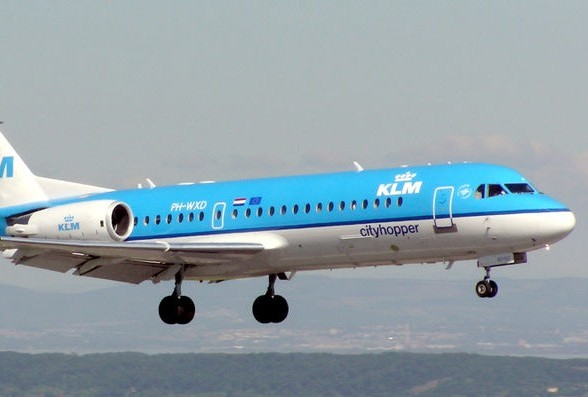
A KLM Royal Dutch airplane (Wikimedia commons/ Arpingstone- public domain)

A KLM Royal Dutch airplane (Wikimedia commons/ Arpingstone- public domain)

Dutch airline KLM has said it will halt flights to Tehran “as a result of the negative results and financial outlook” following the US withdrawal from the Iranian nuclear accord.

The airline, part of the Air France KLM group, made the announcement in a short statement on its website Saturday.

KLM said its last flight will leave Amsterdam on September 22 and return on September 23.

KLM ceased flights to Tehran in 2013, resuming them in 2016 after the nuclear deal was signed. That deal saw sanctions on Iran lifted in exchange for it limiting its enrichment of uranium.

US President Donald Trump announced in early May the unilateral withdrawal of the US from the Iran nuclear deal and the reinstatement of sanctions against the country, as well as against foreign companies who do business with it.

Air France resumed flights to Tehran in 2016 after an eight-year absence. The airline continues its flights.

On Saturday, the world’s third largest shipping container group, the French-owned CMA CGM, decided to withdraw from Iran over the threat of US sanctions, its chief executive said.

“Because of the Trump administration, we have decided to end our service to Iran,” Rodolphe Saade told an economic conference in Aix-en-Provence in southern France.

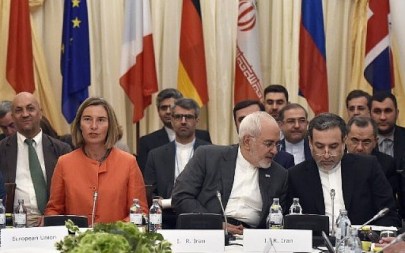
European Union High Representative for Foreign Affairs Federica Mogherini (L); Iranian Minister of Foreign Affairs Mohammad Javad Zarif (C) and political deputy at the Ministry of Foreign Affairs of Iran Abbas Araghchi take part in a Comprehensive Plan of Action (JCPOA) ministerial meeting on the Iran nuclear deal on July 6, 2018 in Vienna, Austria. (AFP/APA/Hans Punz)

On Friday, the remaining partners in the 2015 nuclear deal vowed to keep Iran plugged into the global economy despite the US withdrawal and sanctions threat.

Britain, France, and Germany along with Russia and China met with Iran in Vienna to offer economic benefits and assurances that would lessen the blow of sweeping US sanctions announced by Trump.

The foreign ministers Friday agreed on an 11-point list of joint goals in the Austrian capital, where the accord was signed with the aim of stopping Iran from building the atomic bomb in return for sanctions relief.

In the joint statement, they reconfirmed their commitment to the deal and its “economic dividends” for Iran, which has suffered worsening financial turbulence since Trump abandoned the accord, and vowed to work for “the protection of companies from the extraterritorial effects of US sanctions.”

Although there were no concrete pledges or deadlines, they also vowed efforts to keep open financial channels with Iran, promote export credit cover, and maintain open air, sea, and overland transport links.

Sign of War?

July 8, 2018

“The IDF is prepared for several scenarios and ready to defend the citizens of the State of Israel and its sovereignty” the IDF Spokesperson’s Unit said.

Lior Sharon
http://www.jerusalemonline.com/news/politics-and-military/military/sign-of-war-36288

Antiroket Israel, Iron Dome, meluncurkan amunisi pencegat roket-roket Hamas, 16 November 2012. Photo: Reuters/Amir Cohen

The IDF deployed several Iron Dome batteries in southern Israel Thursday following a situational assessment, the military told The Jerusalem Post.

“The IDF is prepared for several scenarios and ready to defend the citizens of the State of Israel and its sovereignty,” the IDF Spokesperson’s Unit said.

On Thursday, an IDF drone fired “a missile at a motorcycle” east of Deir al-Balah in the central Gaza Strip, official Palestinian news agency Wafa reported, adding that while there were no injuries the motorcycle was destroyed.

The IDF has been carrying out strikes in the Gaza Strip against vehicles used by terrorist cells who launch incendiary aerial devices into Israel. The Hamas terrorist group in turn has launched mortar shells towards southern Israeli communities.

On June 20, Hamas, along with Islamic Jihad, launched a barrage of 45 mortars shortly after IAF jets struck three targets in the Strip in response to incendiary kites and explosive balloons launched towards southern Israel.

Seven of the projectiles were intercepted by the Iron Dome missile defense system and another three fell inside the Strip. Four were found inside communities in the Eshkol Regional Council, causing damage to nearby homes and cars. One landed in the yard of an empty kindergarten.

A week later, at least 13 mortars were fired from the Gaza Strip after the IAF struck a vehicle said to have been heavily involved helping in Palestinians in launching incendiary devices into Israel. Two of the mortar shells were intercepted by the Iron Dome system over the city of Sderot.

Earlier on Thursday, the Defense Ministry announced that it had successfully conducted a planned missile test launch of the Iron Dome system from the Palmachim air base.

According to a statement released by the Ministry of Defense, the series of experiments were led by Rafael, the main contractor of the Iron Dome system, along with Elta and with the participation of the Israel Air Force and Navy.

During the test the various types of targets which simulate the emerging threats developing in the area were launched.

“Homa [missile defense] will continue to develop the Iron Dome system in order to deal with the emerging threats in the arena in order to best protect the State of Israel,” read the statement.

Israel continuously improves the technology behind the country’s anti-missile systems and last year the Defense Ministry carried out a number of experiments using American- made components in the course of the missile interception tests for the first time.

The experiments, which were conducted in the south of the country, focused on the use of the “Tamir” interceptor and it’s ability to intercept a number of targets which were fired simultaneously at different ranges.

The Rafael-built system carries 24 pounds of explosives and can intercept an incoming projectile from four to 70 kilometers away and Israel Aerospace Industries Ltd. which produces the radar system for the Iron Dome system through its ELTA division, has reported sales of it to various armies around the world.

Israel’s air defenses currently include the Iron Dome, designed to shoot down short-range rockets and the Arrow system which intercepts ballistic missiles outside of the Earth’s atmosphere. The David’s Sling missile defense system is designed to intercept tactical ballistic missiles, medium- to long-range rockets, as well as cruise missiles fired at ranges between 40 to 300km.

For the full article – click here

Israel ranks 8th on US News & World Report list of powerful countries

July 8, 2018

Source: Israel ranks 8th on US News & World Report list of powerful countries – Israel Hayom

( This, with over a million less population than the state of New Jersey… – JW )

The Creeping War against Iran is Still on the Cards

July 8, 2018

08.07.2018 Author: Salman Rafi Sheikh

Source Link: The Creeping War against Iran is Still on the Cards

{Watching the Mullahs squirm at the hands of their own people will be the premier sight to behold. – LS}

On June 27 and June 28, in a series of tweets from his official account, the US secretary of state Mike Pompeo went out of the way to praise protests in Iran, calling it a backlash against the “corruption, injustice and incompetence of their leaders.” It was no surprise to see Israel’s Netanyahu also praising the Iranians, asking further as to “why is Iran so poor? Why is unemployment so rampant? The answer is in two words: the regime. Iran’s dictators plunder the country’s wealth… The Iranian people are the ones that suffer.”  Clearly, both the United States and Israel are, if not directly fuelling the protests, certainly involved in an active encouragement of the crisis, an indication of how desirable the goal of regime change in Iran remains. Their encouragement isn’t simply restricted to social media. In fact, the US withdrawal from the Iran deal despite the EU’s opposition and the IAEA’s confirmation of Iranian compliance is also a part of their policy of regime change. Withdrawal has rather expectedly been followed by resumption of sanctions, a step that has always been taken with one cardinal objective in mind: forcing the country into an economic crisis so that wide spread protests may take place, leading to an overthrow of the undesirable regime. Above mentioned tweets and video messages confirm this undoubtedly, also confirming how the Trump administration has ‘pivoted’ to an Israeli agenda, totally scrapping the Obama administration’s legacy of a hard negotiated settlement with Iran.

Clearly, a joint US-Israeli plan against Iran is working, indications of which had already started to come as early as December 2017 when, as a senior US official said, after two days of talks at the White House, US and Israeli officials had reached an understanding, signing a secret pact, to counter Iranian actions. Several working groups, in this behalf, had also been established with an explicit purpose of targeting Iran’s nuclear and missile programme, Iran’s actions in Syria and its support for Hezbollah.

While the reported signatory to this document is the ousted national security adviser, H.R. McMaster, the appointment of John Bolton, the confirmed paid speaker for an Iranian militant group, does also confirm, as we have previously pointed out, how regime change agenda is absolutely back on Iran.

John Bolton, as could be expected, is now already deeply involved in setting up task forces to unsettle Iran in a big way. The purpose of this force is—again unsurprisingly—to exploit protests in Iran to the advantage of both the US and Israel.

The task force, with its world-wide anti-Iran mission, has been established at a time when the remaining signatories of Iran-nuke deal are trying to persuade Iran to stay in the deal. According to Iran’s IRNA news agency, Iranian officials will be meeting EU officials in Vienna on Friday, July 6, to discuss the new “incentive package” the EU has prepared to preserve the deal.

Israel, however, has other plans. According to the reports, the purpose of the task-force is also to use Iran’s internal crisis to build international opposition against the regime. As such, Israel will be sending diplomatic missions to EU, the UNO and even the World Bank to build pressure on what the Israeli officials call the “ayatollahs” in Iran to globally isolate them, put them under sanctions, heat things up in Iran and thus force them out of power.

The plan is also a clear manifestation of what Saudia’s Muhammad Bin Salman, a partner of the US and Israel against Iran, had said a year ago about fighting the war between the Sunni and the Shia not anywhere else, certainly not in Saudi Arabia, but within Iran itself.

Planning for this is already underway. And, an important aspect of this is, apart from encouraging internal crisis by strangulating its economy, is also to stir up Baloch insurgency in Iran by building Arab support for the Baloch against Iran. A Saudi funded think-tank, Arabian Gulf Centre for Iranian Studies, said in one of its 2016 report that the Saudis could “persuade Pakistan to soften its opposition to any potential Saudi support for the Iranian Baluch”, arguing further that “Arab support for the Iranian Baluch is a matter of strategic necessity in confronting the Iranian hegemony in the region.”

By thus heating things up, it is clear that the US-Israel and Saudia are not avoiding a war with Iran; they’re actually preparing the ground for it as Iran has already warned to increase the enrichment level to 20 per cent if the agreement falls apart.

And, If push comes to shove, this would be a win for the hawks in both the US and Israel, who have long been advocating to scrap the deal and have completely ignored sane voices within the same administration. For instance, within the US even, a number of still serving officials from the military and defence establishment had warned against and opposed the US decision to withdraw from the deal.

Even the defence secretary James Mattis is on record to have said that he has read the agreement thrice and found it to be “pretty robust”; Chair of the Joint Chiefs of Staff Gen. Joseph Dunford says, “Iran is adhering to its JCPOA obligations” and that quiting the deal “would have an impact on others’ willingness to sign agreements”; the head of US Strategic Command, Gen. John Hyten says, not only is Iran in compliance with JCPOA”  but also “it’s our job to live up to the terms of that agreement”; and the head of US Central Command, Gen. Joseph Votel says the nuclear deal is “in our interest” because it “addresses one of the principle threats that we deal with from Iran.”

With the latent reasons for withdrawing from the deal thus now in the limelight and certainly not unknown to any observer of geo-politics, one can certainly expect that a US-Israeli-Saudi effort to topple the Iranian regime from within is in its practical phase, which means that the nexus is shifting its geo-political chessboard from Syria to Iran. How long before we would start hearing people from within Iran, gaining foreign support, and chanting such slogans as “Ayatollahs must go”!