Archive for July 2018

Netanyahu vows no end to Gaza strikes until Hamas ‘gets the message’ 

July 14, 2018

Source: Netanyahu vows no end to Gaza strikes until Hamas ‘gets the message’ | The Times of Israel

Palestinians fire more than 100 projectiles into Israel, hit synagogue; Liberman reportedly conveys Israel’s demands to Hamas, including end to incendiary kite, balloon attacks

Palestinian youths look at a building that was damaged by an Israeli air strike in Gaza City on July 14, 2018 ( AFP PHOTO / MAHMUD HAMS)

Palestinian youths look at a building that was damaged by an Israeli air strike in Gaza City on July 14, 2018 ( AFP PHOTO / MAHMUD HAMS)

Prime Minister Benjamin Netanyahu vowed Saturday that Israel would step up its strikes on Gaza until the Palestinian terror groups halt all violence coming out of the coastal enclave.

Netanyahu said that after consultations with Defense Minister Avigdor Liberman and the IDF chief of Staff Gadi Eisenkot it was decided to take “powerful action against Hamas terror.”

“The IDF hit Hamas with the harshest blow since Operation Protective Edge and we will intensify our reaction as much as necessary,” Netanyahu said Saturday evening, after the IDF attacked dozens of targets in the Strip on Saturday, amid relentless rocket fire from Gaza, in the most extensive daytime assault since the 2014 conflict.

“If Hamas does not understand the message today, it will understand tomorrow,” Netanyahu said in a video statement.

Throughout the day Palestinians fired more than 100 rockets and mortar shells at Israel. Three Israelis were wounded when rockets hit a home and a synagogue in the border town of Sderot. They were evacuated to hospital in a moderate condition.
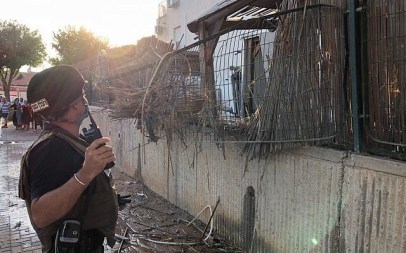
A police officer outside a building hit by a rocket in the city of Sderot. (Israel Police)

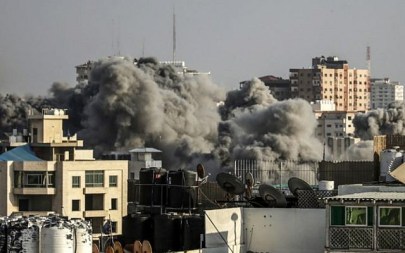
Also, Palestinians reported that two teens were killed when the air force bombed a multi-story Hamas training complex in the Gaza Strip, completely destroying the building and exposing a tunnel complex underneath.

The Hamas-run health ministry identified the dead as 15-year-old Amir al-Nimra and 16-year-old Louay Kahil. It said 14 others were wounded in the more than 40 Israeli strikes throughout the day.

The Walla news site quoted a senior defense official as saying that Liberman had been in talks during the day with Nikolay Mladinov, the United Nations Special Coordinator for the Middle East Peace Process.

Mladinov reportedly held talks with several Israeli and Egyptian officials in an attempt to restore calm to the region.

According to Walla, Liberman told Mladinov that Israel’s main demand was the halt of the fire kites and balloons.
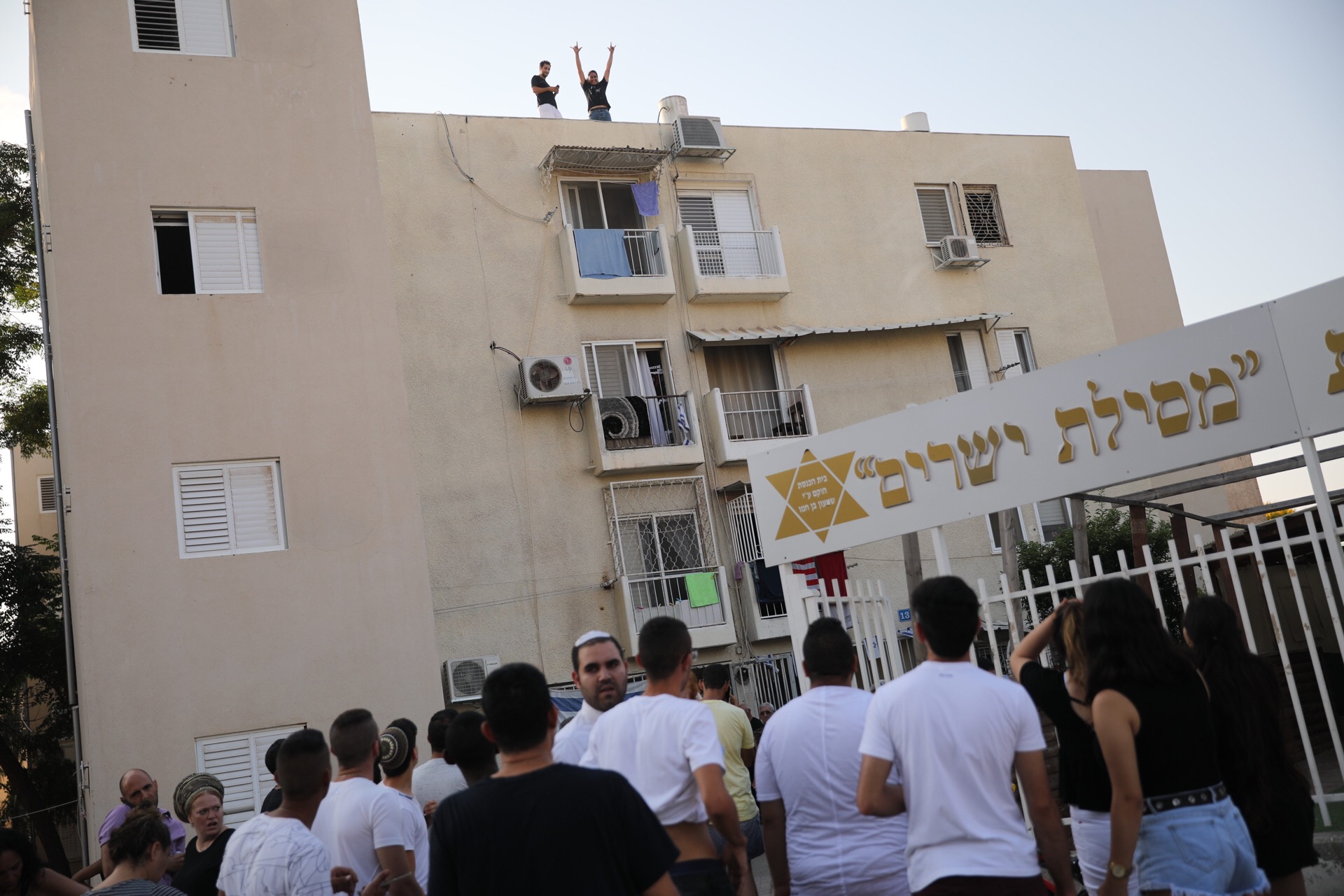
People at the scene where a building was hit by a rocket in the southern Israeli city of Sderot, during an escalation in rocket fire in the Gaza envelope Israeli towns, on July 14, 2018. (Hadas Parush/Flash90)

Hadashot TV news reported late Saturday that while Hamas leaders have told Egyptian mediators that they will keep firing rockets into Israel until the IDF stops its military actions, and bragged about the rocket fire, the Egyptians told Hamas that Israel is ready for an escalation of the conflict if necessary, and that therefore if Hamas wants the exchanges to stop, it will have to halt first. The TV news report also speculated that while Hamas might now be looking for a ceasefire, the small Islamic Jihad terror group was not.
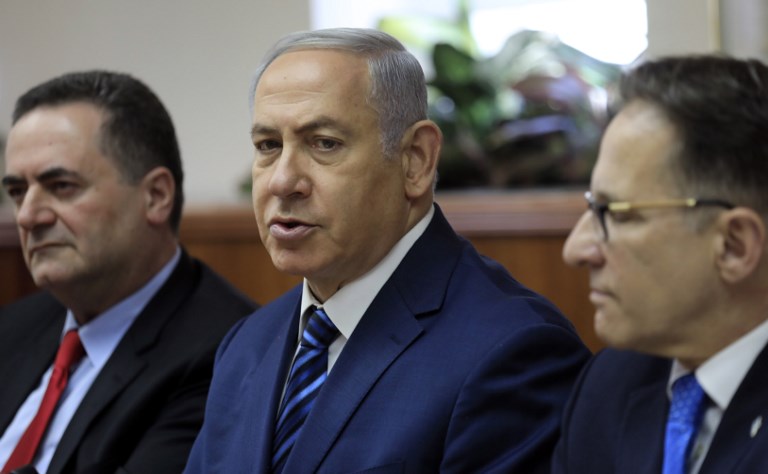
Prime Minister Benjamin Netanyahu chairs the weekly cabinet meeting in his Jerusalem office on July 1, 2018, flanked by Cabinet Secretary Tzachi Braverman (right) and Intelligence Minister Israel Katz (left) (AFP PHOTO / POOL / Tsafrir Abayov)

“The message we are conveying is that we will not accept missiles, explosive devices, mortar shells, or kites,” Israel’s Intelligence Minister Israel Katz told the TV station. “Not any kind of terrorism.”

Over the last few months, Palestinians in Gaza have flown thousands of kites and balloons attached to incendiary devices that have set off hundreds of fires in farm lands and nature reserves along the border with Gaza, destroying tens of thousands of acres.
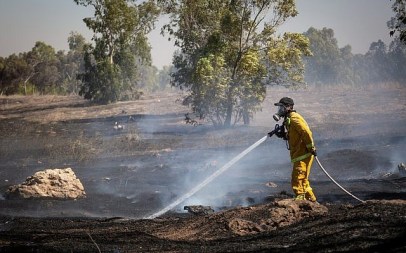
Firefighters extinguish a fire in a field caused by incendiaries attached to kites flown by Palestinians, from the Gaza Strip, June 27, 2018. (Flash90)

Earlier in the day the IDF said it had three main aims in its military actions in Gaza: Stopping the fire kites, the rocket fire, and the weekly protests along the Gaza border.

The Security Cabinet was to convene for an emergency meeting Sunday afternoon to deal with the escalating violence in Gaza.

Israeli ministers were updated on the developments by phone overnight Friday-Saturday, as residents of Israeli communities near Gaza spent the night in bomb shelters.

Israel’s political leadership was considering a range of possibilities for trying to halt the rocket fire, including targeted assassinations of Hamas terror chiefs, the use of ground forces, and a ceasefire mediated by Egypt and/or others, but no decision had been made as of Saturday late afternoon, Hadashot TV news reported.

Eisenkot also met with senior commanders in the south to review the situation.

Egyptian sources said Cairo was working to prevent a further escalation and towards mediating a ceasefire between Israel and Palestinian terror groups, the Walla news site reported.

Nickolay Mladenov, UN Special Coordinator for the Middle East Peace Process, poses for a photo during the INSS conference in Tel Aviv, January 30, 2018. (JACK GUEZ/AFP)

According to unconfirmed reports in Gaza, by late afternoon Hamas and Islamic Jihad officials had ordered their operatives to halt all rocket fire. Nevertheless, the fire continued unabated.

After midnight Friday-Saturday, the Israel Defense Forces hit an attack tunnel and Hamas training bases in Gaza in response to the moderate wounding of an IDF officer by a hand-grenade thrown during a border riot on Friday.

During the night, Palestinians fired more than 30 projectiles into Israel and kept up the attacks on Saturday, firing a further 60 rockets and mortar shells. Residents of Israeli border communities spent the night in bomb shelters and were cautioned to remain close to the shelters during the day.
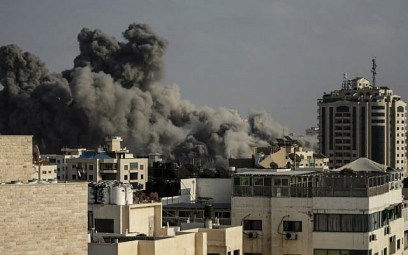
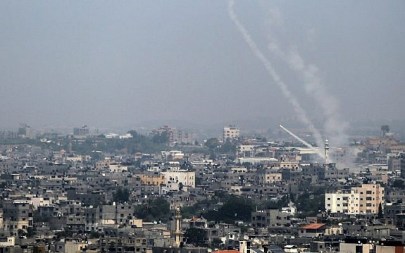
Smoke rises above buildings during an Israeli air strike on Gaza City on July 14, 2018. (AFP PHOTO / MAHMUD HAMS)

The IDF said Iron Dome intercepted 20 projectiles in total that were headed for residential areas.

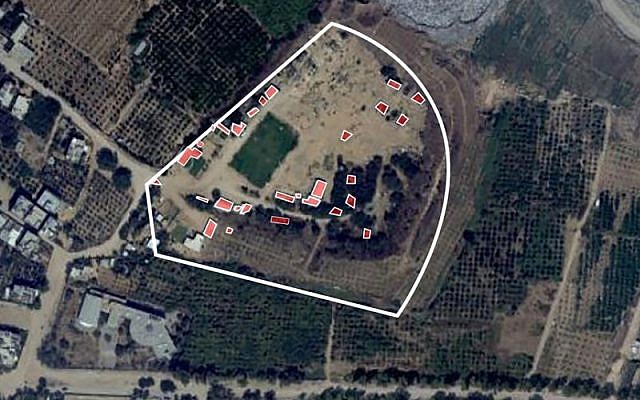
The primary target of the IAF strikes Saturday was the Hamas battalion headquarters in Beit Lahia, in the north of the Strip, the army said.

“The focus of the attack is a wide-scale strike of the Hamas Battalion HQ in Beit Lahia, which includes urban warfare training facilities, weapon storage warehouse, training compounds, command centers, offices, and more,” the IDF said in a statement.
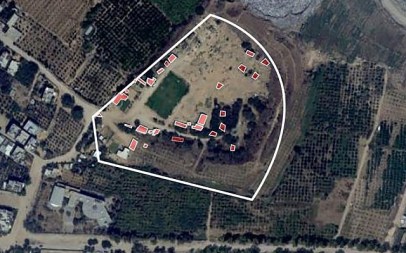
An aerial illustration of the Hamas Battalion headquarters in Beit Lahia. (IDF Spokesperson)

“In addition, a weapons manufacturing site and storage facilities housing various types of weapons, including Hamas’ naval capabilities, were struck,” it said.

The air force also attacked a Palestinian terrorist cell launching mortar shells.

The IDF spokesman said the aim of the operation was to “restore a sense of security” and that the military would “respond as necessary” to a wide range of scenarios.

Local residents, who had earlier been told they could return to their usual routines after a barrage overnight Friday, were instructed to remain close to bomb shelters, and large gatherings of people were to be canceled.

Hamas on Saturday said the barrage of rockets and mortar shells into Israeli territory overnight was fired by the “resistance” to “stop Israeli escalation.”

The spokesman for the terrorist group, Fawzi Barhoum, also said the projectiles were an “immediate response” that was meant to “deliver the message” to Israel.

The army said it held Hamas responsible for all violence emanating from Gaza, which the terror group has ruled since 2007.

Three Israelis wounded as rockets from Gaza hit house, synagogue in Sderot

July 14, 2018

Source: Three Israelis wounded as rockets from Gaza hit house, synagogue in Sderot | The Times of Israel

Palestinians fire a salvo of rockets at the border town, Iron Dome intercepts several but two get through; injured evacuated to hospital in Ashkelon

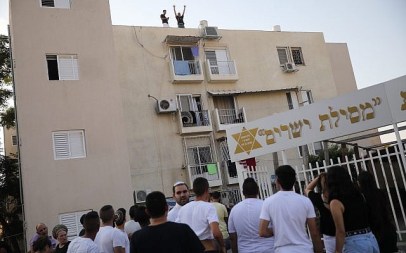
People at the scene where a courtyard of a house was hit by a Gaza rocket in the southern Israeli city of Sderot, on July 14, 2018. (Hadas Parush/Flash90)

People at the scene where a courtyard of a house was hit by a Gaza rocket in the southern Israeli city of Sderot, on July 14, 2018. (Hadas Parush/Flash90)

Palestinians in Gaza fired a salvo of rockets at the border town of Sderot on Saturday evening, with two of the rockets hitting a home and a synagogue. Three Israelis were moderately wounded.

The Magen David Adom rescue service said the three wounded were a 52-year-old man with a chest injury due to shrapnel, and two girls, aged 14 and 15, with limb injuries.

They were evacuated to Barzilai Medical Center in Ashkelon for emergency medical treatment.

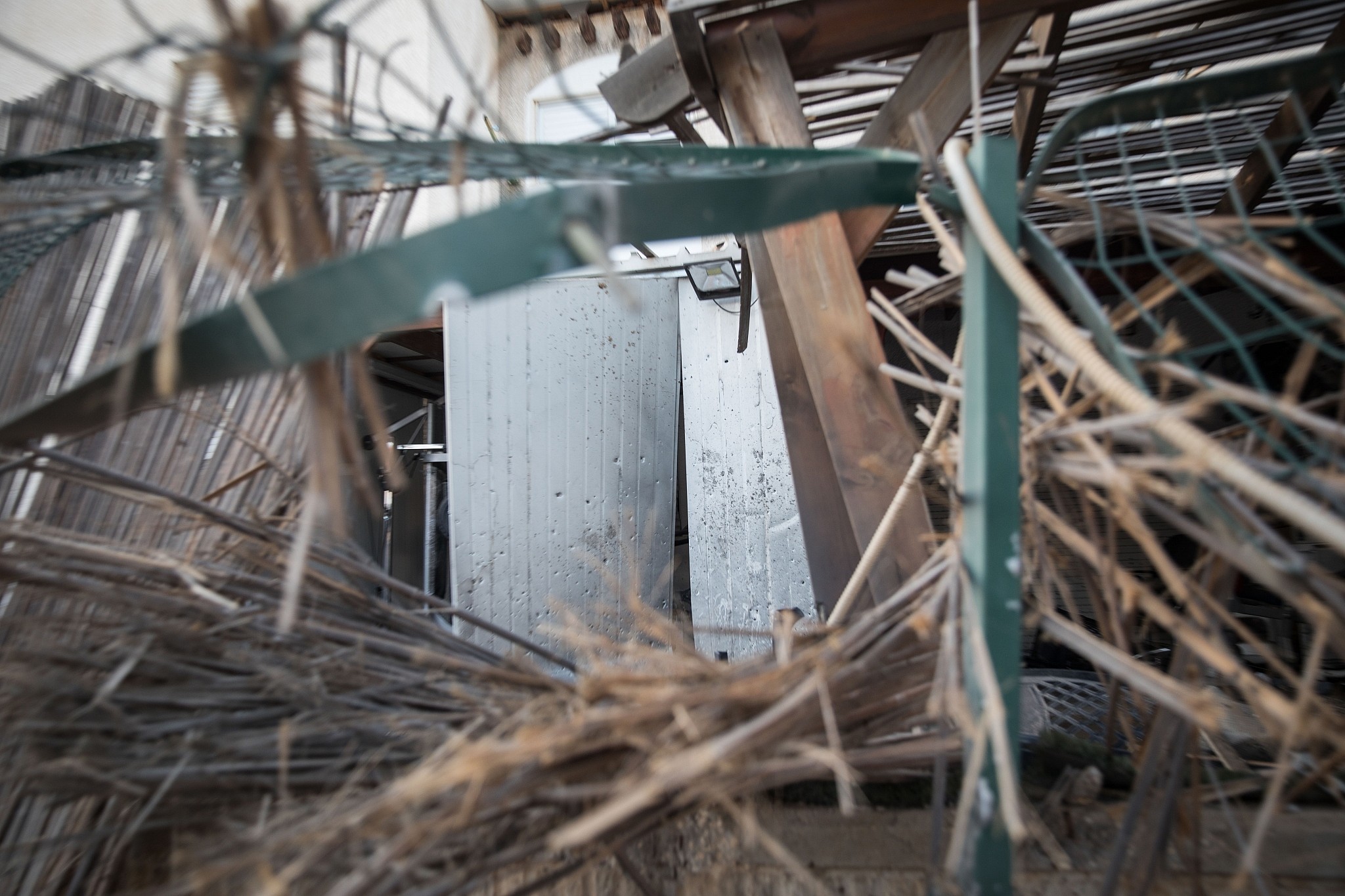
The rocket that injured them landed on the roof of a home in the town. It hit a reinforced bomb shelter in the building, limiting the damage. The second rocket hit a synagogue that was empty at the time.

Several other rockets were intercepted by Iron Dome.

People at the scene where a building was hit by a rocket in the southern Israeli city of Sderot, during an escalation in rocket fire in the Gaza envelope Israeli towns, on July 14, 2018. (Hadas Parush/Flash90)

A 45-year-old Israeli woman who suffered from anxiety was also evacuated to the hospital.

Over the weekend, Palestinians fired dozens of rockets into Israel and the IDF attacked more than 40 targets in the Strip, in the most extensive daytime assault since 2014’s Operation Protective Edge.

Meanwhile, the Palestinian Health Ministry in the Hamas-run Gaza reported that two teenagers, aged 15 and 16, were killed in an IDF strike Saturday on a structure which the Israeli army said was situated over an attack tunnel in Gaza.

“IDF fighter planes attacked a high-rise building in the Shatti refugee camp in the northern Gaza Strip, which served as a training facility for the Hamas terrorist organization,” the IDF said of the strike in a statement. “An attack tunnel was dug under the building, which was used for underground fighting training. This tunnel is part of a network of underground tunnels dug by the Hamas terrorist organization throughout the Gaza Strip.”

A picture taken on July 14, 2018 shows smoke plumes rising following an Israeli air strike in Gaza City. (AFP / MAHMUD HAMS)

Fourteen people have been wounded across Gaza, the Hamas-run health ministry said.

Palestinian sources reported that the IDF conducted several more strikes in the northern Gaza Strip on Saturday evening.

According to unconfirmed reports in Gaza, by late afternoon Hamas and Islamic Jihad officials had ordered their operatives to halt all rocket fire. Nevertheless, just minutes after those reports circulated, a projectile fired in the direction of Kibbutz Alumim near Nahal Oz was intercepted by the Iron Dome missile defense system.

Sirens were also heard in the Eshkol region in southern Israel and in Ashkelon in the evening. No injuries or damage were reported on the Israeli side.

Prime Minister Benjamin Netanyahu was holding ongoing consultations Saturday with Defense Minister Avigdor Liberman, IDF Chief of Staff Gadi Eisenkot, and other senior security officials to review the developing situation surrounding the Gaza Strip.

Israel’s political leadership was considering a range of possibilities for trying to halt the rocket fire, including targeted assassinations of Hamas terror chiefs, the use of ground forces, and a ceasefire mediated by Egypt and/or others, but no decision had been made as of Saturday late afternoon, Hadashot TV news reported.

Damage caused to the back yard of a house that was hit by a rocket from Gaza in the southern Israeli city of Sderot, on July 14, 2018. (Hadas Parush/Flash90)

Egyptian sources said Cairo was working to prevent a further escalation and towards mediating a ceasefire between Israel and Palestinian terror groups, the Walla news site reported.

Also Saturday, Nikolai Mladinov, the United Nations Special Coordinator for the Middle East Peace Process, reportedly held talks with several Israeli and Egyptian officials in an attempt to restore calm to the region.

During the night, Palestinians fired more than 30 projectiles into Israel and kept up the attacks on Saturday, firing a further 60 rockets and mortar shells. Residents of Israeli border communities spent the night in bomb shelters and were cautioned to remain close to the shelters during the day.

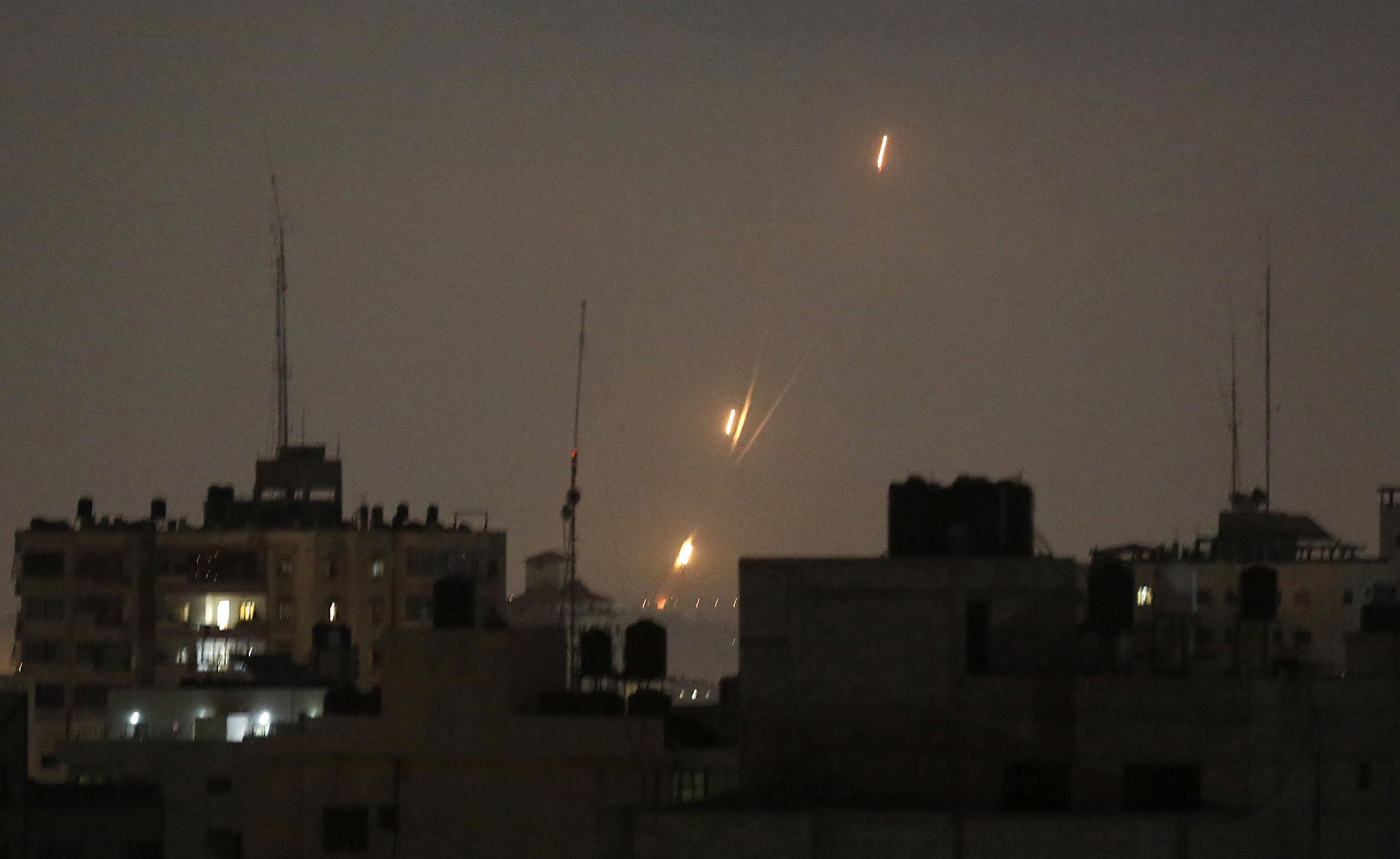
A picture taken on July 14, 2018 shows Palestinian rockets being fired from Gaza City towards Israel. ( AFP PHOTO / BASHAR TALEB)

After midnight Friday-Saturday, the Israel Defense Forces hit an attack tunnel and Hamas training bases in Gaza in response to the moderate wounding of an IDF officer by a hand-grenade thrown during a border riot on Friday.

The IDF said Iron Dome intercepted 20 projectiles in total that were headed for residential areas.

Hamas on Saturday said the barrage of rockets and mortar shells into Israeli territory overnight was fired by the “resistance” to “stop Israeli escalation.”

The spokesman for the terrorist group, Fawzi Barhoum, also said the projectiles were an “immediate response” that was meant to “deliver the message” to Israel.

The army said it held Hamas responsible for all violence emanating from Gaza, which the terror group has ruled since 2007.
Massive Syrian-Hizballah Golan war preparations tie IDF down from reining in Gaza terror

July 14, 2018

Source: Massive Syrian-Hizballah Golan war preparations tie IDF down from reining in Gaza terror – DEBKAfile

“The countdown has started for the battle of Quneitra,” Syrian and Iranian propaganda machines trumpeted on Friday, July 13. Since Thursday, DEBKAfile reports, troops have been pouring out of Daraa towards the Quneitra region opposite Israel’s Golan border.

They consist of the Syrian army and National Defense Forces (NDF) which are composed of Hizballah and Iraqi and Afghan Shiite militias commanded by Revolutionary Guards officers. On Friday, Syrian air defense units in Quneitra and Damascus were placed on war alert against potential Israeli aerial bombardment.

Friday night, Hamas shot 31 rockets into Israel amid two Israeli Air Force strikes in Gaza.

Another straw in the winds of war came on Friday from Ali Akbar Velayati, Iranian supreme leader Ayatollah Ali Khamenei’s adviser on external affairs. After meeting Russian President Vladimir Putin in Moscow, he said: “We will immediately leave if the Iraqi and Syrian governments want it, not because of Israel’s and American pressure.” Tehran has therefore welded together its Syrian and Iraqi policies and made them interdependent.

He went on to say: “We will counter the Americans powerfully… We will help Syria counter…US aggression. If the US does not want to leave our region, we will force it to do that. For the Iranian regime. the US and Israel are interchangeable.”
Velayati’s words are significant in three respects:

  1. Since Iraqi militias are fighting with the Syrian army in the southwestern province of Daraa – and are scheduled to move with them on to the Quneitra region – a decision to oust Iran and its proxies from Syria rests not only with Damascus and Tehran, but also with Baghdad.
  2. By this step, Iran has blocked projected deals for the removal of the Iranian military and proxy presence from Syria that Presidents Donald Trump and Vladimir Putin may seek to transact at their Helsinki summit on July 16.
  3. Israel faces an increasingly heavy price for failing to disrupt Hizballah’s insertion in the Syrian war in 2013.This action opened the door to Iran. The price was compounded when the Netanyahu government refrained from preventing the influx of Iraqi Shiite militias for boosting Syrian and Iranian military strength in Syria. The IDF will have to take on this powerful force in Quneitra to hold it back from the Golan border.

All these moves portend the launching of the Quneitra offensive in the next 48 hours – before or during the Trump-Putin summit. Syrian, Iranian and Hizballah leaders will not hang around and wait for its outcome like Israel. As a result of the Israeli government’s passive stance, the IDF is facing active warfare on two major fronts, the Golan and the Gaza Strip.

Prime Minister Binyamin Netanyahu and Defense Minister Avigdor Lieberman committed a disastrous mistake when they did not resist Hamas’ latest bomb-for-bomb ultimatum. This gave the Palestinian terrorists parity with the IDF and the freedom to call the shots on whether the Israeli communities living next door live in peace. The Hamas example has given Iran, Syria and Hizballah ideas about how to dictate the terms of war in Quneitra. Israeli leaders have maintained that their hands are tied for crushing the Hamas terror machine operating out of the Gaza Strip by the more substantial threat from the north. By this inaction, they have condemned the IDF to fight on two simultaneous fronts.

As dozens of rockets hit Israel, IDF pounds Gaza in heaviest strikes since 2014

July 14, 2018

Palestinian terror groups fire 60 projectiles at Israel on Saturday afternoon; residents in border communities told to remain close to shelters, public gatherings canceled

https://www.timesofisrael.com/idf-pounds-gaza-in-widest-day-of-strikes-since-2014-war/
A picture taken on July 14, 2018 shows a smoke plume rising following an Israeli air strike in Gaza City (AFP PHOTO / MAHMUD HAMS)

Israeli aircraft on Saturday attacked more than 40 targets in the Gaza Strip in the most extensive daytime assault since 2014’s Operation Protective Edge as Palestinian terror groups fired repeated salvos of rockets and mortars into Israel.

The surge in violence intensified after midnight Friday-Saturday as the Israel Defense Forces hit an attack tunnel and Hamas training bases in Gaza in response to the moderate wounding of an IDF officer by a hand-grenade thrown during a border riot on Friday.

During the night, Palestinians fired more than 30 projectiles into Israel and kept up the attacks on Saturday, firing a further 60 rockets and mortar shells. Residents of Israeli border communities spent the night in bomb shelters and were cautioned to remain close to the shelters during the day.

The IDF said Iron Dome intercepted 16 projectiles that were headed for residential areas in total.

Israel’s political leadership is considering a range of possibilities for trying to halt the rocket fire, including targeted assassinations of Hamas terror chiefs, the use of ground forces, and a ceasefire mediated by Egypt and/or others, but no decision had been made as of Saturday late afternoon, Hadashot TV news reported.

The primary target of the IAF strikes Saturday was the Hamas battalion headquarters in Beit Lahia, in the north of the Strip, the army said.

An aerial illustration of the Hamas Battalion headquarters in Beit Lahia. (IDF Spokesperson)

“The focus of the attack is a wide-scale strike of the Hamas Battalion HQ in Beit Lahia, which includes urban warfare training facilities, weapon storage warehouse, training compounds, command centers, offices and more,” the IDF said in a statement.

“In addition, a weapons manufacturing site and storage facilities housing various types of weapons, including Hamas’ naval capabilities, were struck,” it said.

The air force also attacked a Palestinian terrorist cell launching mortars.

The IDF spokesman said the aim of the operation was to “restore a sense of security” and that the military would “respond as necessary” to a wide range of scenarios.

The Hamas-run health ministry said it had not received any reports of injuries in the Israeli strikes.

https://videoidf.azureedge.net/771f7156-c3d9-4e74-8b8e-c16beaced50f.mp4?_=1

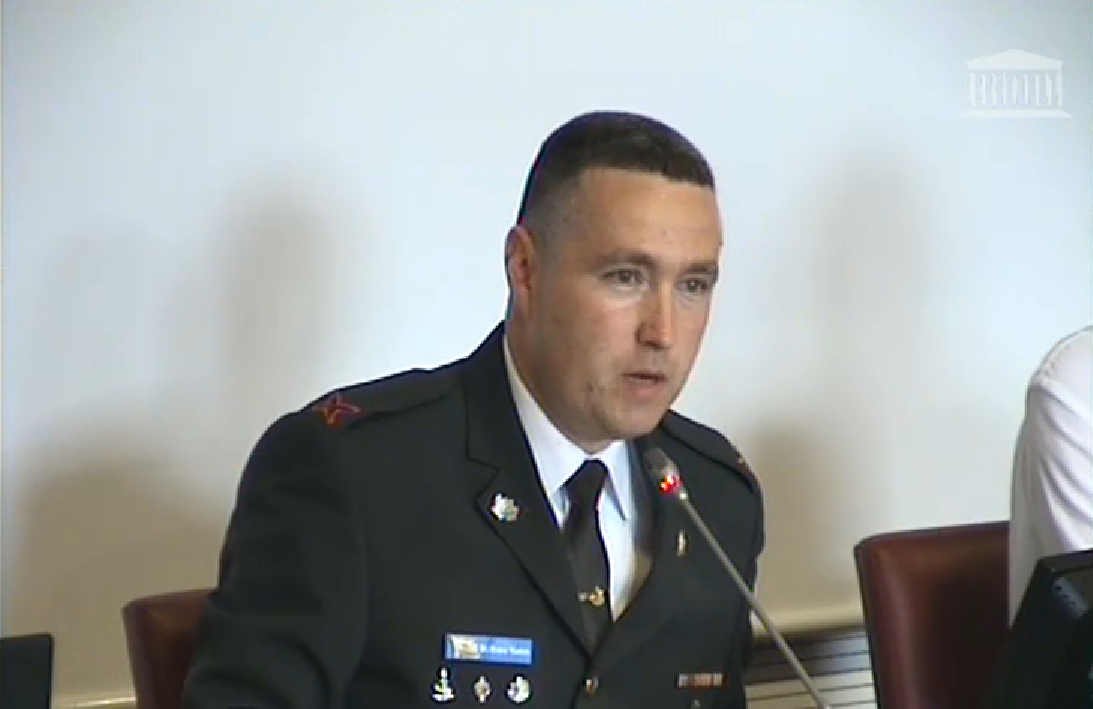
According to IDF spokesman Brig. Gen. Ronen Manelis, the operation had three aims: To end the incendiary kites and balloons from Gaza, end the large-scale border protests, and end the rocket and mortar fire.

IDF Spokesman Brig. Gen. Ronen Manelis (screen capture of National Assembly footage)

“There are three factors occurring that we view seriously and cannot allow to continue,” he said, adding that this was the largest daytime Israeli strike on Gaza since the 2014 Gaza War.

Media reports said that Egyptian intelligence services had contacted the Hamas leadership in Gaza to try to prevent a further escalation of violence.

In the Saturday afternoon salvo, Palestinians fired more than 60 rockets and mortar shells and sirens wailed frequently in southern Israel. Army Radio reported that at least one projectile was intercepted, with the remainder falling in unpopulated areas.

There were no immediate reports of injuries.

A farm building was lightly damaged in one border community, with no harm to any animals reported.

Local residents, who had earlier been told they could return to their usual routines after an earlier barrage overnight Friday, were instructed to remain close to bomb shelters, and large gatherings of people were to be canceled.

The day of tension and violence came after terrorists fired more than 30 rockets and mortars toward Israel overnight Friday in the wake of IDF strikes on a number of Hamas targets in Gaza in response to violence along the border.

No injuries or damage were reported but warning sirens wailed for much of the night in border communities including the Sdot HaNegev Regional Council area and the town of Sderot.

The army earlier on Saturday said it targeted two Hamas attack tunnels as well as other military compounds in the Strip, including those involved in the spate of incendiary kite and balloon attacks.

Even as the airstrikes were being carried out, the IDF said rockets were fired toward Israel.

According to the IDF, six projectiles were intercepted by the Iron Dome aerial defense system. One rocket landed inside a kibbutz in the Shar HaNegev Regional Council area.

Hamas on Saturday said the barrage of rockets and mortar shells into Israeli territory overnight was fired by the “resistance” to “stop Israeli escalation.”

The spokesman for the terrorist group, Fawzi Barhoum, also said the projectiles were an “immediate response” that was meant to “deliver the message” to Israel.

The army said it held Hamas responsible for all violence emanating from Gaza, which the terror group has ruled since 2007.
“The Hamas terror organization is responsible for the events transpiring in the Gaza Strip and emanating from it and will bear the consequences for its actions against Israeli civilians and Israeli sovereignty,” the army said, adding that “the IDF views Hamas’ terror activity with great severity and is prepared for a wide variety of scenarios.”

The IDF said aircraft had attacked “an offensive terror tunnel in the southern Gaza Strip, in addition to several terror sites in military compounds throughout the Gaza Strip, among them complexes used to prepare arson terror attacks and a Hamas terror organization training facility.”

The IDF published video of its air strikes.

https://videoidf.azureedge.net/6ffa8be2-92bf-4633-a125-b805da677753.mp4?_=2

The latest round of violence has threatened to spark a further conflagration after weeks of tensions along the volatile border.

Israel in recent weeks has repeatedly warned Hamas that while it has no interest in engaging in the kind of conflict that led to the sides fighting three wars over the past decade, it would not tolerate its continued efforts to breach the border fence and its campaign to devastate Israeli border communities with incendiary attacks.

On Friday, thousands of Palestinians gathered near the Gaza border for their near-weekly protest. The army said protesters attacked soldiers with grenades, bombs, Molotov cocktails, and rocks.

A 15-year-old Palestinian who tried to climb over the fence into Israel was shot dead, media reports in Gaza said.

Later the IDF said an Israeli officer was moderately wounded by a grenade thrown at him during the clashes at the border.

On Saturday, the Hamas-run health ministry in Gaza announced that a 19-year-old succumbed to his wounds sustained at the clashes a day earlier.

It was not clear whether the two deaths were tied to the attack that wounded the Israeli officer.

Gaza officials said 220 others were hurt in Friday’s riots. Most were treated at the scene, while several dozen were taken to hospital. The violence was held under the banner of “Identifying with Khan al-Ahmar,” a West Bank Bedouin village whose planned demolition by Israel is being debated at the High Court.

Since March 30, weekly clashes have taken place on the Gaza border, with Israel accusing Hamas of using the demonstrations as cover to carry out attacks and attempt to breach the security fence. The “March of Return” protests have also seen Palestinians fly airborne incendiary devices toward Israeli territory, sparking hundreds of fires in southern Israel and causing millions of shekels in estimated damages.

The Israeli army reportedly notified Hamas in recent days that if the incendiary kite and balloon attacks from the Gaza Strip don’t cease, Israel would respond with major military action.

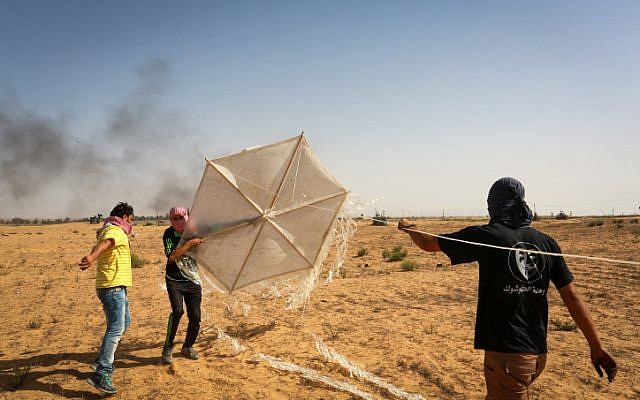
Palestinians prepare a kite with flammable materials that they will fly into southern Israel from Rafah, in the southern Gaza Strip, on June 22, 2018. (Abed Rahim Khatib/Flash90)

On Monday, Israel announced it was shutting down the Kerem Shalom border crossing — the Strip’s main crossing for commercial goods — in response to the endless stream of incendiary and explosive kites and balloons that have been flown into southern Israel, sparking fires that have burned thousands of acres of land and caused millions of shekels in damages. Humanitarian and essential supplies continue to enter Gaza.

The IDF has sought to avoid an escalation of hostilities on the southern front despite the attacks, but according to the Haaretz daily, the political pressure to act has been building as the economic and psychological harm caused by the fires takes its toll.

On Wednesday, incendiary kites and balloons sparked 19 fires of varying sizes in Israel, according to local government officials. Fifteen of them occurred in the Eshkol region, which abuts the southern Gaza Strip. The other four occurred in the Sha’ar Hanegev region, which lies to the northeast of the coastal enclave.

In response, the Israeli military conducted an airstrike against a group of Palestinians it said was launching incendiary balloons toward Israel from the southern Gaza Strip, east of the city of Rafah. There, too, no injuries were reported.

After shuttering Kerem Shalom, the army said humanitarian aid, notably food and medicine, would still be allowed into Gaza, but would require special permission from the military liaison, Maj. Gen. Kamil Abu Rokon, to the Palestinians.

The military said the closure would continue so long as Palestinians persist in launching incendiary kites and balloons into Israel.

Agencies contributed to this report. 

Palestinians fire 17 rockets into Israel as IDF bombs tunnel, Hamas base in Gaza

July 14, 2018

Iron Dome intercepts 5 projectiles, one rocket falls in a kibbutz; no injuries reported in Israel or in Gaza; flare up comes after IDF officer wounded by grenade in border riot.


Illustrative: Flames from rockets fired by Palestinians are seen over Gaza Strip heading toward Israel, in the early morning of May 30, 2018. (AP Photo/Hatem Moussa)

By TOI Staff July 13, 2018 Times of Israel

Source Link: Palestinians fire 17 rockets into Israel as IDF bombs tunnel, Hamas base in Gaza

{Meanwhile, back at the ranch.  – LS}

Israeli aircraft hit several sites in the Gaza Strip early Saturday including a terror tunnel and several Hamas bases after an IDF officer was wounded by a grenade during a riot on the border, the army said. Following the air raids, Palestinian terror groups launched a barrage of at least 17 rockets or mortars into Israel.

The army said five of the launches were intercepted by the Iron Dome system. There were no reports of injuries. However, one rocket landed inside a kibbutz in the Shar HaNegev Regional Council area.

The IDF said aircraft had attacked “an offensive terror tunnel in the southern Gaza Strip, in addition to several terror sites in military compounds throughout the Gaza Strip, among them complexes used to prepare arson terror attacks and a Hamas terror organization training facility.”

No injuries were reported in Gaza.

Following the airstrikes rocket warning sirens wailed repeatedly in Israeli communities around the Gaza Strip, including the Sdot HaNegev Regional Council area and the town of Sderot. Residents reported sounds of explosions, Israel Radio reported.

About 30 minutes after the first wave, sirens sounded again in the Hof Ashkelon Regional Council area and in the Eshkol region. Residents were warned to spend the night in bomb shelters.

The army said it held Hamas responsible for all violence emanating from Gaza, which it has ruled since 2007.

“The Hamas terror organization is responsible for the events transpiring in the Gaza Strip and emanating from it and will bear the consequences for its actions against Israeli civilians and Israeli sovereignty,” the army said, adding that “the IDF views Hamas’ terror activity with great severity and is prepared for a wide variety of scenarios.”

The violence came after an IDF officer was moderately wounded Friday afternoon when a grenade was hurled at him by assailants during clashes at the Gaza border fence, the army reported Friday night.

The military said soldiers fired back at the attackers and identified hitting them. The officer was rushed to Beersheba’s Soroka Medical Center and has family has been notified.

It was the most serious attack on Israeli forces in over three months of border protests, during which time soldiers have on several occasions been targeted with gunfire and bombs.

Israel has long accused Hamas of using the weekly border demonstrations as cover to carry out attacks against Israel.

Earlier the Hamas-run health ministry said a 15-year-old Palestinian was killed during the clashes with the Israeli army along the Gaza border.


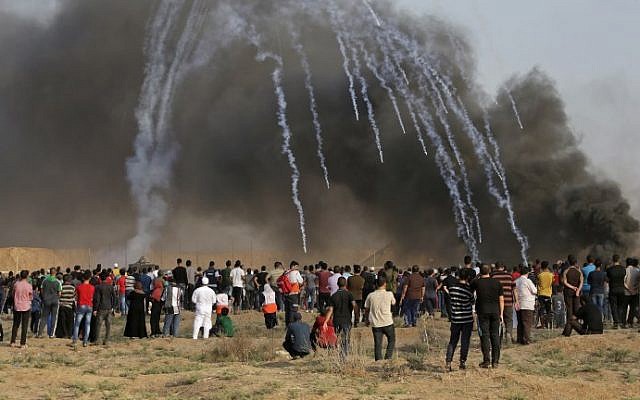
A picture taken on July 13, 2018 shows tear gas canisters fired by Israeli forces landing amidst protesters during a demonstration along the border with Israel east of Gaza City. (AFP/Mahmud Hams)

It was not clear whether that incident was tied to the attack that wounded the officer.

The Israeli military said thousands took part in the demonstrations, and that soldiers were attacked with grenades, bombs, Molotov cocktails and rocks. Troops responded with less-lethal means and fired live rounds in certain cases, including at one person who tried to cut through the security fence.

Gaza officials said 220 others were hurt in the riots. Most were treated at the scene, while several dozen were taken to hospital. Friday’s violence was held under the banner of “Identifying with Khan al-Ahmar,” a West Bank Bedouin village whose planned demolition by Israel is being debated at the High Court.

Also Friday, two soldiers were lightly injured in a car crash near the Gaza border in the afternoon when a utility trailer connected to their vehicle overturned. The soldiers were taking part in efforts to put out a large fire caused by an incendiary kite at Kibbutz Or Haner.

Firefighters said they managed to get the blaze under control, with the help of several teams and four firefighting planes.


Israeli soldiers walk amidst smoke from a fire in a wheat field near the Kibbutz of Nahal Oz, along the border with the Gaza Strip, which was caused by incendiaries tied to kites flown by Palestinian protesters from across the border., May 14, 2018. (Jack Guez/AFP)

Officials said 15 separate fires had erupted in the Gaza periphery since the morning due to incendiary kites and balloons. All were brought under control.

Since March 30, weekly clashes have taken place on the Gaza border, with Israel accusing Hamas of using the demonstrations as cover to carry out attacks and attempt to breach the security fence. The “March of Return” protests have also seen Palestinians fly airborne incendiary devices toward Israeli territory, sparking hundreds of fires in southern Israel and causing millions of shekels in estimated damages.

The Israeli army has reportedly notified Hamas in recent days that if the incendiary kite and balloon attacks from the Gaza Strip don’t cease, Israel will respond with major military action.

The threat comes amid a period of increased tension between Israel and the Gaza-ruling terror group. On Monday, Israel announced it was shutting down the Kerem Shalom border crossing — the Strip’s main crossing for commercial goods — in response to the endless stream of incendiary and explosive kites and balloons that have been flown into southern Israel, sparking fires that have burned thousands of acres of land and caused millions of shekels in damages. Humanitarian and essential supplies continue to enter Gaza.

The IDF has sought to avoid an escalation of hostilities on the southern front despite the attacks, but according to the Haaretz daily, the political pressure to act has been building as the economic and psychological harm caused by the fires takes its toll.


Palestinians prepare a kite with flammable materials that they will fly into southern Israel from Rafah, in the southern Gaza Strip, on June 22, 2018. (Abed Rahim Khatib/Flash90)

Israeli officials have conveyed this to Hamas through an intermediary, and said a significant Israeli response was inevitable if the current situation continued, the paper reported.

The army is now examining options for a significant and painful military response against Hamas that would be pinpoint enough not to spark a full-fledged war, the report said.

Friday’s report came a day after an Israeli drone fired two missiles toward a group of Palestinians flying incendiary balloons into southern Israel from the northern Gaza Strip, according to Palestinian media.

This was the second such airstrike in less than 24 hours.

The IDF confirmed that one of its aircraft fired at a cell that had launched balloons toward Israel from northern Gaza. No injuries were reported in the airstrike, which the official Palestinian Wafa news outlet said occurred near the northern Gaza town of Beit Hanoun.

Multiple Palestinian news outlets, including Wafa, reported that Israel conducted two strikes on Thursday, one near Beit Hanoun and a second east of the city of Jabaliya in the northern Gaza Strip.

An IDF spokesperson denied the Palestinian reports, saying he was “only familiar with one airstrike.”

The southern Israeli Eshkol regional council reported that a number of incendiary and booby-trapped balloons had been flown into the area throughout Thursday morning.


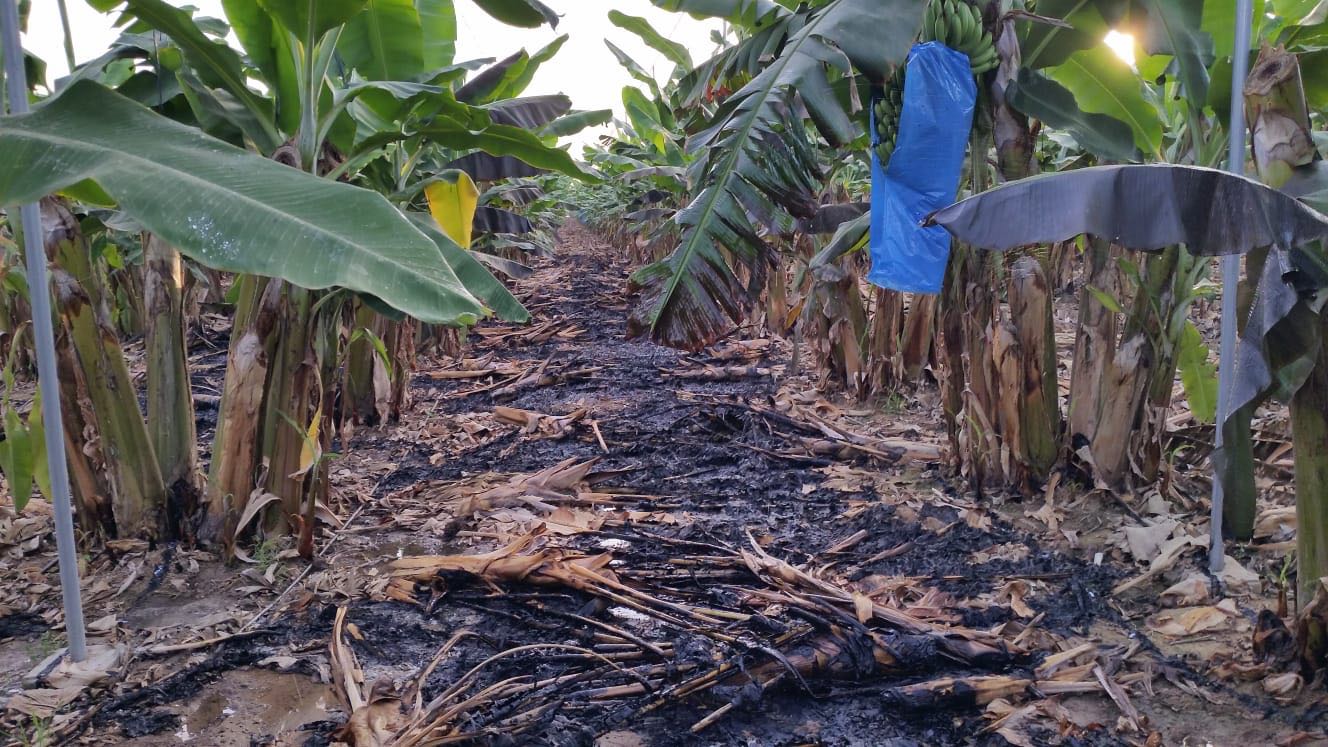
A banana field that was damaged by a fire sparked by an incendiary balloon from the Gaza Strip, in the southern Israel Eshkol region on July 12, 2018. (Eshkol Security)

On Wednesday, incendiary kites and balloons sparked 19 fires of varying sizes in Israel, according to local government officials. Fifteen of them occurred in the Eshkol region, which abuts the southern Gaza Strip. The other four occurred in the Sha’ar Hanegev region, which lies to the northeast of the coastal enclave.

In response, the Israeli military conducted an airstrike against a group of Palestinians it said was launching incendiary balloons toward Israel from the southern Gaza Strip, east of the city of Rafah. There, too, no injuries were reported.

After shuttering Kerem Shalom, the army said humanitarian aid, notably food and medicine, would still be allowed into Gaza, but would require special permission from the military liaison, Maj. Gen. Kamil Abu Rokon, to the Palestinians.

The military said the closure would continue so long as Palestinians persist in launching incendiary kites and balloons into Israel.


Congress Demands State Department Release Secret Report Busting Myth of Palestinian Refugees

July 13, 2018

Cruz, congressional insiders pressuring Trump administration to expose long classified report

Palestinian protestors uses slings to throw stones towards Israeli forces during clashes across the border, following a demonstration calling for the right to return

Palestinian protestors uses slings to throw stones towards Israeli forces during clashes across the border, following a demonstration calling for the right to return / Getty Images

BY:

Congress Demands State Department Release Secret Report Busting Myth of Palestinian Refugees

Key lawmakers in Congress are increasing pressure on the Trump administration to release a long classified government report on Palestinian refugees that insiders have described as a potential game changer in how the United States views the refugee issue and allocates millions in taxpayer funding for a major United Nations agency, according to conversations with senior congressional officials working on the matter.

The State Department has, since the Obama administration was in office, been hiding a key report believed to expose the number of Palestinian refugees as far smaller than the U.N. and other have claimed for decades. The public release of this information could alter how the United States provides funding for Palestinian refugees.

The Washington Free Beacon first disclosed the existence of the refugee report in January, when the Trump administration decided to significantly cut funding to the U.N. Relief and Works Agency, or UNRWA, an organization long accused of harboring anti-Israel bias and of aiding Hamas terrorists in the Palestinian territories.

Though the State Department is legally required to publish an unclassified version of the report, it has repeatedly ignored demands by Congress that the report be released.

The State Department, when asked by the Free Beacon, could not provide any information or timeframe on the report’s possible release.

“The State Department is committed to taking all appropriate measures to provide information in response to requests from Congress,” a State Department official said.

Rep. Doug Lamborn (R., Colo.) spearheaded the initial effort to declassify the report. Congress must have a complete picture of the Palestinian refugee situation in order to ensure that U.S. taxpayer funds are not being wasted, he told the Free Beacon in April.

“It is critical that Congress investigates the United Nations Relief and Works Agency (UNRWA), which operates under the United Nations (UN) using a different definition of a refugee for Palestinians than all other UN refugees around the world,” Lamborn said.

Congressional demands that the report be publicly released come at time of mounting criticism for UNRWA, which is facing a severe cash crunch following the Trump administration’s decision to reduce U.S. funding. The tense situation with UNRWA has sparked protests in the Gaza Strip, where UNRWA mainly operates and employs hundreds.


In addition to regional protests over UNRWA’s inability to pay salaries, Turkey was recently appointed at the U.N. to chair the agency’s advisory committee for the next year. This has stoked concerns that UNRWA could take an even more anti-Israel position in the coming months.

Sources with direct knowledge of the report’s contents have told the Free Beacon it puts the number of actual Palestinian refugees at around 20,000, far fewer than the 5.3 million figure routinely pushed by UNRWA and pro-Palestinian advocates who want to see the United States and international partners continue sending millions in aid to the Palestinian government.

Sen. Ted Cruz (R., Texas), one of the main lawmakers pressuring the Trump administration to release the report, told the Free Beacon that efforts to suppress the information on the actual Palestinian refugees is preventing Congress from providing oversight for the U.S. taxpayer.

“UNRWA lashes out against America and engages in anti-Semitic incitement. Hamas terrorists use UNRWA facilities to target Israeli civilians,” Cruz told the Free Beacon. “The American people deserve to see this reported State Department assessment, so Congress and the administration can have a transparent and productive debate about America’s role in the organization.”

Now that Secretary of State Mike Pompeo is running the State Department following the ouster of former head Rex Tillerson, lawmakers and senior congressional officials see a renewed opportunity to ensure the refugee report is released.

They continue to view the classified report’s findings as a critical tipping point in the debate over UNRWA’s funding and core mission, which has found itself subjected to increased scrutiny as a result of what many allege is UNRWA’s anti-Israel bias and close relationship with Palestinian terror groups.

One senior congressional official who has been involved in the UNRWA issue for several years questioned why the Trump administration is continuing to keep the report classified, particularly as the White House amps up efforts to foster peace between the Israelis and Palestinians. The refugee issue has long been a sticking point in peace talks.

“It’s not really a question of what they’re hiding,” said the source, who was not authorized to speak on the record about the situation. “We know what’s in the report because it’s just a matter of mathematics and demographics. The number of refugees was half a million people to begin with, and that was 70 years ago so many of them have passed away, so it can’t be five million now.”

“The question is why the Trump administration is trying to lock in the Obama era policy of never letting this report see the light of day,” the source said.

Update July 13, 3:16 p.m.: This post has been updated with further information.

Florida: Mass Murder Plot Thwarted, CAUGHT Before Blowing Up Building to “Kill All The F***king Jews”

July 13, 2018

By – on

Florida: Mass Murder Plot Thwarted, CAUGHT Before Blowing Up Building to “Kill All The F***king Jews”

This Jew-hater was captured in the act. He was setting up the gas containers, had poured gas down the hallways and elevators and had padlocks to put on the fire hoses to prevent the fire department from using them. But this story will get nary a mention in the elite (antisemitic) left-press. But comment on a hijab and you are worldwide news.

Note the first sentence of this local news report: “A Miami Beach man upset with his Jewish neighbors” as if that is some justification. My colleagues and I are excoriated for opposing jihad terror and sharia savagery but they imply justification becasue he was “upset with his Jewish neighbors.”


A Strategic Reset for NATO

July 13, 2018

Donald Trump’s criticism that the alliance isn’t fit for form is valid. NATO needs an overhaul.


Image: A U.S. Air Force pilot looks at a KC-135 aerial refueling aircraft as he refuels his F-16 fighter during the U.S.-led Saber Strike exercise in the air over Estonia June 6, 2018. REUTERS/Ints Kalnins

By Zalmay Khalilzad July 10, 2018 National Interest

Source Link: A Strategic Reset for NATO

{Excellent article and outstanding photo. I suggest you visit the source web page and view this pic in higher resolution. Truly inspiring.  I’ll dub it ‘Photo of the Week’  – LS}

At the NATO summit this week, President Donald Trump will undoubtedly criticize allies for not spending enough on defense and for pursuing their own economic wellbeing, in part at the expense of the United States. The president has been lambasted for criticizing U.S. allies and indeed, our alliances are important and represent some of the greatest achievements of U.S. foreign policy. However, Trump’s criticisms are justified. NATO must reform; it is not sustainable in its present form.

The alliance is ill-structured, ill-equipped and ill-financed to deal with the European region’s two major security problems—an aggressive Russia and the spillover of instability and terrorism from the Middle East and North Africa—leaving aside emerging global security challenges. Worse, at times some members can even be said to have enabled the threat. One example being the massive German purchase of Russian gas, which provides Putin with ongoing financing. To deal effectively with these challenges on an equitable and sustained basis among allies, the terms of the partnership must be renegotiated and its common ground redefined. This is in Europe’s best interest too.

Despite the best efforts of the Clinton, Bush (43) and Obama administrations, Russia has embarked on a more aggressive path, going to war against Georgia and Ukraine, conducting cyber attacks on Estonia and otherwise threatening the Baltic states. For the first time since the end of the Cold War, NATO members are directly threatened by Russian aims. Efforts at finding common ground with Russia based on mutual interest in a changing global environment should continue, but so must preparations to deal with threats from Russia.

Also, Europe faces a threat from the south, as the crisis in the Middle East and Europe’s permissive asylum laws and expansive welfare systems have triggered a flow of hundreds of thousands of refugees. The series of terrorist attacks in Europe inspired or coordinated by the Islamic State is one consequence. This terrorist threat—which combines external and internal security problems—is one NATO is ill designed to address.

Many of NATO’s members have effectively disarmed since the end of the Cold War, with only eight of NATO’s twenty-eight members even spending the required 2 percent of GDP on defense. Meanwhile, the United States faces major fiscal constraints, particularly rising entitlement costs and interest payments, and growing demands to meet its other global responsibilities, particularly in the Western Pacific. Additionally, many European members have favorable balances of trade vis-à-vis the United States, giving credence to the claim that we subsidize them on defense and they take advantage of us on trade.

Gentle persuasion by past presidents failed to induce Europeans to spend more on defense. By contrast, Trump’s demands for greater burden sharing are starting to have an effect. Yet much more still needs to happen. Moreover, we need to focus not just on inputs—how much money is spent—but also on outputs. A reformed NATO must hold members accountable in terms of actual military capabilities they can field. Those who care about NATO should criticize free-riding alliance members, not the efforts of Trump to get the alliance to up its game. At the same time, the Trump administration needs to articulate alliance priorities and the steps needed to adequately address them.

A Strategic Reset for NATO

In a new arrangement, NATO members would first agree on specific plans and capabilities needed to meet the threats from the East and the South as well as an operational division of labor. This doesn’t mean abandoning the requirement to spend 2 percent of GDP on defense, but instead would require every NATO member to commit to spending the necessary resources to meet identified defense responsibilities, which in some cases could require expenditure of more than 2 percent.

Specifically, the alliance should collectively take three steps to field an agreed set of defense outputs:

– Develop integrated defense plans within the NATO military committee for dealing with the Russian threat in northeast Europe, and instability and terrorist threats emanating from the Middle East and North Africa, thereby creating a strategy and a division of labor. This will entail a combined planning effort of the major NATO powers and the members living nearest or most directly affected by these threats.

– Agree to specific outputs—forces, weapons systems, operational capabilities, logistics support, and command and control—that each NATO member must develop and maintain at high readiness. This should take into account the capabilities that are needed now but also look to exploit emerging technologies to solve military problems more effectively as these technologies mature.

– Engage in realistic large-scale annual exercises—analogous the Exercise REFORGER of the Cold War—that will serve as a deterrent for would be aggressors, demonstrate resolve and compliance with NATO commitments and identify shortfalls for remediation.

In addition, the United States should candidly inform the European NATO members that the larger share of these agreed upon capabilities must come from them. We must explain that geopolitical realities require the United States to augment our own defense commitments in other priority regions, especially the Western Pacific. They must also understand that the American public expects wealthy countries to defend themselves principally on their own, with the United States playing a supporting role on an as-needed basis.

We must deliver the hard message that the future of the U.S. commitment under Article 5 is contingent on European performance. Those capabilities provided by the United States should be specifically tailored to reinforce NATO war plans and the security of the front-line states. European states would carry the burden on the southern threat, which affects their states domestically.

This would form the basis of a new global division of labor where America’s European allies assume the primary role for the security of Europe; the United States, Japan, South Korea and Australia would assume the primary role for security in the Western Pacific; and collectively, America and its global and regional allies would share roles in providing for security in the Middle East. Thus, working together, America and its allies would be meeting critical security demands in three critical regions.

Elements of the New Construct

To address the Russian threat in northeast Europe, the United States should lead the planning effort in NATO to develop the requirements for forces capable of deterring and, if necessary, defeating Russian irregular and conventional aggression, and to deter nuclear use. While the specifications for these forces requires comprehensive military analysis, we can conclude that a small tripwire force is inadequate to the task.

Among the capabilities that European NATO members would need to develop would include the following:

– An integrated air defense and surface-to-surface strike capability that would create an anti-access/area denial (A2/AD) belt covering the territory of NATO members and extending into adjacent areas of Russia.

– A counter-A2/AD capability that would defeat Russia battle networks and weapons systems, and Moscow’s ability to threaten NATO forward-deployed forces and reinforcements.

– A special operations forces capability sufficient to counter Russia’s sub-conventional operations involving the so-called “little green men.”

– A ground maneuver force that would combine the kind of light infantry that Hezbollah used against Israel’s offensive forces with heavy armor and artillery units that would consolidate territorial control.

As part of the new NATO security construct, the United States should offer to take the following steps:

– Maintain a small, highly capable ground maneuver force in Europe that would partner with a larger European force.

– Maintain a POMCUS capability in Europe, proximate to the locales where it would likely be needed, that would enable a surge of U.S. capability on a rapid basis if needed. Other major NATO powers, such as France, Germany and the UK should also provide POMCUS-style capability.

– Sell to European allies and partners, or license the right to produce, the high-end weapons systems needed to create the required European A2/AD, counter A2/AD, and maneuver force capabilities. Interoperability is vital and should be programmed into the strategy and plans.

– Agree to back up European arsenals of precision-guided munitions with U.S. stockpiles and production capabilities.

– Provide European NATO members with access to U.S. high-fidelity training capabilities and technologies.

– Provide the C4ISR capabilities that would enable integrated NATO operations in the event of conflict.

– Undertake a new look at what would be needed at every step in the escalation ladder—including tactical and intermediate-range nuclear forces—to ensure that Russia would not gain an advantage though escalating to high levels of conflict. This would be a first step to address any deficiencies in our deterrent.

A similar process should be undertaken regarding the threat from MENA. The flood of migrants from MENA and the infiltration of terrorists into European countries should be treated as a first order security problem for NATO. While these challenges principally affect European security, the United States should work through NATO to help enable European members better to address these challenges. This should include the following steps:

– Assist European NATO members in creating stabilization forces capable of brokering political compacts in fragile states, training local security forces, and building key state institutions.

– Work with European NATO members to develop a political-military plan for the stabilization of Libya and play a supporting role to the main European effort, which will likely require deployment of stabilization forces and establishment of a beachhead to deal with the source of refugees embarking across the Mediterranean Sea.

– Develop a counter-terrorism intelligence fusion and operations center that is part of the NATO command structure, thus coordinating the police, internal security and military responses to terrorism.

– Develop an agreed strategy and political-military plan to defeat the remnants of the Islamic State which is a threat to the member states.

A Trump Doctrine for NATO

In essence, the new construct is analogous to the Nixon Doctrine, only this time for the wealthy countries of Europe. Nixon pledged to come to the defense of allies in the developing would should they be threatened or attacked by major power. However, he insisted under the Nixon Doctrine that these states principally carry the burden for internal defense and lesser contingencies, though assisted with U.S. training and economic and military aid. In Europe today, European NATO members are fully capable of providing for their own defense.

To implement this doctrine, the United States should play an active supporting role and develop a three- to five-year timeline and program to create the needed European capabilities. We need to shore up vulnerabilities now, but this has to be part of a plan to create European capabilities and to set limits on the U.S. role that enable us to prioritize the challenge in East Asia, deal with ongoing threats in the Middle East, and work within our fiscal constraints.

Zalmay Khalilzad was the Director of Policy Planning in the Department of Defense and U.S. Ambassador to Afghanistan, Iraq and the United Nations.


Iran will leave Syria, Iraq only if Baghdad, Damascus want it, aide to Khamenei says

July 13, 2018

Reuters Staff July 13, 2018 Writing by Parisa Hafezi, editing by Larry King

Source Link: Iran will leave Syria, Iraq only if Baghdad, Damascus want it, aide to Khamenei says

Bonus Link: After a week of Russian propaganda, I was questioning everything

{I think the USA and Israel might have something to say about that. Besides, anyone smell the Russian propaganda? – LS}

MOSCOW (Reuters) – A top aide to Iranian Supreme Leader Ayatollah Ali Khamenei said on Friday that Iran would immediately withdraw its “military advisers” from Syria and Iraq only if their governments wanted it to.

“Iran and Russia’s presence in Syria will continue to protect the country against terrorist groups and America’s aggression … We will immediately leave if Iraqi and Syrian governments want it, not because of Israel and America’s pressure,” said Ali Akbar Velayati in a conference in Moscow.

Iran and Russia back Syrian President Bashar al-Assad in the country’s civil war.

{Back Syria in civil war?  How about helping Assad murder more of his own people while displacing millions more.  Put that in your morality pipe and smoke it. – LS}

If ‘everyone’ has good relations with Russia, Nord Stream may be ‘less of a problem’ – Trump to NATO

July 12, 2018
https://www.rt.com/news/432857-trump-nord-stream-threat/
Sergey Guneev / Sputnik
Donald Trump, who chastised Germany for buying energy from Russia and extending the natural gas pipeline connecting the two countries, indicated he may reconsider his stance if “everybody” has a good relationship with Russia.

US President Donald Trump hinted at the change of heart at a media conference following the NATO summit in Brussels.

“Frankly, maybe everybody is going to have a good relationship with Russia, so there will be a lot less problem with the pipeline. But to me it was a major point of contention. We discussed it at length today. Germany has agreed to do a lot better than they were doing,” he said.

Read more

© Hannibal Hanschke

Trump was referring to what he described as Germany’s pledge to spend more on defense along with other NATO members, which he sees as a major win for his administration.

Speaking to journalists, Trump seemed pleased with himself for attacking Germany on its energy import from Russia during the first day of the summit.

“I brought it up. Nobody brought it up but me,” he said. “Actually, I think the world is talking about it now maybe more than anything else.”

On Wednesday, Trump called Germany a “captive” of Russia for buying Russian natural gas. The remark was rejected by top German officials, including Chancellor Angela Merkel, who said Berlin conducts an independent foreign policy and was not a captive of any country.

READ MORE: Merkel slams Trump’s ‘Russian captive’ comment, defends Berlin’s ‘independent policies’

Germany insists that its trade with Russia is a national issue and not that of NATO or the EU, and its allies in Western Europe seem to agree. French President Emmanuel Macron, who spoke to the media after Trump on Thursday, said he personally didn’t find Trump’s remarks about Germany shocking but believed that countries should “take such decision in a sovereign manner.”

“Mr. Trump shared his point of view. An ally has the right to speak about strategic issues,” Macron said.

Russia and Germany are currently connected directly by the Nord Stream, an underwater pipeline through the Baltic Sea. A second pipeline that would double the capacity of the first one is currently under construction. The US opposes the project, claiming it would give Russia more leverage over Europe. Officials in Germany and Russia say the US is simply trying to wrestle its way into the European energy market and sell its own liquefied natural gas.

Trump’s targeting of Russian-European energy cooperation, and Merkel personally, during a NATO summit is simply a publicity stunt that would have no tangible effect on the energy trade itself, according to Vladislav Belov, the head of the Center for German Studies at the Moscow-based Institute of Europe.

“Trump linked defense spending of the US with German spending on Russian hydrocarbons. Apparently he sees this as a matter of security that Germany spends money on gas and not on defense. It’s a typical Trump dilettante approach,” he told RT.

Belov said there was “zero chance” that Germany would bend to Trump’s pressure on the pipeline project, regardless of how he attacks the German chancellor. “Trump’s hostile rhetoric towards Merkel proves that apparently Obama forgot to hand over the secret dossier with compromising materials against her, which some conspiracy theorists in Russia claim must exist,” he joked.