https://www.gatestoneinstitute.org/12762/dignity-for-the-palestinians
Anyone who cares for Israel, who aspires to peace, who has a good understanding of the historical, ethical, political, and legal facts that underpin the right of the Jewish people to a state of which they are the indigenous people, will be familiar with the name of Robert Fisk. But not in a good way.
For decades, Fisk has been one of the most unrelenting of Israel’s many haters and one of the most uncritical supporters of the rights of the Palestinians and their unending calls and actions aimed at the total destruction of Israel and the expulsion or massacre of the Jewish people living there.[1]
Fisk is a clever man. He took his PhD in 1983 from Trinity College, Dublin, an ancient and respected university. Although his doctorate was in political science on a topic related to Ireland and Britain, he has worked as the Middle East correspondent for the Times (1976-1988) and, since 1989, for the left-wing daily, The Independent.
Over the years, he has reported on many wars in many countries and has written and co-authored many books about them, all of them about their conflicts.[2]
Given his Jack-of-all trades character, it is not surprising that Fisk does not always get his facts straight, and for this he has often been criticized by people with deeper knowledge, as here or here: He is opinionated, often in an extreme way, functioning more as an activist than a reporter. According to UKMediaWatch:
Among other words we could use to describe Robert Fisk, he’s clearly a curmudgeon, one who views the West’s foreign policy towards the Middle East as a “cynical charade” without ever offering readers any insight into how a more noble, principled stance would take form. Though he’s the Independent’s Middle East ‘analyst’, he’s more of a professional cynic than a learned student of the region. Moreover, though he feigns neutrality in his scathing attacks on political hypocrisy, his body of work clearly suggests that he sees some targets as more deserving of opprobrium than others.
Over the years, his chief target has been Israel. Wars and terrorism have never really stopped there. For Israel-bashers, there never cease to be opportunities for scathing attacks — witness the recent condemnations of Israeli defence measures on the Gaza border, some by Fisk himself.
Fisk’s obsession with Israel presents a threat to Jews elsewhere, as is well explained here by Britain’s Community Security Trust, the country’s leading body in charge of Jewish security:
Writing in the Independent, Robert Fisk gives a startling example of anti-Israel obsession, expressed in words that are about Jews, not Israelis. In doing so, he illustrates how far Israel’s most trenchant critics will go in order to focus scrutiny and disgust upon it, rather than other targets: in this case, the extremes of Jihadi terrorism. Given the links between anti-Israel agitation and antisemitic attack levels, this rhetorical trend / temptation brings obvious risks for Jews.
Nothing seems to irritate Fisk more than attempts to bring about peace between Israel and the Palestinians, since no matter what is proposed it can never satisfy Palestinian demands. As is well known, since 2017 the United States administration has been working on a peace plan, under the supervision of Jared Kushner. The full details of the plan have not yet been revealed, but it has already come in for criticism. It need hardly be said that any peace plan for Israel and the Palestinians anyone has ever advanced has come in for criticism, not least unremittingly from the Palestinians and their supporters. Given that all Palestinian leaderships have called for a Palestinian state that will encompass and obliterate the state of Israel, it is not surprising that they cannot bear to accept any proposal that will give them only one small state (or two small states) in the territory allotted to them by the United Nations in 1947.
Not surprisingly, Fisk was one of the first to condemn what was already known of the plan, but for all the wrong reasons. He focuses on the offer that the US, assisted by Israel, Saudi Arabia and perhaps others will underwrite a major financial input into the Palestinian economy, thereby easing the lives of millions and enabling the creation of a prosperous Palestinian state. Writing on June 28, Fisk arrogantly claimed that the deal “would strip the [Palestinian] people of all their dignity.” His article begins thus:
Is there no humiliation left for the Palestinians? After Oslo, after the “two state solution”, after the years of Israeli occupation – of “Area A” and “Area C” to define which kind of occupation the Palestinians must live under – after the vast Jewish colonisation of land thieved from its Arab owners, after the mass killings of Gaza, and Trump’s decision that Jerusalem, all of Jerusalem, must be the capital of Israel, are the Palestinians going to be asked to settle for cash and a miserable village? Is there no shame left?
He continues in the same vein for almost three pages.
“How can he [Kushner] humiliate an entire Arab people by suggesting that their freedom, sovereignty, independence, dignity, justice and nationhood are merely ‘politicians’ talking points’? Is there no end to this insanity?”
Insanity? To help put an end to a conflict of more than 70 years, one that has taken countless lives, including those of Palestinians, to bypass the greedy and intolerant Palestinian leadership by offering the Palestinian people a path to prosperity, peace, and lives they cannot today imagine for themselves? A peaceful resolution that could mean that the religious and nationalist fanatics who have ruled the Palestinian territories for so long may be pushed from illegitimate office and be replaced by a democratic system?
Peace and prosperity, however, evidently mean little to Fisk and his ilk. There is, for him, something much deeper here. It is, essentially, the long-established belief, here endorsed strongly by Fisk, that the Palestinians are victims — and, not only that, the most important victims of the entire world — forcibly victimized by Western imperialism. This imperialism, according to him, made the former land of “Palestine” [in reality under the mandate of the British: everyone born there from 1920-1948 — Jews, Christians and Arabs — had Palestine stamped on his passport] supposedly a colony, built by the Jewish people after the Second World War, a view that totally disregards more than 3,000 years of both history and archeology. His view is, of course, by now a dogma that has become the basis for what is, for some inexplicable reason, the core campaigning issue for left-wing would-be revolutionaries across the globe, above all in Europe and North America. From that warped perspective, to offer the Palestinians a state (or two states) and to make their lives far better than anything they or their ancestors have ever known is to humiliate them.
There is no room to elaborate fully on what this means here, but some facts and views need to be aired. No one in history has humiliated the Palestinians more than the Palestinian leadership and its many acolytes, or the thousands of Palestinian men, women and youths who have gone out to commit suicide-bombings and a vast range of other attacks on innocent Jewish Israelis. The Israelis have spent more than 70 years fighting for their survival from the wars and terrorist attacks of the Palestinians and several Arab states. Tragically, it has for decades been a source of pride for Palestinians to say they have spent that long trying to destroy a state long yearned-for and established mere years since the Jewish Holocaust, even if that now means the slaughter of another six million and more.
The suicide bombings and other assaults that lead to Palestinian deaths demonstrate a society that values a corrosive status of martyrdom above the lives of children and young people who might have gone on to the true heroism of building a nation, as so many Holocaust survivors did when taming the land of Israel to create the powerhouse that it is today. What possible honour has there ever been for brainwashed youngsters blowing themselves to pieces in cafés or cutting the throats of babies? And why are these willing “martyrs” celebrated as rock stars, football heroes, models to be emulated by children, honorary exemplars of what it means to be Arab or Muslim?
Underlying this prioritization of sacrifice, even of one’s own children is an Islamic concept embraced by all Muslim terrorist movements, including Hamas, that “we love death more than you love life”. In a recent Friday sermon in Chicago, Dr. Ashraf Musairat denounced adherence to non-Islamic norms, saying it was humiliating to do so and insisting that:
“All this is happening because of our distance from the religion of Allah, and because we love this world more than we love Allah and Islam, because we love our children more than we love making sacrifices for the sake of Allah, and because we love our spouses more than we love making sacrifices for the sake of Allah and Islam.”
Is this the sort of humiliation Robert Fisk says is being imposed on Palestinians?
Perhaps Robert Fisk can explain what honour accrued to Palestinians when, after being given one of the most generous peace offers in history, and after having all but guaranteed for himself the highest honour in the eyes of the world, Yasir Arafat walked away from the Camp David negotiations in 2000 and soon after started the second intifada that took so many lives on both sides? As President Bill Clinton later put it: “Arafat’s rejection of my proposal after Barak accepted it was an error of historic proportions.” Israel has made highly successful peace treaties with Egypt and Jordan. Would Fisk say that either the Egyptians or the Jordanians were humiliated by this? Quite the opposite, surely: President Anwar Sadat and King Hussein acquired the status of peacemakers. Anwar Sadat won the Nobel Peace Prize alongside his Israeli counterpart, Menachem Begin. King Hussein was admired for his long-term willingness to meet with Israeli officials on what was a long but dignified road to peace.
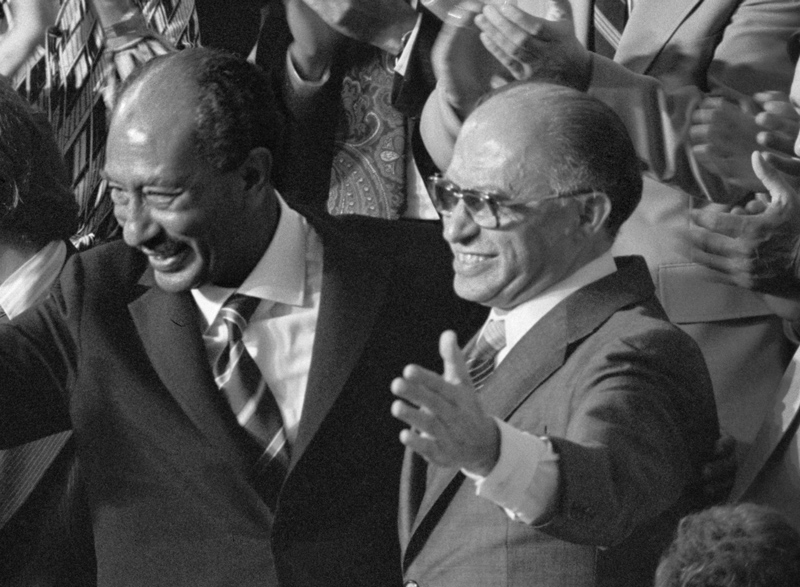 Pictured: Egyptian President Anwar Sadat (left) and Israeli Prime Minister Menachem Begin (right) acknowledge applause during a Joint Session of Congress in which U.S. President Jimmy Carter announced the results of the Camp David Accords, September 18, 1978. (Image source: Warren K. Leffler/Library of Congress) Pictured: Egyptian President Anwar Sadat (left) and Israeli Prime Minister Menachem Begin (right) acknowledge applause during a Joint Session of Congress in which U.S. President Jimmy Carter announced the results of the Camp David Accords, September 18, 1978. (Image source: Warren K. Leffler/Library of Congress) |
Israel has made many generous offers of peace and mutual assistance over the years, and has repeatedly offered to give up physical territory for airy promises of peace: by handing back Sinai to the Egyptians in 1979 or fully (and painfully) pulling out of Gaza in 2005. Agreements have been reached and offers made in 1949, 1979, 1994, 1998, 2000, 2000 again (re the Golan Heights), 2008, 2009, 2010, and to the present day.[3]
But the Palestinians — including the current Palestinian Authority leaders of the Fatah in the West Bank and the intractable Hamas fundamentalist regime in Gaza — have never let themselves be inspired by the Egyptian and Jordanian examples even to contemplate peace or collaboration to bring the Palestinian people to a better life. Next February, Israel will become the fourth country in the world to land a spacecraft on the moon. Meanwhile, Gazans persist in sending flaming kites — some bearing swastikas — across the border, causing severe damage to Israeli farmland and nature reserves. Does that bring honour to Hamas or its subjects? In their own eyes, undoubtedly; but for the rest of the non-Fisk world? Swastikas are not badges of honour, quite the opposite for the vast majority of people. Destroying the environment does not contribute in the smallest measure to making Gaza a better place in which to bring up children.
Palestinians and their supporters in the West often take to the streets chanting “From the River to the Sea, Palestine will be free”. The river is the Jordan; the sea, the Mediterranean. The territory in between comprises Gaza, the West Bank (of the Jordan River), and the entire state of Israel. Since the Palestinians have claimed that, although they have no prejudice against Jews, they will not tolerate Jews currently living in settlements on the West Bank (Judaea and Samaria), and that they will never agree to live alongside Israel as a Jewish state, we must ask on earth it will ever be possible to envisage a Palestinian state at all.
At the heart of this dilemma lies a so-far unbridgeable breach between how Palestinians and their supporters and Israelis and their supporters view Israel and its surrounding territories, including the Hashemite Kingdom of Jordan. For the Palestinians, all Muslim states, and their Muslim supporters worldwide, the refusal to compromise rests on a basic assumption in Islamic shari’a law — the principle that any territory, once ruled as an Islamic state, must never be allowed to pass out of Muslim hands. This is because such territory is considered a waqf, a term applied to any property or stretch of land dedicated as a religious trust in perpetuity. The principle behind this is set out clearly in Article 11 of the 1988 Covenant of Hamas:
The Islamic Resistance Movement believes that the land of Palestine is an Islamic Waqf consecrated for future Moslem generations until Judgement Day. It, or any part of it, should not be squandered: it, or any part of it, should not be given up. Neither a single Arab country nor all Arab countries, neither any king or president, nor all the kings and presidents, neither any organization nor all of them, be they Palestinian or Arab, possess the right to do that. Palestine is an Islamic Waqf land consecrated for Moslem generations until Judgement Day. This being so, who could claim to have the right to represent Moslem generations till Judgement Day?
This is the law governing the land of Palestine in the Islamic Sharia (law) and the same goes for any land the Moslems have conquered by force, because during the times of (Islamic) conquests, the Moslems consecrated these lands to Moslem generations till the Day of Judgement.
The meaning of this for Hamas is set out well by Dr. Samantha May of Aberdeen University in this article. It
“proposes that Hamas’ understanding of waqf as both God’s land in perpetuity and the territorial justification for an independent Palestinian state challenged Western assumptions of national territory and the monopoly of legitimate violence.”
However, whether we date the modern international ordering of states, borders, treaties and the apportionment of territories from the 1648 Treaty of Westphalia that ended the Thirty-Years War, or the end of World War I in 1918, or the end of World War II in 1945 and the establishment of the United Nations in the same year, the fact is that international affairs are now deemed to be conducted and negotiated, not on the basis of any one religious law, but through the principles laid down in hundreds of documents, major legislation and international law.
Israel was brought into being on the basis of international law, first as a mandate territory through the League of Nations, then the United Nations in 1947. So was modern Syria. Likewise, Lebanon, Jordan, Iraq, Pakistan, Bangladesh, and many other Muslim and Arab states, as well as states in the Balkans and elsewhere. Tear away the fabric of international law and the treaties, conventions, and resolutions that knit it together, and any one of these could collapse through cross-national conflict. The Palestinian Arabs were offered a state in 1947, along with Israel. If they expect to have a state or states now, they can only do so on that basis. Re-imposition of Islamic waqf law will not restore Spain, Portugal, Sicily, India, Greece and all the other states of the abandoned caliphal empires to Muslim rule, and it is futile to think that is anything more than a fantasy.
Trapped by allegiance to a thoroughly outdated and discredited system of international law, unwilling to exchange fantasy for realism, the Palestinians have tried everything except for what might actually make them free and prosperous: true peace with Israel. As Bassam Tawil puts it:
By insisting on all Palestinian “national rights,” including the “right of return,” and by refusing to recognize Israel as the homeland of the Jewish people, the Palestinians are in fact signalling that their true goal is to see Israel removed from the Middle East. How do we know that they want to destroy Israel? Abbas says he sees Israel as a “colonialist project that has nothing to do with Judaism.”
Fisk makes much of this “right of return”: “Right of Return. Forget it,” he says in his article. But that is yet another fantasy. The European Court of Human Rights has just ruled that there is no such right (in the legal sense of a human right). Given that the overwhelming majority of people currently identifying themselves as Palestinian “refugees” have never set foot in the territory that became Israel.
A recent US report revealed that there are, it seems, only about 20,000 Palestinian refugees in the world.
Furthermore, it is precisely the insistence that Palestinian refugees from 1948 and generations of their descendants constitute a special category of refugee with their own refugee organization (UNWRA) that has served to perpetuate refugee status and to condemn these “refugees” to live in the humiliating conditions of refugee camps. If anyone has humiliated these people, it has not been Israel (where there are no such camps and Arabs are full and free citizens) but the host countries such as Lebanon, Syria, Jordan, Gaza and the West Bank, whose rulers impose restrictions that condemn these “refugees” to endless dependence on international aid, unable to build real lives through their own endeavours.
It is highly unlikely that Jared Kushner or President Trump will achieve what so many great statesmen have floundered at. The Palestinian leaders will resist to the bitter end and the last Palestinian standing. Even with Saudi Arabia’s crown prince urging Mahmoud Abbas to work for peace in line with US and Israeli proposals, nothing will satisfy the Palestinian craving for either destroying Israel or abject victimhood.
In the end, it is so-called pro-Palestinian activists such as Robert Fisk or writers for papers such as The Independent, The Guardian, or the New York Times who do their utmost to persuade the world to favour Palestinian intransigence over offers of upgrading lives and international law. And this view itself is promoted by the belief that the West is to blame for just about everything wrong, and that non-Western people must never be asked to take responsibility for their actions or indeed just about anything.
Dr. Denis MacEoin has studied, lectured on, and written extensively about the Middle East for some forty-six years. He is a Distinguished Senior Fellow at the Gatestone Institute.
[1] For an extensive archive of Palestinian media, religious, and political anti-Israel propaganda, see Palestinian Media Watch here.
[2] Eg: Pity the Nation: Lebanon at War on the civil war; Syria: Descent into the Abyss; The Age of the Warrior; The Arab Spring Then and Now: From Hope to Despair; Robert Fisk on Afghanistan: Osama Bin Laden; Robert Fisk on Israel: the Obama Years; Robert Fisk on Algeria; Robert Fisk on Egypt; The world of Robert Fisk: Volume 1: 1989-1998 from Beirut to Bosnia, Volume 2: 1999-2008 from Kosovo to Baghdad; The Great War for Civilisation: The Conquest of the Middle East; Islamic Extremism: Middle East in Crisis. He has also written articles on the Soviet and international wars in Afghanistan, the Iran-Iraq war, the ongoing Palestinian-Israeli conflicts, the Gulf War, the Kosovo war, the war in Bosnia, and the 2003 invasion of Iraq. These regions speak very different languages – Pashto and Dari/Farsi in Afghanistan, Arabic in very different dialectical forms in Algeria, Lebanon, and Iraq, Albanian and Serbian in Kosovo, Hebrew in Israel, and Persian (Farsi) in Iran. He may have learned some Lebanese Arabic during his years in Beirut, but linguistic limitations have surely restricted the expertise he might have in any one region. Despite this, he has published, not only articles but entire books on more than one area: Lebanon; Syria; Ireland; Northern Ireland; the Arab Spring in Tunisia, Egypt, Libya, Bahrain, Yemen and Syria; Afghanistan; Algeria and Algeria again; Egypt; the Middle East as a whole; and all the places from which he has reported.
[3] For full details of these offers, see Denis MacEoin, Dear Gary, Why You’re Wrong about Israel: A Letter to an Anti-Israel Activist, London, 2012, pp. 38-45.

By Nidhi Verma Jul 26, 2018 Reuters
Source Link:
Exclusive: India’s HPCL cancels Iran oil shipment after insurer excludes coverage: sources
{Creating instability has its price. Too much risk and the insurance companies back out. Combine this with sanctions and you effectively have an oil blockade imposed on Iran. – LS}
NEW DELHI (Reuters) – India’s Hindustan Petroleum Corp (HPCL) canceled the purchase of an Iranian oil cargo earlier this month after its insurance company refused to provide coverage for the crude because of U.S. sanctions, three sources with knowledge of the matter said.
HPCL, India’s third-biggest state-owned refiner, renewed its installation insurance, which protects against any accidents at its refinery or storage sites, in early July. However, the new policy would not protect against any incidents involving Iranian oil processed or stored at its refineries, the sources said.
The refiner had planned to load 1 million barrels of Iranian crude onto the Suezmax tanker Ankaleshwar in early July but canceled the purchase after it was unable to sell it on to another buyer, said the sources who declined to be identified because of the sensitivity of the matter.
India is the second-biggest buyer of Iranian crude after China and without insurance coverage to protect their plants, the country’s refineries may have to cut off their imports earlier than anticipated.
The United States said in May it plans to re-impose some sanctions against Iran starting in August, with full sanctions in place by November, after withdrawing from a 2015 accord with Iran limiting its nuclear program.
“HPCL faced problems in lifting cargo from Iran because its annual insurance policy was renewed in July after the U.S. pulled out of the nuclear deal in May,” said one of the sources, adding the company will not be able to lift any Iranian oil.
HPCL’s Iranian imports account for only 20,000 barrels per day (bpd) of its full demand of 316,000 bpd but other Indian refiners that take larger volumes are likely to face the same problem if their annual policy is up for renewal before November.
HPCL did not respond to requests from Reuters for a comment.
Companies have until Nov. 4 to fully wind down activities with Iran or risk exclusion from the U.S. financial system. However, banks, shipping firms and insurance companies are already cutting ties with Iran and without financing or insurance coverage refiners will have to halt their purchases.
Iran had hoped to sell more than 500,000 bpd of oil to India during the current fiscal year that started in April, Oil Minister Bijan Zanganeh said in February.
However, the insurance issues may mean a reduction in imports even as India is intent on continuing dealings with Iran.
HPCL did not respond to requests from Reuters for a comment.
Companies have until Nov. 4 to fully wind down activities with Iran or risk exclusion from the U.S. financial system. However, banks, shipping firms and insurance companies are already cutting ties with Iran and without financing or insurance coverage refiners will have to halt their purchases.
Iran had hoped to sell more than 500,000 bpd of oil to India during the current fiscal year that started in April, Oil Minister Bijan Zanganeh said in February.
However, the insurance issues may mean a reduction in imports even as India is intent on continuing dealings with Iran.
“The problem in procuring Iranian barrels appears to be happening much before the Nov. 4 deadline,” said Senthil Kumaran, a senior analyst at consultants FGE. “Most of the reinsurance market is based in the U.S. so without the blessing of the U.S., Iranian oil buyers will find it almost impossible to take and process Iranian cargoes.”
{This bears repeating….“Most of the reinsurance market is based in the U.S. so without the blessing of the U.S., Iranian oil buyers will find it almost impossible to take and process Iranian cargoes.”…and that, my friends, is why Iran is so damned pissed. Enjoy. – LS}
Indian insurers rely on state-run General Insurance Corp for reinsurance, which depends on western re-insurers to hedge its risk. General Insurance did not reply to a request for comment.
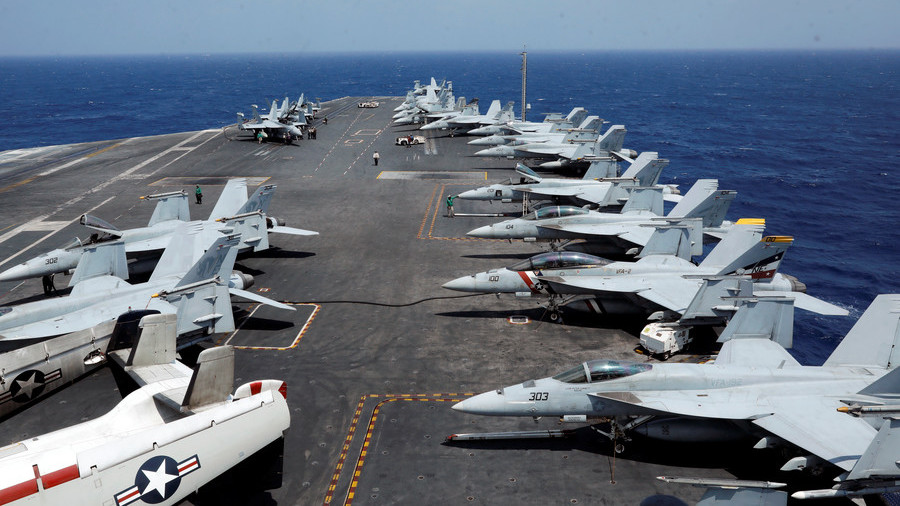
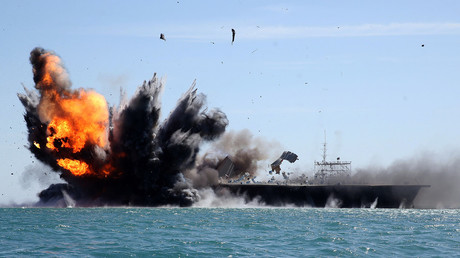
The outlet cites senior figures in the government of Malcolm Turnbull, who believe the United States is “prepared” to bomb Iran’s nuclear sites. The grim prediction suggests the move could happen as early as next month.
The report comes at a time when tensions between Washington and Tehran are hitting boiling point. In one of the latest exchanges of threats between the two nations, Iran said that a war with it would be the “mother of all wars.” This prompted Donald Trump to issue a harsh response, warning that Iran would face“consequences the likes of which few throughout history have ever suffered before.”
READ MORE: ‘War will destroy everything you own,’ head of Iran’s elite troops warns Trump
Australia, a member of global intelligence alliance known as the Five Eyes, is reportedly poised to play a part in the operation, providing its defense facilities to identify targets in Iran. The same assistance may be offered by the UK, while two other parties in the alliance – Canada and New Zealand – “would be unlikely to play a role in any military action in Iran,” according to ABC.
However, the outlet’s security sources noted the significant difference between a country directly participating in a mission, and providing intelligence on Iranian facilities.
“Developing a picture is very different to actually participating in a strike,” the unnamed security source said.
Australian Prime Minister Malcolm Turnbull dismissed the ABC’s report calling it a “speculation.” He acknowledged though that “the whole world” is aware of Trump’s attitude towards Iran.
The commander of the Iranian elite Quds Force cautioned Trump, should he resort to military action, saying on Thursday that “war will destroy everything you own.” He also warned the US against further public outbursts against Iran’s leadership and its people.
US-Iranian relations has been on a downward spiral since the US leader put into action his longstanding threat to withdraw from the landmark Iran nuclear deal in May, citing its supposed flaws and Iran’s malign activities. However, the International Atomic Energy Agency has repeatedly confirmed that Tehran had not been violating the agreement.
The European signatories of the deal, known as the Joint Comprehensive Plan of Action (JCPOA), were reluctant to comply with Trump’s calls to rip it apart. On the contrary, they vowed to maintain it – even without Washington’s participation – and hold additional talks with Tehran. America’s withdrawal was also condemned by Russia and China, which are also signatories of the JCPOA.
Head of the Russian Upper House Committee for International Relations Senator Konstantin Kosachev warned that the world may face a crisis worse than that seen on the Korean peninsula if world powers sit idle in the wake of Trump’s decision.
Minister Yisrael Katz harshly criticizes the defense minister’s conduct against terrorism: tLiberman’s policy is impossible and incorrect,’

Intelligence Minister Yisrael Katz (Likud) said Friday morning that the incitement propagated by the Palestinian Authority is what leads to terrorist attacks such as the the deadly stabbing attack in the town of Adam last night.
“It’s interesting that this terrorist came from the same village from which the terrorist who massacred the Salomon family came. This is proof of the inspiration and the atmosphere. It is enough to see Abu Mazen (Mahmoud Abbas), who also claims that he will pay the last shekel he has as an incentive to the families of the terrorists, to understand the picture in the region. This is the time to implement the law that determines the cessation of funding and the transfer of a budget exactly equal to amount that Abu Mazen funds the families of the terrorists,” Minister Katz said in an interview with Nissim Mishal on Radio 103FM.
Katz mentioned his initiative to pass a law calling for the expulsion of families of terrorists to Gaza: “I am no longer talking about punishment. It is a means of deterrence beyond the demolition of a house whose purpose is to save lives. I called on the prime minister to allow the advancement of the law, because Hamas encourages such terrorism and they receive support and incentives from Abu Mazen.”
He also addressed the security situation in the south and harshly criticized the defense minister. “Israel has no clear policy vis-à-vis Gaza, and there are two options for dealing with the situation in Gaza: complete civil disengagement, or creating a plan for Hamas to decide. The policy Liberman supports is to keep Hamas’ head above water, and that is a failed policy. It is an impossible and incorrect policy.”
“In the Hamas decision, there are military elements that I will not discuss. I always suggest separating from Gaza, but I am being prevented from making a final decision on this proposal, and I have been proposing for years to separate from Gaza and to create a border, like Lebanon and Syria, It is absurd. How can it be that with Nasrallah, who heads an army of 150,000 rockets in Lebanon, we have succeeded in creating a deterrent force, but in Gaza, where there are enormous power gaps, Hamas leaders [are not dettered] from harming the IDF soldiers. Something is wrong with Israel’s policy, and it does not allow itself to express its full power,” added Minister Katz.
According to Katz, the problem is the lack of a consistent policy vis-à-vis Hamas in Gaza. “The defense minister still thinks Hamas should be made to decide on a proposal, in my opinion, if the peace is not restored, we are very close to another battle in Gaza. It is important to understand that I am not pushing for war. We want to supply fuel, electricity, concrete, cement, or water to Gaza, as the security establishment is doing today. As far as I’m concerned, this is not a normal situation, and it is impossible to leave the residents of the State of Israel in the situation they are in.”
Israel Cooperated to Secure Trump’s Prisoners Deal with Erdogan, But the Turks Cheated

Photo Credit: Screenshot – Pastor Andrew Brunson
President Trump thought he had a deal, after his meeting with Turkish President Recep Tayyip Erdogan earlier this month had ended with a smile, a fist-bump and what Trump thought was an agreement to free Andrew Brunson, an American pastor imprisoned in Turkey, the Washington Post reported Friday (A fist bump, then a rancorous call: How Trump’s deal to free an American pastor in Turkey fell apart).
The deal involved Israeli Prime Minister Netanyahu’s agreeing to release Ebru Özkan, a Turkish woman suspected of helping Hamas in return for Brunson’s release. But the deal fell apart on Wednesday, when a Turkish court ordered Brunson’s transfer to house arrest for the duration of his trial.
Turkey’s judicial system will have the ultimate say on a detained American pastor, Turkish Justice Minister Abdulhamit Gul tweeted on Thursday. “Turkey is a fully independent and sovereign country that determines its own destiny,” Gul added, “The Brunson case will proceed in its own way, as it should be in a fully independent and sovereign country, and supreme Turkish justice will have the ultimate say.”
Israel deported Özkan on July 15, a week after indicting her for ties to Hamas. She had been arrested by Israel while on a tourist visa in June.
Brunson, an evangelical pastor of the Izmir Resurrection Church, was arrested in October 2016 for “Christianization” activities. The arrest took place during the government purges that followed the 2016 alleged Turkish coup d’état attempt, when tens of thousands of Turkish military personnel, civil servants, educators, academics, dissidents, and journalists were arrested. Brunson’s Protestant church has about 25 congregants.
Trump, who was proud of his skill at cementing the prisoners’ exchange, was raging on Thursday when he tweeted: “The United States will impose large sanctions on Turkey for their long time detainment of Pastor Andrew Brunson, a great Christian, family man and wonderful human being. He is suffering greatly. This innocent man of faith should be released immediately!”
Vice President Pence said in as speech Thursday that should Turkey not free Brunson, it must be “prepared to face the consequences.”
Source: US senators warn Europe against flouting Iran sanctions – Israel Hayom
In letter to ambassadors of Britain, France and Germany, 10 U.S. senators say that they would be “particularly troubled” by any efforts to evade or undermine sanctions “passed by Congress, signed by President Obama and to be enforced by President Trump.”
|
Sen. Ted Cruz (R-Texas) is one of 10 U.S. senators who issued a warning letter to Europe this week
| Photo: AP
|
A group of Republican senators on Thursday warned European nations against flouting U.S. sanctions on Iran, which will soon be reimposed after U.S. President Donald Trump withdrew from a landmark nuclear accord in May.
The 10 senators, all of whom opposed the 2015 international accord, said in a letter to the ambassadors of Britain, France and Germany that they would be “particularly troubled” by any efforts to evade or undermine the sanctions.
They said attempts to do so could be met with congressional action.
Following Trump’s withdrawal from the accord, the U.S. plans to reimpose a first set of U.S. sanctions, lifted by the Obama administration under the terms of the nuclear deal, on Aug. 4. A second set of sanctions will be reimposed on Nov. 4.
The senators, including outspoken Iran deal critics Ted Cruz of Texas, Marco Rubio of Florida and Tom Cotton of Arkansas, noted that the sanctions are matters of U.S. law and had been eased only because the previous administration had approved of the deal.
“We write to urge you to comply with all American sanctions but also to emphasize we would find it particularly troubling if you sought to evade or undermine American statutes,” the senators wrote. “These laws were passed by Congress, signed by President Obama and will be enforced by President Trump.”
“Any attempt to evade or subvert them could well prompt congressional action, in coordination with other elements of the U.S. government, to ensure their integrity,” they said.
Alongside the U.S. and Iran, Britain, France, China, Russia, and Germany were the other parties to the nuclear deal that was one of then-President Barack Obama’s signature foreign policy ventures. Trump campaigned against the agreement, which he has called the worst deal ever negotiated by the United States, and followed through on that pledge to the anger of the other parties who remain in it.
Some European officials, who believe the deal is vital for the security of the continent, have suggested trying to work around the reimposed U.S. sanctions to preserve the deal. Those sanctions would penalize foreign governments or firms, including financial institutions that do business with Iran.
Source: A tale of two fronts – Israel Hayom
Israel’s attention is currently split between the Gaza and Syria borders, as tensions on both may erupt unexpectedly • The Gaza border is highly volatile, and while Hamas proved it can be pressured, Israel will have to be flexible, too.
|
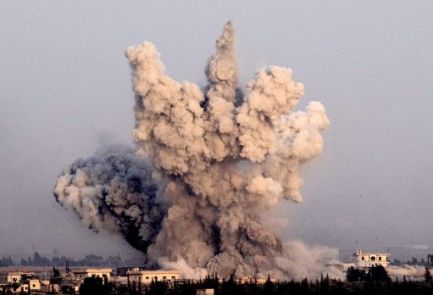
Smoke rises following an explosion in Syria’s Quneitra province
| Photo: EPA
|
Israel found that it had to split its attention this week between its border with Syria, where tensions are high but the risk of escalation is low, and its border with the Gaza Strip, where the potential for escalation is very high, but the threat level is much lower.
The number of security incidents on both borders was unusually high, and sometimes resembled an ongoing conflict. The challenge Israel is facing on both borders is maintaining deterrence without actually going to war.
While it seems the Gaza border poses a constant headache to the IDF and the government, especially given that the tenuous truce with Hamas collapsed after only four days, Israel remains focused on the northern sector.
Israel’s concern lies in two circles and in a broader perspective, in three.
The first circle is tactical and it is currently being waged in the Golan Heights, where the Syrian army is in the midst of a massive offensive to recapture the border area from rebels.
The majority of the territory is already under Syrian President Bashar Assad’s control. Some areas surrendered without a fight to avoid being pummeled to the ground. Villages whose residents insist on resisting the Syria army receive the familiar treatment, which over the past seven years has left hundreds of thousands of Syrians dead across the war-torn country.
The majority of the fighting is currently being waged between the Syrian army and the Khalid ibn al-Walid Army, a Salafi jihadist group affiliated with the Islamic State group.
Israel is not a party to this fight. Its rumored ties with Syrian rebel groups are no longer relevant and any effort vis-à-vis the local population is mainly humanitarian. But Israel has no intention of containing the ricochets of the Syrian civil war.
IDF policy has always been to retaliate over every case of errant Syrian fire that hit Israeli territory. Now, as the Syrian army’s grip on the other side of the border grows stronger that policy is more important than ever.
The fighting on the Syrian side of the Golan border challenged the IDF three times this week: The first time was on Monday, when Syrian missiles launched at rebel forces triggered the David’s Sling defense system, whose operational debut proved a failure; the second time was on Tuesday, when a Syrian fighter jet inadvertently breached Israeli airspace and was shot down; and the third time was on Thursday, when suspected ISIS rockets fired at Syrian forces hit the Sea of Galilee.
Israel was not the target in either case but retaliated in all three. The rationale for that is simple – there are no minor violations of the 1974 cease-fire agreement between Israel and Syria, and Israel will not elasticize its policy on the matter. After all, any sign that Israel’s air defenses are less than complete could be exploited by far more hostile elements, such as Iran and Hezbollah.
This policy will likely be maintained in the future, but it is doubtful it could trigger a security escalation. The Syrian army is battered and bruised by the relentless civil war and it has no interest in taking on the IDF.
This policy also plays an important part in the second circle, which is waged much farther from the northern border and seeks to prevent Iran from entrenching itself militarily in Syria.
In this respect, the past week was highly complex.
From a military standpoint, the Israeli strikes on Iranian assets in Syria continued, including – according to foreign media reports – on a major weapons production facility.
From a diplomatic standpoint, Israel was unable to convince Russia that Iran is a problem, rather than a solution. Russian Foreign Minister Sergey Lavrov and Chief of Staff Gen. Valery Gerasimov, who visited Israel this week suggested allowing Iranian forces to deploy 100 kilometers (62 miles) from the border – an improvement over a prior, 80-kilometer (50-mile) proposal – but Israel refused, as this was merely a minor difference that, given their firepower, would have no real impact on the Iranians.
It is doubtful that Israel alone could thwart Iran’s plans to tighten its grip on Syria. To truly achieve that it needs the United States and Russia, which is why it is taking a great interest in the third, strategic circle, which involves U.S.-Russian talks about Syria’s future.
It is there – and there alone – that the question of Iran’s presence in Syria will be decided. Israel may be able to disrupt Iran’s efforts in Syria in a myriad of ways, but without the help of world powers, it will find it exceedingly difficult to remove Iran from Syria.
Under these circumstances, the northern sector will continue to engage Israel intensively even after the Syrian army completes its takeover of the country’s southwest. In the post-war era, the IDF’s activity will be more complex, because Assad and his forces will have gained confidence. For this reason, if Israel does not want to wake up to a reality where its hands are tied, it must shape the rules of the game it wishes to apply without delay – and make them clear to both Washington and Moscow.
The end of optimism
Meanwhile, on the Gaza border, Israel’s patience is wearing thin.
Last weekend’s flare-up triggered a massive Israeli strike on Hamas targets and prompted the terrorist group to reach out to Egypt and ask for a cease-fire. This, together with a sharp decrease in Palestinian arson terrorism, gave Israel the impression that calm could be restored to the area without a full-scale military operation.
This slight optimism was shattered Wednesday when a Palestinian sniper shot and wounded an IDF officer whose troops were trying to keep a group of Gazan children away from the border.
While the gunman was an operative affiliated with one of the smaller, rogue terrorist groups in Gaza, the message this incident sent was both clear and highly problematic, namely that Hamas is either unable or unwilling to enforce the cease-fire, and that the Palestinian terrorists are eager to recreate last weekend’s successful slaying of an Israeli soldier.
Givati Brigade Staff Sgt. Aviv Levi, 21, who was killed by a Hamas sniper in a border clash last Friday, was the first IDF fatality on the Gaza front since Operation Protective Edge in 2014.
Many in Israel this week called on the IDF to pummel/crush/topple Hamas. Militarily, Israel has no problem doing that, as the disparity in military might is so dramatic that it would take a great deal of self-flagellation mixed with a fundamental misunderstanding of the situation to conclude that Israel is the one wary of confrontation.
But the question, as always, is bigger than the mere deployment of fighter jets and tanks. This is a matter of policy and Israel, even last week, still had not defined the objectives of a potential war in Gaza, should it be dragged into one.
Outline these objectives is crucial precisely because the next clash is right around the corner. These objectives will determine not only the conflict’s immediate results in terms of property damage and potential casualties but also – and mainly – its long-term results and the ability to change Israel’s reality vis-à-vis Gaza.
For now, things seem to be taking their time. The aid package U.N. Middle East envoy Nickolay Mladenov is trying to put together for Gaza has yet to be completed and even when it is, it would take a great deal of optimism to believe that the Arab countries that pledge their help will stick to their word, especially given that behind the scenes, Palestinian Authority President Mahmoud Abbas is sparing no effort to undermine these moves, knowing it would lead to war.
Israel would be better off running things itself. Contrary to public perception, which can lead one to believe that Israel is constantly dancing to Gaza’s tune, the past few weeks have proven that it is Hamas that succumbs to pressure and is wary of a confrontation.
This can be used to promote a dialogue that could secure significant achievements, from restoring peace and quiet to the Gaza-vicinity communities, through the return of the remains of two IDF soldiers and the two Israelis held by Hamas, to the potential regulation of the weapon smuggling and production issues.
This would require Israel to keep an open mind and pursue strategic – not political – thinking, which would prioritize Israel’s broader interest while making it clear to the public that there is no such thing as a “good war.”
Source: Trump readying to strike Iran say Australian government sources – report | The Times of Israel
Prime Minister Malcolm Turnbull rejects report, says ‘no reason’ to believe attack, which sources said would use Australian and UK intelligence, is imminent

US President Donald Trump may have plans to bomb Iran’s nuclear facilities as early as next month, senior Australian government sources said according to a Thursday report, though Prime Minister Malcolm Turnbull said he had “no reason” to believe a strike was imminent.
Sources said that Australian and British intelligence services would be involved in identifying targets for a strike, Australia’s ABC news reported.
However, the sources told the paper that Australia would not actively participate in an attack on Iran.
“Developing a picture is very different to actually participating in a strike,” a source told ABC.
“Providing intelligence and understanding as to what is happening on the ground so that the Government and allied governments are fully informed to make decisions is different to active targeting,” he said.

Turnbull appeared to reject the report, saying it was “speculation” and he had “no reason” to believe a strike was imminent.
“I saw a story today claiming that on the ABC, and citing senior Australian government sources,” he said. “It’s speculation, it is citing anonymous sources.”
He said that the ABC report information did not come from any of the relevant senior government officials.
“President Trump has made his views very clear to the whole world, but this story … has not benefited from any consultation with me, the Foreign Minister, the Defense Minister or the Chief of the Defense Force,” he said.
Australia and the UK partner with the US in the “Five Eyes” intelligence program, along with Canada and New Zealand, though the latter are unlikely to play any role in an attack on Iran, the sources told ABC.
On Sunday Trump issued an intense warning against Tehran, threatening that it would “suffer consequences the likes of which few throughout history have ever seen before.”
 Donald J. Trump
✔@realDonaldTrump
To Iranian President Rouhani: NEVER, EVER THREATEN THE UNITED STATES AGAIN OR YOU WILL SUFFER CONSEQUENCES THE LIKES OF WHICH FEW THROUGHOUT HISTORY HAVE EVER SUFFERED BEFORE. WE ARE NO LONGER A COUNTRY THAT WILL STAND FOR YOUR DEMENTED WORDS OF VIOLENCE & DEATH. BE CAUTIOUS!
The response came after Rouhani earlier Sunday issued his own warning to the US leader not to “play with the lion’s tail,” saying that conflict with Iran would be the “mother of all wars.”
However, Trump tempered the threat Tuesday, saying “we’re ready to make a real deal” with Iran.
The back-and-forth came after the Trump administration withdrew the United States from the Iran nuclear deal forged under former President Barack Obama.
The move sets in motion a renewal of sanctions against the Islamic Republic that were removed once the landmark accord was implemented in January 2016.
Those sanctions are now set to be reimposed in November, causing more than 50 international firms to exit the Iranian market, according to State Department policy and planning director Brian Hook.
Eric Cortellessa and Associated Press contributed to this report.




 anneinpt
 artaxes
 danmillerinpanama
 davidking1530
 Peter Hofman
 Joseph Wouk
 Peter
Peter Louisiana Steve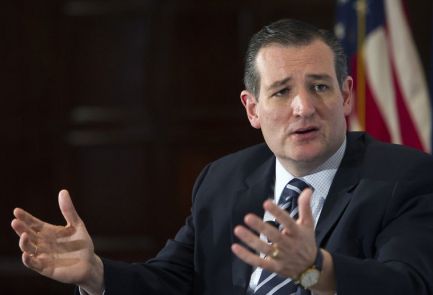
 WarSclerotic
Recent Comments