Source: Trump warns Iran to ‘never, ever’ threaten US amid rhetoric war – Israel Hayom
U.S. President Donald Trump threatens Iran with dire consequences after Iranian president warns that war with Iran would be “the mother of all wars” • U.S. Secretary of State Mike Pompeo compares Iran’s leadership to a “mafia,” says they are “heartless.”
|
Iranian President Hassan Rouhani and U.S. President Donald Trump
|Photo: Reuters
|
U.S. President Donald Trump warned Iranian President Hassan Rouhani late Sunday not to threaten the United States or face dire consequences, hours after Rouhani told Trump that the U.S.’s hostile policies toward Tehran could spark “the mother of all wars.”
In a late night all caps Twitter message directed at Rouhani, Trump wrote: “NEVER, EVER THREATEN THE UNITED STATES AGAIN OR YOU WILL SUFFER CONSEQUENCES THE LIKES OF WHICH FEW THROUGHOUT HISTORY HAVE EVER SUFFERED BEFORE. WE ARE NO LONGER A COUNTRY THAT WILL STAND FOR YOUR DEMENTED WORDS OF VIOLENCE & DEATH. BE CAUTIOUS!”
Iran’s state-owned news agency IRNA dismissed Trump’s warning tweet as a “passive reaction” to Rouhani’s remarks.
IRNA, a government mouthpiece, added that Trump’s Twitter missive was only mimicking and copying Iranian Foreign Minister Mohammad Javad Zarif, who had in the past warned the West to “never threaten an Iranian.”
The escalation in rhetoric came as the Trump administration launched an offensive of speeches and online communications meant to foment unrest in Iran and pressure Iran to end its nuclear program and its support of militant groups, according to U.S. officials familiar with the matter.
Iran has faced increased U.S. pressure and looming sanctions following Trump’s decision to withdraw the United States from a 2015 international accord on Iran’s controversial nuclear program. Tehran has said its nuclear work is just for electricity generation and other peaceful projects.
Meanwhile on Sunday, U.S. Secretary of State Mike Pompeo denounced Iran’s leaders as a “mafia” and promised unspecified backing for Iranians unhappy with their government.
He called the religious leaders of Iran “hypocritical holy men” who amassed vast sums of wealth while allowing their people to suffer, part of a highly critical broadside issued as the republic approached the 40th anniversary of its Islamic revolution.
Pompeo talked about increasing the media outreach to the Iranian people. He said the U.S. Broadcasting Board of Governors is taking new steps to help Iranians get around internet censorship and is launching a new 24/7 Farsi-language channel across television, radio, digital and social media formats, “so that ordinary Iranians inside Iran and around the globe can know America stands with them.”
Pompeo castigated Iran’s political, judicial and military leaders, too, accusing several by name of participating in widespread corruption. He also said the government has “heartlessly repressed its own people’s human rights, dignity and fundamental freedoms.”
Iran “is run by something that resembles the mafia more than a government,” Pompeo said, citing what he called Iranian leaders’ vast wealth and corruption.
He said despite poor treatment by their leaders, “the proud Iranian people are not staying silent about their government’s many abuses.”
Earlier Sunday, addressing a gathering of Iranian diplomats, Rouhani said: “Mr. Trump, don’t play with the lion’s tail, this would only lead to regret,” according to a report by IRNA.
“America should know that peace with Iran is the mother of all peace, and war with Iran is the mother of all wars,” Rouhani said, leaving open the possibility of peace between the two countries, at odds since the 1979 Islamic Revolution.
Rouhani also scoffed at Trump’s threat to halt Iranian oil exports and said Iran has a dominant position in the Gulf and the Strait of Hormuz, a major oil shipping waterway.
Rouhani’s apparent threat earlier this month to disrupt oil shipments from neighboring countries came in reaction to efforts by Washington to force all countries to stop buying Iranian oil.
Washington initially planned to shut Iran out of global oil markets completely after Trump abandoned the deal that limited Iran’s nuclear ambitions, demanding all other countries stop buying Iranian crude by November.
But the United States has somewhat eased its stance, saying it may grant sanction waivers to some allies that are particularly reliant on Iranian supplies.
Separately, a top Iranian military commander warned that the Trump government might be preparing to invade Iran.
“The enemy’s behavior is unpredictable,” Tasnim quoted military chief of staff General Mohammad Baqeri as saying.
“Although the current American government does not seem to speak of a military threat, according to precise information it has been trying to persuade the U.S. military to launch a military invasion [of Iran],” Baqeri said.

Russian Foreign Minister Sergei Lavrov and Chief of Staff Gen. Valery Gerasimov were sent urgently to Israel on Monday, July 23 over the Putin-Netanyahu rift that was exclusively disclosed by DEBKAfile.
Prime Minister Binyamin Netanyahu announced the mission to the cabinet in words that were revealing: He said Israel will not accept the Syrian army’s entry to the buffer zone set up by the 1974 Syrian-Israeli separation of forces accord, thereby indicating that he did not trust in Syrian compliance with this accord, despite the guarantee offered by President Vladimir Putin in their phone conversation on Friday, July 20. DEBKAfile’s sources note that Putin’s pledge came after he reneged on a series of promises he gave US President Donald Trump and Netanyahu in recent weeks, relating to keeping the Iranians and their proxies away from the Israeli border.
To emphasize that Israel now meant business, the IDF was instructed Monday morning to use the David’s Wand anti-missile weapon for its first combat operation against Syrian missiles fired in a battle with rebels in the buffer zone. Warning alerts were triggered the length and breadth of northern Israel – from the Golan and the Bashan north of the Sea of Galilee area up to Safed and Tiberias. David’s Wand broadcast a signal to all those concerned that Israel had every intention of using its most advanced weaponry in southern Syria if necessary.
Three important points emerged from Monday’s events:
The Syrian rockets landed in Syria. Israel suffered no damage or injuries from the rockets.
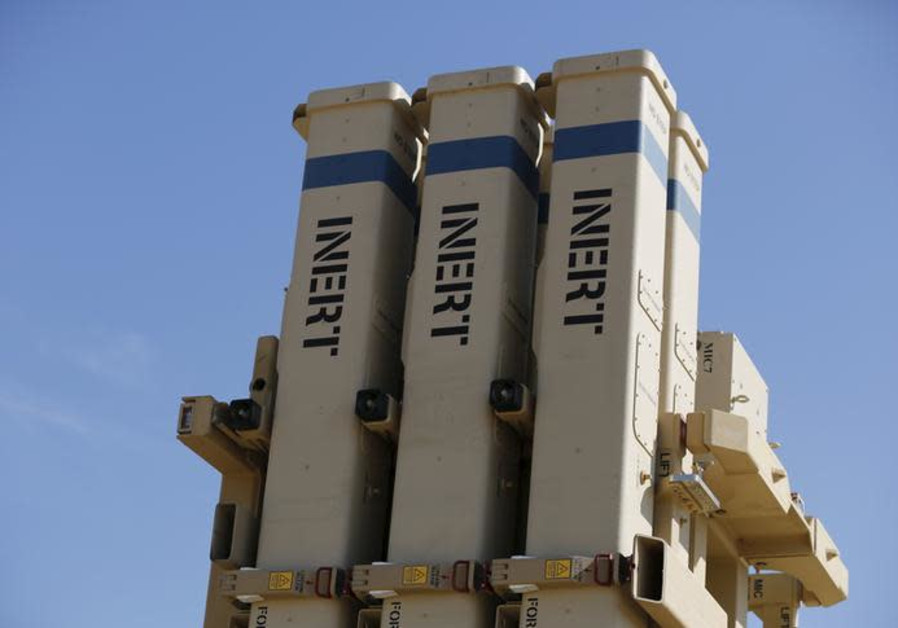
Israel used its David’s Sling interceptor system for the first time on Monday, launching two missiles against SS-21 Tochka tactical ballistic missiles fired from Syria as part of the internal fighting in the war-torn country.
Red alert incoming-rocket sirens sounded across the North on Monday morning, first in Safed and the Galilee region at 10:05 a.m. and moments later in the Golan Heights and Katzrin. Sirens wailed again in the Galilee and Golan less than half an hour later.
“The alarms that were heard in northern Israel were the result of launches that were carried out as part of the internal fighting in Syria,” the IDF said.
“As a result, two David’s Sling interceptors were fired at the rockets, as there was a fear they could strike Israeli territory. The Syrian rockets landed inside Syrian territory. No damage was caused, and there were no injuries,” the military said.
Safed Mayor Ilan Shohat said the city would open bomb shelters to provide a “sense of security” for residents.
He stressed that the routine in the city would continue and that there would be no disruptions to summer camps and summer activities as he had not been instructed by the Home Front Command to open the shelters.
The SS-21 ballistic missiles, which carry a half-ton warhead, were detected by Israel’s aerial defense system when they were fired from southeastern Syria. The decision to intercept them was made by the IDF when it was believed that their trajectory would see them fall near Lake Kinneret. When the system determined that they would not hit Israeli territory, one of the interceptor missiles was ordered to self-destruct over Israel’s southern Golan Heights. It is still not clear whether the other missile was intercepted by David’s Sling.
One SS-21 missile fell inside Syria, one kilometer from the border with Israel.
The defense establishment is currently investigating the event in order to determine whether the use of the system could be defined as a success.
Residents shared videos on social media of a possible launch of what was thought to be a Patriot missile. Israel launched two Patriot missiles two weeks ago toward drones that infiltrated into Israel from Syria, one of which flew 10 km. before being shot down over the Kinneret.
David’s Sling, formerly known as “Magic Wand,” is designed to intercept tactical ballistic missiles and medium- to long-range rockets, as well as cruise missiles fired from ranges of 40-300 km.
Each interceptor launched by the system, which became operational last April, costs about $1 million. •
BY: 38 NORTH JULY 23, 2018 SATELLITE IMAGERY, WMD
Source Link: North Korea Begins Dismantling Key Facilities at the Sohae Satellite Launching Station
{Was calling out Kim Jong Un an attempt by DJT to move the topic of the day off Russia? I think not. Watch for similarities with Iran in the near future. Watch for more forceful engagement with Russia as well. – LS}
A 38 North exclusive with analysis by Joseph S. Bermudez Jr.
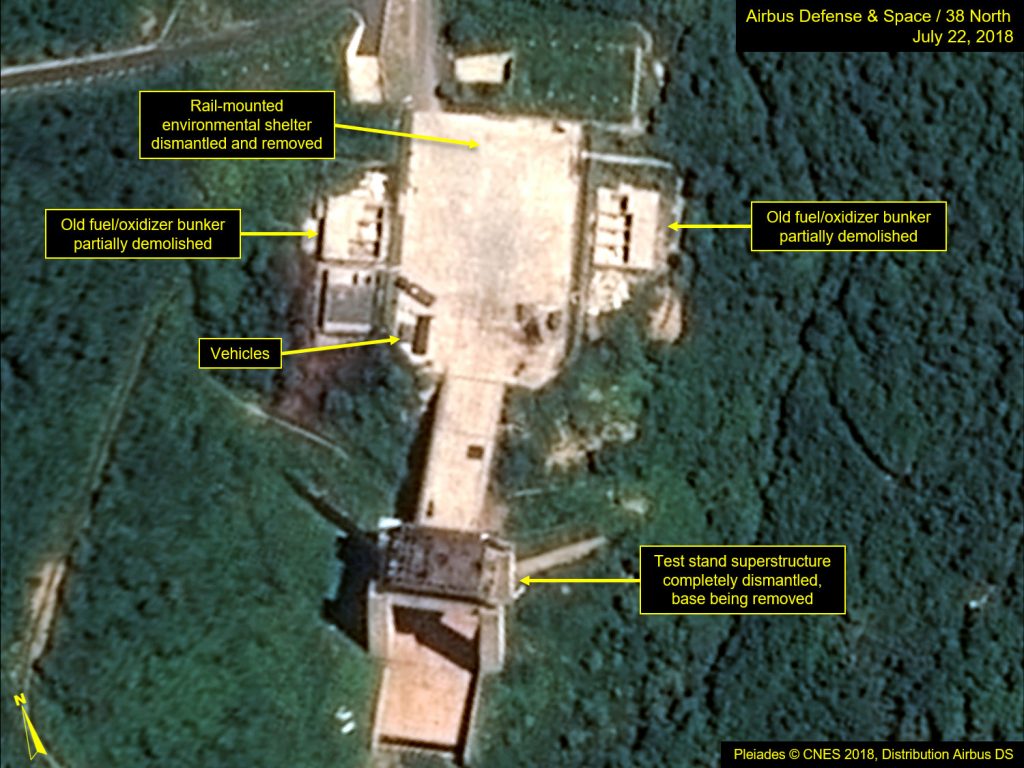
In an important first step towards fulfilling a commitment made by Kim Jong Un at the June 12 Singapore Summit, new commercial satellite imagery of the Sohae Satellite Launching Station (North Korea’s main satellite launch facility since 2012) indicates that the North has begun dismantling key facilities. Most notably, these include the rail-mounted processing building—where space launch vehicles are assembled before moving them to the launch pad—and the nearby rocket engine test stand used to develop liquid-fuel engines for ballistic missiles and space launch vehicles. Since these facilities are believed to have played an important role in the development of technologies for the North’s intercontinental ballistic missile program, these efforts represent a significant confidence building measure on the part of North Korea.
Dismantlement at the Launch Pad
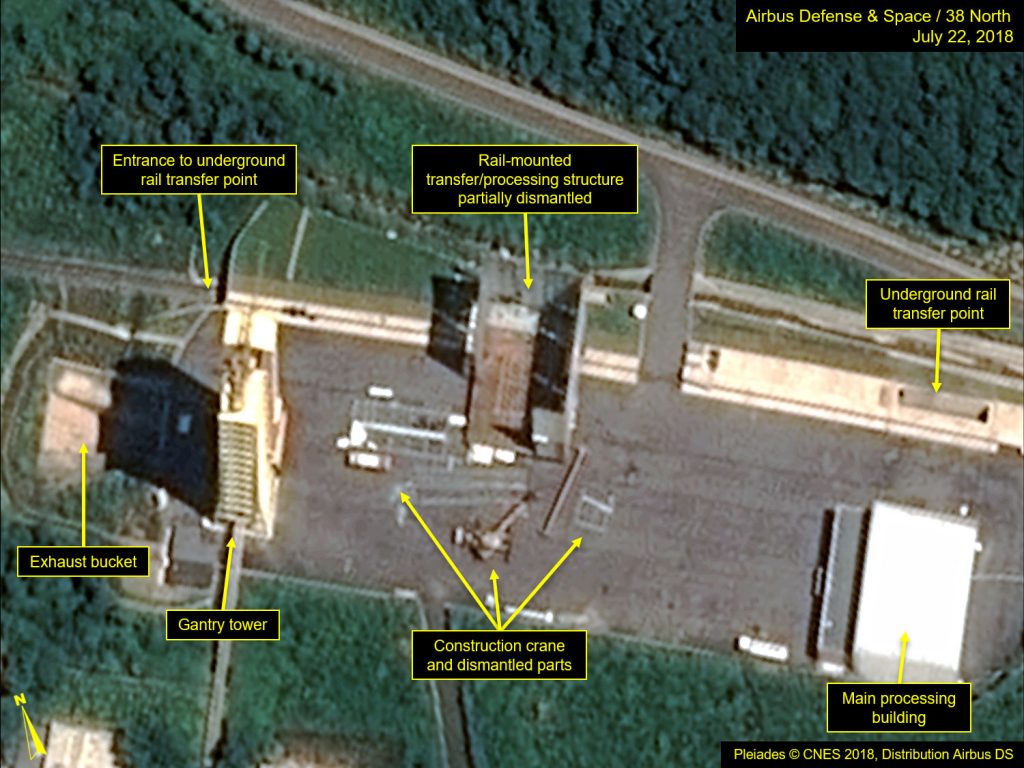
Commercial satellite imagery of the launch pad from July 20 shows that the rail-mounted processing/transfer structure has been moved to the middle of the pad, exposing the underground rail transfer point—one of the few times it has been seen in this location. The roof and supporting structure have been partially removed and numerous vehicles are present—including a large construction crane. An image from two days later shows the continued presence of the crane and vehicles. Considerable progress has been made in dismantling the rail-mounted processing/transfer structure. One corner has been completely dismantled and the parts can be seen lying on the ground. In both images the two fuel/oxidizer bunkers, main processing building and gantry tower remain untouched.
Figure 1. By July 20, dismantlement had begun of the rail-mounted transfer structure on the Sohae launch pad.
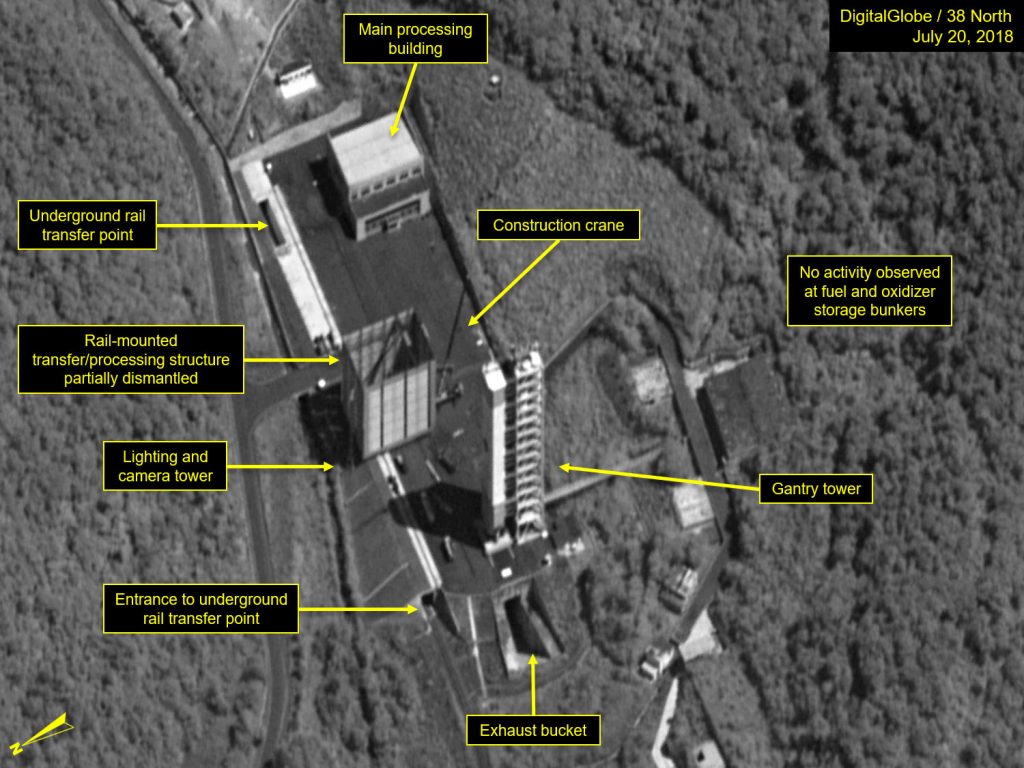
Figure 2. Closeup of the partially dismantled structure.
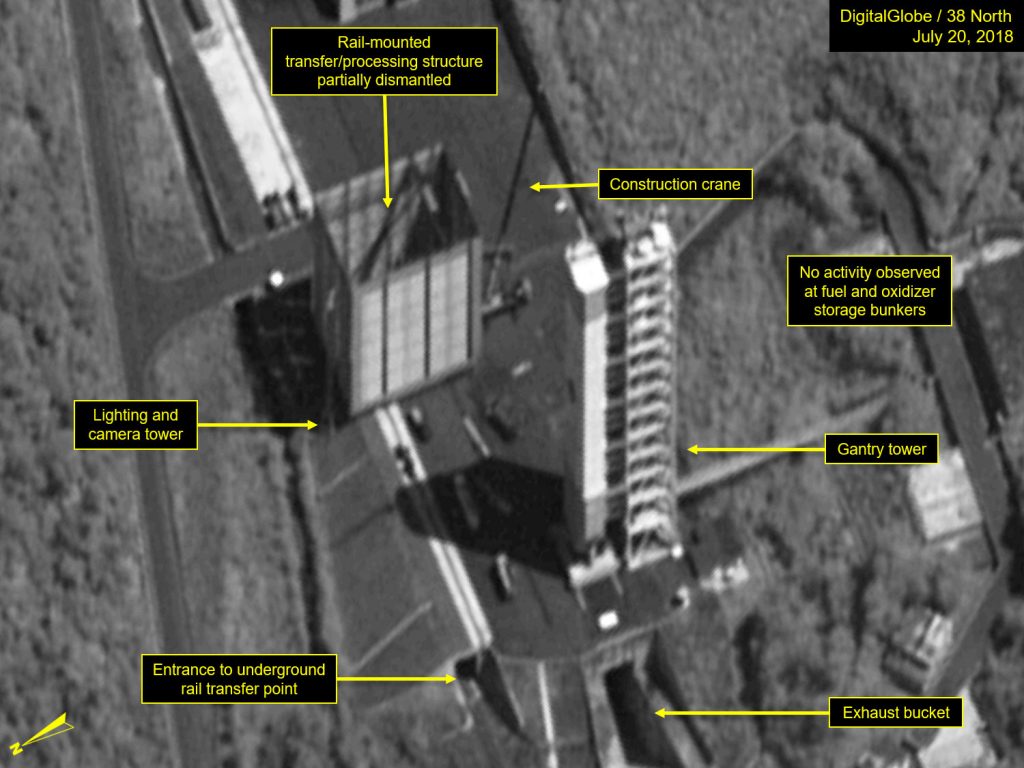
Figure 3. By July 22, significant progress had been made in dismantling the rail-mounted transfer structure on the Sohae launch pad.
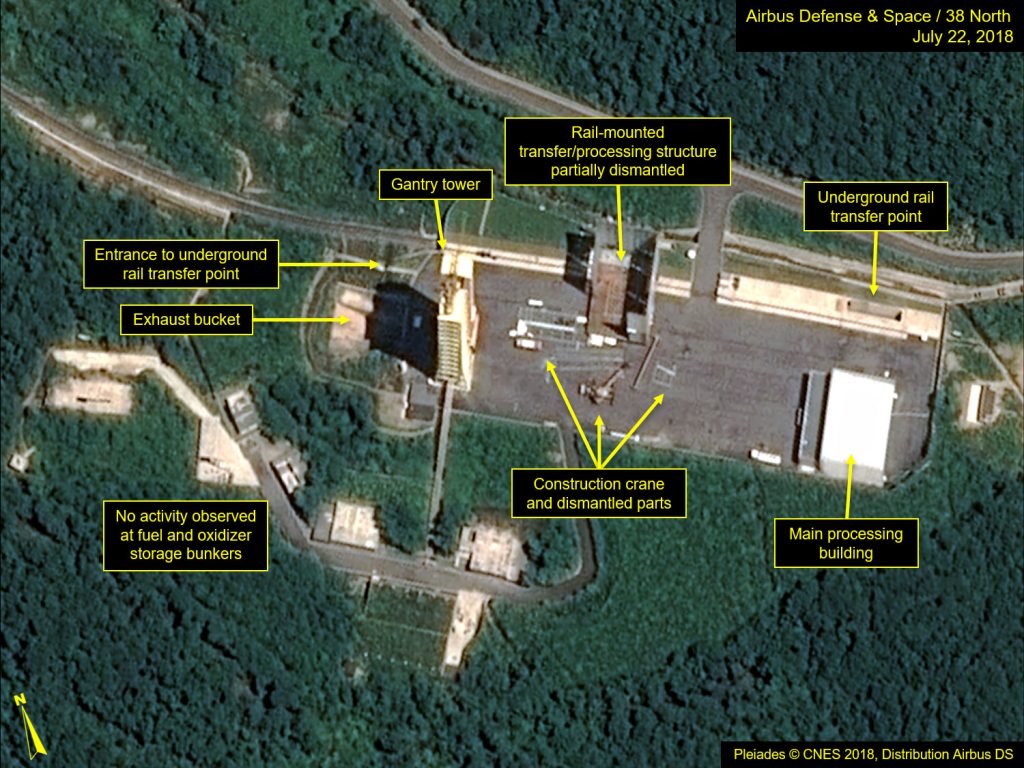
Figure 4. Closeup of the partially dismantled structure.
Work at the Vertical Engine Test Stand
Imagery of the vertical engine test stand from July 20 shows the presence of a crane and a number of vehicles. The rail-mounted environmental shelter—which hadn’t been moved since December 2017—has been razed and removed, the older fuel/oxidizer bunkers are in the process of being razed, and portions of the test stand’s upper steel framework have been dismantled and its paneling removed.
Two days later fewer vehicles are present and the test stand superstructure has been completely dismantled, leaving only the base, which is also in the process of being removed. No additional progress is noted on the demolition of the older fuel/oxidizer bunkers. In both images, the two newer fuel/oxidizer bunkers and vehicle garage remain untouched, as does the concrete foundation of the test stand. Given the state of activity, work is likely to have begun sometime within the past two weeks.
Figure 5. Environmental shelter removed and other dismantlement activities underway at the engine test stand by July 20.
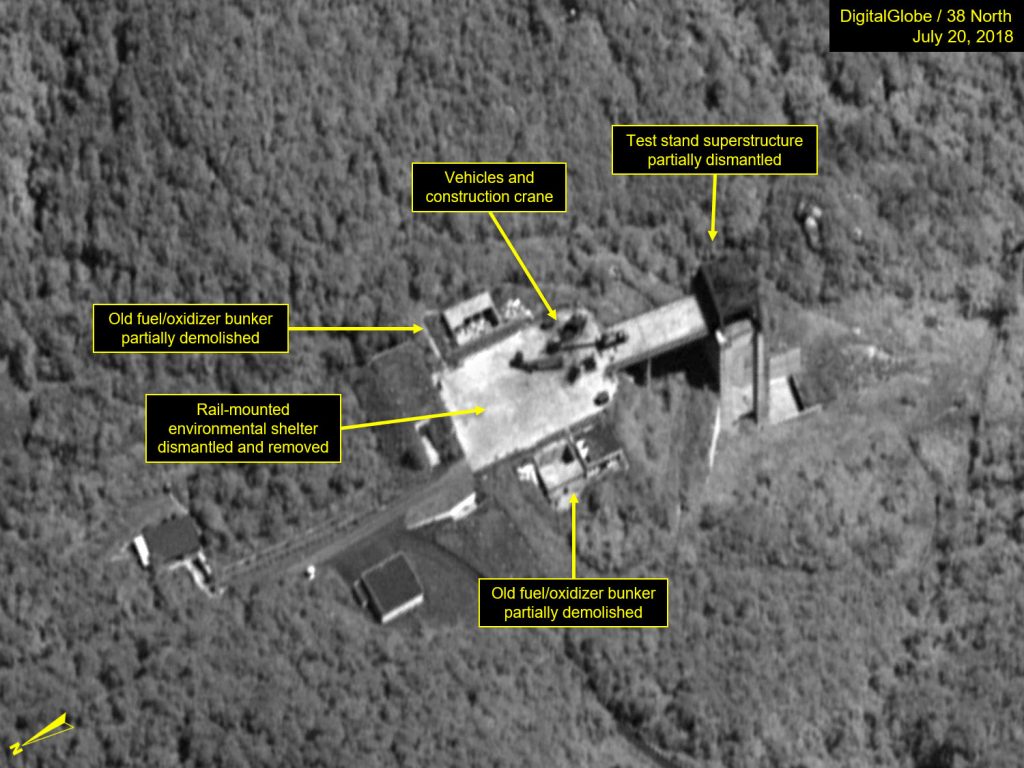
Figure 6. Closeup of the engine test stand activities underway.
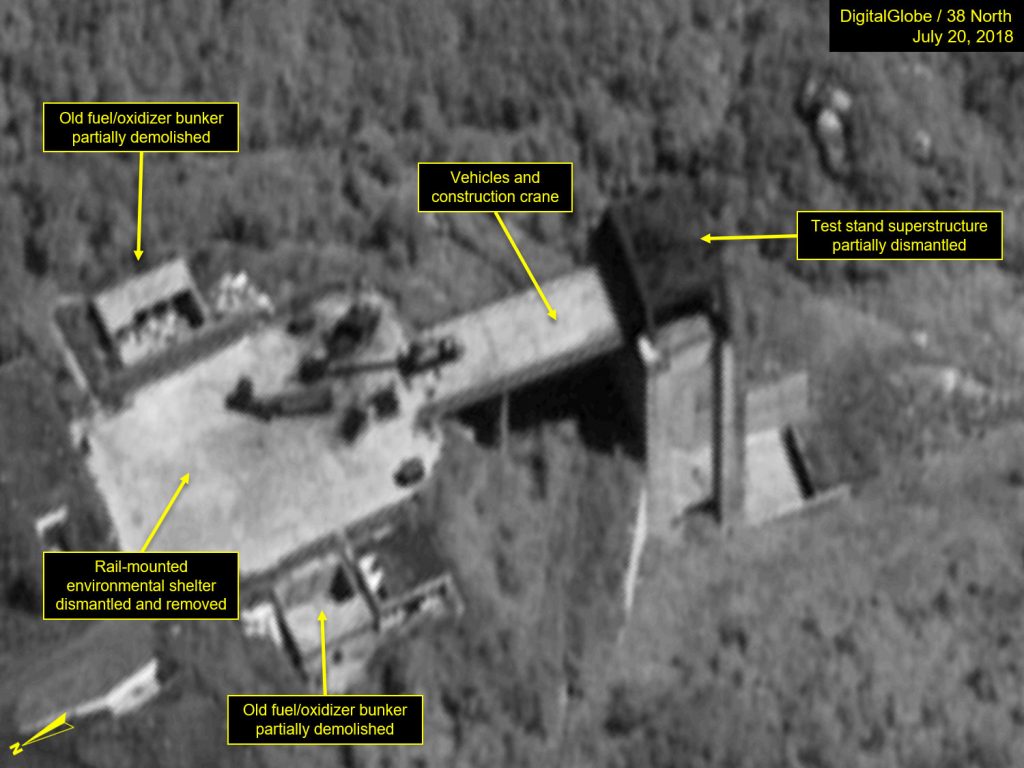
Figure 7. Test stand superstructure completed dismantled by July 22.
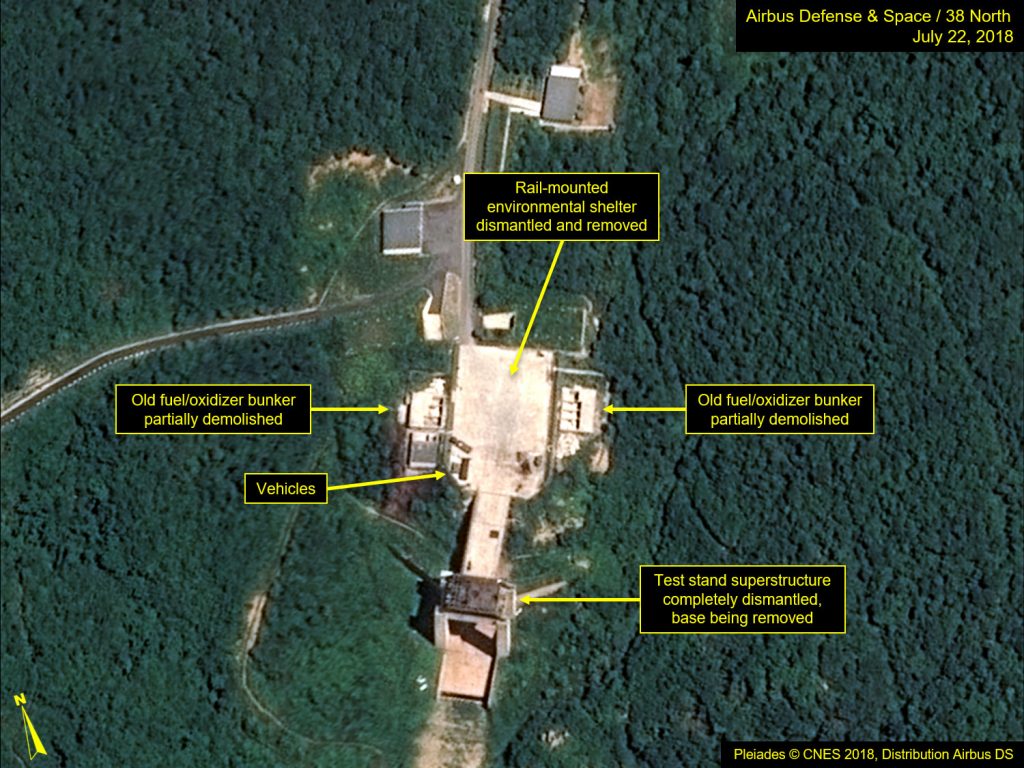
Figure 8. Closeup of the engine test stand activities underway.
Former Southern Command head claims terror orgs from north and south require more meaningful ‘root canal’ treatment to restore deterrence.

Former Southern Command head and Golan Formation Commander Brig. Gen. (Res.) Zvika Fogel is concerned about Israel’s activity in the north and south.
“We lie to ourselves every morning and call Hamas and Hezbollah terror organizations. They have long ceased to be terror organizations, but two states – entities living within a given territory – controlling the population and sometimes even partners in government,” Fogel said.
He warns that failure to deal with the situation today can have an adverse effect on the future. “The only place where we have a strategy is our attitude toward Iran. There we act as a sovereign state.
“We don’t act against Hamas and Hezbollah and we’ll pay a heavy price in the future, because in both places they’ll understand that we’re afraid to enter into a confrontation. If we don’t finish this story at this time, we may not be able to do it in the future.”


Israel Rejects Russia’s Proposed 100 km Buffer Zone for Iran from Syrian Border

Prime Minister Benjamin Netanyahu meets with Russian delegation in Jerusalem
Photo Credit: Haim Zach / GPO
Israel has rejected a Russian proposal to create a 100 kilometer (62 mile) buffer zone that would distance Iranian forces from Syria’s border with Israel in the Golan Heights.
“We will not allow the Iranians to establish themselves even 100 kilometers from the border,” Prime Minister Benjamin Netanyahu told Russia’s Foreign Minister Sergey Lavrov, according to an Israeli official who spoke on condition of anonymity.
The two men met Monday in Jerusalem at the request of Russia’s President Vladimir Putin, together with Defense Minister Avigdor Liberman, Russian military chief of general staff, Gen. Valery Gerasimov and the rest of the Russian delegation.
Also present at the meeting, which lasted two hours, were IDF Chief of Staff Gadi Eizenkot, National Security Adviser Meir Ben-Shabbat and other senior officials.
Israel provided maps and intelligence assessments to back up its positions, according to the official.
Israel is remaining firm on a demand that Iran not be allowed any foothold whatsoever along its northern border, regardless of where in Syria that might be. Furthermore, Israel is demanding that all long-range missiles be removed from Syria, and all factories that produce such missiles and/or precision-guided projectiles, be closed down, according to the official who spoke with reporters.
“The link between us is extraordinarily important and it exists, as you have seen, in the direct meetings between myself and President Putin and between our staffs,” Netanyahu said at the start of the meeting.
“I appreciated the words that were spoken by President Putin together with President Trump regarding the security of Israel during the recent summit.”
Earlier in the day, during the weekly cabinet meeting, Netanyahu had said that Israel would “continue to act against any attempt by Iran and its proxies to establish a military presence in Syria.”
Israel’s air force will not cease its operations to protect Israeli citizens as long as Iranian forces possess the capability to fire long-range missiles at Israeli targets,” the senior official said. Location in Syria does not matter, because long-range weapons are positioned well outside the 100-kilometer zone.
“Iran wants to turn Syria into a second Lebanon,” he noted. “And we’re determined to prevent that,” rather than wait until Iran has hundreds and thousands of missiles in Syria.




 anneinpt
 artaxes
 danmillerinpanama
 davidking1530
 Peter Hofman
 Joseph Wouk
 Peter
Peter Louisiana Steve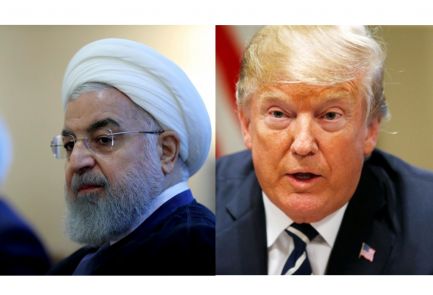
 WarSclerotic
Recent Comments