Let this be cast in gold !
I would rather take a political risk in pursuit of
peace than risk peace in pursuit of politics,”
he said.
Let this be cast in gold !

U.S. President Donald Trump told reporters in Helsinki following his talks with Russia’s President Vladimir Putin on Monday (July 16) that Israel’s safety is important to both world leaders.
Speaking at a joint news conference together with Putin after the summit, Trump said bluntly in response to a question about Syria, “President Putin also is helping Israel. And we both spoke with Bibi Netanyahu, and they would like to do certain things with respect to Syria, having to do with the safety of Israel.
“So in that respect we absolutely would like to work in order to help Israel, and Israel will be working with us, so both countries would work jointly.”
Trump said that a great deal of progress has been made in in certain sections of Syria with the “eradication of ISIS, we’re about 98 percent, 99 percent there,” adding that Russia had helped the United States with, “in certain respects.”
He went on to say, “Working with Israel is a great thing and creating safety for Israel is something that both President Putin and I would like to see very much.”
By Pamela Geller – on
https://gellerreport.com/2018/07/israel-planning-erdogan.html/

After of century of Ataturk — separation of mosque and state — a once-prospering and modern Turkey has been dragged back to stone ages by deeply devout monster Recep Tayyip Erdogan. Islamic Jew-hatred — it’s in the Quran. Erdogan, a vicious anti-semite and former President Obama’s closest friend among world leaders, has based much of his presidency on Islamic Jew-hatred, counting on its popularity in the Muslim country (Mein Kampf has been a number one bestseller in Turkey for years) to secure the popularity of his regime. He has embarked upon the rapid re-islamization of Turkey, which is popular with many Turks outside Istanbul and Ankara despite his war on freedom and his people.
“Israel said planning measures to restrict Erdogan’s influence in Jerusalem,” Times of Israel, July 7, 2018 (thanks to Mark):
Israel is considering restricting the activities of Turkey’s international aid agency in Jerusalem and the Palestinian territories in an effort to counter President Recep Tayyip Erdogan’s reported efforts to extend his influence in East Jerusalem, Hadashot news reported Saturday.
The National Security Council has drafted possible measures to be taken against the Turkish Cooperation and Coordination Agency (TIKA) that operates in East Jerusalem, the West Bank, and the Gaza Strip.
According to the report, Israeli intelligence officials believe that TIKA has hosted members of the Islamic Movement at their offices, and that several of its employees transferred funds and information to the Hamas terrorist group.
Among the measures under consideration was imposing a general restriction on all TIKA actives or requiring the agency to obtain individual permits for each project.
Hadashot said Israel’s suspicions of TIKA were intensified by the recent uptick in Erdogan’s anti-Israel rhetoric.
Last month, the Haaretz daily reported that Jordan, Saudi Arabia, and the Palestinian Authority were urging Israel to act against Erdogan’s efforts in East Jerusalem.
The report said Turkish Islamic associations in recent years have been sponsoring an increasing number of programs and trips for thousands of local Palestinians, and had a strong influence in the protests around the Temple Mount.
According to the Turkey’s Daily Sabah, TIKA has carried out 400 aid projects that include restoration work on the Dome of the Rock, and a new dorm room for female student’s at Ramallah’s Al-Quds University.
One Israeli official told Haaretz in June that Turkey was attempting to purchase property through government charities, and that the Palestinian Authority was weary of “having another landlord in East Jerusalem.”
Diplomats told the paper that Jordan began expressing concern to Jerusalem over a year ago and accused it of “being asleep at the wheel,” since singing the reconciliation agreement with Turkey in 2016.
Riyadh meanwhile is said to be worried that Erdogan will attempt to use his influence in Jerusalem to claim himself the custodian of the Muslim sites in the city, cementing his increasing authority over the Arab-Muslim world.
Relations between Jerusalem and Ankara imploded in 2010, following an Israeli naval raid on a Turkish ship trying to breach Israel’s blockade of the Hamas-controlled Gaza Strip. The raid, in which IDF commandos were attacked by activists on board, left 10 Turks dead and several soldiers wounded.
In May, relations between Israel and Turkey sank to a fresh low point after expelling each other’s envoys amid an acerbic war of words following deadly clashes on the Gaza Strip border.
Erdogan took to social media to accuse Israel of being “a terror state” that was committing “genocide” against Palestinians….
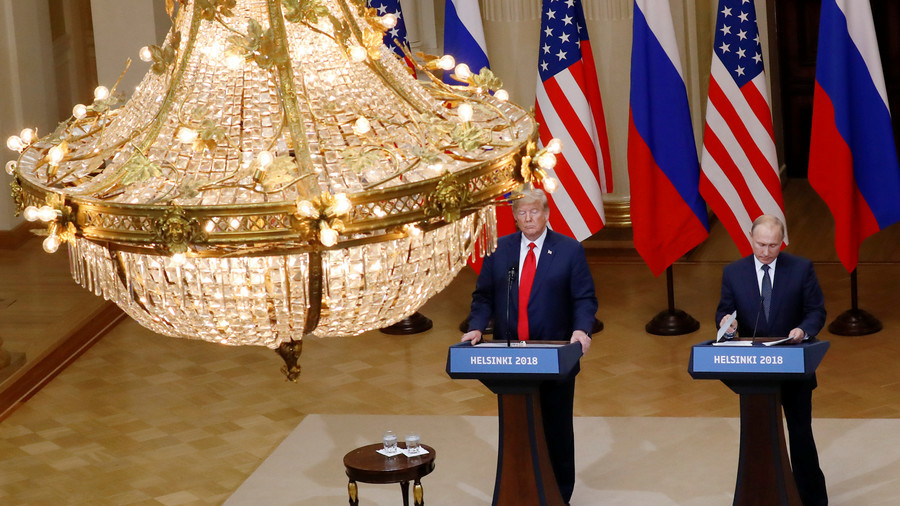
“We’ve reviewed the current status and prospects of the Russia-US ties, key issues of the international agenda. It’s obvious that the bilateral relations are undergoing a difficult stage, but these difficulties, tensions between our countries have no objective reasons. The era of ideological confrontation between our countries is long gone, the situation in the world has changed drastically,” Putin said.
The talks reflected “shared wish” of the two presidents to fix the US-Russia relations and envision the first steps to do so, Putin added.
The US and Russia are facing new challenges nowadays, differing drastically from the ones of the Cold War era, Putin said, naming regional conflicts, spread of terrorism, organised crime, ecology and economy risks.
Trump again asked his Russian counterpart on the alleged Russian meddling into the 2016 presidential elections, Putin revealed, stating that he replied exactly the same, as the last time. Russia has not meddled into the internal affairs of the US, he stated, adding that if any real evidence is provided, Moscow will cooperate on it.
Russia’s President described the talks with his US counterpart as “constructive and sincere,” adding, however, that such meeting was not enough to address “everything piled up.”
DETAILS TO FOLLOW
It is time .
It is time to introduce myself a little bit more , and stop using that nick of my , there is no need for it anymore .
Ok, here we go .
My Name is Peter Hofman married for 37 years and 47 years together with my wife , friend and blood brother Fran .
I am 62 years old, and we are native Dutch and I have Jewish roots from my father’s side .
I am interested and discussing politics , social, social economics and religious matters for a LONG, long time .
Basically it was an important part of my youth and later life .
I am Technicaly educated in electronics, pneumatic and electrical, special in control systems for factories, ships, yachts and so on and have knowledge about quality measurements .
Worked in many places around the world as trouble shooter, quality inspector and construction supervisor .
Now I am retired and enjoy life with my wife , 3 dogs and a cat .
I was honored when Joseph asked me to help him with his site and I will continue to do my part as long it is given .
Source: Code Red alert blares in south Israel after IDF attacks 2 Gaza posts
The siren, which was heard at 5:36pm, came shortly after the IDF confirmed Palestinian reports that it had attacked two observation posts in Beit Hanoun and Jabalia on Monday afternoon located near areas from which Palestinians had flown incendiary balloons earlier in the day.
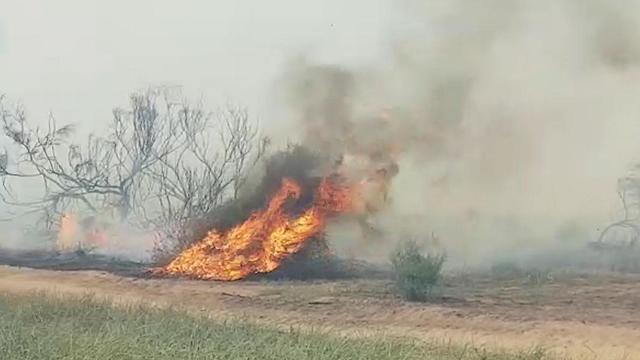
According to the IDF, the attack was carried out in response to the kite and balloon terror led by Hamas against Israeli civilians and against Israeli sovereignty.Firefighters were once again called to Israeli Gaza-border communities on Monday afternoon as flames that incinerated more landscape at the Karmiya Reserve between Kibbutz Karmiya and Kibbutz Yad Mordechai.
Source: Syrian army says it captures strategic hill overlooking Israeli border
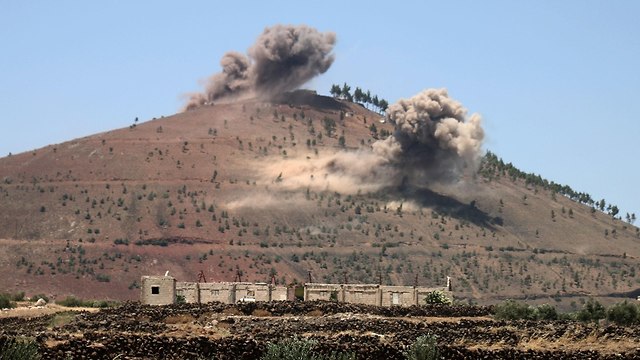
It has been heavily bombed by Russian and Syrian army raids in the past two days as the army has moved closer to the Israeli border after gaining control of most of Daraa province to the east in a push that began last June, according to rebels and a war monitor.
A Syrian army source quoted by state media said the army had made territorial gains in Quneitra province where it seized the town of Mashara, about 11 km (7 miles) from the Golan frontier.

The violence is taking place a few kilometers away from the line marking the start of the United Nations Disengagement Observer Force zone, an area monitored by a UN force since 1974 in the wake of the Arab-Israeli War.
Israel has threatened a “harsh response” to any attempt by Syrian forces to deploy in that zone. Israel does not want its enemies Iran and Hezbollah, both allies of Assad, who are well entrenched in that area to move forces near its border.
US President Donald Trump met Russian President Vladimir Putin on Monday in Helsinki, where Syria is expected to be high on the agenda. Ahead of the summit, Prime Minister Benjamin Netanyahu met Putin in Moscow and on Sunday spoke to Trump about Iran and Syria.
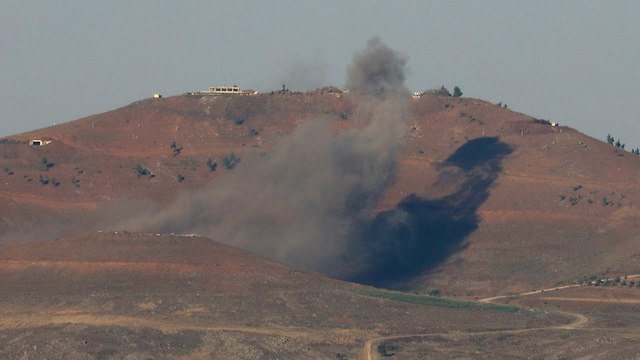
The army offensive aims at completing its control of the strategic area known as the “Triangle of Death”, which connects southern the Damascus countryside with Daraa and Quneitra provinces.
The area is a bastion of Iranian-backed militias including the Hezbollah terror group, according to Western intelligence sources.
Israel signalled it would not impede the Syrian army offensive in Quenitra as long as it steered away from the demilitarized zone, even as it struck Syrian army posts near the frontier and elsewhere in Syria where it suspects Iranian backed forces are stationed.

Russian President Vladimir Putin shakes hands with Israeli Prime Minister Benjamin Netanyahu during their meeting at the Kremlin in Moscow. July 11, 2018Office of the Russian president
Shlomo Bolts Jul 15, 2018 12:39 PM Haaretz
Source Link: Vladimir Putin Is Laying a Bomb on Israel’s Doorstep
{Maybe, just maybe…and I’m going out on a limb here…Putin is no friend of Israel. – LS}
In September 1999, residents of an apartment building in the Russian city of Razyan came home to bags of explosives rigged to detonate in their basement. They hastened to call authorities, who confirmed the threat, defused the bomb, and arrested the perpetrators.
The next day, the perpetrators were released – according to some reports, they were Russian intelligence agents. The government declared that there had been no bomb and that it was all a drill.
Residents of the apartment were skeptical, but as one resident later told the LA Times, “The general opinion is that we’d better not challenge them or they will really blow us up.”
Indeed, many Russians who challenged the state narrative regarding this incident went on to die suspicious deaths.
Yet one Russian in particular benefitted. Prime Minister Benjamin Netanyahu recently met him at the World Cup to discuss the Iranian presence in Syria, and came out proclaiming that Russia had pushed Iranian proxies “tens of kilometers” from Israel’s border.
Russian President Vladimir Putin, then the Russian intelligence chief, blamed Chechen terrorists for the Razyan incident – and for a series of actual bombings of Russian apartment buildings earlier that month that killed nearly 300 people – and went to war with the separatist region of Chechnya the next day. Putin used his role in that war to paint himself as a security hawk, win the Russian presidency, and steer Russia toward authoritarianism. As Russian influence operations on social media gain global notoriety, Israel would be wise to recall this older and more low-tech form of information warfare in Putin’s playbook.
It’s a fundamental paradox: How could the Razyan hotel incident simultaneously have been a harmless drill, and the last straw before a wide offensive on the Chechen capital? Putin made both claims; one must be a lie.
If we examine Russian actions near Israel’s border today, we confront the same paradox at the heart of Netanyahu’s Syria policy: How could Russia simultaneously be the main agent of Iranian expansion, and an Israeli ally in pushing Iran back?

Russian President Vladimir Putin shakes hands with Ali Akbar Velayati, a senior adviser to Iran’s Supreme Leader Ayatollah Ali Khamenei, outside Moscow. July 12, 2018Alexei Druzhinin/AP
Both cannot be true. One is a lie.
Netanyahu does not have long to reveal the truth. The Syrian regime is in the midst of a devastating offensive on opposition forces in southern Syria, which borders Israel. Over 250 civilians have been killed in the offensive, which includes Russian airpower and Iran-backed militia fighters. Current reports indicate an exodus of tens of thousands of civilians fleeing toward Israel’s border.
And as Haaretz analyst Zvi Bar’el has rightly noted, “Israel is considered the party that gave the green light for the entry of Assad forces into southern Syria…based on a Russian commitment to remove Iranian forces.”
Given Netanyahu’s strong focus on containing Iran, the Russian commitment is key. Israel does not want Iranian proxy militias near its border, especially since many of them have declared their intentions to target Israel. Yet Russia is facilitating exactly that.
Many international observers underestimate the extent of Iranian involvement in the regime’s current offensive, perhaps due to Russian pronouncements that Iran must withdraw from the area, or due to multiple feigned Iranian withdrawals that turned out to be ruses.
In fact, the Iranian proxy Liwa al-Zulfikar was integral to the storming of Busr al-Harir, the first major town to fall to pro-regime forces in the current offensive, as Russian warplanes bombed from above. An Iranian Revolutionary Guards Corps commander was recently reported killed in Deir al-Adas, a northern gateway to the Golan Heights. Similarly, the Iranian proxy group “Abu Fadel al-Abbas” recently appeared in the frontline town of Da’el under 30km from Israel.
Da’el activists shared a photograph earlier this month of Abu Fadel al-Abbas leader “Abu Ajeeb” speaking with a Russian general. I queried former residents of Da’el on the photograph, and they traced its precise location to the Martyr Fayz al-Jamous school in northwest Da’el – a plausible site given current battle lines, and a site that aligns with imagery analysis of the photograph. The Assad regime hasn’t controlled Da’el until this month, so the photograph must have been quite recent.
Russian leader Vladimir Putin is hardly distancing Iran from the Israeli border. If anything, Iran and Russia are collaborating as closely as ever. But this is the same treacherous double game that Putin played in Razyan nearly 20 years ago.
Just as the same foiled apartment bombing cannot be both a routine intelligence drill and a provocation to war, we know that Russia can’t be Iran’s air cover for advances toward Israel and an Israeli ally against Iran at the same time. Furthermore, Putin likely knows that we know; the same day the aformentioned photo was released, Russian Foreign Minister Sergei Lavrov strongly backtracked on his stance that “all foreign forces” – including Iranian proxies – must leave Syria.
But Putin’s goal is not factual accuracy or consistency. It is to plant the proverbial bomb on Israel’s doorstep: to present Israel with a mortal threat, make it clear that he is doing so, and leave just enough deniability that Israel chooses to pretend he is an ally rather than confront him for the threat he created.
This mode of information warfare relies on the target audience’s fear of confronting Putin. He wants Israel to say, as residents of a Russian apartment once said, “We’d better not challenge them or they will really blow us up.”
Unfortunately, it appears Netanyahu has fallen into the trap. Russian Foreign Minister Sergei Lavrov declared on May 30 that all Iranian proxies must withdraw; Hezbollah attacked a gateway town to the Golan Heights as recently as July 9; Netanyahu nonetheless declared, mere hours later, that Iranian proxies had withdrawn “tens of kilometers” from Israel’s border. In short, Netanyahu endorsed Putin’s lie.

Despite John McCain and the neocon’s best efforts to disrupt it, his advisors (and the Democrats) warnings, and the rest of the Deep State’s concerted plans with the liberal media to paint Trump into a lose-lose situation, the Trump-Putin Summit in Helsinki is due to start within the next hour or two.
As President Trump noted in a tweet earlier, “Unfortunately, no matter how well I do at the Summit, I would return to criticism that it wasn’t good enough.”
As The Hill notes, Trump has long wanted a closer relationship with Putin, something he believes can mend frayed ties between their two countries. But beyond his apparent affinity for Putin, many in Washington have questioned why the president is sitting down with his Russian counterpart and what he seeks to accomplish.
Here are five things to watch for when Trump and Putin meet in Helsinki:
Russia’s interference in the 2016 election, already at the front of observers’ minds, has rocketed to the top of the agenda ahead of Monday’s summit. Deputy Attorney General Rod Rosenstein announced Friday the indictment of 12 Russian intelligence officers who allegedly hacked into the Democratic National Committee and other Democratic groups. The announcement comes just days before the Helsinki summit, ramping up pressure on Trump to raise the issue with Putin. But the president has long wavered on the matter, despite the U.S. intelligence community’s assessment that Russia interfered in the election. Just last month, Trump tweeted that “Russia continues to say they had nothing to do with Meddling in our Election!”
Trump has repeatedly highlighted that denial — which Putin made during their first face-to-face meeting at last year’s group of Group of 20 summit — as a way of downplaying the issue. “President Trump is now the outlier in his own administration, seemingly,” said a former Trump transition official. The president has promised multiple times to press Putin on election interference, saying Friday he would “absolutely firmly ask the question” when they meet. Trump has expressed a belief, however, there is not much he can do to deter their activity. “I don’t think you’ll have any ‘Gee, I did it, I did it, you got me.’ There won’t be a Perry Mason here,” Trump said at a press conference with British Prime Minister Theresa May.
National security figures with ties to the White House hope Trump publicly warns Putin against interfering in the midterms and threatens the Russian leader with consequences.
But the worst-case scenario they fear is Trump remaining silent on the issue and raising the possibility of lifting sanctions on Moscow, something that would fuel criticism from political opponents who believe he is too close to Putin.
Democrats in Congress have called on Trump to cancel the summit entirely in response to the indictment, but there is no sign Trump is interested in doing so.
Trump has reportedly been eying a deal with Putin in Syria that is aimed at moving Iranian forces away from the border with Israel in exchange for withdrawing U.S. troops. But both U.S. and Russian officials have been reluctant to give ground on thorny issues such as troop levels or territory, and experts are not optimistic a deal will be made in Helsinki. “To me, this whole issue of expecting the Russians or hoping the Russians are going to deliver Iranian concessions in Syria is the triumph of blind hope over grim analysis,” said Robert Ford, former U.S. ambassador to Syria under former President Obama.
Under the terms of a possible deal, Russia would promise to limit Iranian presence near Syria’s border with Israel and Jordan and, in turn, the U.S. would allow Syrian President Bashar Assad’s forces to take control of the area. U.S. forces have an outpost in southern Syria near the border with Jordan and Iraq known as al Tanf, which Pentagon officials have said is key to ensuring Iran does not complete the Tehran-to-Beirut land bridge it desires. But under the reported deal, U.S. forces would leave al Tanf — and eventually Syria — altogether. Experts have warned Trump not to repeat the mistakes of his summit with North Korean leader Kim Jong Un, when he did not come away with an ironclad plan for denuclearization.
“If he buys a vague promise, then it looks like the Singapore summit where he gets some nice words without details from the other side of the summit table,” said Ford.
Crimea has been at the heart of U.S.-Russia tensions since 2014. That’s when Russia annexed the peninsula off Ukraine, sparking a wave of international sanctions and other measures aimed at isolating Moscow. But Trump has repeatedly left the door open to recognizing Russia’s claim over Crimea during his meeting with Putin, even repeating Moscow’s talking point that it has a rightful claim to the territory because most residents speak Russian. The president stoked further concern this week when he again did not rule out the possibility during his press conference at the end of the tumultuous NATO summit.
“That’s an interesting question, because long before I got here President Obama allowed that to happen, that was under his watch, not my watch,” Trump said. “What will happen with Crimea from this point on? That, I can’t tell you.”
One of the post-Crimea punishments for Russia was getting booted from the then-Group of Eight world economic powers. But last month, on his way to the Group of Seven summit in Canada, Trump said that should be reversed. “Russia should be in this meeting,” he said at the time. “Why are we having a meeting without Russia being in the meeting?”
The U.S. and its European allies stepped up their military posture and exercises in Eastern Europe after the Crimea annexation. But after Trump unilaterally agreed to cancel joint military exercises with South Korea during his summit with North Korea’s Kim, allies are fearful of him doing the same with Putin. Republicans in Congress are cautioning Trump against a repeat performance. “I think the president should listen to his security council and our secretary of Defense and our NATO allies on anything of substance dealing with the U.S. military posture. We’ve got to be careful, we’ve got to be strong,” said Sen. Richard Shelby (R-Ala.), who recently led a congressional delegation to Russia.
Trump has said one of his top priorities for the summit is arms control, a topic that could produce a rare opportunity for the U.S. and Russia to find common ground. Arms control advocates say Trump can score an easy win with Putin by agreeing to extend the New START Treaty for another five years. The treaty, negotiated by the Obama administration, caps the U.S. and Russia’s deployed nuclear warheads to 1,550 each and comes up for renewal in 2021. “[Renewal] would ensure that we do not return to a numerical arms race,” said Thomas Countryman, former assistant secretary of State on international security and nonproliferation.
But most experts do not believe a decision on New START will come at the summit. Trump has dismissed the treaty as one of Obama’s “bad deals,” and it could take some convincing to get him on board. Republicans have argued the treaty should not be extended while Russia is in violation of a separate arms control agreement known as the Intermediate-Range Nuclear Forces (INF) Treaty. That agreement, which has been credited with helping end the Cold War, bans ground-launched ballistic and cruise missiles with ranges between 500 and 5,500 kilometers. The United States has repeatedly accused Russia of violating the INF Treaty by developing and deploying a banned missile, a charge Moscow denies.
The summit could provide an opportunity for Trump to address the INF violation directly with Putin, but experts say Russia has shown little appetite for reversing course.
Even more than contentious policy issues, the visuals could be the most memorable part of the Trump-Putin summit. Trump and Putin will hold a joint press conference, which should be a spectacle in and of itself and give U.S. media a chance to rare opportunity to press the Russian leader on election meddling and other key issues. It could cause problems for Trump if he appears too friendly with Putin, especially given the timing of the meeting, just days after the hacking indictments.
But Trump’s desire to form a close bond with Putin could lead the president to give his Russian counterpart a warm reception, just like he did with Kim in Singapore. It could fuel criticism back home that Trump has a greater affinity for strongmen than he does for longtime U.S. allies.
Days before the summit, Trump was shown grimacing during a group photo with NATO partners in Brussels and rolled his eyes when he was asked during a meeting with British Prime Minister Theresa May about critical comments he made about the U.K. leader. Putin, a former KGB officer with a flair for the dramatic, could also have some tricks up his sleeve.
The Russian leader frequently shows up late for meetings with world leaders, even forcing Pope Francis to wait for 50 minutes before a 2015 sit-down in Vatican City. Putin even brought his pet Labrador to a 2007 meeting with German Chancellor Angela Merkel, who has a well-known fear of dogs. The Russian president later said he did not mean to scare Merkel and claimed he apologized after learning she is scared of dogs.
* * *
And in case it’s not immediately obvious, as Jim Jatras recently noted, there are many reasons the bipartisan US establishment hates Trump. His heresies from neoliberal orthodoxies on immigration and trade are prominent. But top among them is his oft-stated intention to improve relations with Russia.

That’s fighting words for the Deep State and its mainstream media arm, for which demonizing Russia and its president Vladimir Putin is an obsession.
The fact that Donald Trump made his intention to get along with Moscow a priority during his 2016 campaign, both against his Republican primary rivals and Hillary Clinton (who has compared Putin to Hitler) was cause for alarm. This is because far more than even the frightening prospect that the 70-year state of war on the Korean Peninsula might end, US reconciliation with Russia would yank the rug out from under the phony justifications for spending hundreds of billions of dollars annually to counter a “threat” that ceased to exist over a quarter century ago. Absent hostility to Russia that money has no reason to keep sustaining the power, privilege, and prosperity of a horde of moochers and profiteers, both at home and abroad.
That’s why when it was reported soon after his January 2017 inauguration that Trump was seeking to open dialogue with the Kremlin and set an early summit with Putin there was a hysterical counteraction.
* * *
Finally, watch out for any ‘hot mic’ incidents, because it would very awkward if a president on the United States was caught offering himself up to a Russian leader…
Trump never colluded with the Russians, but guess who did? 👇 pic.twitter.com/5dzmR1lFyK
— Christine (@Tweetsfor45) July 14, 2018
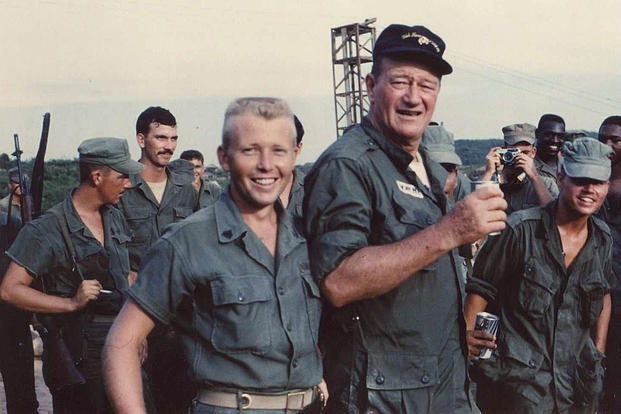
Corpsman Gene Hackemack & John Wayne, June 20, 1966, with Bravo Co., 1st Tanks, 1st Mar. Div. on Hill 55 (Chu Lai/Da Nang area).
We Are The Mighty 16 Feb 2018 By Blake Stilwell
Source Link: How John Wayne Got Rid of the KGB Agents Hired to Kill Him
{Good thing for both sides the KGB failed and Nikita called off the hit. Did I mention Putin was once a KGB agent? Maybe so, but you already knew that. – LS}
It seems like so many dictators just love movies. We all do, but absolute power takes it to a whole new level. Gaddafi had a channel set up just to play his favorite movie – his one favorite movie. Kim Jong-Il kidnapped his favorite actors and actresses to star in North Korea’s movies. Then, of course, the next natural step for these guys is directing movies.
Kim Jong-Il made several films. Benito Mussolini pitched to Columbia pictures. And even Saddam Hussein made a $30 million war epic. But Joseph Stalin was the Soviet Union’s “ultimate censor.”
At the time, global Communism was still very much a growing threat, one Stalin wanted to continue to spread around the world – under Soviet leadership. {It’s still as big a threat as ever. – LS}
He saw how much power and influence films – and the stars in them – held over large audiences. He saw it in Nazi German propaganda during the Second World War and he used it effectively himself to further his own personality cult.
So when he saw John Wayne’s power as an virulent anti-Communist on the rise, he ordered the actor killed and then sent (allegedly) more than one hit squad to do the job. He saw the Duke as a threat to the spread of Communism around the world – and especially in America.
According to the book John Wayne – The Man Behind The Myth, Soviet filmmaker Sergei Gerasimov told Wayne of the KGB plot in 1949. What the Duke and his Hollywood friends did to the hit squad is mind blowing.
Obviously not one to let a thing like Communist assassins get him down, Wayne and his scriptwriter Jimmy Grant allegedly abducted the hitmen, took them to the beach, and staged a mock execution. No one knows exactly what happened after that, but Wayne’s friends say the Soviet agents began to work for the FBI from that day on.
But there were other incidents. The book also alleges KGB agents tried to take the actor out on the set of 1953’s Hondo in Mexico. A captured sniper in Vietnam claimed that he was hired by Chairman Mao to take the actor out on a visit to troops there.
Stalin died in 1953. His successor, Nikita Khrushchev, met privately with John Wayne in 1958 and informed him that the order had been rescinded. Wayne told his friends Khrushchev called Stalin’s last years his “mad years” and apologized.
The entire time Wayne knew there was a price on his head, he refused the FBI’s offer of federal protection and didn’t even tell his family. He just moved into a house with a big wall around it. Once word got out, though, Hollywood stuntmen loyal to the Duke began to infiltrate Communist Party cells around the country and expose plots against him.
Wayne never spoke of the incidents publicly.




 anneinpt
 artaxes
 danmillerinpanama
 davidking1530
 Peter Hofman
 Joseph Wouk
 Peter
Peter Louisiana Steve
 WarSclerotic
Recent Comments