Archive for May 2018

Report: Satellite images reveal secret Iranian missile development site

May 24, 2018

Source: Report: Satellite images reveal secret Iranian missile development site – Israel Hayom

10 reasons to tank the F-35 jet sale to Turkey 

May 24, 2018

Source: 10 reasons to tank the F-35 jet sale to Turkey – Israel Hayom

Prof Ephraim Imbar

The F-35 is a U.S.-manufactured fifth-generation combat platform with stealth capabilities, probably the best fighter jet in the world. (Israel just received its first F-35 jets, and has used them operationally over Syria.)

Turkey is planning to acquire at least 100 F-35 fighter jets, the first of which is scheduled to be delivered in 2019. Delivering such a war machine to Turkey – an authoritarian, Islamist-leaning state that undermines Western interests in the region – would be a big mistake.

Under the leadership of President Recep Tayyip Erdogan, Turkey has long stopped behaving as a reliable Western ally, even though it is still a formal member of the NATO alliance.  Instead, Turkey has succumbed to Ottoman and Islamist impulses, and it seems to have imperial ambitions.

Turkey is spending large amounts on arms procurement and on building a domestic military industry intended to bolster its ability to project power beyond its border. It is intervening militarily in Iraq and in Syria. It has used military force against Kurds in Syria (an important American partner in the war against ISIS). Turkish-sponsored militias may yet confront American forces in Syria.

Ankara is also very hostile to American allies in the region. Turkish fighters regularly violate Greek airspace, underscoring Turkey’s desire for a revision in the international border. It bullies Cyprus (a third of which is occupied by Turkey) by sending its navy to intervene with gas explorations in Cypriot continental shelf waters. Turkey is also challenging the legitimacy of President Abdel-Fattah el-Sissi in Egypt (who deposed the Muslim Brotherhood former President Mohammed Morsi). Ankara opposes the Saudi attempt to isolate Qatar (a country that supports the Muslim Brotherhood and that is cozy with Iran). Similarly, Turkey’s relations with Israel have been strained. And at the same time, Turkey is nurturing good relations with Russia, China and Iran.

The Barack Obama and Donald Trump administrations have failed to significantly signal their displeasure with Ankara, allowing Turkey to pursue policies that are inimical to the American interest. It is time to change that. It makes no sense to strengthen Turkish military capabilities, and therefore the sale of F-35 jets to Turkey should be halted.

Telegraphically, here are 10 reasons why the F-35 sale to Turkey should be tanked:

  1. The sale by America of F-35 fighter jets abroad is meant to be a booster for the capabilities of U.S. allies. Turkey hardly qualifies any longer for this title.
  2. Delivering the F-35 to Turkey would indicate American support for Erdogan’s Turkey. Yet, Turkey is an increasingly authoritarian Islamist regime. Under Erdogan, infringements on human rights have gradually increased resulting in a “Putinization” of the Turkish political system. The military, once the defender of the Kemalist secular tradition, has been successfully subordinated by the Islamists.
  3. Supplying F-35s will significantly strengthen the capabilities of the Turkish military to make mischief in the region. Erdogan may decide to use the upgraded air force to establish himself as arbiter of developments in the eastern Mediterranean and other parts of the Middle East, or to interfere with Israel’s air supremacy, or even to attack Israel.
  4. The planned delivery of the Russian-made S-400 air defense system to Turkey, a procurement that has antagonized NATO members, makes the F-35 deal very problematic. If Turkey integrates the American-made F-35 and the Russian-produced S-400, details about the airplane operating systems might leak to the Russians. Thus, F-35 security could be compromised in other arenas where the jet is deployed.
  5. Turkey might facilitate Russian access to data about American weapon systems on the F-35.
  6. Leakage of sensitive information and technical details of U.S. weapons systems to Tehran is also a distinct possibility since Turkey is developing warmer relations with Iran.
  7. Eskisehir, in Turkey, has been chosen as an industrial hub for the production of F-35 engines and as a maintenance hub for all European operators of the F-35. This too is a mistake. It could create a problematic logistical dependency upon a country whose political direction is uncertain.
  8. This could result in the transfer of state-of-the-art technology to Turkey and increase the capabilities of the Turkish domestic arms industry. This would reduce Turkey’s dependence upon foreign suppliers, enhancing its freedom of action.
  9. The economic benefits of the F-35 deal for Turkey are evaluated at over $12 billion, thus aiding the fortunes of an Islamist regime. It is unwise to confer such advantages on a country whose behavior is not helpful to the U.S.
  10. Arms sales should be subordinated to paramount political and strategic considerations. American economic fears of losing the Turkish arms market should not supersede the negative strategic ramifications of the transaction.

In sum, the sale of F-35 fighter jets to Turkey must be stopped.

Professor Efraim Inbar is president of the Jerusalem Institute for Strategic Studies, jiss.org.il.

Behind The Smokescreen Part 2 ( The great deception )

May 24, 2018

Prison Authority Extracts 6 Smuggled Cellphones from Security Prisoner’s Orifice

May 24, 2018

Prison Authority Extracts 6 Smuggled Cellphones from Security Prisoner’s Orifice

Photo Credit: Police Spokesperson’s Office

Six cellphones that were extracted by Border Police from a terrorist’s body

Israeli border police on Wednesday arrested for the second time an Arab who was trying to scale the security fence surrounding Jerusalem, and then, minutes before he was placed behind bars in the Ofer security prison, they discovered and removed six cellphones from his body – before he was able to distribute them to fellow inmates, the Border Police Spokesperson’s office reported.

The suspect was initially spotted by the Border Police Nitzan battalion on Tuesday evening, attempting to scale the security fence near al-Ram, just outside the capital’s north-eastern municipal boundary. He was picked up, interrogated and sent home.

He returned Wednesday night, same Arab, climbing the same section of the security fence, and picked up by the same Border Police unit.

Because of the repeat offense, the suspect was taken this time to the Ofer security prison following his interrogation, where the guards performed the full intake procedure on him, during which six cellphones were extracted from his intestines. Clearly, the entire affair had been about the suspect getting arrested so that he would be able to distribute the contraband phones among six lucky imprisoned terrorists.

Following the discovery, the suspect was taken in for yet another Border Police interrogation, which may lead to cracking the illegal terror network that paid him to deliver his precious commodities.

Hamas Leader Acknowledges Iranian Support Amid Fall-Out From Gaza Clashes

May 24, 2018

by IPT News May 23, 2018 The Investigative Project on Terrorism

Source Link: Hamas Leader Acknowledges Iranian Support Amid Fall-Out From Gaza Clashes

{A proxy love affair. – LS}

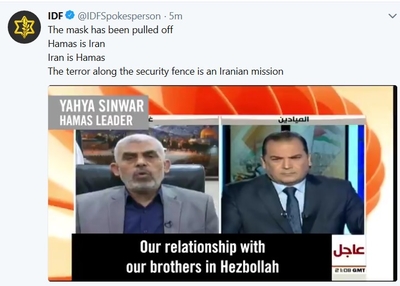
While many analysts and most of the international community refuses to acknowledge Iran’s role in fueling tensions on Israel’s border with Gaza, Hamas leader Yahya Sinwar this week boasted of his organization’s “strong and warm” ties with Iran and Hizballah.

In an interview Monday with Lebanon’s Al-Mayadeen TV channel, Sinwar admitted that Iran funnels “a lot of money, equipment and expertise” to Hamas’ military wing and other Gaza-based terrorist organizations,reports the Middle East Media and Research Institute (MEMRI),

For helping Hamas develop its capabilities, Sinwar thanked “first and foremost the Islamic Republic of Iran, which has provided the Al-Qassam Brigades (Hamas’ military wing) and the other factions of the resistance a lot of money, equipment, and expertise,” adding that “our ties with the Islamic Republic of Iran, with brother Qasem Soleimani and the other brothers in the IRGC leadership are very strong, powerful, and warm. Our relations with the Islamic Republic are excellent.”

In December, senior Hamas official Saleh Al-Arouri bragged about Hamas’ ties with Iran and Hizballah, and formally credited the Islamic Republic for arming Palestinian terrorist groups.

“Who supports the resistance in Gaza and Palestine? Iran. It is Iran and Hizballah that confront that entity [Israel] along with us,” Al-Arouri said in a Dec. 30 interview on Al-Quds TV.

He admitted that “the aid Iran provides to the resistance is not merely symbolic” and that “nobody but Iran gives us [Palestinian terrorist groups] any military support.”

In his latest interview, Sinwar also discussed “excellent relations” with Hizballah and revealed that both terrorist groups “coordinate and are in touch on an almost daily basis.”

This is the latest in a growing number of statements from senior Hamas and Hizballah leaders acknowledging that relations have reached new heights – to the point where Hizballah is helping Hamas build military infrastructure in south Lebanon to threaten Israel.

These connections and public admissions are ignored by Israel bashers in the West.

Prominent American Islamists, like Linda Sarsour, continue to propagate the narrative that Israel massacred peaceful, unarmed Palestinian protesters on the Gaza border in recent weeks. Even articles in respected policy outlets like Foreign Policy tow this view.

Hamas leaders, on the other hand, openly admit that they coordinated the violent demonstrations and orchestrated several attacks on the border with Israel.

“This is not peaceful resistance… so when we talk about ‘peaceful resistance,’ we are deceiving the public,” Mahmoud Al-Zahhar said in a May 13 interview with Al-Jazeera, adding that Hamas’ efforts at the border are “bolstered by a military force and by security agencies.”

Iran and its main proxy Hizballah are actively supplying Hamas with weapons and talking on a near daily basis to coordinate terrorist operations against the Jewish state.

This nuance is largely omitted from mainstream media analyses – further promoting Hamas public deception campaign, knowingly or not.

Report: Kim fears coup if he travels to Singapore for Trump summit

May 24, 2018

by Rick Moran May 23, 2018 American Thinker

Source Link: Report: Kim fears coup if he travels to Singapore for Trump summit

{Hotel North Korea, you can check out but you can never leave. – LS}

North Korea is far more than a run-of-the-mill dictatorship.  It is a paranoid gangster state, enormously corrupt, with various factions always at odds as they jostle for power.

This much is basically public knowledge.  But behind the scenes, even the supreme leader, Kim Jong-un, feels threatened.  And there is apparently a feeling among the top leadership in North Korea that if Kim attends the Singapore summit with Donald Trump, the military will take advantage of his absence to stage a coup.

Business Insider:

Citing sources familiar with the preparations, The Washington Post reported Tuesday that Kim was less concerned about meeting Trump than he was about what might happen at home in Pyongyang while he’s gone.

Kim is apparently concerned that the trip to Singapore may leave his government vulnerable to a military coup or that other hostile actors might try to depose him, sources told The Post.  The Kim dynasty has ruled North Korea since the country’s inception following the armistice in 1953.

Rumors of a simmering military revolt in North Korea are precisely the kind of thing that emboldened Kim to keep a tight grip on power over the years, according to some experts.

“The notion that Kim is secure in his power is fundamentally wrong,” Victor Cha, a director for Asian affairs for the National Security Council during the George W. Bush administration, wrote in a 2014 opinion column.

“Dictators may exercise extreme and draconian power like Kim, but they are also pathologically insecure about their grip on the throne,” Cha said.  “All of the public speculation about coups or interim leaders would feed the paranoid impulse of a dictator to correct that perception as quickly as possible, even if it were misplaced.”

As if to confirm those worries, Strategy Page is reporting that Kim shook up his military high command in just the last few days.

May 18, 2018: In North Korea Kim Jong Un again reorganized the senior military leadership.  This time there were not a lot of dismissals but instead, a lot of senior commanders were moved to other senior military posts.  Kim has been wary of the generals ever since he took power in 2012.  Ge was the youngest national leader ever in North Korea and many of the old timers doubted young Kim could handle it.  Kim soon executed a number of senior generals and retired many more.  …

Another sad fact is that few North Korean military personnel even remember the glory days (the 1980s) of the Cold War when Russia (as the Soviet Union) was supplying new weapons and support for older ones and the troops had fuel for training.  All that disappeared in 1991 and the North Korean military is still suffering massive deprivation.

The wild card is China.  Things are so bad in North Korea that a steady stream of refugees is crossing the border into China.  The Chinese government hardly knows what to do with these people.  There is a real fear on the part of Kim that if the refugee problem gets much worse, China will support a coup against him.  China is also tired of the brinkmanship between Kim and Trump and could support a coup to bring more stability to the peninsula.

No wonder Kim fears his own military.  At least this time, he apparently didn’t tie any of them to the barrel of an anti-aircraft gun and pull the trigger.

Washington is well aware of the situation, and the Trump administration’s public doubts about the summit taking place may have something to do with the whispers his people getting from North Korea about a fearful Kim.  But North Korea’s situation is beyond desperate, and Kim may be forced to take a risk he wouldn’t ordinarily take to save his regime from economic and social collapse.


Evidence points to Iranian work on long-range missiles at secret base — report

May 23, 2018

Source: Evidence points to Iranian work on long-range missiles at secret base — report | The Times of Israel

NY Times says researchers pieced together clues from satellite images that appear to show activity and powerful rocket engine tests at facility near Shahrud

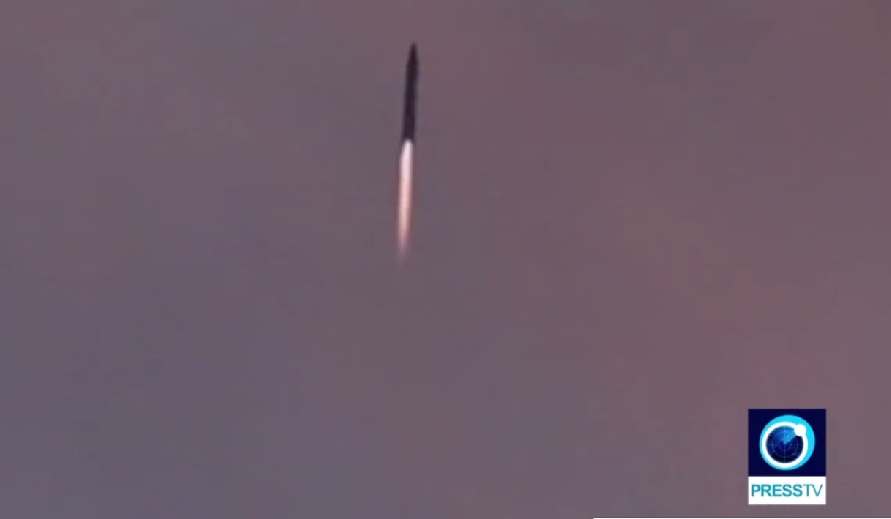
Iran showed footage on Saturday, September 23, 2017, of a missile test (Screenshot/PressTV)

Iran showed footage on Saturday, September 23, 2017, of a missile test (Screenshot/PressTV)

Weapons researchers have identified activity at a remote secret facility in the Iranian desert that points to the covert development of long-range missiles that could potentially be used to attack the United States, The New York Times reported Wednesday.

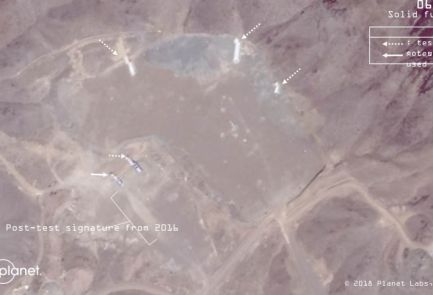
Satellite images appear to show, among other things, activity around a tunnel leading underground and evidence of powerful rocket engine tests that scorched telltale marks in the desert sand near the city of Shahrud, the report said.

Although there are no restrictions in place on the range of Iranian missiles, US President Donald Trump had insisted that limitations be placed on Tehran’s missile program as a prerequisite for Washington remaining in the landmark 2015 nuclear deal with Iran. He ultimately pulled out of it on May 12.

According to the report, researchers from the Middlebury Institute of International Studies at Monterey watched a recent Iranian documentary about rocket scientist Gen. Hassan Tehrani Moghaddam, a leading figure in the country’s missile development program, who was killed in a devastating 2011 explosion at Iran’s main research facility near the town of Bidganeh. Based on details in the film, the researchers came to the conclusion that before his death Moghaddam had helped set up another facility, which is still operational.

Screen capture from video of Gen. Hasan Tehrani Moghaddam, a ballistic missile engineer for Iran’s Islamic Revolution Guard Corps, who was killed in an explosion in 2011. (YouTube)

Another key clue came when one researcher, reviewing material from an Iranian journalist association, saw an undated photo of Moghaddam, who was a commander in Iran’s Islamic Revolutionary Guard Corps, that included in the background a box marked “Shahrud.”

The Shahrud site, located about 350 kilometers (220 miles) east of Tehran, was used for a missile test firing in 2013 and was thought to have remained largely unused since. However, satellite images of the site showed a steady increase in the number of buildings there over the past few years, the report said. Curiously, the buildings were painted an aquamarine color, the same shade that Moghaddam had ordered be used at the destroyed Bidganeh site, researchers noticed.

Large marks on the desert floor appeared to be the result of rocket engine test-firings, and the marks had appeared in 2016 and 2017, the report said. Rocket engines can leave a big scorching shaped like a candle flame on the ground.

Analysis of the concrete stands that would have held the engines during the firings suggested the motors had somewhere between 62 and 93 tons of thrust — consistent with the kind of power needed for a long-range missile. Other test structures, apparently also used for engine tests, were reportedly even larger.

Additional imaging from sophisticated sensors also showed traffic at the opening of an underground tunnel, indicating a large structure buried in the sand, the report said.

Researchers came to the conclusion that the site was working on advanced rocket motors and rocket fuel.

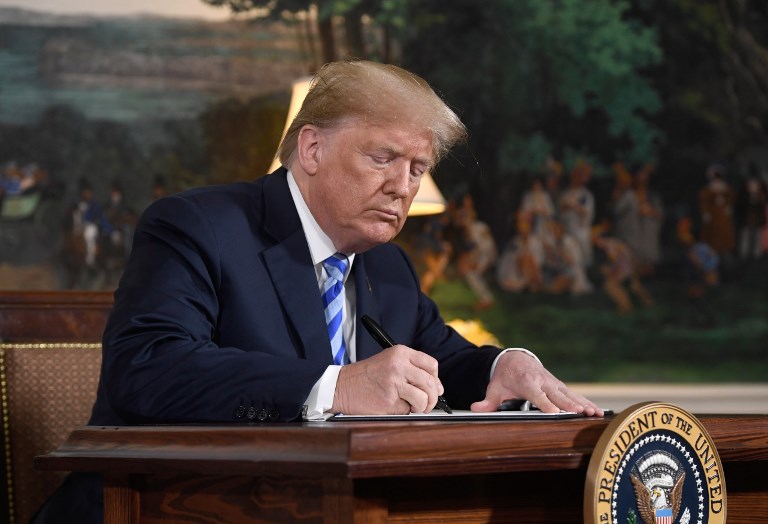
US President Donald Trump signs a document reinstating sanctions against Iran after announcing the US withdrawal from the Iran Nuclear deal, in the Diplomatic Reception Room at the White House in Washington, DC, on May 8, 2018. (AFP/Saul Loeb)

The report said that five experts who reviewed the research material agreed it strongly indicated work on long-range missiles. However, the report also noted that “it is possible that the facility is developing only medium-range missiles, which Iran already possesses, or perhaps an unusually sophisticated space program.”

The US and its allies have been demanding that Iran curb its production of ballistic missiles, which can reach parts of Europe and could soon reach the US as well. Western officials have maintained that the only reason Tehran could have for manufacturing such missiles would be to fit them with non-conventional, including atomic, warheads.

Tehran insists that it sees the missile program as crucial to its defensive posture, and says its existence is non-negotiable.

Iranian leaders have also said they are not working on missiles with a range beyond the Middle East. It has so far produced a missile with a range of 2,000 kilometers (1,240 miles), putting all of Israel in range as well as much of Eastern Europe.

The 2015 nuclear deal saw heavy sanctions lifted on Iran in return for Tehran freezing much of its nuclear program. Having pulled out of the deal in May, the US has vowed to apply the “strongest sanctions in history” on Iran.

United Nations Security Council Resolution 2231, which affirmed the Iran nuclear deal, called on Iran to refrain from developing missiles capable of carrying nuclear weapons. Iran has maintained that it never intended to develop nuclear weapons and therefore its missile development doesn’t violate the agreement.

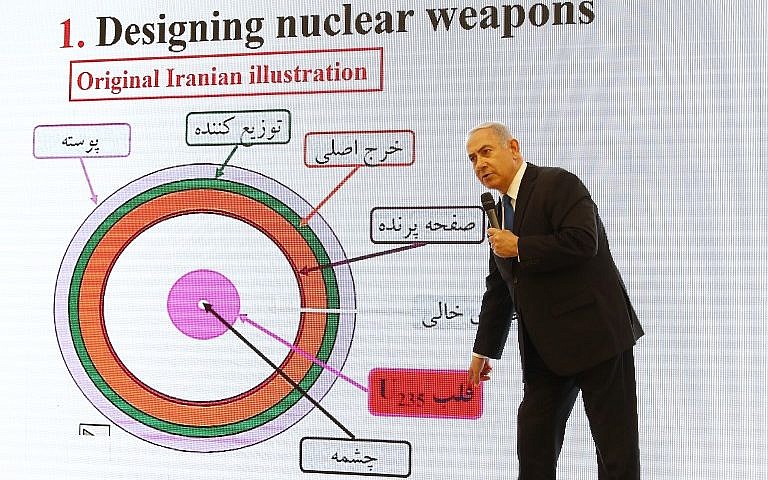
Prime Minister Benjamin Netanyahu gives a speech on files obtained by Israel he says proves Iran lied about its nuclear program, at the Defense Ministry in Tel Aviv, on April 30, 2018. (AFP Photo/Jack Guez)

However, Prime Minister Benjamin Netanyahu last month presented a vast archive of Iranian documents, obtained by the Mossad spy agency, which he said detailed Iranian efforts and research programs specifically aimed at producing an atomic weapon.

Netanyahu said at the time the evidence proved Iran had “lied” about its nuclear ambitions. In announcing his withdrawal from the nuclear agreement, Trump cited the Israeli intelligence haul as among the reasons for his decision.

Agencies contributed to this report.

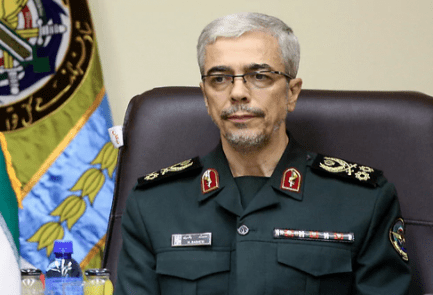
Iran’s top general: Iran doesn’t need permission to develop defense capabilities

May 23, 2018

Source: Iran’s top general: Iran doesn’t need permission to develop defense capabilities – Israel Hayom

Does Iran want war? 

May 23, 2018

Source: Does Iran want war? – Israel Hayom

Dr. Ephraim Kam

The most recent clash between Iran and Israel, on May 10, ended badly for Iran: All of the missiles it fired at Israeli military positions were intercepted or landed outside of Israeli territory. In response, Israel struck some 50 Iranians targets in Syria.

The results should come as no surprise because Israel is considerably stronger than Iran in the Syrian arena and Tehran’s use of its own forces and Shiite militias is predicated on a mistaken conception.

Originally, these forces were sent to Syria to help save the Assad regime and topple Islamic State, and they were aided by Russian air support. Iran, however, had other ideas: to build a long-term presence in Syria that would pose a significant threat to Israel. The Russian warplanes, though, were deployed to help Assad and to safeguard Russian interests in Syria. Thus far, Russia has not helped Iran in its fight against Israel, and it appears it has no intention of doing so. The Iranian and Shiite forces, therefore, were left without adequate air defenses, while the Iranian air force cannot contend with its Israeli counterpart. The Israeli airstrikes, which destroyed Syrian and Iranian air-defense systems, rendered the Iranian and Shiite fighters exposed. This situation isn’t likely to change in any substantial manner in the future. After their resounding failure in early May, the Iranians must know they cannot continue on the same path as before, and that Israel has forced it to plot a new course.

Iran now has two main courses of action to choose from – both problematic. The first option is using its most effective card for deterring Israel from further airstrikes: triggering Hezbollah’s massive rocket and missile arsenal; and, less likely, helping it by firing missiles at Israel from Iran. If Iran decides to utilize this capability on a significant scale, it’s reasonable to assume Hezbollah will follow orders.

This option, however, comes with two severe risks. First, Israel has repeatedly clarified that missile barrages from Hezbollah will lead to a particularly harsh Israeli response – not just against Hezbollah but all of Lebanon. The second risk is even more profound: Even if Hezbollah fires missiles, Israel will still hold Iran responsible. Israel can retaliate with a concentrated campaign to dislodge the Iranian foothold in Syria and Lebanon, which if successful would ultimately remove Iran from those countries. Even if the Iranians restrict their barrage to military targets, the most recent clash should inform them that even limited rocket fire can provoke a massive Israeli response, and moreover – that activating Hezbollah’s missile arsenal on any significant scale means war with Israel. Iran has no interest in getting dragged into a wide-scale conflict because its involvement in Syria places it at a disadvantage. A war with Israel would hamper Iran’s attempts to solidify its influence in Syria as well as Iraq and Lebanon. Above all, Israel could see an Iranian provocation as justification for an attack on Iran’s nuclear sites.

Iran’s other option is to switch into a lower gear when it comes to Israel. Iran won’t forgo its intent to raise a flag in Syria, which is its top strategic priority. But in light of the threat that the Iranian foothold in Syria presents to Israel, even though Iran does not have the capability of going to war with Israel on that particular state, Iran might prefer not to make the situation worse. What’s more, the Trump administration now comprises an unprecedented threat to Iran, under which Iran can use other methods to bolster its status in Syria, such as economic investment, tighter political ties, and helping build up the Shiite militias in Syria. This does not mean that Iran will give up on military action, just that it will leave out the elements that will pose a challenge to Israel before it has a proper response.

It’s hard to know which route Iran will opt for. There could be a debate between the radical arm of the regime and the moderates, which is reflected in President Hassan Rouhani’s remarks that Iran does not want more tension and in the calls by the protesters who flooded the streets at the end of 2017 for Iran to stop its costly intervention in Syria.

Dr. Ephraim Kam is a senior research fellow with the Institute for National Security Studies.

Likud MK urges U.S. to recognize Israeli Golan Heights

May 23, 2018

The 1981 Golan Heights Law, passed when Menachem Begin was prime minister, states that “the law, jurisdiction and administration of the State [of Israel] will take effect in the Golan Heights.”

By Lahav Harkov
May 23, 2018 17:52
https://www.jpost.com/Israel-News/Likud-MK-to-US-Recognize-Israeli-Golan-Heights-558177
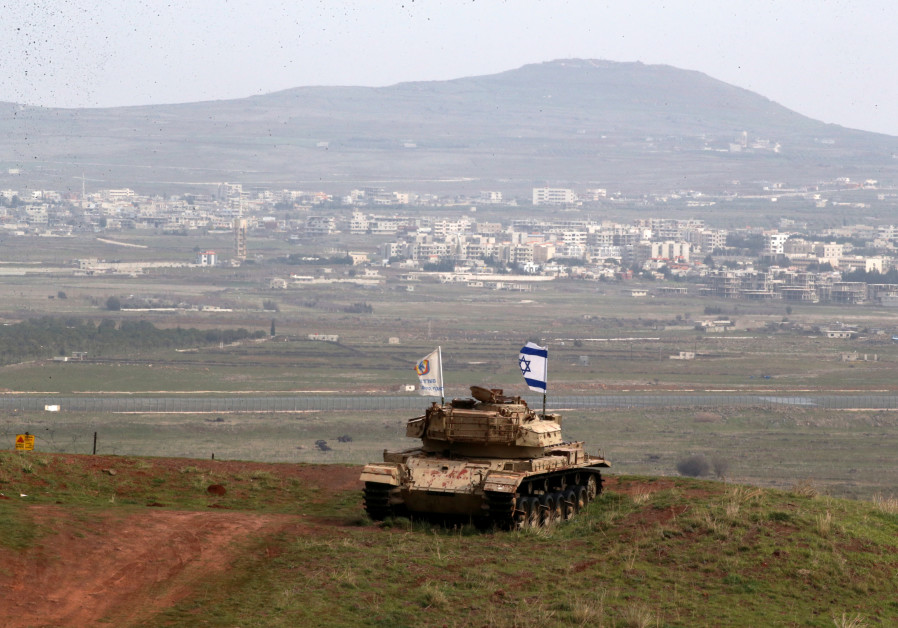
An old military vehicle can be seen positioned on the Israeli side of the border with Syria, near the Druze village of Majdal Shams in the Golan Heights. (photo credit: AMMAR AWAD/REUTERS)

The United States should recognize Israeli sovereignty over the Golan Heights, Likud MK Yoav Kisch wrote to US Ambassador to Israel David Friedman in a letter obtained by The Jerusalem Post on Wednesday.

“In 1981, Israel declared sovereignty over the Golan Heights,” Kisch wrote last week. “The Golan Heights has since developed and became an inseparable part of Israel. Today, facing a reality in which the borders of Syria are redefined, a US declaration supporting the Israeli sovereignty over the Golan Heights is imperative.

“We believe that [US] President Donald J. Trump is aware of the difficulties and challenges in the region,” the Likud MK said.
Kisch cited recent US policy toward Israel, including its withdrawal from the Iran nuclear deal and moving the US Embassy from Tel Aviv to Jerusalem.

The MK added: “We believe that an official American recognition of the Golan Heights as a sovereign Israeli territory would be a natural continuation of the current US policy in our region.”

The Golan Heights Law passed in 1981, when Menachem Begin was prime minister, states, “The law, jurisdiction and administration of the State [of Israel] will take effect in the Golan Heights.” It holds the record for the fastest-passed law in the Knesset’s history, having been legislated in one day. The Reagan administration criticized the move, and the UN declared the Golan Heights Law “null and void and without international legal effect.”

In recent years, several ministers and MKs have said the time has come for international recognition of Israeli sovereignty in the Golan Heights. In February, Prime Minister Benjamin Netanyahu told UN Secretary-General Antonio Guterres that the Golan “will remain in the hands of Israel forever.”

Last week, US Rep. Ron DeSantis (R-FL) proposed a resolution to have the US recognize Israeli sovereignty over the Golan Heights.

“It is the sense of the Congress that the Golan Heights represent an integral part of the State of Israel and are crucial to the ability of Israel to safeguard its borders and maintain its existence,” the measure reads, according to The Washington Free Beacon. “Given the civil war in Syria and the expansion of Iranian influence in Syria, the United States should recognize Israel sovereignty over the Golan Heights.”

DeSantis’s resolution does not have any cosponsors, and is seen as a long shot on Capitol Hill.