Archive for May 2018

Shi’ite militia groups in Syria to do Iran’s dirty work, strike Israel 

May 7, 2018

Source: Shi’ite militia groups in Syria to do Iran’s dirty work, strike Israel – Arab-Israeli Conflict – Jerusalem Post

Israel is bracing for a barrage of missiles to be launched towards military positions along its northern front from Syrian territory.

BY ANNA AHRONHEIM
 MAY 7, 2018 18:37
An IDF soldier stands atop a tank near Alonei Habashan on the Golan Heights, close to the ceasefire

 An IDF soldier stands atop a tank near Alonei Habashan on the Golan Heights, close to the ceasefire line between Israel and Syria. (photo credit: REUTERS)

Israel is bracing for a barrage of missiles to be launched towards military positions along its northern front from Syrian territory, masterminded by Iran’s Revolutionary Guard Corps, as revenge for alleged Israeli strikes on Iranian bases there.

While Hezbollah and the IRGC are the only groups who have the weapons and know-how to launch the strike, it is believed that the attack will be launched by one of the many Shi’ite groups stationed in Syria and active in the civil war there.

According to Aymenn al-Tamimi, research fellow at the Middle East Forum, there are several key candidates who might launch the missile barrage backed by Iran.

“The Syrian civil war has led to the expansion of the IRGC’s network of regional clients,” Tamimi told The Jerusalem Post, adding that there are therefore “a variety of groups that could possibly strike Israel on its behalf, such as one of the many new ‘Syrian Hezbollah’ groups integrated into the registers of the Syrian armed forces, or one of the Iraqi groups that emerged during the war, like Harakat al-Nujaba’ and its ‘Golan Liberation Brigade.'”

Another possible group, Tamimi said, is a Palestinian group linked to Hezbollah and the IRGC such as “Force of Return,” who are currently fighting on the side of the Bashar Assad regime in the Yarmouk camp outside Damascus.

“But it still remains the case that Lebanon’s Hezbollah, which maintains some bases in Syria, is the most likely and capable of carrying out an attack,” Tamimi said.

According to Michael Horowitz, senior regional analyst at Middle-East-based geopolitical consultancy Le Beck, having Hezbollah carry out the attack would go against Tehran’s plans, which are said to include trying to avoid a full-fledged war with Israel.

“This would defeat the purpose of using Shi’ite militias, which in my opinion, was meant to enable Iran to respond without actually provoking an escalation,” Horowitz told The Post.

According to intelligence, Iran, which is reported to be very determined to carry out an attack, has claimed to be in the advanced planning stages and may soon execute the retaliatory attack that it had vowed to carry out in retaliation for an alleged Israeli airstrike against the T-4 airbase near Homs, used by the IRGC two months ago.

Israel is reported to have uncovered involvement by Hezbollah commanders and senior operatives from Shi’ite militias in the planning of the retaliatory strike, and it is believed that these militias, along with experts from Hezbollah under the command of the IRGC’s Quds Force Commander Iran’s Major General Qassem Soleimani, will launch the attack in the form of precision-guided missiles or armed drones from a base in Syria.

“The idea is to use heavy Iranian missiles, including the Fateh-110, under the command and with the advisory work of Hezbollah but without an IRGC presence,” Channel 10 said on Sunday night, adding that Hezbollah members from Lebanon have been brought to Syria to train Shi’ite militia members for the attack.

While military officials have briefed mayors across the country on the latest developments, the heads of local councils in northern Israel have told their residents that there are no special instructions or precautions.

In recent months, Israel has identified and released to the media pictures of a number of air bases throughout Syria that they said are being used by Iranian forces. It is believed to be an effort to deter Iran from carrying out strikes on Israel, as those bases would likely be targeted by Jerusalem in response to any such attack.

According to Horowitz, “Israel chose to publish such threats to send the message that it will see any attack coming from an Iranian-backed group as one actually coming from Iran, and thus will respond in kind.”

Tensions have risen dramatically between the two arch-enemies, and in late April, Israel’s ambassador to the United Nations Danny Danon told the UN Security Council said that there are “over 80,000 extremists from all over the Middle East who are members of Shia militias in Syria under Iranian control.”

Israeli officials have been warning against Iranian entrenchment in the Golan Heights, an area of key strategic importance for the Jewish State, stressing that it is a red line for Jerusalem. Officials have also stated that the northern border is no longer considered as two separate entities, but as one continuous front.

In February, OC Northern Command Maj.-Gen. Amit Fisher warned not only of the Iranian entrenchment across the border, but the return of Syrian troops to an area which was relatively quiet for nearly six years while under the control of rebels.

“We must prepare ourselves operationally and in terms of intelligence for the growing threat: The return of the Syrian army and Iranian forces, Hezbollah and others.”

Iran warns of ‘historic regret’ if US ends nuclear deal

May 7, 2018

Source: Iran warns of ‘historic regret’ if US ends nuclear deal – Israel Hayom

Don’t threaten us with war

May 7, 2018

Source: Don’t threaten us with war – Israel Hayom

Prof. Eyal Zisser

A day does not pass without someone trying to frighten the Israel public with doomsday prophecies of impending war with Iran.

Thus, United Nations Secretary General Antonio Guterres warns of a regional conflagration if U.S. President Donald Trump withdraws from the nuclear deal. Thus, former senior officials and media pundits in Israel warn that the ongoing fight against Iran’s presence in Syria and its race to a nuclear bomb could spark a regional war at a very heavy cost to Israel.

These threats are utterly baseless and lack credibility. They are simply a scare campaign, which at best stems from a fixed thought process and adherence to the status quo, even at the cost of mortgaging our future, and at worst is motivated by political or personal considerations.

The warnings are rooted in a false and even naive assumption that the regional bully can do anything he wants, and that imposing boundaries on him is a mistake because it will only make him angry and cause him to respond violently. However, experience teaches us that setting red lines and backing them up is the only way to deter bullies and cause them to change their behavior.

We must keep in mind that Iran does not want war and is not prepared for one. Its power has always lain in waging campaigns via proxies who spill their own blood on its behalf. The Iranians are far more careful with their own blood.

Iran is also mired in economic difficulties at home, and the Iranian public is not hiding its objections to expensive and bloody adventures far from its borders. Even among Iran’s leaders, President Hassan Rouhani and his supporters are spearheading opposition to the country’s military entanglements in Yemen, Iraq and Syria. The Iranian public will not forgive those who drag them into another war that only serves the interests of the Islamic Revolutionary Guard Corps, whose entire reason for existence is to establish an Iranian presence throughout the Middle East.

Aside from this, Iran is weak militarily as well as economically, and its presence in Syria is still limited, thanks in large part to Israel’s airstrikes in Syria. The threats by Iranian leaders to destroy Israel should not be taken lightly, but at the same time they should not pose a deterrent. Shimon Peres, the architect of Israel’s nuclear program, said that Iran is incapable of destroying Israel, but that through its hollow threats it exposes itself to an existential threat it cannot counter.

None of this is to say that Iran will be deterred by the unfolding poker game with the American president over the Iranian nuclear program, and with Israel over the Iranian presence in Syria. Iranian retaliation for the alleged Israeli airstrikes will eventually come, but it will not be in the form of all-out war; it will consist of precise, if painful, blows, in the form of terrorist attacks.

What remains to be seen is who among the players will blink first. Throughout the 70 years of its existence, Israel has already gained experience in “poker games” such as these – against Egypt’s President Gamal Abdel Nasser in the 1950s, and against the PLO and Hezbollah in Lebanon – and for the most part it has emerged with the upper hand. If Israel aspires to survive in the Middle East, it cannot be deterred and retreat.

Indeed, in the Middle East wars often erupt organically and unpredictably without anyone planning or initiating them. Misunderstandings, miscalculations and unforeseen events could lead to war. Caution, alertness and readiness are necessary, certainly among those in charge. However, there is quite a bit of distance from this to an atmosphere of public hysteria and panic about a possible war this summer. There is a difference between rational concern that breeds caution and panic that breeds political and military paralysis and will exact a price in the long run.

History teaches us that the fear of antagonizing an enemy and appeasement attempts do not pay. Ultimately, not only do these fail to deter the adversary, they actually encourage it to advance to the next stage of its plan. At that point, confronting the enemy can be far more complicated and daunting.

Eyal Zisser is a lecturer in the Middle East History Department at Tel Aviv University.


Report: Hamas offered long-term truce to Israel

May 7, 2018

Terror group that rules Gaza reportedly seeks cease-fire in exchange for easing of restrictions on goods entering Gaza.

Hamas trains for confrontation with Israel

Reuters

Hamas leaders in Gaza have sent messages to Israel through various channels in recent months offering to negotiate a long-term ceasefire.

According to a report in the Israeli daily Haaretz on Monday, Hamas wants to tie the cease-fire to an easing of the partial blockade on Gaza, a green light for large-scale infrastructure projects and a prisoner exchange.

Israel has “not responded clearly” to the messages, according to Haaretz.

Hamas reportedly is more open to discussing such a cease-fire since it is in “dire and unprecedented strategic distress,” the report said. In addition, reconciliation efforts between Hamas and the Palestinian Authority remain frozen in the wake of an assassination attempt in March on PA Prime Minister Rami Hamdallah during his visit to Gaza.

Hamas has called on Gazan demonstrators to continue to protest at the border with Gaza as part of the March of Return protests, and has vowed that the protests will continue past what was supposed to be the end date, May 14, the date on the Gregorian calendar that marks Israel’s 70th birthday, and which the Arab world calls The Nakba, or The Catastrophe. The Palestinian Authority also is planning a large demonstration on that day in Ramallah in the West Bank, the seat of government of the PA.

The Israel Defense Forces estimates that 70 percent of the 48 Gazans killed in the current protests are connected to Hamas or the military wings of other terror organizations in Gaza, according to Haaretz.

Former US Senator Joe Lieberman: ‘I Hope Trump Leaves the Iran Nuclear Deal’

May 7, 2018

Former US Senator Joe Lieberman: ‘I Hope Trump Leaves the Iran Nuclear Deal’

Former U.S. Senator Joe Lieberman on Fox News Futures, discussing the Iranian JCPOA

Photo Credit: Fox News Futures / screen capture

Former Connecticut U.S. Senator Joe Lieberman — also a former Democratic vice presidential candidate and currently chairman of the advocacy group, United Against Nuclear Iran — says he hopes President Donald Trump decides to withdrawn from the Iranian nuclear deal next week.

Lieberman told Fox News Futures host Marie Bartiromo in an interview on Sunday (May 6), “I give you the perspective of somebody who was in the Senate for 24 years, worked with people in both parties to put sanctions, economic pressure on Iran with a singular goal which was to denuclearize Iran to stop their nuclear weapons development program.

“What the Obama administration and our allies in Europe did was not that. It basically gave away all our leverage against them in return for a pause in their nuclear program – if they’re keeping their word, which they don’t have a good reputation for doing – and it gave them $100 billion which they’ve used to support terrorists and to spread their rule throughout the Middle East.

“So it was a bad deal, a mistake for us. I think the president really has the power to correct that mistake and I hope he does.”

The worst part of the nuclear deal, says Lieberman, is that it “didn’t really end Iran’s nuclear program. It’s clear they’ve got tremendous capacity.”

Lieberman says that Iran signed the JCPOA in 2015 in order to “get the economic pressure off of them to get the $100 billion. They can go back and have a legitimate nuclear weapons development program in about ten years — and that’s not the security that the world needs.”

The second point, he says, is that although the agreement gave United Nations International Atomic Energy Agency inspectors the right to inspect facilities “all over Iran,” the Tehran government has not allowed those inspectors to enter any military site, which is “where they would be cheating, if they’re cheating,” says Lieberman, adding, “and I worry that they are.”

Regarding whether or not Europe will ultimately go along with Washington if the president decides to withdraw from the deal — Lieberman says despite the vocal protests to the contrary, he is convinced they will, for the simple reason that the United States has a bigger economy than that of Iran. Money talks.

“The Iranian economy is four or five hundred billion dollars. Ours is like $44 trillion,” Lieberman emphasized, “so you give the European banking and business community a choice of what to do if we pull out, and slap the sanctions back on Iran.

“It’s no choice: They’re going to continue to do business with us and they’re going to turn their backs on the Iranians, and most of the rest of the world will do the same,” he said.

“Then, hopefully the Iranians will come back to the table and negotiate a total denuclearization of their country and then we can welcome them into the world community.”

Putin inaugurated as Russian president (FULL VIDEO)

May 7, 2018

Iran says it could remain in nuke deal even if US pulls out

May 7, 2018

President Rouhani says Tehran won’t bolt accord provided the European Union offers guarantees it’ll keep benefiting from it

Today, 2:00 pm

https://www.timesofisrael.com/liveblog-may-7-2018/

Iranian President Hassan Rouhani says his country would be willing to remain in the nuclear deal even if the United States pulls out, providing the European Union offers guarantees that Tehran would keep benefiting from the accord.

Rouhani’s remarks came ahead of President Donald Trump’s decision expected later this week on whether to pull America out of the landmark deal between Iran and world powers. Rouhani speaks during a meeting with officials in the northeastern city of Mashhad.

He says a US pullout would be a “strategic mistake.”

He says that “what we want for the deal is that it’s preserved and guaranteed by the non-Americans” — a reference to other signatories of the 2015 agreement.

He adds that in this case “the US pullout will be OK.”

We’ll Assassinate Assad, Warns Senior Israeli Minister

May 7, 2018

We’ll Assassinate Assad, Warns Senior Israeli Minister

Syrian President Bashar al-Assad, Russian President Vladimir Putin, in Sochi

Photo Credit: Courtesy the Kremlin

(JNi.Media) Minister Yuval Steinitz, who is a member of Israel’s Security Cabinet made it very clear that Israel intends to assassinate Syrian president Bashar Assad, if Assad continues to allow Iran to operate in Syrian territory, Steinitz said in an interview with YNet on Monday.

“If Syrian President Bashar Assad continues to allow the Iranians to operate from Syrian territory, Israel will eliminate him and collapse his regime,” Steinitz said.

Advertisement

Yesterday reports emerged in the Israeli media that Iran was planning a missile strike on Israel, probably using its proxies in Syria, including Hezbollah.

Steinitz said, “Until now, Israel has not intervened in the Syria civil war. If Assad allows Iran to transform Syria into a military base against us, to attack us from Syrian territory, he needs to know that that is his end.”

Steinitz said Israel previously had that same dilemma with Hezbollah, when Hezbollah attacked Israel from Lebanese territory — should Israel respond to just Hezbollah or also to Lebanon?

Israel has since made it clear, her policy would be to bomb Lebanon back to the stone age if Hezbollah attacks Israel from their territory.

Assad, Steinitz said, can decide whether or not Iran can act from his territory, bringing in missiles and weapons. But Assad won’t be allowed to sit quietly in his palace while Syria is turned into a base to attack Israel.

Referring to Prime Minister Benjamin Netanyahu’s upcoming meeting this Russian President Vladimir Putin, Steinitz said Israel has unprecedented levels of dialogue with Putin, many ties and common interests, as well as few conflicts of interest.

Issuing a not-so-disguised hint to Putin, Steinitz said that Israel has red lines, and that if someone is interested in maintaining Assad’s survival, they had better respect our red lines, and tell Assad to not allow any missile or drone strikes against Israel.

Steinitz said Israel isn’t interested in a war with Iran or any other party, but Israel will not allow Iran to turn Syria into a base for the Iranian Revolutionary Guard Corps. What happened to Lebanon from Hezbollah is serious enough.

On Sunday, PM Netanyahu said “We have no interest in an escalation [with Iran], but we are prepared for every scenario. We don’t want a confrontation – but if one must come, it’s better now than later.”

A few months ago, Netanyahu warned Putin that Iran was building weapons factories in Lebanon, where its military advisers were attempting to manufacture precision weapons for use against Israel. He also warned Putin that Iran was continuing to establish a permanent military presence in Syria – an existential threat to the State of Israel, which would not be allowed to continue.

Update: Minister Steinitz later clarified that he was expressing his own personal opinion.

Make Turkey great again: Erdogan trumpets more Syria ops & ‘100% local arms’ in bold manifesto

May 7, 2018
https://www.rt.com/news/425997-turkey-military-syria-manifesto/
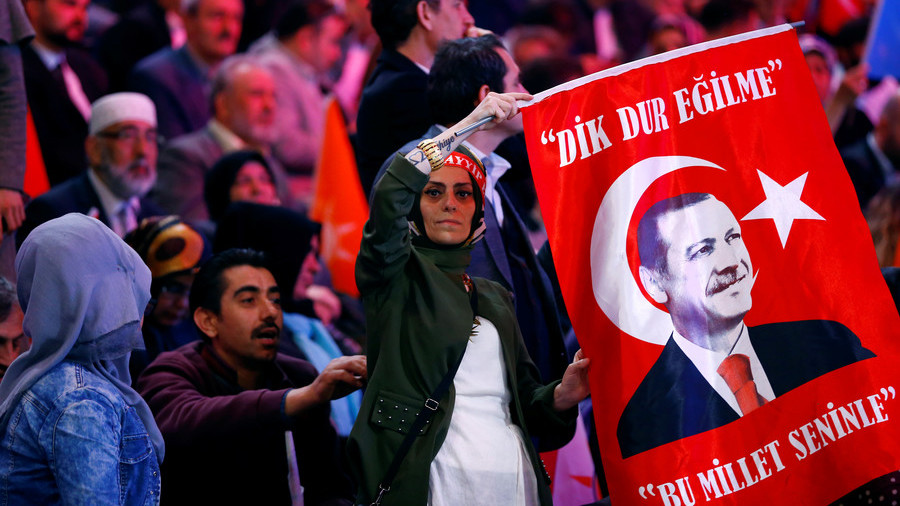
Turkish AK Party’s Istanbul congress © Osman Orsal / Reuters
Ankara will conduct more cross-border military operations in Syria and will focus on developing a fully self-sufficient defense industry, the Turkish president said, unveiling his ruling party’s manifesto ahead of June elections.

“Turkey will launch new operations in the new period, like Operation Euphrates Shield and Operation Olive Branch, to clear its borders from terrorists,” president Recep Tayyip Erdogan said, outlining the ruling Justice and Development Party (AKP) manifesto, ahead of a snap general election on June 24.

The country’s priorities for the next five years will focus, among other things, on military production, an independent foreign policy and on border security.

Read more

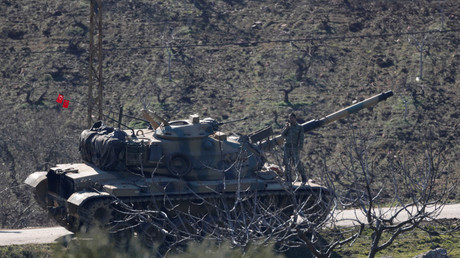
A Turkish tank near the Turkish-Syrian border in Kilis province, Turkey January 31, 2018. © Osman Orsal

“Turkey is becoming an important power in the world. Turkey will be a global power, a leading force,” Erdogan said Sunday, noting that the country aims to enter the ranks of the world’s top 10 economies by 2023.

Part of the domestic development would focus on achieving complete “independence” in defense, as NATO allies continue to hinder weapons-supply and technology-sharing with Ankara.

“Turkey’s goal is to have 100 percent indigenously-made land, air and sea defense systems,” Erdogan said. “We will continue to produce our own weapons to become a global power. We will increase our defense industry [assets], like our ALTAY tank, ATAK helicopter, drones, armed drones.”

“The basic principles of our foreign policy will continue to be independence, national interest, national security and a conscientious stance,” the president added, addressing thousands of AKP’s loyalists in Istanbul.

Erdogan’s pledge to conduct further incursions into a neighboring country comes in the middle of the ongoing cross-border ‘Olive Branch’ operation in the north-western Syrian region of Afrin, which began in January.

Besides fighting the remnants of radical Islamists in the region, the Turkish offensive is also focused on rooting out the Kurdish-led Democratic Union Party (PYD), and especially its armed wing People’s Protection Units (YPG), from the border areas.

Read more

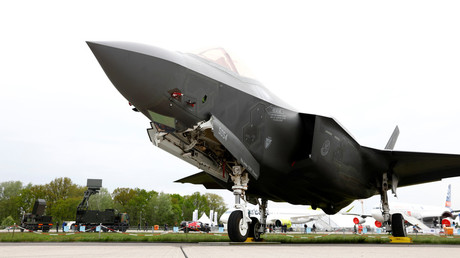
A Lockheed Martin F-35 aircraft. © Axel Schmidt / Reuters

Ankara considers Syria’s Kurdish entities an extension of the Kurdistan Workers’ Party (PKK), which has been a thorn in Turkey’s side for decades. The Afrin campaign is the country’s second such operation in Syria, after the so-called ‘Euphrates Shield’ was completed in early 2017.

Turkish persecution of the Kurds on Syrian territory has further deteriorated its relations with the United States, which has long relied on the Syrian Democratic Forces (SDF), comprising mainly Kurds, to do its bidding along Turkish borders. Ankara has repeatedly criticized the US and other NATO allies for their support of Kurdish militias to keep a foothold in Syria, reiterating on an almost daily basis that it views them as a national security threat.

In addition to the Kurdish issue, Ankara has locked horns with its NATO allies over their criticism of Ankara’s ‘undemocratic’ post-2016 coup-attempt crackdown and their increasing refusal to sell arms and share military technology with Turkey. The reluctance by the West to cater to the needs of NATO’s second largest armed contingent has led Turkey to develop its indigenous arms production and even to seek arms supply from Russia – which has, in turn, evoked anger in Washington.

Defense officials warn of impending Iranian missile strike on northern Israel 

May 7, 2018

Source: Defense officials warn of impending Iranian missile strike on northern Israel | The Times of Israel

TV reports say Tehran looking to retaliate for Israeli raids in Syria without causing all-out war, likely with rockets at IDF bases rather than civilian targets

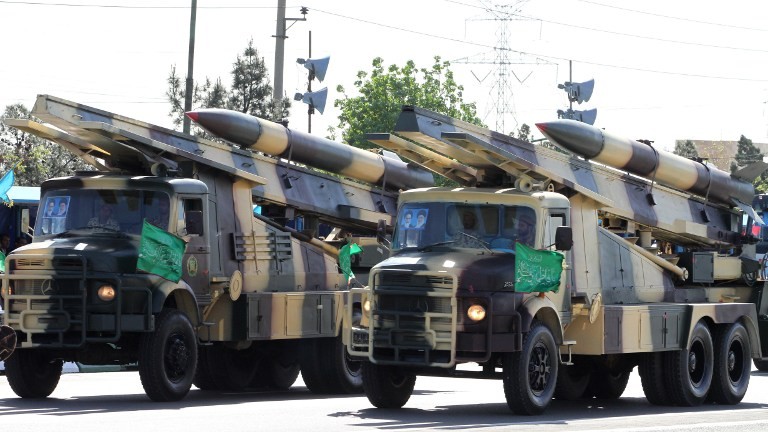
Iranian military trucks carry surface-to-air missiles during a parade on the occasion of the country’s Army Day, on April 18, 2017, in Tehran. (AFP Photo/Atta Kenare)

Iran is planning to retaliate for recent deadly airstrikes in Syria attributed to the Jewish state by having its proxies fire missiles at military targets in northern Israel sometime in the near future, defense officials warned on Sunday.

Tehran vowed revenge after the T-4 army base in Syria was struck in an air raid on April 9, killing at least seven members of the Iranian Revolutionary Guard Corps. The strike was widely attributed to Israel, though Jerusalem refused to comment on it. (T-4 was the base from which Israel said Iran launched an attack drone into Israel in February.) Late last month, a second strike, allegedly conducted by Israel, against an Iranian-controlled base in northern Syria was said to have killed more than two dozen Iranian soldiers.

On Sunday, all of Israel’s nightly news broadcasts reported that the Israeli military and intelligence services had identified preliminary efforts by Iran in Syria to carry out its reprisal, using its IRGC (Islamic Revolutionary Guard Corps), the Hezbollah terrorist group and local Shiite militias to launch a barrage of precision-guided missiles, likely at Israeli military targets in the north.

“Israel has recently identified with certainty Iranian preparations to fire at the north,” Channel 10 said. “We are not on the eve of war with Iran… but Iran is very determined to carry out an attack” to avenge the T-4 strike and the deaths of its military personnel, it said.

Israel Radio said the Iranian planning for an attack was at “an advanced stage.”

The understanding in the defense services is that Iran is looking to conduct its retaliation in such a way as to avoid full-fledged war with Israel, and will therefore likely not target civilian locations, according to the reports, which did not attribute the information to any specific source.

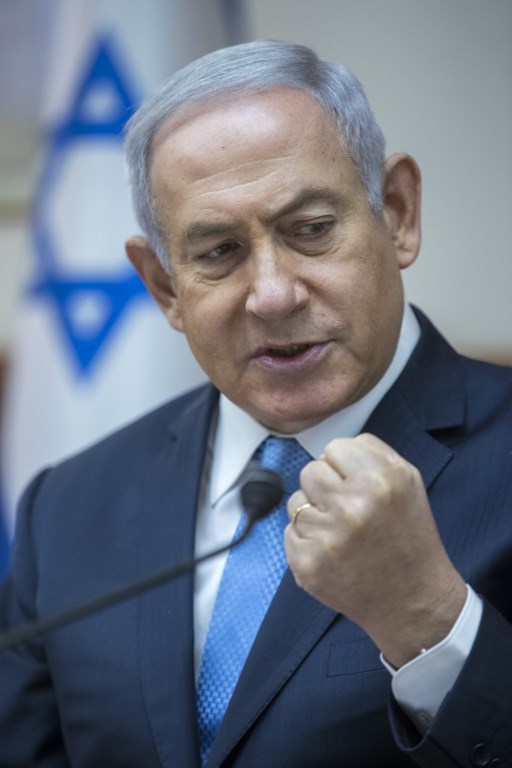
Israeli Prime Minister Benjamin Netanyahu chairs the weekly cabinet meeting in Jerusalem on May 6, 2018. (AFP PHOTO / POOL / JIM HOLLANDER)

No special instructions were given to residents of northern Israel. Indeed, the heads of local councils in the north have reportedly been told to tell citizens not to take any specific precautions and to go about their daily lives as usual.

Israel was working to prevent or counter such an attack, but was also preparing for the possibility that the Iranians “succeed in hitting a base in the north with missiles,” Channel 10 reported. The Israel Defense Forces was threatening to hit all Iranian targets in Syria if Tehran launched an attack on Israeli territory, the TV report said.

Seeking Russian pressure on Iran, Prime Minister Benjamin Netanyahu is set to present the information in Tehran’s preparations to strike Israel to Russian President Vladimir Putin during their meeting Wednesday in Moscow, the reports said.

Earlier on Sunday, Netanyahu said that while Israel is not interested in a military escalation with Iran, if there has to be a fight, he would prefer it be now, rather than later.

“We are determined to block the Iranian entrenchment, even at the cost of confrontation,” Netanyahu said at the start of the weekly cabinet meeting. “We don’t want an escalation, but we are prepared for every scenario. We don’t want confrontation, but if there needs to be one, it is better now than later.”

The prime minister also suggested Iran could directly launch a strike on Israeli territory.
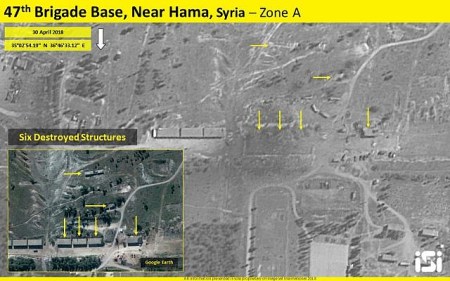
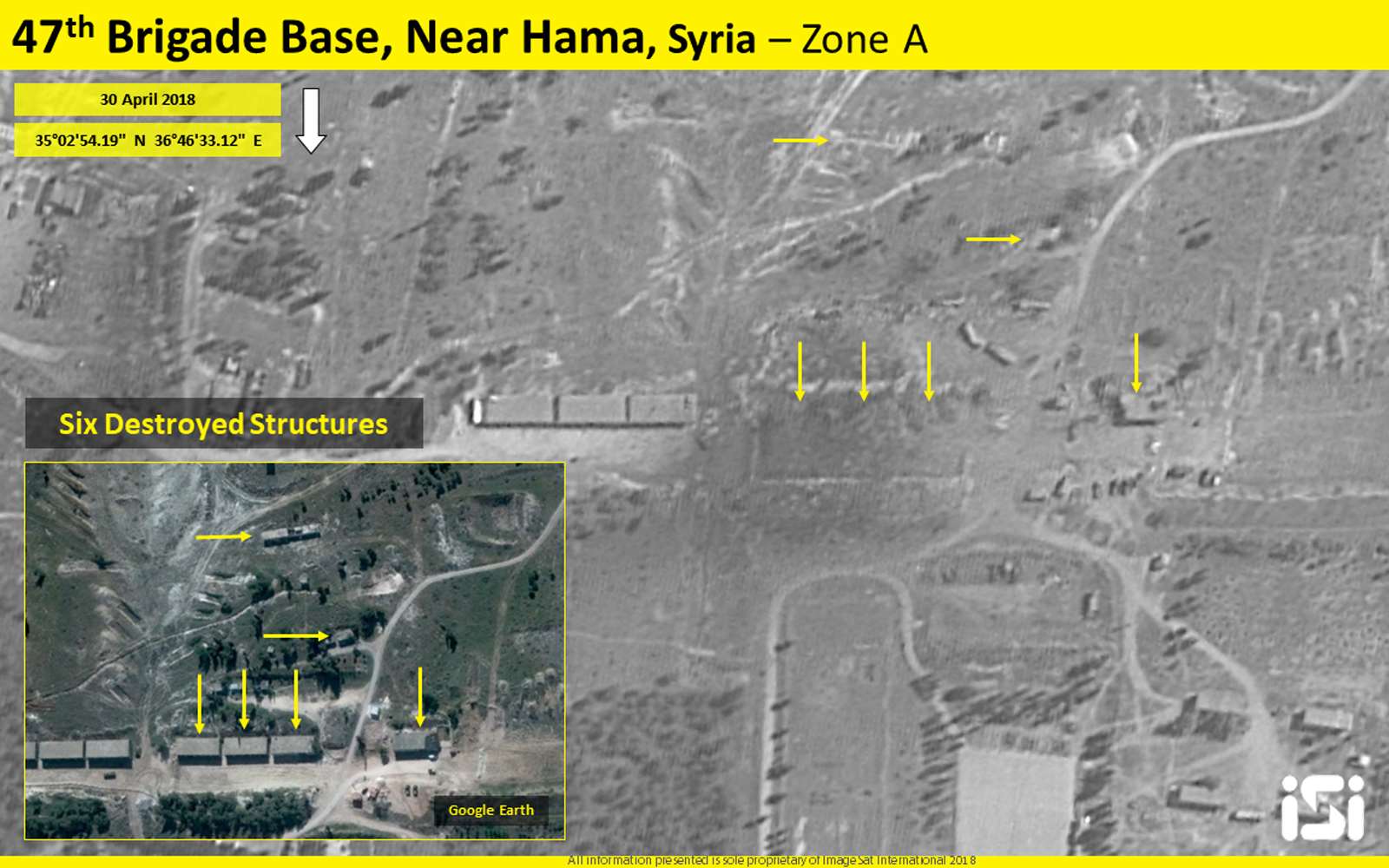
A satellite image showing the results of an alleged Israeli airstrike on a reported Iranian base outside the northern Syrian city of Hama the day before, on April 30, 2018. (ImageSat International ISI)

“In recent months, the Iranian Revolutionary Guards transferred to Syria advanced weaponry in order to attack us both on the battlefield and the home front, including weaponized UAVs, ground-to-ground missiles and Iranian anti-aircraft batteries that would threaten air force jets,” he said.

Sunday night’s warning about Iran’s plans to attack, as disseminated on the TV news broadcasts, appeared to constitute an attempt by Israel to show the Iranians that it was aware of their plans and was prepared to respond if they went through with the reprisal.

A Hadashot TV report said the warning was aimed both to deter Iran and to make it plain to the Iranians that Israel knows what they are planning, and that it will not be fooled if the missiles themselves are fired by Syrian militiamen.

A mainstay of Iran’s defense strategy is the use of proxies to conduct its bidding across the Middle East — the Houthis in Yemen, Hezbollah in Lebanon, Shiite militias in Syria and Iraq, as well as the Palestinian Islamic Jihad and Hamas in the Gaza Strip and West Bank. This is seen as an effort to limit Iranian casualties and keep any fighting limited to outside the Islamic Republic.

Last month, Defense Minister Avigdor Liberman said Israel was prepared to strike the Iranian homeland. “If they attack Tel Aviv, we will strike Tehran,” he said.

The unnamed defense officials on Sunday did not specify when the Iranian attack was expected to take place. The Channel 10 report said Iran’s preparations had been going on for weeks, but had been disrupted in recent days because of several strikes on targets in Syria, including on missile stocks in the Hama area, attributed to Israel. “But the Iranians have not given up,” the report said.

It added that missiles had been brought from Lebanon to Syria for use in the intended attack against Israel. “The idea is to use heavy Iranian missiles, including the Fateh-110” — under the command and with the advisory work of Hezbollah but “without an IRGC presence,” Channel 10 said.
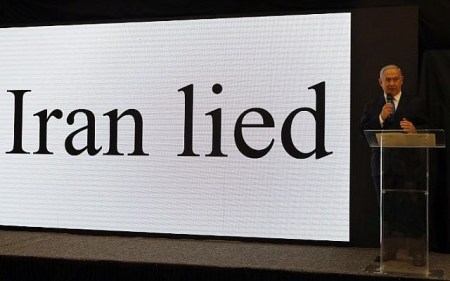
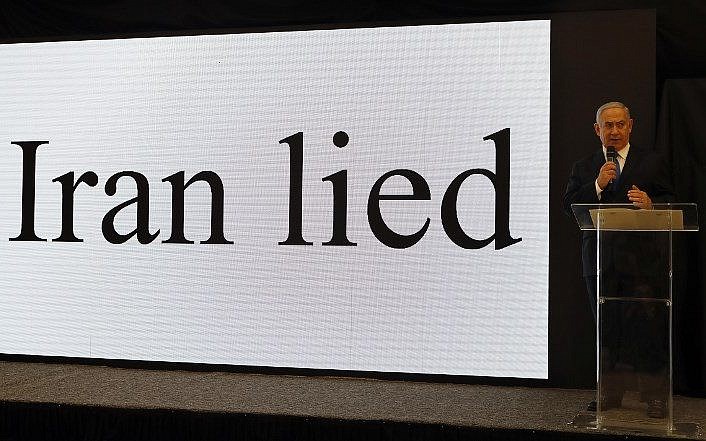
Prime Minister Benjamin Netanyahu gives a speech on files obtained by Israel he says proves Iran lied about its nuclear program, at the Defense Ministry in Tel Aviv, on April 30, 2018. (AFP Photo/Jack Guez)

Iran has been taking a number of heavy blows of late, including Israel’s seizure of its nuclear weapons archives from under its nose in Tehran, Channel 10 noted, and is determined to strike back but not for confrontation to escalate into war.

Last month, a member of the coalition supporting Iran’s ally, Syrian dictator Bashar Assad, told The New York Times that the reprisal would likely not come before the Lebanese parliamentary elections, which began on Sunday.

Further stoking tensions, this week US President Donald Trump is expected to determine the fate of the Iran nuclear accord, which he has repeatedly threatened to leave. On Sunday, French President Emmanuel Macron warned that if America abandoned the Iran deal, it could lead to a war.

Earlier on Sunday evening, Israel’s security cabinet held a three-and-a-half-hour session to discuss recent developments in the region, including the tensions with Iran in Syria and the upcoming decision by Trump regarding the nuclear deal. Channel 10 said this meeting was not a routine meeting, but it was prevented by Israel’s military censorship from explaining why.

Sunday’s warning was not the first intimation by Israeli defense officials of a potentially imminent retaliatory attack by Iran. Shortly before Israel’s Independence Day, the military prepared for the possibility of a direct attack from the IRGC’s air force.

The Times of Israel learned at the time that Israel’s defense establishment believed the Iranian revenge attack would likely be carried out with surface-to-surface missiles or armed drones. Others have speculated that an Iranian retaliation could come in the form of a cyber attack.
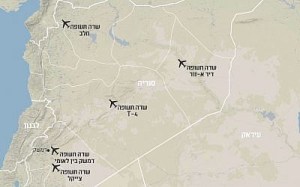
A map of Syria, provided to Israeli media, shows the approximate locations of five bases that Israel believes to be controlled by Iran.

In an apparent effort at deterrence, the IDF last month provided Israeli media with a map showing five Iranian-controlled bases in Syria that would likely constitute potential targets for an Israeli response, should Iran carry out any kind of attack. Satellite photographs of bases were also provided.

Those were Damascus International Airport, through which Iranian transport planes bring in weapons and military gear; the Sayqal air base; the T-4 air base; an airfield near Aleppo; and a base in Deir Ezzor, which was recaptured from the Islamic State terror group by the regime last year.

Israeli intelligence believes the sites are used by Iran for its missions in Syria, as well as to transport weapons to its proxies in the region, including Hezbollah.
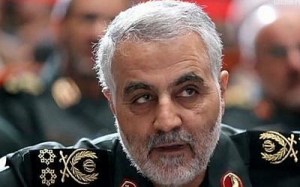
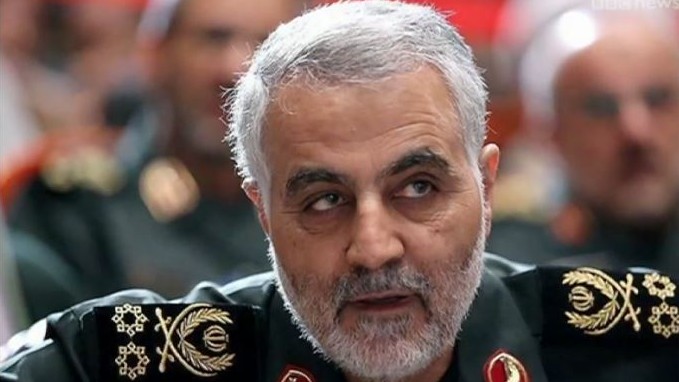
Iranian Revolutionary Guards al-Quds Force commander Maj. Gen. Qassem Soleimani (YouTube screenshot)

Israel believes Iran’s retaliatory effort is being led by Major General Qassem Soleimani, the head of the IRGC’s Quds Force, which operates around the world, with assistance from the head of the IRGC air corps, Brig. Gen. Amir Ali Hajizadeh; the head of its surface-to-surface missile program; Col. Mahmoud Bakri Katrem Abadi; and the head of its air defense operations, Ali Akhbar Tzeidoun.
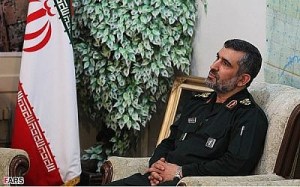
The head of the Iranian Revolutionary Guard Corps’ Air Force Brig. Gen. Amir Ali Hajizadeh. (Fars news)

Soleimani has repeatedly warned Israel, and threatened to “wipe out the Zionist entity” in February over the assassination of a Hezbollah leader, which has been attributed to the Mossad and America’s CIA.

Iran has access to a variety of surface-to-surface missiles, from short-range Fajr-5 rockets to medium-range Fateh 110 missiles, which have a range of approximately 300 kilometers (190 miles), to long-range Shehab ballistic missiles capable of hitting targets over 1,300 kilometers (800 miles) away.

To counter those threats, Israel has a multi-tiered missile defense system consisting of the Iron Dome for short-range rockets and mortar shells, the David’s Sling for medium-range missiles, and the Arrow for long-range ballistic missiles.

Israel sees Iran, which has vowed to destroy the Jewish state, as its main enemy in the region. Israeli officials have repeatedly stated that Israel will not allow Iran to entrench itself in Syria, marking it as a “red line” that it will fight militarily if necessary.