Archive for May 2018

Haley says Hamas pleased by Gaza deaths; Palestinian Authority envoy calls her racist 

May 16, 2018

Source: Haley says Hamas pleased by Gaza deaths; Palestinian Authority envoy calls her racist – Arab-Israeli Conflict – Jerusalem Post

It was a meeting that underscored the increasing enmity between Washington and the Palestinian Authority.
BY TOVAH LAZAROFF, DANIEL J. ROTH
 MAY 16, 2018 00:47
Haley says Hamas pleased by Gaza deaths; PA envoy calls her racist

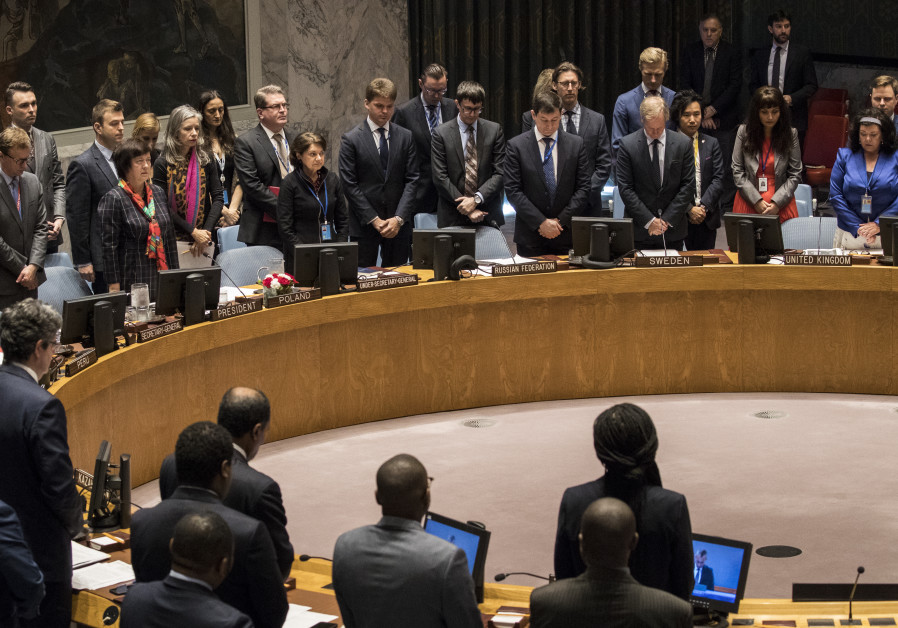
NEW YORK, NY – MAY 15: Members of the United Nations Security Council observe a moment of silence for those killed in the Gaza Strip on Monday, before the start of a UN Security Council meeting concerning the violence at the border of Israel and the Gaza Strip, at United Nations headquarters, May 15. (photo credit: DREW ANGERER / AFP)

It was a meeting that underscored the increasing enmity between Washington and the Palestinian Authority.

Haley, the United States’ representative to the Security Council, arrived late to the meeting, as did Israel’s Ambassador to the UN Danny Danon.

They both arrived after the other 14 Security Council members held a moment of silence for the more than 60 Palestinians who the Hamas-run health ministry reported were killed by the IDF in an attempt to quell a violent protest along its southern border with Gaza.

It was the bloodiest day since the start of the Hamas-led “Great March of Return” on March 30, which had the goal of breaking down the border barrier and entering Israel.

Haley made a brief speech, arguing that none of the 15-member body would be as restrained as Israel if their borders were threatened.

“Make no mistake: Hamas is pleased with the results from yesterday,” she said, as she explained how the terror group had goaded protestors into heading into dangerous areas of the fence by falsely telling them the IDF had fled.

Hamas used “loudspeakers that urge demonstrators to burst through the fence, falsely claiming Israeli soldiers were fleeing, when in fact, they were not. The same loudspeakers are used by Hamas to urge the crowds to ‘Get closer! Get closer!’ to the security fence,” Haley said.

“I ask my colleagues here in the Security Council: Who among us would accept this type of activity on your border? No one would. No country in this chamber would act with more restraint than Israel has. In fact, the records of several countries here today suggest they would be much less restrained,” she charged.

Haley then left the room, just as Mansour, who was an invited guest to the meeting, addressed the council.

Mansour charged that her words were “racist” and “provocative.”

He compared the Gaza protests to the demonstrations in the US against gun violence.

“We reject the racist discourse that turns us into excluded victims of humanity. We have the right to demonstrate as families against the occupation and its arrogance,” Mansour said.

The right to demonstrate is accepted throughout the world, he said.

“Why are we accused in a racist, fallacious way just because we exercise the same rights as anyone else?” Mansour asked.

“Stop the massacre committed against our people. The council cannot remain silent,” he said.

He called on the council to offer international protection to the Palestinians.

Danon then responded, explaining to the council that “these were not demonstrations, these were not protests – these were violent riots. They have repeatedly attempted to sabotage and breach the fence with the explicit goal of killing Israelis.”

Danon accused Hamas of wanting “death over peace,” and condemned the terrorist organization for exploiting its own people and using them as a collective “human shield.”

“Its goal was to kill and kidnap Jews in surrounding Israeli towns,” Danon charged.

When it comes to the safety of Israelis, “too often the world is silent,” he said.

He also charged that the Palestinians had caused their own people to die in a deadly public relations game.

“What would you do if a mob charged at your border with explosives and weapons?” he asked.

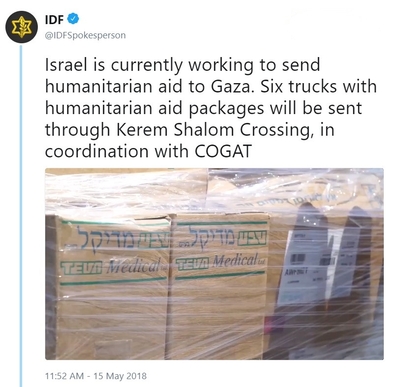
At a press conference outside the Security Council chamber, Danon showed a photograph of the sole commercial crossing between Israel and Gaza, the Kerem Shalom crossing, through which food and supplies enter the Strip. But during the Gaza riots, it was burned by the rioters, he said.

The council debate, in which most of the members spoke out against Israel’s disproportionate use of force, ended without any vote or formal condemnation.

The United States, which is one of five permanent members of the Security Council with veto power, had blocked any attempt to issue a statement with respect to Gaza or to demand a UN investigation into the deaths.

The UN Human Rights Council plans to hold an emergency session on the Gaza deaths on Friday. The office of the UN High Commissioner for Human Rights called for an independent investigation into IDF actions on the border.
Analysis: The new war against Iran in Syria is psychological

May 16, 2018

Source: Analysis: The new war against Iran in Syria is psychological – Middle East – Jerusalem Post

The shadow war with Iran in Syria is politics by other means because the grand strategy is to evict Iran from Syria.

BY SETH J. FRANTZMAN
 MAY 16, 2018 07:26
Analysis: The new war against Iran in Syria is psychological

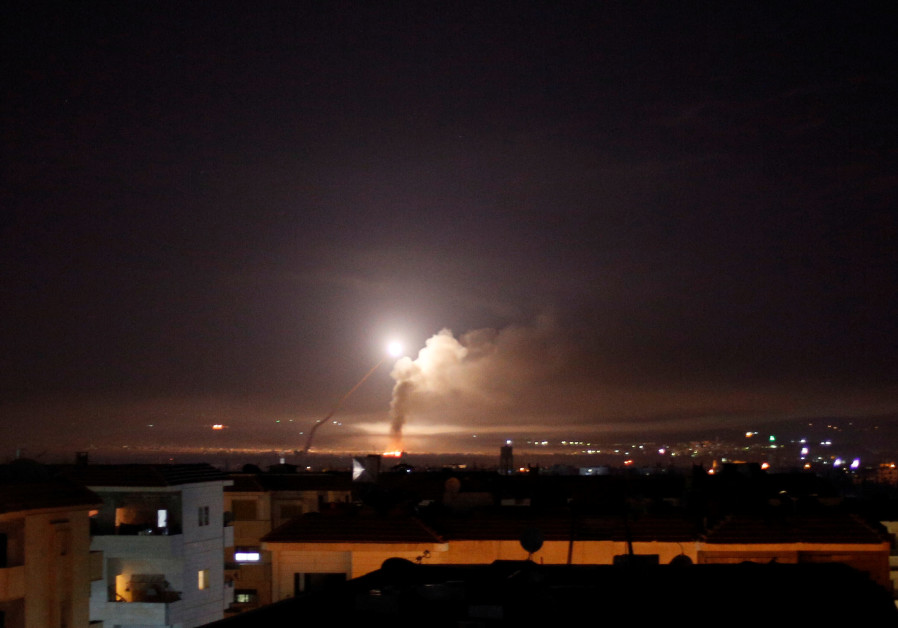
Missile fire is seen from Damascus, Syria May 10, 2018. (photo credit: REUTERS/OMAR SANADIKI)

The images show relatively limited damage to several sites, but they do appear to show that the giant building known as the “Glass House” at Damascus International Airport has been evacuated. The images are from May 11, the day after the raid. The first images were taken in September 2017.

Evacuation of the headquarters "the Glasshouse," Damascus International Airport, Syria, 11 May 2018 (Credit: IMAGESAT INTERNATIONAL - ISI)

Evacuation of the headquarters “the Glasshouse,” Damascus International Airport, Syria, 11 May 2018 (Credit: IMAGESAT INTERNATIONAL – ISI)

The evacuation of Iranians from this one site is emblematic of a larger and deadly chess game being played out in Syria. Over the last five years the game has involved limited and precision air strikes – a handful for which Israel has taken responsibility while others have only been reported in foreign media.

Now Iran’s apparatus in Syria has a new problem. After the large May 10 strikes which targeted numerous positions, including munitions, command and control and intelligence gathering sites, Iran’s agents in Syria must be wondering what’s coming next. They also have to be concerned about how much Jerusalem knows about their operations. After the strikes, around two dozen people were reportedly killed in Syria, most of them non-Syrian.

The ancient Chinese military strategist Sun Tzu is reputed to have written that every battle is won before it is fought. It appears that the evacuation of the so-called “Glass House” near Damascus is an example of this.

Iran evacuated this key part of its infrastructure without a battle. The Glass House has been known in media since 2016. The Daily Mail claimed “Iran is shoring up the Syrian regime from a secret HQ in Damascus nicknamed ‘the Glass House’ – and commanding a huge covert army in support of Assad, according to leaked intelligence passed by activists to MailOnline.”

The article went on to give all sorts of details. “The third and fourth floors are apparently occupied by the [Iranian] Revolutionary Guards’ intelligence unit, which is in overall command of the HQ. These areas are off-limits to even the most senior army officers. On the ground floor there is reportedly a cafe and a 20-bed private clinic for wounded senior military personnel, while the first floor houses the Revolutionary Guards’ propaganda department.”

THIS ALL may be accurate or it may not. The building allegedly contains up to 280 rooms. “A number of departments are based inside ‘the Glass House’, including counterintelligence, logistics, propaganda and foreign-mercenary command. The Iranian intelligence services, who are in charge of the base, are said to occupy the top two floors. The building is also said to contain prayer rooms, a 20-bed private clinic for wounded senior officers, and facilities for holding millions of dollars in cash, which are reportedly kept in the basement,” notes the website Israel Defense.

But when Israel decided to strike Iranian targets on May 10 in response to rocket fire, it didn’t destroy the Glass House. Instead a storage facility nearby was hit – a kind of warehouse. The major alleged Iranian investment at the Glass House appears to have been left intact.

Rendering the building unusable, since people are now afraid to go back to it for fear of air strikes, is almost as good as destroying it. In fact in a kind of Sun Tzu kind of way it’s better than having to destroy it. If you can win a battle without fighting it you have done better than had you been forced to risk soldiers in battle.

In this case the Iranians appear to have abandoned a prized possession because of fears of what Israel might do next.

That, in a sense, is a true Clausewitz achievement. “War is politics by other means,” the early 19th-century Prussian military theorist Carl von Clausewitz claimed. The shadow war with Iran in Syria is politics by other means because the grand strategy is to evict Iran from Syria. Jerusalem said numerous times last year that it wants Iran to reduce its presence in Syria.

The danger now is that Israel may have a bit of hubris after the May 10 air strikes and the lack of response from Iran or its numerous proxies and allies such as Hezbollah. The psychological war in Syria can be fought – but only so long as Iran and Hezbollah are deterred and only so long as the threat of retaliation, in some form or another, is always taken seriously.

Shapiro Debunks Gaza Protests in 5 Minutes 

May 16, 2018


Ben Shapiro responds to the media complicity with Hamas’ talking points in the situation with the Gaza protests.


An Israeli Soldier’s answer to the world – תשובת החייל הישראלי לעולם

May 16, 2018


(After the latest Gaza “blood libel” by the MSM, I thought this would be appropriate. – JW )


How Hamas Sabotages Gaza’s Economy to Advance Terror Aims

May 16, 2018

by Yaakov Lappin May 15, 2018 The Investigative Project on Terrorism

Source Link: How Hamas Sabotages Gaza’s Economy to Advance Terror Aims

{Reality check. – LS}

Gaza’s dire economic situation is one reason observers cite for the ongoing violent Palestinian protests at the border with Israel. But, Israeli officials say, the blame for the stark economic reality lies with those who control Gaza.

Israel is working hard to prevent the economy of Gaza from collapsing, but Hamas is doing just the opposite, recklessly harming the economic situation of the very people it rules over.

Nowhere is this more apparent than in Friday’s Hamas-orchestrated attack on a gas and fuel terminal – the only one that supplies the Gaza Strip – at the Kerem Shalom border crossing.

According to senior Israeli defense officials, Hamas operatives divided rioters into groups and gave them specific instructions on which part of the crossing to attack on the Gazan side – the same side that serves the basic needs of Gaza’s estimated 1.8 million inhabitants.

In what can only be described as utter self-destruction, the rioters, acting on Hamas orders, set fire to a pipeline delivering gas and fuel to Gazans. They also destroyed conveyer belts that send construction material and animal feed into Gaza. The crossing was attacked twice more since then, including during Monday’s mass border infiltration attempt, also organized by Hamas, which resulted in many Palestinian casualties a significant portion of whom were operatives in Hamas or the Palestinian Islamic Jihad.

It will take months for authorities to repair the burned out fuel pipelines. The pipes blazed so hot that they left the concrete roads beneath them in pieces. The Palestinian Authority (PA) had previously constructed the Gazan side of the fuel terminal at a cost of ten mission shekels. Now, the PA will have to decide if it will pay for a new one.

All of this means that the people of Gaza are facing a new, Hamas-engineered, imminent fuel and energy crisis.

The incident is just one of many ways that Hamas cynically and actively harms Gaza’s civilian interests for its own benefit.

Hamas has a financial interest in shutting down Kerem Shalom, since all goods that pass through it are taxed by the PA – Hamas’s bitter rival. Hamas would prefer that goods pass through the Rafah border crossing between Gaza and Egypt, where taxes go directly to the Hamas regime, and the funds are diverted to the military wing.

But Egypt keeps Rafah closed most days as part of its own blockade of Gaza. Egypt is guided by a deep suspicion of Hamas’s intentions, due to the affiliation between Hamas and the Egyptian Muslim Brotherhood.

Ultimately, Hamas is keen to increase pressure on ordinary Gazans, so that they vent their frustration on Israel and the Palestinian Authority.

In recent days, Hamas has banned Gazan fishermen from heading out to sea, despite Israel widening the Mediterranean Sea fishing zone for Palestinians.

According to Israeli defense officials, Hamas has also systematically prevented Palestinian businesspeople and merchants from crossing into Israel via the Erez pedestrian border crossing.

Israel has provided an increasing number of entry permits to Gazan businesspeople in a bid to encourage Palestinian economic growth. Yet Hamas has thwarted this effort via a checkpoint it has set up before the Erez Crossing.

“As long as people suffer, they can continue with their well-funded propaganda, and shout to the world, ‘come and save us,’ and ‘pour some money into Gaza,'” said a senior IDF official.

The reason Hamas pursues this agenda is simple enough. Whenever it receives money, it must always face the basic question of where to invest it. If it invests in civilian needs, it cannot use that same money for the military wing: to dig tunnels, manufacture rockets, and build weapons, and prepare for war with Israel. So Hamas tries blackmailing the international community into funding Hamas’s humanitarian and economic needs, which would free Hamas to invest purely in its military force build-up.

This situation has not, however, stopped Israel from taking determined steps to improve the Gazan economy. Israel increased the number of pedestrian crossings at Erez by 30 percent in the first quarter of 2018, and most of those crossing – 80 percent of the roughly 10,000 crossings – are made up of Gazan merchants and businesspeople.

The Palestinian Authority is also undermining Gaza’s economy as part of a bid to bring Hamas to its knees and force it into a reconciliation agreement that would see the armed wing disbanded. As part of that pressure, the PA has ceased transferring medicine into Gaza, and has been holding up permits for a number of sick Gazans to travel to West Bank hospitals for treatment.

In response, Israel increased the number of medical-humanitarian journeys from Gaza into Israel, coordinating the movement of 450 ambulances to Israeli hospitals during the past three months alone.

Meanwhile, Hamas continues attempting to use the mail to import items such as drones, uniforms, and dual use items like drills and building materials for its military wing. The Israeli Defense Ministry has intercepted magazine clips, binoculars, and even military boots sewn into large slippers heading into Gaza.

“One of our main challenges is that we have hard, solid intelligence that Hamas is trying to use any humanitarian route to build up its military power, and promote terrorism,” the senior defense source added.

One prominent example of this occurred in April, the official said, when a 65-year-old Gazan woman was given a permit to receive medical treatment at an Israeli hospital. The woman, a cancer patient, arrived at Erez Crossing, where Israeli security found enough explosives in her belongings to blow up four buses.

Israel remains determined to keep Gaza’s economy going and prevent a collapse. It has recently allowed more dual use materials – items intended for civilian use, but which Hamas could use for military means as well to enter the Strip, to assist the civilian population. It also approved 350 new economic projects in Gaza that provide jobs for Palestinians.

Still, the challenge remains. Pipes imported for water treatment plants end up being turned into rockets. Generators designed to help civilian buildings deal with power shortages end up in terror tunnels that are dug in the direction of Israeli communities.

Perhaps the most cynical example of all can be found in the form of medical oxygen tanks that Israel sends to Gaza. “Unfortunately,” the defense source said, “Hamas seized some of these shipments and took them underground, so that [combat] tunnel diggers can breathe freely as they work in tunnels 30 meters underground.”

Journalists Should Stop Falling For Hamas’ Deadly PR Efforts Against Israel

May 15, 2018

The terrorist organization uses its own people as cannon fodder so it can play victim.

By David Harsanyi May 14, 2018 The Federalist

Source Link: Journalists Should Stop Falling For Hamas’ Deadly PR Efforts Against Israel

{Of course, you know they won’t stop. I just wonder if these so-called journalists realize the amount of violence they inspire. – LS}

Hamas isn’t merely a terrorist organization committed to murdering Jews, it’s a terrorist organization that urges its own people to become cannon fodder as a means of appealing to Western journalists and intellectuals. The higher the death toll, the happier Hamas will be. And few things have more of a detrimental effect on the Palestinian cause than the media’s asymmetrical coverage of this conflict with the Jews.

Until Palestinians shed their hatred, turn from the Israeli fences, and march towards their own governments, they will remain pawns and saps in a decades-long suicide mission. That’s because no amount of bad press about Israel’s efforts to stop violence coming from Gaza will impel that nation to create a terror state on its borders. It’s untenable, not to mention immoral. We would never contemplate such a thing. Nor would any rational country.

Despite what you’ve heard, the 35,000 Palestinian “demonstrators” massed along the security fence between Israel and Gaza — the ones throwing firebombs and other explosives, burning tires, chucking rocks (if you think these are aren’t deadly, you should see one landing; I have), and those attempting to light fires to burn crops and vegetation — are only ostensibly protesting the United States moving its embassy to Israel’s capital. I know this because Hamas doesn’t accept a U.S. embassy anywhere in Israel, as it doesn’t recognize Israel at all.

Hamas has openly asserted that it’s attempting to create incursions into Israel, and that has absolutely nothing to do with East or West or North or South Jerusalem. For Palestinians this is about the 70th anniversary of Israel — or, as they see it, Nakba. It’s about an ongoing historic effort — an intermittently theocratic or nationalistic effort, depending on the trends — to play victim.

https://twitter.com/ElliottRHams/status/996039101823569920?ref_src=twsrc%5Etfw&ref_url=http%3A%2F%2Fthefederalist.com%2F2018%2F05%2F14%2Fjournalists-should-stop-falling-for-hamas-deadly-pr-efforts%2F&tfw_creator=davidharsanyi&tfw_site=FDRLST

So while it might grate against the sensibilities and preconceived notions of those covering the mess, Hamas is the oppressor in this situation. And while rioters might think they’re fighting a “war,” Israel is merely trying to stop a mob from breaching a fence. To frame this as a battle between occupier and occupied is deeply simplistic. Gaza is unoccupied territory. It is only after a Hamas coup d’etat that dispatched the opposition political party of Fatah led by Mahmoud Abbas, the internationally recognized leader of the Palestinians, that both Israel and Egypt imposed a blockade on Gaza. Like Israel, Egypt was rightly worried about the increase of Iranian influence and terrorism.

Although there is occasionally talk of a unity government with Hamas, Fatah leader Abbas still threatened Gaza with more blockades. Now, if Hamas can’t even adhere to agreements with the supposed moderates of the Palestinian government, what is Israel expected to do?

Hamas might regularly crush political dissent, torture opponents, and limit every freedom imaginable, but let’s not forget that it’s also plagued by corruption. Since Israel conferred semi-autonomy on Gaza, Hamas has created one of the highest unemployment rates in the world, at more than 40 percent. The government siphons off hundreds of millions in international aid it should be using to promote economic growth and for basic necessities for the people, to fund the making and use of thousands of rockets and mortars (rendered ineffective by the Iron Dome; and the reason Hamas has not turned to riots), concrete-bolstered tunnels that shuffle terrorists into Israel, and other unnecessary terror activity.

One of those activists is ginning up mobs to rush a fence separating Gaza and Israel. At one gathering near Gaza City, The Washington Post reported, Hamas organizers encouraged rioters to push through the fence, “telling them Israeli soldiers were fleeing their positions, even as they were reinforcing them.” The purpose, of course, was to create casualties.

On the other hand, Israel dropped leaflets urging Palestinians to stay away from the fence. “Save your lives and work on building your futures,” the papers read. Israelis also fired warning shots at people as they began breaching the fence. Snipers only fired real shots at those who had already crossed the first fence despite warnings and were trying to breach the main security fence.

Using civilians as human shields and canon fodder, and the resulting death tolls as propaganda, has been a tool for Palestinian groups for more than half a century. In 2015, the United Nations was forced to admit that Hamas was storing explosives in at least three UN schools (where displaced people as well as children were housed) that Israel targeted during the mini-war of 2014. Using international aid buildings as staging grounds for terrorism is part of Yasser Arafat’s legacy.

Of course Israel makes mistakes. Many of them. But what is Israel supposed to do when a mob of violent rioters march towards them? Should it shut down the IDF and allow Hamas to overtake their military positions? Should it tear down the fences and allow a million Gazans, propagandized over a generation by violent regimes and steeped in virulent anti-Semitism, to walk into Israel proper?

Should they give full autonomy to Hamas and allow it to create a mini Iran right on its border? Should Jews pick up and leave Jerusalem? Even if Israel wanted to make a deal, Hamas makes no genuine demands, much less offers any concessions. It wants to provoke death. They want to become the victim. Sadly for the Palestinian people, they get plenty of help creating that fiction.


Russian deputy FM says Iran must make concessions to save nuke deal

May 15, 2018

Source: Russian deputy FM says Iran must make concessions to save nuke deal | The Times of Israel

But Sergei Ryabkov says accord cannot be altered to address Tehran’s Mideast policy, missile program, as demanded by Trump; Zarif says talks with EU on ‘right track’

Russian Deputy Foreign Minister Sergei Ryabkov at the State Department in Washington, July 17, 2017 (AP Photo/Carolyn Kaster)

Russian Deputy Foreign Minister Sergei Ryabkov at the State Department in Washington, July 17, 2017 (AP Photo/Carolyn Kaster)

Russian Deputy Foreign Minister Sergei Ryabkov said Tuesday the nuclear deal with Iran could not be preserved without some concessions from Tehran, Reuters reported, citing the Interfax news agency.

However, Ryabkov added that Moscow did not believe the accord could be amended to include limits on Iran’s actions in the Middle East or its ballistic missile program, as has been demanded by US President Donald Trump.

Ryabkov said the missile program was a legitimate measure by Tehran in preserving its security.

And he warned that Iran could yet follow in Washington’s footsteps in withdrawing from the 2015 accord.

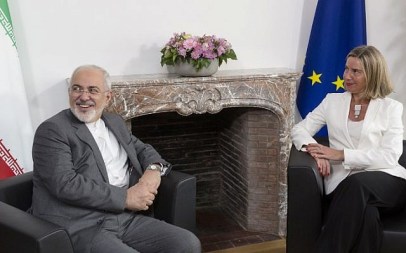
Meanwhile, Iran’s foreign minister began talks in Brussels Tuesday on the final leg of a global tour rallying diplomatic support for the deal after the abrupt withdrawal by the United States.

Mohammad Javad Zarif said he had a “constructive meeting” with EU Foreign Policy Chief Federica Mogherini, Reuters reported.

Iranian Foreign Minister Mohammad Javad Zarif (L) meets with European Union Foreign Policy Chief Federica Mogherini, to discuss Iran’s nuclear deal, on May 15, 2018 at the EU headquarters in Brussels. (AFP PHOTO / POOL / Thierry Monasse)

“We are on the right track to make sure the interests of the remaining signatories of the (nuclear accord), especially Iran, are guaranteed,” he said.

Zarif will also hold talks with counterparts from Britain, France and Germany — the three European signatories to the landmark deal who are scrabbling to preserve it.

Tehran has warned it is preparing to resume “industrial-scale” uranium enrichment “without any restrictions” unless Europe can provide solid guarantees that it can maintain the economic benefits it gained from the nuclear agreement despite the US reimposing sanctions.

The EU insists the deal is working, pointing to repeated UN inspections verifying the Islamic Eepublic’s compliance with its side of the bargain, and Mogherini’s spokeswoman Maja Kocijancic told AFP ahead Zarif’s arrival that “we must do our utmost to preserve it.”

But European diplomats have sought to play down expectations of Tuesday’s meetings, stressing the enormous challenge of finding a way around US sanctions punishing foreign businesses trading with Iran, which have global reach.

European firms, especially those from France and Germany, rushed to invest in Iran following the 2015 agreement, under which Tehran agreed to freeze its nuclear program in return for the repeal of punishing international sanctions.

German exports to Iran totaled nearly 3 billion euros ($2.3 billion) in 2017, while French exports soared from 562 million euros ($670 million) in 2015 to 1.5 billion ($1.8 billion) in 2017 and oil giant Total has pledged to invest some $5 billion in the South Pars gas field.

When he quit the deal last week, Trump gave businesses a maximum of six months to wind up operations in Iran or face severe penalties under American sanctions.

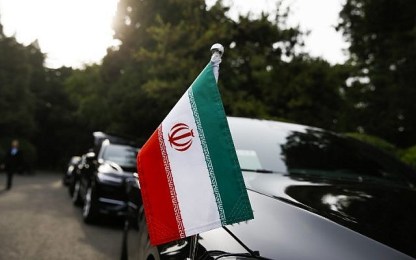
Cars of the Iranian delegation are parked outside a building of the Diaoyutai state guesthouse in Beijing on May 13, 2018. (AFP PHOTO / POOL / THOMAS PETER)

Zarif’s meetings in Brussels cap a whirlwind global tour, including trips to both Russia and China, the two other signatory nations, in a bid to bolster support.

Washington’s decision to go against its European allies’ advice and abandon the deal has pushed them closer to Beijing and Moscow on the issue as diplomats scramble to keep the pact alive.

French President Emmanuel Macron held phone talks with his Russian counterpart Vladimir Putin on Tuesday, according to a Kremlin statement, which said they had “confirmed Russia and France’s commitment to make the deal work.”

On Monday Zarif sent a letter to the United Nations in which he accused the US of showing a “complete disregard for international law” in pulling out of the deal.

Putin has already spoken with German Chancellor Angela Merkel and Turkey’s President Recep Tayyip Erdogan about efforts to save the accord, after voicing his “deep concern” over Trump’s decision.

Russian President Vladimir Putin, right, and French President Emmanuel Macron, left, at the Palace of Versailles, near Paris, France, Monday, May 29, 2017. (AP Photo/Alexander Zemlianichenko, pool)

And on Monday Putin met Yukiya Amano, the head of the International Atomic Energy Agency, telling him that Russia was “ready to continue to uphold the Iran nuclear deal despite the withdrawal of the United States.”

On Sunday, US Secretary of State Mike Pompeo said Washington still wants to work with Europe to counter Iran’s “malign behavior” and was working hard to thrash out a more wide-ranging deal with its European partners.

But while he talked up the prospect of renewed coordination with America’s allies, another top aide reminded Europe its companies could face sanctions if they continue to do business with the Middle Eastern power.

Russian efforts to save the accord will boost its role as a power player in the Middle East, after its intervention on the side of Bashar Assad’s regime in Syria.

This, along with its diplomatic moves to orchestrate an end to the Syrian conflict, has put Moscow at loggerheads with the US and Europe, which have intervened against the regime.

Merkel is set to visit Russia and meet Putin in the Black Sea resort of Sochi on Friday, while French President Emmanuel Macron will be in Saint Petersburg later this month for an economic forum.

Australian PM: Hamas is to blame for Gaza deaths 

May 15, 2018

Source: Australian PM: Hamas is to blame for Gaza deaths | The Times of Israel

Terror group ‘pushing people to the border,’ Turnbull says; Canberra also calls on Israel to avoid excessive use of force

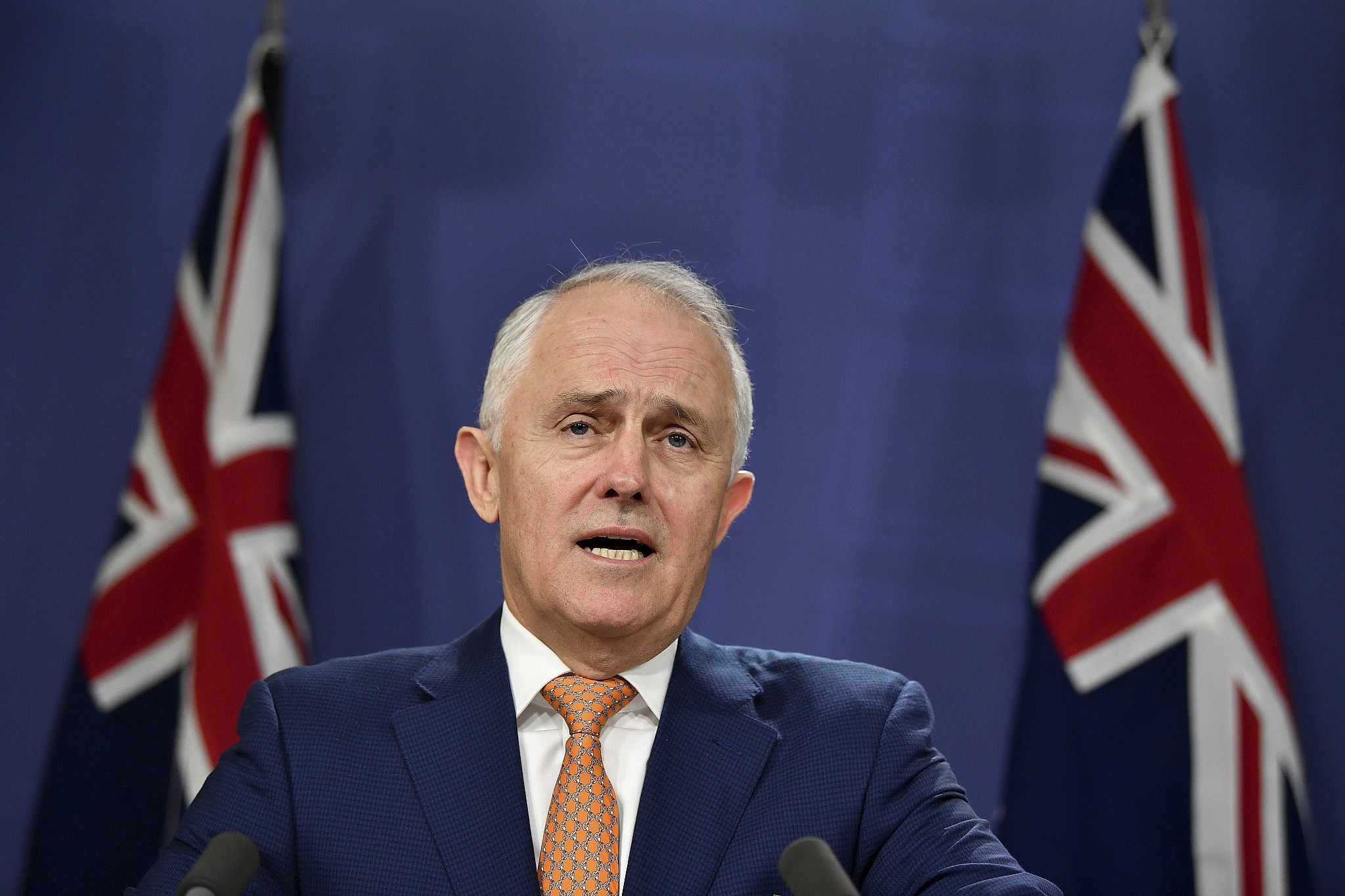
Australian Prime Minister Malcolm Turnbull speaks during a press conference in Sydney, October 28, 2017. (Joel Carrett/AAP Image via AP)

Australian Prime Minister Malcolm Turnbull speaks during a press conference in Sydney, October 28, 2017. (Joel Carrett/AAP Image via AP)

Australia’s prime minister on Tuesday blamed Hamas for the dozens of deaths in Gaza in violent clashes the previous day between Palestinians protesters and Israeli forces along the border.

It was the bloodiest day in the Israeli-Palestinian conflict since the 2014 Gaza war, with at least 58 Palestinians killed and more than 2,700 Palestinians wounded, according to figures from the Hamas-run Gazan health ministry. The dead included six minors, the health ministry said.

Prime Minister Malcolm Turnbull told Melbourne Radio 3AW the loss of life was “tragic” but that “Hamas’s conduct is confrontational. They’re seeking to provoke the Israeli Defense Forces.”

Turnbull said the terror group was “pushing people to the border. In that conflict zone, you’re basically pushing people into circumstances where they are very likely to be shot at.”

Meanwhile Australian Foreign Minister Julie Bishop called on Israel to be proportionate in its response and refrain from excessive use of force. She added in a statement that Israel had the right to protect it population and called on Palestinians “to refrain from violence and attempting to enter into Israeli territory.”

The clashes began before Israeli officials and a White House delegation including US President Donald Trump’s daughter Ivanka formally opened the embassy in Jerusalem, and continued throughout the day. Monday’s demonstrations, which were timed to coincide with the move, were also part of the weeks-long March of Return campaign marking the 70th anniversary of the establishment of Israel, or the Nakba (“catastrophe”), as Palestinians call it.

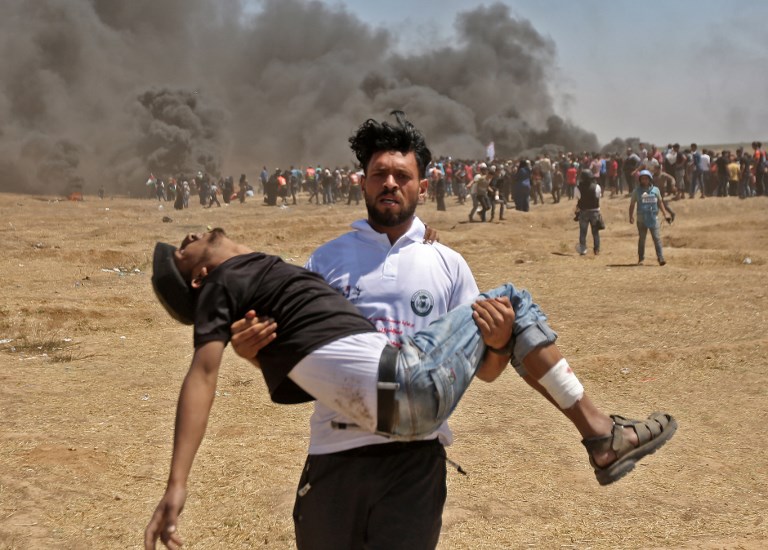
A Palestinian carries an injured protester during clashes with Israeli forces near the border between the Gaza strip and Israel east of Gaza City on May 14, 2018. (AFP / MAHMUD HAMS)

Israel has blamed Hamas for the deadly violence, saying the terror group encouraged and led the protests, which included attacks on Israeli troops and attempts to breach the border fence.

The IDF’s spokesman said Hamas deployed 12 separate terrorist “cells” to try to breach the border at different locations, and that all were rebuffed. Citing Palestinian sources, Israel’s Hadashot TV news said 10 of the terror group’s members were among those killed in the clashes, including a son of its co-founder Abdel Aziz al-Rantisi.

Several countries condemned the events, questioning the proportionality of Israel’s response while urging Hamas to refrain from violence. The EU called for “utmost restraint” by all sides. South Africa and Turkey said they were recalling their ambassadors from Israel, with Ankara accusing Jerusalem of “genocide.”

The United States was one of the only countries to endorse Israel’s version of the events and fully blame Hamas for the deaths on the border. Later Monday it also blocked the adoption of a UN Security Council statement that would have called for an independent probe of the violence.

A draft of the statement read, “The Security Council expresses its outrage and sorrow at the killing of Palestinian civilians exercising their right to peaceful protest. The Security Council calls for an independent and transparent investigation into these actions to ensure accountability.

“The Security Council calls upon all sides to exercise restraint with a view to averting further escalation and establishing calm,” it said.

The council is due to hold an emergency meeting on the violence Tuesday, called at the request of Kuwait. It’s not immediately clear what will come out of the discussion. At an emergency meeting after similar protests in March, council members urged restraint on both sides but didn’t decide on any action or joint message.

US foils anti-Israel Security Council move over deadly Gaza riots

May 15, 2018

Source: US foils anti-Israel Security Council move over deadly Gaza riots – Israel Hayom

Why is it that Latin American countries are moving their embassies?

May 15, 2018

I was interested in this question when I saw who the first countries to follow the US were: why is it that Latin American countries are moving? I didn’t know of any particular connection between these countries and Israel.

This article gives 3 possible reasons. The one about the historical ties of these countries to Israel is interesting.

Why these Latin American countries support moving their embassies to Jerusalem

https://www.timesofisrael.com/why-these-latin-american-countries-support-moving-their-embassies-to-jerusalem/

Guatemala, Paraguay and Honduras look to strengthen ties with the US by supporting Israel, plus their leaders have personal connections to the Jewish state

(JTA) — US President Donald Trump’s decision in December to recognize Jerusalem as Israel’s capital drew wide international criticism, with 128 countries including the United Kingdom, Germany and Canada voting in favor of a United Nations resolution condemning it.

But several countries saw Trump’s decision in a different light: as an example to follow.

Shortly after the United States officially moves its embassy from Tel Aviv to Jerusalem on Monday, it will be joined by Guatemala and Paraguay. Both countries are planning to make the move this month, and Honduras may be next: Its Congress recently passed a resolution urging its foreign ministry to move its embassy.

Along with the Czech Republic, whose president said last month it will begin the process of moving its embassy to Jerusalem, these countries belong to a small club (albeit one with a superpower). On a visit to Venezuela on Monday, Palestinian Authority President Mahmoud Abbas urged other Latin American countries not to move their embassies.

So how come? Why do these Latin American countries go where others fear to tread?

Observers suggest a number of reasons, or a combination thereof: The countries are likely motivated by a desire to curry favor with the Trump administration, their leaders’ personal views of the Jewish state and strong historic ties to Israel.

In the cases of Guatemala and Honduras, both countries are facing or recently faced political crises — Guatemalan President Jimmy Morales is mired in a corruption scandal and Honduran President Juan Orlando Hernandez’s recent re-election was dogged by allegations of voter fraud. Their leaders are looking to the US for support, said Arie Kacowicz, a professor at the Hebrew University of Jerusalem specializing in Latin America.

“They pretty much need and want support and legitimacy from the US and one way of achieving that is by being on friendly, cordial or even extraordinary terms with Israel,” he told JTA. “So if the U.S. is showing the way on this particular issue of Jerusalem, the natural candidates to follow would be those two Central American countries.”

Though the countries are looking to strengthen ties with Israel, that is not their primary focus, Kacowicz said.

“For Guatemala and Honduras, the US is primordial. It’s much more important than Israel,” he said.

The two countries also have large immigrant populations in the US that are facing threats of deportation. Those immigrants contribute to their home countries’ economies — for example, one-tenth of Guatemala’s gross domestic product comes from remittances sent back by Guatemalans living abroad. It makes sense to want to be on the Trump administration’s good side.

Moving their embassies or expressing support for doing so “is a show of good will” to Trump and the US, agreed Mariano de Alba, associate director of the Adrianne Arsht Latin America Center at the Atlantic Council, a think tank focusing on international affairs.

The embassies of Guatemala, Paraguay and Honduras in Washington, DC, did not respond to requests for comment by JTA in time for publication.

Trump has signaled that it cares about how other countries respond to its policies regarding Jerusalem. In December, the president said the US was watching the votes of its allies on the UN condemning his recognition of Jerusalem as Israel’s capital. One hundred and twenty eight countries voted to pass the resolution with only nine — including Guatemala and Honduras — voting against it and 35 countries abstaining — including Paraguay. The resolution asserted the traditional position that “Jerusalem is a final status issue to be resolved through negotiations in line with relevant United Nations resolutions.”

Following the vote, UN ambassador Nikki Haley even threw a party for the 65 countries that did not support the resolution. The event was labeled as a means to thank the countries for “their friendship to the United States,” according to a copy of the invite obtained by CNN.

But it’s not all about Trump. The three countries have ties to Israel that date back to its founding.

Latin American countries were largely sympathetic to Israel in its early days, said Dina Siegel Vann, director of the American Jewish Committee’s Arthur and Rochelle Belfer Institute for Latino and Latin American Affairs.

 “Most Latin American countries are relatively young, and they were very much captivated by Israel’s story, a young country beating the odds after destruction in the Holocaust, and trying to make it in a very hostile environment,” Vann said.

Guatemala and its UN ambassador Jorge Garcia Granados played a crucial role in the adoption of the UN partition plan for Palestine in 1947, which recommended creating a Jewish and an Arab state in pre-state Israel. In 1948, Guatemala became the first in Latin America to recognize Israel, setting off a domino effect in the region.

Following Israel’s establishment, the country focused on achieving international recognition of Jerusalem as its capital, said Jonathan Grossman, a postdoctoral research fellow at the Institute for Israel Studies at the University of Texas at Austin. He has researched ties between Israel and Latin America.

“Latin America was a major target in this struggle because they were mostly very friendly toward Israel,” Grossman said.

The campaign was successful and some 11 Latin American countries opened up embassies in Jerusalem, starting with Guatemala in 1948.

But ties soured in 1967, following the Six-Day War, which drew wide international condemnation. Then in 1980, when the Knesset passed a law that declared the entire city of Jerusalem to be Israel’s capital, all the Latin American countries as well as the Netherlands and Haiti, decided to move their embassies out of Jerusalem. Venezuela turned hostile under its late dictator, Hugo Chavez, and ties between Argentina and Israel have blown hot and cold since the the 1992 terrorist attack on Israel’s embassy in and the 1994 bombing of the AMIA Jewish center, both in Buenos Aires.

The last 15 years have once again seen improved ties between Israel and some Latin American countries, including Guatemala, Honduras and Paraguay, said Daniel Mariaschin, CEO of B’nai B’rith International, which has projects in Latin America.

“The leadership in these countries in this past 15-year period has made the point of reaching out to Israel, as Israel has reached out to them,” Mariaschin said.

In addition to trade interests, each of the countries’ leaders also have personal reasons for supporting Israel.

Morales of Guatemala is an evangelical Christian, as is 40 percent of Guatemala’s population, and evangelicals have strong religious attachments to Israel. Paraguay’s president, Horacio Cartes, has close ties with Israeli Prime Minister Netanyahu, and one of his campaign advisers, Ari Harow, is an Israeli-American who previously served as Netanyahu’s chief of staff.

Hernandez of Honduras participated early in his career in an outreach program by Mashav, Israel’s Agency for International Development Cooperation.

Grossman said that Trump’s decision opened the door for Latin American countries that have good relations with Israel to follow suit.

“This move kind of removes the barrier for many of those small countries who have excellent relations with Israel, very developed trade relations and security cooperation,” he said.

Will the upcoming moves by Guatemala and Paraguay spark a trend? De Alba said it is “very highly unlikely” that a large number of Latin American countries will follow suit because such a move is seen as “too forceful.”

“The position of the majority of the Latin American countries will be not to do so and try not to take sides on the [Israeli-Palestinian] conflict,” he said.

Meanwhile Mariaschin thinks the Latin American countries’ decisions may lead others to at least rethink their policies.

“I think these moves will spur other countries to reconsider because there’s a critical mass which is assembling here, not only in Latin America but in other places as well.”