Archive for May 2018

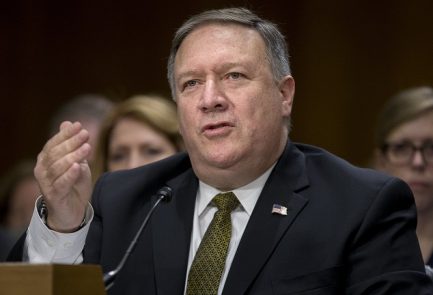
Pompeo to Iran: Get ready for “strongest sanctions in history”

May 21, 2018

Ed Morrissey May 21, 2018 Hot Air

Source Link: Pompeo to Iran: Get ready for strongest sanctions in history

{I suggest the Mullahs pay attention. – LS}

Mike Pompeo offered both a clenched fist and an open hand to Iran in his first major policy speech. At the Heritage Foundation this morning, the new Secretary of State pledged never to “repeat the mistakes of past administrations” and rejected entirely the effort to “renegotiate the JCPOA,” the executive agreement created by the Obama administration. Instead, Pompeo offered to open full diplomatic and economic ties with Tehran, but only if they comply with twelve “basic requirements” for non-proliferation and the end of state-sponsored terrorism:

Otherwise, Iran will face a much tougher sanctions regime — and presumably, so would anyone else doing business with them:

U.S. Secretary of State Mike Pompeo is threatening to place “the strongest sanctions in history” on Iran if its government doesn’t change course.

Pompeo on Monday called for a new nuclear agreement with Iran following President Donald Trump’s withdrawal from the 2015 nuclear deal. He says the Trump administration prefers for it to be a treaty that is ratified by Congress.

Pompeo is laying out an onerous list of 12 “basic requirements” demands on Iran that he says should be included. He says Iran must “stop enrichment” of uranium and never preprocess plutonium. Iran must also allow nuclear “unqualified access to all sites throughout the country.”

Pompeo says Iran must also “release all U.S. citizens,” end support for Houthi rebels in Yemen, “withdraw all forces” from Syria and stop threatening Israel.

Iran’s not likely to agree to any of this, of course, especially about Israel. The mullahcracy in Tehran has its mission to destroy Israel and to spread its Shi’a Islam to dominate the region. Its ultimate goal is control over Mecca and Medina, which makes Saudi Arabia a higher priority than even Israel or propping up Bashar al-Assad in Syria, at least for Assad’s sake. Their encirclement strategy around Riyadh is too important to worry about diplomatic and economic engagement with “the Great Satan,” even if it was nice for a while not to have economic obstruction from the US.

The real target for this speech wasn’t Tehran, though. It was the capitals of Europe, especially Berlin, Paris, and London. Pompeo intended to lay out the case that the Obama administration and the P5+1 group essentially funded Iran’s aggression in the region over the last few years with the execrable JCPOA, and that they are responsible now for cutting off that flow of funds in order to slow Tehran’s encirclement strategy:

Mike Pompeo, the US secretary of state, is expected to call on European countries to help ramp up economic pressure on Iran as he outlines America’s ‘Plan B’ to the nuclear deal.

Delivering his first major foreign policy speech since taking the job, Mr Pompeo will double down on the United States’ decision to quit the agreement earlier this month.

He is expected to frame the 2015 deal as allowing Iran to increase its malign influence across the Middle East on the back of funding from renewed trade with the West.

Mr Pompeo is also expected to urge other nations to join America in reimposing economic sanctions on the regime in a bid to bring it back to the negotiating table.

Pompeo wants to underscore just how serious the Trump administration is about putting the shackles back on the Iranian regime. The existing, re-imposed sanctions will already put European businesses at risk for sustaining major economic damage if they continue to work with Iran. Pompeo made it clear in his speech today that the US does not intend to find ways to avoid that damage. The “strongest sanctions in history” only work as long as the US enforces them strongly enough to make them work as deterrents. The best way for Europe to avoid getting hurt in that exchange is to join up with the US in imposing them.

This won’t prompt any immediate change from either Iran or our allies. It’s a marker laid down by Pompeo and Donald Trump, not yet an action in itself. Our allies will try to work Pompeo and Trump to mitigate those consequences, and perhaps Trump will be willing to negotiate around the edges. But Pompeo’s making it clear that the US plans to take a very hard line on Iran, and not just in nuclear-weapons proliferation.


Secretary of State Mike Pompeo unveils next steps on US-Iran policy | Monday, 21 May 2018 

May 21, 2018


Stopping Robert Mueller to protect us all

May 21, 2018

12,232

http://thehill.com/opinion/judiciary/388549-stopping-robert-mueller-to-protect-us-all

The “deep state” is in a deep state of desperation. With little time left before the Justice Department inspector general’s report becomes public, and with special counsel Robert Mueller having failed to bring down Donald Trump after a year of trying, they know a reckoning is coming.

At this point, there is little doubt that the highest echelons of the FBI and the Justice Department broke their own rules to end the Hillary Clinton “matter,” but we can expect the inspector general to document what was done or, more pointedly, not done. It is hard to see how a year-long investigation of this won’t come down hard on former FBI Director James Comey and perhaps even former Attorney General Loretta Lynch, who definitely wasn’t playing mahjong in a secret “no aides allowed” meeting with former President Clinton on a Phoenix airport tarmac.

With this report on the way and congressional investigators beginning to zero in on the lack of hard, verified evidence for starting the Trump probe, current and former intelligence and Justice Department officials are dumping everything they can think of to save their reputations.But it is backfiring. They started by telling the story of Alexander Downer, an Australian diplomat, as having remembered a bar conversation with George Papadopoulos, a foreign policy adviser to the Trump campaign. But how did the FBI know they should talk to him? That’s left out of their narrative. Downer’s signature appears on a $25 million contribution to the Clinton Foundation. You don’t need much imagination to figure that he was close with Clinton Foundation operatives who relayed information to the State Department, which then called the FBI to complete the loop. This wasn’t intelligence. It was likely opposition research from the start.

In no way would a fourth-hand report from a Maltese professor justify wholesale targeting of four or five members of the Trump campaign. It took Christopher Steele, with his funding concealed through false campaign filings, to be incredibly successful at creating a vast echo chamber around his unverified, fanciful dossier, bouncing it back and forth between the press and the FBI so it appeared that there were multiple sources all coming to the same conclusion.

Time and time again, investigators came up empty. Even several sting operations with an FBI spy we just learned about failed to produce a Delorean-like video with cash on the table. But rather than close the probe, the deep state just expanded it. All they had were a few isolated contacts with Russians and absolutely nothing related to Trump himself, yet they pressed forward. Egged on by Steele, they simply believed Trump and his team must be dirty. They just needed to dig deep enough.

Perhaps the murkiest event in the timeline is Rod Rosenstein’s appointment of a special counsel after he personally recommended Comey’s firing in blistering terms. With Attorney General Jeff Sessions shoved out of the way, Rosenstein and Mueller then ignored their own conflicts and took charge anyway. Rosenstein is a fact witness, and Mueller is a friend of Comey, disqualifying them both.

Flush with 16 prosecutors, including a former lawyer for the Clinton Foundation, and an undisclosed budget, the Mueller investigation has been a scorched-earth effort to investigate the entirety of the Trump campaign, Trump business dealings, the entire administration and now, if it was not Russia, maybe it’s some other country.

The president’s earlier legal team was naive in believing that, when Mueller found nothing, he would just end it. Instead, the less investigators found, the more determined and expansive they became. This president and his team now are on a better road to put appropriate limits on all this.

This process must now be stopped, preferably long before a vote in the Senate. Rather than a fair, limited and impartial investigation, the Mueller investigation became a partisan, open-ended inquisition that, by its precedent, is a threat to all those who ever want to participate in a national campaign or an administration again.

Its prosecutions have all been principally to pressure witnesses with unrelated charges and threats to family, or just for a public relations effect, like the indictment of Russian internet trolls. Unfortunately, just like the Doomsday Machine in “Dr. Strangelove” that was supposed to save the world but instead destroys it, the Mueller investigation comes with no “off” switch: You can’t fire Mueller. He needs to be defeated, like Ken Starr, the independent counsel who investigated President Clinton.

Finding the “off” switch will not be easy. Step one here is for the Justice Department inspector general report to knock Comey out of the witness box. Next, the full origins of the investigation and its lack of any real intelligence needs to come out in the open. The attorney general, himself the target of a secret investigation, needs to take back his Justice Department. Sessions needs to act quickly, along with U.S. Attorney John Huber, appointed to conduct an internal review of the FBI, on the Comey and McCabe matters following the inspector general report, and then announce an expanded probe into other abuses of power.

The president’s lawyers need to extend their new aggressiveness from words to action, filing complaints with Justice Department’s Office of Professional Responsibility on the failure of Mueller and Rosenstein to recuse themselves, and going into court to question the tactics of the special counsel, from selective prosecutions on unrelated matters, illegally seizing Government Services Administration emails, covering up the phone texts of FBI officials Peter Strzok and Lisa Page, and operating without a scope approved by the attorney general. (The regulations call for the attorney general to recuse himself from the investigation but appear to still leave him responsible for the scope.)

The final stopper may be the president himself, offering two hours of testimony, perhaps even televised live from the White House. The last time America became obsessed with Russian influence in America was the McCarthy hearings in the 1950s. Those ended only when Sen. Joseph McCarthy (R-Wis.) attacked an associate of the U.S. Army counsel, Joseph Welch, and Welch famously responded: “Sir, have you no decency?” In this case, virtually every associate and family member of the president has been subject to smears conveniently leaked to the press.

Stopping Mueller isn’t about one president or one party. It’s about all presidents and all parties. It’s about cleaning out and reforming the deep state so that our intelligence operations are never used against opposing campaigns without the firmest of evidence. It’s about letting people work for campaigns and administrations without needing legal defense funds. It’s about relying on our elections to decide our differences.

Mark Penn served as pollster and adviser to President Clinton from 1995 to 2000, including during his impeachment. He is chairman of the Harris Poll and author of “Microtrends Squared.” Follow him on Twitter @Mark_Penn.

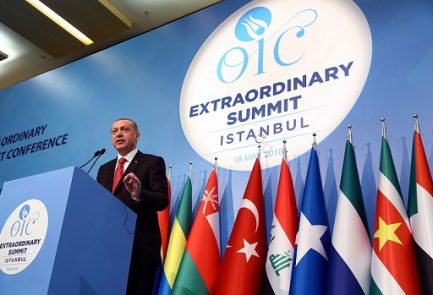
Muslim nations condemn Israel and US at emergency summit 

May 21, 2018

Source: Muslim nations condemn Israel and US at emergency summit – Israel Hayom

( Erdogan is Israel’s 2nd most dangerous enemy after Iran.  It is beyond absurd that an Islamist country remains a member of NATO.  Time for some Trump realism… – JW )

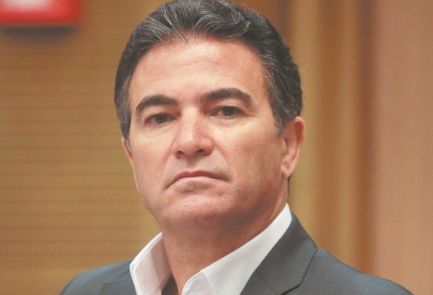
Israel’s spy chief: It is a great pleasure to steal from the Persians 

May 21, 2018

Source: Israel’s spy chief: It is a great pleasure to steal from the Persians – Israel Hayom

Report: US looking to restart nuclear negotiations with Iran 

May 21, 2018

Source: Report: US looking to restart nuclear negotiations with Iran – Israel Hayom

Report: Explosions heard at Iranian facility near Damascus

May 21, 2018

Source: Report: Explosions heard at Iranian facility near Damascus | The Times of Israel

Sky News Arabia says blasts target electronic warfare facility used by Tehran south of Syrian capital; no confirmation

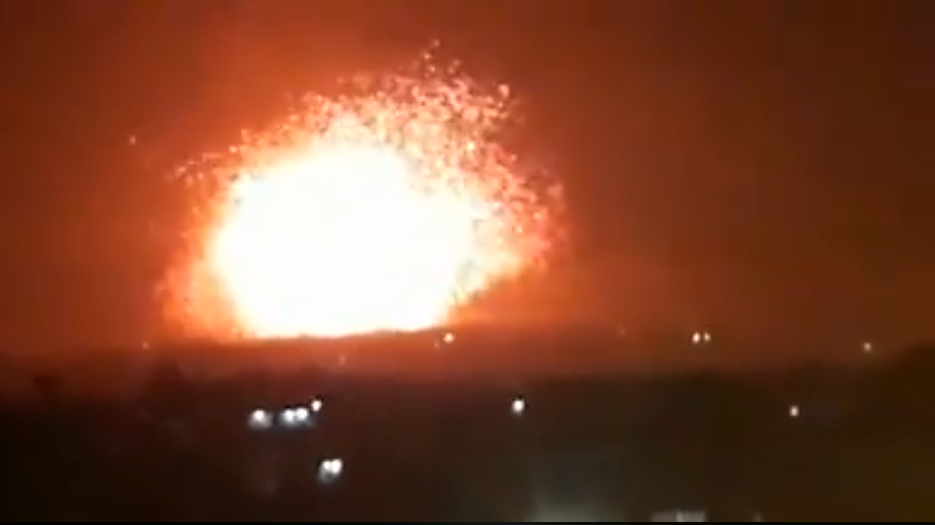
An explosion is seen coming from an army base, allegedly used by Iran-backed militias, outside the northern Syria city of Hama on April 29, 2018. (Screen capture; Facebook)

An explosion is seen coming from an army base, allegedly used by Iran-backed militias, outside the northern Syria city of Hama on April 29, 2018. (Screen capture; Facebook)

Explosions reportedly rocked an area thought to house an Iranian facility near Damascus early Monday morning, according to a report in Sky News Arabia.

There was no immediate confirmation of the explosion and it was not clear what may have caused the blasts, which came days after another mysterious explosion at a Syrian base.

Sky News said locals reported hearing explosions in the area of Najjah, a neighborhood south of Damascus which houses a military academy.

According to the report, the blasts are thought to have occurred at an Iranian electronic warfare facility there.

There was no immediate word from Syria, which was said to be on the verge of pushing the last pockets of Islamic State resistance out of southern Damascus on Monday.

Israel has increasingly taken aim at Iranian facilities in southern Syria over recent months as it attempts to keep Tehran from gaining a military foothold on its doorstep.

The sorties, which Israel rarely admit to openly, have led to increased tensions in the border region and earlier this month sparked a barrage of 20 missiles at northern Israel, drawing a massive Israeli reprisal attack.

The explosions were reported after mysterious blasts tore through weapons and fuel depots on Friday at a military airport in Syria’s Hama province, according to the Syrian Observatory for Human Rights, killing at least 28 people.

Syrian state media reported the blasts at the time but did not provide any details, while the Observatory had said they were likely due to a technical malfunction.

However, the Sky News Arabia outlet reported that the explosions were caused by an attack on an advanced Iranian air defense system, despite it coming in the middle of the day, when Israel rarely carries out airstrikes.

After maintaining an official policy of refusing to comment on such strikes, the Israeli military last week revealed that it had been conducting air raids against Iranian targets in Syria as part of a mission dubbed “Operation Chess.”

The purpose of “Operation Chess” was to prevent Iran from carrying out reprisals for an Israeli airstrike against the Iranian-controlled T-4 air base in central Syria on April 9, which killed at least seven members of the Islamic Revolutionary Guard Corps, including a senior officer responsible for its drone program.

Iran had also used the T-4 base to launch an attack drone carrying explosives into Israel in February, according to the Israel Defense Forces; the drone was shot down.

The IRGC’s al-Quds Force in southern Syria launched 20 rockets at northern Israel last week. Four of the rockets were intercepted by Israeli air defenses, the army said, and the rest fell short of the border.

In response, the Israeli Air Force conducted strikes against over 50 Iranian military targets in Syria and destroyed several Syrian air defense systems that had fired on Israeli jets, the army said.

Israeli officials have repeatedly stated that the Jewish state will not accept Iranian entrenchment in Syria and is prepared to take military action in order to prevent it.

Last week, the Israeli army reportedly told senior ministers that it believes the current round of hostilities was over, but tensions in the north will persist, and that border incidents are still possible.

Paraguay president lands in Israel for Jerusalem embassy opening

May 21, 2018

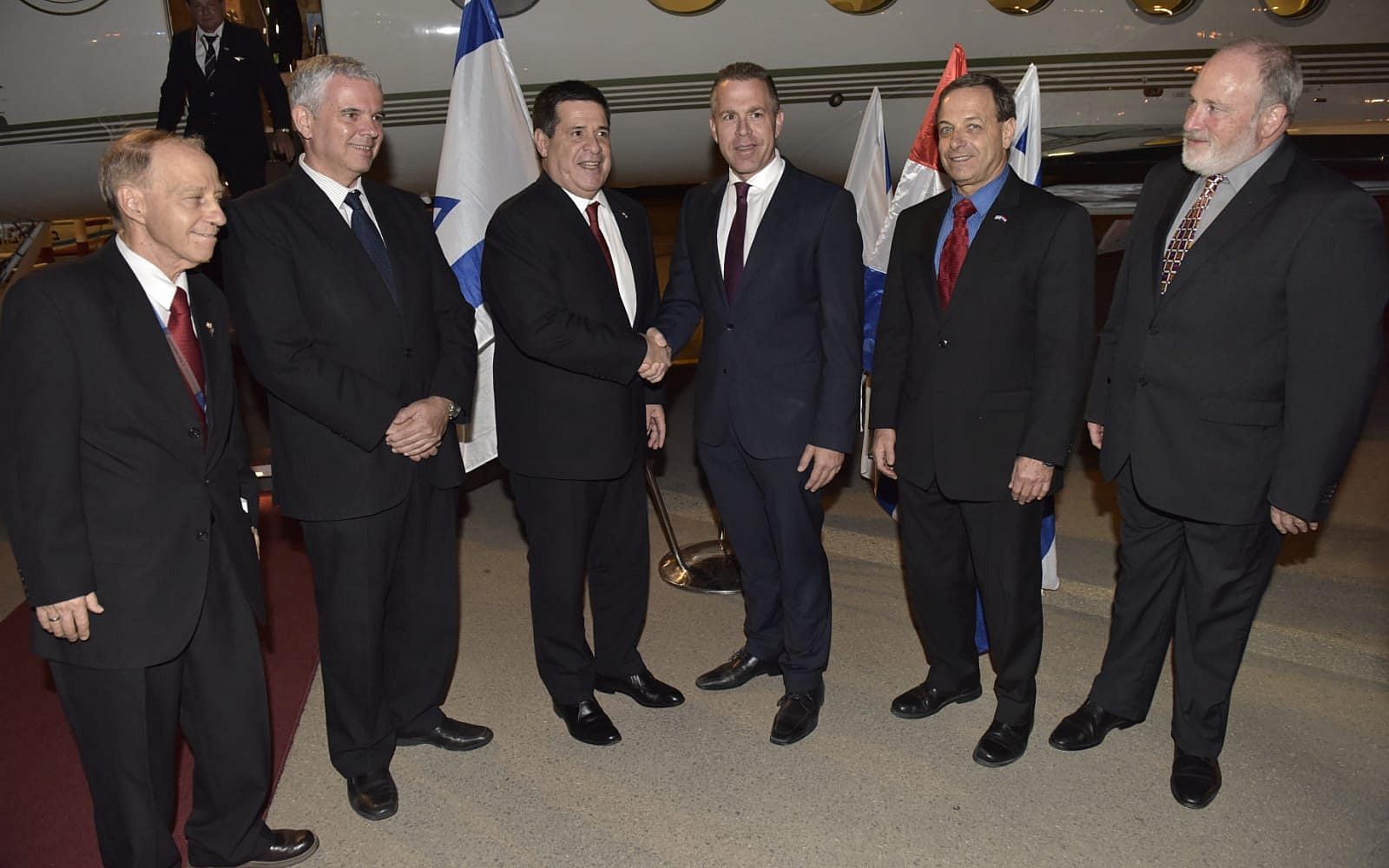
Paraguay’ President Horacio Cartes (3rd-L) is greeted at Ben Gurion International Airport by Public Security Minister Gilad Erdan (3rd-R) after landing in Israel to attend the opening of the Paraguayan embassy in Jerusalem, on May 20, 2018. (Foreign Ministry)

Horacio Cartes greeted at airport by Likud minister, who thanks him for his ‘brave leadership’; new mission to be inaugurated Monday

By TOI STAFF 20 May 2018, 11:41 pm Times of Israel

Source Link: Paraguay president lands in Israel for Jerusalem embassy opening

{More winning! – LS} 

Paraguay’s President Horacio Cartes arrived in Israel Sunday evening ahead of the opening of his country’s embassy in Jerusalem this week.

Cartes was greeted at the airport by Public Security Minister Gilad Erdan, who praised him for moving the Paraguayan embassy in Israel to Jerusalem.

“I thanked the president for his decision that testifies to the depth of countries’ ties and his brave leadership. Another state leader that chooses truth and strengthens our sovereignty in our capital,” Erdan tweeted.

Paraguay is set to open its new mission in Jerusalem on Monday, making it the third country to do so after the United States and Guatemala opened their embassies in the city last week.

Following the embassy inauguration, Cartes will attend a reception at the Foreign Ministry attended by Prime Minister Benjamin Netanyahu, Foreign Ministry spokesman Emmanuel Nahshon said.

Last month, Cartes said he wanted to relocate the country’s embassy to Jerusalem before the end of his presidential term in August.

The decision has been controversial in Paraguay. It comes less than two months before Mario Abdo Benitez replaces Cartes, and the president-elect has said he wasn’t consulted.

Israel claims the entire city as its eternal capital. Palestinians seek East Jerusalem as their future capital and have been infuriated by the embassy moves.

Most countries maintain embassies in Tel Aviv and have balked at moving them until the international legal status of the city has been resolved in negotiations between Israel and the Palestinians.

In addition to the US, Guatemala and Paraguay, a number of other countries have expressed interest in moving their embassies to Israel, among them Honduras, the Czech Republic and Romania.

US President Donald Trump bucked longstanding international consensus with his December 6 recognition of Jerusalem as Israel’s capital, when he also announced he would move the embassy to the city.

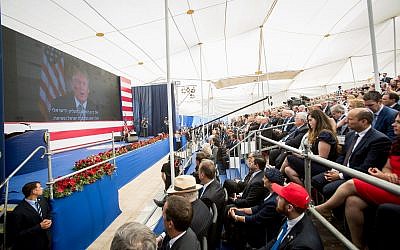
In a video message shown at Monday’s embassy inauguration, Trump said his recognition was of the “plain reality that Israel’s capital is Jerusalem,” noting that the city houses Israel’s main governmental facilities, Supreme Court, Prime Minister’s Office and president’s home.

He also stressed that the US remains committed to facilitating an Israeli-Palestinian peace deal and called for Israel to preserve the status quo at religious sites in Jerusalem.


People watch as US President Donald Trump speaks in a prerecorded video shown at the inauguration of the US embassy in Jerusalem on May 14, 2018. (Yonatan Sindel/Flash90)

AP contributed to this report.

Siblings attacked in suspected anti-Semitic incident in Australia

May 21, 2018

A Jewish brother and sister were attacked on Saturday. The attacker fled the scene.

Maia Shani

http://www.jerusalemonline.com/news/world-news/the-jewish-world/jewish-brother-and-sister-attacked-in-melbourne-35866

Police car in Australia Photo Credit: EurovisionNim via Wikimedia Commons

A Jewish brother and sister were attacked while standing outside of a home in Melbourne, Australia, the Australian Herald Sun reported on Saturday.

The siblings were apparently wearing religious symbols at the time of the attack. The 22-year-old victim was struck on his head while his 25-year-old sister, who was attacked with a sharp object, suffered wounds to her shoulder and cheek.

According to the report, the attacker left the scene immediately after the attack, and local police are investigating the case. The incident is being treated as a suspected anti-Semitic attack.

Dr. Dvir Abramovich, the Anti-Defamation Commission Chairman, responded to the incident and said it was “shocking on many levels” and “was in fact driven by anti-Semitism.” He added that the incident should be treated as a hate-crime.

House of Cards 

May 20, 2018

Source: House of Cards – Arab-Israeli Conflict – Jerusalem Post

Due in part to Russia, war between Israel and Iran is not on the horizon, despite rising tensions in Syria.

BY YOSSI MELMAN
 MAY 16, 2018 10:30
ussian President Vladimir Putin, Prime Minister Benjamin Netanyahu and Serbian President Aleksandar

Malcolm Hoenlein (center) Russian President Vladimir Putin, Prime Minister Benjamin Netanyahu and Serbian President Aleksandar Vucic lay flowers at the Tomb of the Unknown Soldier, in Alexander Garden in Moscow, on May 9ceives his honorary doctorate from Bar-Ilan University at the Tel Aviv Fairgrou. (photo credit: KREMLIN/REUTERS)

THE FIRST two weeks of May were very hectic and dramatic for Israeli leaders and security chiefs in dealing with Iran. On May 1, Prime Minister Benjamin Netanyahu revealed that Mossad operatives had stolen Iran’s central nuclear archive, proving that the Islamic Republic had violated its nuclear deal with the six major world powers. A week later, in light of the revelations, and more importantly, the contents of the stolen documents and disks, the US cancelled and pulled out of the deal.

A few hours after President Donald Trump announced his decision, Israeli intelligence prevented a revenge attack by Iran. The Israel Air Force (IAF) attacked and destroyed an Iranian mobile launcher in Syria that carried rockets slated to be fired against Israel.

Twenty-four hours later, the intelligence proved insufficient. From another base in Syria, Iran launched 32 rockets against Israeli military positions on the Golan Heights. Four rockets were intercepted and the rest fell in Syrian territory.

Within hours, Israel retaliated by attacking 70 Iranian positions in Syria. The targets were intelligence installations, rocket depots, army bases, logistic warehouses that Iran had built in the last year in Syria, as well as Syrian anti-aircraft systems, which fired at the Israeli planes. The operation, code-named “House of Cards” by the IDF, was the largest Israeli attack on Syria since the 1973 Yom Kippur War – and the closest Israel and Iran have come to the brink of a direct confrontation.

But the factor that likely played the greatest role but was most overlooked in galvanizing Israel to act against the Iranian presence in Syria is Russia.

Hours before the IAF launched its massive strike, Netanyahu flew to Moscow to meet Russian President Vladimir Putin and attend the annual Victory Day military parade commemorating Russia’s defeat of Nazi Germany. It was their ninth face-to-face meeting in the last 32 months – since Russia deployed its forces in Syria to save the regime of Bashar Assad.

Following the meeting, a senior Russia official said that his country was not negotiating a deal to supply the Syrian army with advanced S300 anti-aircraft systems. Israel has consistently opposed the deal, fearing the batteries would limit IAF freedom of action and maneuverability over the Syrian sky.

Later, a senior IAF officer, briefing Israeli reporters, admitted that Israel had coordinated in advance with Russia without telling it when and where the House of Cards operation would take place in general terms, without providing exact details.

All these factors taken together, it seems that the Kremlin has slightly changed its double game in Syria with regard to Israel.

Originally, the double game meant that while Russia cooperated militarily with Iran to help the Assad regime in its war against Syrian rebels, it tolerated and turned a blind eye to Israeli strikes against Iran.

Russia still needs Iranian advisers and commanders and their proxies – Shi’ite militias from Iraq, Lebanon (Hezbollah), Pakistan and Afghanistan – to be present in Syria as “boots on the ground.” But as the Assad regime extends its control over more territory, Russia needs Iran to a lesser extent. In a cynical way, Russia no longer cares, and maybe it is even happy, if the growing Iranian presence and influence in Syria is challenged and blocked by Israeli military actions.

Iranian-Syrian relations have come a long way to reach their present peak. Since 1970, Syria has been ruled by a family dynasty – the Assads, who belong to the Alawite sect, which is an offspring of the Shi’ite community.

But it isn’t only religious roots that bind the two regimes. They were also tied in the past by a common rivalry with Iraq and hatred of its late leader, Saddam Hussein.

The late Syrian president Hafez el-Assad, who died in 2000, respected but also suspected Iran. His cooperation with the country was cautious and limited. Even his son and heir, Bashar Assad, didn’t fully trust Iran when he came to power. He concealed from Iran his ambitious and secret program to build nuclear bombs, a plan that was destroyed in September 2007 when the IAF demolished Syria’s nuclear reactor.

But after that, Bashar strengthened his relations with Iran. He allowed Iran to use Syria as a hub for resupplying Hezbollah with rockets and missiles after the Lebanese Shi’ite movement suffered a blow at the hands of Israel in the 2006 war.

But the turning point came after the eruption of civil war in Syria in March 2011.

Fearing he would lose power to the mosaic of rebel groups, including al-Qaeda (and later ISIS) supported by Saudi Arabia, Qatar, Turkey and the US, Assad asked Iran to help repel his enemies.

Iran gladly agreed. First, it sent Hezbollah warriors to salvage the Syrian regime, then its own advisers and commanders, and eventually, Shi’ite militias to serve as cannon fodder. Indeed, Iran and its proxies, together with a later Russian intervention, rescued Assad. As the combined efforts repelled and defeated ISIS, and as the Assad regime regained more territory, Iran moved to phase two of its plan.

It began deepening its military deployment in Syria with three aims. One, to establish a land corridor from its territory via Iraq to Syria and then to Lebanon, as part of its expansionist policy to set strong footholds in the entire Middle East by reaching the Mediterranean and the Red Sea via Yemen.

The second aim is to reap economic benefits in Syria, particularly by gaining oil and gas concessions as well as construction deals.

The third aim is to have a military presence near the Israeli border in order to threaten the Jewish state from three directions: long-range missiles from Iran; the huge missile and rocket arsenal (120,000) of Hezbollah in Lebanon; and the Hezbollah presence on the Syrian side of the Golan Heights.

Iran’s ambitious grand strategy is challenged in two respects: one, in a minor way, by Russia, which also seeks to benefit economically through rebuilding the new Syria; and secondly, in a big way, by Israel. Israel can’t allow itself to be threatened by two Shi’ite enemies – Hezbollah in Lebanon and Iran in Syria – that are plotting to encircle and besiege the Jewish state on its northern fronts.

After ignoring the challenge for some time, and getting off to a slow start, a year ago, Israel identified and understood the real threat and began countering it.

THE ISRAELI strategy has four dimensions.

Firstly, Israel wants to maintain the mechanism of coordination and cooperation (via direct military and diplomatic channels) with Russia to avoid clashes in the Syrian skies between the air force and air defense systems of the two countries.

Secondly, Israel has deeply penetrated Iran’s intelligence in depth to collect accurate information of its intentions and capabilities in both Iran and Syria.

Thirdly, Israel has launched a psychological campaign against Gen. Qassem Soleimani, the commander of al-Quds Force in the Iranian Revolutionary Guards Corps.

Soleimani is one of the most powerful and influential figures in Iran, adored and worshipped by many and a confidant of the supreme leader, Ali Khamenei. He is considered the main architect of Iran’s expansionist policy in the region in general, and in Syria in particular. By “marking” Soleimani, Israel hopes to create a wedge between him and the political-religious echelon and other military commanders in order to portray him as the villain acting against basic Iranian interests.

Fourthly, Israeli embarked on a gradual military campaign, which reached its peak in May, to destroy Iranian deployment in Syria. It seems that Israeli policy has, for the time being, the upper hand. Militarily speaking, in Syria, Iran has long land supply lines, poorly trained militias and a lack of air force and air defense systems. Thus, it is no match for Israeli superiority in the air, fire power and intelligence.

But the exchange of punches has not resulted in an Israeli knockout. True, at the moment, Iran is under great pressure. The US decision to pull out of the nuclear deal and impose new sanctions are threatening to once again cripple Iran’s economy, which is already deteriorating with weak local currency and workers’ strikes. Its military, which is consuming large chunks of the national budget, is overstretched on four fronts: Iraq, Syria, Yemen and Lebanon.

For now, war between Israel and Iran, as some Israeli and international commentators wrongly predicted, is not on the horizon.

Nevertheless, Iran is determined to continue to consolidate its deployment in Syria and to challenge Israel. No doubt, it will draw lessons from the recent events in order to improve its intelligence and military capabilities.

So too will Israel. Time after time, Israeli leaders and military chiefs have said they will not tolerate an Iranian presence in Syria, certainly not one close to Israel’s border.

The outcome: the basic contradictory reality and interests of the two enemies remain.