Archive for May 25, 2018

Iran sets May 31 deadline to see EU measures to save nuclear deal 

May 25, 2018

Source: Iran sets May 31 deadline to see EU measures to save nuclear deal – Israel Hayom

End European subversion 

May 25, 2018

Source: End European subversion – Israel Hayom

Eldad Beck

For years, the European Union has been funding activities that are detrimental to Israel’s interest and cast doubt on its right to exist.

The apparent paradox between the EU’s commitment to Israel’s existence, security and welfare and its actual policies, which include the generous funding of the most virulent opponents of Israel’s existence both within and outside Israel, is in fact due to the compromising and pacifist policies of past Israeli governments. Those governments shut their eyes to the notoriously subversive activity of the EU, which undermines the foundation of the State of Israel’s existence.

Those past Israeli governments sought, for obvious reasons, to tie Israel’s economy to that of Europe. Israel has much to offer in many fields and the Europeans have a lot of money. Geographical proximity to the continent makes Europe Israel’s main trade partner. While Israel enjoys access to various major EU programs, this relationship, which contributed to Israel’s transformation into a stable and leading economy, came at a heavy price: The Europeans conditioned this cooperation on their involvement in Israel’s internal affairs and a significant role in the promotion of a “peace process” between Israel and the Palestinians. In retrospect, this role was meant from the outset to allow Europe to defend Palestinian interests, at the expense of Israel’s.

This is not just about unlimited and unconditional assistance to the Palestinians in their struggle to “liberate” Judea and Samaria and, in the past, the Gaza Strip from “Israeli occupation.” For a while now, the EU has acted on several fronts to directly undermine Israel’s interests and has grossly interfered in its internal affairs. Its funds have allowed the Palestinian Authority and the U.N. refugee agency education systems to propagate anti-Israel and anti-Semitic incitement for years.

According to a new report from the Ministry of Strategic Affairs, and many past reports from serious non-governmental organizations like NGO Monitor, the EU and its member counties help fund organizations that aim to delegitimize and bring an end to the State of Israel in a variety of ways. As part of its campaign of delegitimization, the EU encourages the financing of bodies that seek to eradicate the Jewish character of Israel and transform it from an “apartheid state” to a state of all its citizens. This is not about bringing change to the status of the “occupied territories,” but rather a fundamental change to the State of Israel.

The EU also supports groups and organizations that oppose the current government’s policies, in an effort to influence internal Israeli politics.

The Europeans directly fund and indirectly finance these efforts through the funding of governments of EU-member states and institutions or funds that enjoy the financing of those governments, like private funds, cultural centers, movie funds and many others. Such is Europe’s involvement in the campaign to sully and impose a reality on Israel that is incompatible with its Jewish identity.

And yet, all this could not have happened had successive Israeli governments not allowed the phenomenon to develop and intensify.

Israel is not a European colony and certainly has no interest in joining the European Union in its present state. If the EU is interested in good ties with Israel, and there are many reasons and motives for this to be the case, it must immediately cease its subversive efforts to impose on Israel arrangements and solutions that are neither to its advantage nor its benefit. As a sovereign state, Israel must both demand this and make every effort to prevent it from happening.

Hamas military leader admits Iran provides group with weapons, expertise 

May 25, 2018

Source: Hamas military leader admits Iran provides group with weapons, expertise – Israel Hayom

‘I’d put my money on the US and Israel against Iran’ 

May 25, 2018

Source: ‘I’d put my money on the US and Israel against Iran’ – Israel Hayom

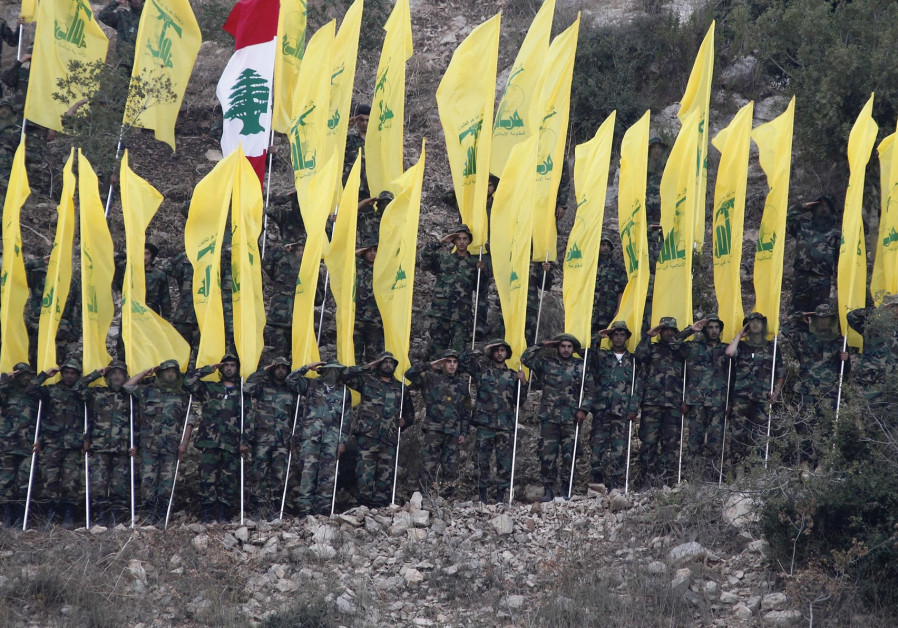
Report: Israel attacked a Hezbollah base in Syria 

May 25, 2018

Source: Report: Israel attacked a Hezbollah base in Syria – Arab-Israeli Conflict – Jerusalem Post

According to the Syrian Al-Marsad organization for human rights, Thursday’s attack on the Dabaa military airport in central Syria was aimed at Hezbollah members and militias.

BY REUTERS, TAMAR BEN-OZER, YASSER OKBI/MAARIV
 MAY 25, 2018 13:25
Report: Israel attacked a Hezbollah base in Syria

The Syrian Al-Marsad organization for human rights reported on Friday that Thursday’s attack on the Dabaa military airport in central Syria was aimed at Hezbollah members and militias supporting the regime. According to the report, six strong explosions, allegedly related to missile strikes, were heard in the region of Homs, near the Lebanese border.  Syrian air defense systems reportedly attempted to intercept the missiles. So far, no fatalities have been reported. Al-Marsad did not state whether the attempt was successful.

The report further claimed that the missile attack was carried out by Israel.

Earlier on Friday, the Lebanese army announced that on Thursday, May 24, five Israeli Air Force planes circled above Lebanese territory for some 15 hours altogether. According to the report, most of the flights took place in the southern and northern regions of Lebanon, but one of them was mentioned to have circled above “all regions of the country.” No offensive action or operation was said to have been carried out by the aircraft.

On Thursday, Syrian state media said a military airport near Homs had come under missile attack which was repelled by its air defense systems.

“One of our military airports in the central region was exposed to hostile missile aggression, and our air defense systems confronted the attack and prevented it from achieving its aim,” state news agency SANA said.

SANA earlier reported sounds of explosions heard near the Dabaa airport, about 12 miles southwest of the central Syrian city of Homs and 6 miles from the Lebanese border.

Pentagon spokesman Lieutenant Colonel Kone Faulkner, when asked about reports of the attack, said the US-led coalition fighting Islamic State in Syria did not carry it out and the coalition does not target Syrian government positions.

British-based war monitor the Syrian Observatory for Human Rights said troops belonging to Hezbollah and other militias allied to Syrian President Bashar Assad are stationed in the Dabaa military airport. It had no information on casualties.

Earlier reports on Thursday from the Syrian opposition pointed to an Israeli attack on a Syrian Revolutionary Guard air missile base at the Dabaa airport west of Homs, by the Lebanese border.

An Israeli military spokeswoman declined to comment.

In recent months Israel has carried out several airstrikes in Syria, targeting Iranian and Iranian-linked targets.  Israeli leaders have repeatedly asserted that Jerusalem would not allow Iran to gain a foothold in southern Syria.

Satire: Gazans Officially Run Out of Things to Set Fire To

May 25, 2018

Falls into the funny coz its true category.

Gazans Officially Run Out of Things to Set Fire To

by Jamie Yankie

Gazans Officially Run Out of Things to Set Fire To

Following weeks of protests and riots along the Gaza border with Israel as part of their “March of Return”, one Hamas spokesman has announced that Gaza has officially run out of things to set fire to, and has declared a state of emergency.

“It’s official”, the spokesman said in a statement, “we’ve literally run out of things to burn. We’ve got nothing, zilch, nada. Frankly, this is a disaster as it will leave tens of thousands of Gazans even more unemployed than they were before, as the closest we ever got to providing mass employment out here was encouraging people to set fire to things. Like Fahrenheit 451, but with more rock throwing.”

It is understood that Hamas is looking for flammable alternatives but is facing problems doing so. “We’ve used up all the tires we could find, and our kids are still crying about the fact that we took all their kites away to set them on fire and fly them into Israel”, one Hamas source has revealed. “Then we went for the fuel pipelines which come into Gaza from Israel. In fact, we set fire to those three times, but those bastard Israelis keep repairing them, so that’s no fun. One operative suggested we resort to hurling flaming kittens over the fence but even though we’re a genocidal organization which deliberately puts children in danger in periods of conflict, we’re not that heartless. Those critters are just so goddamn cute. Plus you get lot more bang for your buck with donkeys.”

North Korea Says It Remains Willing to Meet With U.S. Any Time 

May 25, 2018

Source: North Korea Says It Remains Willing to Meet With U.S. Any Time – Bloomberg

 Updated on 
( Don’t fuck with the Donald… – JW )

Trump Says He Decided to Cancel Summit With North Korea’s Kim.

North Korea said it was surprised by President Donald Trump’s decision to cancel a June 12 summit with Kim Jong Un and it remains willing to meet with the U.S. at any time.

Vice Foreign Minister Kim Kye Gwan said Friday that his country still wants to pursue peace and said it would give Washington more time to reconsider talks. He added that North Korea “inwardly highly appreciated” Trump for agreeing to the summit, and hoped the “Trump formula” would help lead to a deal between the adversaries.

“The first meeting would not solve all, but solving even one at a time in a phased way would make the relations get better rather than making them get worse,” Kim said in a statement carried Friday by the state-run Korean Central News Agency. “We would like to make known to the U.S. side once again that we have the intent to sit with the U.S. side to solve problem regardless of ways at any time.”

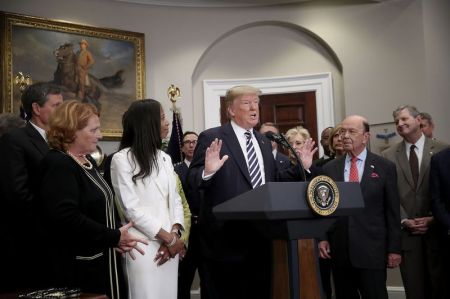
Trump speaks about the canceled summit with North Korean leader Kim Jong-un on May 24.

Photographer: Win McNamee/Getty Images

The statement appeared designed to get the summit back on track after Trump abruptly canceled the Singapore meeting, citing “tremendous anger and open hostility” in recent statements from Pyongyang. Asian stocks pared opening losses after the olive branch from North Korea as investors weighed the likelihood of a return to missile tests and military threats that raised tensions last year.

“We will likely see, at best, tensions rise,” said Mintaro Oba, a former U.S. State Department official who worked on North Korean issues. “At worst, we will see renewed discussion in Washington of military options.”
Trump said he had spoken with Defense Secretary Jim Mattis and the leaders of South Korea and Japan. He called the collapse of his planned summit with Kim “a tremendous setback for North Korea and indeed a setback for the world,” adding that the U.S. military is ready if necessary in the event of a conflict on the Korean Peninsula.

The U.S. president also held out hope that he and Kim could meet in the future: “Nobody should be anxious. We have to get it right,” he said. Secretary of State Mike Pompeo said there were “a lot of dial tones” as the U.S. sought to work out logistics with North Korea to hold the summit.

South Korean President Moon Jae-In said that peace on the peninsula shouldn’t be abandoned and suggested that Trump and Kim hurt chances for a successful summit by speaking to each other through statements, tweets and spokespeople.

“It’s hard to resolve the diplomatic issue, which is both difficult and sensitive, with the current way of communication,” Moon said in a statement. “I wish the leaders would have a more direct and closer conversation to deal with it.

Japanese Chief Cabinet Secretary Yoshihide Suga said that making progress on nuclear, missile and abductee issues is more important than holding a summit. China wasn’t surprised by the collapse of the summit given recent signals that had come from Trump, said a government official who asked not to be identified commenting on the matter.

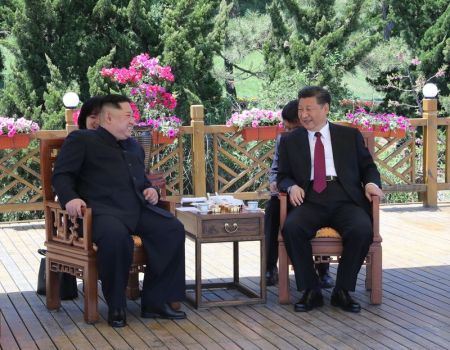
Kim Jong Un with Xi Jinping in Dalian in early May.

Photographer: Xinhua/Ju Peng via Getty Images

“I can imagine Seoul will hustle to try and bring the two leaders together again because Moon really needs a U.S.-North Korea summit and diplomatic process to happen on the nuclear front in order for him to drive and achieve his peace agenda,” said Duyeon Kim, a visiting senior research fellow at the Korean Peninsula Future Forum in Seoul. “A summit will eventually happen if Pyongyang still wants a summit, shows it still wants a summit, practices restraint, and plays nice before the two leaders meet.”

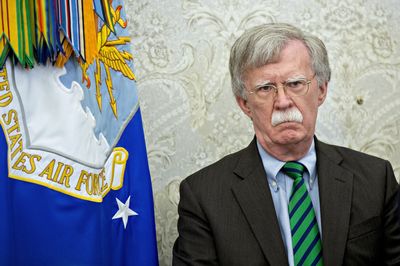
John Bolton

Photographer: Andrew Harrer/Bloomberg

North Korea hardened its rhetoric toward the U.S. earlier Thursday, lashing out after remarks by Vice President Mike Pence and the White House national security adviser, John Bolton, that had linked the country with Libya. Choe Son Hui, vice-minister of foreign affairs, called Pence “stupid” and a “political dummy,” according to an English-language statement from KCNA.

Trump then issued his own threat in a letter to Kim. “You talk about your nuclear capabilities, but ours are so massive and powerful that I pray to God they will never have to be used,” Trump wrote.

The timing of Trump’s letter may be an additional embarrassment to North Korea, as the country made a show of demolishing its main nuclear-weapons test site earlier on Thursday before a select group of foreign journalists. The exercise was portrayed as the destruction of tunnels used for all six of North Korea’s nuclear tests, but there was no independent verification that the site was disabled.

Read more: Ahead of letter, North Korea scraps nuclear site

The site’s closure doesn’t preclude North Korea from using other potential sites for testing or conducting atmospheric nuclear tests, said Van Jackson, a strategy fellow at the Center for Strategic Studies at Victoria University of Wellington.

“North Korea has reached a point with both its nuke and missile programs that testing isn’t essential,” said Jackson, a former U.S. Department of Defense adviser. “Missile reliability would benefit from more testing, but they have a ‘good enough’ strike capability at this point.”

— With assistance by Andy Sharp, Keith Zhai, Kanga Kong, Nick Wadhams, Margaret Talev, Sam Kim, Toluse Olorunnipa, and Colin Keatinge

The Gazans have shot themselves in the foot. Again.

May 25, 2018

Source: The Gazans have shot themselves in the foot. Again. – Blogs – Jerusalem Post

Ira Sharkansky

How many times have we seen it? Abba Eban said that they never miss an opportunity to miss an opportunity.

Here from the eastern edge of French Hill (and Jerusalem), we often see the black smoke of Palestinians burning tires. It’s most likely a protest against Israel’s existence or what they see as Israel’s mistreatment, but the prevailing winds bring the smoke to other Palestinians.
They’re latest efforts in Gaza began with a heavy investment of their aid money in building tunnels meant to bring killers into nearby Israeli settlements. But IDF and Israeli defense firms developed a technology to locate and destroy those tunnels.
Then it was a simpler and cheaper device — homemade kites with burning bottles of gasoline using the prevailing winds to light fires in Israeli fields.​
So far the rush of thousands toward the border on successive weekends hasn’t accomplished anything more than occupying thousands of IDF personnel, burning a few acres of Israeli crops, losing some 100 Palestinian lives, and the wounding of what’s said to be thousands, as well as destroying the Gazan side of a crossing point that cut the supply of Israeli gas, fuel oil, food, medicine and other consumer goods from Israel.
That isn’t the way to create a Palestinian state, much less accomplish the pronounced aims of destroying Israel.
The last time the Gazans sought to conquer Israel with their rockets cost them more than 2,000 lives.
This upsurge in Gazan aggression seems to have been quieted with the intervention of Egypt and Qatar, as well as the disinterest of the Gazan cousins in the West Bank and the fatigue of other Arabs with the Palestinians.
Nakba Day was relatively quiet in Gaza and the West Bank, as was the high profile first Friday of Ramadan.
It appears that Israel’s show of force, along with the cooperation of Arab governments, have helped to fizzle what the Gazan’s were proclaiming as their latest great campaign.
Parallel predictions from Tehran that Iran will destroy Haifa and/or Tel Aviv have so far produced Iranian wreckage in Syria, and funerals of Iranians and their mercenaries from Lebanon, Pakistan, Afghanistan, or wherever else there are ambitious Shi’ites.
The Gazans have had some success in the media. While Israeli politicians and media commentators have shown considerable support for what’s happened in Gaza, international media and some governments have been nasty in their condemnation. No surprise. Goliath gets a worse press than David. Iran remains an excited supporter, reportedly sending money for Hamas to use in this campaign.
Donald Trump and Nikki Haley are firmly in Israel’s corner.
Turkey has upped its enmity, sending home Israel’s Ambassador and making him take off his shoes in front of local media while passing through airport security.
Israel also has some clout in this spat. In cooperation with Egypt, also not a great friend of Ottoman aspirations, Turkey won’t be able to get wounded Gazans to its hospitals. And the expulsion of Turkey’s Consul in Jerusalem will hamper its efforts to play the Palestinian card in Al Quds..
Hamas sent its soldiers along with others recruited and paid for the effort to a shooting gallery, where Israeli soldiers did what is necessary and justified to defend their border, and the civilian settlements close to it.
Should Palestinians get through that border, we could expect a slaughter of Israeli civilians, in the style of pogroms once popular in Europe and the Middle East.
Israelis should be more concerned about the post-traumatic care of soldiers having to kill than for the Gazan aggressors who were killed.
Maybe the Gazan motto should be success via suicide. But success seems unlikely, except in showing pictures of bodies being carried, and then crowds at the funerals.
Palestinian activists are calling it a slaughter. They are right. But they are wrong to blame Israel. They should blame Hamas.
Media reports from Gaza are unreliable. Overseas journalists allowed into Gaza are subject to control by those who see the slaughter of their children and the closing of supply routes as a way to international support.
Prominent American publications, including CNN and The New York Times, are shaming themselves by accepting Hamas claims that the thousands were unarmed civilians, and joining the call for an international investigation likely to censure Israel.
The tilt of the Times recalls the action of that same Jewish-owned paper in the 1940s, burying its discomfort in having to report the early news of the Holocaust somewhere in the back pages, what one study described as alongside the ads for soap and shoe polish.
Hamas said that 50 of the most recent 60 killed were its people, most likely armed, and motivated to lead who ever could get through the border to massacre Jews.
The IDF positioned in soldiers in groups of ten or so, opposite clusters of thousands, with officers to monitor the actions of snipers.
International worthies, claiming to be even-handed, say that Israel should do more to help Gaza.
Beginning with the pullout of Gazan settlements, and extending to last week when Israel refurbished three times the supply lines that the Gazans had destroyed again and again, we can wonder what else a reasonable Israeli could have done.

Hamas and its allies are affected by intense hatred and an unwillingness to deal with Israel. It seems part of their political-religious-cultural DNA, and apparently beyond the capacity of Israel’s critics and some of its well wishers to grasp.
Worsening the plight of its people–for the purpose of attracting overseas media attention–appears to be the essence of the Gazan strategy.
The Gazans must begin to help themselves. Israel’s prime concern is to protect its own people from the savagery we hear.
A majority of what’s called the UN Human Rights Council has voted to establish a commission to investigate Israel’s use of deadly weapons against peaceful protesters.
Seen that. Done that. What else’s new?

Putin welcomes European efforts to save Iran nuclear deal

May 25, 2018

Source: Putin welcomes European efforts to save Iran nuclear deal – Middle East – Jerusalem Post

After meeting with France’s Macron, Russia’s president warned of “lamentable consequences” if deal abandoned.

BY REUTERS
 MAY 25, 2018 00:04
Russian President Vladimir Putin (R) and his French counterpart Emmanuel Macron attend a signing cer

Putin made the comment in a news conference with French President Emmanuel Macron, who has proposed broadening talks with Tehran to cover Iran’s ballistics program and its role in the Middle East.

Macron met Putin seeking to win concessions on Syria, Iran and Ukraine, after returning largely empty-handed from a state visit to the United States.

Macron said France and Russia agreed on creating a coordination mechanism between world powers to push ahead with finding a political solution in Syria, and that the focus should be on a new constitution and setting up elections that would include all Syrians.

“We need to be talking about the situation after the war. The key is to build a stable Syria,” Macron said.

He and Putin said they hoped the United States and North Korea would continue working towards denuclearizing the Korean peninsula after US President Donald Trump called off a planned summit.

Macron said he hoped Trump’s move “was just a glitch in a process that should be continued.”

Recent Iran protests part of potential wider unrest 

May 25, 2018

Source: Recent Iran protests part of potential wider unrest – Middle East – Jerusalem Post

Several protesters were reportedly killed on May 16 when police used deadly force to disperse them.

BY SETH J. FRANTZMAN
 MAY 24, 2018 05:45
People protest in Tehran, Iran December 30, 2017 in this still image from a video obtained by REUTER

People protest in Tehran, Iran December 30, 2017 in this still image from a video obtained by REUTERS. (photo credit: REUTERS)

Protesters in the southern Iranian city of Kazerun represent wider percolating unrest that has continued in Iran since the large protests in December and January.

Several protesters were reportedly killed on May 16 when police used deadly force to disperse them.

They soon spread throughout rural areas and regional centers in Iran. Reports indicated that outside Tehran, they were far larger than the mass protests of 2009. A UN Security Council discussion on the protests on January 5 said that more than 1,000 were reportedly detained and affirmed that protesters had burned government offices, banks and others infrastructure.

Since then, there have been continued local protests in Iran. This has also included women refusing to wear the headscarf that Iranian law imposes. Usually these take the form of “White Wednesday” protests, named for the women who don white hijabs on Wednesdays and sometimes remove them.

For instance, activist Masih Alinejad wrote in March that it was “becoming increasingly common to see women walk certain distances in Iran unveiled.”

On the eve of his May 21 speech, Secretary of State Mike Pompeo tweeted that “we support the Iranian people who are demonstrating against an oppressive government.

Three deaths and internet interruption show the regime’s true nature.”

Pompeo referenced the ongoing social unrest and challenges to the Iranian regime in his Iran speech on Monday: “The protests of the past few months show that the Iranian people are deeply frustrated with their own government’s failures.”

Inside Iran, the Pompeo speech galvanized a local Farsi hashtag calling for regime change and another titled “thank you Pompeo.”

Reasons for the protests in Iran are myriad, with some blaming a bad economy, anger over the authoritarian regime, suppression of minorities and women and resentment over Iran’s foreign policy.

For instance, the Kazerun protests, a gathering that initially was fueled by anger over changes in local county boundaries, became a protest against government policy.

People chanted: “The government supports Gazans but betrays Kazerun,” and “Our enemy is here, not in the US,” The Daily Beast reported.

M. Hanif Jazayeri, a news editor who closely follows protests in Iran, wrote on May 22 that Iran’s truckers were also on strike over the “steep cost of government tolls on roads.” He said truckers in 62 cities in 23 provinces had taken part in the strike. Other accounts said the strike only spread to seven provinces.

The Iranian regime’s only answer to the protests has been to either deny they are happening or to suppress them with police. In Kazerun, The New Arab reported that an estimated 3,700 anti-regime protesters had been arrested. The truckers’ strike has so far not been met with the regime’s batons. Instead, people have been waiting in long lines because of a shortage of fuel as the strike went into its second day, BBC Persian reported.

The regime continues its policies of executions and arresting activists. The regime sentenced a Kurdish man, Ramin Hossein Panahi, to death in January and intends to carry out the execution at the end of Ramadan, according to Amnesty International. In addition, a group of 13 environmental activists detained in January is still being held, accused of “spying.” One of the more outlandish charges was that a fishing rod one activist had was an antenna being used to communicate with foreign intelligence.

The state’s obsession with hunting down such innocuous groups appears to show its growing paranoia.

As it clamps down on social media and its media speak of “Zionist” plots, it refuses to address the root causes of the unrest at home.