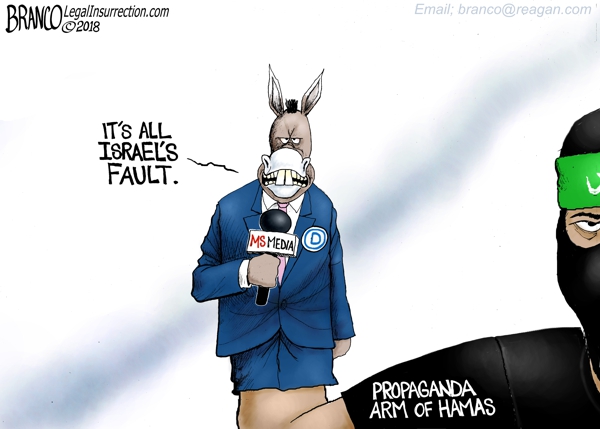
Source Link: Legal Insurrection Branco Cartoon
{Yep. – LS}

The Tower
Source Link: Israeli Researchers Announce Patent of Molecule that Could Reprogram Cancer Cells
{Saving mankind one cell at a time. – LS}
A novel molecule that not only inhibits growth of cancer cells but also has the ability to reprogram the cancer cells back to normal-like cells is patented and ready to be further developed with a commercial partner, according to BGN Technologies (the tech-transfer company of Ben-Gurion University of the Negev) and the National Institute for Biotechnology, a research institute at the university.
The potentially groundbreaking approach, which came out of a research group led by BGU Prof. Varda Shoshan-Barmatz, is based on preventing the expression of VDAC1, a protein that is highly overexpressed in many solid and non-solid tumors.
VDAC1 serves as the gatekeeper of the mitochondria, organelles that control cell metabolism, and is therefore crucial for supplying the high energy demands of malignant cells.
Shoshan-Barmatz showed that silencing VDAC1 expression using the siRNA method leads to inhibition of cancer cells (but not healthy cells), both in vitro and in mouse models of glioblastoma, lung cancer and triple negative breast cancer.
Treating cancer cells with VDAC1-specific siRNA also induces metabolic rewiring of the cancer cells, reversing their oncogenic properties and prompting normal cell differentiation.
“Although still in early stages, we are excited with our results that demonstrate the potential of this novel molecule for cancer treatment,” said Shoshan-Barmatz.
The paper revealing the results of the studies was published in July 2017 in the journal Neuro-Oncology.
Dr. Ora Horovitz, senior vice president of business development at BGN Technologies, said, “We are now seeking partners for the further development and advancement of this promising patented treatment towards the clinic in the hope that it will lead to a novel path for cancer treatment.”
(via Israel21c)
[Photo: Spongelab Community / YouTube ]

In this courtroom sketch Mehmet Hakan Atilla, second from left, listens to the judge during his sentencing, flanked by his attorneys Cathy Fleming, left, and Victor Rocco as Atilla’s wife, upper right, listens to the proceedings Wednesday, May 16, 2018, in New York. U.S. District Judge Richard Berman imposed a sentence of 32 months in prison on the Turkish banker convicted of helping Iran evade U.S. sanctions. (Elizabeth Williams via AP)
OAN Newsroom Thurs. May 17, 2018 One America News Network
Source Link: Turkish Banker Sentenced to Prison for Helping Iran Evade U.S. Sanctions
{Don’t do the crime if you can’t do the time. – LS}
A Turkish banker is sentenced to 32-months in prison for helping to execute one of the largest sanction evasion cases ever prosecuted in the U.S.
A New York-based federal court announced the decision against Mehmet Hakan Atilla on Wednesday, just months after he was convicted of bank fraud and conspiracy in January.
A judge is granting Atilla time served for the 14-months he already spent behind bars following his arrest in 2017 during a trip to the U.S. This means the 47-year-old could return to Turkey in little more than a year.
The sentence comes as a disappointment to prosecutors, who recommended Atilla serve at least 20-years for jeopardizing U.S. national security.
They say he abused his top position at a state-owned Turkish bank a decade ago to help Iran circumvent U.S. sanctions and access frozen assets.
The move helped to pour billions of dollars of Iranian oil profits into the world market, creating a slush fund for the country to use.
Eight other Turkish and Iranian defendants were indicted along with Atilla for their alleged roles in the evasion.
One of the men — prominent gold trader Reza Zarrab — shocked the world by pleading guilty and helping the U.S. to unravel the scheme.
The judge ruled Atilla was more of a minor player in the overall plan, and not the mastermind prosecutors tried to paint him out to be.
The decision came in part after more than 100 letters from Atilla’s friends, family and colleagues were read by the courts attesting to his character as a family man.
Turkish President Tayyib Erdogan has weighed in on the case, blasting it as a slight towards the whole country.
The legal proceedings have caused further division between the U.S. and its NATO ally Turkey. Lawyers for Atilla say he plans to appeal the ruling.

by Jim Hoft May 17, 2018 Gateway Pundit
Source Link: Guatemala Opens Embassy in Jerusalem, Israel
{Congrats ! – LS}
Guatemala held an opening ceremony in Jerusalem on Wednesday.
A warm welcome to the wonderful Guatemalan delegation led by President Jimmy Morales. President Morales, you made history today when you moved the Guatemalan embassy to Jerusalem. We will continue to strengthen the relationship between Israel and Guatemala. 🇮🇱🇬🇹 pic.twitter.com/gzk531N4EA
— Benjamin Netanyahu (@netanyahu) May 16, 2018
The United States opened its embassy in Jerusalem on Monday following decades of promises.


Israeli soldiers are seen in the Golan Heights / Getty Images
BY: Follow @Kredo0
Congress to Consider Recognition of Israeli Sovereignty Over Golan Heights
Congress is set to consider a new measure to recognize Israel’s sovereignty over the contested Golan Heights region that separates Israel from Syria, a key piece of territory that has become all the more important since the civil war in Syria brought scores of jihadist fighters, including those backed by Iran, into the region.
Rep. Ron DeSantis (R., Fla.), a member of the House Foreign Affairs Committee, introduced on Thursday a resolution that could lead to an historic recognition by the United States that the contested area fully belongs to Israel, according to a copy of the amendment obtained by the Washington Free Beacon.
Israel annexed the Golan Heights in 1981 following the Six Day War with Arab nations in the region. The United States has declined for decades to take a position on the status of this territory, but following President Donald Trump’s decision to move the U.S. embassy in Israel from Tel Aviv to Jerusalem, DeSantis and others see an opportunity for the United States to recognize another territorial reality—that the Golan Heights will not be given back to Syria, particularly in light of the strife gripping the country.
The amendment puts the United States on Israel’s side in the land dispute and describes the Golan Heights as a key piece of territory that cannot fall into the hands of Iran, which has staked claims in Syria and continues to threaten Israel’s northern border.
“It is the sense of the Congress that the Golan Heights represent an integral part of the state of Israel and are crucial to the ability of Israel to safeguard its borders and maintain its existence,” the measure states.
“Given the civil war in Syria and the expansion of Iranian influence in Syria, the United States should recognize Israeli sovereignty over the Golan Heights,” the amendment adds.
The House Rules Committee is in possession of the measure, but have yet to take a stance.
DeSantis told the Free Beacon the Golan Heights territory is key to thwarting Iranian influence across the region and that the United States’ recognition that Israel owns the territory could send a powerful message across the region.
“The continuing turmoil in Syria and the steady expansion of Iranian influence illustrate why the Golan Heights are so important to the state of Israel and the anti-terror alliance,” DeSantis said. “The Golan provides Israel with a necessary buffer against the malevolent actors that are wreaking havoc in Syria.”
If Israel was forced to give back the territory it would leave itself vulnerable to an increase in terror attacks from Iranian controlled forces and other malevolent actors who would use the Golan region to stage strikes, DeSantis said.
“Indeed, Israel would be hard-pressed to ward off such threats without the Golan,” the lawmaker explained. “Given the interest of the U.S. in rolling back Iranian influence and combating terrorism, it is time for the United States to recognize Israeli sovereignty over the Golan Heights.”
As with the United States’ recent recognition that Jerusalem is Israel’s capital city, the recognition that the Golan Heights cannot be given back to Syria represents a factual reality on the ground, DeSantis said.
“There is no conceivable scenario in which it makes sense for Israel to abandon such a strategically significant location so that terrorists can fill the vacuum left behind,” he said.
Six others reportedly wounded and over 100 arrested in latest demonstration over decision to divide region’s administration

MEE and agencies Thursday 17 May 2018 09:35 UTC Middle East Eye
Source Link: One dead after protesters set fire to police station in southern Iran
{Trouble in paradise. – LS}
One person was killed and six others injured in violence in a city in southern Iran that has seen several protests in recent months, the Fars news agency reported on Thursday.
It said a group of people gathered in Kazerun on Wednesday evening to chant “subversive slogans” and set fire to a local police station.
Videos of the incident were shared on social media overnight.
Residents of Kazerun have held sporadic demonstrations for weeks against a government decision to establish an administrative division in the region.
One video posted on Twitter purported to show protesters chanting “They support Gaza, but betray Kazerun”.
Wednesday’s scuffle was the first reported unrest in the town in two weeks after a decision to shelve the reform initiative, the semi-official Fars agency said.
According to Iran Human Rights Monitor, which is associated with the exiled opposition group the National Council of Resistance of Iran, state security forces opened fire on demonstrators, killing two protesters, and arrested more than 100.

Citing local reports, IHRM said 40 armoured police vehicles were sent to the city to quell protests and residents in a nearby town blocked roads in an attempt to stop the police forces from reaching Kazerun.
Middle East Eye could not independently verify NCRI’s account.
At least 25 people were killed in a wave of social unrest that swept towns and cities across Iran between 28 December and 1 January.
The largest demonstrations since the 2009 Green Movement, the protests were fuelled by harsh economic conditions in the country.
Source: Britain warns US sanctions on Iran make 3rd-party trade difficult – Israel Hayom
Since withdrawing from 2015 nuclear deal, U.S. President Donald Trump has imposed new sanctions on Islamic republic, including barring it from major banking network • U.K. official: Britain working with U.S., EU to protect our businesses.
|
Iranians shout slogans during a protest in Tehran last week against U.S. President Donald Trump’s decision to walk out of the 2015 nuclear deal |Photo: Reuters / Tasnim News Agency
|
U.S. sanctions against Iran are having a clear impact on other countries and were making it difficult for firms to assess the risks of doing business there, Britain said Wednesday.
U.S. President Donald Trump on May 8 withdrew from a deal between Iran and major world powers according to which some sanctions against Tehran were lifted in exchange for curbs on its nuclear program. Trump has since imposed new sanctions, cutting Iran’s use of a critical banking network.
“It is clear that there is extraterritorial reach to some of these sanctions,” said Rona Fairhead, a trade department minister in the upper house of the British parliament, acknowledging that the sanctions would have an impact on trade between Iran and countries other than the United States.
“All businesses have to take into account the commercial risks, the legal risks, the financing risks of any transaction, and clearly these sanctions make that difficult,” she said.
Fairhead said Britain was providing guidance on the ground in Iran and at home to help companies navigate those risks and was also working with other governments to keep trade ties alive.
“We are working with our EU colleagues and directly both with the U.S. and with the EU to try and both protect our businesses as well as encourage the U.S. to allow us to continue economic ties because we think that’s important,” she said.
British, French and German foreign ministers met in Brussels on Tuesday to see how they can save the nuclear deal without the United States, but appeared hard-pressed over how their companies could continue doing business with Iran once Washington begins to reimpose sanctions.
Source: Fresh US sanctions target Hezbollah’s main decision-making body – Israel Hayom
New measures take aim at terrorist group’s Shura Council, as well as leader Hassan Nasrallah and his deputy, Naim Qassem • Treasury Secretary Mnuchin: We reject the false distinction between Hezbollah’s so-called “political wing” and terrorist plotting.
|
Hezbollah deputy leader Sheikh Naim Qassem has been specifically named in U.S. sanctions for the first time
| Photo: Reuters
|
The United States and Persian Gulf partners imposed additional sanctions on Lebanon’s Hezbollah leadership on Wednesday, targeting its top two officials, leader Hassan Nasrallah and his deputy, Naim Qassem.
The U.S. Treasury Department said four other individuals were also sanctioned, as was the Islamic State group in the Greater Sahara, which was designated as a foreign terrorist organization.
It was the third round of sanctions announced by Washington since the United States pulled out of the Iran nuclear deal last week.
Wednesday’s sanctions targeted members of the primary decision-making body of Hezbollah, Treasury said in a statement.
“By targeting Hezbollah’s Shura Council, our nations collectively rejected the false distinction between a so-called ‘Political Wing’ and Hezbollah’s global terrorist plotting,” Treasury Secretary Steven Mnuchin said.
The move expands U.S. sanctions against Nasrallah, who was sanctioned by Washington in 1995 for threatening to disrupt the Middle East peace process and again in 2012 over Syria. It is, however, the first time that the U.S. Treasury has acted against Qassem, who is being listed for his ties to Hezbollah.
The measures were imposed jointly by Washington and its partners in the Terrorist Financing and Targeting Center, which includes Saudi Arabia, Bahrain, Kuwait, Oman, Qatar and United Arab Emirates, it said.
The Gulf states targeted four of the movement’s committees and ordered individuals’ assets and bank accounts frozen.
A number of those targeted by the TFTC had been previously blacklisted by the United States.
Earlier on Wednesday, U.S. Secretary of State Mike Pompeo and his Qatari counterpart Sheikh Mohammed bin Abdulrahman Al Thani, discussed Qatar’s efforts to counter the financing of terrorism, the State Department said.
Last year, Nasrallah dismissed the prospect of tougher U.S. sanctions against his group.
“The American administration, with all available and possible means, will not be able to damage the strength of the resistance,” Nasrallah said on Aug. 13, 2017, in a televised address to mark the anniversary of the end of the 2006 Second Lebanon War.
Shiite Hezbollah and its political allies made significant gains in Lebanon’s parliamentary election earlier this month, boosting an Iranian-backed movement fiercely opposed to Israel and underlining Tehran’s growing regional clout.
The Trump administration has sought in recent days to choke off funding for Iran’s overseas operations, including its backing for Hezbollah.
Source: Egypt furious over Qatar, Iran meddling in effort to defuse Gaza violence – Israel Hayom
Egypt reads Hamas leader the riot act for causing Palestinians’ senseless death • Qatari mediation role negligible as it increasingly represents Iranian interests, Egyptian official says • Hamas leader: We will continue nonviolent popular resistance.
|
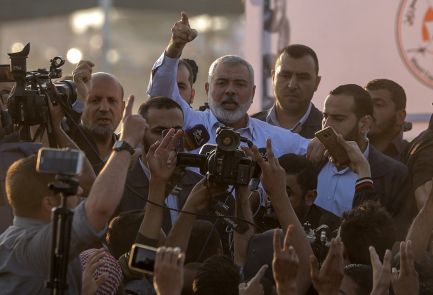
Hamas leader Ismail Haniyeh speaks in Gaza on Tuesday
| Photo: EPA
|
Egypt’s harsh rebuke of Hamas leader Ismail Haniyeh was prompted by Saudi Arabia learning that Iran and Qatar meddled in efforts to diffuse the violent demonstrations orchestrated by the terrorist group on the Gazan-Israeli border, a senior Egyptian intelligence official told Israel Hayom on Wednesday.
Sixty Palestinians were killed and 2,700 others were wounded in riots on the Israel-Gaza border Monday. It was the deadliest day since Hamas launched its border riots campaign on March 30, bringing the overall death toll to 120.
Haniyeh was urgently summoned to Cairo on Monday, where, according to a senior Egyptian official, “he was told, in no uncertain terms, that the blood of the dead was on his hands.”
The Israeli military said it had proof that at least 24 of the dead were known terrorists. On Tuesday, Hamas leaders admitted that 50 of the dead were its operatives.
“The Saudis, who supported the Egyptian pressure exerted on Hamas, are vehemently opposed to any semblance of collaboration with Doha, and even declared that any involvement by Qatar will cause the Saudis to withdraw the support and backing it gave for the pressure placed on Hamas” by Egypt, the official said.
Arab media reported on the drama that had unfolded in Cairo on Monday extensively.
The Egyptian official told Israel Hayom that the urgent meeting between Egyptian General Intelligence Service head Maj. Gen. Abbas Kamel and other top officers and Haniyeh was “extremely heated.”
The Saudis accused Qatar of helping Hamas instigate border riots through its envoy to the Gaza Strip, Mohammed Al-Emadi, saying Qatar’s assertion that it was key to convincing Hamas to roll back the riots was false.
“Contrary to reports on Qatari mediation, their role was negligible, effectively nonexistent,” the Egyptian official noted. “Qatar is beginning to show more and more that it represents the interests of Iran. Following the intelligence that was gathered on Iranian involvement and support for the violent incidents on the border with Gaza, causing the deaths of dozens of Palestinians, there was no place for Qatar to mediate between the parties and try to improve their image in the Arab and Western world at the expense of Palestinians killed and wounded.”
Reports that during Haniyeh’s scolding the Egyptians delivered a message from Israel saying that unless the border riots subside the IDF will resurrect its policy of targeted assassinations against Hamas’ leadership, received wide coverage in Arab media.
Egyptian intelligence officials said a shocked Haniyeh was told by Kamel that if his people continue the demonstrations and bring about the death of more Palestinians, they will hold him and the rest of the Hamas leadership personally responsible.
“Kamel demanded Haniyeh return to Gaza in the helicopter that brought him and order his people to immediately halt the incidents along the border with Israel,” the Egyptian official said. “Meanwhile, Hamas has received no positive gesture [from the international community] other than Gaza being in the headlines again. It’s likely that later, if the border remains quiet, gestures toward Hamas and the population of Gaza are likely to be made.
“The message sent, however, was hostile and placed the responsibility on Hamas to bring the order back to Gaza,” he said.
Haniyeh reportedly told the Egyptians that Hamas was prepared to discuss a “tahdiya,” or lull in hostilities with Israel, which could, eventually, secure a cease-fire, but he did not agree to discuss basic conditions for a cease-fire and rejected even the possibility of discussing the disarmament of Hamas’ military wing.
In response, “Haniyeh was told that Hamas is in no position to stipulate any conditions whatsoever,” the official said. “Hamas is effectively not even willing to discuss ways for actual steps that will allow a tahdiya. Therefore, in such a situation, there is absolutely nothing to discuss. The era of empty rhetoric is over, and Hamas must understand this.”
Meanwhile, Egyptian President Abdel-Fattah el-Sissi confirmed Wednesday that Egypt was involved in behind-the-scenes communications between Israel and Hamas.
“We are in contact with the Palestinian and Israeli sides to stop the bloodshed,” he said.
Meanwhile, Hamas military leader Yahya Sinwar told Al Jazeera that the Egyptians and Hamas agreed not to allow clashes on the border fence to escalate into an armed conflict. He said that the “peaceful” demonstrations along the fence achieved some of their goals.
“The right of return and the Palestinian problem returned to the world stage,” he said. “Hamas will continue its nonviolent approach of popular resistance. We will do everything in our power to ensure the demonstrations do not escalate, but we will not remain indifferent if the enemy spills the blood of our people.”
Source: Irreparable damage – Israel Hayom
Eldad Beck
The most concerning development in the current crisis between Israel and Turkey is the joint statement condemning Israel from President Recep Tayyip Erdogan’s ruling Islamist party and the opposition Republican People’s Party.
At the height of the presidential campaign for the early elections that Erdogan forced on his country, it appears an anti-Israel political consensus has been reached that is completely unrelated to the violent events Hamas has been instigating on Israel’s border with the Gaza Strip.
Through the joint statement, the secular opposition party sought to prevent Erdogan from using anti-Semitic incitement against Israel as a campaign tool, as he has done in past Turkish elections. Thanks to Erdogan’s efforts, a majority of Turks no longer see Israel as an ally but as an arch enemy.
Until now, Israel had for strategic purposes sought to maintain ties with Turkey in the hope that once Erdogan was no longer in power, the old alliance could be rebuilt. But the systematic and consistent damage Erdogan has caused during his many years as Turkey’s leader is absolute. His hatred of Israel goes beyond populist opportunism and deep-seated religious animosity. By exploiting the widespread popular belief in Turkey in conspiracy theories according to which the descendants of the Sabbateans are secretly working to take over or destroy Turkey, Erdogan has made anti-Semitism his country’s official policy.
If a political alternative ever comes to power, it will not be able to undo the damage Erdogan has caused. Moreover, it will in all likelihood preserve his hostile approach to Israel and the Jews in order to establish legitimacy in the eyes of the people.
Israel needs to wake up: We have lost Turkey and we must act accordingly. Israel must correct a terrible historical injustice and formally recognize the mass genocide of the Armenian people by the Turks in World War I. Israel must also do everything in its power to promote the idea of the establishment of an independent Kurdish state outside of northern Iraq, which has become something of an Iranian protectorate. Finally, Israel must act in the international arena to isolate Turkey as long as it under the totalitarian-democratic rule of Erdogan and his Justice and Development Party.
If Ankara does see regime change, the new Turkish government will need to prove it is different from its predecessor. Israel has catered to Turkey’s whims for far too long. If the Turks are interested in bilateral ties, they can pursue us.




 anneinpt
 artaxes
 danmillerinpanama
 davidking1530
 Peter Hofman
 Joseph Wouk
 Peter
Peter Louisiana Steve

 WarSclerotic
Recent Comments