Archive for May 16, 2018

PM Netanyahu: Turkey has no business preaching morality to Israel

May 16, 2018

Source: PM Netanyahu: Turkey has no business preaching morality to Israel – Israel Hayom

Haley says Hamas pleased by Gaza deaths; Palestinian Authority envoy calls her racist 

May 16, 2018

Source: Haley says Hamas pleased by Gaza deaths; Palestinian Authority envoy calls her racist – Arab-Israeli Conflict – Jerusalem Post

It was a meeting that underscored the increasing enmity between Washington and the Palestinian Authority.

BY TOVAH LAZAROFF, DANIEL J. ROTH
 MAY 16, 2018 00:47
Haley says Hamas pleased by Gaza deaths; PA envoy calls her racist

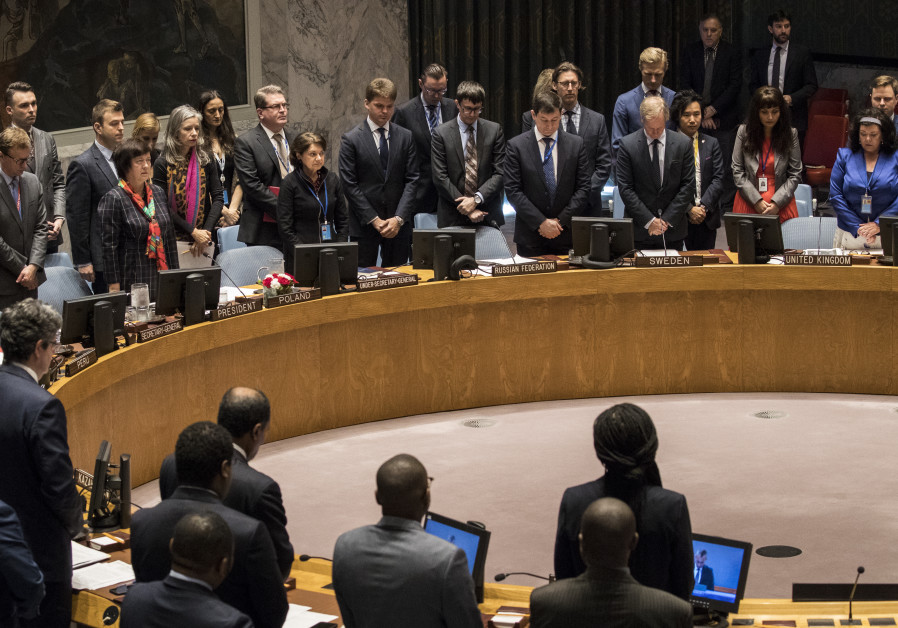
NEW YORK, NY – MAY 15: Members of the United Nations Security Council observe a moment of silence for those killed in the Gaza Strip on Monday, before the start of a UN Security Council meeting concerning the violence at the border of Israel and the Gaza Strip, at United Nations headquarters, May 15. (photo credit: DREW ANGERER / AFP)

It was a meeting that underscored the increasing enmity between Washington and the Palestinian Authority.

Haley, the United States’ representative to the Security Council, arrived late to the meeting, as did Israel’s Ambassador to the UN Danny Danon.

They both arrived after the other 14 Security Council members held a moment of silence for the more than 60 Palestinians who the Hamas-run health ministry reported were killed by the IDF in an attempt to quell a violent protest along its southern border with Gaza.

It was the bloodiest day since the start of the Hamas-led “Great March of Return” on March 30, which had the goal of breaking down the border barrier and entering Israel.

Haley made a brief speech, arguing that none of the 15-member body would be as restrained as Israel if their borders were threatened.

“Make no mistake: Hamas is pleased with the results from yesterday,” she said, as she explained how the terror group had goaded protestors into heading into dangerous areas of the fence by falsely telling them the IDF had fled.

Hamas used “loudspeakers that urge demonstrators to burst through the fence, falsely claiming Israeli soldiers were fleeing, when in fact, they were not. The same loudspeakers are used by Hamas to urge the crowds to ‘Get closer! Get closer!’ to the security fence,” Haley said.

“I ask my colleagues here in the Security Council: Who among us would accept this type of activity on your border? No one would. No country in this chamber would act with more restraint than Israel has. In fact, the records of several countries here today suggest they would be much less restrained,” she charged.

Haley then left the room, just as Mansour, who was an invited guest to the meeting, addressed the council.

Mansour charged that her words were “racist” and “provocative.”

He compared the Gaza protests to the demonstrations in the US against gun violence.

“We reject the racist discourse that turns us into excluded victims of humanity. We have the right to demonstrate as families against the occupation and its arrogance,” Mansour said.

The right to demonstrate is accepted throughout the world, he said.

“Why are we accused in a racist, fallacious way just because we exercise the same rights as anyone else?” Mansour asked.

“Stop the massacre committed against our people. The council cannot remain silent,” he said.

He called on the council to offer international protection to the Palestinians.

Danon then responded, explaining to the council that “these were not demonstrations, these were not protests – these were violent riots. They have repeatedly attempted to sabotage and breach the fence with the explicit goal of killing Israelis.”

Danon accused Hamas of wanting “death over peace,” and condemned the terrorist organization for exploiting its own people and using them as a collective “human shield.”

“Its goal was to kill and kidnap Jews in surrounding Israeli towns,” Danon charged.

When it comes to the safety of Israelis, “too often the world is silent,” he said.

He also charged that the Palestinians had caused their own people to die in a deadly public relations game.

“What would you do if a mob charged at your border with explosives and weapons?” he asked.

At a press conference outside the Security Council chamber, Danon showed a photograph of the sole commercial crossing between Israel and Gaza, the Kerem Shalom crossing, through which food and supplies enter the Strip. But during the Gaza riots, it was burned by the rioters, he said.

The council debate, in which most of the members spoke out against Israel’s disproportionate use of force, ended without any vote or formal condemnation.

The United States, which is one of five permanent members of the Security Council with veto power, had blocked any attempt to issue a statement with respect to Gaza or to demand a UN investigation into the deaths.

The UN Human Rights Council plans to hold an emergency session on the Gaza deaths on Friday. The office of the UN High Commissioner for Human Rights called for an independent investigation into IDF actions on the border.

Analysis: The new war against Iran in Syria is psychological

May 16, 2018

Source: Analysis: The new war against Iran in Syria is psychological – Middle East – Jerusalem Post

The shadow war with Iran in Syria is politics by other means because the grand strategy is to evict Iran from Syria.

BY SETH J. FRANTZMAN
 MAY 16, 2018 07:26
Analysis: The new war against Iran in Syria is psychological

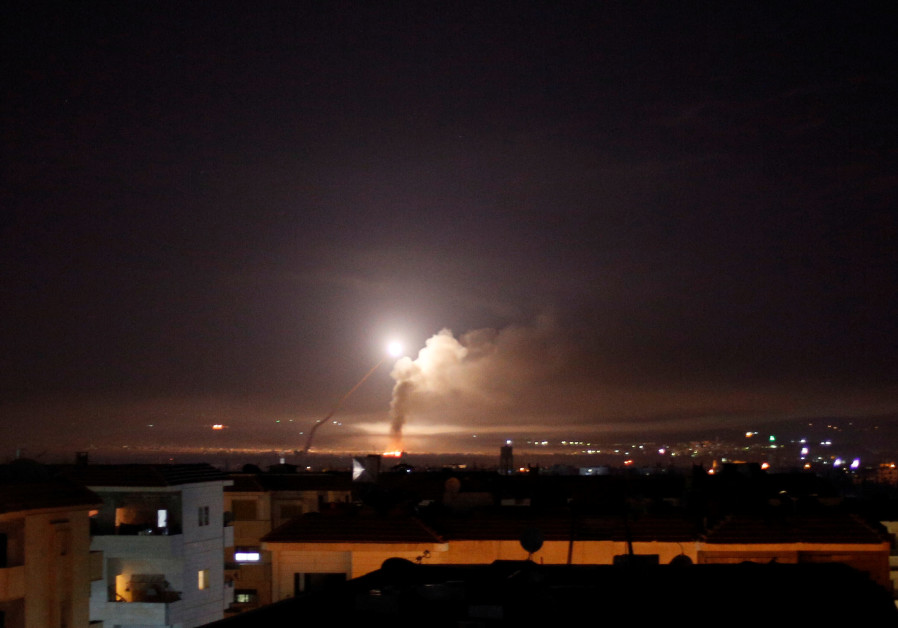
Missile fire is seen from Damascus, Syria May 10, 2018. (photo credit: REUTERS/OMAR SANADIKI)

The images show relatively limited damage to several sites, but they do appear to show that the giant building known as the “Glass House” at Damascus International Airport has been evacuated. The images are from May 11, the day after the raid. The first images were taken in September 2017.

Evacuation of the headquarters "the Glasshouse," Damascus International Airport, Syria, 11 May 2018 (Credit: IMAGESAT INTERNATIONAL - ISI)

Evacuation of the headquarters “the Glasshouse,” Damascus International Airport, Syria, 11 May 2018 (Credit: IMAGESAT INTERNATIONAL – ISI)

The evacuation of Iranians from this one site is emblematic of a larger and deadly chess game being played out in Syria. Over the last five years the game has involved limited and precision air strikes – a handful for which Israel has taken responsibility while others have only been reported in foreign media.

Now Iran’s apparatus in Syria has a new problem. After the large May 10 strikes which targeted numerous positions, including munitions, command and control and intelligence gathering sites, Iran’s agents in Syria must be wondering what’s coming next. They also have to be concerned about how much Jerusalem knows about their operations. After the strikes, around two dozen people were reportedly killed in Syria, most of them non-Syrian.

The ancient Chinese military strategist Sun Tzu is reputed to have written that every battle is won before it is fought. It appears that the evacuation of the so-called “Glass House” near Damascus is an example of this.

Iran evacuated this key part of its infrastructure without a battle. The Glass House has been known in media since 2016. The Daily Mail claimed “Iran is shoring up the Syrian regime from a secret HQ in Damascus nicknamed ‘the Glass House’ – and commanding a huge covert army in support of Assad, according to leaked intelligence passed by activists to MailOnline.”

The article went on to give all sorts of details. “The third and fourth floors are apparently occupied by the [Iranian] Revolutionary Guards’ intelligence unit, which is in overall command of the HQ. These areas are off-limits to even the most senior army officers. On the ground floor there is reportedly a cafe and a 20-bed private clinic for wounded senior military personnel, while the first floor houses the Revolutionary Guards’ propaganda department.”

THIS ALL may be accurate or it may not. The building allegedly contains up to 280 rooms. “A number of departments are based inside ‘the Glass House’, including counterintelligence, logistics, propaganda and foreign-mercenary command. The Iranian intelligence services, who are in charge of the base, are said to occupy the top two floors. The building is also said to contain prayer rooms, a 20-bed private clinic for wounded senior officers, and facilities for holding millions of dollars in cash, which are reportedly kept in the basement,” notes the website Israel Defense.

But when Israel decided to strike Iranian targets on May 10 in response to rocket fire, it didn’t destroy the Glass House. Instead a storage facility nearby was hit – a kind of warehouse. The major alleged Iranian investment at the Glass House appears to have been left intact.

Rendering the building unusable, since people are now afraid to go back to it for fear of air strikes, is almost as good as destroying it. In fact in a kind of Sun Tzu kind of way it’s better than having to destroy it. If you can win a battle without fighting it you have done better than had you been forced to risk soldiers in battle.

In this case the Iranians appear to have abandoned a prized possession because of fears of what Israel might do next.

That, in a sense, is a true Clausewitz achievement. “War is politics by other means,” the early 19th-century Prussian military theorist Carl von Clausewitz claimed. The shadow war with Iran in Syria is politics by other means because the grand strategy is to evict Iran from Syria. Jerusalem said numerous times last year that it wants Iran to reduce its presence in Syria.

The danger now is that Israel may have a bit of hubris after the May 10 air strikes and the lack of response from Iran or its numerous proxies and allies such as Hezbollah. The psychological war in Syria can be fought – but only so long as Iran and Hezbollah are deterred and only so long as the threat of retaliation, in some form or another, is always taken seriously.

Shapiro Debunks Gaza Protests in 5 Minutes 

May 16, 2018


Ben Shapiro responds to the media complicity with Hamas’ talking points in the situation with the Gaza protests.


An Israeli Soldier’s answer to the world – תשובת החייל הישראלי לעולם

May 16, 2018


(After the latest Gaza “blood libel” by the MSM, I thought this would be appropriate. – JW )


How Hamas Sabotages Gaza’s Economy to Advance Terror Aims

May 16, 2018

by Yaakov Lappin May 15, 2018 The Investigative Project on Terrorism

Source Link: How Hamas Sabotages Gaza’s Economy to Advance Terror Aims

{Reality check. – LS}

Gaza’s dire economic situation is one reason observers cite for the ongoing violent Palestinian protests at the border with Israel. But, Israeli officials say, the blame for the stark economic reality lies with those who control Gaza.

Israel is working hard to prevent the economy of Gaza from collapsing, but Hamas is doing just the opposite, recklessly harming the economic situation of the very people it rules over.

Nowhere is this more apparent than in Friday’s Hamas-orchestrated attack on a gas and fuel terminal – the only one that supplies the Gaza Strip – at the Kerem Shalom border crossing.

According to senior Israeli defense officials, Hamas operatives divided rioters into groups and gave them specific instructions on which part of the crossing to attack on the Gazan side – the same side that serves the basic needs of Gaza’s estimated 1.8 million inhabitants.

In what can only be described as utter self-destruction, the rioters, acting on Hamas orders, set fire to a pipeline delivering gas and fuel to Gazans. They also destroyed conveyer belts that send construction material and animal feed into Gaza. The crossing was attacked twice more since then, including during Monday’s mass border infiltration attempt, also organized by Hamas, which resulted in many Palestinian casualties a significant portion of whom were operatives in Hamas or the Palestinian Islamic Jihad.

It will take months for authorities to repair the burned out fuel pipelines. The pipes blazed so hot that they left the concrete roads beneath them in pieces. The Palestinian Authority (PA) had previously constructed the Gazan side of the fuel terminal at a cost of ten mission shekels. Now, the PA will have to decide if it will pay for a new one.

All of this means that the people of Gaza are facing a new, Hamas-engineered, imminent fuel and energy crisis.

The incident is just one of many ways that Hamas cynically and actively harms Gaza’s civilian interests for its own benefit.

Hamas has a financial interest in shutting down Kerem Shalom, since all goods that pass through it are taxed by the PA – Hamas’s bitter rival. Hamas would prefer that goods pass through the Rafah border crossing between Gaza and Egypt, where taxes go directly to the Hamas regime, and the funds are diverted to the military wing.

But Egypt keeps Rafah closed most days as part of its own blockade of Gaza. Egypt is guided by a deep suspicion of Hamas’s intentions, due to the affiliation between Hamas and the Egyptian Muslim Brotherhood.

Ultimately, Hamas is keen to increase pressure on ordinary Gazans, so that they vent their frustration on Israel and the Palestinian Authority.

In recent days, Hamas has banned Gazan fishermen from heading out to sea, despite Israel widening the Mediterranean Sea fishing zone for Palestinians.

According to Israeli defense officials, Hamas has also systematically prevented Palestinian businesspeople and merchants from crossing into Israel via the Erez pedestrian border crossing.

Israel has provided an increasing number of entry permits to Gazan businesspeople in a bid to encourage Palestinian economic growth. Yet Hamas has thwarted this effort via a checkpoint it has set up before the Erez Crossing.

“As long as people suffer, they can continue with their well-funded propaganda, and shout to the world, ‘come and save us,’ and ‘pour some money into Gaza,'” said a senior IDF official.

The reason Hamas pursues this agenda is simple enough. Whenever it receives money, it must always face the basic question of where to invest it. If it invests in civilian needs, it cannot use that same money for the military wing: to dig tunnels, manufacture rockets, and build weapons, and prepare for war with Israel. So Hamas tries blackmailing the international community into funding Hamas’s humanitarian and economic needs, which would free Hamas to invest purely in its military force build-up.

This situation has not, however, stopped Israel from taking determined steps to improve the Gazan economy. Israel increased the number of pedestrian crossings at Erez by 30 percent in the first quarter of 2018, and most of those crossing – 80 percent of the roughly 10,000 crossings – are made up of Gazan merchants and businesspeople.

The Palestinian Authority is also undermining Gaza’s economy as part of a bid to bring Hamas to its knees and force it into a reconciliation agreement that would see the armed wing disbanded. As part of that pressure, the PA has ceased transferring medicine into Gaza, and has been holding up permits for a number of sick Gazans to travel to West Bank hospitals for treatment.

In response, Israel increased the number of medical-humanitarian journeys from Gaza into Israel, coordinating the movement of 450 ambulances to Israeli hospitals during the past three months alone.

Meanwhile, Hamas continues attempting to use the mail to import items such as drones, uniforms, and dual use items like drills and building materials for its military wing. The Israeli Defense Ministry has intercepted magazine clips, binoculars, and even military boots sewn into large slippers heading into Gaza.

“One of our main challenges is that we have hard, solid intelligence that Hamas is trying to use any humanitarian route to build up its military power, and promote terrorism,” the senior defense source added.

One prominent example of this occurred in April, the official said, when a 65-year-old Gazan woman was given a permit to receive medical treatment at an Israeli hospital. The woman, a cancer patient, arrived at Erez Crossing, where Israeli security found enough explosives in her belongings to blow up four buses.

Israel remains determined to keep Gaza’s economy going and prevent a collapse. It has recently allowed more dual use materials – items intended for civilian use, but which Hamas could use for military means as well to enter the Strip, to assist the civilian population. It also approved 350 new economic projects in Gaza that provide jobs for Palestinians.

Still, the challenge remains. Pipes imported for water treatment plants end up being turned into rockets. Generators designed to help civilian buildings deal with power shortages end up in terror tunnels that are dug in the direction of Israeli communities.

Perhaps the most cynical example of all can be found in the form of medical oxygen tanks that Israel sends to Gaza. “Unfortunately,” the defense source said, “Hamas seized some of these shipments and took them underground, so that [combat] tunnel diggers can breathe freely as they work in tunnels 30 meters underground.”