Watch Live! US Embassy Opening Ceremony in Jerusalem, Israel
Archive for May 14, 2018
New images show damage at Damascus International Airport from Israeli strike
May 14, 2018Some more pretty pictures that will warm your heart.
Also, this article states that the operation was called “Operation House of Cards” – first time I have read that anywhere.
Other pictures previously blogged about here:
Everything Destroyed: IDF Releases Aerial Images of Attacked Iranian Targets
New images show damage at Damascus International Airport from Israeli strike
Satellite pictures reveal abandoned ‘Glass House’ building, believed to be headquarters of Iran’s military operations in Syria
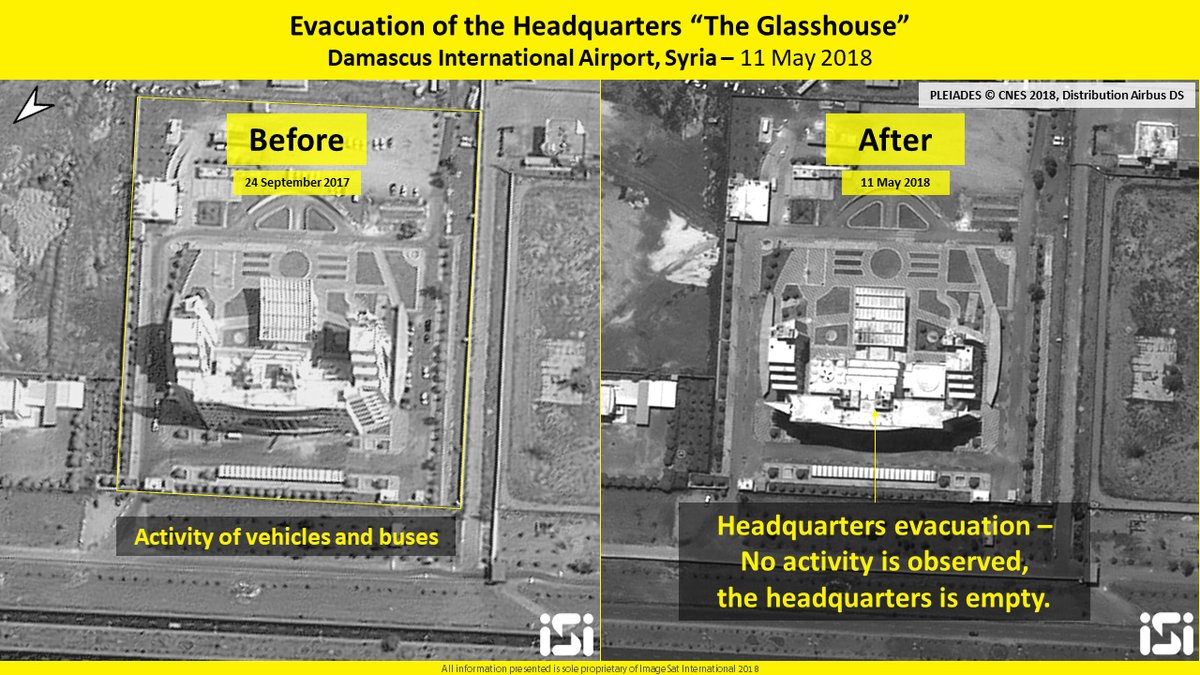
Satellite image allegedly showing damage to buildings at Damascus International Airport caused by a May 11 Israeli airstrike, released by ImageSat International, on May 13, 2018. (ImageSat International)
Fresh satellite photos released Sunday show the damage caused to Syria’s airport in Damascus by the series of Israeli airstrikes last week, when the IAF hit over 50 Iranian targets in the war-torn country.
The Israeli strikes, the largest air force operation in Syria in over 40 years, came in response to an Iranian rocket barrage at the Golan Heights last week and Israel warnings that it would not tolerate Tehran’s attempts to entrench itself militarily on Israel’s northern border.
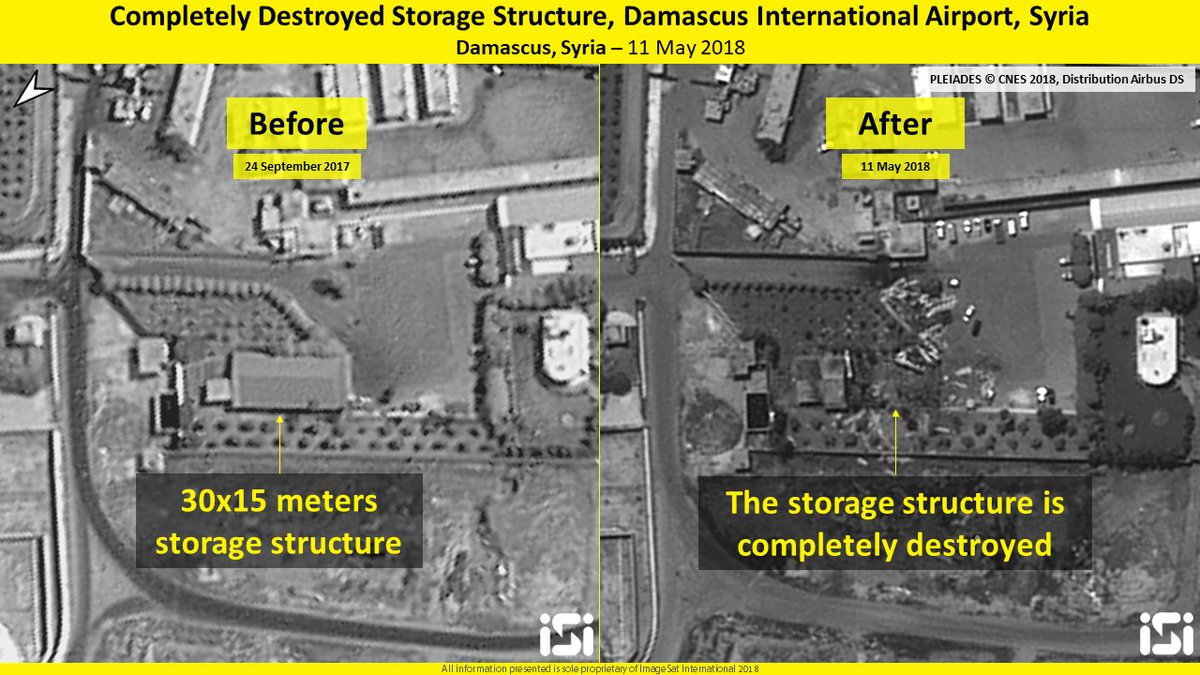
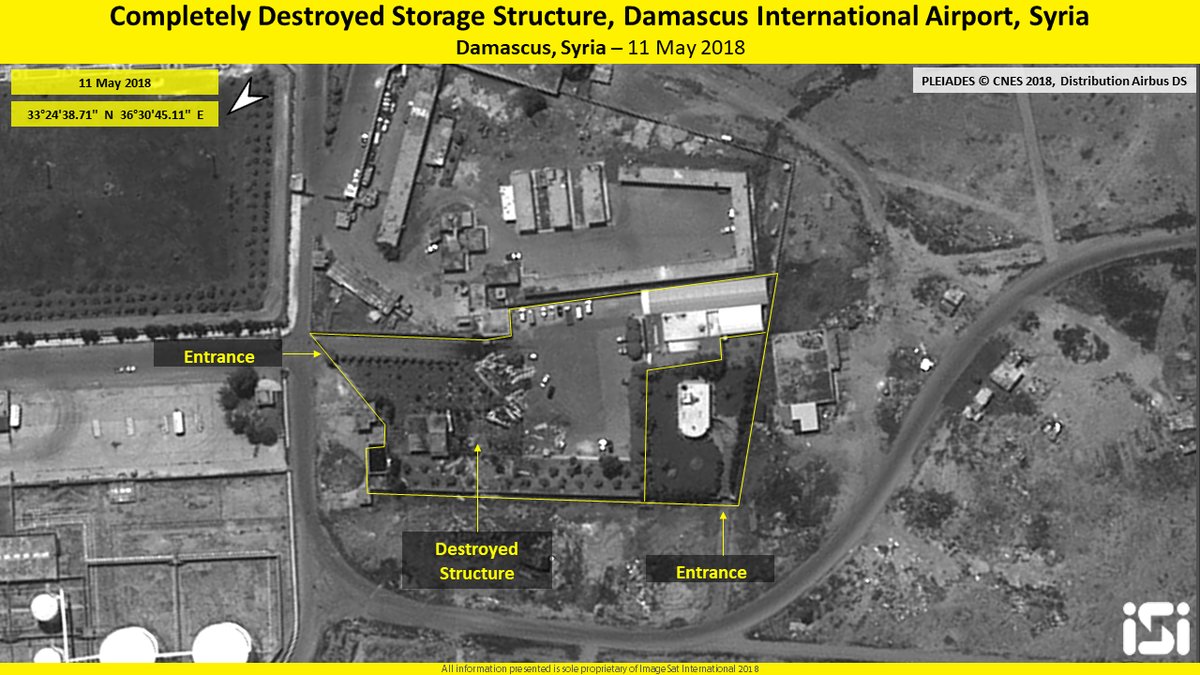
Before and after photos of the May 10 attack show the destruction of storage facilities near the airport, as well as the disappearance of all activity around one building, which reportedly housed the headquarters for Iran’s military operations in Syria.
Among the buildings featured in the images are a warehouse located just 500 meters (1,640 feet) from the main terminal and a building the company identified as the so-called “Glass House” — a five-level command complex from which Iran reportedly coordinated its military campaign in Syria.
Iran, along with Russia, is helping the Syrian regime suppress a bloody insurgency, now in its eighth year.
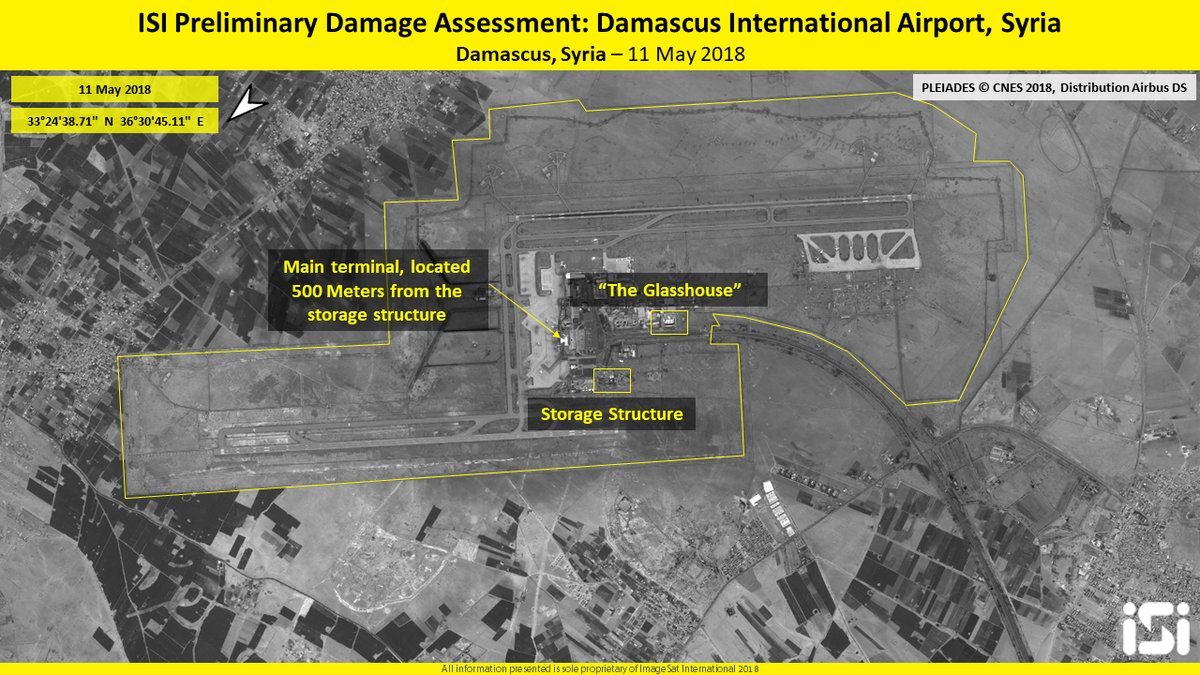
In the September photo the Glass House is surrounded by vehicles indicating it was busy with activity, whereas the image from May 11 shows the area around the damaged building empty. According to ImageSat, that indicates the building was “abandoned.”
Israeli F-15 and F-16 fighter jets bombed over 50 Iranian targets throughout Syria as the Israel air force carried out an extensive campaign, dubbed “Operation House of Cards,” to try to destroy Iran’s military presence in the country, the army said last Thursday.
Among the targets were a weapons depot in the international airport in Damascus, as well as positions, observation posts, and arms placed in the buffer zone on the Israel-Syria border.
The sorties came after Iran fired 20 missiles toward Israel just after midnight on Thursday morning. Four of the missiles were knocked down by the Iron Dome air defense system and the rest failed to reach Israeli territory, according to the IDF.
The overnight exchange was the largest-ever direct clash between the Iranian forces and the IDF, and appeared to be the largest exchange involving Israel in Syria since the 1973 Yom Kippur War.
At least 23 fighters were killed, according to the Britain-based Syrian Observatory for Human Rights, including five Syrian regime troops and 18 other allied forces.
The monitor said the regime troops killed in the strikes included an officer, adding that the other casualties included Syrians and foreigners, without specifying their nationality.
The military said it also targeted a number of Syrian air defense systems — SA-5, SA-2, SA-22, and SA-17 batteries — that had fired at Israeli planes, despite the military’s Arabic-language spokesperson explicitly warning earlier that “any Syrian involvement will be met with the utmost severity.”
Syria’s military denied the Observatory’s report, saying the Israeli airstrikes killed three people and wounded two others, destroyed a radar station and an ammunition warehouse, and damaged a number of air defense units.
In the days and weeks before the Iranian barrage, defense officials had warned that Israel would respond aggressively to any attack from Syrian territory.
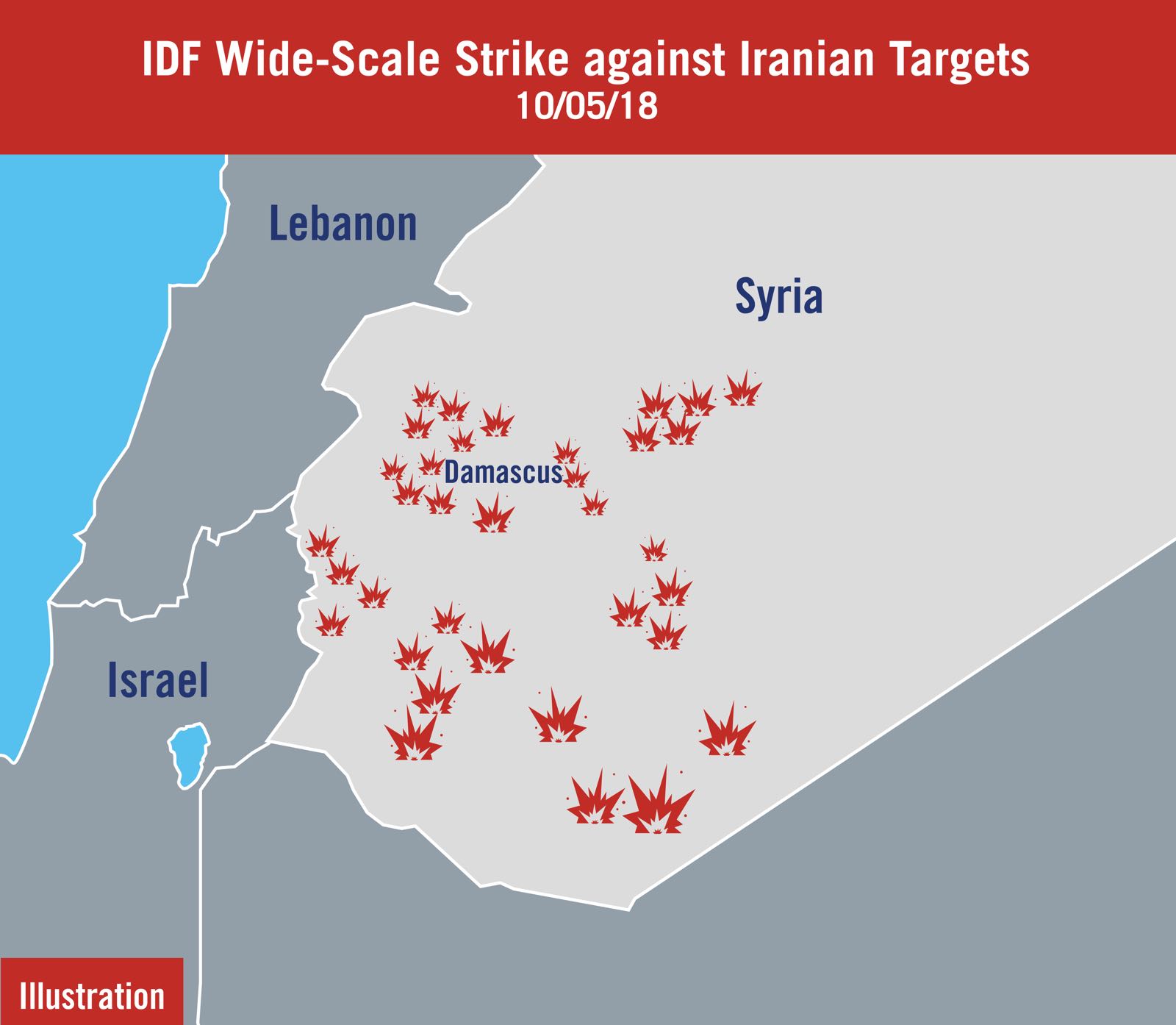
Tehran has repeatedly vowed revenge after the T-4 army base in Syria was struck in an air raid — widely attributed to Israel — on April 9, killing at least seven members of the Iranian Revolutionary Guard Corps, including a senior officer responsible for the group’s drone program.
Israel has committed to preventing Iran from establishing forward bases in Syria, fearing they could be used to launch strikes against the Jewish state, and also to prevent advanced weapons from reaching Iran’s Lebanese proxy, the Hezbollah terror group. A number of deadly air strikes against Syrian targets which reportedly destroyed Iranian military assets, have been attributed to Israel.
Don’t be Hamas’ puppets, IDF tells Gazans
May 14, 2018The IDF has alot of experience in doing this – other instances I am thinking of are when forewarning of attacks (with phone calls and “roof knocking” being the follow up warning methods).
Wonder if anyone collects all these different leaflets? Bit like collecting stamps…
Very few militaries in the world go to this length in trying to prevent casualties amongst the enemy.
Don’t be Hamas’ puppets, IDF tells Gazans
https://www.ynetnews.com/articles/0,7340,L-5259961,00.html
Ahead of the expected riots amid US Embassy opening in Jerusalem and Nakba Day events, Air Force drops leaflets in Gaza warning strip’s residents to keep away from border fence; ‘Hamas is using you to conceal its failures and is endangering you and your family members,’ one of leaflets reads.
Israel Air Force planes dropped leaflets in the Gaza Strip on Monday morning ahead of the expected riots amid US Embassy opening in Jerusalem and the Nakba Day events, warning residents to keep away from the border fence, to refrain from vandalizing it or from carrying out terror attacks and not to serve as Hamas’ tool.
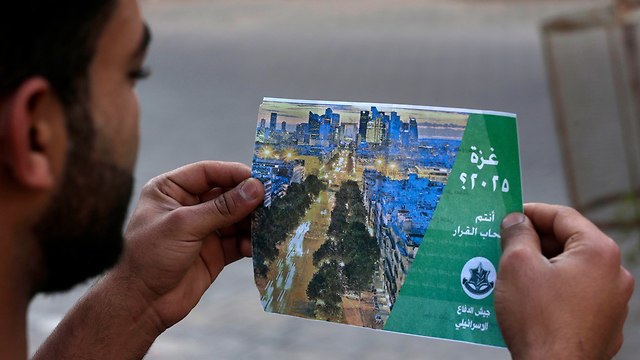
The IDF Spokesperson’s Unit said in a statement that the army was prepared for any scenario: “The IDF won’t allow any damage to the security infrastructure and the fence defending Israel’s citizens and will act against anyone operating against Israel’s security.”
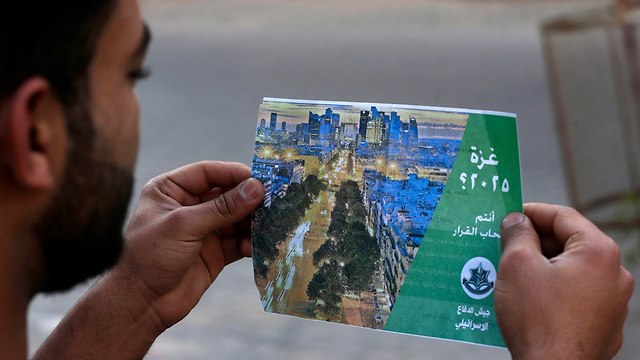
An IDF leaflet warning Gaza residents (Photo: AFP)
One of leaflets read, “To the protestors, you are taking part in violent protests that are putting your life in danger. Hamas is using you to conceal its failures and is endangering you and your family members. The IDF is prepared for any scenario and will act against any attempt to target the security fence or to threaten the forces or Israel’s citizens. Hamas is using you. Don’t be its puppets. Stay away from the fence and beware terror operators and violent rioters! Take care of yourselves and work to build your future!” [fat chance of that – Ed.]
Another leaflet stated, “Hamas said it was going to improve the infrastructure in the Gaza Strip. Has that been done? Hamas said it was going to built new medical and educational centers. Has that been done? Hamas said it would take care of civil affairs. Has that been done? Hamas said that participating in protests would improve your lives. Do you think that will happen?” [this sounds a better approach towards changing the minds of Gazans – Ed.]
The leaflets were signed by the IDF Headquarters.
The army is preparing for the arrival of dozens of Palestinians, including children, at points of friction along the Gaza border Monday. They are expected to try torch heavy equipment, target security infrastructures on the fence and kidnap IDF soldiers during the riots.
According to estimates, thousands of them will try to break through the security fence, which has not been crossed so far despite many attempts since the start of the “March of Return” campaign about a month and a half ago.
Article continues at link here:
The president who stopped playing by the old rules
May 14, 2018Source: The president who stopped playing by the old rules
( I’ve known Nachum Barnea as an intelligent leftist for more than 30 years. That’s why I found this piece so interesting. – JW )
Op-ed: Trump is the exact opposite of Obama: The former president questioned America’s greatness, its righteousness, its pretension to serve as an example to others. Trump questions nothing. His gut feeling about America’s status may be a more efficient foreign policy tool than Obama’s scholarly doubts.
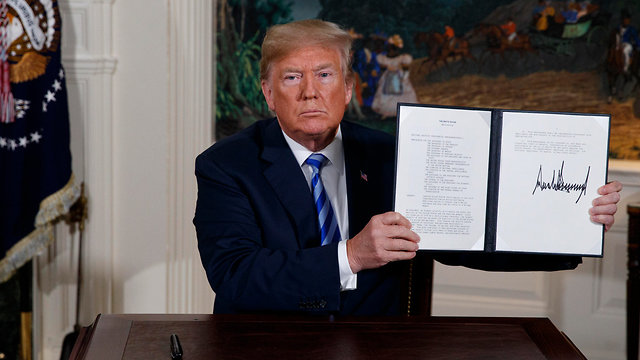
Hit them in the pocket, Netanyahu advised Trump, and the US president fully adopted this policy (Photo: AP)
Meanwhile, the gamble is working. The Iranians have yet to respond to the two recent strikes that targeted their forces and missiles in Syria. They haven’t responded to Tuesday night’s attack near Damascus either. IDF officials assume that the wait for Trump’s decision on the nuclear agreement postponed the Iranian retaliatory attack, and possibly the need for preparations as well.
Now, they have another reason to practice restraint: The battle over the public opinion in Europe and the European governments’ decisions following the American withdrawal from the agreement. Iran can’t afford to misbehave.
The gamble is also working with Trump and his new, super-hawkish team—National Security Adviser John Bolton and Secretary of State Mike Pompeo. Trump could have announced an American withdrawal and ended it there. But under the influence of Netanyahu and the new team, he chose to take it one step further. The economic sanctions on Iran will be stepped up and be much harsher than before the nuclear agreement was signed. Hit them in the pocket, Netanyahu advised Trump. If you hit them in the pocket, they’ll suffocate, and when they suffocate they’ll kick the ayatollahs out. On Tuesday evening, Trump fully adopted this policy.
But what will happen if instead of breaking down, the ayatollahs choose war, or, more likely, if the region finds itself in a state of war as a result of a reckless, uncalculated move of one of the players? Will Trump be willing to open a new front in the Middle East to defend Israel and Saudi Arabia? If he does that, it will be in complete contradiction to everything he promised his voters in the election campaign.

Trump not only rejected Merkel, Macron and May’s claims in favor of the agreement, he also scolded them like a teacher scolding slow-witted students (Photo: EPA, Reuters)
Trump is an interesting man. He is often criticized for his embarrassing performances, his lies and insults, his poor language and his ignorance. From all these aspects, he is the exact opposite of former President Barack Obama. But he is the exact opposite of Obama in another sense: Obama questioned America’s greatness, questioned its righteousness, questioned its pretension to serve as an example to others. In his second term in the White House, he didn’t act as the world’s leader but as its official receiver. Trump questions nothing. His gut feeling about America’s status is possibly a more efficient foreign policy tool than Obama’s scholarly doubts.
Tuesday’s speech allegedly created a wide gulf between the United States and Western Europe. Trump not only rejected the claims made by German Chancellor Angela Merkel, French President Emmanuel Macron and British Prime Minister Theresa May in favor of the agreement, he also scolded them like a teacher scolding slow-witted students.
Will Europe favor Putin’s Russia, Xi Jinping’s China or even Khamenei’s Iran from now on over the alliance with America? I don’t think so. The Europeans are more likely to try to buy Iran with money and maintain their alliance with America.
The concern that an American withdrawal would have a negative effect on the reconciliation efforts with North Korea hasn’t been verified so far either. Kim Jong-un likely believes that what happened to the nuclear agreement with Iran won’t happen to the agreement he will get Trump to sign. Meanwhile, he is hosting the American secretary of state in Pyongyang.
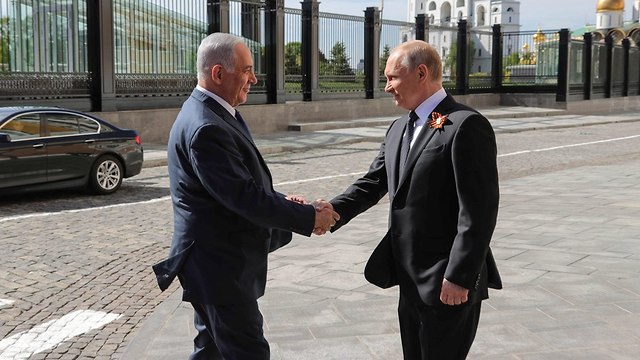
What Netanyahu failed to achieve in his seven previous meetings with Putin likely won’t be achieved in the eighth one (Photo: AFP)
The North Korean model is fascinating: It begins with mutual threats, personal curses and battle cries. And then, suddenly, it turns into a mad love affair. I wonder what will happen if an invitation to a summit with Iranian President Hassan Rouhani suddenly arrives at the White House. One invitation, and Iran’s sins will be forgotten.
Netanyahu arrived in Moscow on Wednesday morning, riding on the waves of the Trump speech. Putin appreciates power. Netanyahu tried to convince him that Russia’s interest in Syria doesn’t match Iran’s interest. If Putin wants a quiet summer, a summer that will be dedicated to the World Cup celebrations, he should curb the Iranians’ growing strength. He should stop the transfer of precision-guided missiles, prevent the stationing of antiaircraft systems, and stop Suleimani’s forces far from the Golan border. The Israeli advice conceals a threat: If Iran keeps doing what it wants, Israel will launch military activities behind Russia’s back.
Putin welcomed him with all formalities, and then likely made it clear to Netanyahu that Russia does only what benefits Russia. There are no celebrity discounts in the Kremlin: What Netanyahu failed to achieve in his seven previous meetings won’t be achieved in the eighth one.
Between Tehran and Gaza: From the dangerous threat to the explosive threat
May 14, 2018Source: Between Tehran and Gaza: From the dangerous threat to the explosive threat
Analysis: Iran’s ayatollahs and media fell for Qassem Suleimani’s ‘fake news’ about the deaths and serious damage his forces inflicted on Israel, but the Quds Force commander knows the truth—and that’s what counts. Meanwhile, the IDF is working to prevent new conflict in the strip by wearing out the ‘human tsunami’ before it reaches the fence area.
Last week was “Iranian,” but the coming week and the following week will likely be “Palestinian.”The US Embassy will open in an official ceremony in Jerusalem on Monday. The following day, the Palestinians will mark Nakba Day. The Ramadan fast will begin Wednesday night, and the “March of Return” will take place in the Gaza Strip on Friday.
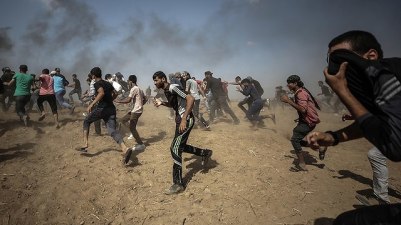
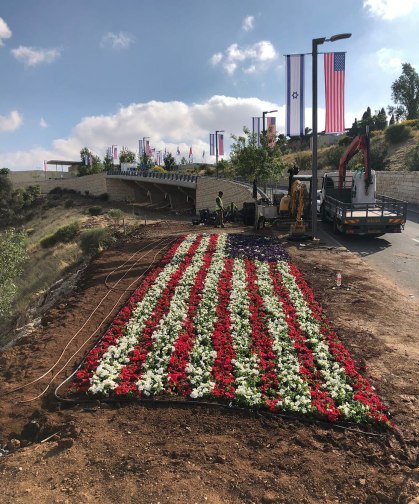

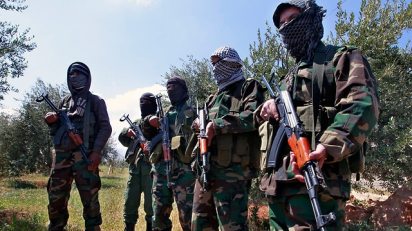
The IDF and police are preparing for major physical clashes with crowds of young Palestinians. The residents of the Gaza vicinity, Jerusalem and Judea and Samaria should prepare for the coming week as well, to reduce friction with the Palestinians and keep the potential death toll low.
Israel’s main goal, and the IDF’s core mission, is to prevent hundreds and perhaps thousands of Palestinians from infiltrating Israeli territory from Gaza and reaching communities in the western Negev.
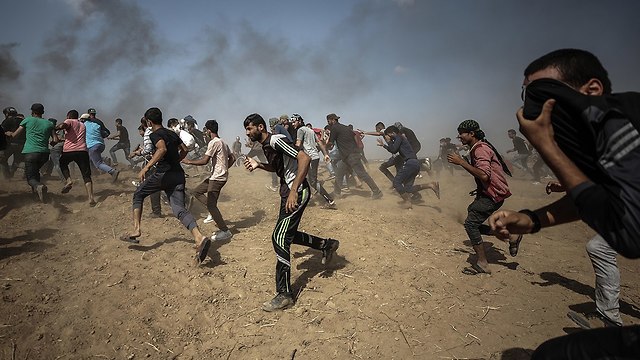
Palestinians protest on the Gaza border fence, Friday (Photo: EPA)
In the West Bank, the core mission is to prevent terror attacks with firearms and cold weapons, as well as community infiltrations. So far, there is no apparent trend of an escalation in the West Bank, an arena which has remained calm in recent weeks even when the situation in Gaza escalated and young Gazans lost their lives on the fence. There are no indications or warnings of a flare-up in Jerusalem as well, for now.
In Jerusalem, the security forces’ mission is to prevent a “religionization” of the conflict with the Palestinians. Clashes with an angry crowd and terror attacks over the Muslim holy sites and around them will extend and intensify the conflicts, stir up things in the Muslim world (including Egypt and Jordan) and could even lead to border attacks from Lebanon, Syria and Sinai.
History shows it’s almost impossible to put out a fire started by religion. Religious violence erupts time and again and claims many victims. A religiously-motivated conflict could also lead to terror attacks against Israelis and Jews around the world.
The religious motive has been working for years in the service of the Iranian Quds Force, and the force’s leader, Qassem Suleimani, may take advantage of the flare-up in the Muslim world following riots in Jerusalem to further a terror attack abroad and retaliate the victims among his people and the humiliations he has suffered from Israel in recent weeks in the Syrian Golan Heights.
Defense establishment officials are aware of all of this and are taking several measures to guarantee that the missions are accomplished in the three Palestinians arenas with zero victims on the Israeli side and by avoiding killing unarmed Palestinians, as long as they don’t pose a clear and present danger to our forces or to Israeli citizens.
The reason isn’t just ethical but also practical: Experience shows that a death toll of dozens and perhaps hundreds of Palestinians from IDF and police fire will only intensify the violence and the motivation to carry out terror attacks and may lead to a new wave of terror and possibly even to an intifada that will spill into Israeli territory.
Another important reason is that a lot of deaths among the Palestinians will push Israel into a difficult PR, diplomatic and legal corner—and this is exactly what Hamas leader Ismail Haniyeh and Palestinian President Mahmoud Abbas are trying to do. As a result, Israel will become isolated and may face boycott initiatives and attempts to prosecute IDF officers in the International Criminal Court (ICC) in The Hague. This will gradually reduce Israel’s legitimacy to defend itself and it may even be slapped with sanctions in the international arena.
Boosting forces and using technological means
The most important measure used by the security and law enforcement authorities is a massive boost of the forces along the Gaza border fence and between the fence and the Gaza vicinity communities, as well as in Judea and Samaria: Dozens of squadrons of qualified fighters from the IDF’s regular field units will be stationed in possible friction areas, in addition to units on routine security missions. Other units will be stationed on the ground or put on a heightened state of alert as reserve forces. The large number of regular fighters in every point of friction will serve as a “blanket” that will be throw on the fire to suffocate it—a measure which has proved itself in the past.
Furthermore, the army will use technological means to disperse the crowd and control it, including portable fences that can easily be erected, psychological warfare, etc. All the forces that have already been dispatched to the Gaza border or to the West Bank and the ones that will arrive there later, including elite units, have undergone specific training in the Central Command and Southern Command bases, where they learned to confront and take over an unruly crowd.

Preparations for US embassy move to Jerusalem (Photo courtesy of Jerusalem Municipality)
As part of the effort to prevent Palestinian casualties and unnecessary shooting, senior officers have been stationed in every point of friction and next to the snipers. They are the only ones authorized to give the soldiers permission to shoot if they are not in clear and present danger.
For the same reason, reserve units haven’t been called up to take part in the direct conflict with the unruly crowds. The reserve soldiers are excellent fighters when it comes to conventional fighting against an armed enemy, but most of them are unaccustomed to and have no experience with a close-range conflict with a wild crowd throwing Molotov cocktails and stones. As a result, many of them stress out and push the trigger unnecessarily.
The main concern is that thousands and perhaps tens of thousands of Palestinians will run towards the border fence as part of the “March of Return” on Nakba Day and on the following days. Hamas is going to great lengths to get more and more people to take part in the march, knowing that a large number of people storming the fence is likely to lead to a high death toll and harm Israel both internally and internationally.
The security forces are planning to wear out the “human tsunami” wave with different measures before it reaches the fence area, in a bid to reduce and control the number of Palestinians storming the fence. These measures can’t and shouldn’t be specified, to prevent Hamas from preparing an effective response.
In Judea and Samaria, the IDF has been focusing on prevention measures every single night: Conducting arrests by using intelligence and warnings gleaned from social media and public information on the Web. When the conflicts begin on the ground, and possibly earlier, the combat intelligence collection system will be activated too. The collection of intelligence through ground and aerial observations will make it possible to quickly locate points and friction and weak spots created during the events and send reinforcement to those areas.
Meanwhile, the army is working to continue the separation and distinction between actual and potential terrorists and the uninvolved population which doesn’t wish to get involved. Efforts are being made to prevent the terrorists—Hamas people or Palestinians inspired by social media and “shahidim” who serve as their role models—from executing their plans.
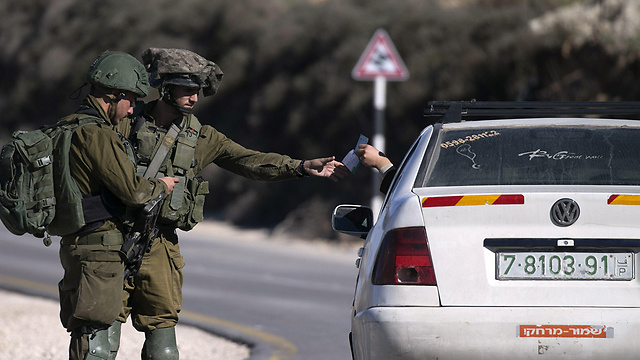
IDF checkpoint in the West Ban (Photo: AFP)
At the same time, the plan is to allow the uninvolved population to continue its routine life and move freely on the traffic routes. This is where Judea and Samaria settlers must plan an active role: They must help the Shin Bet and IDF restrain the “price tag” rioters and, if necessary, block them themselves. In this case too, the reason isn’t just ethical but mainly practical: Jewish rioters endanger Judea and Samaria settlers in their activities, which increase both the Palestinian incitement and the criticism against Israel in the international arena.
The Palestinian security apparatuses have been instructed by Abbas to coordinate their activities and work together with the Israeli forces. The fact that the order is being implemented proves that Abbas still holds full control over his people despite the cognitive weakness he has been demonstrating latterly in his anti-Semitic speeches.
Even when he isn’t at his best, Abbas knows that the cooperation between the Palestinian security apparatuses and their Israeli counterparts is vital for both sides. The Shin Bet and IDF want to prevent terror attacks initiated and encouraged by Hamas against Israel, while Abbas has an existential interest in stopping Hamas from taking over the West Bank. Both sides are also interested in preventing the protests and riots from spinning out of control, a situation which could threaten the Palestinian Authority’s survival.
IDF Chief of Staff Gadi Eisenkot, Police Commissioner Roni Alsheikh, Shin Bet Director Nadav Argaman and their organizations’ top officials have already prepared the infrastructure, built up strength, trained the forces and decided on the modus operandi. The implementation, however, requires great skills as well as caution and experience from the commanders on the ground, who are operating under Gaza Division Commander Brigadier-General Yehuda Fuchs and Judea and Samaria Division Commander Brigadier-General Eran Niv. These two officers, alongside the Southern Command and Central Command chief, will largely determine how the State of Israel passes this test—both the physical test and the perceptual and diplomatic test.
Summary of the Iranian round
A moment before the Israeli public opinion shifts its focus and concerns from the more dangerous threat (Iran) to the more explosive threat (the Palestinians), we should take a moment to understand how the “Iranian round” ended last week and what might happen in the future.
The good news is that the ayatollah regime and its power base, the Revolutionary Guards, were dealt two painful blows last week. The first was a strategic blow from US President Donald Trump, who announced an American withdrawal from the nuclear agreement between Iran and the world powers. Immediately after the Washington declaration, the Iranian rial tumbled, reaching a record low. In other words, the income and savings of millions of Iranians were slashed within hours, threatening the regime’s survival in the long run.

Qassem Suleimani, commander of the Quds Force
The second, tactical blow, came from the IDF against the Revolutionary Guards and the Quds Force in Syria. The limited retaliation and deterrence operation that was planned by Qassem Suleimani against military targets in Israel was disrupted and eventually thwarted altogether thanks to the right combination between high-quality and accurate intelligence in real time, military and diplomatic discretion and activity, as well as the Air Force’s excellent planning and performance abilities.
While Suleimani managed to sell his bosses in Tehran a classic “fake news” story about deaths and serious damage his forces allegedly inflicted on Israel, and although Ayatollah Ali Khamanei and the Iranian media likely fell for it, Suleimani knows the truth—and that’s what counts.
The good news is that Russian President Vladimir Putin has restored his original approach towards the relations with Israel which he had adopted at the start of the Russian involvement in Syria in 2015. Putin, who is very unhappy with the fact that NATO has placed sophisticated antiaircraft and antimissile systems on his country’s borders, has referred to it several times as an aggressive Western move.
Putin was likely quite satisfied, therefore, when Prime Minister Benjamin Netanyahu and Minister Ze’ev Elkin told him that the Israel Air Force had destroyed Iranian-made antimissile systems, which are remarkably similar to the Russian S-300 system, after they were placed on Israel’s border. Putin doesn’t appreciate competition and has high regard for force. This was reflected not only in the way he honored the Israeli prime minister during the Moscow parade, but also in his decision to suspend the supply of the S-300 system to Syria.
Another positive development, as far as Israel is concerned, is the fact that Hezbollah has no intention of intervening in the conflict for now and using its missile arsenal and special forces to help the Iranian military entrenchment in Syria. In other words, the Israeli deterrence is working, particularly since Israel made it clear that “Hezbollah equals Lebanon.” This means that in the next war, Israel will make no distinction between Hezbollah and the state of Lebanon its infrastructure. If Hezbollah’s missiles and rockets hit Israel, the damage inflicted on all of Lebanon will be disproportional.
This was explained very well recently by Education Minister Naftali Bennett, a member of the Political-Security Cabinet: “There is no point in running after every Hezbollah rocket and after every Hezbollah missile launcher. It would also be a mistake to fight Hezbollah alone. We must fight the entire state of Lebanon, in Baalbek and in the villages of southern Lebanon, which is allowing Hezbollah to fire thousands of missiles on the citizens of the State of Israel.”
Bennett has rich experience in fighting in Lebanon, and his perception is likely accepted by the rest of the cabinet members, especially after Hezbollah reifnroced its effective control over the parliament and the government in Beirut following last week’s elections in Lebanon.
Syrian President Bashar Assad is likely unsatisfied either with the conflict waged by the Iranians against Israel from his country’s territory. The bottom line is that Suleimani and his people are alone in this story.

Hezbollah fighters (Photo: AP)
We shouldn’t get caught in the euphoria, however, as there is bad news as well. It’s already clear that the serious blows suffered by the Iranians last week weren’t enough to change the regime and Revolutionary Guards’ vision and objectives in any way. They haven’t given up their nuclear aspirations, their ambition to reach an Iranian-Shiite hegemony in the Middle East and the desire to destroy the State of Israel by military entrenching themselves in Syria.
The Iranians have simply taken a timeout to recalculate their route. As a result, Israeli officials were able to order the closure of bomb shelters in the Golan Heights over the weekend and estimate that the current round with the Iranians has been put on hold.
Suleimani likely hasn’t given up his plan to create a military front against Israel in Syria which would operate in addition to the Lebanese front, and separately too if necessary. He has also noticed Hezbollah leader Hassan Nasrallah’s growing independence in Lebanon. All signs indicate that Suleimani hasn’t given up his desire to take revenge against Israel and that he will likely try to target Israelis and Jews abroad.
In any event, we should remember that the Shiites in general, and the Iranians in particular, are filled with a sense of self-victimization. This mentality contains an important advantage: Because they are prepared for the blows in advance, they recover quickly and move on. It’s difficult to deter them or divert them from their path. So our conflict with the ayatollahs and with the Revolutionary Guards hasn’t ended in the current round and won’t end in the following round either. The same applies to the conflict with the Palestinians.
IDF: Hamas planning Monday ‘massacre’ of Israelis, over 100,000 rioters expected
May 14, 2018The IDF issued a stark warning about the culmination of the Hamas terror group’s “March of Return,” which is arriving a day earlier than planned.
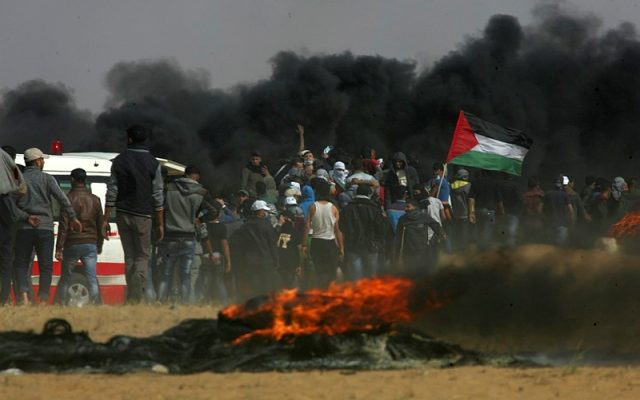
Palestinian rioters on the Gaza border. (Abed Rahim Khatib/Flash90)
By: World Israel News Staff
In anticipation of violence and mayhem planned by the Hamas terror group to coincide with the opening of the US embassy in Jerusalem, the IDF projected that the number of Palestinian rioters on Monday could reach 100,000, with hundreds potentially attempting to breach the border fence and attack nearby towns within Israel.
The IDF’s warnings included reference to the potential for an attempted “massacre” of Israeli civilians, as the Palestinian street prepares for the unbridled rioting that generally accompanies “Nakba Day” on May 15, which is the Palestinians’ version of Israel’s Independence Day, invoking the Arabic word for catastrophe.
Military intelligence indicates, however, that Hamas won’t wait the extra day and will instead push up the violence to May 14 to coincide with Monday’s US Embassy move in an attempt to attract more international attention.
The Israeli military and police are prepared for a number of scenarios, including chaotic attacks staged by groups of rioters breaking through the security barrier, mass arson and property damage, and direct armed attacks on troops by Hamas commandos. The IDF is also on guard against attempts to kidnap soldiers.
In the video below, the IDF Spokesperson’s Unit warns that Hamas seeks to “torch farmland,” as it has already done with arson kites in recent days, and murder “innocent men, women, and children.”
“The IDF’s preparation includes the additional deployment of a number of combat battalions to the Gaza border, special forces, intelligence collection units, and snipers. In addition, the Central Command will also receive additional combat battalions and intelligence collection teams as reinforcement,” announced the army on Sunday. To that end, additional troops were deployed to Israeli communities close to the Gaza border.
It has been suggested that Hamas seeks sufficient violence to distract Gazans from the terror group’s utter failure to effectively govern the coastal enclave, while avoiding full-blown war with Israel, which would be disastrous for Hamas.
In recent weeks, for instance, Hamas has directed rioters to not only destroy Israeli property, but has also ordered the destruction of humanitarian infrastructure, such as the Kerem Shalom crossing (through which medical supplies enter Gaza) and major gas pipelines running into the Strip.
Hamas’ health ministry claims that about 50 Palestinians have been killed during the riots, with Israel identifying a significant number of the casualties as Hamas operatives.
This is NOT the video that anyone wants to see this week. pic.twitter.com/gBUIQivyRo
— IDF (@IDFSpokesperson) May 13, 2018




 anneinpt
 artaxes
 danmillerinpanama
 davidking1530
 Peter Hofman
 Joseph Wouk
 Peter
Peter Louisiana Steve
 WarSclerotic
Recent Comments