Iran is planning to retaliate for recent deadly airstrikes in Syria attributed to the Jewish state by having its proxies fire missiles at military targets in northern Israel sometime in the near future, defense officials warned on Sunday.
Tehran vowed revenge after the T-4 army base in Syria was struck in an air raid on April 9, killing at least seven members of the Iranian Revolutionary Guard Corps. The strike was widely attributed to Israel, though Jerusalem refused to comment on it. (T-4 was the base from which Israel said Iran launched an attack drone into Israel in February.) Late last month, a second strike, allegedly conducted by Israel, against an Iranian-controlled base in northern Syria was said to have killed more than two dozen Iranian soldiers.
On Sunday, all of Israel’s nightly news broadcasts reported that the Israeli military and intelligence services had identified preliminary efforts by Iran in Syria to carry out its reprisal, using its IRGC (Islamic Revolutionary Guard Corps), the Hezbollah terrorist group and local Shiite militias to launch a barrage of precision-guided missiles, likely at Israeli military targets in the north.
“Israel has recently identified with certainty Iranian preparations to fire at the north,” Channel 10 said. “We are not on the eve of war with Iran… but Iran is very determined to carry out an attack” to avenge the T-4 strike and the deaths of its military personnel, it said.
Israel Radio said the Iranian planning for an attack was at “an advanced stage.”
The understanding in the defense services is that Iran is looking to conduct its retaliation in such a way as to avoid full-fledged war with Israel, and will therefore likely not target civilian locations, according to the reports, which did not attribute the information to any specific source.

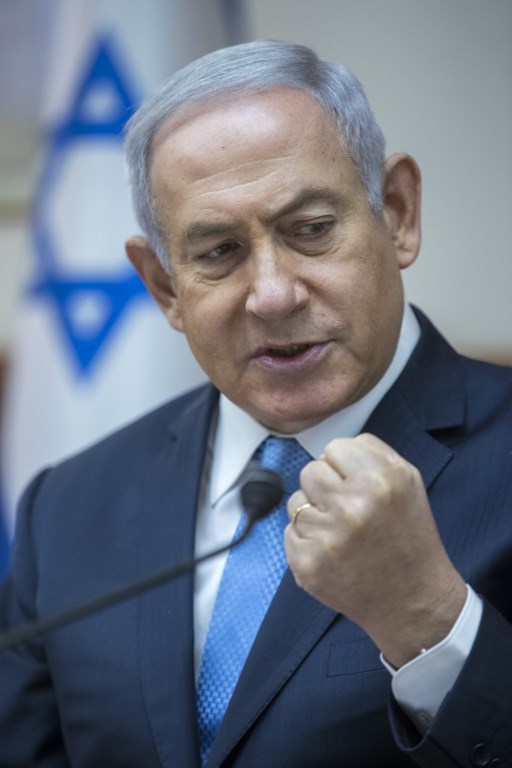
Israeli Prime Minister Benjamin Netanyahu chairs the weekly cabinet meeting in Jerusalem on May 6, 2018. (AFP PHOTO / POOL / JIM HOLLANDER)
No special instructions were given to residents of northern Israel. Indeed, the heads of local councils in the north have reportedly been told to tell citizens not to take any specific precautions and to go about their daily lives as usual.
Israel was working to prevent or counter such an attack, but was also preparing for the possibility that the Iranians “succeed in hitting a base in the north with missiles,” Channel 10 reported. The Israel Defense Forces was threatening to hit all Iranian targets in Syria if Tehran launched an attack on Israeli territory, the TV report said.
Seeking Russian pressure on Iran, Prime Minister Benjamin Netanyahu is set to present the information in Tehran’s preparations to strike Israel to Russian President Vladimir Putin during their meeting Wednesday in Moscow, the reports said.
Earlier on Sunday, Netanyahu said that while Israel is not interested in a military escalation with Iran, if there has to be a fight, he would prefer it be now, rather than later.
“We are determined to block the Iranian entrenchment, even at the cost of confrontation,” Netanyahu said at the start of the weekly cabinet meeting. “We don’t want an escalation, but we are prepared for every scenario. We don’t want confrontation, but if there needs to be one, it is better now than later.”
The prime minister also suggested Iran could directly launch a strike on Israeli territory.
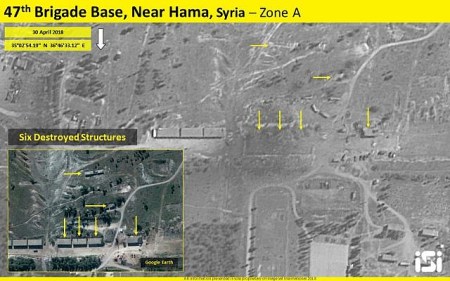
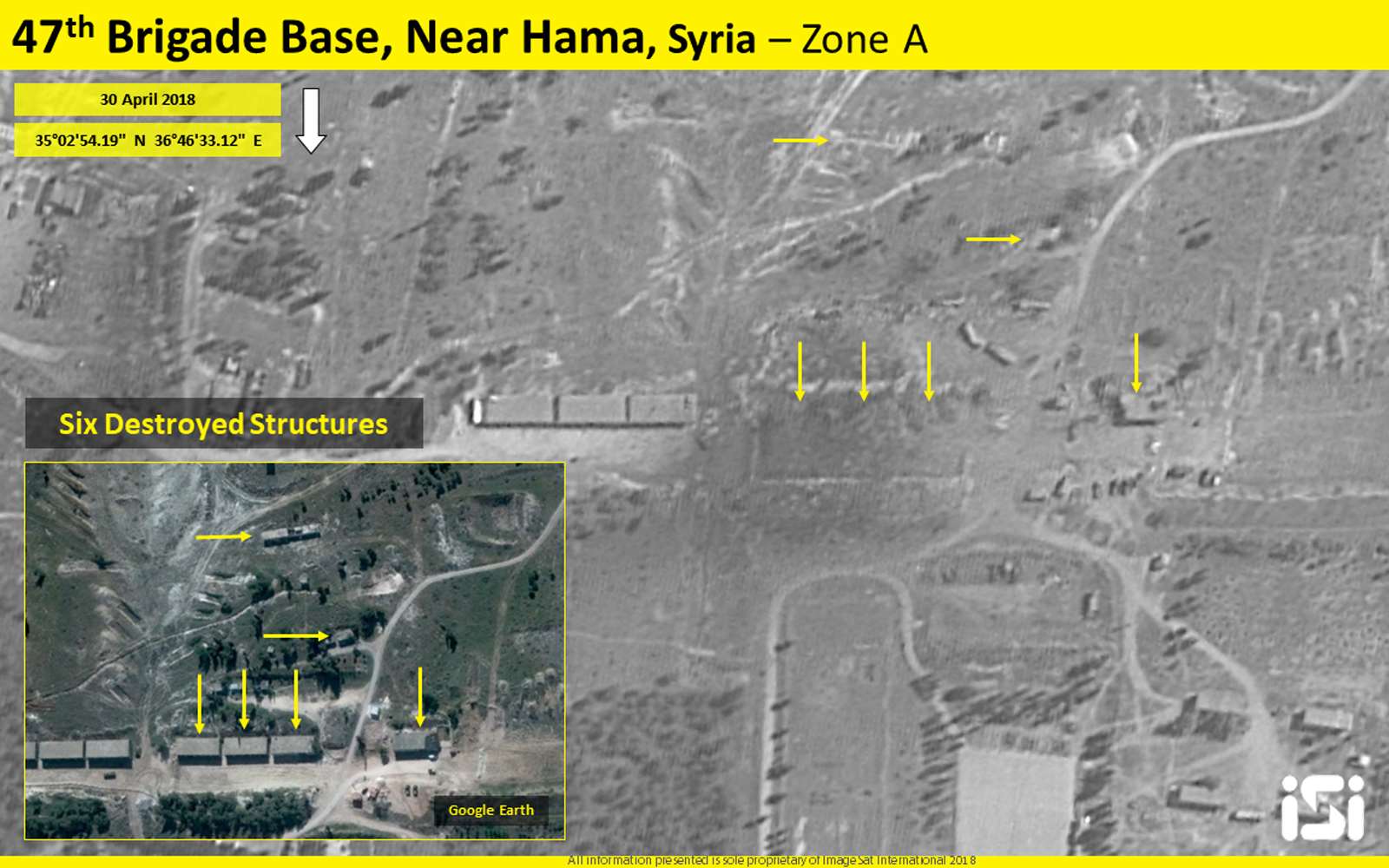
A satellite image showing the results of an alleged Israeli airstrike on a reported Iranian base outside the northern Syrian city of Hama the day before, on April 30, 2018. (ImageSat International ISI)
“In recent months, the Iranian Revolutionary Guards transferred to Syria advanced weaponry in order to attack us both on the battlefield and the home front, including weaponized UAVs, ground-to-ground missiles and Iranian anti-aircraft batteries that would threaten air force jets,” he said.
Sunday night’s warning about Iran’s plans to attack, as disseminated on the TV news broadcasts, appeared to constitute an attempt by Israel to show the Iranians that it was aware of their plans and was prepared to respond if they went through with the reprisal.
A Hadashot TV report said the warning was aimed both to deter Iran and to make it plain to the Iranians that Israel knows what they are planning, and that it will not be fooled if the missiles themselves are fired by Syrian militiamen.
A mainstay of Iran’s defense strategy is the use of proxies to conduct its bidding across the Middle East — the Houthis in Yemen, Hezbollah in Lebanon, Shiite militias in Syria and Iraq, as well as the Palestinian Islamic Jihad and Hamas in the Gaza Strip and West Bank. This is seen as an effort to limit Iranian casualties and keep any fighting limited to outside the Islamic Republic.
Last month, Defense Minister Avigdor Liberman said Israel was prepared to strike the Iranian homeland. “If they attack Tel Aviv, we will strike Tehran,” he said.
The unnamed defense officials on Sunday did not specify when the Iranian attack was expected to take place. The Channel 10 report said Iran’s preparations had been going on for weeks, but had been disrupted in recent days because of several strikes on targets in Syria, including on missile stocks in the Hama area, attributed to Israel. “But the Iranians have not given up,” the report said.
It added that missiles had been brought from Lebanon to Syria for use in the intended attack against Israel. “The idea is to use heavy Iranian missiles, including the Fateh-110” — under the command and with the advisory work of Hezbollah but “without an IRGC presence,” Channel 10 said.
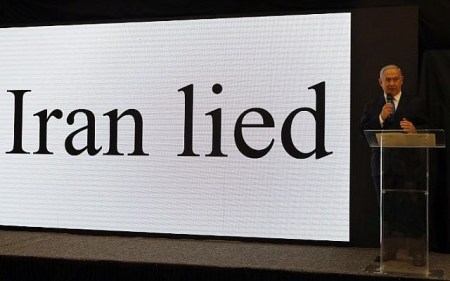
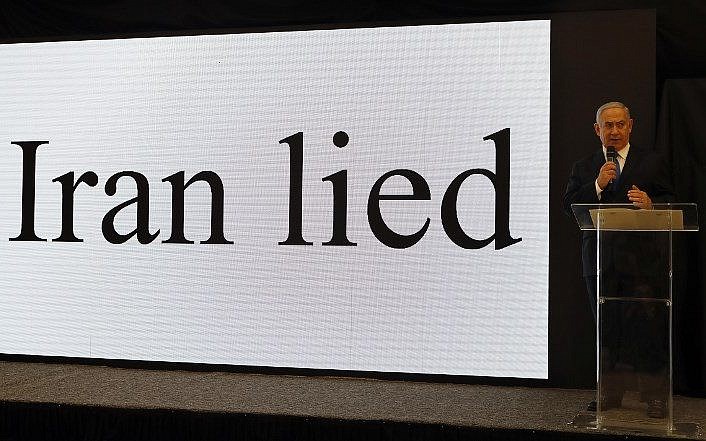
Prime Minister Benjamin Netanyahu gives a speech on files obtained by Israel he says proves Iran lied about its nuclear program, at the Defense Ministry in Tel Aviv, on April 30, 2018. (AFP Photo/Jack Guez)
Iran has been taking a number of heavy blows of late, including Israel’s seizure of its nuclear weapons archives from under its nose in Tehran, Channel 10 noted, and is determined to strike back but not for confrontation to escalate into war.
Last month, a member of the coalition supporting Iran’s ally, Syrian dictator Bashar Assad, told The New York Times that the reprisal would likely not come before the Lebanese parliamentary elections, which began on Sunday.
Further stoking tensions, this week US President Donald Trump is expected to determine the fate of the Iran nuclear accord, which he has repeatedly threatened to leave. On Sunday, French President Emmanuel Macron warned that if America abandoned the Iran deal, it could lead to a war.
Earlier on Sunday evening, Israel’s security cabinet held a three-and-a-half-hour session to discuss recent developments in the region, including the tensions with Iran in Syria and the upcoming decision by Trump regarding the nuclear deal. Channel 10 said this meeting was not a routine meeting, but it was prevented by Israel’s military censorship from explaining why.
Sunday’s warning was not the first intimation by Israeli defense officials of a potentially imminent retaliatory attack by Iran. Shortly before Israel’s Independence Day, the military prepared for the possibility of a direct attack from the IRGC’s air force.
The Times of Israel learned at the time that Israel’s defense establishment believed the Iranian revenge attack would likely be carried out with surface-to-surface missiles or armed drones. Others have speculated that an Iranian retaliation could come in the form of a cyber attack.
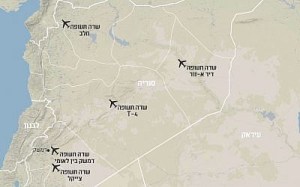
A map of Syria, provided to Israeli media, shows the approximate locations of five bases that Israel believes to be controlled by Iran.
In an apparent effort at deterrence, the IDF last month provided Israeli media with a map showing five Iranian-controlled bases in Syria that would likely constitute potential targets for an Israeli response, should Iran carry out any kind of attack. Satellite photographs of bases were also provided.
Those were Damascus International Airport, through which Iranian transport planes bring in weapons and military gear; the Sayqal air base; the T-4 air base; an airfield near Aleppo; and a base in Deir Ezzor, which was recaptured from the Islamic State terror group by the regime last year.
Israeli intelligence believes the sites are used by Iran for its missions in Syria, as well as to transport weapons to its proxies in the region, including Hezbollah.
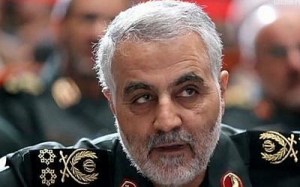
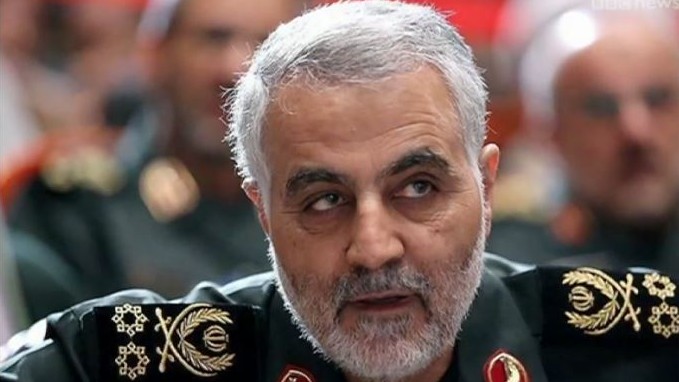
Iranian Revolutionary Guards al-Quds Force commander Maj. Gen. Qassem Soleimani (YouTube screenshot)
Israel believes Iran’s retaliatory effort is being led by Major General Qassem Soleimani, the head of the IRGC’s Quds Force, which operates around the world, with assistance from the head of the IRGC air corps, Brig. Gen. Amir Ali Hajizadeh; the head of its surface-to-surface missile program; Col. Mahmoud Bakri Katrem Abadi; and the head of its air defense operations, Ali Akhbar Tzeidoun.
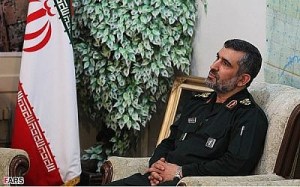
The head of the Iranian Revolutionary Guard Corps’ Air Force Brig. Gen. Amir Ali Hajizadeh. (Fars news)
Soleimani has repeatedly warned Israel, and threatened to “wipe out the Zionist entity” in February over the assassination of a Hezbollah leader, which has been attributed to the Mossad and America’s CIA.
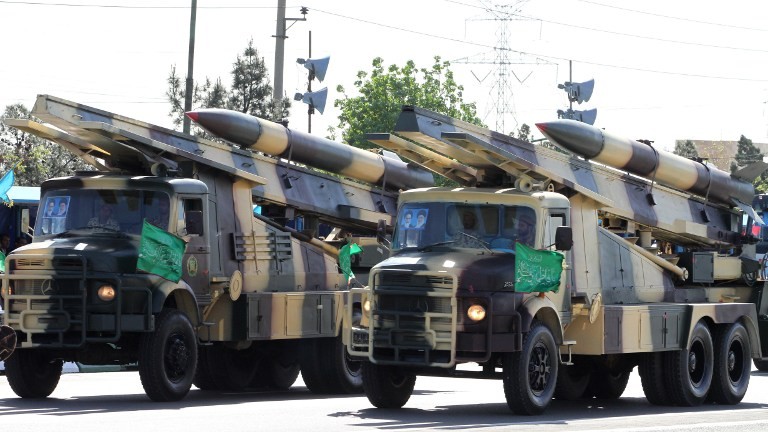
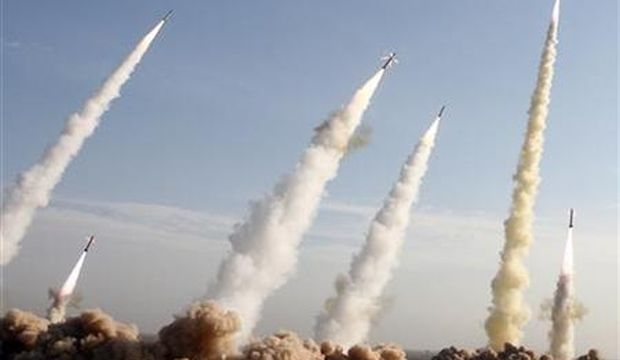
Iran has access to a variety of surface-to-surface missiles, from short-range Fajr-5 rockets to medium-range Fateh 110 missiles, which have a range of approximately 300 kilometers (190 miles), to long-range Shehab ballistic missiles capable of hitting targets over 1,300 kilometers (800 miles) away.
To counter those threats, Israel has a multi-tiered missile defense system consisting of the Iron Dome for short-range rockets and mortar shells, the David’s Sling for medium-range missiles, and the Arrow for long-range ballistic missiles.
Israel sees Iran, which has vowed to destroy the Jewish state, as its main enemy in the region. Israeli officials have repeatedly stated that Israel will not allow Iran to entrench itself in Syria, marking it as a “red line” that it will fight militarily if necessary.





 anneinpt
 artaxes
 danmillerinpanama
 davidking1530
 Peter Hofman
 Joseph Wouk
 Peter
Peter Louisiana Steve
 WarSclerotic
Recent Comments