Archive for May 1, 2018

US officials say Israel behind latest Syria strike, preparing for war with Iran

May 1, 2018

NBC news reports Israeli Air Force used F-15 fighter jets to target recent Iranian weapons shipment delivered to Syria’s Hama air base

Today, 7:30 pm
https://www.timesofisrael.com/us-officials-say-israel-behind-latest-syria-strike-preparing-for-war-with-iran/?utm_source=us-officials-say-israel-behind-latest-syria-strike-preparing-for-war-with-iran&utm_medium=desktop-browser&utm_campaign=desktop-notifications

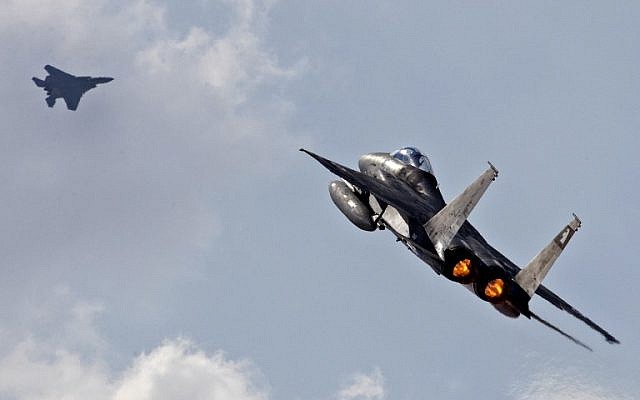
An Israeli Air Force F-15 takes off during the Blue Flag air exercise at the Ovda air force base, north of the Israeli city of Eilat, on November 8, 2017. (Jack Guez/AFP)

Three American officials on Tuesday told NBC news that Israel, using F-15 fighter jets, conducted the airstrike on an allegedly Iranian-controlled military base in northern Syria this week, in the latest bout of the increasingly public fight between Tehran and Jerusalem.

The unnamed US officials said Israel appears to be preparing for active conflict and is seeking American assistance, noting the recent visits to the US by Defense Minister Avigdor Liberman and trips to Israel by senior American officials.

According to NBC, the target of the Sunday night strike was an incoming weapons shipment, including surface-to-air missiles, which were freshly delivered from Iran.

Casualty counts from the attack have varied, but most put the death toll at between 16 and 38, including many Iranians. Iran denied that any of its soldiers were killed in the attacks and that any of its bases in Syria were targeted.

According to NBC, one unnamed senior US official said the Iran-Israel conflict is the most likely in the world to devolve into open clashes.

“On the list of the potentials for most likely live hostility around the world, the battle between Israel and Iran in Syria is at the top of the list right now,” the official said.
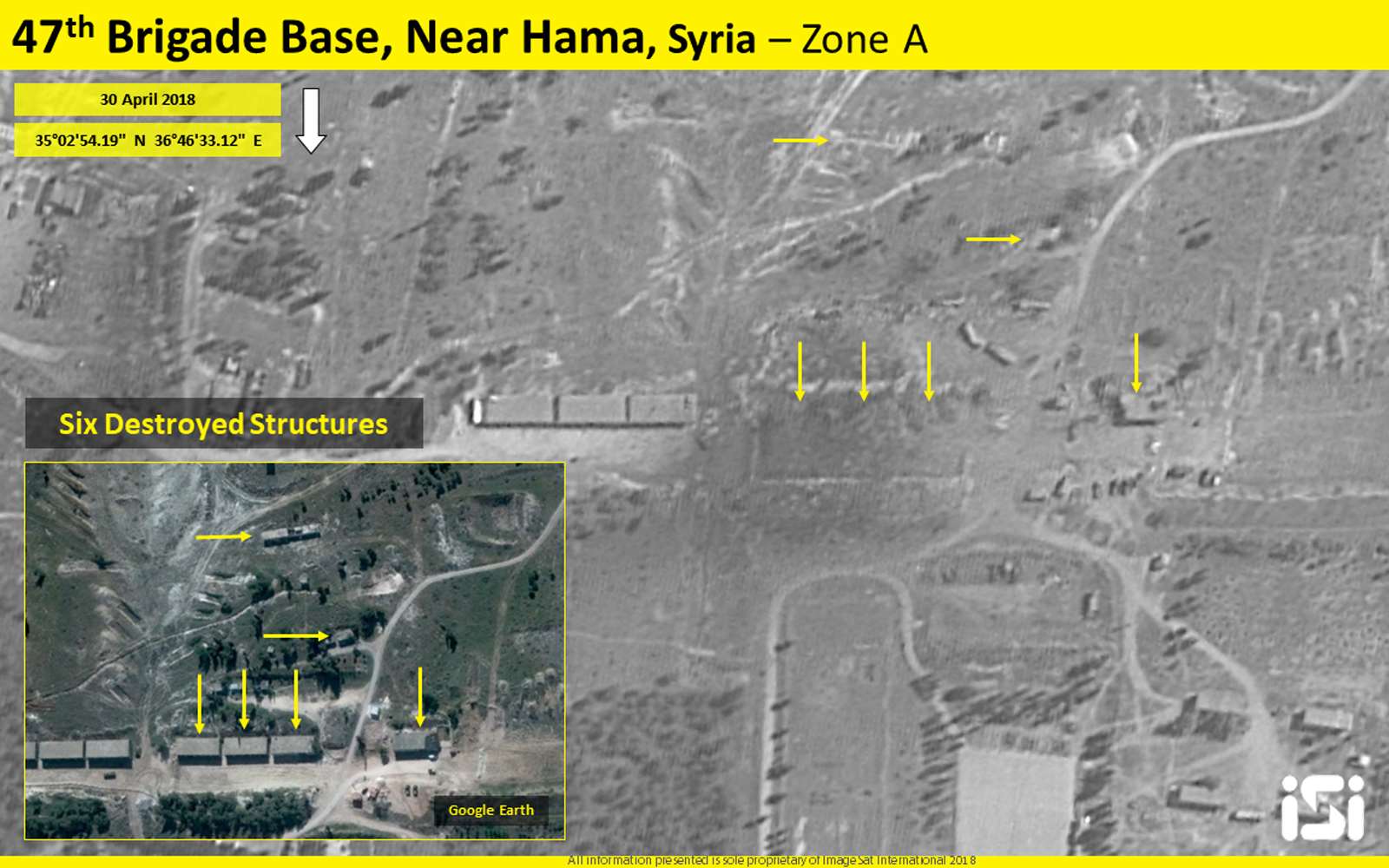
A satellite image showing the results of an alleged Israeli airstrike on a reported Iranian base outside the northern Syrian city of Hama the day before, on April 30, 2018. (ImageSat International ISI)

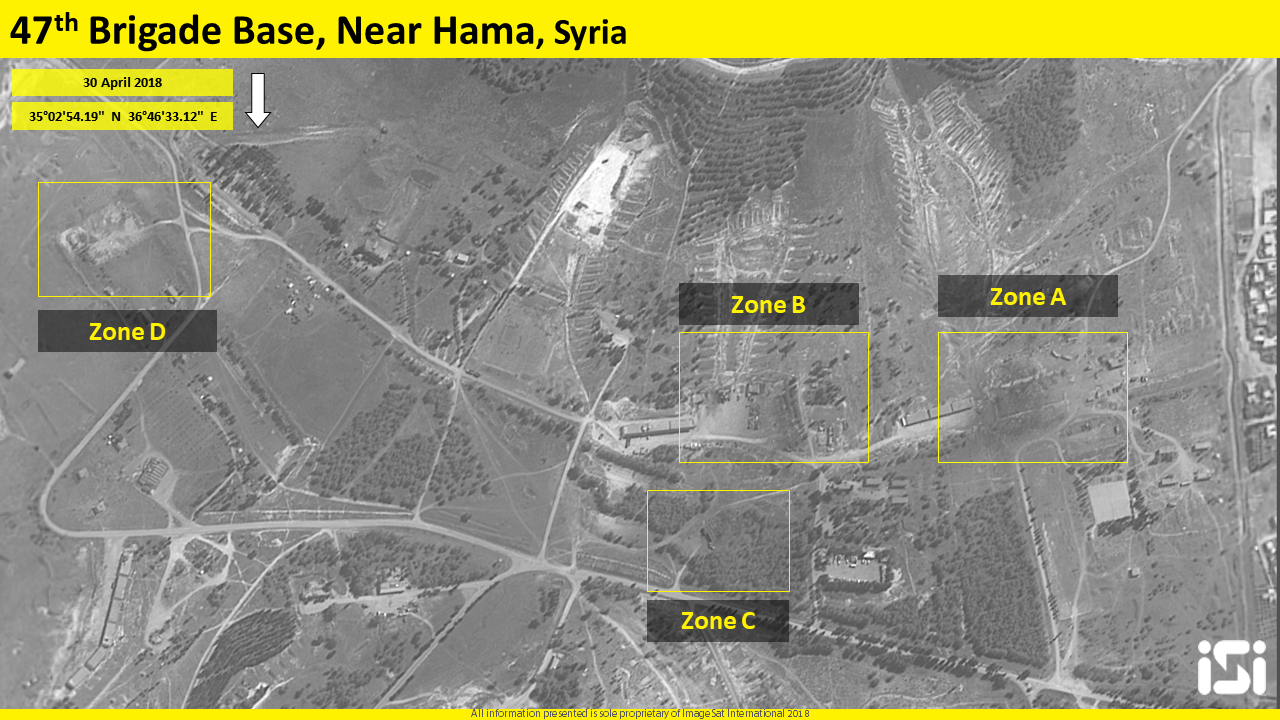
The base hit in the Sunday night airstrike was located south of the city of Hama in northwestern Syria and belonged to the Syrian army’s 47th Brigade, but has reportedly been used as a headquarters for Iranian troops for several years.

American and Israeli officials have been monitoring as Iran has increased the number of transport planes that it sends from its Mehrabad Airport in Tehran to Syria. The US and Israeli officials fear that these planes are loaded with advanced munitions, which could potentially be used against Israel.

The day before the strike, one such plane was spotted by a civilian skywatcher, using open-source flight tracking software, as it flew from Tehran toward an airfield in Hama.

The blast from the air raid could be seen from kilometers away and registered a 2.6 on the Richter scale on nearby seismographs, likely from the munitions in the weapons depot and not the initial bombing.

Israeli officials have refused to comment on the strike. Neither Syria nor Iran has publicly accused Israel of carrying it out, though many news outlets affiliated with them have pointed the finger at the Jewish state. Some have claimed that the United States or United Kingdom was behind the attack.

An Israeli satellite company revealed the damage caused to the site. Aerial photographs showed that at least 13 buildings were hit in the strike on the Hama base.
Speaking on condition of anonymity about the attack, an official from the coalition backing Syrian dictator Bashar Assad said Tehran can be expected to hit back at Israel for the bombing, according to the New York Times.

However, Iran would likely wait to do so until after May 6 parliamentary elections in neighboring Lebanon, where its ally Hezbollah is fielding candidates, the official said.

Tehran has sent some 80,000 Iran-backed fighters to back Syrian President Bashar Assad’s forces in the country’s seven-year civil war, Israeli Ambassador to the United Nations Danny Danon said last week.

Israel has designated Iranian military entrenchment in Syria as unacceptable to it, fearing that Tehran could use the country as a springboard for attacks against the Jewish state.

Defense Minister Avigdor LIberman, center, visits a national emergency preparedness exercise, alongside IDF Chief of Staff Gadi Eisenkot, right, and the head of the Home Front Command, Maj. Gen. Tamir Yadai, in March 2018. (Israel Defense Forces)

Defense Minister Avigdor Liberman has repeatedly vowed that Israel will work to prevent this from occurring, “no matter the cost.”

The Sunday night attack comes amid soaring tensions between Iran and Israel following an airstrike earlier this month on Syria’s T4 air base in the central province of Homs that killed seven Iranian military personnel. Tehran has vowed to retaliate for the T4 attack.

Syria, Iran, and Russia blamed Israel for that T4 attack. Israel did not confirm or deny it.
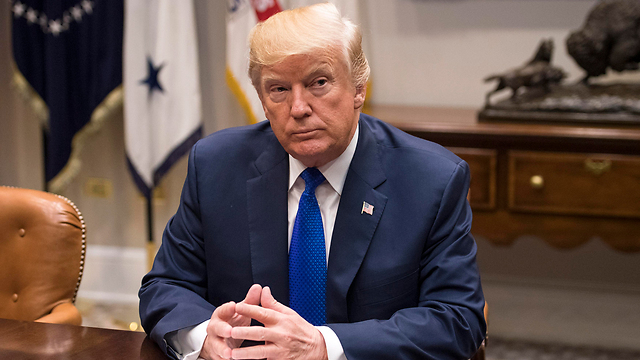
Trump’s ‘madness’ may be doing the trick

May 1, 2018

Source: Trump’s ‘madness’ may be doing the trick

Op-ed: An American success vis-à-vis North Korea will weaken Iran’s bargaining position, which in turn will affect Trump’s Israeli-Palestinian peace plan. There is a difference between a plan presented by an inarticulate and rejected US president and a peace plan presented by a president who has scored significant achievements in the international arena.

Ben-Dror Yemini|Published:  04.30.18 , 19:09

 In 1994, something seemed to be happening between the United States and North Korea. With former US President Jimmy Carter’s help, Kim Il-sung, the nuclearizing country’s former leader, vowed to halt the nuclear development in exchange for international aid.

But the agreement didn’t last long. North Korea dishonored the international community in general and the US in particular, and succeeded in developing a nuclear weapon despite the sanctions.

Has almost a quarter of a century made any difference? Can we trust the declaration made by Kim Jong-un, the former leader’s son, that his country is finally going to abandon its nuclear weapons?

Trump’s threats in the Korean arena are working, and that’s exactly what Iran is afraid of (Photo: EPA)

Trump’s threats in the Korean arena are working, and that’s exactly what Iran is afraid of (Photo: EPA)

The next stage is coming up, a meeting between the tyrant from Pyongyang and US President Donald Trump. Contrary to previous reports, Kim has presented conditions for the disarmament, which means nothing has been finalized yet.

One thing is clear: Tehran is closely examining every piece of information. There are initial signs that Trump’s threats are working in the Korean arena, and that’s exactly what Iran is afraid of, because Trump’s success in one arena will pave the way.

The European countries, primarily France and Germany, which are in principle against changing the nuclear agreement with Iran, have also started to blink. They understand Trump is insisting. They have also started talking about the need for a certain change.

Trump’s insistence, against the opinion of all experts and advisors and commentators, may actually be doing the trick. Now, we’re about to be flooded with commentaries arguing that even if there is an achievement or breakthrough, it shouldn’t be attributed to Trump. The Iranians, however, understand what the commentators are refusing to understand—that the rules of the game are changing. And they are definitely troubled by that.

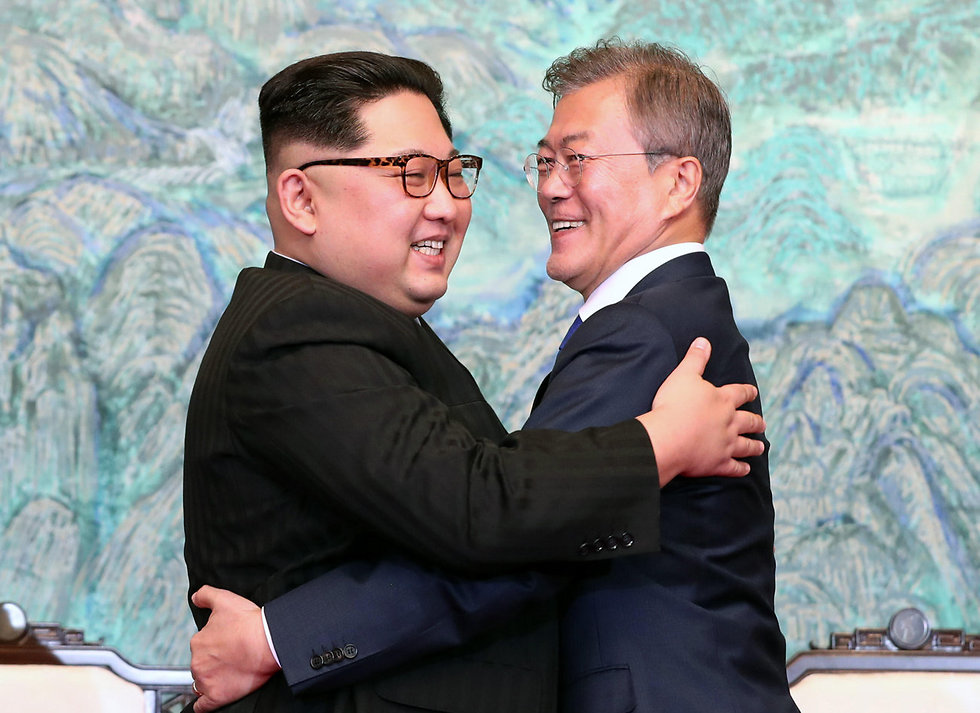
North Korean leader Kim Jong Un and South Korean President Moon Jae-in (Photo: AFP)

North Korean leader Kim Jong Un and South Korean President Moon Jae-in (Photo: AFP)

The nuclear agreement with Iran is a bad agreement, mainly because it gave the Shi’ite country an open-ended ticket to a Middle Eastern expansion. Since the agreement was signed, Iran has turned into a regional power that controls—fully or partially—Yemen, Iraq, Syria and Lebanon, and influences Hamas as well. And its appetite is only growing.

It’s true that Iran is in the middle of an economic crisis. It’s true that the Iranian currency is collapsing. It’s true that there are different streams in Iran. But the thing is, as an exiled Iranian professor told me a decade ago, the Iranian regime doesn’t go by rational or conventional rules. Its logic is similar to Hamas’ logic: The most important thing is the damage inflicted on the enemy, regardless of the harm to Iran’s residents. That’s why it’s more important to invest a fortune in a military infrastructure in Syria than to solve Iran’s economic problems. Just like Hamas prefers to invest tens of millions of dollars in the industry of death than in the Gaza Strip’s reconstruction.

We must admit that the rational Western approach has failed miserably in the face of the North Korean and Iranian madness. Appeasement is perceived as weakness. So to make some kind of change, there may be a need for an American leader whose conduct is slightly “insane.” In this sense, contrary to what I myself thought, the Trump method may be providing to yield dividends. Kim wouldn’t have changed his stance if it weren’t for Trump’s tough stance.

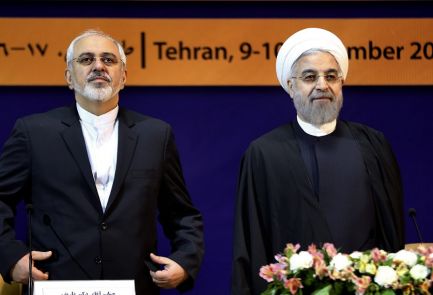
Iranian President Hassan Rouhani. The rules of the game are changing (Photo: AFP)

Iranian President Hassan Rouhani. The rules of the game are changing (Photo: AFP)

Which leads us to the Palestinian arena. An American success vis-à-vis Pyongyang will weaken Tehran’s bargaining position, which in turn will affect Trump’s peace plan in regards to the Israeli-Palestinian conflict. It’s possible, just possible, that the US is delaying the presentation of its peace plan until it reaches a much stronger position after the developments in the Korean and Iranian arenas.

In recent months, the Palestinians have adopted an ultra-scornful approach towards the US in general and Trump in particular. It’s possible that in a few weeks from now, they will meet a new Trump. Granted, that won’t make them give up fantasies like “the right of return,” and the right-wing government in Israel would not rush to accept a peace plan which includes conceding most of Judea and Samaria. But there is a difference between a plan presented by an inarticulate and rejected Trump and a peace plan presented by a president who has scored considerable achievements in the international arena.

We are in the midst of a fascinating diplomatic chess game. Trump is making unpredictable and unrecommended moves in every sphere, including moving the American embassy to Jerusalem. There’s no need to be one of his fans to admit that if he succeeds, we’ll be living in a slightly more civilized world. And I will be forced to eat my hat too. Inshallah.

Iran mocks Israeli prime minister as ‘boy who cried wolf’

May 1, 2018

Source: Iran mocks Israeli prime minister as ‘boy who cried wolf’ – Israel Hayom

Iran warns it will further enrich uranium if US exits nuclear deal 

May 1, 2018

Source: Iran warns it will further enrich uranium if US exits nuclear deal – Israel Hayom

How Israel obtained Iran’s nuclear secrets

May 1, 2018

By David Rosenberg, INN Israpundit

Source Link: How Israel obtained Iran’s nuclear secrets

{Simply amazing. – LS}

According to a report Monday night by The New York Times which cited an anonymous Israeli senior official, the massive document haul was undertaken in a January 2017 operation he hailed as one of Israel’s “greatest achievements” in intelligence gathering.

Israel’s national intelligence agency, the Mossad, discovered the location of the Iranian nuclear weapons program’s secret file archive in Tehran in February 2016, the source told the Times, which Netanyahu revealed was located in the Shorabad district.

Last January, Mossad agents infiltrated the archive in an overnight operation, removing the half ton of material, and smuggled the files to Israel that very same night.

No details on the technical execution of the covert operation were provided.

Iranian officials were initially unaware the documents had been removed, learning of the infiltration only months later, Yediot Ahronot reported Tuesday morning.

Mossad chief Yossi Cohen later informed Donald Trump of the successful operation during a trip to Washington.

While Israel has been in possession of the documents since January 2017, Israeli officials refrained from disclosing the contents to the public until now, due in large part to the lengthy translation process for the 110,000 documents and extensive efforts to verify their authenticity.

Following Prime Minister Netanyahu’s address on Monday, Secretary of State Mike Pompeo confirmed the authenticity of the materials furnished by Israel as proof of Iran’s nuclear weapons program.

I can confirm with you, for you, that these documents are real, they are authentic,” said Pompeo.

Russia’s S-300, S-400 and S-500 vs. America’s F-35 and F-22: Who Wins?

May 1, 2018

Dave Majumdarb April 9, 2017 The National Interest

Source Link: Russia’s S-300, S-400 and S-500 vs. America’s F-35 and F-22: Who Wins?

{We may never know the full range of capabilities of Russia’s ‘S’ air defense systems and America’s  F-35 and F-22 platforms. These are clearly matters of national security and are obviously top secret. – LS}

For the Russians, solving the problem of targeting a low observable aircraft is something that they continue to work on—but it is doubtful the Moscow has resolved the issue. Russia’s strong investment in layers of air defenses tells us that the Kremlin believes the primary threat to its ground forces comes from U.S. airpower. As such, defeating stealth technology is one of Moscow’s top priorities, Kofman notes, and the Kremlin has dedicated a lot of resources to that end.

Russia has tried a number of different techniques to defeat stealth technology. Among those is trying to develop a tight integrated air defense network with multiple radars trying to look at the same aircraft from different directions—but how effective those efforts have been is an open question. “It’s great being able to see an aircraft, or parts of it, but getting accuracy such that you can confidently get a missile near the target is the primary challenge,” Kofman said.

Russian air defenses may appear formidable as part of Moscow’s increasingly sophisticated anti-access/area denial (A2/AD) capability, but areas protected by these systems are far from impenetrable bubbles or ‘Iron Domes’ as some analysts have called them.

While it is true that a layered and integrated air defense may effectively render large swaths of airspace too costly—in terms of men and materiel—to attack using conventional fourth generation warplanes such as the Boeing F/A-18E/F Super Hornet or Lockheed Martin F-16 Fighting Falcon, these systems have an Achilles’ Heel. Russian air defenses will still struggle to effectively engage fifth-generation stealth aircraft such as the Lockheed Martin F-22 Raptor or F-35 Joint Strike Fighter.

“In terms of establishing viable air defenses against opponents with fifth generation aircraft, it’s quite clear how Russia is trying to tackle the problem of stealth,” said Mike Kofman, a research scientist specializing in Russian military affairs at CNA Corporation during an interview with The National Interest. “Russia’s advanced radar, variety of capable missiles and systems that try to integrate large amounts of data for a more potent air defense will increasingly segregate Western air forces into two benches. In a future where these systems have proliferated to China, Iran and other regional powers there will be those that can penetrate and survive against advanced air defenses in a high end fight, and those whose job it is to bomb ISIL or its successor.”

Kofman notes that advanced Russian-built air defenses like the S-300, S-400 and forthcoming S-500 family come with systems designed to detect and track the presence of low observable (LO) aircraft such as the F-22 and F-35. That’s just a function of physics, as I have noted before. The problem for Moscow is that while Russian early warning and acquisitions radars operating in the VHF, UHF, L and S bands can detect and even track a tactical fighter-sized stealth aircraft, those systems don’t deliver a weapons quality track. “Russia has invested in low-band early warning radars, with some great variants out there, but can it use these to put a good picture together, and process it to develop a track against low-observation aircraft?” Kofman asked rhetorically.

Physics dictate that a tactical fighter-sized stealth aircraft must be optimized to defeat higher-frequency bands such the C, X and Ku bands, which are used by fire control radars to produce a high-resolution track. Industry, Air Force and Navy officials all agree that there is a “step change” in an LO aircraft’s signature once the frequency wavelength exceeds a certain threshold and causes a resonant effect—which generally occurs at the top part of the S-band.

Typically, that resonance effect occurs when a feature on an aircraft—such as a tail-fin—is less than eight times the size of a particular frequency wavelength. Effectively, small stealth aircraft that do not have the size or weight allowances for two feet or more of radar absorbent material coatings on every surface are forced to make trades as to which frequency bands they are optimized for. That means that stealthy tactical fighters will show up on radars operating at a lower frequency bands—such as parts of the S or L band or even lower frequencies. Larger stealth aircraft such as the Northrop Grumman B-2 Spirit or forthcoming B-21 don’t have many of the airframe features that cause a resonance effect—and are, as such, much more effective against low-frequency radars.

For the Russians, solving the problem of targeting a low observable aircraft is something that they continue to work on—but it is doubtful the Moscow has resolved the issue. Russia’s strong investment in layers of air defenses tells us that the Kremlin believes the primary threat to its ground forces comes from U.S. airpower. As such, defeating stealth technology is one of Moscow’s top priorities, Kofman notes, and the Kremlin has dedicated a lot of resources to that end.

Russia has tried a number of different techniques to defeat stealth technology. Among those is trying to develop a tight integrated air defense network with multiple radars trying to look at the same aircraft from different directions—but how effective those efforts have been is an open question. “It’s great being able to see an aircraft, or parts of it, but getting accuracy such that you can confidently get a missile near the target is the primary challenge,” Kofman said.

While the Russians—and the Chinese—have not yet cracked the problem, it is clear that stealth is becoming much less of an advantage over time, though perhaps no less expensive an acquisition. Eventually, Moscow will find a solution to the stealth problem as the cyclical struggle between offense and defense continues ad infinitum—it’s just a matter of time.

Dave Majumdar is the defense editor for the National Interest. You can follow him on Twitter: @davemajumdar.

This first appeared in the Summer of 2016 and is being reposted due to reader interest. 


British Foreign Secretary responds to Netanyahu’s Iran speech

May 1, 2018

‘That Iran conducted sensitive research in secret until 2003 shows why we need intrusive inspections allowed by Iran nuclear deal today.’

Mordechai Sones, 01/05/18 17:33
Boris Johnson Reuters

British Foreign Secretary Boris Johnson responded today to Israel’s historic operation to obtain Iran’s nuclear archive, which uncovered over 100,000 documents detailing Tehran’s nuclear program.

“The Israeli Prime Minister’s presentation on Iran’s past research into nuclear weapons technology underlines the importance of keeping the Iran nuclear deal’s constraints on Tehran’s nuclear ambitions,” Johnson said.

“The Iran nuclear deal is not based on trust about Iran’s intentions; rather it is based on tough verification, including measures that allow inspectors from the International Atomic Energy Agency unprecedented access to Iran’s nuclear programme.

“The fact that Iran conducted sensitive research in secret until 2003 shows why we need the intrusive inspections allowed by the Iran nuclear deal today. The verification provisions in the Iran nuclear deal would make it harder for Iran to restart any such research. That is another good reason for keeping the deal while building on it in order to take account of the legitimate concerns of the US and our other allies.”

Netanyahu last night revealed the purpose of Iran’s secret nuclear program, Project Amad, was to design, produce, and test five nuclear warheads, each with an explosive yield of 10 kilotons of TNT, for integration with ballistic missiles. “That’s like 5 Hiroshima bombs to be put on ballistic missiles.”

He further revealed that Project Amad had all five elements of a nuclear weapons program, designing nuclear weapons, developing nuclear cores, building nuclear implosion systems, preparing nuclear tests, and integrating nuclear weapons with missiles.

The Inside Scoop of How Deadly the ‘New’ F-35 Will Be

May 1, 2018

Kris Osborn April 30, 2018 The National Interest

Source Link: The Inside Scoop of How Deadly the ‘New’ F-35 Will Be

{Obama did not want the F-35 and tried every reason his little mind could imagine to block its development. Lucky for us, smarter people prevailed. – LS}

The Air Force has begun early testing, software development and weapons integration for its upcoming Block 4 variant of the F-35 Joint Strike Fighter, an emerging model intended to give the multi-role fighter a new dimension of attack mission possibilities, service leaders said.

The new version, to emerge in the early 2020s, will add new long-range precision-tracking weapons such as the Small Diameter Bomb II and also integrate a computer-generated automatic ground collision avoidance technology.

“The next step for F-35 weapons integration will be to address the weapon requirements within Block 4. Integration of the Small Diameter Bomb II has already begun, and flight test is scheduled to start as early as 2019,” Capt. Emily Grabowski, Air Force Spokeswoman, told Warrior Maven in a statement.

The current consensus among senior Pentagon weapons developers holds that, at the moment, the F-35 is the most capable 5th generation plane in the world. Maintaining this edge, however, is anticipated to quickly become more and more difficult now that both Russia and China are building 5th-gen stealth fighters.

“Block 4 is important with the national defense strategy to make sure we are modernizing the plane to keep it dominant on the battlefield. We are close to knowing the strategy for how to go after it,” Dr. Will Roper, Assistant Secretary of the Air Force for Acquisition, Technology and Logistics, the F-35, told a group of reporters.

While the applied impact of Block 4 will incorporate a range of mission-expanding technologies, much of the ongoing preparation work is in the realm of software development, Roper said.

“The physical pieces of the plane are moving in a good direction. Most of what we have left to do is software. The department (DoD) has not historically been good at software development. That will take a little longer. I cannot imagine building anything for the Air Force that is not software intensive,” Roper said.

The Block 4 initiative is part of a long range trajectory planned for the F-35 described by Pentagon developers as C2D2 – Continuous Capability Development and Delivery. The idea, officials say, is to position the multi-role fighter such that it can consistently accommodate new weapons, stealth materials, sensors and guidance technology as it becomes available.

“We own today’s fight,” said Lt. Col. Tucker Hamilton, F-35 Test Director, Edwards AFB, told reporters. However, Tucker went on to say that, in the absence of aggressive modernization, sustainment and various improvement efforts, this will no longer remain the case.

The SDB II, described as a key element of Block 4, is a new air-dropped weapon able to destroy moving targets in all kinds of weather conditions at ranges greater than 40-miles, Air Force and Raytheon officials said.

It is designed to destroy moving targets in all kinds of weather. GPS and laser-guided weapons such as Joint Direct Attack Munitions have been around for decades, however, they have primarily been designed for use against fixed or stationary targets.

While the Air Force currently uses a laser-guided bomb called the GBU-54 able to destroy moving targets, the new SDB II will be able to do this at longer ranges and in all kinds of weather conditions. In addition, the SDB II is built with a two-way, dual-band data link which enables it to change targets or adjust to different target locations while in flight, Raytheon developers told Warrior Maven.

The Small Diameter Bomb II (SDB II ), which has already completed a series of wind tunnel tests, can destroy moving targets in all weather conditions at ranges greater than 40 miles — a Raytheon statement said.

A key part of the SDB II is a technology called a “tri-mode” seeker — a guidance system which can direct the weapon using millimeter wave radar, uncooled imaging infrared guidance and semi-active laser technology.

Raytheon weapons developers say the tri-mode seeker provides a range of guidance and targeting options typically not used together in one system. Millimeter wave radar gives the weapon an ability to navigate through adverse weather, conditions in which other guidance systems might encounter problems reaching or pinpointing targets.

Imagining infrared guidance allows the weapon to track and hone in on heat signatures such as the temperature of an enemy vehicle. With semi-active laser technology, the weapon can be guided to an exact point using a laser designator or laser illuminator coming from the air or the ground, Raytheon officials told Warrior.

Also, the SBD II brings a new ability to track targets in flight through use of a two-way Link 16 and UHF data link, Raytheon officials said.

One Raytheon SDB II developer told Warrior in a previous interview that “the millimeter wave radar turns on first. Then the data link gives it a cue and tells the seeker where to open up and look. Then, the weapon can turn on its IR (infrared) which uses heat seeking technology.”

France and EU allies say Netanyahu’s claims reinforce Iran nuclear deal

May 1, 2018

Israeli Prime Minister Benjamin Netanyahu’s revelations about Iran’s nuclear weapons program only prove the need for a nuclear deal, according to French and EU leaders.

Maria Burtin
http://www.jerusalemonline.com/news/world-news/around-the-globe/france-continues-to-support-iran-nuclear-deal-35628
Netanyahu, yesterday Photo Credit: Miriam Alster/Flash 90
The French Foreign Ministry responded today to Israeli Prime Minister Benjamin Netanyahu’s presentation of Iran’s nuclear weapons program and stated that Netanyahu only repeated information revealed by Europe back in 2002. The French statement stressed that the presented materials reinforce the importance of maintaining the Iran nuclear deal, formerly known as 2015 Joint Comprehensive Plan of Action.

“At first sight, they (the details) confirm that part of the Iranian nuclear program, as France and its partners stated during the first revelations in the summer of 2002, was not civilian,” said the spokesperson for the ministry, according to a statement obtained by AFP.

In a televised address Monday, Netanyahu presented information gathered from Iran’s nuclear weapons program, claiming that Iran had lied about its efforts to acquire atomic weapons and had developed a nuclear weapons plan that can be activated at any time.

Statements from other European leaders were made before the French ministry’s remarks and said that the revealed information will not change their current position on Iran’s nuclear deal.

“What I have seen from the first reports is that Prime Minister Netanyahu has not put into question Iran’s compliance with the JCPOA [Joint Comprehensive Plan of Action] commitments, meaning post-2015 nuclear commitments,” said European Union foreign affairs chief Federica Mogherini. “The JCPOA, the nuclear agreement, is not based on assumptions of good faith or trust – it is based on concrete commitments, verification mechanisms and a very strict monitoring of facts, done by the IAEA. The IAEA has published 10 reports, certifying that Iran has fully complied with its commitments.”

The British Foreign Office released a statement on Monday evening confirming UK involvement with the plan and its importance.

“We have never been naive about Iran and its nuclear intentions. That is why the IAEA inspection regime agreed as part of the Iran nuclear deal is one of the most extensive and robust in the history of international nuclear accords,” said a spokesperson for the ministry. “It remains a vitally important way of independently verifying that Iran is adhering to the deal and that Iran’s nuclear program is exclusively peaceful.”

Watch: Netanyahu reveals Iranian nuclear files

US President Donald Trump responded to Netanyahu’s speech and praised him for “sending the right message on Iran’s nuclear program.”

“In seven years, that deal will have expired and Iran is free to go ahead and create nuclear weapons,” said Trump. “That is just not an acceptable situation.”

Despite his agreement with Netanyahu, Trump refused to address the possible US withdrawal from the nuclear deal this month.  “We’ll see what happens,” Trump said. “I’m not telling you what I’m doing. [A lot] of people think they know. And on or before the 12, we’ll make a decision.”

Mogherini responds to Netanyahu

May 1, 2018

EU High Representative of for Foreign Affairs says she hasn’t seen arguments from Netanyahu that Iran isn’t complying with nuclear deal.

Elad Benari, 01/05/18 00:09
Federica Mogherini

Reuters

Federica Mogherini, the European Union’s High Representative of for Foreign Affairs and Security Policy, on Monday responded to Prime Minister Binyamin Netanyahu’s presentation on Iran.

“What I have seen from the first reports is that Prime Minister Netanyahu has not put into question Iran’s compliance with the JCPOA [Joint Comprehensive Plan of Action] commitments, meaning post-2015 nuclear commitments,” she said, asserting that an agreement was needed due to lack of trust between the sides.

“The JCPOA, the nuclear agreement, is not based on assumptions of good faith or trust – it is based on concrete commitments, verification mechanisms and a very strict monitoring of facts, done by the IAEA. The IAEA has published 10 reports, certifying that Iran has fully complied with its commitments,” continued Mogherini.

“And in any case, if any party and if any country has information of non-compliance, of any kind, it can and should address and channel this information to the proper, legitimate, recognized mechanisms, the IAEA and the Joint Commission [of the JCPOA] for the monitoring of the nuclear deal that I chair and that I convened just a couple of months ago. We have mechanisms in place to address eventual concerns.”

“Again, I have not seen from Prime Minister Netanyahu arguments for the moment on non-compliance, meaning violation by Iran of its nuclear commitments under the [nuclear] deal. And again, the deal was put in place exactly because there was no trust between the parties, otherwise we would not have required a nuclear deal to be put in place,” she concluded.

Netanyahu revealed intelligence from Iran’s secret nuclear files earlier on Monday, noting that “Iran lied big time” when its leaders denied that the Islamic Republic had a program to develop nuclear weapons.

The Prime Minister noted that after it signed the nuclear deal in 2015, Iran intensified its efforts to hide its secret nuclear files. He also pointed out that “in 2017, Iran moved its nuclear weapons files to a highly secret location in Tehran”.

Netanyahu addressed U.S. President Donald Trump’s upcoming decision on whether to remain in the Iran nuclear deal or not and said that he believed that Trump would withdraw from the deal.

“I am sure he will do the right thing, the right thing for the United States, the right thing for Israel, and the right thing for the peace of the world.”

Trump later responded to Netanyahu and said his speech “sends the right message” on Iran’s nuclear program.

The president called the 2015 Iran nuclear deal a “horrible agreement for the United States” and added that Netanyahu’s speech confirmed that he was “100% right” to criticize the 2015 nuclear agreement with Iran.”

However, Trump refused to say whether he would withdraw from the nuclear deal.

The president has set a deadline of May 12 for Europe to fix the flaws of the 2015 Iranian nuclear deal.