Archive for April 2018

US said to confirm Israel hit Syria base as Russia complains it was not warned

April 9, 2018

Moscow says ’cause for concern’ since Russian military advisers could have been present; US officials say Jerusalem had updated Washington ahead of time

https://www.timesofisrael.com/us-said-to-confirm-israel-hit-syria-base-as-russia-complains-it-was-not-warned/

US officials have reportedly confirmed that Israel carried out a predawn missile strike on an air base in central Syria that reportedly killed 14 people on Monday, while Russia protested that it had not been informed ahead of time.

NBC News quoted two US officials as saying that Israel had carried out the strike, adding that Washington had been informed in advance. Israel has refused to comment on the attack.

Dmitry Peskov, spokesman for Russian President Vladimir Putin, told reporters that Israel had not spoken to Moscow ahead of the airstrike even though Russian military advisers could have been present at the base, which he described as “a cause for concern for us.”

Russian President Vladimir Putin’s spokesman Dmitry Peskov in Moscow, Russia, Thursday, April 6, 2017. (AP Photo/Pavel Golovkin)

In a rare move, Russia accused Israel earlier Monday of carrying out the strike, as did dictator Bashar Assad’s regime.

“This is a very dangerous development. I hope at least that the US military and those of the countries participating in the coalition led by the United States understand that,” Russian Foreign Minister Sergey Lavrov told a press conference Monday.

The United States and France officially denied carrying out the strike, which came shortly after both countries threatened to retaliate for a chemical weapons attack allegedly conducted by Assad in the Syrian town of Douma late Saturday.

The target of the reported airstrike was the Tiyas air base — also known as the T-4 air base — outside Palmyra in central Syria. Israel has previously carried out at least one explicitly acknowledged attack on the base, which it said was home to an Iranian drone program.

According to Russia, the strike was carried out shortly before 4 a.m. Monday by two Israeli F-15 fighter jets. The Russian defense ministry said the Israeli aircraft launched eight missiles at the base from Lebanese airspace, five of which it said were intercepted.

In a statement carried by the official Syrian news agency SANA, however, a military official source said eight of the missiles fired by the Israeli jets were downed by air-defense batteries, though some of them got through. “There are martyrs and wounded,” the source said.

Syrian television showed footage of the alleged Israeli missiles flying through Syrian airspace toward the base.

The Lebanese military reported that in total four Israeli warplanes violated its airspace for approximately 10 minutes early Monday morning. This account does not necessarily contradict the Russian claim that two F-15 jets carried out the attack, as it is common for additional fighters to act as escorts for the bombers on such strikes.

Lebanon also reported that Israeli reconnaissance drones had been operating intensively along its Syrian border over the past three days, calling into question the claims that the reported strike was connected to the Douma chemical weapons attack.

According to the Syrian Observatory for Human Rights monitor, at least 14 people were killed and more were wounded. Iranian nationals were listed among the casualties.

Moscow noted that no Russians were injured in the strike.

“According to a military source in Damascus, the Syrian Air Defense system was deployed from the Mezzeh Air Base after the jets entered Syria from Lebanon’s Beqa’a Valley,” Lebanese news site Al-Masdar News reported.
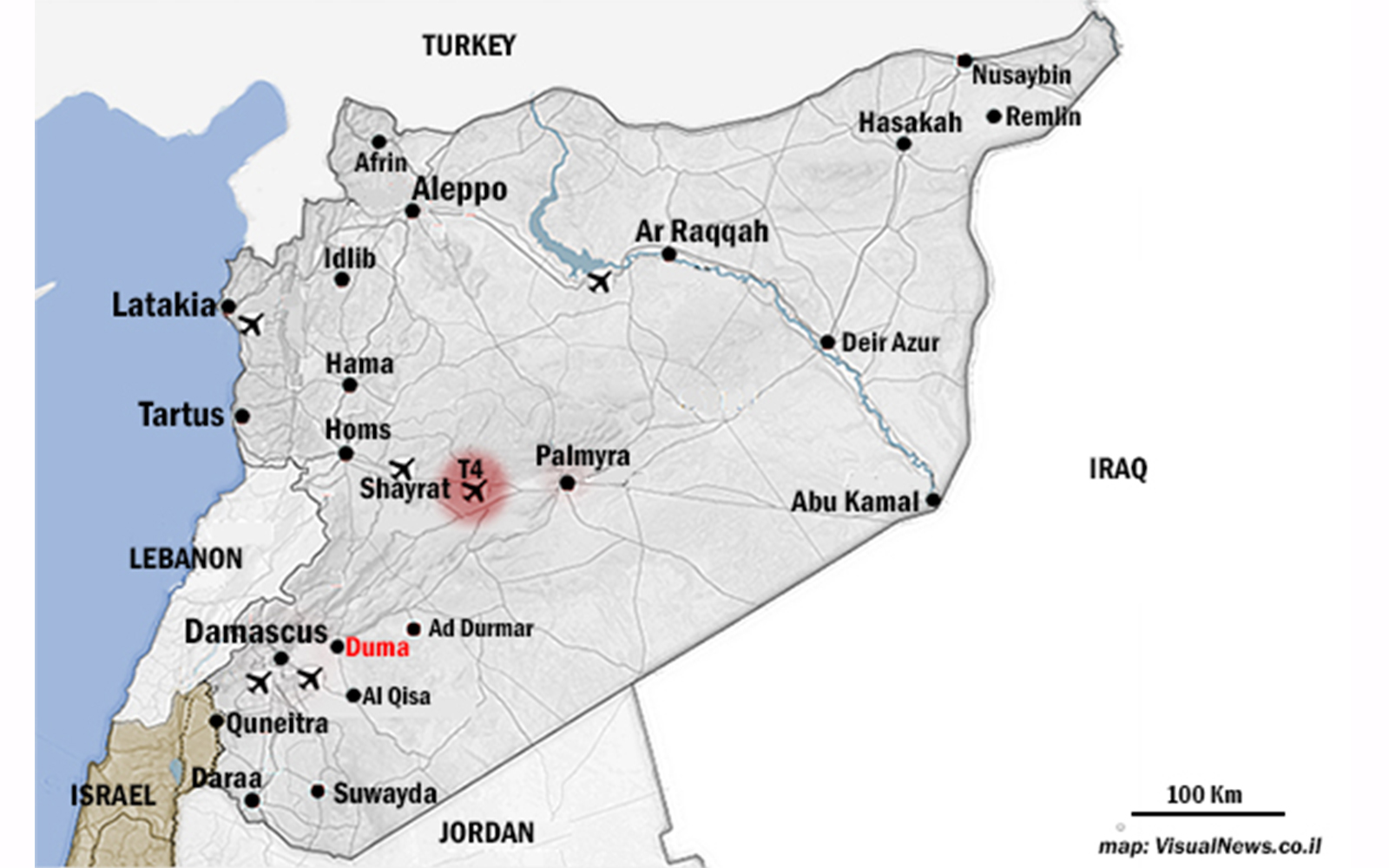
The location of the T-4 airbase, highlighted in red, that was bombed in the predawn hours of April 9, 2018. Syria and Russia have blamed Israel for the attack. (Credit: Joseph Hirsch)

That is the route that Israeli jets generally take before bombing military targets in Syria, according to foreign reports.

Israel conducted an airstrike against the Tiyas base on February 10, after an Iranian operator working out of it flew an Iranian-made drone into Israeli territory, according to the army.

“Iran and the [Iranian Revolutionary Guards Corps’ special unit] Quds Force for some time have been operating the T-4 Air Base in Syria next to Palmyra, with support from the Syrian military and with permission from the Syrian regime,” the Israel Defense Forces said in a statement at the time.

Construction Minister Yoav Galant, a former IDF major general and a member of Israel’s security cabinet, would not comment directly on the attack, but reiterated the “red lines” that Jerusalem considers grounds for launching strikes.

“In Syria many forces, from various bodies and coalitions, are operating. Each one says what it says and denies what it denies,” he told Israel Radio. “We have clear interests in Syria and we set red lines. We will not allow weapons to pass from Syria to Lebanon, and we will not allow the establishment of an Iranian base.”

Public Security Minister Gilad Erdan also appeared to comment on the reported strike during a meeting in the Knesset, albeit in a roundabout way, saying the allegations indicated that Israel operated without limitation.

“I won’t comment on the security matter being attributed to us, but the fact that this morning they are attributing to us what they are attributing to us shows the independence of Israel in every way. The State of Israel presents an object of admiration for the entire world,” Erdan said, according to Israel Radio.

Former defense minister Moshe Ya’alon, a long-time advocate of maintaining ambiguity about strikes in foreign countries, told Army Radio that the important thing is for Israel to abide by the “red lines” that it sets for itself, not to advertise its actions.

“There’s no need to run and tell your friends or to take responsibility. Whoever needs to understand will understand,” he said.
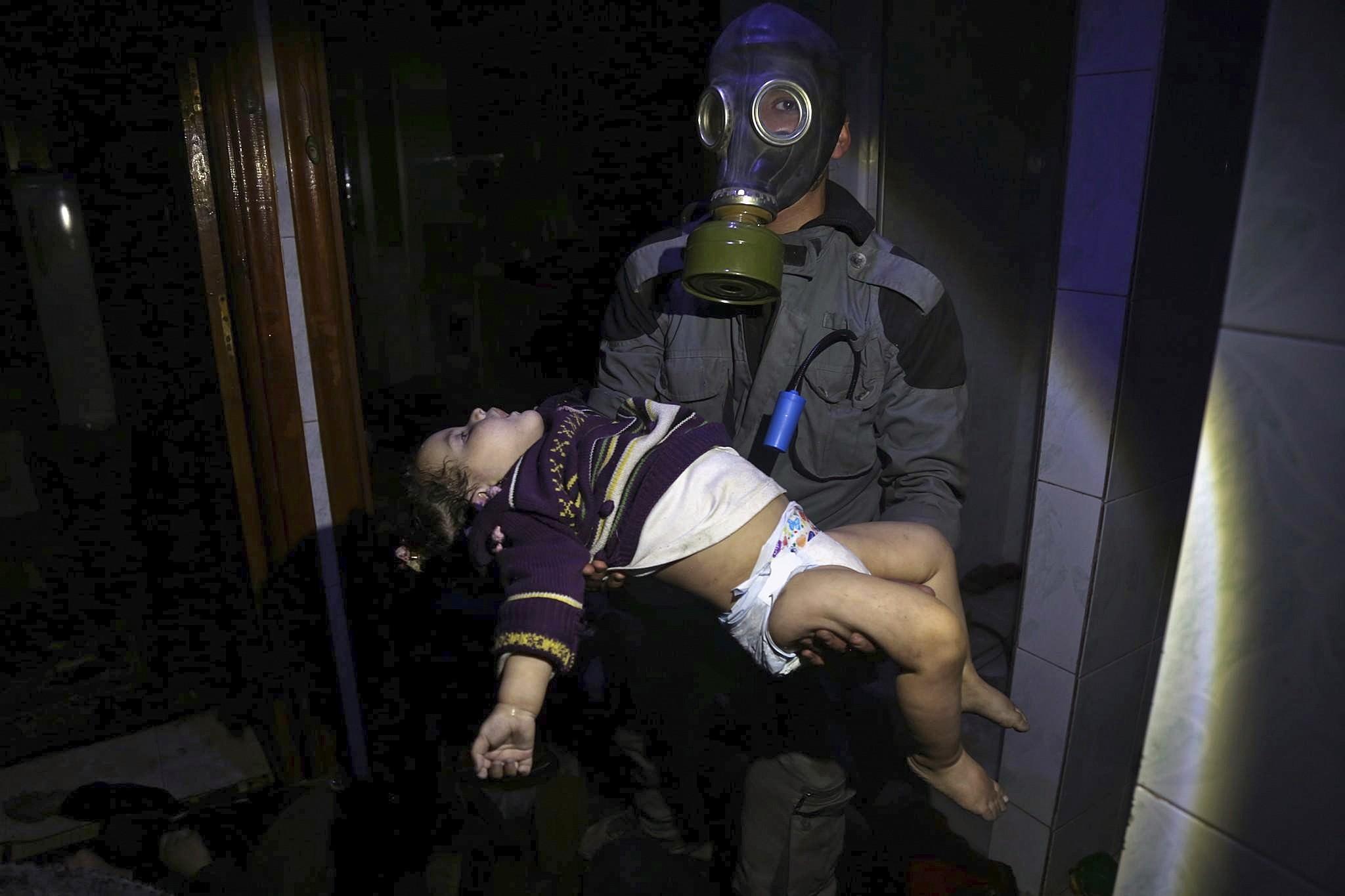
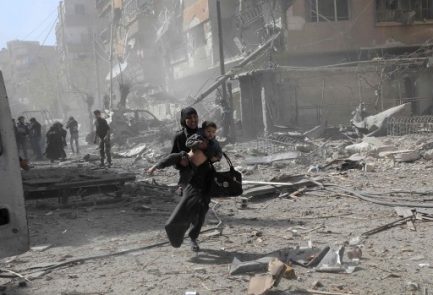
This image released early Sunday, April 8, 2018 by the Syrian Civil Defense White Helmets, shows a rescue worker carrying a child following an alleged chemical weapons attack in the rebel-held town of Douma, near Damascus, Syria. (Syrian Civil Defense White Helmets via AP)

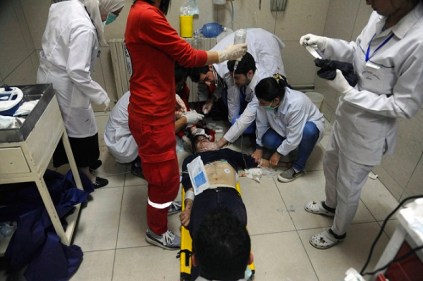
The missile attack followed a suspected poison gas attack Saturday on the last remaining foothold for the Syrian opposition in the eastern suburbs of Damascus. At least 40 people were killed, including families found in their homes and shelters, opposition activists and local rescuers said.

On Sunday, US President Donald Trump had promised a “big price to pay” for the suspected chemical attack.

After the airstrikes were reported, however, Pentagon spokesman Christopher Sherwood said in a statement, “At this time, the Department of Defense is not conducting air strikes in Syria.”

Judah Ari Gross and agencies contributed to this report.

Report: US notified ahead of Syria strike blamed on Israel

April 9, 2018

https://www.timesofisrael.com/liveblog-april-9-2018/


A pair of US officials tell NBC News that Israel was behind the deadly airstrike on a Syrian air base earlier today and that the US was notified ahead of the strike.

The NBC News report comes as Russian President Vladimir Putin’s spokesman says the Kremlin was not warned of the attack in advance.

Israelis military officials have refused to comment on the airstrike, which Russia and Syria have blamed on Israel.

Petition to award my father the Medal of Honor

April 9, 2018

With thanks to Adan Taxim…


https://petitions.whitehouse.gov/petition/time-presidential-medal-freedom-author-and-living-treasure-herman-wouk-103-years-old-may-2018

Assad’s Horror, and Those Who Enable It

April 9, 2018

Russia, Iran, and North Korea all play a role in the Syrian regime’s chemical attacks on its own people.

APR 08, 2018 | By THOMAS JOSCELYN via Weekly Standard

Source Link: Assad’s Horror, and Those Who Enable It

{Birds of a feather flock together. – LS}

Horrific images from the aftermath of a suspected chemical weapons attack in Syria are once again circulating online. The scene of this gassing is the eastern Ghouta suburb of Damascus. Both the location and the timing of this apparent war crime are symbolically important. And while the immediate focus will be on Syrian dictator Bashar al-Assad and his willingness to gas his own people, any long-term solution will require understanding the role of the rogue states that enable and support him.

It was one year ago, on the morning of April 7, 2017, that the Trump administration launched punitive airstrikes against Assad’s regime at the Shayrat Airfield in response to a Sarin gas attack days earlier. Those targeted bombings were intended to send a message to Assad: Stop using banned weapons of war against your own people. Assad was undeterred.

He had failed to adhere to a previous deal, negotiated by the Obama administration and Russia, that was intended to end his chemical weapons capability. The concord was struck in the aftermath of the August 21, 2013, nerve agent attack on eastern Ghouta–the same suburb hit in the last 24 hours. The U.S. government determined that the Assad regime was responsible and “that 1,429 people were killed … including at least 426 children.”

Just a few weeks later, in September 2013, the U.S. and Russia agreed to “special procedures” for the “expeditious destruction of the Syrian chemical weapons program and stringent verification thereof.” Secretary of State John Kerry claimed in 2014 that the agreement had worked, saying “we got 100 percent of the chemical weapons out” of Syria. That obviously wasn’t true, or at least highly misleading, as Assad retained the capability to regenerate and use certain weapons.

And now—one year after the U.S. attempted to punish Assad with airstrikes, and in the same neighborhood that was terrorized in 2013— the Syrian regime has seemingly struck again.

Many details concerning this most recent attack remain to be confirmed. But the world has already learned some valuable lessons regarding the behavior of rogue actors when it comes their pursuit and use of banned weapons.

There is no real question that Assad has continued to use chemical weapons even after he agreed to give them up. As the State Department was quick to note yesterday, the U.S. has concluded that he was responsible for the April 4, 2017, Sarin gas attack in Khan Sheikhoun—the same incident which prompted the Trump administration’s bombing. And both the U.S. government and the UN have found that Assad’s goons used other chemical weapons, namely crude chlorine bombs, more than once. While some of these bombs struck areas held by jihadi rebels, they have also indiscriminately killed civilians.

Assad’s principal international backer, Vladimir Putin, hasn’t stopped him from using of them. Nor has Iran, which is deeply embedded in Syria alongside Assad’s forces. In fact, the Assad-Putin-Khamenei axis has a legion of online apologists who argue that the high-profile chemical weapons assaults aren’t really the work of the Syrian “president” at all. This noxious advocacy on behalf of mass murderers is readily available on social media.

It gets even worse, as another rogue state has reportedly facilitated Assad’s acquisition of chemical weapons: North Korea. This facilitation is especially worrisome in light of the two nations’ previous cooperation on a nuclear reactor that was destroyed by the Israelis in 2007.

In March, the U.N. issued a report on North Korea’s active “prohibited military cooperation projects…stretching from Africa to the Asia-Pacific region, including ongoing ballistic missile cooperation with the Syrian Arab Republic and Myanmar, widespread conventional arms deals and cyberoperations to steal military secrets.”

The U.N. traced a number of visits by North Korean officials to Syrian soil, finding that “multiple groups of ballistic missile technicians” have been inside Syria. Citing intelligence received from a “Member State,” the U.N. explained that these “technicians … continued to operate at chemical weapons and missile facilities at Barzah, Adra and Hama.” The Assad regime tried to deflect this accusation by claiming the North Koreans were in town simply for “training athletics and gymnastics.”

But the U.N. documented additional suspicious details, including previously unknown illicit shipments and transfers. The U.N. investigative body’s “investigations into several cases of hitherto unreported arms shipments and cooperation with front companies of designated entities between 2010 and 2017 showed further evidence of arms embargo and other violations, including through the transfer of items with utility in ballistic missile and chemical weapons” programs.

In one such transfer, the North Koreans provided the Assad regime with “special resistance valves and thermometers known for use in chemical weapons” programs. U.N. member states also interdicted suspicious shipments, including bricks and tiles that may be used as part of a chemical weapons program. Although the U.N. found these specific materials weren’t banned, a member state noted that they “can be used to build bricks for the interior walls of [a] chemical factory.”

The U.N. found it especially suspicious that North Korean front companies were doing business with the Syrian government’s Scientific Studies and Research Center (SSRC), which oversees Assad’s chemical weapons development.

The U.S. Treasury Department sanctioned 271 SSRC staffers in the aftermath of the April 2017 Sarin gas attack in Khan Sheikhoun. Treasury explained that the SSRC is “the Syrian government agency responsible for developing and producing non-conventional weapons and the means to deliver them.” And the sanctioned SSRC employees “have expertise in chemistry and related disciplines and/or have worked in support of SSRC’s chemical weapons program since at least 2012.”

Therefore, the U.N.’s conclusion that North Korea has been working with the SSRC is especially noteworthy.

The U.S. and its allies will continue to face daunting challenges when it comes to restraining rogue nations and their pursuit of banned weapons. As Syria’s ongoing work on chemical weapons shows, such proliferation concerns often involve multiple rogue states. Assad’s chemical weapons attacks inside Syria are principally his own doing, but not solely. He has friends outside of Syria who are willing to help.


At least 40 dead in Syrian gas attack, Damascus denies ‘fabrications’ 

April 8, 2018

Source: At least 40 dead in Syrian gas attack, Damascus denies ‘fabrications’ – Israel Hayom


France: Soon with No Jews?

April 7, 2018

Official: Escalation may lead to another round of fighting

April 7, 2018

Security official tells Arutz Sheva: The recent Gaza developments may be part of Hamas’ plan to start another round of fighting by May 14.

Ido Ben Porat, 05/04/18 09:39
http://www.israelnationalnews.com/News/News.aspx/244061
Terror march

Abad Rahim Katib, Flash 90

A security official spoke to Arutz Sheva on Thursday morning about the recent developments in Gaza and the possibility of another war breaking out.

According to the source, who insisted on anonymity, the recent events are part of a larger Hamas plan, which is expected to reach its peak on May 14.

“Hamas is interested in gradually fanning the flames, until May 14,” the source told Arutz Sheva. “And from there, they want to lead an escalation which will bring about another round of fighting in Gaza.”

In February, IDF Chief of Staff Gadi Eizenkot predicted that a new conflict between Israel and the Hamas terror organization in Gaza was likely in 2018 resulting from Hamas’ mismanagement of the Gaza Strip and the correspondingly difficult humanitarian conditions. Hamas is attempting to turn the people’s attention away from the terror organization’s misuse of foreign aid and its rampant corruption by focusing on Israel.

In March, the Palestinian Authority (PA) official in charge of Gaza affairs told Finance Minister Moshe Kahlon (Kulanu) that beginning April 1, the PA would stop paying salaries to its employees in Gaza. Such a step, causing tens of thousands of Gaza workers to lose their income, could cause a humanitarian crisis in the Strip, making it all the more expedient for Hamas to target Israel.

Iranian cleric: Tel Aviv, Haifa will be razed to the ground in future Israel-Hezbollah conflict

April 7, 2018

In a speech on Friday, Tehran cleric Ayatollah Ahmad Khatami warned Israel that an attempt to target Hezbollah would lead to the destruction of Tel Aviv and Haifa. “Hezbollah is stronger today, much stronger than it ever was,” Khatami said.

Avital Zippel

http://www.jerusalemonline.com/news/world-news/around-the-globe/iranian-cleric-tel-aviv-haifa-will-be-razed-to-the-ground-if-israel-attacks-hezbollah-35374

Ahmad Khatami Photo Credit: Mostafameraji/Wikimedia Commons

A top Iranian cleric in Tehran has warned Israel that if it “dares” to attack Hezbollah, the cities of Tel Aviv and Haifa would be “razed to the ground,” Iranian media outlets reported on Friday. The Islamic cleric referred to recent remarks by Israeli officials concerning the possibility of a potential conflict with the terrorist organization in Lebanon in 2018.

Speaking to a group of worshipers in Tehran on Friday, Ayatollah Ahmad Khatami claimed Israel has already attempted to defeat Hezbollah “one or two times,” but the terrorist organization had turned Tel Aviv and Haifa into “ghosts cities” with 70km-range missiles.

“Hezbollah is stronger today, much stronger than it ever was,” Khatami said, as quoted by Iranian news outlets. “I tell the Zionists, if you are willing to see Tel Aviv and Haifa razed to the ground, you can try your chance once again.”

The cleric added that although Iran’s Supreme Leader Ali Khamenei had predicted Israel would not last for 25 years, “maybe the divine ordinance is that they will do something crazy and get eradicated much earlier.” In addition, Khatami addressed the recent statement by Saudi Arabia’s Crown Prince Mohammed bin Salman, in which he recognized the Jewish people’s right to a homeland, and slammed the royal’s remarks as being “bullshit by a crude young Saudi.”

Palestinians: Abbas Targets Hamas, Then Condemns Israel for Targeting Hamas

April 6, 2018

Khamenei: Israel should be forced to ‘retreat to point of demise’

April 6, 2018
Iranian Supreme Leader Khamenei calls on people of Muslim countries to defeat Israel, says negotiations with ‘cheating, lying and oppressive regime’ are ‘unforgivable mistake’; statements come in the wake of The Atlantic interview with Saudi Crown Prince bin Salman, in which he said Israelis were entitled to live peacefully on their own land.
https://www.ynetnews.com/articles/0,7340,L-5220465,00.html

Iran’s Supreme Leader Ayatollah Ali Khamenei called Wednesday on the people of Muslim countries to defeat Israel. “With an intense and planned struggle, they should force the enemy to retreat toward the point of demise,” he said.

Any move to negotiate with Israel would be an “unforgivable mistake”, the cleric added, after Saudi Arabia’s crown prince said Israelis were entitled to live peacefully on their own land.Supreme Leader Khamenei later tweeted, “On days when escalation of oppression & barbarism by the Zionists, in Gaza has saddened and angered those who care for Palestine, we reiterate the perpetual stance of the Islamic Republic regarding the issue of Palestine.

Iranian Supreme Leader Ayatollah Khamenei called on all Muslims to defeat Israel (Photo: Reuters)

Iranian Supreme Leader Ayatollah Khamenei called on all Muslims to defeat Israel (Photo: Reuters)

“The return of dignity and power to the Islamic nation is exclusively linked to resistance—while confronting arrogant powers and their wicked plots—and the issue of Palestine is at the top of Islam’s international agenda in the face of the arrogant front.”

Saudi Arabia—birthplace of Islam and site of its holiest shrines—does not officially recognize Israel, but Mohammed bin Salman’s comments, quoted in the US magazine The Atlantic, are a further sign of an apparent thawing in bilateral ties.

They come as mainly Sunni Muslim Saudi Arabia faces off against Shiite Iran in a regional power struggle. Tehran and Riyadh back opposing sides in the conflicts in Yemen and Syria, as well as rival political groups in Iraq and Lebanon.

“Movement toward negotiation with the cheating, lying and oppressive regime (of Israel) is a big, unforgivable mistake that will push back the victory of the people of Palestine,” Khamenei said in a statement posted on his official website.

The statement, which did not explicitly name Saudi Arabia, said it was the duty of all Muslims to support Palestinian resistance movements and it pledged continued Iranian backing for the Palestinian Islamist group Hamas.
After the crown prince’s comments, his father King Salman reiterated Saudi Arabia’s support for a Palestinian state.

Riyadh has long maintained that normalizing ties with Israel hinges on an Israeli withdrawal from Arab lands captured in the 1967 Six Day War—territory Palestinians seek for a future state.

Saudi King Salman (L) with his son (Photo: MCT)

Saudi King Salman (L) with his son (Photo: MCT)

However, Saudi Arabia opened its air space for the first time to a commercial flight to Israel last month, which an Israeli official hailed as historic following two years of efforts.

In November, an Israeli cabinet member disclosed covert contacts with Saudi Arabia, a rare acknowledgment of long-rumored secret dealings that Riyadh still denies.
Khamenei issued Wednesday’s statement in reply to a letter he recently received from Hamas chief Ismail Haniyeh that criticized the support of Arab governments in the region for the United States.
 Hamas, which is sworn to Israel’s destruction, dominates the small coastal strip of Gaza, where this week at least 17 Palestinians were killed in clashes with Israeli security forces.

First published: 04.04.18, 22:11