Archive for March 2018

U.S. pledges record $705 million in missile defense aid to Israel 

March 26, 2018

Source: U.S. pledges record $705 million in missile defense aid to Israel – Israel News – Jerusalem Post

“I thank our great friend the United States, which has invested $6.5 billion to defend the skies of the State of Israel. We are grateful for the assistance.”

BY ANNA AHRONHEIM
 MARCH 26, 2018 10:47
Iron dome

 Iron Dome launcher fires an interceptor rocket . (photo credit: REUTERS)

The United States Congress has dramatically increased its budget for the Israeli missile defense programs by $148 million to include ongoing Iron Dome and Arrow 3 development.

“I am pleased and excited to announce that the US Congress has approved a record sum for Israel’s missile defense program: $705m. in 2018!” Defense Minister Avigdor Liberman announced on Monday.

According to Israel’s Defense Ministry, the increase of funding was requested for production of the Iron Dome, David’s Sling and Arrow-3 missile defense systems.

Together, the systems provide Israel with a protective umbrella able to counter threats posed by both short and mid-range missiles used by Gaza terror groups and Hezbollah as well as the threat posed by more sophisticated long-range Iranian ballistic missiles.
The newest generation of the Arrow 3 system, which will be tested in Alaska this summer, is believed to have better-intercepting capabilities at a much higher altitude and much further away from Israeli soil.

The increase in the budget will also be used for further trials of all systems as Israel and the US continue to develop additional capabilities for them against future aerial threats.

“I thank our great friend the United States, which has invested $6.5 billion to defend the skies of the State of Israel,” Liberman continued. “We are grateful for the assistance and uncompromising commitment of the administration and Congress to Israel’s security. Tomorrow in Jerusalem I will meet with a delegation of congressmen headed by Israel’s friend Nancy Pelosi, and will thank them personally.”

The announcement came mere hours after the Iron Dome system mistook gunfire in the Gaza Strip for a missile barrage, launching close to 10 interceptor missiles after multiple Code Red alarms were mistakenly activated in communities in the Hof Ashkelon and Sha’ar HaNegev Regional Councils and in the southern city of Sderot.

The army said that it has opened an investigation into the incident.

Earlier on Sunday, Maj.-Gen. Herzl Halevi, head of the IDF’s intelligence directorate, warned of a possible Palestinian “explosion” ahead of Israel’s Independence Day next month.

Tensions on Israel’s southern and northern borders have been rising in recent months, with Israel recently completing the large-scale Juniper Cobra missile defense exercise with the United States.

Over the course of the two-week long exercise, troops drilled on possible challenging and complex scenarios adapted to Israel’s operational reality such as missile threats in various sectors simultaneously as well as the threat posed by precise missiles that Iran is trying to produce for Hezbollah.

Hamas terrorists stage first “military exercise” with tunnels, drones, rockets 

March 26, 2018

Source: Hamas terrorists stage first “military exercise” with tunnels, drones, rockets – DEBKAfile

The Hamas military wing, launching its first “exercise” on Sunday, March 25, tested its internal tunnel network, test-fired rockets towards the sea and lofted drones and gliders. “We have an army,” said a spokesman. Its initial communique aped the format of IDF spokesmen’s announcements. DEBKAfile’s military sources report: Most of the ground forces operated out of the internal tunnel network; the rocket squads fired between 10 and 12 rockets towards preset areas of the Mediterranean Sea; and a large number of drones made in Iran were lofted. Hamas mobilized four regional brigades for the exercise, all of them drilled for autonomous action. The terrorist group, striving hard for the image of a proper army rather than a paramilitary or terrorist organization, is preparing to release its greatest secret, the names of its senior officers.

As DEBKAfile reported earlier Sunday, this exercise is the prologue for  the Palestinian extremists’ next act of war on Israel, “The Great March of Return” – or the “March of Millions,” starting on Passover Eve, March 30, and unfolding up until May 15, when Israel celebrates its 70th anniversary of independence and the Palestinians mark a day of mourning for the Naqba. A tent city is going up behind the Gaza the border to house large numbers of civilians, including many women and children, who are intended by the sheer force of masses to flatten the border fence and surge across into Israel. That is the Hamas plan.
Before launching its “exercise,” four Hamas operatives managed on Saturday night, March 24, to cut through the Gaza-Israel security fence near Kibbutz Kissufim and reached unnoticed the big IDF crane and other equipment used for building a concrete wall fitted with sensors dozens of meters under group for blocking terrorist tunnels under the Gaza border into Israel. Still unnoticed, they poured flammable materials on the equipment and ignited it. Alerted by the black smoke, Israeli soldiers arrived in time to beat out the fire, while the four infiltrators escaped and slipped back across the border. Found later were containers of gasoline and glue.

Hamas therefore came close to pulling off a sabotage operation that caught Israel’s defense chiefs napping a week ahead of its threatened mass march and in the middle of widely publicized account of IDF preparations for thwarting it  The IDF retaliated as per usual by bombing a Hamas compound in Rafah, in southern Gaza.  But clearly Defense Minister Avigdor Lieberman, IDF Chief of Staff, Lt. Gen. Gady Eisenkot and the Gaza Region’s OC Brig.-Gen. Yehuda Fuchs, have some explaining to do, DEBKAfile’s military sources note. Not surprisingly Israel’s defense cabinet was called into urgent session Sunday when some of the ministers posed hard questions over the infiltration: How did the IDF spotters posted round the clock miss the four infiltrators? Where were the units supposed to be deployed behind the sand banks along the border fence? Were there no guards at the site of the heavy engineering equipment used in works for blocking the tunnels? Above all, how was the IDF preparing to thwart the big Hamas event in the next six weeks?
The IDF spokesman issued a bombastic announcement which offered no answers to any of those questions. “The IDF takes a grave view of all attempts to damage Israel’s security infrastructure and the security fence as well as breaches of Israel’s sovereignty above and below ground. Hamas is held responsible for any aggression emanating from the Gaza Strip.

Bringing in Bolton, White House appears to stiffen against Palestinians, Iran 

March 25, 2018

Source: Bringing in Bolton, White House appears to stiffen against Palestinians, Iran | The Times of Israel

Trump appoints hardline security adviser, who has opposed two-state solution and advocated striking Iran, just ahead of big moves on Middle East peace and nuclear deal

Former US ambassador to the U.N. John Bolton speaks at the Republican Jewish Coalition Saturday, March 29, 2014, in Las Vegas. (AP/Julie Jacobson)

Former US ambassador to the U.N. John Bolton speaks at the Republican Jewish Coalition Saturday, March 29, 2014, in Las Vegas. (AP/Julie Jacobson)

WASHINGTON — US President Donald Trump’s decision to nominate hawkish former diplomat John Bolton as his national security adviser brings a figure known for pushing for pre-emptive strikes on burgeoning nuclear powers as well as skepticism toward Palestinian statehood into the administration’s powerful inner circle.

On Tuesday, Trump announced on Twitter that former US Ambassador to the United Nations John Bolton would replace H.R. McMaster as his chief in-house adviser on national security issues.

McMaster had been expected to leave later this year, but Bolton’s nomination shocked Washington.

A vocal advocate of the Iraq war, he has also advocated preemptive strikes against North Korea and war with Iran.

With the White House preparing to unveil its Mideast peace plan in the near future, the ascension of Bolton, who has declared the two-state solution dead, could further chill the administration’s chances of getting moribund negotiations off the ground.

While McMaster was not a main player in the Israeli-Palestinian portfolio during his tenure, national security advisers past have been deeply involved. In the Obama administration, Susan Rice and Tom Donilon, both held that role and spent substantial time trying to forge a peace agreement between the sides.

Bolton is highly defensive of Israel. After former president Barack Obama allowed passage of a UN Security Council resolution in December 2016 that condemned Israeli settlements, Bolton said Obama “stabbed Israel in the front” and that the measure was “clearly intended to tip the peace process toward the Palestinians.”

He further scolded Obama’s secretary of state John Kerry for his speech laying out principles for an Israeli-Palestinian peace deal, in which Kerry warned a two-state future was slipping away as Israel continued to accelerate its West Bank settlement presence.

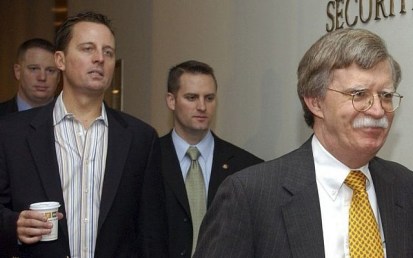
In this Nov. 11, 2006 file photo, Richard Grenell, left, walks with John Bolton, the United States ambassador to the United Nations, right, to a Security Council meeting at the United Nations headquarters in New York. (AP Photo/Osamu Honda)

“Just as a matter of empirical reality, the two-state solution is dead,” Bolton told Breitbart Radio at the time. “That’s about the only thing John Kerry came close to getting right.”

In a 2014 Op-Ed in the Washington Times titled “A ‘three-state solution’ for Middle East peace,” Bolton argued that Gaza should be given back to Egypt and the West Bank to Jordan.

“The only logic underlying the demand for a Palestinian state is the political imperative of Israel’s opponents to weaken and encircle the Jewish state, thereby minimizing its potential to establish secure and defensible borders,” he wrote. “As long as Washington’s diplomatic objective is the ‘two-state solution’ — Israel and ‘Palestine’ — the fundamental contradiction between this aspiration and the reality on the ground will ensure it never comes into being.”

A frequent commentator on Fox News, Bolton is known for his bellicose posturing on security issues. Not only has he encouraged the use of force against Iran, but also a preemptive strike against North Korea. He was also a major voice inside the George W. Bush administration in favor of the 2003 Iraq invasion.

Bolton, who’s been a resident at the conservative American Enterprise Institute since he left the Bush administration, has advocated for Israel bombing Iran to curtail its nuclear ambitions.

“Time is terribly short, but a strike can still succeed,” he wrote in an op-ed in The New York Times in May 2015. “Such action should be combined with vigorous American support for Iran’s opposition, aimed at regime change in Tehran.”

Bolton’s hiring comes a week after Trump ousted Secretary of State Rex Tillerson for CIA Director Mike Pompeo, another fierce Iran hawk.

Bolton and Pompeo will now ascend to two of the highest positions in American foreign policy making a little less than two months before the May 12 deadline when Trump has threatened to scuttle the Iran nuclear deal if Congress and European allies are unable to amend the accord to his liking.

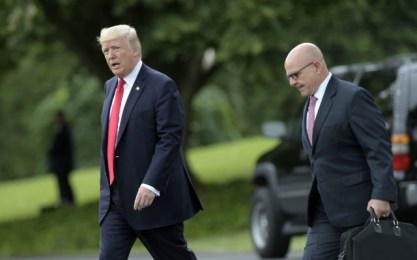
US President Donald Trump walks with National Security Adviser H.R. McMaster to Marine One on the South Lawn of the White House, June 16, 2017. (AP Photo/Susan Walsh)

Both Tillerson and McMaster were reported to be moderate voices inside the White House, each of whom encouraged the president not to rip up the landmark pact.

Earlier this year, Bolton said, “Our goal should be regime change in Iran.”

Bolton has been rumored to be a frontrunner for to replace McMaster for months. The national security adviser, unlike the secretary of state, does not require a Senate confirmation.

Left-leaning organizations immediately came out Thursday to condemn the move and warn of Bolton’s inclination for armed confrontation.

“This decision continues the crisis around President Trump’s cabinet, a move that is dangerous for America’s foreign policy and further diminishes our ability to lead,” said Diplomacy Works, a foreign policy advocacy group of former Obama-era diplomats. “Ambassador Bolton represents the worst in American foreign policy adventurism. This pick signals to the rest of the world that President Trump has no regard for diplomacy and values a political yes-man who favors military interventionism over national security expertise.”

Meanwhile, members of the Jewish right applauded Trump for picking Bolton for the role.

“John Bolton is ridiculously knowledgeable and will be a great National Security Adviser,” said Rep. Lee Zeldin, a New York Republican, in a statement.

AFP contributed to this report.

Moscow: “US attack on Damascus is imminent”

March 25, 2018

Source: Moscow: “US attack on Damascus is imminent” – DEBKAfile

Russia is claiming for the past ten days that the Trump administration is about to attack Syria because of the Assad army’s use of chemical poisons in East Ghouta. Washington has not addressed this claim one way or the other.

Tthe Russian General Staff  first warned “about an imminent attack in Syria” on Tuesday, March 13. The Chief of Russia’s General Staff, Gen. Valery Gerasimov, was quoted as saying that Russia has “reliable information about militants preparing to falsify a government chemical attack against civilians,” and warning that Russia would “respond to a US strike on Syria, if the lives of Russian servicemen were threatened, targeting any missiles and launchers involved.”

Underlying the Russian general’s warning was a suggestion that Syrian rebels fighting in Al Ghouta would, or had, faked a Syrian chemical attack on civilians as the pretext for an American attack. Then, on March 17, Gen. Sergei Rudskoi, head of the main operations for Russia’s General Staff, amplified the claim by charging that the US had sent “a fleet of strike carriers to the Mediterranean and Red Sea carrying cruise missiles.” He added details: “This force is comprised of 7,500 army personnel, an aircraft carrier, at least one cruiser, destroyers and 65 toi70 aircraft.” Actual US military movements are confirmed by DEBKAfile’s military sources.

But Russian military sources go on to state that this armada “is ready to launch roughly 400 long-range Tomahawks against a target in the Middle East on any given day.”

To meet the US war threat articulated by Moscow, DEBKAfile’s military and intelligence sources report that, last week, the Russian air force landed at its Khmeimim air base in Syria a Mi-8MTPR-1 helicopter carrying a Rychag-AV active jamming station. This electronic package is capable of detecting and suppressing the electronic command-and-control systems and radars of surface-to-air and air-to-air missiles carried by aircraft, drones, land vehicles and surface ships within a 400km radius. The Rychag-AV station can moreover suppress diverse targets simultaneously, and function on board ships, aircraft and land vehicles, as well as helicopters.

The arrival of this advanced jamming station certainly beefs up Syrian defenses against sophisticated US and Israeli attacks. There is no word on how many of these stations were shipped to Syria. If properly spaced out on Syrian soil, they would be capable of disabling US military operations right across the country, from northern Iraq to the Mediterranean, and also interfere with Israeli military activity inside its northern border.

There has been no comment from American or Israel sources either to confirm or deny the Russian claims of the past ten days of an imminent US attack in Syria. Perhaps they are waiting to see what is behind them.

Operation Orchard: Israel’s strike on the Syrian reactor

March 25, 2018

https://www.youtube.com/watch?v=5GfdH9AzAXE

From Wikipedia, the free encyclopedia:

Operation Orchard[2][3] (Hebrew: מבצע בוסתן‎, Mivtza bustan) was an Israeli airstrike on a suspected nuclear reactor[4] in the Deir ez-Zor region[5] of Syria, which occurred just after midnight (local time) on September 6, 2007.

The Israeli and U.S. governments imposed virtually total news blackouts immediately after the raid that held for seven months.[6] The White House and Central Intelligence Agency (CIA) subsequently confirmed that American intelligence had also indicated the site was a nuclear facility with a military purpose, though Syria denies this.[7][8] A 2009 International Atomic Energy Agency (IAEA) investigation reported evidence of uranium and graphite and concluded that the site bore features resembling an undeclared nuclear reactor. IAEA was initially unable to confirm or deny the nature of the site because, according to IAEA, Syria failed to provide necessary cooperation with the IAEA investigation.[9][10] Syria has disputed these claims.[11]

Nearly four years later, in April 2011, the IAEA officially confirmed that the site was a nuclear reactor.[4] The Israeli attack followed top-level consultations with the Bush Administration.

After realizing that the US was not willing to take its own military action, Prime Minister Ehud Olmert decided to adhere to the 1981 Begin Doctrine and unilaterally strike to prevent a Syrian nuclear weapons capability, despite serious concerns about Syrian retaliation. In stark contrast to the doctrine’s prior usage against Iraq, the airstrike against Syria did not elicit international outcry. A main reason is that Israel maintained total and complete silence regarding the attack, and Syria covered up its activities at the site and did not cooperate fully with the IAEA.

The international silence may have been a tacit recognition of the inevitability of preemptive attacks on “clandestine nuclear programs in their early stages.” If true, the Begin Doctrine has undoubtedly played a role in shaping this global perception.[12] According to later news reports, the raid was carried out by Israeli Air Force (IAF) 69 Squadron F-15Is,[13] F-16Is, and an ELINT aircraft; as many as eight aircraft participated and at least four of these crossed into Syrian airspace.[14]

The fighters were equipped with AGM-65 Maverick missiles, 500 lb bombs, and external fuel tanks.[2][15] One report stated that a team of elite Israeli Shaldag special-forces commandos arrived at the site the day before so that they could highlight the target with laser designators,[13] while a later report identified Sayeret Matkal special-forces commandos as involved.[16]

Why is Israel ‘dancing in the end zone’ 10 years later?

March 25, 2018

Source: Why is Israel ‘dancing in the end zone’ 10 years later? – Israel News – Jerusalem Post

When the dust settles on Israel’s admission it destroyed Syria’s nuclear reactor and all the battles for credit are forgotten, one question will still need to be answered: Why now?

BY HERB KEINON
 MARCH 23, 2018 09:15

Imagine the NFL Super Bowl for a minute. Then imagine one team winning the game and the NFL championship on a last minute 70-yard touchdown pass. Then imagine that team waiting 10 years to do their celebratory victory dance in the end zone.

That is pretty much what happened this week with the belated admission by Israel that it indeed was responsible for that attack back in September 2007 on a Syrian nuclear reactor under construction.

This admission triggered not only our own end zone chest-beating, but also something not generally seen in NFL victory dances: teammates pummeling each other over who really deserves credit for the score. Who called the play? Who read the defense? Who executed it to perfection?

When the dust settles and all the battles for credit are forgotten, one question will still need to be answered: Why now?

Why did the defense establishment – which for over a decade was determined to keep a blackout on any information coming out about the bombing from Israel – finally agree this week to lift the ban on publication of the details?

A number of ideas have been proffered over the last few days, from the far-fetched notion that it was designed to boost the sales of then-prime minister Ehud Olmert’s new memoirs, to the equally implausible notion that it was meant to boost Olmert in the public eye and perhaps even pave his way to a political comeback, to the more likely suggestion that it was designed as a message to Iran:

“Don’t test us, we have done this before, we can do it again.”

As Prime Minister Benjamin Netanyahu said in a laconic statement on Wednesday: “The government of Israel, the IDF and the Mossad prevented Syria from developing a nuclear capability. Israel’s policy has been and remains consistent – to prevent our enemies from arming themselves with nuclear weapons.”

Or, even more to the point, as Col. Amir – one of the pilots of the mission, who was quoted in Haaretz – said: “An existential threat to the State of Israel arose here and we dealt with it, the way the air force had dealt with the reactor in Iraq in the past. For me, today it connects with our ability to remove threats in distant countries in the third circle [Iran]. Since the attack in Syria, we have also improved wonderfully – in intelligence, in our range of action, in our ability to attack secretly.”

Another explanation for the timing is that the original reason for not taking responsibility for the action is no longer relevant. According to this reasoning, the original decision to remain mum was to provide Syrian President Bashar Assad with “plausible deniability”: if you don’t make a public spectacle of the attack, if you don’t rub Assad’s nose in it, if you don’t spike the ball in the end zone, he will not feel the need to react in order to save face.

A decade and a very bloody civil war later, this is no longer a consideration. Firstly, because people generally don’t take face-saving action for an event that took place more than 10 years ago, and secondly, because even if he wanted to, Assad is currently in no position to pick a fight with Israel.

One date that should be kept in mind when trying to decipher the timing of Jerusalem’s acknowledgment of the attack is May 12 – the date by which US President Donald Trump will have to decide whether to renew sanctions on Iran that were suspended with the Iranian nuclear deal in 2015.

Trump has given his European partners – France, Britain and Germany – until that day to fix the nuclear deal. If not, the US is likely to pull out of it.

The question then becomes, what will Iran do if Trump does indeed walk away from the deal?

While Netanyahu has said there won’t be much the Iranians can do if the US walks away, since their economy will suffer severely and lead to increased internal strife inside the country, the Europeans – who are currently looking at how they can fix the deal to keep Trump inside it – are saying Netanyahu’s projections are wishful thinking and that if the US cancels the deal the Iranians will make a mad dash toward the nuclear finish line.

Within this context, Israel’s very public admission of the attack in Syria sends a message to both the Europeans and the Iranians.

To the Europeans, it says: “If you want to prevent a recurrence of what happened in Syria, fix the deal and ensure that the US remains inside it so Israel won’t be forced to take action.”

And to the Iranians, the message is: “If the Americans walk out, don’t race to acquire nuclear arms, because – as the Syrian attack illustrates – we can, and we will, stop you.”

Iranians indicted for allegedly hacking hundreds of universities

March 23, 2018

By Priscilla DeGregory March 23, 2018

Source Link: Iranians indicted for allegedly hacking hundreds of universities

{Stolen info soon to be on sale to the highest bidder. – LS}

Nine Iranian nationals were indicted Friday for hacking into over 300 universities in the US and abroad to rip off academic data and intellectual property, according to a newly unsealed Manhattan federal indictment.

The men — who infiltrated 144 American universities and 176 institutions in 21 other countries — worked for the Iran-based company Mabna Institute, which carried out the cyberattacks “at the behest of the government of Iran, specifically the Islamic Revolutionary Guard Corps,” according to the court documents.

“The members of the conspiracy compromised thousands of accounts belonging to professors at victim universities and targeted academic data and intellectual property for theft,” according to the indictment, which said the hacks cost the US universities $3.4 billion.

The hackers allegedly stole 31.5 terabytes of data and intellectual property from the universities, the court documents charge.

The men also “compromised” computer networks at five government agencies, 36 private companies and two non-governmental organizations.

Trump Hints He May Break With His Generals on Iran

March 23, 2018


FILE – U.S. Air Force General John Hyten testifies in a Senate Armed Services Committee hearing on Capitol Hill in Washington, April 4, 2017.

March 20, 2018 7:45 PM Jeff Seldin via VOA

Source Link: Trump Hints He May Break With His Generals on Iran

{Trump is getting his players in order to strengthen his deal making position for upcoming in-your-face meetings with Iran. – LS}

WASHINGTON —

U.S. President Donald Trump appears increasingly willing to defy some of his top generals, as his administration grapples with how best to deal with Iran.

Trump is facing a May deadline to recertify the Iran nuclear deal, and signaled again Tuesday that he is not afraid to pull the U.S. out of the agreement unless other signatories are willing to make major changes.

“A lot of bad things are happening in Iran,” the president said during a visit to the White House by Saudi Arabia’s Crown Prince Mohammed bin Salman.

“The deal is coming up in one month, and you will see what happens,” he added.


U.S. President Donald Trump delivers remarks as he welcomes Saudi Arabia’s Crown Prince Mohammed bin Salman in the Oval Office at the White House in Washington, March 20, 2018.

Trump has long been critical of the 2015 Iran deal, also known as the Joint Comprehensive Plan of Action, which aimed to contain Tehran’s nuclear program and block the country’s pathway to building nuclear warheads.

In January, Trump said he was waiving nuclear sanctions against Iran for the “last time,” demanding U.S. lawmakers and Washington’s European allies “fix the deal’s disastrous flaws.”

But since then, top U.S. military officials have pushed back, repeatedly describing the deal as mostly beneficial, even as they continue to voice deep concerns about Tehran’s aggressive behavior across the Middle East.

“As I sit here today, Iran is in compliance with JCPOA [Joint Comprehensive Plan of Action],” the commander of U.S. Strategic Command, General John Hyten, told lawmakers on the Senate Armed Services Committee on Tuesday.
{Sorry, General. I find your statement extremely troubling. – LS}

“From a command that’s about nuclear [threats], that’s an important piece to me,” he said. “It allows me to understand the nuclear environment better.”

Hyten’s comments follow those made to the Senate Armed Services Committee last week by the commander of U.S. Central Command, which is responsible for U.S. operations in the Middle East.

“The JCPOA addresses one of the principle threats that we deal with from Iran so, if the JCPOA goes away, then we will have to have another way to deal with their nuclear weapons program,” said CENTCOM’s General Joseph Votel.


FILE – U.S. Army General Joseph Votel, commander of the U.S. Central Command, testifies during a House Armed Services Committee hearing on Capitol Hill in Washington, Feb. 27, 2018.

“Right now, I think it is in our interest,” Votel added. “There would be some concern [in the region], I think, about how we intended to address that particular threat if it was not being addressed through the JCPOA.”

Both Defense Secretary Jim Mattis and Chairman of the Joint Chiefs of Staff, General Joseph Dunford, have argued that staying in the deal is in the best interest of the U.S.

But despite having expressed confidence in his military advisers and officials early in his presidency, Trump has slowly been pushing aside those who have argued in favor of keeping the deal, most recently firing Secretary of State Rex Tillerson.

“When you look at the Iran deal, I think it’s terrible. I guess he thinks it was OK,” Trump told reporters last week after announcing Tillerson’s removal. “I wanted to break it or do something, and he felt a little bit differently.”

‘Destabilizing influence’

The man tapped to replace Tillerson, current U.S. Central Intelligence Agency Director Mike Pompeo, has gained a reputation for favoring a much tougher approach to Iran.


FILE – CIA Director Mike Pompeo speaks at a forum in Washington, Jan. 23, 2018.

“The deal put us in a marginally better place, with respect to inspection, but the Iranians have on multiple occasions been capable of presenting a continued threat,” Pompeo said during an appearance in Washington last October.

“The notion that the entry into the JCPOA would curtail Iranian adventurism or their terror threat or their malignant behavior has now, what, two years on, proven to be fundamentally false,” he added.

Those concerns, both from the U.S. intelligence community and from defense officials, have only grown.

Top defense officials have criticized Iran for what they described as malign and destabilizing activities in places such as Iraq, Syria, Yemen and even Afghanistan.

“They [Iran] are not changing their behavior,” Mattis warned during a visit to the region last week. “They’re continuing to be a destabilizing influence.”

Other defense officials said such concerns cannot be discounted when contemplating U.S. policy toward Iran.

“We are taking a comprehensive look,” chief Pentagon spokesperson Dana White told reporters last Thursday.

“We remain in the agreement, but we want our partners to understand that Iran is the source of chaos and confusion in the region,” she said. “Everywhere you look, Iran is there.”

The missing piece of the puzzle

March 23, 2018

Source: The missing piece of the puzzle – Israel Hayom

Bolton In, McMaster Out: Trump Announces John Bolton as Next National Security Advisor

March 23, 2018

by Kristina Wong

22 Mar 2018

http://www.breitbart.com/big-government/2018/03/22/bolton-in-mcmaster-out-trump-announces-john-bolton-as-next-national-security-advisor/

AP Photo/Rainier Ehrhardt, AP Photo/Susan Walsh, Breitbart News Edit

President Donald Trump announced on Thursday that he is appointing Amb. John Bolton as his new national security advisor, ending weeks of speculation he would be tapped for the job.

Trump made the announcement via Twitter:

Bolton’s appointment comes after months of speculation that current National Security Advisor H.R. McMaster was on his way out, after repeated reports that he and the president were not close. It also comes after someone leaked to the press that the president congratulated Putin on his election win after a briefing card had included the note: DO NOT CONGRATULATE.

According to a White House official, the president and McMaster had “mutually agreed” on his resignation, and the two had been discussing it for “some time.” However, the timeline was “expedited as they both felt it was important to have the new team in place, instead of constant speculation.”

“This was not related to any one moment or incident, rather it was the result of ongoing conversations between the two,” the official said.  Trump announced last week that Secretary of State Rex Tillerson was resigning, and CIA Director Mike Pompeo would take his place.

McMaster, a lieutenant general, said in a statement that he is requesting retirement from the Army, and will leave public service.

“I am thankful to President Donald J. Trump for the opportunity to serve him and our nation as national security advisor. I am grateful for the friendship and support of the members of the National Security Council who worked together to provide the President with the best options to protect and advance our national interests,” he said.

Trump praised McMaster in a statement.

“H.R. McMaster has served his country with distinction for more than 30 years. He has won many battles and his bravery and toughness are legendary. General McMaster’s leadership of the National Security Council staff has helped my administration accomplish great things to bolster America’s national security. He helped develop our America First National Security Strategy, revitalize our alliances in the Middle East, smash ISIS, bring North Korea to the table, and strengthen our nation’s prosperity. This work and those achievements will ensure that America builds on its economic and military advantages. I thank General McMaster and his family for their service and wish them the very best.”

White House Chief of Staff John Kelly called McMaster a “true soldier-scholar.”

“His impact on his country and this government will be felt for years to come,” he said.

Bolton was spotted entering the West Wing late Thursday afternoon:

Bolton last served in the George W. Bush administration as the U.S. Ambassador to the United Nations. Bolton is a senior fellow at the conservative American Enterprise Institute and a frequent Fox News commentator. He has also been a regular guest on Breitbart News Daily.

He spoke with Breitbart News Daily on Thursday morning, discussing the Trump administration’s actions against unfair trade practices by China.