Archive for March 2018

Water Crisis Spurs Protests in Iran

March 29, 2018

Babak Dehghanpisheh March 29, 2018 via Reuters

Source Link: Water Crisis Spurs Protests in Iran

{Trouble in paradise. – LS}

BEIRUT (Reuters) – A number of protests have broken out in Iran since the beginning of the year over water, a growing political concern due to a drought which residents of parched areas and analysts say has been exacerbated by mismanagement.

The demonstrations have been relatively small, sporadic and limited to towns around the central city of Isfahan and Khuzestan province in the west. But they have highlighted an issue that played a role in earlier unrest and the authorities have cracked down, while recognizing the need for change.

In early March, the turnout was light in a town near Isfahan, with dozens of farmers chanting the tongue-in-cheek slogan “Death to farmers, long live oppressors!”, according to online videos. A week later the protests became more tense.

Dozens of riot police on motorcycles faced off against farmers in the same town, Varzaneh, another video showed. Smoke swirled around the protesters and the person filming said tear gas was being fired. A second person reported clashes. Police in the city of Isfahan were not immediately available to comment.

“What’s called drought is more often the mismanagement of water,” said a journalist in Varzaneh, who asked not to be identified because of the sensitivity of the subject.

“And this lack of water has disrupted people’s income.”

Farmers accuse local politicians of allowing water to be diverted from their areas in return for bribes.

While the nationwide protests in December and January stemmed from anger over high prices and alleged corruption, in rural areas, lack of access to water was also a major cause, analysts say.

At least 25 people were killed and, according to one parliamentarian, up to 3,700 people were arrested, the biggest challenge yet for the government of president Hassan Rouhani, who was reelected last year.

DISPLACED

In Syria, drought was one of the causes of anti-government protests which broke out in 2011 and led to civil war, making the Iranian drought particularly sensitive.

Approximately 97 percent of the country is experiencing drought to some degree, according to the Islamic Republic of Iran Meteorological Organization. Rights groups say it has driven many people from their homes.

“Towns and villages around Isfahan have been hit so hard by drought and water diversion that they have emptied out and people who lived there have moved,” said Hadi Ghaemi, the executive director for the Center for Human Rights in Iran (CHRI), a New York-based advocacy group.

“Nobody pays any attention to them. And people close to Rouhani told me the government didn’t even know such a situation existed and there were so many grievances.”

Rouhani and Iran’s Supreme Leader Ayatollah Ali Khamenei mentioned drought as a problem that needs to be addressed in the country during their speech last week commemorating Nowruz, the Iranian new year, while condemning “lawlessness and violence”.

An ad running on state TV which encourages Iranian citizens to conserve water shows a man sitting in a chair in the middle of a desert with the slogan, “Drought is closer than you think”.

A United Nations report last year noted, “Water shortages are acute; agricultural livelihoods no longer sufficient. With few other options, many people have left, choosing uncertain futures as migrants in search of work.”

In early January, protests in the town of Qahderijan, some 10 km (6 miles) west of Isfahan, quickly turned violent as security forces opened fire on crowds, killing at least five people, according to activists. One of the dead was a farmer, CHRI said, and locals said water rights were the main grievance.

Videos posted on social media show protesters chanting outside a police station and throwing Molotov cocktails at the building, one of the most violent incidents documented during the nationwide protests.

A journalist in Qahderijan who asked not to be identified because of the sensitivity of the issue said the attack on the police station was not the right thing to do but that water mismanagement had deprived farmers of their livelihoods.

SECURITY

Hassan Kamran, a parliamentarian from Isfahan, publicly criticised energy minister Reza Ardakanian this month, accusing him of not properly implementing a water distribution law.

“The security and intelligence forces shouldn’t investigate our farmers. The water rights are theirs,” he told a parliamentary session.

In early March, Ardakanian set up a working group comprising four ministers and two presidential deputies to deal with the crisis.

Since the January protests, Rouhani has repeatedly said the government will do what it can to address grievances. But there is no quick fix for deeply rooted environmental issues like drought, observers say.

“These are local grievances but the solutions are with the national government,” said Tara Sepehri Far, Iran researcher for Human Rights Watch, adding that the government had limited power and widespread corruption.

Rouhani’s office was not immediately available to comment.

Iranian security forces are aware of the potential for water issues to cause instability. A senior Revolutionary Guards commander, Yahya Rahim Safavi, noted in a public speech in late February that water will play a key role for both the Islamic Republic’s national and regional security.

Environmentalists have found themselves in the firing line.

In late January, Kavous Seyed-Emami, the director of the Persian Wildlife Heritage Foundation, and six other environmentalists were arrested.

Two weeks later, authorities said Seyed-Emami had committed suicide in jail after confessing to being a spy for the United States and Israel. His family has denied the allegation.

State TV later aired a report saying Seyed-Emami and his colleagues were telling Iran’s enemies the country could no longer maintain domestic agriculture production because of a water shortage and needed to import food.

In late February, three more environmentalists were arrested and three weeks ago, Seyed-Emami’s wife was prevented from leaving Iran, according to family members.

“Public opinion has become sensitized to environmental issues,” said Saeed Leylaz, a Tehran-based economist and political analyst. “So the government may see the organizations and institutions who work on environmental issues as problematic.”

New Palestinian Authority Budget Continues Paying Salaries to Terrorists and Their Families

March 28, 2018

New Palestinian Authority Budget Continues Paying Salaries to Terrorists and Their Families

Photo Credit: MEF

Taylor Force likely won’t be the last American killed as a result of Palestinian terror incitement.

It was revealed on Wednesday that the new Palestinian Authority budget continues paying salaries to terrorists and families of terrorists, and was released around the same time as the U.S. passed the Taylor Force Act, which cuts off nearly all US aid to the Palestinian Authority if it continues its ‘pay to slay’ policies encouraging bloodshed and murder. The PA even reversed a policy of hiding the payments and returned to directly and openly paying the Commission of Prisoners, which pays the salaries to terrorist prisoners.

After studying the recent PA budget, Director of Palestinian Media Watch (PMW) Itamar Marcus and Palestinian Media Watch’s Head of Legal Strategies Lt. Col. (res.) Maurice Hirsch brought it to the attention of Knesset Israel Victory Caucus (KIVC) Chair MK Oded Forer to collaborate with his counterparts in the Congressional Israel Victory Caucus (CIVC), especially Rep. Doug Lamborn, who introduced the Taylor Force Act, to bring this to the attention of the American authorities that can trigger the clauses in the law.

 “That the Palestinian Authority brazenly and openly boasts of its payments to terrorists as the Taylor Force Act was being passed into law is Mahmoud Abbas’ official response to it and is a slap in the face to the U.S.,” MK Forer said. “This can not go unanswered and amply demonstrates the necessity of the Taylor Force Act and a similar law we will pass in the Knesset. The outrageous and shameless commitment to murder and the funding apparatus surrounding it are signs that the Palestinian Authority leadership feels immune from international reproach for its bloody policies, and this must stop immediately.”

MK Forer communicated this outrage to his counterpart Rep. Lamborn and called on the two caucuses to work together to put an end to the impunity of the PA for its rewarding terror.

“The Taylor Force Act was built precisely to put an end to this policy,” Rep. Lamborn said. “It seems like the Palestinian Authority did not receive the message we tried to send by passing this law so now we have to ensure that the U.S. will slash its funding to it. American taxpayer’s money should no longer be used to provide benefits and enticements for the murder of Israelis and others. We will continue to work with both our CIVC and KIVC allies to ensure that this terrible policy becomes a thing of the past.”

According to PMW, 7.47% of the PA’s operational budget is for salaries to terrorist prisoners, released terrorists, and payments to families of “Martyrs” and wounded. The PA’s budget categories rewarding terror equal 44% of anticipated foreign aid.

“For years the Palestinian Authority has promoted terror, glorified terror and rewarded terror,” said PMW Director Marcus, “and tragically the donor countries have indirectly funded these activities by funding the PA. PMW welcomes the new approach by the members of the Israel Victory Caucuses in the US and in Israel. The first step to defeating Palestinian terror is to stop paying for it.”

According to the Taylor Force Act, within 30 days the U.S. State Department must certify to Congress whether the PA and PLO have stopped the payments to terrorists and their families, the so-called ‘pay-for-slay program’ and repealed the pay-for-slay laws. No later than 45 days after enactment (i.e. 15 days after the above certification), State must report to Congress an explanation of why State was unable to certify PA/PLO compliance, plus the total amount of funds to be withheld.

The two caucuses will be working together to highlight Palestinian non-compliance and the continuation of the PA’s policy of providing payments to terrorists and their families.

Security forces prepare for Hamas mass march on Israel

March 28, 2018

March 22, 2018

Israeli forces are preparing for Hamas’ mass marches on Israel’s border, which could result in many civilian casualties. 

By: Aryeh Savir, World Israel News

Security forces prepare for Hamas mass march on Israel

Palestinians demonstrate on Israel’s border. (Abed Rahim Khatib/Flash90)

The IDF is preparing for the Hamas-led mass march on Israel’s southern border which they have called for next Friday.

Hamas has called for “all Palestinians” to take part in a mass protest, another “Friday of Rage,” to mark the 100th day since President Donald Trump recognized Jerusalem as Israel’s capital and pledged to relocate the US embassy to the city.

Hamas wants the protests to begin on March 30 and to last for several weeks, with thousands of Palestinians moving to tent cities to be built along Israel’s border.

 Hamas also called for Palestinians to stage the protests in the Judea and Samaria area after Friday prayers.

Hamas stated such protests would continue until the US’ recognition of Jerusalem as the capital of Israel “is undermined.”

Israel is preparing for a scenario in which tens of thousands of Gazans will march to Israel’s border fence with Gaza, possibly attempting to take it down and march into Israel.

“We want to frighten the Israelis with the images of massive crowds of people who peaceably gather and sit close to the border,” Hamas spokesman Ahmed Abu Retaima told Bloomberg this week. “We are working to bring out more than 100,000 people for the march.”

The Hamas march is “clearly an attempt to break through the fences, and they are ready to tolerate losses,” Ehud Yaari, an international fellow at the Washington Institute for Near East Policy, told Bloomberg.

 The IDF will attempt to minimize casualties by deploying non-lethal crowd dispersal ordinance, including drones that will drop tear gas canisters on the crowds.

Israel fears a situation in which dozens of Palestinians will cross the border and enter Israeli territory, a situation which could result in many civilian casualties.

 Such violent protests on Israel’s border with Gaza have occurred on Fridays over the past months, with several bombs being placed and detonated against Israeli forces, using the cover of the demonstrations to do so.

Yousef Munayyer, an analyst at the Arab Center in Washington, said the border march will force Israel into an unpleasant choice.

“You’re essentially talking about the Israeli military lining up like a firing squad against a wall of Palestinians civilians walking toward the fence,” Munayyer told Bloomberg.

“I don’t think that’s the optics the Israelis want to have out there,” he remarked. However, it appears that Hamas is seeking exactly such a scenario, to exploit the death of its civilians at Israel’s expense and to generate more violence in the region.


‘Cant We Talk About this?’ Ad Campaign

March 28, 2018
Pamela Geller, Organizer
$20,658 USD
raised by 315 people in 7 months
41% of $50,000 goal
Our Story

We bought a hundred buses and a series of billboards in New York City’s Time Square – we need your support to pay for the ad campaign and production costs of the film.

Please give generously. No one dares do the work we do.

AFDI President Pamela Geller said in a statement: “In this film, we’re setting the record straight about our Garland free speech event, at which we were not only targeted by Islamic jihadis but apparently by the FBI as well. But we’re doing much more as well: we’re telling the whole, as-yet-untold truth about the war on free speech.”

Geller added: “Hollywood will never tell this story. The media will never tell this story. Our public schools and universities will never teach our children what happened. The truth must be told.”

Can’t We Talk About This? is a follow-up to AFDI’s acclaimed 2011 documentary, The Ground Zero Mosque: The Second Wave of the 9/11 Attacks. This much-needed new web series gives viewers the inside story of what happened in Garland and why, and lays out the full and appalling details of the all-out assault on the freedom of speech that is taking place today – and why this may be the most crucial battleground today in the war for the survival of the United States of America as a free republic.

The web series also features seldom-seen news footage and revealing details not only of the Garland event and the jihad killers who wanted to wage jihad there, but also of the many other battlegrounds in the war for free speech that led up to the Garland attack, including the death fatwa issued in 1989 by the Islamic Republic of Iran against Salman Rushdie for his supposed blasphemy in The Satanic Verses; the assassination of Theo Van Gogh by a Muslim on an Amsterdam street in November 2004 for his alleged blasphemy; the Dutch newspaper Jyllands Posten’s cartoons of Muhammad, published in September 2005, which touched off international riots and killings by Muslims – and most disturbing of all, calls in the West for restrictions on the freedom of speech; the Organization of Islamic Cooperation’s years-long struggle at the UN to compel the West to criminalize “incitement to religious hatred” (a euphemism for criticism of Islam); and the U.S. under Obama signing on to UNCHR Resolution 16/18, which calls on member states to work to restrict incitement to religious hatred.

Can’t We Talk About This? covers lesser-known skirmishes in the war against free speech as well, such as Seattle cartoonist Molly Norris’ “Everybody Draw Muhammad Day” in 2010, after which Norris was forced to go into hiding and change her identity after threats. And it traces what immediately led up to the Garland event – most notably, the January 2015 massacre of Muhammad cartoonists at the offices of the Charlie Hebdo satirical magazine in Paris and the subsequent “Stand with the Prophet” event in Garland, at which Muslim groups gathered in the wake of that massacre not to defend free speech, but to complain about “Islamophobia,” while AFDI members and supporters protested outside.

Geller explained: “We’ll set out the media firestorm that followed the Garland event, as well as the attempts to kill me, and explain why the event’s detractors were all missing the point: the freedom of speech doesn’t apply only if you like the message; it applies to everyone. And if it is gone, so is a free society.”

Can’t We Talk About This? tells the whole horrifying story of how advanced the Islamic war on free speech is, and how close leftist and Islamic authoritarians are to final victory and the death of the freedom of speech and free society

Israel deploys 100 sharpshooters on Gaza border for Palestinian protests

March 28, 2018

By REUTERS March 28, 2018 14:30 via Jerusalem Post

Source Link: Israel deploys 100 sharpshooters on Gaza border for Palestinian protests

{Just in case things to asunder, add a little Israeli thunder. – LS}

“We have deployed more than 100 sharpshooters who were called up from all of the military’s units, primarily from the special forces.”

JERUSALEM/GAZA – The Israeli military has deployed more than 100 sharpshooters on the Gaza border ahead of a planned mass Palestinian demonstration near the frontier, Israel’s top general said in an interview published on Wednesday.

Organizers hope thousands in Gaza will answer their call to flock, starting on Friday, to tent cities in five locations along the sensitive border in a six-week protest for a right of return of Palestinian refugees to what is now Israel.

Citing security concerns, the Israeli military enforces a “no go” zone for Palestinians on land in Gaza adjacent to Israel’s border fence.

Lieutenant-General Gadi Eizenkot, the military’s chief of staff, told the Yedioth Ahronoth daily that the military would not allow “mass infiltration” or tolerate damage to the barrier during the protests.

“We have deployed more than 100 sharpshooters who were called up from all of the military’s units, primarily from the special forces,” Eizenkot said in the interview. “If lives are in jeopardy, there is permission to open fire.”

Israeli soldiers are confronted by frequent violent Palestinian protests along the Gaza border and have used tear gas, rubber bullets and live ammunition against demonstrators whom the military said hurled rocks or petrol bombs at them.

Organizers said the protest is supported by several Palestinian factions, including Gaza’s dominant Islamist Hamas movement that is dedicated to the destruction of Israel.

RISING TENSION

Israeli cabinet minister Tzachi Hanegbi, speaking on Israel Radio, said Hamas had avoided direct conflict with Israel since the end of the 2014 Gaza war.

But he said that pressure Hamas was now feeling from Israel’s destruction of some of its network of attack tunnels near the border, coupled with harsh economic conditions in Gaza, were “a formula for rising tension.”

The start of the demonstration was symbolically linked to what Palestinians call “Land Day,” which commemorates the six Arab citizens of Israel killed by Israeli security forces in demonstrations in 1976 over land confiscations. The week-long Jewish holiday of Passover, when Israel heightens security, also begins on Friday.

The protest is due to end on May 15, the day Palestinians call the “Nakba” or “Catastrophe”, marking the displacement of hundreds of thousands of Palestinians in the conflict surrounding the creation of Israel in 1948.

Palestinians have long demanded that as many as five million of their compatriots be granted the right to return. Israel rules this out, fearing an influx of Arabs that would eliminate its Jewish majority. Israel argues the refugees should resettle in a future state that the Palestinians seek in the Israeli-occupied West Bank and the Gaza Strip.

Informant provided FBI evidence Russia aided Iran nuclear program during Obama years

March 27, 2018

By John Solomon and Alison Spann – 03/26/18 06:39 PM EDT via The Hill

Source Link: Informant provided FBI evidence Russia aided Iran nuclear program during Obama years

{It figures. – LS}

A former undercover informant says he provided evidence to the FBI during President Obama’s first term that Russia was assisting Iran’s nuclear program even as billions in new U.S. business flowed to Moscow’s uranium industry.

William Douglas Campbell told The Hill his evidence included that Russia was intercepting nonpublic copies of international inspection reports on Tehran’s nuclear program and sending equipment, advice and materials to a nuclear facility inside Iran.

Campbell said Russian nuclear executives were extremely concerned that Moscow’s ongoing assistance to Iran might boomerang on them just as they were winning billions of dollars in new nuclear fuel contracts inside the United States.

“The people I was working with had been briefed by Moscow to keep a very low profile regarding Moscow’s work with Tehran,” Campbell said in an interview. “Moscow was supplying equipment, nuclear equipment, nuclear services to Iran. And Moscow, specifically the leadership in Moscow, were concerned that it would offset the strategy they had here in the United States if the United States understood the close relationship between Moscow and Tehran.”

A spokesman for former President Obama did not return multiple requests for comment.

Congressional Democrats have written a memo questioning Campbell’s credibility and memory while Republicans say his story calls into question the favorable treatment the Obama administration gave Russia.

Notes of Campbell’s FBI debriefings show he reported in 2010 that a Russian nuclear executive was using “the same kind of payment network” to move funds between Russia and Iran as was used to launder kickbacks between Moscow and Americans.

Campbell worked from 2008 to 2014 as an undercover informant inside Rosatom, Russia’s state-controlled nuclear giant, while posing as a consultant. He helped the FBI put several Russian and U.S. executives in prison for a bribery, kickback, money laundering and extortion scheme.

He said he became concerned the United States was providing favorable decisions to the Russian nuclear industry in 2010 and 2011 — clearing the way for Moscow to buy large U.S. uranium assets and to secure billions in nuclear fuel contracts — even as he reported evidence of Moscow’s help to Iran.

“I got no feedback. They took the reports and the reports, I assume, went to specific people assigned to analyze the reports and that was the last I heard of it,” he said.

In 2012, FBI agents asked Campbell to press a top Russian nuclear executive about the Iran assistance, providing a list of detailed questions. The Russians became suspicious about Campbell’s inquiries and fired him from his consulting job, he said

“It raised a red flag almost immediately and within a matter of weeks thank God I was out of harm’s way,” he said.


ISIS: Surging Again in Syria?

March 27, 2018

The Middle East After the Defeat of the Islamic State

March 27, 2018

By Daniel Byman Tuesday, March 27, 2018 via Lawfare

Source Link: The Middle East After the Defeat of the Islamic State

{When the smoke clears, the people must be served. – LS}

The collapse of the Islamic State’s caliphate and the military campaign that drove the group underground is a win for the Trump administration, the United States and the world as a whole. Even by the standards of terrorist groups, the Islamic State is bloody, extreme and toxic. However, even if the Islamic State isn’t revived——the Middle East as a whole is likely to remain broken. The region will still suffer massive civil wars, jihadist terrorism, a lack of regime legitimacy, economic weakness, and constant meddling by neighboring powers. Moreover, the Islamic State’s defeat may make several problems worse, or at least more complex.

Let’s start with some good news. Should peace negotiations in the Syrian civil war start to gain traction, the destruction of the Islamic State removes, or at least weakens, an important “spoiler”—the group would have opposed any negotiated peace and would have fought against any actor, including other Islamists, who would consider negotiations. Negotiations, however, have a sad history in the Syrian conflict, and the Assad regime, along with its Russian and Iranian backers, appears bent on winning rather than willing to accept some sort of deal.

Before the Islamic State declared a caliphate in 2014—and otherwise electrified the broader jihadist movement—terrorist groups ran amok in the Middle East, and they persist despite the Islamic State’s decline several years later. Al-Qaeda in the Arabian Peninsula plagues Yemen, al-Qaeda in the Islamic Maghreb is a force in Algeria and neighboring states, is deeply embedded within the Syrian opposition, and a host of smaller groups operate in these and other countries. Some that al-Qaeda has used the Islamic State’s ascendance to quietly rebuild and now poses a serious threat.

The fall of the Islamic State will likely aid these groups as would-be Islamic State recruits and funders will support others. In addition, the Islamic State often acted as a divisive force within the jihadist movement, fighting as much with rival groups as against the governments it ostensibly opposed. Its collapse may strengthen unity within the overall jihadist movement and allow these groups to divert attention to new targets.

However, no group would likely assume overall leadership of the jihadist movement, and none would match the appeal of the Islamic State. The al-Qaeda core led by Ayman al-Zawahiri has been for several years, its leadership decimated by drone strikes and arrests. In response, al-Qaeda delegated more authority to its regional branches, hurting its global image when they killed Muslim civilians or otherwise discredited the cause. Many regional groups endorse at least part of what al-Qaeda embraces, but their regionalism limits their broader appeal: Al-Qaeda in the Arabian Peninsula, for example, will not inspire Maghrebis, while the more limited horizons of these groups are unlikely to attract the hordes of Europeans, central Asians, and others who flooded to the Islamic State’s ranks during the 2013–2016 period.

From the U.S. perspective, these shifts represent positive developments: The jihadist groups will weaken and focus more locally and regionally. However, the groups will not disappear, and some may become stronger.

Regimes in the Arab world suffer from a deep legitimacy crisis. With the , no government maintains even a hint of a popular mandate. In the past, regimes in the region from their revolutionary legacies and social and economic growth. These sources have dried up. The anti-colonial struggles are a distant memory for even older citizens of the Middle East. Rather, such “republican” regimes are military dictatorships with only a hint of representative window dressing. Arab monarchies enjoy slightly greater legitimacy from their traditions and more obvious succession mechanisms. However, much of their survival depended on their successful transformation of their societies due to oil wealth, foreign support, or other forms of “rents” that enabled them to greatly improve the lives of their citizens. In the last fifty years, life expectancy in Saudi Arabia increased from nearly 46 years to 75 years, and primary school completion rates increased by 172 percent from 1979 to 2015. However, a generation has emerged accustomed to some degree of wealth and social services, and indeed they enjoy fewer opportunities than their parents who grew up when oil price surges could be spent on a smaller population. The governments all perform poorly in bolstering economic growth and providing services, further decreasing their legitimacy. This lack of legitimacy led to the “Arab Spring” in 2011, the revolutions’ rapid spread, and the civil wars that often followed.

The collapse of the Islamic State may highlight and even exacerbate the legitimacy deficit. Area regimes have pointed to civil wars and the Islamic State’s excesses as proof of the danger of revolution and even reform. With this threat diminished, area regimes will have fewer excuses for their own failures.

Perhaps the biggest change in the region would be a further U.S. withdrawal from the Middle East. The threat of Islamic State terrorism motivated the Obama administration, which was eager to avoid the Middle East quagmire, to intervene militarily and engage in high-level diplomacy. The threat also motivated the Trump administration to continue those efforts. Even then, both administrations tried to keep their distance from the region, rejecting calls for larger interventions or sustained diplomatic efforts to end the wars. The collapse of the Islamic State diminishes the rationale for the U.S. military presence particularly in Syria but also in Iraq. President Trump also seems opposed to a massive intervention in Syria, perhaps because it would h.

Even if opportunities for peace arise in Yemen or Syria, or if a miracle happens and the Israeli-Palestinian conflict is again ripe for resolution, Washington is unlikely to seize the opportunity. The Trump administration’s focus on “American first” would suggest that negotiating political settlements no longer is a U.S. national interest. In addition, U.S. bureaucratic weakness will make it less likely to negotiate effectively. These weaknesses include the dismantling of the State Department, the refusal to nominate or appoint key positions through the agencies, and the Trump administration’s difficulty in coordinating policy across government. Washington would also be less likely to act as the negotiator to restrain regional allies from fighting each other or intervening in ways that exacerbate existing conflicts—a shift that U.S. policy toward the dispute between Qatar and its neighbors and regarding Turkey’s intervention in Syria suggests is already underway.

Instead, the absence of perceived threats allows other parts of the world—or problems at home—to take precedence. Whether this is the rise of China, a more aggressive Russia, or simply a desire to keep American forces and dollars out of a perennial trouble spot, many American leaders in both political parties would see little reason to increase or even sustain U.S. involvement in the Middle East.

Although the enduring collapse of the Islamic State is a step forward, the Middle East’s troubles run deep, and new dangers will likely emerge or worsen. From an American point of view, much depends on defining U.S. interests. Washington would have a greater ability to wash its hands of a troubled region, but such a move may increase the region’s many tribulations.


Hamas fires rockets into Israel, UN demands Israel pay for damage in Gaza

March 27, 2018

By – on

Hamas fires rockets into Israel, UN demands Israel pay for damage in Gaza


Hamas is launching rockets into Israel, Israelis are running to shelters, and the UN is hounding Israel to pay for damage in Gaza that came about because Hamas deliberately launched attacks against Israel from civilian areas.

There is NO end to the UN’s anti-Semitic bias. Why is Israel still part of the UN at all?

Yet just days ago, CNN “journalist” Andrew Kaczynski was hitting John Bolton for agreeing with me that the UN was anti-Semitic. This is what passes for “journalism” today.

“Israel needs to pay for damage to Gaza facilities, UN says,” by Tovah Lazaroff and Herb Keinon, Jerusalem Post, March 27, 2018:

United Nations has demanded that Israel pay compensation for damage done to seven of its Gaza facilities by the IDF during the 2014 war between Israel and Hamas.

“On 22 March, the UN submitted to the Ministry of Foreign Affairs of Israel a claim for reimbursement for the losses that the UN had sustained in seven incidents in 2014,” UN spokesman Farhan Haq told The Jerusalem Post in response to an email query.

The UN “also submitted a claim for the losses sustained by the dependents of one of its staff members who was killed in one of the incidents,” Haq said.

A UN board of inquiry looked “into the matter found that the seven incidents in which UN premises were hit were all attributable to the IDF,” he said, adding that the board had finished its work in February 2015.

Israel’s Mission to the UN in New York said it had received a demand for $528,725 for the facilities and $64,449 for the death.

The question of compensation had been a bone of contention between Israel and the UN when the board of inquiry examined the incidents, particularly because Israel has claimed that Hamas hid weapons in weapons in UN facilities and attacked its force from or near those facilities.

The facilities had also served as emergency shelters for Palestinians in Gaza during the war and as such, were supposed to be immune from IDF shelling.

Ambassador to the UN Danny Danon said it was “unacceptable” that the organization should make demands for compensation from Israel, and not from Hamas.

“Everyone knows our intention was to protect our citizens, and not harm anyone else, while Hamas uses UN facilities to hide behind,” Danon told the post, noting the terrorist tunnels built underneath UN schools.

“The blame should go on Hamas,” he said.

“Israelis Run to Bomb Shelters as Iron Dome Rockets Launched Around Gaza,” by Avi Abelow, Israel Unwired, March 26, 2018 (thanks to David):

Last night Israelis on the Gaza border were surprised to hear air raid sirens go off, warning them to run to their bomb shelters. Israel then launched Iron Dome rockets to shoot down the projectiles and protect Israeli citizens.

Thankfully no rockets were fired into Israel and nobody was injured.

Israeli citizens from various Southern communities recorded the rockets being launched, before running to their shelters.

What Happened?

It ends up that Hamas did not shoot a barrage of rockets at Israel. Rather, Hamas was conducting a live-fire drill, which mostly consisted of machine gun fire as well as rocket fire.

The IDF also responded to the Hamas drill with tank shells fired on Hamas posts in Northern Gaza….

‘I’ve got your back’: How Israel scored U.S. support for bombing Syria 

March 26, 2018

Source: ‘I’ve got your back’: How Israel scored U.S. support for bombing Syria – Israel News – Jerusalem Post

Bush looked intently at Olmert: “I didn’t think you would have the ‘courage’ to do it, Ehud.”

BY MIKE EVANS
 MARCH 26, 2018 08:15

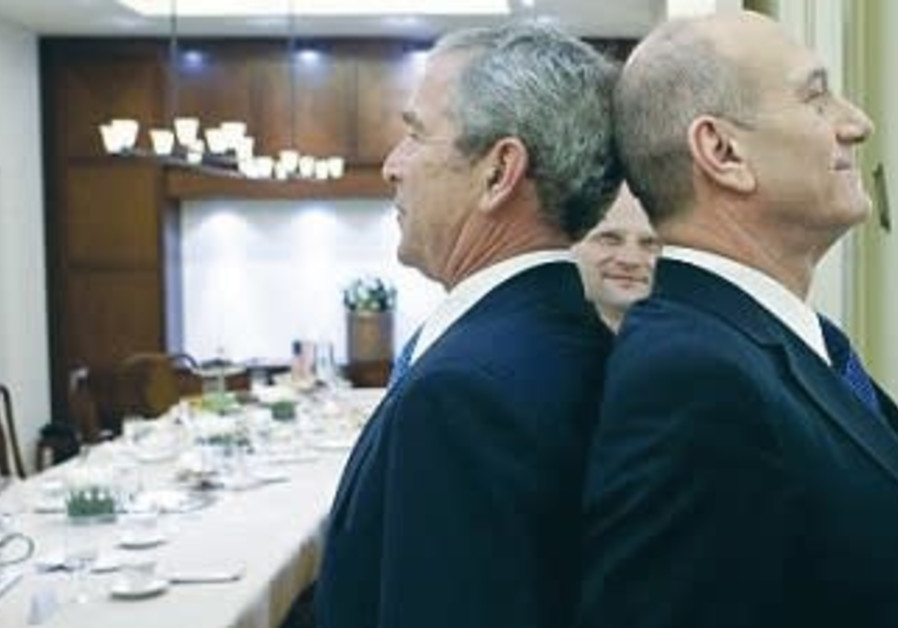
Former president George W. Bush and former prime minister Ehud Olmert meet at the White House, 2008

 Former president George W. Bush and former prime minister Ehud Olmert meet at the White House, 2008. (photo credit: JASON REED/REUTERS)

The two leaders sat in the private residence at the White House: President George W. Bush and President Ehud Olmert.

Both held lit cigars in celebration of the bombing of the Syrian reactor. Bush looked intently at Olmert: “I didn’t think you would have the ‘courage’ to do it, Ehud.” Olmert responded, “I told you I would do it.” Bush responded, “Well, at least I’m taller than you, Ehud.”

Like two little boys, the two men stood back-to-back in a photo-op attempt to measure their height.

George Bush and Ehud Olmert (credit: Eric Draper)

George Bush and Ehud Olmert (credit: Eric Draper)

I first saw the picture when it stood for a time on a credenza behind Olmert’s desk.

It was signed by President Bush with the words, “I’ve got your back.”

The scenario began on September 6, 2007, at an eastern Syria complex which allegedly housed a nuclear reactor.

It was being built with the aid of the North Koreans, according to The New Yorker.

The attack on the Syrian site was the result of a raid that had taken place in Vienna months earlier and that which Israel has never taken responsibility for. According to former Jerusalem Post editor David Makovsky, writing in The New Yorker in 2012, Mossad agents had dared to infiltrate the home of Ibrahim Othman, the chief of the Syrian Atomic Energy Commission. Makovsky wrote: “Othman was in town attending a meeting of the International Atomic Energy Agency’s board of governors, and had stepped out. In less than an hour, the Mossad operatives swept in, extracted top-secret information from Othman’s computer, and left without a trace.”

As a result, the Mossad learned that apparently the rumors of a nuclear reactor being erected in Syria were true. The decision-making process to demolish the Syrian reactor began with what would be a battle between two Ehuds: prime minister Olmert and defense minister Ehud Barak. Barak charged Olmert with being too precipitous and not making proper preparations, while Barak thought the prime minister was overly-enthusiastic.

While the two men debated the incursion, Olmert took the unprecedented step of contacting Bush to seek US assistance. Bush was aware only of a “well-hidden facility in eastern Syria” and declined American aid. He felt there was no well-defined rationale for an attack.

In a meeting with prime minister Olmert, he told me Bush had offered the services of then-secretary of state Condoleezza Rice to try to work out a diplomatic solution to the problem. Olmert said his response was, “We don’t need diplomacy. I need you to take it out – or I will.”

When Bush declined, Olmert gave the green light.

The prime minister chose, however, to follow in the footsteps of Menachem Begin, who ordered the destruction of Iraq’s Osiris reactor in 1981. He made two slight deviations: Olmert sought input from President Bush, and then after the fact chose not to inform the entire world of Israel’s attack.

When the Israel Air Force leveled the site northwest of Damascus during the nighttime hours of September 6, 2007, worldwide awareness was centered on the fact that Syria had nuclear ambitions rather than on the means of the destruction.

Israel’s resolve to create an aura of obscurity around the incursion was an effort to maintain Syrian President Bashar Assad’s stature while deterring a retaliatory strike. With over a decade of hindsight, it seems Olmert was correct in making that choice: war was averted, and Israel sustained no losses.

Apart from the obvious contentious responses from Iran and North Korea, global leaders maintained silence.

Today, the international community can look back with gratitude to the Israelis for eliminating what would have been an even greater threat from Islamic State had that terrorist group been able to secure nuclear devices from either Iraq or Syria.

In subsequent years, data emerged regarding the Israeli mission. As the aircraft completed their task, one simple word, “Arizona,” was whispered over the airwaves. It was a confirmation that the mission had been completed, the site destroyed, and not one Israeli pilot had been lost. When that was conveyed to prime minister Olmert, he sent a communiqué to Prime Minister Recep Tayyip Erdogan of Turkey informing him of the circumstances surrounding the attack and asking him to apprise President Assad in Syria. Regardless of the wording of the dispatch, the message was, “Don’t build another nuclear plant.”

The Syrian strongman was caught in what some would call “a rock and a hard place.”

He could not readily decry Israel’s destruction of a nuclear reactor that he avowed was non-existent. Silence was also exercised by Olmert and the Israelis. According to the Syrian Arab News Agency, the IAF simply “dropped some ammunition” and returned to Israeli airspace, and erroneously commented that no damage had been done.

Since the Syrian attack in 2007, Israel had been reticent to announce security strikes beyond its boundaries. Such occurrences are often reported by foreign entities that have “somehow” attained video recordings or photographs.

An ambiguous statement may be forthcoming from Israeli sources, but details are generally omitted.

During the past several years, there have been reports of numerous Israeli attacks inside Syria reported by foreign news sources. The Israelis have assumed responsibility for a few incidents, and even when one of their F-16s was shot down in February 2018, it had little, if any, effect on Israel’s determination to protect its homeland.

The author is a No. 1 New York Times bestselling author with 80 published books. He is the founder of Friends of Zion Museum in Jerusalem of which the late president Shimon Peres, Israel’s ninth president, was the chairman.