Archive for February 2018

Erekat says US is pushing a Palestinian ‘coup,’ tells Nikki Haley to ‘shut up

February 4, 2018

Top PLO official rails against the Trump administration for criticisms of PA President Mahmoud Abbas, but insists Palestinians are not looking for confrontation with US

3 February 2018, 10:26 pm

https://www.timesofisrael.com/erekat-slams-us-for-pushing-palestinian-coup-tells-nikki-haley-to-shut-up/

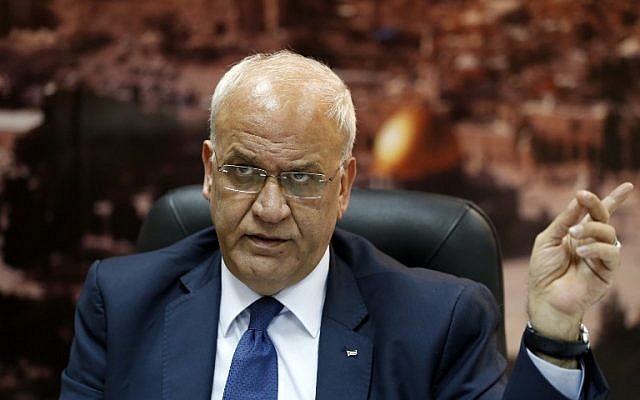
PLO Secretary General Saeb Erekat in his Ramallah office, November 23, 2015. (AFP/Abbas Momani)

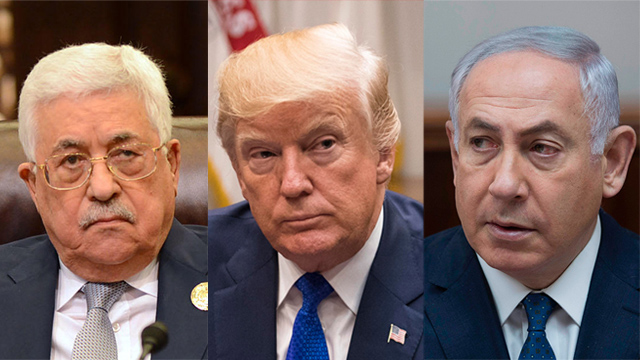
Senior Palestinian official Saeb Erekat on Saturday accused the Trump administration of trying depose the Palestinian leadership in a “coup” and told the “impudent” US envoy to the United Nations Nikki Haley she should “shut up” with her criticism of Palestinian Authority President Mahmoud Abbas.

Erekat, who has led the Palestinian peace negotiations and is secretary general of the Palestine Liberation Organization, singled out Haley, who slammed Abbas for a recent speech that was full of anti-Semitic tropes.

Erekat said that Haley’s “impudence” has gone as far as calling for removing Abbas from power.

“She called for overthrowing the democratically elected Palestinian president,” Erekat complained in an interview with the Palestinian Al-Watan Voice news website.

“This is the president who led the peace process and promoted the principle of the two-state solution,” Erekat said, referring to Abbas. “Now this [US] ambassador is accusing him of lacking courage, and is calling for replacing him.”

Only the Palestinian people have that right, he said. “The Palestinian people are loyal to their martyrs, prisoners, wounded, struggles, steadfastness, and heroism. This is the reality. The Palestinians are the only ones who are entitled to hold their leaders accountable.”

Erekat was reacting to a speech given by Haley to the UN on January 25.

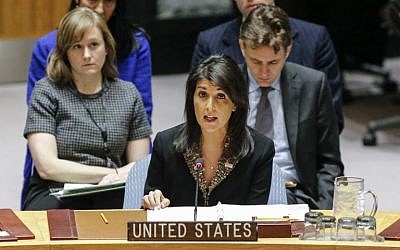
US Ambassador to the UN Nikki Haley speaks during a UN Security Council meeting on the Middle East on December 18, 2017, at UN Headquarters in New York. (AFP Photo/Kena Betancur)

“President Abbas declared the landmark Oslo Peace Accords dead. He rejected any American role in peace talks. He insulted the American President. He called for suspending recognition of Israel. He invoked an ugly and fictional past, reaching back to the 17th century to paint Israel as a colonialist project engineered by European powers,” Haley said.

“A speech that indulges in outrageous and discredited conspiracy theories is not the speech of a person with the courage and the will to seek peace,” she said.

“I ask here today, where is the Palestinian King Hussein? Where is the Palestinian Anwar Sadat,” she said, referring to the Jordanian and Egyptian leaders who made peace with Israel. “If President Abbas demonstrates he can be that type of leader, we would welcome it. His recent actions demonstrate the total opposite.”

Erekat insisted that Trump’s recognition of Jerusalem as the capital of Israel, together with Haley’s remarks, amounted to an attempt to stage a “coup” against the “Palestinian political system.”

“Nikki Haley needs to shut up and realize that the Palestinian leadership is not the problem,” the top PLO official added. “Instead, the problem is the Israeli occupation and the policies it continues to pursue. I’m not saying that we don’t make mistakes; every society and every government makes mistakes.”

Erekat said the goal of Israel and the US was to “undermine the Palestinian national project.”

“US and Israeli officials are saying that any Palestinian leader who insists on East Jerusalem becoming the capital of Palestine and is committed to the right of return, in accordance with United Nations resolution 194, should be removed from power and replaced,” he said.

The US and Israel are searching for Palestinian leaders who will accept the “liquidation of the Palestinian national project,”  Erekat said.

“The Palestinian leadership has told the Americans and Israelis that, even after 1,000 years, they will not find any Palestinian who will collaborate with their scheme,” Erekat said.

Palestinian Authority President Mahmoud Abbas (C-R) speaks during a meeting in the West Bank city of Ramallah on January 14, 2018. (AFP PHOTO / Abbas Momani)

The Palestinians, Erekat stressed, are determined to pursue diplomatic efforts at the UN Security Council and other international forums in response to the policies of the Trump administration.

“We will take Trump’s decision [to recognize Jerusalem as the capital of Israel] to the International Court of Justice and we will seek membership in more international agencies,” he said.

In the wake of the recognition, formally declared by President Donald Trump on December 6, the Palestinians have said the US cannot be an honest broker in the peace talks and have refused to meet with US officials, including Vice President Mike Pence, who visited the region last month.

Nevertheless, Erekat insisted that the Palestinians were not looking for a fight with the US.

“We don’t seek a confrontation or a fight with the US administration,” Erekat said. “On the contrary — they are the ones taking several steps. The US administration is itself saying that it’s not an honest broker in the peace process. Therefore, we are seeking, together with international parties, to convene an international conference for peace.”

Syrian Rebels Shoot Down Russian Sukhoi 25 Fighter Jet, Kill Pilot

February 4, 2018

Syrian Rebels Shoot Down Russian Sukhoi 25 Fighter Jet, Kill Pilot

Photo Credit: Staff Sgt. Dean Wagner via Wikimedia

An Iraqi Su-25 fighter jet destroyed in Operation Desert Storm.

A Russian Aerospace Force Su-25 fighter jet was shot down by Syrian rebels on Saturday in Idlib Province in northwestern Syria, near the Turkish border. The pilot ejected but was killed in an exchange of gunfire, the Russian defense ministry reported.

“On February 3, 2018, a Sukhoi 25 Russian fighter jet crashed when flying over the Idlib de-escalation zone. The pilot was able to report ejection from an area controlled by Jabhat al-Nusra militants. The pilot was killed while fighting against terrorists. According to preliminary information, the jet was brought down with a portable anti-aircraft missile system,” the defense ministry said.

 “The Russian center for reconciliation of warring sides in Syria alongside the Turkish side, responsible for the Idlib de-escalation zone, are taking steps to retrieve the Russian pilot’s body,” the ministry noted.

Earlier reports said that Syrian governmental forces were fighting against Jabhat al-Nusra units in the Idlib province.

The de-escalation zones were set up in Syria in May 2017, based on an agreement signed by Russia, Iran and Turkey. The zones are not recognized by the rebels, and Israel is vehemently opposed to such a zone being established in al-Quneitra Province in southern Syria, on Israel’s Golan Heights border.

The downing of the plane came as Syrian government forces, backed by Russian air support and Iranian infantry, have intensified their offensive in Idlib, one of the last rebel-held bastions in Syria.

So, no one is observing the de-escalation zone idea up there. In fact, Rami Abdel Rahman of the London-based Syrian Observatory for Human Rights has reported on Saturday that “there have been dozens of Russian air strikes in the area over the past 24 hours. This plane was also carrying out raids there.”

Israel operates against ISIS terrorists inside Egypt, report says

February 3, 2018

A New York Times report claimed Israel has been operating to defeat ISIS in Egypt for over two years with the approval of Egyptian President Abdel Fattah el-Sisi. According to the report, Israel has sent unmarked aircraft that frequently conducted airstrikes in the Sinai Peninsula.

Avital Zippel
http://www.jerusalemonline.com/news/middle-east/israel-and-the-middle-east/report-israel-operates-against-isis-in-egypt-34073
Israeli fighter jet (archive) Israeli Air Force/Wikimedia Commons

Israel has carried out a covert campaign against ISIS in Egypt, a report in the New York Times claimed on Saturday. As ISIS militants and Islamists spread in the Sinai desert since 2015, unmarked Israeli aircraft conducted over 100 airstrikes within Egypt, the Times said.

 The report cited current and former UK and US officials involved in Middle East policy as sources, all speaking on the condition of anonymity. The frequent airstrikes were allegedly carried out with the approval of Egyptian President Abdel Fattah el-Sisi and with full cooperation between the two countries. Furthermore, the US officials said Israel’s covert campaign has played a major role in enabling Egypt’s military to gain an upper hand against terrorists in the Sinai Peninsula.

Both Israel and Egypt allegedly sought to conceal the operation, as the two countries maintain a fragile and fraught relationship. In order to avoid detection, the Israeli aircraft reportedly flew circuitous routes in an attempt to create the impression that they were based in Egypt.

Spokesmen for the Israeli and Egyptian militaries declined to comment. The Egyptian Foreign Ministry also declined to address the report.

As previously reported by JOL, president el-Sisi declared in November that he has instructed the Egyptian authorities to use “all the force necessary” to defeat the terrorist groups in Sinai within three months. “This isn’t logical,” el-Sisi said during a speech, referring to the spread of terrorism in the region. “Within three months, we will fight with all our might and achieve security.”

Trump administration, pushing back on Iran’s influence, slaps fresh sanctions on Hezbollah

February 2, 2018

By Adam Shaw | Fox News February 2, 2018

Source: Trump administration, pushing back on Iran’s influence, slaps fresh sanctions on Hezbollah

{Iran will make up the difference and further deprive it’s already suffering people from economic recovery. – LS}

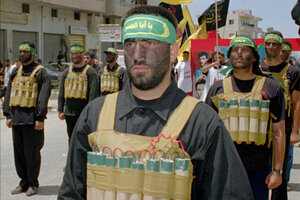
The Trump administration announced Friday that it was slapping fresh sanctions on Hezbollah-linked individuals and businesses in Africa and the Middle East — a move to limit not only the operations of the terrorist group, but also Iran’s influence in the region.

The Treasury announced that it is targeting a network of companies and individuals in Lebanon, Sierra Leone, Ghana, Liberia and other countries linked to Hezbollah financier Adham Tabaja.

The sanctions freeze assets in the U.S. and prevent Americans from doing business with any of the six individuals and seven companies. The U.S. has designated Hezbollah a terrorist organization that also plays a major political role in Lebanon.

Senior officials told the Associated Press that it is the “first wave” of a campaign to put pressure on the Iranian-linked organization. In a statement, Treasury Secretary Steven Mnuchin described the group as “responsible for the deaths of hundreds of Americans.”

“It is also Iran’s primary proxy used to undermine legitimate Arab governments across the Middle East,” he said. “The Administration is determined to expose and disrupt Hezballah’s networks, including those across the Middle East and West Africa, used to fund their illicit operations.”

Experts say that there is a sense that the administration is attempting to re-invigorate global efforts to push back against Hezbollah, while walking a fine line so it does not destabilize Lebanon.

“There is a position by the administration that they want to do it so as not to destabilize Lebanon’s economy and banking sector and do it in a way that targets global aspect of Hezbollah and in a way that minimizes Lebanon’s exposure,” Tony Badran, a research fellow at the Washington-based Foundation for Defense of Democracies and the author of “The Third Lebanon War” told Fox News.

The U.S. estimates Iran sends Hezbollah about $700 million a year and officials say that Hezbollah has become Iran’s main proxy in the Arabic-speaking world. The U.S. is particularly concerned about Hezbollah’s presence in Syria and Yemen. Badran warned against making an “artificial” distinction between Hezbollah and Iran, arguing that it is largely an extension of the Iranian Revolutionary Guard.

Most of the individuals targeted had not been publicly known to be financiers of Hezbollah, nor are they prominent names in Lebanon.

Don’t Ignore Kushner’s Quiet Mideast Gains

February 2, 2018

Ahmed Charai January 29, 2018 The National Interest

Source: Don’t Ignore Kushner’s Quiet Mideast Gains

{Giving credit where credit is due. – LS}

He may be the most effective presidential Middle East envoy in decades, but he doesn’t get much respect from the press.

It is hardly an understatement to say that Jared Kushner, a baby-faced real-estate magnate and presidential son-in-law, didn’t send expectations soaring when he was named to supervise Israel-Palestine peace efforts.

Lacking years of diplomatic experience and advanced degrees in Near Eastern politics, his appointment seemed more like favoritism than a confirmation of expertise, more a presidential gift to his daughter than a strategic decision.

What little coverage Kushner has received has varied from skeptical to scornful. And, tellingly, he hasn’t tried to dispel the pundits’ prejudices. He doesn’t travel with reporters or invite press attention. His few appearances are fleeting and uneventful.

Still, his frequent visits and stray public remarks reveal a surprisingly sophisticated understanding of the region. Behind the scenes, he is making surprising progress.

First, he recognizes that Iran now matters more to the Arabs than Palestine. With Iran and Islamic militants threatening the survival of major Arab states, many Arab leaders have quietly decided to align with Israel—dialing down their interest in the Palestinian drama. Consider that President Trump’s plan to move the United States’ embassy in Israel to Jerusalem did not touch off huge protests in Arab capitals or angry editorials in the Arab press. Kushner was one of the strongest voices inside the White House in favor of the long-promised move. Any other mediator would fret that the move would needlessly complicate his job. Kushner knows that Iran has replaced Palestine as the center of Arab interest, and he spotted an opportunity that few in Washington saw.

Second, Kushner realizes that younger Arab generation has a fundamentally different perspective from that of its elders. More than 60 percent of Arabs are too young to remember the 1967 and 1973 wars with Israel, and many more regard them as ancient history. Consider an American equivalent; how many millennials are outraged at the fate of South Vietnam? As a result, younger Arabs largely accept Israel’s existence as a settled fact, and generally see trading with its prosperous economy as essential to their own economic growth. I know. I have heard them tell me these things in the privacy of their living rooms. Their septuagenarian leaders do not share their views, and punish younger leaders who try to independently engage with Israelis—which only deepens the divide.

The generation gap is based on practical economic concerns. Young Arabs want well-paying jobs that allow them to marry and start families. They want good schools for the children. Many see no issue with taking an ambulance across the border to an Israeli hospital, unlike their retirement-age relatives who say that they would rather die.

Kushner correctly captured the sentiment of the new Arab generation when he said in July 2017, “We don’t want a history lesson. We’ve read enough books. Let’s focus on, How do you come up with a conclusion to the situation?”

To be sure, the Israeli-Palestinian conflict is one of the longest and thorniest conflicts in history. It cannot be resolved quickly or easily. Kushner has publicly acknowledged this, usually adding the idea that new approaches are more likely to bear fruit than old ones.

And he is trying a new approach, completely at odds with the conventional wisdom among diplomats. Kushner, speaking at the Saban Forum in Washington, said, “The most important thing was to focus on the final status issues, not on daily distractions that come up along the way.”

This signals a sharp break with the conventional State Department view that it is better to start modestly, focus on building trust, build the capacity of the Palestinian Authority, foster economic ties between the parties and lay a foundation for still greater capacity on the Palestinian side. Only then, after years of “capacity building,” can the final-status negotiations start.

Kushner blunted turned this upside down, adding that it had been tried for decades with little success. In the absence of a political horizon to steer toward, he said, people make decisions based on who is holding guns now. And that cements the current impasse.

Finally, Kushner has three key relationships that make progress possible.

First, he enjoys the complete trust of the president and has continuous real-time access to Trump. Few U.S. negotiators, at least since Henry Kissinger, have had such a unique bond with the president.

Second, he is liked and trusted by Israel’s Prime Minister Benjamin Netanyahu and its influential ambassador to the United States, Ron Dermer. Obama administration officials often publicly faulted Israel’s elected leaders, and the relationship was, at best, lukewarm.

Third, Kushner has befriended Saudi Arabia’s thirty-one-year-old deputy crown prince, Mohammed bin Salman. Both are seen as tech-savvy, young disrupters of the status quo, and both favor practical solutions over symbolic displays. Saudi pressure on Qatar to end its funding of Hamas, the Palestinian terror group, would not have happened with earlier generations of Saudi leadership.

Other Gulf Arab leaders that I have met with tell me that they have heard positive things about Kushner, and are eager to work with him.

In short, Kushner’s correct reading of this unique moment in Arab politics as well as the strong relationships with key players that he has fostered position him, and the United States, to make historic progress in the Middle East.

Is peace between Arabs and Israelis possible? Consider the case of my homeland, Morocco. Under the leadership of King Mohamed VI, a constitutional monarchy has emerged with legal protections for Jews and other religious minorities. Here in Casablanca, Jews and Muslims attend each other’s schools, form business partnerships and leave peacefully side by side. With a dose of Kushner’s quiet diplomacy, there is no reason Arabs and Jews couldn’t live the same way in Israel and Palestine.

Scoop: Trump may present peace plan even if Palestinians won’t negotiate

February 2, 2018

Barak Ravid of Israel’s Channel 10 news February 2, 2018 Via Axios

Source: Scoop: Trump may present peace plan even if Palestinians won’t negotiate

{Finally, after all these years we now have an administration that believes in transparency. – LS}

The White House is considering presenting President Trump’s Middle East peace plan even if the crisis with the Palestinian Authority continues and Palestinian President Abbas refuses to come to the negotiating table, senior U.S. officials tell me.

The bottom line: The U.S. officials say the administration won’t impose on the Israelis or Palestinians to accept the plan, but may release it so the parties and international community can judge it at face value.

The officials said no decisions were made yet in this regard but stressed the president and his “peace team” are not ruling out this option.

One senior U.S. official told me:

“Since it’s not done, we haven’t decided yet how we are going to put it forward and what happens if one of the sides isn’t ready to come to the table. We are not there yet. But we are very optimistic that all relevant countries who want to support a peace agreement between the two sides are still waiting for our plan, want to work with us and realize we cannot be replaced. Despite all of the false reports about our plan, we are confident it will be beneficial to both sides and both peoples.”

The current standoff

After Trump’s Jerusalem announcement on December 6th, Abbas announced he would cut ties with the U.S. over the peace process. The Palestinians also boycotted Vice President Pence’s visit in the region.

  • Abbas claimed Trump is not an honest broker and called his peace plan “the slap of the century”.
  • Meanwhile Israeli Prime Minister Netanyahu said he will react to the Trump plan after he sees it but stressed he is ready to renew peace talks.

The latest developments…

  • U.S. special envoy Jason Greenblatt held a series of meetings with Netanyahu, his advisers and several ministers over the last two weeks. Greenblatt also met with opposition leader Hertzog and briefed EU member states representatives in Tel-Aviv and East Jerusalem. He did not meet with any Palestinian officials but met with Palestinian students and private sector executives.
  • On Wednesday, Greenblatt participated in an emergency meeting of the donor countries to the Palestinian Authority. The meeting focused on the crisis in the peace process and on the humanitarian situation in Gaza. The Palestinian Prime Minister Rami Hamdallah also participated in the meeting. It was the first time senior Palestinian and U.S. officials were around the same table since the Jerusalem announcement. Greenblatt and Hamdallah shook hands but didn’t hold a meeting.
  • In his speech during the plenary meeting, Greenblatt referred to Hamdallah and said he hopes that the fact he is participating shows the Palestinians are still committed to the efforts to renew the peace process. Greenblatt also said President Trump’s announcement was just a recognition of reality and the connection of Israel and the Jewish people to Jerusalem. Greenblatt also said in his speech: “Did the President’s decision prejudge any final status issues? No. We have not taken a position on borders”.
  • Greenblatt stressed that the Trump administration continues drafting its peace plan and called on the Palestinians to return to the peace talks: “Peace will not be achieved by walking away from negotiations. It is easy to walk away from the table. But that helps no one, and it reduces or perhaps eliminates the chances of achieving a comprehensive peace agreement. And that would be terrible for the Palestinian people”.

Here’s how Israel is adjusting its tune on Lebanon 

February 2, 2018

Source: Here’s how Israel is adjusting its tune on Lebanon – Middle East – Jerusalem Post

BY CHARLES BYBELEZER/THE MEDIA LINE
 FEBRUARY 2, 2018 08:00
High-ranking Israeli officials have sounded alarm bells about Iran’s growing presence in the north.
Hezbollah

 Hezbollah. (photo credit: REUTERS)

Israel appears to be adjusting its tune — and strengthening its tone — when it comes to Lebanon. For years, the government’s mantra has been, “Hezbollah is Lebanon and Lebanon is Hezbollah,” a refrain that, in various iterations, similarly dominated the military establishment’s doctrine. Given the terror group is a wholly owned Iranian subsidiary, the missive, when uttered, implicitly blamed Tehran for the effective takeover by its Shiite proxy of Israel’s northern neighbor.

Of late, however, the blame is being shifted squarely onto the shoulders Hezbollah’s patron, with a series of high-ranking Israeli officials having warned this week that the Islamic Republic’s growing control over Lebanon, coupled with its attempts to establish a permanent military presence in Syria, is raising the prospect of war. Jerusalem has not only conveyed this message both to Washington and Moscow, in particular, but also has transmitted the warning directly to the Lebanese opposition and thus, as a corollary, to their political representatives.

According to Maj. Gen. (ret.) Giora Eiland, a former head of Israel’s National Security Council, Jerusalem’s actions are motivated by a concern over the prospect of a future war being fought on two fronts. “As far as Israel is concerned, it does not want to fight a war in Lebanon and Syria simultaneously,” he explained to The Media Line, “and at least today there is no significant Iranian presence in the Golan Heights. As such, even if a war broke out in Lebanon, the Syrian theater might stay closed. But in five years, this could be different and Israel could have to face Hezbollah and Hezbollah 2.0 along separate borders.”

Nevertheless, Eiland stressed that training has long been underway for such a scenario. “The way the Israeli armed forces is structured, the various components are [streamlined] to fight in multiple places at the same time. So this is not something new. However, since 1973 we never experienced a war on multiple fronts and this is obviously more challenging.”

The full-scale diplomatic press began Sunday when a rare article by IDF spokesman Brig.-Gen. Ronen Manelis was published on the Lebanese Ahewar website and then quickly went viral throughout the region. “Lebanon has become — both by its own actions and omissions and by a blind eye from many members of the international community — one large missile factory,” he wrote. “It’s no longer a transfer of arms, funds or consultation[s]. Iran has de-facto opened a new branch, the ‘Lebanon branch.’ Iran is here.”

A day later, Israeli Prime Minister Benjamin Netanyahu flew to Moscow, where in a meeting with President Vladimir Putin he condemned Iran’s efforts to turn Lebanon into “one big missile site,” adding that Jerusalem would not countenance the manufacturing of advanced rockets in the country. Netanyahu’s comments come amid heightened concern that the Islamic Republic is developing precision-guidance systems — possibly in subterranean facilities — to be fitted onto Hezbollah’s longer-range missiles, which could potentially allow the terror group to accurately target critical Israeli infrastructure.

On Wednesday, it was the turn of Israeli Defense Minister Avigdor Liberman, who made clear at the INSS conference in Tel Aviv that Lebanon, in its entirety, would “pay the full price” for Iran’s entrenchment there. A future war would not be like the last one against Hezbollah in 2006, the defense chief declared, as next time around “there won’t be pictures…showing people on the beach in Beirut while Tel Aviv residents [sit] in bomb shelters. This won’t happen.”

Avi Melamed, the Salisbury Fellow of Intelligence and Middle East Affairs for the Eisenhower Institute in Washington, D.C. believes that Israel’s policy must be viewed within the context of changes in Lebanon and Syria, with Iran being the catalyst and common denominator in both domains. “It is a cohesive Israeli effort to signal very clearly to Iran and Hezbollah that there are red lines have been drawn in the sand that are different from the previous [Obama] administration.”

But as Israel attempts to blur any distinction between Iran and Hezbollah, on the one hand, and the Lebanese government and its armed forces on the other, the international community continues doing just the opposite.

In fact, just hours before Liberman made his comments, a senior US official pledged — on the exact same stage at the exact same conference — continued support for Lebanon’s military. “We will sustain our efforts to support legitimate state security institutions such as the Lebanese Armed Forces…[which] could well serve as a counter-weight to Hezbollah’s desire to expand its own influence, as well as Iran’s reach in Lebanon,” asserted David Satterfield, acting Assistant US Secretary of State.

This followed numerous public declarations of support by Washington for Lebanese Prime Minister Saad Hariri — who sits in a government with Hezbollah — after he reversed his decision, amid western intervention, to resign late last year under suspicious circumstances. At the time, a White House statement noted “the need to work with allies to counter Hezbollah’s and Iran’s destabilizing activities in the region.”

All of this comes on the backdrop of US Attorney General Jeff Sessions’ announcement earlier this month of the formation of a new task force to combat Hezbollah’s vast drug trafficking and money laundering empire. That move, in turn, followed a Politico report claiming that the Obama administration interfered with a Drug Enforcement Agency initiative — code-named Project Cassandra — to thwart the Lebanese organization’s illicit activities for fear of jeopardizing the nuclear deal with Iran.

To this end, US Treasury Assistant Secretary for Terrorist Financing, Marshall Billingslea, was in Lebanon last week and “urged [the government] to take every possible measure to ensure [Hezbollah] is not part of the financial sector.” He briefed both Hariri and President Michel Aoun, a Hezbollah ally, on the prospective American initiative while vowing that any measures implemented would not destroy the banking system underpinning the Lebanese economy.

But the tacit acknowledgment that Lebanon’s financial sector could be crippled if the terror group’s assets are targeted evidences Hezbollah’s deep penetration of the country, and, in turn, highlights what many view as an apparent contradiction in Washington’s strategy.

In this respect, the US firmly backs the Lebanese government despite Hezbollah’s domination over Beirut. This reality was made stark when head of state Aoun raised eyebrows by praising the terror group as the primary source of “resistance” to Israel and for playing a “complimentary role to the Lebanese army,” in the process seemingly validating the Israeli contention that the two bodies coordinate together. The US also contributes more than one hundred million dollars in annual military aid even though sophisticated American weaponry provided to the Lebanese Armed Forces has found its way into Hezbollah’s hands.

As regards Europe, the situation is even more abstruse, as evidenced by Wednesday’s news that Bulgarian state prosecutors will not charge Hezbollah with involvement in the 2012 bombing of an Israeli tour bus at the Burgas airport, which killed six people. The prosecutors claimed that they had not been provided with proof of the terror group’s complicity; this, despite multiple previous pronouncements by Bulgarian officials explicitly linking Hezbollah to the attack, including one by then-foreign minister Nikolay Mladenov who, in a further bit of irony, also attended the INSS conference in Tel Aviv in his new capacity as UN Middle East peace envoy.

Developments in Bulgaria fit into Europe’s broader approach to Hezbollah, which might be described as a separation of terror and state. While the Lebanese group’s “military wing” was blacklisted by most of the European Union in 2013—a decision that, equally ironic, was prompted by the Burgas bombing that EU member state Bulgaria now says had nothing to do with Hezbollah—the terror group’s so-called “political arm” freely operates throughout the continent, raising funds and recruiting members at will.

In Eiland’s estimation, this complexity — and perplexity — stems from a misunderstanding of the Lebanese arena, which is perceived very differently by western nations than it is by Israel. The former, he explained to The Media Line, “differentiates between a camp of ‘good guys’ and ‘bad guys.’ So the theory is to support the good guys, which is obviously simplistic and naive. But despite the supposed distinction, there is an agreement between both sides in which the good guys act in a way that ensures the continued support of the West while the bad guys provide security.”

In fact, the bifurcation of Hezbollah’s terrorist elements by Europe parallels the US’ bifurcation of the same terror elements from Lebanon’s political, military and economic spheres. This is in sharp contrast to the position of Israel, which therefore cannot expect to garner much support even from its closest allies for its stated policy that, in a future war with Hezbollah, all of Lebanon will be “fair game.”

Dr. Avi Davidi, formerly the Iran Director at the Israeli Ministry of Strategic Affairs and currently a Fellow at the Jerusalem Center for Public Affairs, insists there is an increasing sense of urgency on Jerusalem’s part. “The issue is becoming very serious because we are approaching the end of the war in Syria, at which point the extent of Iran’s future presence will be determined. So Israel wants to make sure that everyone knows its position that Tehran not be allowed to replicate in Syria its activities in Lebanon.

“Israel knows what it is facing with Hezbollah in Lebanon,” he elaborated, “but Syria is a different story. What does it mean, for example, to attack Syria? Plus, the Russians are the major power there. So it is easier for Israel to make its point by saying it will attack Lebanon. This also acts as an indirect threat to [Russian President Vladimir] Putin who does not want any added instability.”

Nevertheless, it could be that “game-changing” developments are, in fact, occurring in Lebanon. It is possible that Moscow will not abide by a major Iranian military presence in Syria and, in response, Tehran is trying to enhance its capabilities next door. What is crystal clear is that Israel will not sit idly by and watch the Islamic Republic make further inroads in its backyard.

Despite the Israeli full-press, Melamed contended to The Media Line that it is currently not in the interest of Iran and its proxy to engage the Jewish state militarily. “From their perspective, they will try to avoid a direct confrontation because the Trump administration has [upped pressure] on Hezbollah and they are aware of the steps that could come. Furthermore, a conflict could result in an outcome that would be devastating for both parties.

“There is also a big awareness in the Arab world,” he continued, “that there may be a big plan being cooked up in the US, Israel, and Saudi kitchen to greatly diminish Hezbollah and Iran’s influence. They are cognizant of this and must take it into consideration.”

As such, analysts point to three major objectives of Jerusalem’s present diplomatic offensive. First, to try to prevent a conflict by reminding all parties of the utter destruction wreaked upon Lebanon by the IDF in 2006, while putting the world on notice that the Israeli military will do whatever is necessary if Iran is allowed to pursue its agenda uninhibited. This, in turn, could induce countries with leverage to apply pressure on Tehran to curb its militarization of Lebanon, while simultaneously making the Islamic Republic think twice about threatening Israel through its forces in Syria.

Second, the campaign is meant to prepare the Israeli public for a potential “war of choice,” one that would be initiated by Israel — irrespective of the predictable international outcry — before the risks posed by its enemies in the north cross the threshold of defensibility.

And lastly, to foster dissent among the Lebanese opposition, a tactic not dissimilar to the Israeli government’s support for Iranians during their recent nationwide protests.

Two age-old adages come to mind that seemingly encapsulate Israel’s policy, the first being ancient military strategist Sun Tzu’s assertion that, “the supreme art of war is to subdue the enemy without fighting.” While this aptly describes the attempt to deter Iran and Hezbollah via a diplomatic offensive, no amount of rhetoric can substitute for active preparation.

And as Israel readies militarily for what many deem inevitable, there is still hope in George Washington’s affirmation that, “to be prepared for war is one of the most effective means of preserving peace.”
The not-so-tamim Tamimi family of Ahed Tamimi

February 1, 2018

Ahed Tamimi and family – the not-so-tamim Tamimis | Anne’s Opinions, 1st February 2018

(My headline refers to the word “tamim” which in Hebrew means “innocent” or “wholesome” – two words which are the absolute antithesis of the Tamimi clan).

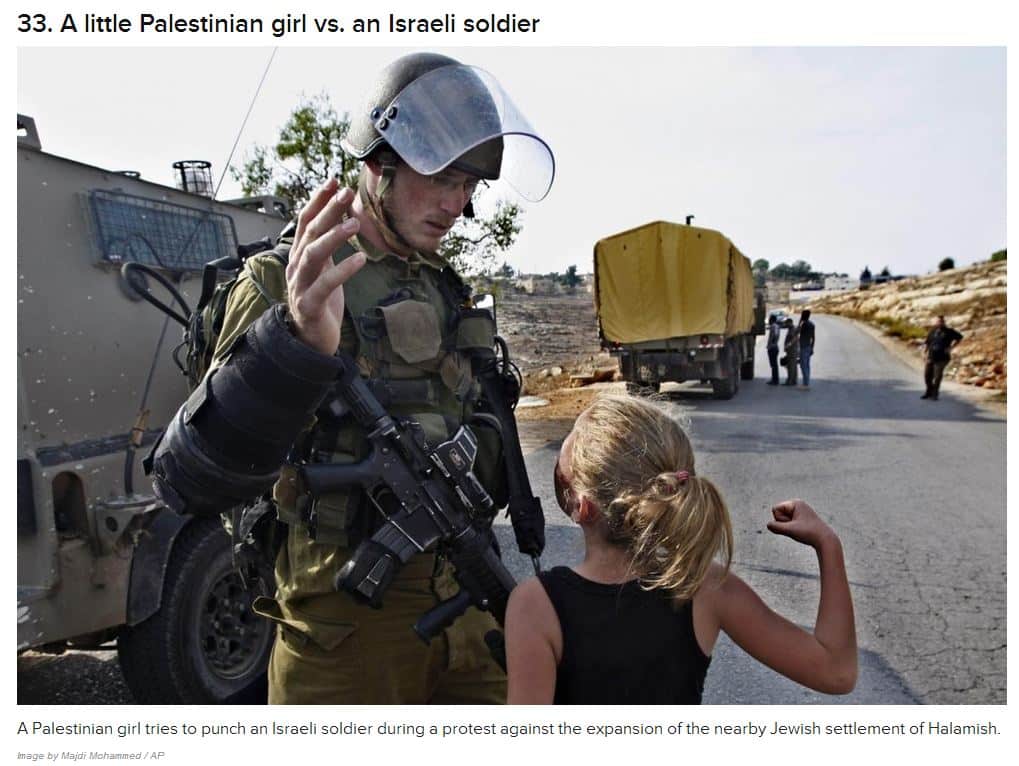
The saga of the Ahed Tamimi – the golden-haired, blue-eyed poster girl for Palestinian support of terrorism (which they like to call “resistance”) – has been dominating the “social justice” media for the last few weeks. Ever since she was arrested – finally! – by the IDF for slapping a soldier, after years of other provocations against soldiers, she has become a heroine of the foreign social justice warriors, the extreme left and of antisemites in general.

Ahed Tamimi was dubbed with the immortal nickname Shirley Temper by Aussie Dave of Israellycool and it fits her perfectly. Her staged displays of temper tantrums and faux outrage at IDF soldiers, always in front of a camera, earned her fame and fortune amongst those who bear ill-will towards Israel. And she has always been aided and abetted by her parents, to the extent that they have set up their own media company, Tamimi Press.

Here is the video of the incident that was the last straw (all videos via Israellycool):

Dave writes:

You may recognize the main child as none other than Ahed Tamimi aka Shirley Temper, already a veteran of these attempts to provoke soldiers, encouraged by her vile parents.

…As I have said before, this is child abuse, plain and simple. While I suspect the parents know full well these soldiers will not hurt their children, they are hoping they will – all for the propaganda value.

A great fuss was made in the international media that Israel had arrested a “child” – and Israel’s case was NOT helped by the Knesset’s resident idiot Oren Hazan who embarrassed his position as well as the entire nation in his interview on the BBC (who obviously knew exactly whom to interview to put Israel in the worst possible light). But the BBC item was a typical example of the slant applied to the story by the international media.

With all the emphasis on the arrest of this “child” it must be stressed that Ahed has been looking rather grown up lately. Dave at Israellycool got out his calculator and figured out that Ahed is in fact an adult:

With everyone’s favorite Pallywood actress back in the news, I have noticed how the Israel-haters post photos of her in her younger days – to emphasize she is just a child.

But she looks more like this these days:

… The question is, and always has been, how old is she? News reports give her age as either 16-years-old or 17-years-old, but by my previous calculations, she is now 18.

The question is why then the mentions of her as being younger. But I think we all already know the answer.

And if they lie about this, you can bet they are lying about a bunch of other things as well.

As for claiming Ahed is “innocent” – this could not be further from the truth. Later the same day that she hit the soldiers she spewed hate, violence and support of murder, suicide bombings and stabbings:

It is now clear beyond doubt that Ahed Tamimi has been indoctrinated by her parents from infancy to hate Israelis and Jews, and to support their murder.

What is even more staggering is that footage has now emerged (thanks to a keen-eyed reader of Israellycool) that Ahed’s mother actively encouraged her to attack the soldiers. In other words, this loving mother wanted her daughter to get arrested or maybe even killed just to score propaganda points against Israel. Watch the video:

But a very observant Israellycool reader noticed Nariman speaking softly right before Ahed and Nour went and starting attacking the soldiers. It has been confirmed by two Arabic speakers that she was saying “utrodo” (“اطرد”), which means kick them out/expel them.

In other words, Nariman deliberately told her young daughter Ahed and cousin Nour to go down there and start trouble with the soldiers, in order to kick them off the property.

Are we shocked yet? We shouldn’t be. The Tamimi’s have form, as I have said before. Read this Twitter thread:

Researcher and journalist Petra Marquardt-Bigman writes about the Tamimis’ history of incitement, in particular their support of the mass-murderer Ahlam Tamimi, now a fugitive from American justice (as thoroughly documented by the Roths at This Ongoing War), sitting safely in Jordan which disgracefully refuses to extradite her:

I have documented in great detail that for years, the Tamimis have glorified and incited terrorism, and that they hold family members who have committed terror attacks in high esteem. This is particularly true for Ahlam Tamimi, the mastermind and facilitator of the 2001 Sbarro bombing in Jerusalem that killed fifteen people including seven children and a pregnant woman, and left some 130 people injured; one young mother remained in a permanent vegetative state. Ahlam Tamimi has repeatedly boasted of the carnage she planned and helped perpetrate.

Given the current efforts to whitewash the Tamimis’ glorification of terror and their openly acknowledged association with, and admiration for, murderous terrorists, it is time to demonstrate that nothing has changed. It is particularly noteworthy that in the past year, Nariman Tamimi continued to advertise her admiration for Ahlam Tamimi. Below is a screenshot of some of Nariman Tamimi’s Facebook photos posted in 2017. The five images marked with yellow circles show Ahlam Tamimi, the Sbarro massacre mastermind and facilitator.

But one image, posted on March 16, 2017, shows a poster with Sbarro massacre mastermind and facilitator Ahlam Tamimi flashing a victory sign; the text calls for solidarity with her and reads in translation:

“Out of loyalty for the sacrifices of Ahlam, and emphasizing her right to wage resistance against the plundering occupier, and in rejection of the US demand to hand her over #All of us are_Ahlam_Tamimi. Take part in our campaign of solidarity with the liberated prisoner #All of us are_Ahlam_Tamimi. Today, Thursday at 7 pm – Be with us.”

Nariman Tamimi repeated the slogan in her own writing: “#All of us are_Ahlam_Tamimi”

Nariman Tamimi posted this photo with the chilling comment “#Ahlam_will triumph” – which is likely a reference to the publication of an FBI notice that included Ahlam Tamimi among the agency’s “Most Wanted” terrorists.

This is presumably the first time that Amnesty International, Human Rights Watch and B’Tselem are enthusiastically campaigning for someone who has declared publicly for years that a murderous terrorist who is now on the FBI’s Most Wanted list should be viewed as an admirable hero who deserves full solidarity.

Yet, when these so-called human rights organizations insist that the Tamimis are a symbol of Palestinian “resistance,” they are entirely right. And no matter how much Amnesty International, Human Rights Watch and B’Tselem may try to mislead, Nariman Tamimi – along with other members of the clan – has demonstrated over and over again that supporting this “resistance” is supporting terrorism.

Next time you hear about Palestinian “resistance” just keep those words of warning in your mind.

Now let’s just hope that the judge throws the book at Ahed Tamimi and gives her the maximum sentence allowed. Maybe then her reeducation can begin.

Israel threatens Lebanon with ‘full strength’ ground invasion in case of conflict

February 1, 2018
https://www.rt.com/news/417610-israel-ground-operation-lebanon/
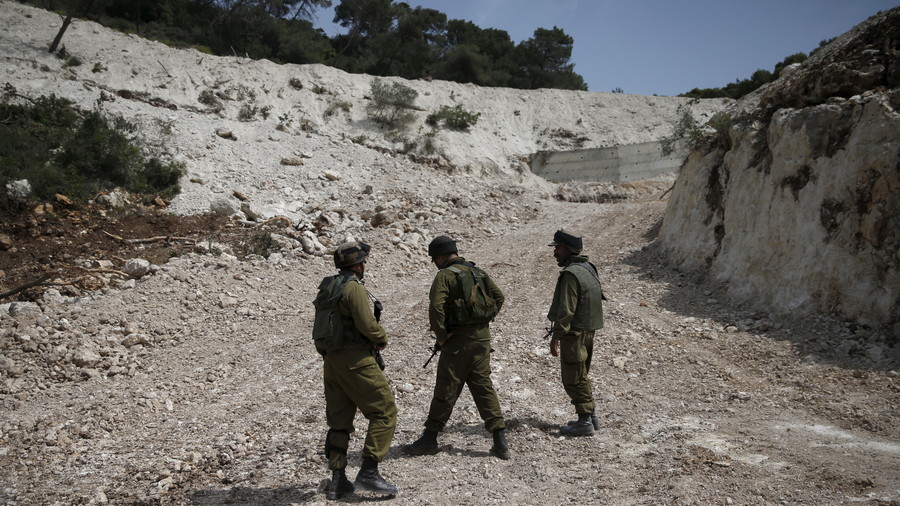
Israeli soldiers patrol the border with Lebanon, near the community of Shlomi in northern Israel on April 6, 2016. © Ronen Zvulun / Reuters
Tel Aviv is ready for an all-out ground invasion of Lebanon in the event of a military conflict with Beirut, Defense Minister Avigdor Lieberman said. His comments come as relations between the two neighbors continue to sour.

“We must prepare for maneuvering on the ground too, even if we do not use it,” the minister said at a conference of the Institute for National Security Studies (INSS) held at Tel Aviv University on Wednesday.

Not mincing his words, Lieberman said that, in a worst-case scenario, Israel would conduct the operation at “full strength.” “We must not take one step forward and one step backward. We will move forward as fast as possible,” Lieberman added, speaking about the Israeli strategy in a possible conflict with its northern neighbor.

At the same time, he said that “maneuvering is not a goal in itself,” but is a means of ending the war in what Tel Aviv sees as the most efficient way.“No one is looking for adventures, but if we have no choice the goal is to end [the fighting] as quickly and as unequivocally as possible,” the minister told the conference, adding that Israel’s past experience has shown that “all the conflicts in the Middle East” do not “come to an end” without “soldiers on the ground.”

Israel will act tough on Lebanon, the minister warned. He particularly said that the situation of the Second Lebanon War, “in which the residents of Beirut were at the beach and in Tel Aviv [they were] in bomb shelters,” will not repeat itself if a new conflict breaks out. “If in Israel they sit in shelters, then in the next fighting all of Beirut will be in shelters,” Lieberman added.

The minister’s comments come amid Israel’s concerns over the Lebanese Hezbollah armed group, which allegedly plans to arm itself with locally-produced precision-guided missiles.

“The Hezbollah terror organization is violating the UN Security Council resolutions, maintaining a military presence in the region, possessing weapons systems and increasing its military capabilities,” Gabi Eisenkot, the head of the Israeli Defense Forces General Staff, said on Tuesday, as cited by Haaretz.

Lieberman also said that he sees no difference between Hezbollah and the rest of Lebanon, as he believes that the armed group has enough influence to control both political and military forces of Israel’s northern neighbor. “They are part of Hezbollah and they will all pay the full price” for any large-scale attack on Israel.

The last major conflict between Israel and Lebanon broke out in 2006. The military confrontation, known as the Second Lebanon War in Israel and the July War in Lebanon, lasted 34 days and ended with a UN-brokered ceasefire.

In contrast to Lieberman’s words, the war took a much higher toll on Lebanon than on Israel. The conflict claimed the lives of 1,191 Lebanese people and left more than 4,400 injured, according to the local officials cited by a UN report. More than 900,000 Lebanese had to flee their homes because of the hostilities.

Israel reportedly lost fewer than 200 people in the conflict, according to various sources, with most of them being IDF soldiers. Tensions between the two nations heightened following a brief November political crisis in Lebanon.

In late November, the Lebanese Army asked the military to be at “full readiness” to face “the Israeli enemy” on the southern border. At the same time, Lebanese President Michel Aoun said that “Israeli targeting still continues and it is the right of the Lebanese to resist it and foil its plans by all available means.”

Iran’s Future, In Its Own Words (or lack thereof)

February 1, 2018

Heshmat Alavi , Contributor February 1, 2018 Forbes

Source: Iran’s Future, In Its Own Words

{The so-called enemies of Iran’s ruling class are knocking on Tehran’s door, yet the Mullahs do not hear. – LS}

On the very sensitive subject of how Iran plans to confront ongoing protests, described by some as an uprising, all the while attempting to resolve the very issues engulfing the ruling regime, there are critical concerns raising from various voices within.

And considering U.S. President Donald Trump’s powerful State of the Union message, underscoring “America stands with the people of Iran in their courageous struggle for freedom,” the stakes at hand in the months ahead for Tehran are extremely high.

Iran’s state-linked media are a good source, shedding significant and noteworthy light on the seemingly obscure nature of the Iranian regime.

The common tone heard in all such messages is hopelessness. Those loyal to the faction of Iranian Supreme Leader Ali Khamenei see the solution in sacking the regime’s president, Hassan Rouhani.

Arguments from the other side of the aisle in Tehran’s politics rely on warning the Khamenei camp that such a scenario will not end the regime’s escalating quandaries. This is only the beginning and there is no stopping this train, adding the entirety of this regime is in the crosshairs.

There are those who believe dark days await those sitting on the throne in Tehran, speaking of future uprising waves. Providing no solutions, their words can mean nothing but succumbing to an inevitable downfall.

“Those who have continuously spread despair and anxiety through their platforms in state TV/radio and Friday prayers (in reference to the Khamenei camp) seek to portray Rouhani as incompetent. They issue and chant slogans of ‘Death to Rouhani,’ failing to answer the inescapable question of who after Rouhani. The answer is obvious: surpassing Rouhani means overcoming the government, reaching the very principle of our state, and finally surpassing the Islamic republic itself,” according to the Tadbir24 website, known for its affiliation to the Rouhani camp.

Interesting is how this piece considers Rouhani a synonym of the ruling state, or at least the velayat-e faqih regime’s last chance of survival, warning surpassing Rouhani is tantamount to the end of the clerical rule altogether.

Protesters in the streets, however, are crystal clear in their intentions and how they view the overall regime apparatus. Chanting “Death to Rouhani,” “Death to Khamenei,” and most interestingly, “Reformists, principalists, end of story,” the Iranian people are demanding sweeping changes, accepting nothing short of regime change. This ends Iran’s scheme of portraying a system established on two parties of conservatives and reformists.

“The issue at hand is not limited to merely surpassing Rouhani. More grave ends may be awaiting us,” according to the Jamaran website, explaining how these protests are raising eyebrows across the board amongst senior Iranian officials.

“Let us be frank: Taking into consideration the current heading, our destination will be nothing but all out ruin,” according to the Asr Iran website, another Rouhani camp mouthpiece.

“The society has become a cradle for numerous crises that will surface in other forms (read in further nationwide protests),” according to Rouhani’s economic advisor Hossein Zaghfar.

Warnings of other crises in the making and Iran anticipating further calamities are indicating signs of Iran’s ruling elite understanding very well there the harsh reality of these protests’ refusal to ever melt down.

To add insult to injury for the mullahs, the brave Iranian people are showing how the regime’s crackdown machine no longer enjoys its previous teeth. For forty years the clerical regime has been relying on this entity to remain intact and in power. Scenes of protesters tearing down Khamenei posters and attacking sites of the Revolutionary Guards Basij paramilitary force, parallel to a wave of Basij members burning their IDs and credentials, speak for themselves.

#IranProtests #تظاهرات_سراسرى #بسيجی_نیستم
The trend continues, terrifying senior security commanders and regime authorities. — Heshmat Alavi (@HeshmatAlavi) January 8, 2018

Iran’s protests will continue despite the fact that authorities killed 53 protesters and sent over 8,000 others behind bars, reports indicate.

The Iranian people are proving to the world over their objective of seeking regime change and establishing a republic based on democratic values rightfully cherished by most of today’s countries.

History shows those movements presenting a specific alternative to the ruling state have a far better chance of realizing victory for the people. A leading entity with a publicized plan for the future and the courage that the populace can rely on.

The time has come to set aside the “reformist” mirage in Iran. For decades, Maryam Rajavi, as President of the National Council of Resistance of Iran, is providing the sole, realistic alternative for Iran with a ten-point plan that enjoys the support of thousands of elected officials across the globe.

For starters, however, there are certain duties and obligations before the international community:

* Demand the release of all recently arrested protesters & political prisoners.

* Provide free internet access to all of Iran to allow activists report the truth about this regime, unfortunately cloaked by mainstream media.

* Continue cutting off Iran’s access to the global financial system. This will deprive the IRGC from the financial sources it desperately needs to continue its slate of domestic and foreign belligerence.

This is a noble launch of standing shoulder to shoulder with the Iranian people in “their courageous struggle for freedom.”