Archive for January 22, 2018

Pence at Knesset: US Embassy Will Move to Jerusalem in 2019

January 22, 2018


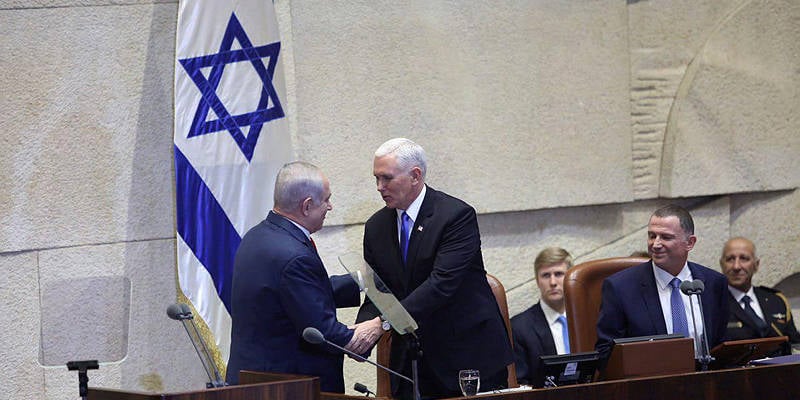
PM Benjamin Netanyahu greets US VP Mike Pence at the Knesset as Knesset Speaker Yuli Edelstein looks on, Jan. 22. 2018. (Gil Yochanan/POOL)

By: Aryeh Savir, World Israel News

https://unitedwithisrael.org

Trump “righted a 70-year wrong” by acknowledging Jerusalem as Israel’s capital, Pence said, adding that the US Embassy will move there by the end of 2019, ahead of schedule.

By: Aryeh Savir, World Israel News

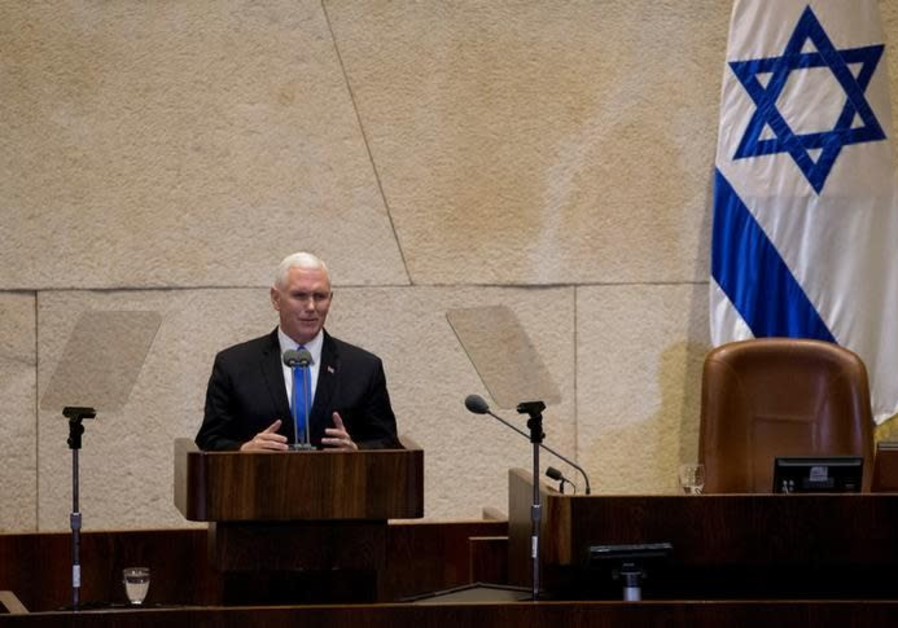
Vice President Mike Pence on Monday addressed the Knesset, Israel’s parliament, affirming the US’ support for the Jewish state, for Jerusalem as Israel’s capital, and for Israel’s security.

In a history-laden and bible-infused keynote speech, Pence stated, “I am here to convey a simple message from the heart of the American people: The American people stand with Israel.”

“We stand with Israel because your cause is our cause, your values are our values… we stand with Israel because we believe in good over evil, in liberty over tyranny,” he stated.

“John Adams said the Jews have done more to civilize man than any other civilization,” Pence said. “Through the generations the American people became fierce advocates for the Jewish aspiration to return to the land of your forefathers.”

“In the story of the Jews we’ve always seen the story of America. It is the story of an exodus, a journey from persecution to freedom,” he declared.

Pence told the Knesset that when he visits Yad Vashem on Tuesday with his wife, they will “marvel at the faith and resilience” of the Jewish people, who rose up three years after the Holocaust to establish the State of Israel.

Pence then recited the “Shehechiyanu” blessing in Hebrew, a Jewish prayer recited to celebrate special and joyous occasions, eliciting a standing ovation from the Jewish-majority parliament.

He said the US is proud to have been the first country to recognize Israel as a Jewish state. President Donald Trump, he said, “righted a 70-year wrong” by acknowledging Jerusalem as Israel’s capital.

Pence said that the US will open its embassy in Jerusalem by the end of 2019, ahead of schedule.

‘Peace Can Only Come Through Dialogue’

Pence “strongly” urged the Palestinians to return to the negotiating table, saying “peace can only come through dialogue.”

The Palestinians have angrily protested the US decision to recognize Jerusalem, saying the US cannot be trusted as a mediator. They also said they will reject any peace plan the Trump administration presents.

Pence told the Knesset that Israel “can be confident” that “the United States will never compromise the safety and security of the state of Israel,” adding that any peace agreement with the Palestinians “must guarantee Israel’s ability to defend itself, by itself.”

He noted the “remarkable transformation that is taking place across the Middle East today.”

“Descendants of Isaac and Ishmael” are coming together in an unprecedented way, he said, possibly alluding to covert cooperation between Israel and Sunni Arab nations in the Middle East.

In that vein, Pence called the Iranian nuclear deal a “disaster” and said the Trump administration will no longer certify the “ill-conceived agreement.”

Instead, Pence said the administration is “committed to enacting effective and lasting restraints on Iran’s nuclear and ballistic missile programs.”

Pence vowed that if the deal is not fixed in the coming months, the US will “withdraw from the deal.”

He also pledged that the US will continue to work with Israel “to confront Iran, the leading state sponsor of terror” who “sows chaos across the region.”

“The United States will never allow Iran to acquire a nuclear weapon,” Pence said. “We will also no longer tolerate Iran’s support for terrorism.”

A ‘Better Message’ for the Iranian People

Addressing the Iranian people directly, Pence said that he has a “better message” for them.

“From the people of America to the proud and great people of Iran: We are your friends,” he said, promising them their “day of liberation” is coming soon. Then “the friendship between our peoples will blossom once again,” he said.

“Today, as I stand in Abraham’s promised land, I believe that all who cherish freedom and want a better future” should look to Israel and “marvel at what they behold,” he stated.

“It was faith that rebuilt the ruins of Jerusalem and made it strong again,” he said, adding that the US is proud to stand with the Jewish state. “And so we will pray for the peace of Jerusalem”

“We will work and strive for that brighter future where everyone who calls this ancient land their home shall sit under their vine and fig tree, and none shall make them afraid,” Pence concluded.

Repeated Standing Ovations

Pence received repeated standing ovations for his remarks.

Prior to Pence’s address, Prime Minister Benjamin Netanyahu thanked him for standing up for the “truth” and supporting Israel at the United Nations (UN).

Netanyahu stated that Trump’s recognition of Jerusalem as the country’s capital will go down as one of the most historic decisions in Israel’s chronicles.

Alternating between English and Hebrew, Netanyahu lauded the unbreakable alliance between the countries, saying they had a “shared destiny.”

“America has no greater friend than Israel, and Israel has no greater friend than the United States of America,” he declared.

As Pence began to speak, Arab lawmakers heckled him and brandished signs protesting the US recognition of Jerusalem, but were swiftly tossed from the chambers. The Arab party in the Israeli parliament had previously announced it would boycott Pence.

The Knesset, which is accustomed to such high-profile visits, had added a new layer of security, and besides the speaker and other dignitaries, lawmakers did not have direct access to Pence.

Sign the Declaration to Keep Jerusalem United
Ramadan Shalah sings Jerusalem Song

Jerusalem Must Remain the United Capital of Israel

I declare that Jerusalem is the eternal capital of the Jewish People and support all efforts to maintain and strengthen a united Jerusalem as the undivided capital of the State of Israel.

U.S. Oil Production Will Soon Overtake Saudi Arabia’s

January 22, 2018

Written by Bob Adelmann Monday, 22 January 2018 The New American

Source: U.S. Oil Production Will Soon Overtake Saudi Arabia’s

{A little ingenuity can go a long way. – LS}

Fatih Birol, head of the Paris-based International Energy Agency (IEA), told a congressional committee last week, “What we see is a result of the shale revolution [fracking]. The U.S. is becoming the undisputed leader of oil and gas production worldwide. [U.S.] oil production is growing very strongly and will continue to grow. We think that this growth is unprecedented [both in the] size of the growth and the pace of the growth.”

In 1973, Saudi Arabia punished U.S. citizens with an oil embargo in retaliation for the U.S. government’s support for Israel during the Yom Kippur War. It could do so because it held the biggest hammer: Saudi Arabia controlled the world’s largest reserves of crude oil and the kingdom. Within months, the price of oil quadrupled in the United States, resulting in shortages and rationing. Gas stations were closed, and when they reopened they were forced to restrict gasoline purchases to “odd” and “even” days depending upon their customers’ license plate numbers. The federal government imposed “double-nickel” (55 mph) speed limits on highways, and experimented with “daylight saving” time in order to reduce the impact of the embargo.

Those days are long gone and not likely ever to return. Saudi Arabia and its OPEC cartel are slowly being reduced to bit players in the global energy market. Saudi Crown Prince Mohammed bin Salman saw that coming more than two years ago when he announced the kingdom’s “Saudi Vision 2030,” a plan to diversify his country’s economy away from its dependence on oil and gas revenues. He created a “sovereign wealth fund” to invest in various schemes and projects to expand public service sectors such as healthcare, education, infrastructure, recreation, and tourism. Part of the plan was to take advantag of the country’s unique geographical location as a central hub connecting Asia, Africa, and Europe.

To do all of that, the crown prince needed money — lots of money — to transform his country and move it away from its dependence on oil and gas revenues. In April 2016, he announced that he would be offering for sale up to five percent of his oil company, Saudi Aramco, hoping to raise an initial $500 billion, as the company was estimated to be worth $10 trillion. But with the decline in oil prices, his country’s stagnant oil and gas production, and the coming of age of the fracking revolution in the United States, estimates of the real marketable value of Aramco have continued to drop. The latest estimate is that the company is worth about $2 trillion, with the sale of that five percent (if it happens at all) generating a paltry $100 billion.

It’s been two years since that announcement, and the offering continues to be delayed. The latest delay is pushing the public offering of shares into the second half of 2018.

All of which raises a question: What happened to rebalance the equation against Saudi Arabia in favor of the United States? What happened was George P. Mitchell. A son of poor Greek immigrants (who entered the U.S. legally in 1901), Mitchell served in the U.S. Army Corps of Engineers during World War II. After the war he joined his brother Johnny in starting an oil exploration business in Houston.

Fast-forward to the late 1970s. Mitchell was using company resources to explore ways of getting more natural gas out of shale formations at such a rate that his board of directors and investors were getting nervous. It took almost 20 years and the threat of near-bankruptcy before Mitchell and his company’s engineers finally developed the magic formula of techniques and materials to extract gas, and then oil, from shale.

In 2002 Mitchell sold his company, Mitchell Energy & Development Corporation, to Devon Energy Corporation for $3.1 billion.

Why couldn’t Saudi Arabia have done the same thing? Why did it wait until the issue became an existential threat with the development of fracking in the United States?

Part of the answer has to be the culture. In Saudi Arabia, the country’s vast reserves — some 360 billion barrels of recoverable oil, at last count — belong to Aramco, i.e., the government. What is the incentive then for an entrepreneur to risk his capital, his time, his reputation, and his energy to try to find a way to squeeze more production out of those reserves?

In the United States, the culture is vastly different. The oil in the vast Permian Basin (which lies under west Texas and eastern New Mexico), for example, belongs to the people who successfully negotiate the land leases and then develop it. They take risks with their own money (and that of other people — investors) and spend themselves into exhaustion both physically and financially in the hopes of striking it rich. If they succeed, they get to keep what they have reaped. If they don’t, they eat their losses and perhaps return for another go at it in the future. It is the peculiar, some say unique, mixture of limited government intervention, the enforcement of contracts at law, and the exhilaration that comes from success, that drives people such as George Mitchell to change the world.

It was thus inevitable that the United States, given that peculiar culture, would eventually become the “undisputed leader” of the world in energy development. It has an unfair advantage over every statist economy on the planet. All it took was time, and George Mitchell, to soon relegate Saudi Arabia to second place.

VP Mike Pence Addresses the Knesset

January 22, 2018

https://www.youtube.com/watch?v=LiFVPI3-oMo&feature=youtu.be


( A beautiful speech… God bless! – JW )


Turkey Expects Swift Campaign Against U.S.-Backed Kurds in Syria

January 22, 2018

Turkey Expects Swift Campaign Against U.S.-Backed Kurds in Syria

Turkish soldiers stand on tanks in a village on the Turkish-Syrian border in Gaziantep province, Turkey / Reuters

By Mert Ozkan

HASSA, Turkey (Reuters) – Turkey shelled targets in northwest Syria on Monday and said it would swiftly crush the U.S.-backed Kurdish YPG fighters who control the Afrin region in an air and ground offensive that President Tayyip Erdogan said Russia had agreed to.

Amid growing international concern over the three-day-old military operation, President Tayyip Erdogan said there would be “no stepping back” from the campaign, which has opened up a new front in Syria’s complex civil war.

Turkish forces and their Syrian rebel allies began their push to clear YPG fighters from the northwestern enclave on Saturday, despite concern from the United States, which urged both sides on Monday to show restraint.

France called for an emergency meeting of the United Nations Security Council on Monday to discuss the fighting in Afrin and other parts of Syria, and Britain said it would look for ways to prevent any further escalation.

But Erdogan said Turkey was determined to press ahead. “There’s no stepping back from Afrin,” he said in a speech in Ankara. “We discussed this with our Russian friends, we have an agreement with them, and we also discussed it with other coalition forces and the United States.”

Moscow, a military ally of President Bashar al-Assad that operates a major air base in Syria, has not confirmed giving a green light to the campaign – which Syria has strongly objected to – but did not appear to be acting to prevent it.

The YPG’s Afrin spokesman, Birusk Hasaka, said there were clashes between Kurdish and Turkish-backed forces on the third day of the operation, and that Turkish shelling had hit civilian areas in Afrin’s northeast.

The U.S.-backed Syrian Democratic Forces (SDF), dominated by YPG fighters, said they might send reinforcements to Afrin, and called for international efforts to halt the attack.

U.S.-TURKEY TENSION

Ankara considers the YPG a terrorist group tied to Kurdish insurgents in Turkey, and has been infuriated by U.S. support for the YPG in the battle against Islamic State in Syria — one of the issues that have brought relations between the United States and its Muslim NATO ally close to breaking point.

Erdogan has also pledged to drive the SDF from the town of Manbij to the east, part of a much larger area of northern Syria controlled by the SDF, which led the U.S.-backed campaign to defeat Islamic State in its Syrian strongholds last year.

That raises the prospect of protracted conflict between Turkey and its allied Free Syrian Army factions against the U.S.-backed SDF.

Turkish Deputy Prime Minister Mehmet Simsek sought to play down the long-term risks.

“Our investors should be at ease, the impact will be limited, the operation will be brief and it will reduce the terror risk to Turkey in the period ahead,” Simsek, who oversees economic affairs, said in Ankara.

A senior Turkish official declined to give a timeframe but said the operation would “move fast”, adding that Turkey believed there was some local support for its action in both Afrin and Manbij.

YPG official Nouri Mahmoud said Turkish-backed forces had not taken any territory in Afrin. “Our forces have to this point repelled them and forced them to retreat,” he told Reuters.

A Turkish official said Turkish troops and Free Syrian Army fighters had begun to advance on Afrin’s eastern flank, taking control of Barshah hill, northwest of the town of Azaz.

TURKISH SHELLING

A Reuters cameraman near Hassa, across the border from Afrin, saw Turkish shelling on Monday morning. Dogan news agency said Turkish howitzers opened fire at 1 a.m. (2200 GMT), and that YPG targets were also being hit by Turkish warplanes and multiple rocket launchers.

Turkey sees the YPG presence on its southern border as a domestic security threat. Defeating it in Afrin would reduce Kurdish-controlled territory on its frontier and link up two regions controlled by insurgents opposed to Assad – Idlib province and an area where Turkey fought for seven months in 2016-17 to drive back Islamic State and the YPG.

The Turkish-backed FSA factions, which have come together under the banner of a newly branded “National Army”, also want to see an end to YPG rule in Afrin.

They accuse the YPG of displacing 150,000 Arab residents of towns including Tel Rifaat and Menigh to the east of Afrin, captured in 2016.

“This is a historic moment in our revolution,” Mohammad al-Hamadeen, a senior officer in the FSA forces, told fighters in Azaz on Sunday as they prepared to join the ground offensive.

“God willing, very soon we will return to our region that we were driven from two years ago.”

Throughout most of the multi-sided seven-year-old civil war in Syria, Turkey and the United States jointly backed Arab fighters seeking to overthrow Assad. Since 2014, Washington has angered Turkey by growing closer to the Kurdish militia, which it supported with air strikes, arms, training and special forces advisers on the ground to oppose Islamic State.

(Additional reporting by Daren Butler in Istanbul, Orhan Coskun, Tuvan Gumrukcu and Ece Toksabay in Ankara; Tom Perry, Ellen Francis and Lisa Barrington in Beirut; Writing by Dominic Evans; Editing by David Dolan, Gareth Jones, Peter Graff andEditing by Kevin Liffey)

More than a state visit

January 22, 2018

Source: More than a state visit – Israel Hayom

Dror Eydar

Israel has welcomed many American statesmen throughout the years, but U.S. Vice President Mike Pence is not here on a mere state visit. He is making a pilgrimage to Jerusalem as a devout Christian. He is here representing a vast community of Zionist Evangelical Christians who believe in the Biblical prophecies heralding the return of the Jewish people to Zion.

The Evangelical movement has launched nothing less than a revolution: For the first time in hundreds of years, Evangelicals are rejecting the central tenet of Catholic Christianity. This tenet, known as Replacement Theory, argues that when the Jews refused to accept Jesus as their savior, God abandoned us, his chosen people, and chose the church in our stead. Evangelicals, however, reject this notion and read the Bible more literally – the Israelites in the Bible remain the Israelites today, and if the prophecies predict the Israelites’ return to Zion, then the Evangelists will help them come to pass.

They often repeat the words of the Prophet Isaiah who, 2500 years ago, declared: “For Zion’s sake will I not hold my peace, and for Jerusalem’s sake I will not rest, until her triumph go forth as brightness, and her salvation as a torch that burneth” (Isaiah 62:1). They treat this verse as a divine command to enshrine Jerusalem. It was this belief that fueled the Evangelical push for American recognition of Jerusalem as the capital of the Jewish state and the relocation of the American embassy from Tel Aviv to Jerusalem. They believe that the moment Donald Trump made his campaign promise to relocate the U.S. Embassy to Jerusalem, divine intervention guided the election in his favor.

Israel’s Arab MKs and Muslim countries are riling against Pence and for good reason. They understand the political implications of the Evangelical theology on the future of Israel and particularly on Jerusalem.

The Zionist Christians read God’s promises to Abraham in Genesis as a commandment and a promise: “And I will bless them that bless thee, and him that curseth thee will I curse; and in thee shall all the families of the earth be blessed” (Genesis 12:3). In other words, anyone who helps the Jews and the Jewish state will enjoy God’s blessings and anyone who fights against the Jews and prevents their return to Zion will be punished by God.

This is precisely what happened to the nations of the world throughout history, they believe. Those who helped the Jews thrived and flourished and those who turned their backs on us and abused us were reduced to nothing. According to the Evangelical faith, the U.S. enjoys its superpower status thanks to its staunch support for the Jewish people and the Jewish state. I have heard many Christian leaders say: We are Zionists because we love America.

Pence speech rife with biblical references rocks the Knesset 

January 22, 2018

Source: Pence speech rife with biblical references rocks the Knesset – Israel News – Jerusalem Post

BY LAHAV HARKOV
 JANUARY 22, 2018 16:41
VP Pence’s Biblical speech to Knesset met with multiple standing ovations.
Pence speech rife with biblical references rocks the Knesset

 US Vice President Mike Pence addresses the Knesset, Israeli Parliament, in Jerusalem January 22, 2018. (photo credit: REUTERS/ARIEL SCHALIT/POOL)

US Vice President Mike Pence was met with one standing ovation after another in the Knesset, during his speech rife with Biblical references and expressions of support for Israel and the Jewish people.

Under US President Donald Trump, Pence said, US-Israel ties are stronger than ever.

“We stand with Israel, because we believe in right over wrong, liberty over tyranny. People in the US have always held a special admiration for the People of the Book. In the story of the Jews, we’ve always seen the story of America, the story of Exodus, a journey from persecution to freedom,” he stated.

Pence, the first US Vice President to address the Knesset’s plenary, spoke to a packed room.

A devout Evangelical Christian, Pence paraphrased Psalms: “The American people are proud to stand with Israel as allies. And so we will pray for the peace of Jerusalem, that there will be peace in your citadels. We will work and strive for that brighter future, so everyone who calls this ancient land home shall sit under their fig tree, and none shall make them afraid.”

Pence urged the Palestinians, who are boycotting his visit to the region, to come to the negotiating table.

“We realize peace will come through compromise, but the US will never compromise on the safety and security of Israel,” he stated.

“The US remains committed to peace,” Pence stated, saying that the US will support a two-state solution if the sides want it. That comment was met by a standing ovation from the opposition, while the coalition noticeably stayed in their seats.

The Vice President announced that the US embassy will move from Tel Aviv to Jerusalem by the end of next year, emphasizing that Jerusalem is Israel’s capital.

The Vice President also spoke out against Iran, calling the nuclear deal a “disaster,” and saying Trump will not certify it again.

Pence rapped Iran as the world’s biggest state sponsor of terrorism, and used the phrase “radical Islamic terrorism” several times, saying it “respects no creed, it takes the lives of Jews, Christians and especially Muslims.”

“Together with our allies we will continue to work with our full might to drive radical Islamic terrorism from the face of the earth,” he said.

During his speech, Pence waxed poetic about Israel and Jewish history.

“As I stand in Abraham’s promised land, I believe that those who cherish freedom and seek a brighter future should cast their eyes here and marvel at what they behold. How unlikely is Israel’s birth. How more unlikely is her survival,” he said.

Pence said the Jewish people held on to hope to return to their homeland over a 2,000 year exile, “through the darkest and longest nights.”

“Tomorrow, when I stand with my wife Karen at Yad Vashem to honor the six million Jewish martyrs of the Holocaust, we will marvel at the faith and resilience of your people, who just three years after walking in the shadow of death, rose up to reclaim a Jewish future and rebuild the Jewish State.”

Speaking on Israel’s upcoming 70th Independence Day, Pence said the “shehechiyanu” blessing, said to thank God on a momentous occasion.

Pence’s blessing was met with a standing ovation from nearly all of the MKs present, as were several other points in the speech.

At the start of his speech, Joint List MKs held up signs that said “Jerusalem is the capital of Palestine.” They were immediately ejected by ushers. Holding up signs or other props in the Knesset is prohibited in all plenary sessions, and when a foreign dignitary speaks, there is a zero-tolerance policy against heckling.

Pence took the interruption in stride, praising Israel’s “vibrant democracy.”

Joint List chairman Ayman Odeh tweeted that he was proud to lead his party in a “strong, legitimate protest, against the Trump-Netanyahu regime’s exaltation of racism and hatred, who speak of peace solely as lip service.”

Pence’s speech was otherwise extremely well-received from both the opposition and the coalition.

The Vice President concluded his speech with “God bless the Jewish people, God bless Israel, andGod bless the USA,” and Likud MK Yehudah Glick shouted: “God bless you, Mr. Vice President!”

Transportation and Intelligence Minister Israel Katz called Pence’s speech “inspiring,” and Bayit Yehudi chairman Naftali Bennett said “it will go down in the history books of both nations.”