Archive for December 28, 2017

Scoop: U.S. and Israel reach joint plan to counter Iran

December 28, 2017

Source: Scoop: U.S. and Israel reach joint plan to counter Iran – Axios

The U.S. and Israel have reached a joint strategic work plan to counter Iranian activity in the Middle East. U.S. and Israeli officials said the joint understandings were reached in a secret meeting between senior Israeli and U.S. delegations at the White House on December 12th.

What it means: A senior U.S. official said that after two days of talks the U.S. and Israel reached at a joint document which included understandings on countering Iranian actions in the region. The U.S. official said the document goal’s was to translate President Trump’s Iran speech to joint U.S.-Israeli strategic goals regarding Iran and to set up a joint work plan.

At the table: The Israeli team was headed by national security adviser Meir Ben-Shabbat and included senior representatives of the Israeli military, Ministry of Defense, Foreign Ministry and intelligence community. The U.S. side was headed by national security adviser H.R. McMaster and included senior representatives from the National Security Council, State Department, Department of Defense and the intelligence community.

As part of the understandings that were reached the U.S. and Israel decided to form several working groups according to the joint goals:
  1. Covert and diplomatic action to block Iran’s path to nuclear weapons – according to the U.S. official this working group will deal with diplomatic steps that can be taken as part of the Iran nuclear deal to further monitor and verify that Iran is not violating the deal. It also includes diplomatic steps outside of the nuclear deal to put more pressure on Iran. The working group will deal with possible covert steps against the Iranian nuclear program.
  2. Countering Iranian activity in the region, especially the Iranian entrenchment efforts in Syria and the Iranian support for Hezbollah and other terror groups. This working group will also deal with drafting U.S.-Israeli policy regarding the “day after” in the Syrian civil war.
  3. Countering Iranian ballistic missiles development and the Iranian “precision project” aimed at manufacturing precision guided missiles in Syria and Lebanon for Hezbollah to be used against Israel in a future war.
  4. Joint U.S.-Israeli preparation for different escalation scenarios in the region concerning Iran, Syria, Hezbollah in Lebanon and Hamas in Gaza.

Senior Israeli officials confirmed that the U.S. and Israel have arrived at strategic understandings regarding Iran that would strengthen the cooperation in countering regional challenges.

The Israeli officials said:

“[T]he U.S. and Israel see eye to eye the different developments in the region and especially those that are connected to Iran. We reached at understandings regarding the strategy and the policy needed to counter Iran. Our understandings deal with the overall strategy but also with concrete goals, way of action and the means which need to be used to get obtain those goals.”

Sarsour: You Have No Right To Tell Us We Can’t Kill Jews

December 28, 2017
https://www.frontpagemag.com/point/268841/sarsour-you-have-no-right-tell-us-we-cant-kill-daniel-greenfield

A few more deep anti-Semitic thoughts from the new Islamist face of the left.

On December 9th, taking to her Facebook account, Linda Sarsour justified Palestinian terrorism:

In context of what’s happening in Palestine in response to the announcement about Jerusalem and in general living under the longest and most brutal military occupation – we have to get a few things straight.

Nobody gets to tell an occupied people how to respond to their own oppression and the continued stripping of their humanity, agency and land whether they are Palestinians or not. Nobody. Oppressed people determine how, when and where to resist. They set the parameters. You don’t have to agree. Unless you have lived in their condition under the boot of a racist, supremacist, violent regime that sees them as less than human – you have no say in this conversation…

Good to know that the laws of warfare don’t apply to oppressed peoples under the boot of a racist, supremacist, violent regime.

Considering that the indigenous Jewish population of Israel freed itself from the rule of the Islamic colonial racist and supremacist regime, no one has the right to tell the IDF how to defend against the “Palestinian” settlers who are the proxy armies of the Islamic Supremacist occupation.

Islamic terrorists would like immunity from any accountability. They want to smash in the skulls of little girls, fire rockets at schools from kindergartens and then accuse Israel of violating human rights. But standards work both ways, despite Sarsour’s “punching up terrorism” nonsense. If you opt out of the laws of war, so do your enemies. Everyone is oppressed in their own minds anyway.

But the Democrats continue to stand by Linda Sarsour, despite a blatant defense of anti-Semitic Islamic terrorism and accusations of complicity in sexual harassment against a fellow Muslim woman.

Because there’s nothing the left won’t excuse from Islamic Supremacists.

Satire | Fed Up With Oppressive Capitalism, Bernie Sanders Retires To Socialist Paradise Venezuela

December 28, 2017

Fed Up With Oppressive Capitalism, Bernie Sanders Retires To Socialist Paradise Venezuela, Babylon Bee, December 27, 2017

LAKE CHAMPLAIN, VT—After years of suffering oppression at the hands of the capitalist system in America, Vermont Senator Bernie Sanders announced Wednesday that he would be quitting politics and retiring to the socialist paradise of Venezuela.

Senator Sanders held a press conference at his summer vacation home on Lake Champlain to announce the move.

“I simply have had enough of being exploited by billionaires and evil corporations,” the democratic socialist who owns three homes said. “I will be retiring from my Senate seat and its problematic $200,000 annual salary and going to live in the idyllic land of Venezuela.”

“Here in America, we have great wealth inequality, whereas in the utopia of Venezuela, everyone has the same amount of money,” he added.

Sanders announced he would be driving his luxury SUV as far as he could before catching a ferry to the socialist wonderland, where he’d live in peace, comfort, and security for the rest of his days, “just like all the other lucky citizens of Venezuela.”

At publishing time, Sanders had been detained at the Venezuelan border and had his car confiscated by authorities.

US won’t strike ISIS resurgent in Assad-ruled areas, pushes Russia to curb pro-Iranian Hizballah push near Israel

December 28, 2017

US won’t strike ISIS resurgent in Assad-ruled areas, pushes Russia to curb pro-Iranian Hizballah push near Israel, DEBKAfile, December 28, 2017
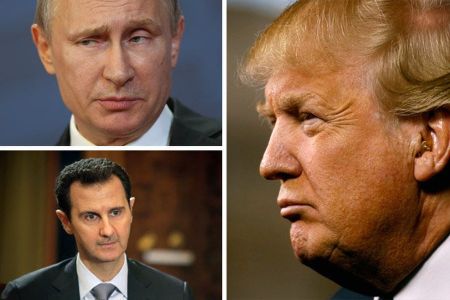
Israel has quietly warned the Trump administration that if this combined hostile force moves any closer, the IDF will have no option but to step in to push it back. Clearly, the understandings reached between presidents Donald Trump and Vladimir Putin were not holding up in this sector.

The next few days are therefore fraught with three critical uncertainties: (a) Will ISIS persevere in its westward movement, or be halted by military counteraction? (b)  Will the Syrian army, Hizballah and pro-Iranian forces push forward from Beit Jinn to Quneitra and Israel’s Golan border? Or will they be stopped? And (c) Will the Trump-Putin understandings hold water, or will they be scuttled by (a) and (b)?


*****************************

While openly blaming Syria (and Russia) for giving ISIS free rein, US quietly rebukes Moscow for not reining in the pro-Iranian push towards Israeli border.

“The Syrian regime has failed to prevent the resurgence of ISIS on their own soil,” said British Maj. Gen. Gedney, deputy commander of Strategy and Support for the US-backed coalition to defeat the Islamic State terror group.  And even in areas where Syrian forces have intensified their efforts against ISIS, progress has been, at best, fleeting, he said. “We’ve got no intention to operate in areas that are currently held by the [Assad] regime.”

DEBKAfile places the coalition general’s comments against the backdrop of the quiet deal struck earlier this month between Presidents Donald Trump and Vladimir Putin. That conversation charted a division of labor in the Syrian arena to avoid clashes between their forces. It was understood that Russia would reciprocate for US consent to abstain from operating west of the Euphrates (in Assad-ruled domains) by curbing Turkish, Iranian and Hizballah operations, especially in border regions.

Gedney’s comments, while only directly referring to ISIS, also coincided Wednesday with the fall of the Beit Jinn enclave in one of those operations.<

He went on to say that a “limited numbers of ISIS militants… seem to be moving with impunity through regime-held territory,” and pointed to a new concentration outside the US al-Tanf post in the Syrian-Jordanian-Iraqi border triangle. “We’ve clearly seen a lot of operations by pro-regime forces, Russian-backed Syrian forces over to the east of the [Euphrates] river,” Gedney said. “We’ve questioned the effectiveness of some of those operations.” Syria and Russia must do more to wipe out ISIS in areas still controlled by the regime, US officials insist.

The US-led coalition is clearly pressing for a decision as to who will assume responsibility for dealing with this rising ISIS threat. DEBKAfile’s sources note that, alongside this question, is the one the US is implicitly addressing to the Russians regarding another terrorist threat: This one is posed by the fall of Beit Jinn opposite an IDF outpost in the foothills of Mount Hermon to a combined Syrian-Hizballah-militia force under the command of Iranian Revolutionary Guards officers. At the moment, this combined force stands 11km from the Israeli border and appears to be poised to continue its victorious momentum for an assault on the Quneitra pocket on the doorstep of Israeli Golan, unless it is stopped.

Israel has quietly warned the Trump administration that if this combined hostile force moves any closer, the IDF will have no option but to step in to push it back. Clearly, the understandings reached between presidents Donald Trump and Vladimir Putin were not holding up in this sector.

The Trump-Putin understanding was first revealed on Dec. 22 in DEBKA Weekly 783 (for subscribers) and the DEBKA Files ILTV show on Dec. 25. According to our exclusive sources, that understanding was sealed in a long telephone conversation on the Syrian question between the two presidents on Dec. 14.

Until now, it was understood in Washington and Jerusalem that Russia would reciprocate for US consent to abstain from operating west of the Euphrates (in Assad-ruled domains) by curbing Turkish, Iranian and Hizballah operations. Their deal hinged on two major points:

  1.  The war on ISIS in eastern Syria. A joint war room run by Russian and US-backed Kurdish YPG militia officers was to be established to deploy troops for blocking the westward movement of ISIS forces. (Hence Gen. Gedney’s complaint about this continuing movement.)
  2. Russia and the US would team up to thwart military operations by Iran, Hizballah and Turkey in areas controlled by the Assad regime, especially in proximity to Syria’s borders with Turkey, Israel and Jordan. On this point, Washington undertook to warn the Turks off their plans to invade northwestern Syria and seize control of Idlib province, whereas Moscow was to have instructed Damascus, Tehran and Hizballah to desist from military activity on those borders. This point has likewise gone by the board.

According to DEBKAfile’s military sources, Moscow claims that Putin’s commitment to Trump was met by withholding Russian air support from the disputed Syrian-Hizballah operations. But, in actual fact, the Iranian-commanded force circumvented the Russians and their deal with the Americans by fighting for Beit Jinn without Russian air support and winning the day without its help. This was more than a tactical victory to throw in Israel’s face; it set up a new reality in Syria, whereby Iran and Hizballah can cock a snoot at Moscow, its air cover and its deals with the Americans and go forward to win battles regardless and without Russian help.

The next few days are therefore fraught with three critical uncertainties: (a) Will ISIS persevere in its westward movement, or be halted by military counteraction? (b)  Will the Syrian army, Hizballah and pro-Iranian forces push forward from Beit Jinn to Quneitra and Israel’s Golan border? Or will they be stopped? And (c) Will the Trump-Putin understandings hold water, or will they be scuttled by (a) and (b)?

Raymond Ibrahim: Trump Scraps Cherished “Israel Grievance” Myth

December 28, 2017

Raymond Ibrahim: Trump Scraps Cherished “Israel Grievance” Myth, Jihad Watch

Yet, as with Trump’s return of words such as “jihadi” to formal discourse, one doubts that the Establishment will follow suit, as the polarization of America continues unabated.

*********************************************

President Trump’s new National Security strategy is not only notable for what it brings back to the paradigm — words such as “jihadi” and “sharia” — but in what it gets rid of, namely, the long held, much entrenched notion that Israel is the root source of all the turmoil plaguing the Middle East. According to the new strategy document,

For generations the conflict between Israel and the Palestinians has been understood as the prime irritant preventing peace and prosperity in the region. Today, the threats from jihadist terrorist organizations and the threat from Iran are creating the realization that Israel is not the cause of the region’s problems. States have increasingly found common interests with Israel in confronting common threats.

That this is true cannot be overstated. For decades, the official establishment position championed by politicians, academics, and journalists of all stripes seeking to apologize for all the anger, violence, and jihad terror plaguing the region was the creation of Israel. Because the Jewish state is stronger than its Muslim neighbors, the latter were always presented as frustrated “underdogs” doing whatever they could to achieve “justice.” No matter how many rockets were shot into Tel Aviv by Hamas and Hezbollah, and no matter how anti-Israeli bloodlust was articulated in distinctly jihadi terms, that was always presented as ironclad proof that Palestinians under Israel are so oppressed that Muslims have no choice but to resort to terrorism.

Yet, as with all false narratives, the survival of this one relied on concealing the bigger, more complete picture, as captured by the following question: If Muslims get a free pass when their violence is directed against those stronger than them, how does one rationalize away their violence when it is directed against those weaker than them — for example, millions of indigenous Christians living in the Muslim world? According to reliable statistics published annually, some 40 of the 50 worst nations in which to be Christian are Muslim majority. Of the absolute worst 21 nations — 18 of which are Muslim — “100 percent of Christians experience persecution.”

The rationalizations used to minimize Muslim violence against Israel simply cannot work here, for now Muslims are the majority — and they are the ones violent and oppressive to their minorities, in ways that make Israeli treatment of Palestinians seem enviable. In other words, Christian persecution is perhaps the most obvious example of a phenomenon the mainstream media wants to ignore out of existence — Islamic supremacism, the true source of the Arab-Israeli conflict.

Vastly outnumbered and politically marginalized Christians in the Islamic world simply wish to worship in peace, and yet they are still hounded and attacked; their churches are burned and destroyed; their women and children are kidnapped, raped, and enslaved. These Christians are often identical to their Muslim co-citizens in race, ethnicity, national identity, culture, and language; there is generally no political or property dispute on which the violence can be blamed. The only problem is that they are Christian — they are non-Muslims — the same category Israelis fall under.

From here one also understands why what has been described by some authorities as a “genocide” of Christians at the hands of Muslims in Iraq, Syria, Nigeria, Somalia, Pakistan, and Egypt — Muslims who couldn’t care less about Israel and Palestinians — is one of the most dramatic but also least known stories of our times. The media simply cannot portray Muslim persecution of Christians — which in essence and form amounts to unprovoked pogroms — as a “land dispute” or a product of “grievance” (if anything, it is the ostracized and persecuted indigenous Christian minorities who should have grievances). And because the media cannot articulate such Islamic attacks on Christians through the “grievance” paradigm that works so well in explaining the Arab-Israeli conflict, their main recourse is not to report on them at all.

Such is the way for all apologists of Islam: to ignore or whitewash Muslim aggression — and then, in that vacuum, distort and present non-Muslim responses as the origins of the conflict. This is especially prevalent in the portrayal of history. Thus Georgetown University’s John Esposito claims that “Five centuries of peaceful coexistence [between Islam and Europe] elapsed before political events and an imperial-papal power play led to [a] centuries-long series of so-called holy wars [the Crusades] that pitted Europe against Islam and left an enduring legacy of misunderstanding and distrust.” In reality, these “five centuries of peaceful coexistence” saw Muslims terrorize and conquer more than three-fourths of Christendom, but this inconvenient fact is seldom mentioned, for knowledge of it ruins the “Muslim-grievance” narrative, just as knowledge of modern-day Muslim persecution of Christians ruins it.

Either way, it is refreshing to see that the sun is breaking through the darkness of deceit that has for too long clouded Middle Eastern realities, including by presenting victims as aggressors and aggressors as victims. Yet, as with Trump’s return of words such as “jihadi” to formal discourse, one doubts that the Establishment will follow suit, as the polarization of America continues unabated.

Former security chief: Benjamin Netanyahu right to push for submarines 

December 28, 2017

Source: Former security chief: Benjamin Netanyahu right to push for submarines – Israel News – Jerusalem Post

Former defense minister Moshe Ya’alon has also slammed Netanyahu for circumventing him in purchasing the submarines.

Dolphin-class submarine

 The Dolphin-class submarine first entered service in 2000. (photo credit: IDF SPOKESMAN’S UNIT)

Amidror’s comments at the Jerusalem Institute for Strategic Studies conference were of special interest, as the prime minister has been attacked harshly for his interventions regarding acquiring submarines from Germany, and some of his top aides are being criminally probed for possible corruption concerning the transaction.

Former defense minister Moshe Ya’alon has also slammed Netanyahu for circumventing him in purchasing the submarines.

But Amidror said this has been a regular fight between other prime ministers and the defense establishment, implying that the premiers have had a broader strategic view of the submarines’ role than some in the security establishment.

One area where he said that it had become more important for the navy to project power and provide security regarded Israel’s sea-based natural gas reserves.

Turning to the skies, he said that the “F-35 [fifth-generation combat aircraft] gives the IDF a new capability… like when the Phantom aircraft arrived” decades ago, changing Israel from weak to strong in airpower.

Amidror said the F-35 “cockpits will now have information that in the past could only be found back in headquarters,” suggesting this would “change the way the air force works.”

The former National Security Council chief implied that the fuller picture for pilots would eventually lead air force headquarters to delegate more authority to F-35 pilots to take action where higher level approvals might have been required in the past.

Reviewing a range of other unpredictable issues that could come up in future wars, Amidror said that “drones will have a much bigger impact even than they do” currently, maybe even exceeding major forces driven and piloted by humans. But he implied that how big that impact will be could be one of the largest wild cards.

In the cyber arena, he said that even as the IDF is investing huge resources, neither it nor any other body “knows exactly how to build a complete defense.”

This is even more crucial than in the past because the IDF has become far more networked, such that any hacking of the network or of networked weapons could be a major problem, he said.

Discussing special forces, Amidror said that to date they “have not had a big impact on most wars,” which he called “a big waste of power.”

He expressed hope that now that the number of special forces operators has been increased that they might make a greater contribution in future conflicts.

Moving on to intelligence challenges, he said that Hezbollah now has so many rockets and precision weapons that the intelligence services will have their work cut out for them defending the home front.

Putting the challenge in perspective, he noted that during the 2006 Second Lebanon War, intelligence helped the air force take out much of Hezbollah’s precision arsenal while it as still on the ground.

Even with all of these specific predictions, Amidror said a main point was that “we cannot really answer” what the IDF needs to do to prepare for the next war, because “we don’t know what the next war will” look like.

Still, he projected optimism, saying that Israel no longer faces any conventional army threat, since the only nearby powerful army belongs to Egypt, with which we are at peace.

He pointed out that Israel “is a huge power,” and that even its worst close-by adversary, Hezbollah, at most might be able to rally 50,000-70,000 fighters compared to the millions of enemy soldiers, thousands of tanks and hundreds of aircraft that once threatened the Jewish state.

Noting that Hamas’s forces were “much smaller” even than Hezbollah’s, Amidror said that Israel’s adversaries “have weapons that can hurt us tactically, but are extremely lacking” in terms of posing a broader threat.


