Archive for December 2, 2017

Ahmadinejad to Khamenei: There is Little Hope for Improvement in Regine’s Status

December 2, 2017

Ahmadinejad to Khamenei: There is Little Hope for Improvement in Regine’s Status, Iran News Update, Jazeh Miller, December 2, 2017
According to Ahmadinejad, “due to heavy economic, propaganda and emotional pressures as well as political and psychological ones, many people and families are subjected to serious harms and breakdown, and a bleak outlook has been formed in the minds of all people, the youth in particular. Considering the country’s current conditions, hope for a better future has reached bottom low.”

In another part of his letter, Ahmadinejad focuses on his conflict with regime’s judiciary, saying “irregular, unjustified, and unlawful insistence on sticking to personal and political stances and involving those viewpoints in judicial process while taking advantage of judicial power in political, personal, and family relations has stripped the judiciary of any chance to address and improve its status, avoid mistakes and injustice, attempt to resolve the country’s major problems and realize people’s rights.”

*******************************************

Revealing his recent letter to the regime’s Supreme Leader Ali Khamenei, Iranian regime’s former president has given new dimensions to the power struggle between regime’s rival factions while describing the country’s awkward situation.

On Monday November 27, Mahmoud Ahmadinejad revealed a letter he apparently wrote two weeks ago to Ali Khamenei.

The letter was released a few hours after regime judiciary’s spokesman ‘Mohseni Ejei’ referred to Ahmadinejad’s attacks on the judiciary, describing him as a ‘thug who talks big’.

Although Ahmadinejad’s letter gives detailed description about the country’s current conditions, but he doesn’t mention how much his government and policies are responsible for today’s situation.

“Due to authorities’ ignorance and effectiveness of enemies’ plans, such crises like unprecedented economic slowdown, liquidity, banking problems, unemployment, poverty, wide gap between the rich and poor and production fall have reached such a critical level that could at any moment hit the country and people with unpredictable and unmanageable consequences”, says Ahmadinejad.

According to Ahmadinejad, “due to heavy economic, propaganda and emotional pressures as well as political and psychological ones, many people and families are subjected to serious harms and breakdown, and a bleak outlook has been formed in the minds of all people, the youth in particular. Considering the country’s current conditions, hope for a better future has reached bottom low.”

In another part of his letter, Ahmadinejad focuses on his conflict with regime’s judiciary, saying “irregular, unjustified, and unlawful insistence on sticking to personal and political stances and involving those viewpoints in judicial process while taking advantage of judicial power in political, personal, and family relations has stripped the judiciary of any chance to address and improve its status, avoid mistakes and injustice, attempt to resolve the country’s major problems and realize people’s rights.”

Ahmadinejad says he’s against Larijani brothers and their dominance over the country’s (judicial and legislative) branches.

He then refers to judiciary’s performance as the source of public discontent in the country, saying “having 17 million judicial cases means that an overwhelming majority of Iranian families are somehow involved in lawsuits. It clearly and totally mirrors the country’s conditions and the performance of different entities, and yet by itself is a proof and a clear sign of the judiciary’s awkward situation, judicial officials’ incompetence and real problems in the branch. Public discontent towards the status of the country and judiciary is unprecedented, so much so that the majority of people are shouting against injustice and improper relations.”

Ahmadinejad’s fierce attack on the judiciary is despite the fact that the branch played a key role in oppressing the 2009 uprising during Ahmadinejad’s second term. Nonetheless, Ahmadinejad never questioned or criticized the judiciary’s record at the time, nor does he refer to it now. But only now that the branch, amid clashes between regime’s rival bands, has targeted Ahmadinejad and those around him, he has started criticizing.

Regime’s former president, who never seriously opposed limitations and violating individual and social freedoms, now writes “any kind of criticism, protest, or freedom of expression is harshly blocked for different excuses while a few groups and known families seek to exclusively take the power and major positions stemmed from people’s revolution, so they can consolidate the rule of factions and owners of wealth and power.”

Considering the escalation of conflicts between regime’s former president and judiciary over the past few weeks, the release of Ahmadinejad’s letter to Khamenei could lead to even more heated conflicts.
UN votes 151-6 against Israel, an ‘occupying power’ with no rights to Jerusalem

December 2, 2017

By: United with Israel Staff

Dec 1, 2017

UN votes 151-6 against Israel, an ‘occupying power’ with no rights to Jerusalem

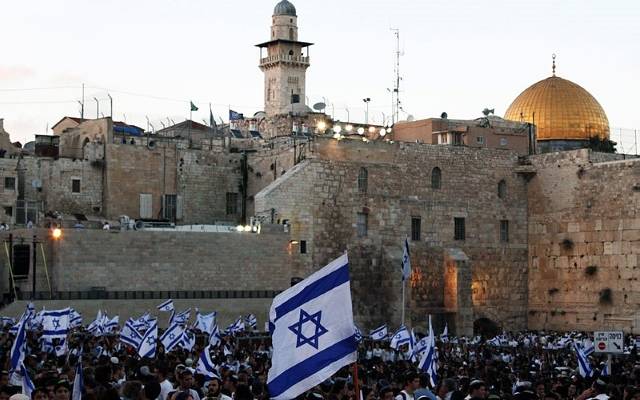
Jerusalem Day celebrations in the Old City. (Nicky Kelvin/Flash90)

The UN passed six new resolutions against the Jewish state, including one denying Israeli sovereignty over Jerusalem 151-6.

The United Nations General Assembly in New York passed six resolutions on Thursday affirming Palestinian rights and condemning Israeli violations of international law, Middle East Monitor reported.

According to one resolution (‘Jerusalem’), “the Assembly reiterated that any actions by Israel, the occupying Power, to impose its laws, jurisdiction and administration on the Holy City of Jerusalem were illegal and therefore null and void.”

This resolution was adopted by 151 votes in favor to 6 against (Canada, Federated States of Micronesia, Israel, Marshall Islands, Nauru, United States), with 9 abstentions (Australia, Cameroon, Central African Republic, Honduras, Panama, Papua New Guinea, Paraguay, South Sudan, Togo), the Monitor said.

Israel’s delegate condemned the resolutions, claiming that the UN “continued to annually adopt biased resolutions and devote precious resources…to politicized bodies whose sole purpose was to attack and denounce Israel”. The US representative “echoed that opposition.”

U.N. Report: Yemen Rebel Missiles Fired at Saudi Arabia Appear Iranian

December 2, 2017

BY:

By Michelle Nichols

U.N. Report: Yemen Rebel Missiles Fired at Saudi Arabia Appear Iranian

Houthi fighters standing guard in Yemen / Reuters

UNITED NATIONS (Reuters) — Remnants of four ballistic missiles fired into Saudi Arabia by Yemen’s Houthi rebels this year appear to have been designed and manufactured by Riyadh’s regional rival Iran, a confidential report by United Nations sanctions monitors said, bolstering a push by the United States to punish the Tehran government.

The independent panel of U.N. monitors, in a Nov. 24 report to the Security Council seen by Reuters on Thursday, said it “as yet has no evidence as to the identity of the broker or supplier” of the missiles, which were likely shipped to the Houthis in violation of a targeted U.N. arms embargo imposed in April 2015.

Earlier this month, U.S. Ambassador to the United Nations Nikki Haley accused Iran of supplying Houthi rebels with a missile that was fired into Saudi Arabia in July and called for the United Nations to hold Tehran accountable for violating two U.N. Security Council resolutions.

The report said that monitors had visited two Saudi Arabian military bases to see remnants gathered by authorities from missile attacks on Saudi Arabia on May 19, July 22, July 26, and Nov. 4.

They also visited four “impact points” from the Nov. 4 attack where other remnants of the missiles were identified.

“Design characteristics and dimensions of the components inspected by the panel are consistent with those reported for the Iranian designed and manufactured Qiam-1 missile,” the monitors wrote.

The Qiam-1 has a range of almost 500 miles and can carry a 1,400-pound warhead, according to GlobalSecurity.org public policy organization.

Saudi-led forces, which back the Yemeni government, have fought the Iran-allied Houthis in Yemen’s more than two-year-long civil war. Saudi Arabia’s crown prince has described Iran’s supply of rockets to the Houthis as “direct military aggression” that could be an act of war.

SMUGGLING ROUTE

 Iran has denied supplying the Houthis with weapons, saying the U.S. and Saudi allegations are “baseless and unfounded.” Iran’s mission to the United Nations did not immediately respond to a request for comment on the U.N. monitors report.

Another ballistic missile was shot down on Thursday near the southwestern Saudi city of Khamis Mushait, the Saudi-owned al-Arabiya channel reported.

The U.N. monitors said they gathered evidence that the missiles were transferred to Yemen in pieces and assembled there by missile engineers with the Houthis and allied forces loyal to Yemen’s former President Ali Abdullah Saleh.

“The panel has not yet seen any evidence of external missile specialists working in Yemen in support of the Houthi-Saleh engineers,” the monitors wrote.

They visited Saudi Arabia after the monitors called on the coalition to provide evidence backing Riyadh’s claim that Iran was supplying missiles to the Houthis, warning that a failure to do so would violate a U.N. resolution.

They said the missiles most likely were smuggled into Yemen along “the land routes from Oman or Ghaydah and Nishtun in al Mahrah governorate (in Yemen) after ship-to-shore transshipment to small dhows, a route that has already seen limited seizures of anti-tank guided weapons.”

 The monitors also said that while “concealment in cargo of vessels offloading in the Red Sea ports is unlikely, it cannot be excluded as an option.”

The Saudi-led coalition used the Nov. 4 missile attack to justify a blockade of Yemen for several weeks, saying it was needed to stem the flow of arms to the Houthis from Iran.

The United Nations had said the blockade could spark the largest famine the world has seen in decades. Some 7 million people in Yemen are on the brink of famine, and nearly 900,000 have been infected with cholera.

EU resolution calls for arms embargo against Saudi Arabia, accuses it of war crimes

December 2, 2017

Published time: 1 Dec, 2017 19:52

https://www.rt.com/news/411678-eu-parliament-saudi-embargo/

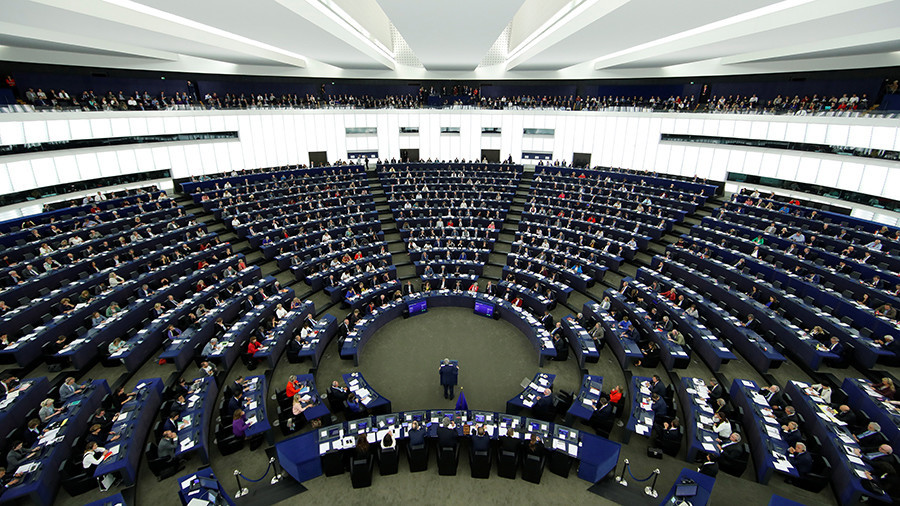
The European Parliament in Strasbourg, France © Christian Hartmann / Reuters

The European Parliament has adopted a resolution, which calls for an EU-wide embargo on arms sales to Saudi Arabia over the alleged war crimes it has committed in Yemen. The resolution also criticizes EU members selling arms to the Gulf kingdom.

The EU parliament “condemns in the strongest terms the ongoing violence in Yemen and all attacks against civilians and civilian infrastructure, which constitute war crimes,” the resolution passed on Thursday says. It goes on to say that “dozens of Saudi-led airstrikes have been blamed for indiscriminately killing and wounding civilians in violation of the laws of war, including through the use of internationally banned cluster munitions.”

Read more

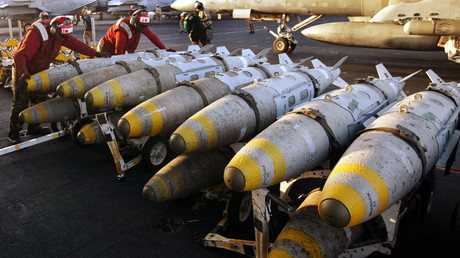
FILE PHOTO Aviation ordinancemen organise 1000 pound MK-83 JDAM (Joint Direct
Attack Munitions) bombs © Paul Hanna

The document particularly says that the European lawmakers “deplore” the blockade of Yemen established by the Saudi-led coalition and specifically condemns “the indiscriminate coalition-led airstrikes leading to civilian casualties, including children, and destruction of civilian and medical infrastructure.” It adds that they equally condemn the actions of the Houthi rebels resulting in civilian casualties, including the missile attacks on the Saudi cities.

The MEPs then renewed their call on the EU foreign policy chief, Federica Mogherini, to launch “an initiative to impose an EU arms embargo against Saudi Arabia” in the view of the serious allegations of it committing war crimes in Yemen. The motion, which is, however, non-binding, was adopted by a vast majority as 539 MEPs supported it while only 13 of them voted against and 81 abstained.

The resolution also calls on Mogherini to “urgently propose an integrated EU strategy for Yemen” as well as urged all parties to the conflict to “urgently agree on a cessation of hostilities” and to return to peace negotiations.It then goes on to slam the EU member states for selling arms to the Saudis in spite of numerous allegations of war crimes committed by the coalition.

“EU Member States have continued to authorize transfers of arms to Saudi Arabia since the escalation of the conflict, in a violation of Council Common Position … on arms export control,” the document says. It then goes on to say that an EU arms embargo against Saudi Arabia would “effectively promote compliance” of the member states with the relevant EU guidelines and eventually with the international humanitarian law.

Read more

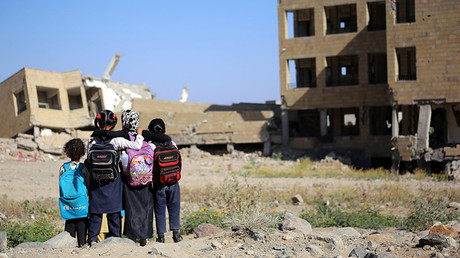
Yemeni school girls look at a school on March 16, 2017, that was damaged in an air strike in the southern Yemeni city of Taez  © Ahmad Al-Basha

This is not the first time the EU parliament had called for an arms embargo against the Saudis. A similar appeal to the EU authorities was included into another its resolution on the situation in Yemen adopted in February 2016.

Meanwhile, some EU states continue to actively supply the Saudis with weapons and military equipment despite the Kindgom’s involvement in the war in Yemen. In mid-November, the German government revealed that the total value of its arms sales to Saudi Arabia has grown fivefold in the third quarter of 2017 comparison to the same period of the previous year.

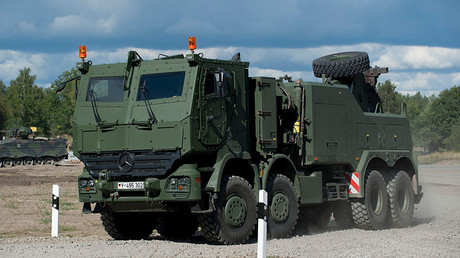
While Germany supplies the Kingdom with military trucks and patrol boats, according to the disclosed documents, the UK is selling the Saudis various munitions, including bombs and missiles. And the UK arms sales to the Saudis also jumped by almost 500 percent, a November report said.

In September, an NGO said that the UK sold the Saudis £6 billion ($8 billion) worth of weapons since the war in Yemen began. It was also recently revealed that up to 50 British military personnel were teaching battlefield skills to Saudi officers engaged in the Yemeni conflict.

Read more

Towing truck Bison © Morris Mac Matzen

However, the oil-rich Kingdom enjoys support not only of its European partners. In late November, it was reported that the Saudis were purchasing $ 7 billion worth of precision arms from the US manufacturers, which is almost equal to the total worth of the British arms sales to the Saudi Arabia over the entire period of the Yemeni conflict. The purchase came as part of the mammoth $110-billion deal earlier brokered by the US President Donald Trump during his visit to Riyadh.

Since 2015, the Sunni monarchy has been waging a war against Iran-backed Shiite Houthi rebels in Yemen, which pushed one of the Arab world’s poorest countries to the brink of famine and left some 4,800 Yemenis killed, according to UN that says most of the civilian casualties were caused by Saudi-led coalition airstrikes, though Riyadh consistently denied the reports.

According to the UN, some 20.7 million people in Yemen are currently in need of humanitarian assistance while a cholera outbreack, which is considered to be one of the worst in the world, affected more than 900,000 people there. At the same time, the UN Food and Agriculture Organization (FAO) also called the humanitarian situation in Yemen the “largest food-security emergency in the world.”

Charge Against Flynn is More Evidence that Mueller Has Nothing

December 2, 2017

Charge Against Flynn is More Evidence that Mueller Has Nothing, Power LineJohn Hinderaker, December 1, 2017

News media are breathlessly reporting that Gen. Michael Flynn has agreed to plead guilty to lying to the FBI. You can read the Statement of the Offense here. The false statements alleged by the government seem rather pathetic: 1) Flynn falsely told an FBI agent that he didn’t ask the Russian ambassador to “refrain from escalating the situation in response to sanctions” the U.S. had just imposed, and 2) that he didn’t recall the ambassador subsequently telling him that the Russians had moderated their response per his request; 3) Flynn falsely said that he didn’t ask the Russian ambassador to delay or defeat a pending U.N. Security Council resolution, and 4) that the ambassador never subsequently described his country’s response to that request. (Flynn tried, unsuccessfully, to convince several members of the Security Council, including Russia, not to proceed with an anti-Israel resolution. This is to his, and President Trump’s, credit.)

That’s it, after a year of huffing and puffing. Nothing about the election, nothing about the long-awaited “collusion” between the Trump campaign and Russia. I have no idea why Flynn apparently lied to an FBI agent, assuming that he did. But the communications described in the information are exactly the sorts of contacts that a national security advisor to an incoming president should be having with foreign powers.

In short, the allegations against Flynn suggest that Robert Mueller has nothing significant against President Trump or other members of his administration.

The press, of course, is gleeful. ABC‘s headline blares, “Flynn Prepared To Testify Against Trump, Trump Family, White House Staff.” Really? Testify to what?

ABC’s Brian Ross reports: Michael Flynn promised “full cooperation to the Mueller team” and is prepared to testify that as a candidate, Donald Trump “directed him to make contact with the Russians.”

But of course, there is nothing wrong with directing Flynn to make contact with the Russians. ABC says this is contrary to statements that Trump has made, but I don’t know whether that is true or not. It would require considerable research into Trump’s many statements to discern whether he has said that he never directed Flynn to contact any Russian on any subject.

In any event, what is the point? Contacting foreign governments was part of Flynn’s job, and directing Flynn to contact foreign governments was part of Trump’s job.

Andy McCarthy sees the Flynn plea the same way that I do:

Obviously, it was wrong of Flynn to give the FBI false information; he could, after all, have simply refused to speak with the agents in the first place. That said, as I argued early this year, it remains unclear why the Obama Justice Department chose to investigate Flynn. There was nothing wrong with the incoming national-security adviser’s having meetings with foreign counterparts or discussing such matters as the sanctions in those meetings. Plus, if the FBI had FISA recordings of Flynn’s conversations with Kislyak, there was no need to ask Flynn what the conversations entailed. Flynn, an early backer of Donald Trump and a fierce critic of Obama’s national-security policies, was generally despised by Obama administration officials. Hence, there has always been cynical suspicion that the decision to interview him was driven by the expectation that he would provide the FBI with an account inconsistent with the recorded conversation — i.e., that Flynn was being set up for prosecution on a process crime.

In the information filed against Flynn, what is most important is what is not there–the dog that isn’t barking:

[W]hen a prosecutor has a cooperator who was an accomplice in a major criminal scheme, the cooperator is made to plead guilty to the scheme. This is critical because it proves the existence of the scheme. In his guilty-plea allocution (the part of a plea proceeding in which the defendant admits what he did that makes him guilty), the accomplice explains the scheme and the actions taken by himself and his co-conspirators to carry it out. This goes a long way toward proving the case against all of the subjects of the investigation. That is not happening in Flynn’s situation. Instead, like Papadopoulos, he is being permitted to plead guilty to a mere process crime. A breaking report from ABC News indicates that Flynn is prepared to testify that Trump directed him to make contact with the Russians — initially to lay the groundwork for mutual efforts against ISIS in Syria. That, however, is exactly the sort of thing the incoming national-security adviser is supposed to do in a transition phase between administrations. If it were part of the basis for a “collusion” case arising out of Russia’s election meddling, then Flynn would not be pleading guilty to a process crime — he’d be pleading guilty to an espionage conspiracy.

I suppose it is still possible that Mueller could surprise us, but General Flynn was supposed to be the key witness, and he apparently has little or nothing to say that is newsworthy.

Trump will recognize Jerusalem as Israel’s capital in Wednesday speech — report

December 2, 2017

A White House official will not confirm the Axios report, saying only that president ‘is still considering options and we have nothing to announce’

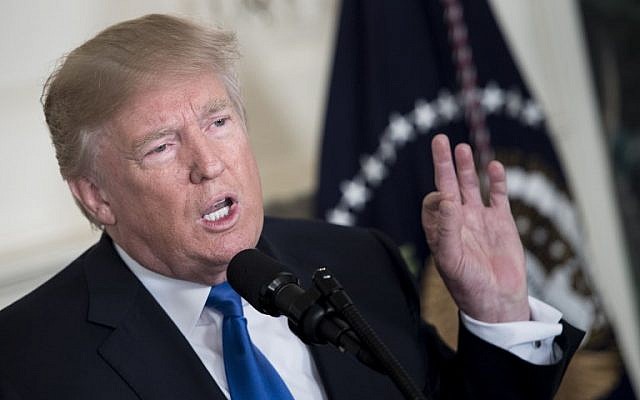
US President Donald Trump speaks about the Iran deal from the Diplomatic Reception room of the White House in Washington, DC, on October 13, 2017. (AFP/Brendan Smialowski)

WASHINGTON — Defying longstanding American policy, US President Donald Trump will give a speech Wednesday recognizing Jerusalem as Israel’s capital, according to an Axios report on Friday.

A White House spokesman, contacted by The Times of Israel on Friday afternoon, would not confirm the story. “The president has always said it is a matter of when, not if,” the official said. “The president is still considering options and we have nothing to announce.”

The Axios report cited two sources with direct knowledge of Trump’s intentions.

The US Embassy building in the Israeli coastal city of Tel Aviv, December 28, 2016. (AFP Photo/Jack Guez)

Multiple reports surfaced this week that the president would for the second time waive a congressional mandate requiring the US embassy be moved from Tel Aviv to Jerusalem, but that he would take the dramatic step of formally recognizing the holy city as Israel’s capital.

An Israeli television report on Wednesday, for instance, said that the Israeli government considered it extremely likely that Trump would declare in the next few days that he recognizes Jerusalem as Israel’s capital and that he is instructing his officials to prepare to move the US Embassy to Jerusalem from Tel Aviv. The White House rejected that report as “premature.”

On Tuesday, US Vice President Mike Pence said Trump “is actively considering when and how to move the American embassy in Israel from Tel Aviv to Jerusalem.” Pence spoke at a gathering of UN ambassadors, diplomats and Jewish leaders at an event in New York commemorating the 70th anniversary of the UN vote for partition of Palestine, which led to the creation of the State of Israel.

US Vice President Mike Pence speaks as he attends a Permanent Mission of Israel to the United Nations event celebrating the 70th anniversary of the UN vote calling for ‘the establishment of a Jewish State in the Land of Israel’ at the Queens Museum on November 28, 2017 in New York. (AFP/ Timothy A. Clary)

Declaring Jerusalem as Israel’s capital would be a highly controversial move, with the potential to spark unrest in the Middle East. The Wall Street Journal reported that US officials were contacting embassies in the region warning them to prepare for the possibility of violent protests.

A presidential declaration could risk producing an angry response from the Palestinians and other Arab allies, like Jordan and Saudi Arabia, just as the Trump White House is preparing to move forward with its attempts to broker a Mideast peace accord.

Israel says Jerusalem is the eternal and undivided capital of the Jewish state, while the Palestinians claim East Jerusalem as the capital of a future state.

Trump’s senior adviser and son-in-law Jared Kushner has been tasked with leading the administration’s peace efforts. He will participate in a highly anticipated keynote conversation this Sunday at the Brookings Institution’s Saban Forum in Washington, DC, marking a rare occasion when he will give public remarks and discuss the administration’s peace push.

Jared Kushner exits the West Wing of the White House October 17, 2017 in Washington, DC. (Drew Angerer/Getty Images via JTA)

At that event, he will likely face questions about the Trump team’s position vis-a-vis Jerusalem and how that might impact their quest to forge an agreement between the sides.

A 1995 law requires the relocation of the US Embassy in Israel to Jerusalem, but provides the president with the prerogative to postpone the move every six months on national security grounds.

Each of Trump’s three immediate predecessors — Bill Clinton, George W. Bush and Barack Obama — repeatedly exercised that right. Trump, for his part, signed the waiver when faced with his first deadline in June. He will have to decide whether to sign it for the second time in his presidency on Monday. (While the official deadline is December 1, since that date falls on a Friday this year, the deadline is extended until after the weekend.)

Israel’s Channel 10 TV news, citing sources in Israel,  said there were three camps in the White House with differing opinions on how to deal with the issue.

The first was pushing the president not to sign the waiver and start the process of moving the embassy, and also recognize Jerusalem at Israel’s capital. “It could happen” that the president “simply doesn’t sign” the waiver, Channel 10 reported Friday.

A second camp says don’t do anything, sign the waiver and don’t recognize Jerusalem as it would harm prospects for a peace process and hurt ties with Arab states. The third group is urging the president to sign the waiver, but make a symbolic gesture by recognizing Jerusalem as the capital, the report said.