Archive for November 27, 2017

Hamas Vows to Expand Terror from Gaza to Judea and Samaria

November 27, 2017

Nov 27, 2017

By: AP and United with Israel Staff

https://unitedwithisrael.org

Hamas terrorists in Gaza. (AP/Adel Hana)

Hamas is refusing to cede control of its weapons and is threatening to infringe on Fatah territory. Is more violence on the horizon? 

The Palestinian Hamas terror group has vowed to expand its terror activities to the Judea and Samaria region, despite demands by the rival Fatah movement that it disarm as part of a reconciliation agreement.

A senior Hamas official, Khalil al-Hayya, stated the group’s arsenal “can’t be divided or talked about in any dialogue.”

His remarks on Monday highlight the stark antagonism between Hamas and Palestinian Authority (PA) head Mahmoud Abbas’s Fatah as the rivals negotiate steps for reconciliation.

Fatah, which holds sway in parts of Judea and Samaria, wants Hamas’s rockets, explosives and attack tunnels in Gaza neutralized. While Hamas is refusing to disarm, Fatah maintains that “the Palestinian weaponry must be one.”

In 2007, Hamas violently wrested control of Gaza from the PA after winning legislative elections a year earlier. It has wielded absolute power in Gaza since, driving humanitarian conditions to near-total collapse.

Last month, Fatah and Hamas signed a reconciliation deal under which Hamas began ceding control to Abbas, but differences remain.

More Violence on the Horizon

Middle East envoy Nickolay Mladenov warned the UN Security Council (UNSC) last week of the consequences, including a likely conflict, if the Hamas-Fatah agreement fails.

“Whether it would be triggered by a meltdown of law and order in Gaza, by the reckless action of extremists or by strategic choice, the result will be the same — devastation and suffering for all,” Mladenov said. “This cycle must be avoided at all costs.”

He said Palestinian leaders, Israel and the international community “have an important responsibility to advance the peace efforts.”

Some analysts say that the weapons control issue will ultimately cause the failure of the reconciliation and lead to more violence.

Earlier this month, Hazem Atallah, the Palestinian national police commander, cast doubt on whether the reconciliation agreement can be carried out, warning that his forces cannot guarantee law and order unless Hamas disarms in Gaza.

With his comments, Atallah acknowledged that this issue is nowhere near resolution.

“It is impossible. How can I do security when there are all these rockets and guns? Is this possible? It doesn’t work,” Atallah stated.

Several attempts have been made in the past to reconcile between Hamas and Fatah since Hamas violently took control of Gaza in 2007. So far, all attempts have failed.

 

Arab states will abandon Israel when Iran threat dies, security expert warns

November 27, 2017

Latest News from Israel

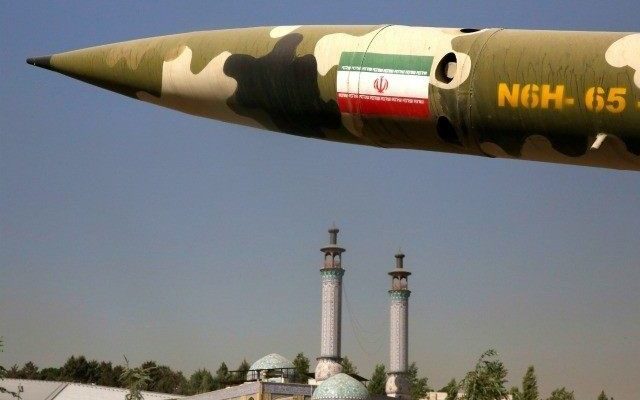
An Iranian missile (AP/Vahid Salemi/File)

Sunni Arab states will abandon Israel as US abandoned the Kurds, leading Israeli national security analyst warns.

By: Ben Cohen, The Algemeiner

One of Israel’s leading national security analysts has urged caution in assessing a potential alliance between the Jewish state and the conservative Sunni Arab countries, pointing to the recent abandonment of the Kurds by the international community as a sobering reminder that perceived national interests invariably trump other values like loyalty and shared security.

“[L]et us suppose the Iranian threat disappears because Israel launches a successful attack on Tehran’s nuclear facilities,” wrote Lt. Col. (Res) Mordechai Kedar in a briefing for Israel’s Begin-Sadat Center for Security Studies (BESA).  “As a result, war breaks out between Israel and Iran (including Hezbollah), Israel sacrifices hundreds of soldiers and civilians – and the Iranian problem ceases to exist. Will the Arab and Western worlds be grateful to Israel and act to protect its interests?”

“The answer is simple: look to the Kurds,” Kedar – an expert on Syria who spent 25 years with IDF military intelligence – continued. “What happened to them will happen to Israel,” he said, in a reference to last month’s onslaught on Kurdish-held areas by Iranian-backed and Iraqi government forces following the September 25 referendum in which 93 percent of Kurdish voters opted for independence.

‘Kurds Fought ISIS…and Were Thrown to the Wolves’

“The Kurds fought ISIS, sacrificed their soldiers and people, and were thrown to the wolves once they had outlived their usefulness,” Kedar asserted. “That is exactly what will happen to Israel once it saves the Arab states from the Iranian threat. And why not? The immediate interests of each state, not the moral rights of the Kurds and the Israelis, are what make the world go round.”

“The Kurds expected the world, headed by the US, to stand behind them once ISIS was defeated, remembering their great contribution to that defeat and supporting their demand for independence,” he noted. “Those hopes were dashed very quickly.”

Revived concern over the prospect of a new war with Hezbollah on Israel’s northern border and the escalation of a bitter of war of words between the Saudi and Iranian regimes have fueled the expectation that Saudi Arabia and its allies and Israel will end their historic enmity. On Thursday, Saudi Crown Prince Muhammed Bin Salman described Iran’s “supreme leader,” Ayatollah Ali Khamenei, as “the new Hitler of the Middle East” – echoing the language used by many Israeli and Jewish leaders in their responses to Iran’s frequent threats to eliminate Israel.

“Israel may indeed be the darling of the ‘moderate Sunni axis’ – for as long as there is an Iranian threat,” Kedar wrote. “Once that is gone, the possible fracturing of Iran into ethnic components (on the lines of the former USSR, Yugoslavia, and Czechoslovakia) will obviate the need for good relations with Israel. For this reason, Israel would do well not to give up land for a piece of paper with the word ‘peace’ stamped on it. That paper can easily fly away in the desert wind while the words on it fade in the blazing Middle Eastern sun.”

Examples of Short-term Alliances: Jordan, Egypt

Kedar argued that in addition to the Kurdish experience, Israel’s peace treaties with Egypt and Jordan provided “two unassailable confirmations” of the perils of an alliance of short-term convenience.

“The [Egypt-Israel] peace treaty did not stand in [former Egyptian President] Hosni Mubarak’s way when he allowed Hamas and its supporters to smuggle arms from Sinai to Gaza,” he wrote. “It was in Mubarak’s interest to bring about a war between Israel and Hamas, because it allowed Israel to do Egypt’s dirty work with the Palestinian branch of the Muslim Brotherhood (Hamas). As soon as Sinai became a haven of jihadism and began fighting Egypt, the weapons smuggling from Sinai to Gaza ceased abruptly. In short, the peace between Israel and Egypt exists so long as it suits Egyptian interests.”

On Jordan, Kedar said that “King Abdullah II changed his father’s [the late King Hussein] policies and is a strong backer of the idea of a Palestinian state in the West Bank with its capital in East Jerusalem. He acts against Israel in every international forum, as if he were one of its greatest enemies. He relates to the peace treaty as an agreement to refrain from war and no more, while enjoying its attendant economic benefits.”

