The Saudi Arabian monarch will announce his son as successor, who plans to count on IDF backing to defeat Iran and its proxy Hezbollah and has already promised Israel billions of dollars if they agree, a new report indicates.
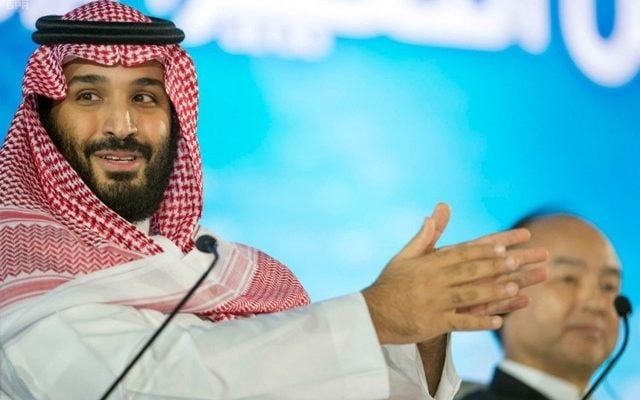
Saudi Crown Prince Mohammed bin Salman (Saudi Press Agency via AP)
King Salman of Saudi Arabia plans to step down and announce his son as his successor next week, a source close to the country’s royal family told DailyMail.com in an exclusive interview.
The transfer of power to Prince Mohammed bin Salman, known as MBS, is expected already next week, DailyMail.com said in the report published Thursday, adding that the king will continue only as a ceremonial figurehead.
“Unless something dramatic happens, King Salman will announce the appointment of MBS as King of Saudi Arabia next week,” said the unnamed source. There was no official comment from Riyadh.
Quoting the unnamed “high level source,” the report says the prince will shift his focus to its longtime rival Iran and enlist the help of the Israeli military to crush its proxy Hezbollah in Lebanon.
“MBS is convinced that he has to hit Iran and Hezbollah,” according to the source. “Contrary to the advice of the royal family elders, that’s MBS’s next target.”
The prince reportedly plans to count on the IDF to fulfill his mission.“MBS’s plan is to start the fire in Lebanon, but he’s hoping to count on Israeli military backing. He has already promised Israel billions of dollars in direct financial aid if they agree,” the source said.
“MBS cannot confront Hezbollah in Lebanon without Israel. Plan B is to fight Hezbollah in Syria,” the source added.
‘Wake-up Call’ to Iranian Threat
Former Lebanese Prime Minister Saed Hariri resigned from his position two weeks ago, fearing for his life. In an address made in Saudi Arabia, he cited Iran’s hostility and meddling in his country.
Iran generated “disorder and destruction” in Lebanon and meddled in its internal affairs as well as in other Arab countries, Hariri charged.
Prime Minister Benjamin Netanyahu reacted to the dramatic resignation two week ago, saying it was “a wake-up call to the international community to take action against Iranian aggression.”
Trump’s Ultimate Deal?
Furthermore, a secret correspondence between the Saudi Foreign Minister Adel Al Jubeir and Crown Prince Mohammed Bin Salman reveals the draft of a possible peace deal between Saudi Arabia and Israel, the Lebanese website Al-Akhbar reported this week.
Speculation about a regional deal has been rife since US President Donald Trump’s visit to Saudi Arabia in May and was strengthened by Arab reports, since denied by Saudi officials, of a secret visit to Israel by the Crown Prince in September, where, according to reports, he met with Netanyahu.
U.S. officials have become increasingly concerned that American military aid to the Lebanese army is arming the Iranian-backed terror group Hezbollah, which has been amassing a large cache of advanced arms on Israel’s border, according to multiple current and former U.S. officials who spoke to the Washington Free Beacon.
Following the resignation of Lebanese Prime Minister Saad Hariri, who fled the country and disclosed that Hezbollah controls the entirety of Lebanon, the U.S. government has continued its support for the Lebanese military, which multiple sources say has long been under the thumb of Hezbollah militants.
The ongoing policy is said to be fueling diplomatic tensions between the United States and Israel, which has found itself allied with Saudi Arabia as the American government advances a host of policies that have contributed to Iran’s regional dominance, including in Iraq and Syria.
The Trump administration’s State Department is coming under increased pressure from lawmakers and other foreign policy insiders to halt all military aid to Lebanon in light of Hariri’s resignation and new evidence that Hezbollah is benefiting from the American arms and aid.
Multiple U.S. officials and other national security insiders who spoke to the Free Beacon about the situation criticized the Trump administration for continuing a host of policies that they say have emboldened Iran’s grip on the region, including in Syria and Iraq, where U.S. arms have recently been detected going to Iranian-backed militia groups.
“It is clear that the State Department and [Defense Department] operate on the false construct that Lebanese Hezbollah and the Lebanese State are two distinct entities when in reality the information available to decision makers points to the dominance of Hezbollah within the state,” one former senior U.S. defense official familiar with the matter disclosed to the Free Beacon.
“Our Gulf allies and the Israelis are intimately familiar with the internal dynamics of Lebanon and clearly understand that Hezbollah is the defacto Lebanese state today, but we refuse to acknowledge this unfortunate reality even when confronted with obvious evidence,” said the source, who would only discuss the sensitive information on background.
Accusations that the Trump administration is helping to preserve Hezbollah’s grip on Lebanon come just days after a large, bipartisan delegation of lawmakers petitioned the Trump administration to present them with a plan on how it will stop Iran’s growing military presence in Syria, where the Islamic Republic has been building weapons factories that arm Hezbollah.
The situation is said to have fueled ongoing diplomatic tensions between the Trump administration and regional allies such as Israel, which has warned for some time that Iran’s presence across the region is emboldening Hezbollah and setting the stage for a brutal regional war.
Some experts have conceded in recent weeks that the United States has found itself more in line with Iran’s interests than those of allies such as Israel and Saudi Arabia, who have been seeking to combat Iran’s military efforts across the region.
Congressional officials are already examining ways to force the Trump administration into using current sanctions laws on the books to halt all U.S. aid to the Lebanese military, which these sources say is fully under Hezbollah’s control.
“The resignation of Lebanese Prime Minister Hariri is the latest consequence of Iran’s increasingly pervasive influence in Lebanon through its terrorist proxy Hezbollah,” Sen. Ted Cruz (R., Texas), said in recent remarks. “Given these developments, it is time for the United States to reassess the military assistance we provide to Lebanon, including to the Lebanese Armed Forces, and conduct a formal review of our strategy there.”
Rep. Brian Mast (R., Fla.), a combat veteran and member of the House Foreign Affairs Committee, told the Free Beacon in a recent interview that Congress must play a more active role in reassessing U.S. military aid to Lebanon in light of the situation.
“What can be done can be undone and maybe nobody wanted to undo this for the last eight years,” Mast said, referring to U.S. aid programs to Lebanese forces “This is exactly the role that foreign affairs is meant to play.”
It remains unclear what steps the Trump administration is willing to take.
Current and former U.S. officials who spoke to the Free Beacon about the situation said the State and Defense Departments continue to operate under the false belief that Lebanon can be separated from Hezbollah.
“It’s time for the U.S. to cease supporting this mirage of a Lebanon as an independent state given the penetration and dominant influence of the Iranian proxy Hezbollah,” the Defense source said.
A White House National Security Council spokesperson denied that Hezbollah has benefitted from any U.S. assistance to Lebanon’s Armed Forces, telling the Free Beacon the U.S. government has emphasized there “there must be absolutely zero cooperation between the LAF and Hezbollah.”
“The United States is focussed on continuing aid to the LAF to strengthen it and ensure that it alone is the sole defender of Lebanon,” according to the NSC official. “The United States remains committed to strengthening Lebanon’s legitimate government institutions, including the LAF.”
The administration official praised the LAF as a “well-trained, well equipped, and fully capable fighting force” that has been legitimized by U.S. aid, which has topped $1.5 billion since 2006.
“Many of the highest ranking officers in the LAF have attended U.S. professional military education courses at various points in their careers, building professionalism in the LAF’s officer corps,” according to the NSC official, who maintained “U.S. training and weapons” have helped mitigate “the destabilizing effects of the Syrian conflict.”
State Department officials declined to comment on the situation, only telling the Free Beacon that they “must refer all questions regarding the presence of Lebanese Prime Minister Saad Hariri in Saudi Arabia to the governments of Saudi Arabia and Lebanon.”
The Treasury Department, in comments to the Free Beacon, said the United States has multiple sanctions in place against Hezbollah.
One senior congressional official familiar with the efforts to thwart Iran’s regional takeover told the Free Beacon the Trump administration must immediately impose new sanctions on Hezbollah and halt U.S. military aid to the Lebanese Armed Forces, which have already been accused of letting these weapons flow to Hezbollah.
“The United States must counter Iran’s growing control of Lebanon through its terrorist proxy Hezbollah through enforcing and imposing new sanctions to dry up the group’s ability to finance its terrorist operations,” said the official, who would only speak on background about the efforts.
“Furthermore, the U.S. must ensure that the progress against ISIS does not distract us from countering and stopping Iran’s goal to fill this vacuum to further threaten our allies in the region, especially Israel,” the official said. “This step should therefore include reassessing whether U.S. military assistance is in U.S. national security interests and take additional steps to ensure the assistance that has already been provided does not unintentionally fall into the wrong hands.”
The situation has become particularly pressing in light of recent accusations by many leading lawmakers that the United States also has played a role in arming Iranian-backed militia fighters in Iraq, where the American military has been running a program to train, fund, and equip various Iraq militia groups.
“We should reject the idea that its banking system needs to be protected from the consequences of its own corrupt behavior or that the Lebanese Armed Forces deeply influenced by Hezbollah can function in the best interest of all the Lebanese people,” said the former official quoted above.
One veteran foreign policy adviser close to the White House told the Free Beacon that the Trump administration is still taking advice from current officials who served in the Obama administration and have an urge to continue that administration’s policies.
“President Trump has been publicly and fully backing our Saudi and Israeli allies, who are on the front lines against Hezbollah,” said the source, who would only speak on background because policy deliberations are ongoing. “They assess that Hezbollah has full political and military control over Lebanon and they’ve been acting accordingly.”
“But there are parts of the Trump administration that still live in the fantasy world created by Obama, where Lebanon is up for grabs and maybe we can push out Iran if we finance these puppets over here that Iran has installed, but sanction these other puppets over here,” the source said. “The result is we’re paying to boost Iran.”
Israeli officials have expressed concerns to the Trump administration about the situation in Lebanon, according to multiple sources.
A Treasury official, speaking only on background, said it continues to implement sanctions on Hezbollah, though it is waiting for direction from the State Department about future actions.
“Hezbollah is designated under multiple sanctions authorities as are its members, operatives, and supporters,” the official said. “While we do not comment on specific cases or potential future actions, Treasury is committed to imposing sanctions against Hezbollah, and we will continue to expose, block, and disrupt Hezbollah’s finances and deny this terrorist group access to the U.S. and international financial systems.”
The administration continues to consider Lebanon’s Central Bank “as a valuable partner in the fight about Hezbollah,” according to the official.
“Treasury continues to work with the Central Bank of Lebanon and Lebanese banks to expand their capability to protect the Lebanese financial system from abuse by Hezbollah in order to maintain connections with the U.S. financial system,” the administration official said.
This stance, however, is coming under question in light of former Prime Minster Hariri’s claim that Hezbollah controls every facet of the Lebanese government.
“The most important point about Hariri’s resignation—and the Saudi position—is the admission that Hezbollah controls the state,” said Tony Badran, a writer and prominent authority on Lebanon who serves as a research fellow at the Foundation for Defense of Democracies. “There is no distinction between Hezbollah and the state.”
“This acknowledgment has direct bearing on U.S. policy in Lebanon,” Badran explained. “It puts paid to the conceit that we can distinguish between Hezbollah and this theoretical construct called ‘the Lebanese state,’ which is supposedly not only independent of Hezbollah, but perhaps even opposed to it. This is myth. ”
“The premise of the support to the LAF [Lebanese Armed Forces] is that we are strengthening the ‘Lebanese state,’ and in so doing, we are somehow undermining Hezbollah,” Badran said. “How that is, nobody has ever come up with an actual answer.”
U.S. officials acknowledged Iranian-backed forces in Iraq could be using American-made arms, an admission that comes amid growing concern on Capitol Hill the U.S. government is quietly working with militia fighters in Iraq who are directly tied to the Islamic Revolutionary Guards Corps (IRGC), according to multiple sources familiar with the situation.
U.S. lawmakers and military insiders are concerned by what they described as the American government’s continued arming and training of Iranian-backed fighters in Iraq, an ongoing policy that multiple sources described to the Washington Free Beacon as one of the U.S.’s chief foreign policy failures in the region.
Top lawmakers and others have begun to present evidence showing that the State Department continues to provide widespread support for Iranian-backed militias in Iraq, a program that first begun under the Obama administration.
This has helped solidify Iran’s presence in key Iraqi territories and appears to directly conflict with the Trump administration’s newly outlined push to combat the Islamic Republic’s regional military efforts, which have included targeting U.S. forces in Syria and other locations.
Multiple sources who spoke to the Washington Free Beacon both on and off the record accused the State Department of making “common cause” with the IRGC, which they say has benefited from ongoing American efforts to arm and train Iraqi militia groups, many of which have direct ties to Iran.
These sources pointed to the continued presence of senior Obama administration officials in government as one of the primary drivers of this ongoing policy.
Senior Trump administration officials acknowledged they have seen evidence that some Iraqi forces on its blacklist are using American arms.
“We have seen reports that some U.S.-origin military equipment is being operated by Iraqi militia units that are not the approved end-users,” said a spokesman for the White House National Security Council. “We urge the Government of Iraq to expeditiously return this equipment to the full control of the Iraqi Army.”
However, the official said the United States has strict policies in place to prevent Iranian-tied forces and other terrorist actors from benefitting from its military programs in Iraq.
“All recipients of U.S. security assistance are fully vetted and subject to end-use requirements,” the official said. “The United States has strict standards to avoid providing security assistance to designated terrorist organizations, units with close ties to Iran, or units under suspicion of committing gross violations of human rights.”
Leaders on Capitol Hill are currently pushing the Trump State Department to come clean about possible interactions with Iranian-tied forces in Iraq.
Rep. Ron DeSantis (R., Fla.), a member of the House Foreign Affairs Committee, is one of several lawmakers who recently disclosed direct evidence of Iranian-backed fighters using American-made tanks and other military equipment in Iraq.
DeSantis told the Washington Free Beacon Congress is increasing pressure on the State Department to disclose currently withheld information on the relationship between the U.S. military and Iranian-backed militia groups in Iraq.
“The State Department should not be making common cause with the IRGC, [Iranian commander] Qassem Soleimeni, the [Iranian] Quds Force or Shia militias,” DeSantis said, explaining that these groups have long worked to thwart U.S. operations in the region.
“These groups were responsible for killing hundreds of U.S. troops in Iraq during our operations there last decade,” DeSantis said. “Congress needs to get the facts about the relationship between our own State Department and these nefarious actors.”
Intelligence information circling around Capitol Hill and reviewed by the Washington Free Beacon shows that multiple IRGC proxy groups have been operating under the Iraqi Ministry of Interior (MOI), which coordinates and doles out U.S. funding and equipment to various militia groups.
Iranian-tied entities believed to be benefiting from U.S. programs include Kata’ib Hezbollah, an Iraqi Shia military group supported by Iran; and the Badr forces, an Iranian backed military group. At least four other Iranian-supported military groups also are said to have benefited from U.S. training programs, according to the intelligence information.
Photographs and other open-source intelligence information appear to show that Iraqi Prime Minister Haider al-Abadi is aware that Iran is cashing in on U.S. programs.
Al-Abadi’s government is believed, in part, to allocate funds to these Iranian forces via Abu Mahdi al-Mohandes, a designated terrorist who leads Kata’ib Hezbollah, who then doles out U.S. funds to various Iranian-backed militia groups.
Kata’ib Hezbollah has been identified as receiving American funding, armor, and artillery via these programs.
Other photographic evidence in the possession of lawmakers appears to show various Iranian-backed militia fighters in Iraq using American-made M1A1 Abrams tanks, which require direct training from the United States to operate.
The State Department and Trump administration officials are said to be aware of this information, as well as other evidence, but stand accused of downplaying it so as not to interfere with the fight against ISIS in Iraq, which these Iranian militias have helped wage.
Bill Roggio, a veteran military analyst and editor of the Long War Journal, which chronicles U.S. military efforts, said the drive to defeat ISIS has pushed senior U.S. military and diplomatic officials to ignore Iran’s growing role in the Iraq.
“The U.S. military and government has been so desperate to defeat the Islamic State that it has consciously ignored that its allies in Iraq and Syria include Shia militias backed by Iran and the PKK [a Kurdish rebel group], which is designated by the U.S. government as foreign terrorist organization,” Roggio said.
U.S. military officials who spoke to the Washington Free Beacon about the situation said that any concerns over the misuse of American-made arms are brought directly to the Iraqi government.
“If we receive reports that U.S.-origin equipment is being misused or provided to unauthorized users, we engage the Iraqi government in conjunction with the U.S. Embassy to address any confirmed issues—up to the highest levels, if necessary,” one senior U.S. military official said. “That communication, however, is private.”
The U.S. has “received assurances from the Government of Iraq and the Iraqi Security Forces that they will use U.S. equipment in accordance with U.S. law and our bilateral agreements,” the official added.
Lawmakers and other have singled out Brett McGurk, the special presidential envoy for the Global Coalition to Counter ISIS, as playing a key role in enabling policies that help arm Iranian backed forces.
McGurk, who was also a senior official in the Obama administration, has long been viewed as a controversial figure due to his 2008 affair with a Wall Street Journal reporter while the two were in Iraq.
“The State Department continues to downplay the role of the IRGC militias, but they’ve literally hijacked the MOI [Ministry of Interior],” said Michael Pregent, a former intelligence official who has tracked U.S. aid to rogue militia groups. “The MOI receives U.S. funds and equipment, so what is the State Department doing about it? By not addressing it, they’re putting Americans on the ground in danger.”
One veteran congressional advisor who works closely with lawmakers on the Iran portfolio expressed concern the Trump administration is being led down the wrong foreign policy path.
“The Trump administration is supporting Iran in just about every country across the Middle East,” the source said, expressing frustration about the policy on background because he is not authorized to speak on the record. “In the Gulf, the State Department is trying to get the Saudis to cave to Iran’s Qatari allies. In Syria, the Defense Department is abandoning our allies. In Lebanon, they’re bolstering the Hezbollah-controlled government. And in Iraq they’re at-best incoherent because they continue to support Iran-controlled militias.”
“That’s what you get when you leave in place the Obama officials who originally orchestrated the pro-Iran pivot, like Brett McGurk,” the source added. “The mystery is why the good people inside the administration, who come up to the Hill and tell lawmakers they don’t want to see the Middle East controlled by Iran, don’t do anything about it.”
The State Department did not return a request for comment.
The New School, a Manhattan- based university, is sponsoring the event in cooperation with the Jewish Voice for Peace and Jacobin Magazine, both of which promote causes of the radical Left.
Sarsour is Muslim activist and unrelenting critic of Israel who supports a boycott against the Jewish state. Among numerous other controversial statements, she tweeted in 2012, “Nothing is creepier than Zionism.”
Rebecca Vilkomerson, executive director of JVP, is also scheduled to speak at the event, which will be moderated by Amy Goodman, host of the radio program Democracy Now.
The mind boggles. Jason Greenblatt, the head of the ADL, tweeted:
Having Linda Sarsour & head of JVP leading a panel on #antisemitism is like Oscar Meyer leading a panel on vegetarianism. These panelists know the issue, but unfortunately, from perspective of fomenting it rather than fighting it. https://t.co/s4tvBrvjBj 1/2
It’s just a shame he used a US-specific reference and spelled ‘Oscar Mayer’ (the American meat and cold cut production company, owned by Kraft Heinz) as ‘Oscar Meyer’
And Rebecca Vilkomerson, executive director of Jewish Voice For Peace (JVP), who sure love their murderers of Jews.
Linda Sarsour is also not the great feminist that she promotes herself as being, as the Tower notes:
In a critique of Linda Sarsour, Julie Lenarz, a senior fellow at The Israel Project, observed this past June in The Tower, “Linda Sarsour is not a feminist. She supports a culture that is forcing millions of women into religious slavery. She is a false apostle selling her regressive views to a blinded liberal audience.”
As for Rebecca Vilkomerson, you can read some of her anti-Israel activity and comments here, and below is a clip of her speaking at J Street, promoting BDS:
The New School did not seem to see the enormity of the problem, and assured the Jerusalem Post wide-eyed and disingenuously of their good intentions:
The New School responded in writing to The Jerusalem Post, saying the institution “is founded on principles of tolerance, social justice, and free intellectual exchange. These values remain central to our mission today, and we believe that engaging in debate on a range of issues and ideas is critical to our role as an academic institution”.
A representative who spoke on behalf of the school added: “We understand that there are different views on this issue.
For that reason, the Creative Publishing and Critical Journalism Program has invited representatives of the magazine Tablet to organize an event to present some of these different views on this important topic; the program has also invited to participate Jonathan Greenblatt, national director and CEO of the Anti-Defamation League”.
Founded in 1919 by progressive New York intellectuals, The New School rose to prominence two decades later, when it took in a small band of Jewish intellectuals fleeing the Nazis. Eminences like Hannah Arednt, Leo Strauss, and Erich Fromm all benefited from the institution’s commitment to taking in the victims of the world’s most ancient and persistent hatred and giving them a place to pursue their ideas in peace.
How things change: Later this month, the university will co-sponsor a panel on anti-Semitism that will feature, among others, Linda Sarsour, who opined that “nothing is creepier than Zionism,” praised Nation of Islam leader Louis Farrakhan, and believes one cannot support the right of Jews to a homeland of their own and still be a feminist. Alongside Sarsour will be Rebecca Vilkomerson, who heads the odious Jewish Voice for Peace. The group, as an ADL report aptly put it, “uses its Jewish identity to shield the anti-Israel movement from allegations of anti-Semitism and to provide the movement with a veneer of legitimacy.” Among JVP’s recent achievements are the enthusiastic support of Rasmea Odeh, a Palestinian terrorist convicted of a bombing attack on a Jerusalem supermarket that left two young students dead and who was recently deported from the United States after lying about the incident on her immigration forms. The group is also a frequent supporter, despite its allegations to the contrary, of Alison Weir, an activist robustly promoting modern-day blood libels against Jews.
It goes without saying, sadly, that the event—which is co-sponsored by prominent progressive institutions like the radical magazine Jacobin—features not a single actual scholar of anti-Semitism, nor one voice that doesn’t belong comfortably in the deep left.
The New School, scrambling to respond to the widely broadcast negative reactions it received, offered to organize a second panel “to discuss these issues”:
We understand that there are differing views on the issue of anti-Semitism. For that reason, the Creative Publishing and Critical Journalism Program has invited representatives of the magazine Tablet to organize an event to present some of these differing views on this important topic; the program has also invited to participate Jonathan Greenblatt, National Director and CEO of the Anti-Defamation League.
to which Liel Leibowitz at The Tablet angrily responded:
The aforementioned invitation arrived several moments later, to myself and other editors at Tablet, strongly suggesting that it had more to do with stanching the bleeding of a public relations problem that seriously resolving a brutal moral error. Even more insulting and infuriating is the fact that the invitation suggests that the New School sees this as a matter of balancing out two equally legitimate sides, each with its own point of view.
There ought never to be a debate between those who fan the flames of hatred and those who suffer its consequences. The New School of all institutions ought to know this, and it’s a shame that this once revered institution now peddles in the bluntest form of moral relativism rather than speak out against bigotry of all stripes.
My question remains: can the organizers at the New School really be so ignorant and obtuse as to think there is no problem with the panel of speakers at the antisemitism debate? Do they honestly think having another panel to discuss these “controversial issues” will balance out the problem?
Either they are so open-minded their brains fell out. Or they are outright antisemites. I still have not made up my mind.




 anneinpt
 artaxes
 danmillerinpanama
 davidking1530
 Peter Hofman
 Joseph Wouk
 Peter
Peter Louisiana Steve
 WarSclerotic
Recent Comments