Source: Jeremy Corbyn struggles with the shadow of Antisemitism. – Opinion – Jerusalem Post
BRITAIN’S OPPOSITION Labour Party leader Jeremy Corbyn listens to speeches at the Labour Party Conference venue in Brighton yesterday.. (photo credit:REUTERS)
Since 2015, Britain has been one election away from having an antisemitic prime minister backed by antisemitic voters. If current trends in the Democratic Party continue, in the not-so-distant future, the United States might be in the same position.
Two years ago, Jeremy Corbyn was elected leader of Britain’s main opposition Labor Party. That officially put an end to Tony Blair’s alignment of the Labor Party with the political center in Britain, both in economic and in foreign affairs.
Corbyn is an antisemite. He refers to Hezbollah and Hamas – two terrorist groups that openly support the genocide of world Jewry and the annihilation of the Jewish state – as “our friends.” He has shared stages with Hamas terrorists and Holocaust- deniers. Since his ascension to leadership of the Labor Party, he has overseen the mainstreaming of antisemitic actions and rhetoric by his party members and supporters.
Shortly after Corbyn’s election, repeated, well-publicized acts of antisemitism by senior Labor Party members forced Corbyn to call for an investigation of the phenomenon. He appointed his ally Shami Chakrabarti to oversee the effort.
The Chakrabarti report – first presented at a Labor Party conference convened last June for that purpose – was not merely a whitewash. It effectively denied that it is possible to be concerned with antisemitism without being racially insensitive to other minority groups. In other words, concern for antisemitism is a form of racism in and of itself.
As for Corbyn himself, he couldn’t be clearer about his feelings. His remarks at his conference on antisemitism were antisemitic.
Corbyn insisted that it’s wrong “to assume that a Jewish friend is wealthy, part of some kind of financial or media conspiracy or takes a particular position on politics in general, or on Israel and on Palestine in particular.”
After all, not all Jews are bad, rich Jews who run the media and support Israel.
If that wasn’t enough, Corbyn then proceeded to allege that Israel is as evil as Islamic State. In his words, “Our Jewish friends are no more responsible for the actions of Israel and the Netanyahu government than our Muslim friends are for those various self-styled Islamic states and organizations.”
Since then, according to Jewish Labor Party members, Corbyn has refused to take any steps to diminish the increasingly strident antisemitic rhetoric and character of his party.
This then brings us to the American Democratic Party.
Over the past week, two incidents occurred that indicate that the party of Harry Truman and Bill Clinton is becoming increasingly comfortable with blaming the Jews.
First, last Thursday, Obama loyalist and former CIA operative Valerie Plame approvingly shared a fiercely antisemitic article on her Twitter feed.
The article, “America’s Jews are Driving America’s Wars,” was written by Philip Giraldi, a fellow former CIA officer and outspoken Jew-hater.
Giraldi’s piece included all the classic antisemitic tropes: Jews control the media and culture; they control US foreign policy; and they compel non-Jewish dupes to fight wars for Israel, to which the treacherous Jews of America are loyal.
Giraldi recommended barring Jews from serving in government positions and participating in public debates related to the Middle East. And, he added, if an American Jewish Israel-backer refuses to recuse himself, the media should duly label him, “Jewish and an outspoken supporter of the State of Israel.”
Such a label, he contended, “would be kind of like a warning label on a bottle of rat poison.”
Plame, who ultimately issued a contrite, defensive apology for circulating Giraldi’s anti-Jewish screed, initially justified her decision to repost the article and say it was “thoughtful.”
She added, “Many neocon hawks ARE Jewish.”
And she should know.
Plame rose to fame in 2003, when she was at the center of a chain of events that led to the delegitimization of Jewish neo-conservatives in the Bush administration through a campaign of antisemitic innuendo and legal persecution.
In 2003, Plame’s husband, former diplomat Joe Wilson, published an article in The New York Times in which he falsely denied White House claims that Saddam Hussein had sought to purchase uranium yellow cake from Niger for the purpose advancing his nuclear program.
Apparently in retaliation for his false allegations, then-deputy secretary of state Richard Armitage leaked to syndicated columnist Robert Novak that Wilson’s wife Valerie was a CIA officer. Plame was a covert operative at the time, making Armitage’s leak a crime.
The Justice Department appointed special prosecutor Patrick Fitzgerald to oversee the investigation and prosecute the leak. Fitzgerald knew almost from the outset that Armitage was the source of the leak.
Yet he failed to prosecute him.
Instead, Fitzgerald went on a fishing expedition to root out then-vice president Richard Cheney’s Jewish chief of staff Scooter Libby. After a multiyear investigation, Libby, who did not leak Plame’s identity, was indicted and convicted on a specious count of perjury.
The effect of Libby’s indictment, prosecution and conviction was to place all his fellow Jews in the Bush national security team under constant and deeply antisemitic scrutiny. This defamation of Jewish American security experts in many ways paved the way for Barack Obama’s wholesale use of antisemitic undertones to defend his nuclear deal with Iran.
As Omri Ceren from the Israel Project recalled in a long series of Twitter posts after Plame circulated Giraldi’s article, Obama and his advisers repeatedly argued that “lobbyists” and Israel were seeking to convince lawmakers not to act in the US’s best interest. Instead they tried to manipulate senators into defending Israel and oppose Obama’s nuclear deal with Iran, to the detriment of America. These exhortations, made repeatedly by Obama and his surrogates were then expanded upon and made explicit by their political allies in places like the Ploughshares Foundation, which served as focal points of Obama’s media campaign on behalf of the Iran nuclear deal.
Until she resigned on Sunday, Plame served on the Ploughshares board of directors.
Plame’s wing of the Democratic Party is not explicitly antisemitic. Obama never said, “Jews are undermining US national security.” Instead, he attacked Israel and Prime Minister Binyamin Netanyahu. He attacked “lobbyists” and foreign interests.
Plame’s mistake last week was that, in tweeting a link to Giraldi’s article, she moved beyond Obama’s dog-whistle approach.
In a way, she can be excused for crossing the line, because the rising force in her party has little problem openly trucking in Jew-hatred.
That force, of course is the Bernie Sanders radical leftist wing of the party.
Around the same time that Plame was tweeting her way into ill-repute, Iran was showing off a medium- range ballistic missile capable of hitting Israel and Europe and Sanders was giving a foreign policy speech in Missouri.
Israel was a key focus for Sanders, who is now in charge of the Democratic Party’s outreach efforts.
Sanders said the US is “complicit” with Israel’s “occupation” of Judea and Samaria and Gaza. He said that he would consider cutting off US military aid to Israel. He argued the US should take a more evenhanded approach to Israel.
No similar statements have ever been made by any major presidential contender or political leader in either party.
And yet, they have raised no outcry among his fellow Democrats.
Sanders’s rise has unleashed forces in the party such as former Nation of Islam spokesman Rep.
Keith Ellison and BDS activist Linda Sarsour. Both have been outspoken in their antisemitism. Both routinely defame and delegitimize American Jews who support Israel. And both are all but unanimously embraced as leaders by their partisan colleagues.
Since Donald Trump’s election, most of the media coverage of US politics has centered on cleavages within the Republican Party. But while it is true that the Republican Party is dysfunctional, the Democratic Party is transforming into something never before seen in mainstream US politics.
In 2016, the party of Bill Clinton ceased to be the party of the working class. Hillary Clinton abandoned her husband’s Rust Belt base, referring to his voters as “deplorables.”
Today, the two predominant branches of the party are the Obama branch – which is comfortable with antisemitic dog whistles – and the Sanders branch, which is comfortable with Corbyn-style Jew-baiting and open discrimination of pro-Israel Jews.
Absent a major restructuring of the party’s makeup, Plame’s forced resignation from Ploughshares may be remembered as the high-water mark in the new Democratic Party’s efforts to root out antisemitism from its ranks.
Bin Laden Heir Breathes New Destructive Energy Into Al Qaeda, Investigative Project on Terrorism, Abigail R. Esman, September 25, 2017
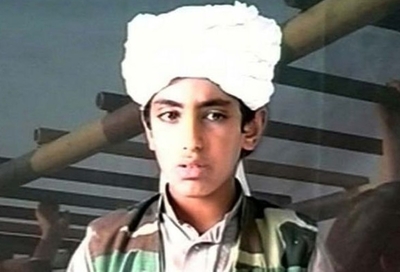
Nicknamed the “Crown Prince of Terror,” Osama bin Laden’s favorite son “grew up with a fervor for jihad and a determination to follow in the footsteps of his notorious father,” according to an investigative report by Ali Soufan and published in Newsweek. After bin Laden’s 2011 death, Hamza swore revenge on the U.S. in the name of his father and “those who defended Islam.”
“We will continue striking you and targeting you in your country and abroad in response to your oppression of the people of Palestine, Afghanistan, Syria, Iraq, Yemen, Somalia and the rest of the Muslim lands that did not survive your oppression,” he pronounced in a speech.
To be sure, Al Qaeda is not the only group that has quietly strengthened while the world has focused on the Islamic State. Hizballah also continues to be a threat, especially from South America: “The threat is coming from everywhere,” Shaikh wrote. “When Americans talk about the Muslim threat from the Mexican border, it’s not all hyperbole. That laptop ban, for instance, was not based on nonsense: in Somalia, a Shabaab bomber blew himself right … out of the airplane.” But Al-Qaeda, he believes, may pose the biggest danger.
“AQ is playing the Long Game,” he said. “We’re not. That’s our problem.”
******************************************
Since the start of his presidential campaign, Donald Trump has sworn to destroy ISIS, threatening to be “nasty” and to “annihilate” the terrorist group and its leaders by “bombing the s*** out of them.”
But is he missing the larger threat?
“We need to start preparing for a big comeback by al-Qaeda” former FBI terrorism expert Ali Soufan told PRI earlier this month. The author of Anatomy of Terror: From The Death of Bin Laden To the Rise of the Islamic State, Soufan is one of many who warn of an Al-Qaeda resurgence, likely to take place under Osama bin Laden’s charismatic 28-year-old son, Hamza.
Canadian counterterrorism expert Mubin Shaikh agrees. “The thing that everyone keeps getting wrong about Al Qaeda is because of what AQ’s Al Suri said long ago,” he wrote in a recent e-mail. “Al Qaeda is a system, a methodology, not a group per se.”
Indeed, as ISIS loses territory in Syria and Iraq, Al Qaeda’s influence and power is growing. Some experts have speculated about a potential ISIS-Al Qaeda merger. Others point to the demise of ISIS as a motivation for Al Qaeda operatives to strengthen their recruiting efforts, and as reason for newly-inspired would-be jihadists to turn to Al Qaeda in its place.
An extensive guide to targeting trains for attacks that Al Qaeda published last month may have paved the way to the Sept. 15 London Underground bombing. Now French officials also warn of potential train-based attacks inspired by the Al Qaeda guidebook.
That guide may have marked the beginning of the terror group’s comeback, as Hamza bin Laden is seen as taking on more power in the organization. Nicknamed the “Crown Prince of Terror,” Osama bin Laden’s favorite son “grew up with a fervor for jihad and a determination to follow in the footsteps of his notorious father,” according to an investigative report by Ali Soufan and published in Newsweek. After bin Laden’s 2011 death, Hamza swore revenge on the U.S. in the name of his father and “those who defended Islam.”
“We will continue striking you and targeting you in your country and abroad in response to your oppression of the people of Palestine, Afghanistan, Syria, Iraq, Yemen, Somalia and the rest of the Muslim lands that did not survive your oppression,” he pronouncedin a speech.
Hamza, according to Soufan’s extensive biography of the younger bin Laden, has been “groomed to lead” from a young age. But unlike his father, who served as a kind of wise elder figure in inspiring recruits and followers of his jihad, Hamza has a different advantage: his youth, which makes him better suited to attract the kinds of younger jihadists and aspiring jihadists who have been more recently attracted to ISIS. He is, in fact, just two years older than your average jihadi recruit. He “gets” social media. If Al Qaeda has historically been credited for its planning expertise and ISIS for its recruitment, a Hamza bin Laden-led Al Qaeda has the potential to excel at both.
The Al Qaeda he is poised to lead is also different than his father’s organization, having quietly strengthened itself in the shadows while the West focused its energies and intelligence on ISIS. In addition, a Vox report points out, while ISIS has been shrinking in Syria and Iraq, Hayat Tahrir al-Sham, the Syrian Al-Qaeda affiliate, has expanded to become “one of the most effective fighting forces in the Syrian civil war,” in part through its alliances with other anti-Assad groups in the region.
It has proved to be a clever strategy: Al Qaeda can now call on those groups for support as it focuses its sights elsewhere. And while Vox observes that it’s “unclear how interested many of these al-Qaeda affiliates are in attacking America at this particular moment,” the threat of such an attack is undeniable. That the group is already publishing manuals encouraging train derailments in Western countries and other maneuvers – even noting that such attacks will not end in “martyrdom” – indicates that it is turning its focus back in our direction.
Hamza has also called for Muslims worldwide to “join arms” against the Western crusaders. In an undated video cited by Al Arabiya, the young bin Laden declared that, “In order for the people of Syria to resist the Crusader, Shiite and international aggression, Muslims – all Muslims – must stand with them, support them and give them victory.”
It is this kind of rhetoric that Shaikh believes is working in Al Qaeda’s favor. Unlike ISIS, he says, “they did not go all barbaric Sharia Law on people, because they realized the problems they would face in brand management, and that this was the problem IS faced. They are working to win hearts and minds in Syria, and they are succeeding.”
Not everyone agrees, however. “Hamza’s messages have barely registered in jihadi and Islamist spheres,” argues Hassan Hassan, a senior fellow at the Tahrir Institute for Public Policy, and “senior jihadis in Syria have dismissed Hamza’s leadership prospects.” Nor does Hassan see much chance of collaboration with ISIS. Nonetheless, he notes, Al Qaeda appears to be trying ” to position itself as the true heir of bin Ladenism and the unrivaled leader of global jihad.”
To be sure, Al Qaeda is not the only group that has quietly strengthened while the world has focused on the Islamic State. Hizballah also continues to be a threat, especially from South America: “The threat is coming from everywhere,” Shaikh wrote. “When Americans talk about the Muslim threat from the Mexican border, it’s not all hyperbole. That laptop ban, for instance, was not based on nonsense: in Somalia, a Shabaab bomber blew himself right … out of the airplane.” But Al-Qaeda, he believes, may pose the biggest danger.
“AQ is playing the Long Game,” he said. “We’re not. That’s our problem.”
Iran Defies Nuclear Deal With Latest Ballistic Missile Test, Washington Free Beacon,

Iranian President Hassan Rouhani / Getty Images
Iran’s weekend test firing of yet another long-range ballistic missile is amplifying congressional calls for the Trump administration to formally declare Iran in violation of the landmark nuclear agreement, a move that would lay the groundwork for the United States to abandon the agreement.
Iran claims to have successfully test fired a new long-range ballistic missile in response to threats by the Trump administration to leave the nuclear accord.
President Donald Trump criticized Iran during his first speech before the United Nations last week, singling out the Islamic Republic as one of the leading global threats. The speech prompted tough talk by senior Iranian leaders and military officials, who vowed to boost the country’s capabilities.
The latest ballistic missile test has amplified congressional calls for Trump to leave the deal and has provided grist to those inside the administration pushing for the president to formally declare Iran in violation of the nuclear deal due to these tests and other actions that violate the accord.
“Iran’s missile test is further proof that the Obama-Khamenei nuclear deal has only served to empower and embolden the Islamist regime,” Rep. Ron DeSantis (R., Fla.), a member of the House Foreign Affairs Committee, told the Washington Free Beacon.
“Given Iran’s belligerent conduct and its violations of the terms of the deal, President Trump should follow his instincts and decertify the JCPOA in October,” DeSantis said, using the acronym for the nuclear agreement, also known as the Joint Comprehensive Plan of Action. “We can’t allow Iran to follow in the footsteps of North Korea when it comes to acquiring a nuclear capability.”
DeSantis’s comments jibe with public remarks from Trump and some of his most senior officials, including United Nations Ambassador Nikki Haley, who has been a vocal critic of the nuclear accord and Iran’s threatening behavior.
Haley, commenting on Iranian violations of U.N. accords last week, said that U.S. is focused on holding the Islamic Republic responsible for defying these resolutions.
“What we’re looking at and what you’re going to hear us very vocal on is the fact that 2331, the resolution that was in place, what we saw was it basically wrapped in with the nuclear deal; it said if Iran did any of these things, it would be in violation,” Haley said, adding that evidence indicates Iran has violated international resolutions multiple times.
The ballistic missile test shows that Iran had made further strides in its long-range ballistic technology and that international calls for it to refrain from such behavior have no impact on the country’s actions.
Under U.N. Security Resolution 2231, which codifies the nuclear agreement, Iran is prohibited from test firing ballistic missiles, though the restriction has not altered Tehran’s behavior.
The newest missile, unveiled during a Friday military parade in Tehran, is reported to be Iran’s third such rocket capable of traveling nearly 1,250 miles. It weighs more than a ton and can carry “several warheads,” according to reports in Iran’s state-controlled media.
Trump offered a strong response to the missile test, tweeting that the missile is “capable of reaching Israel.”
Iran is also “working with North Korea. Not much of an agreement we have,” Trump wrote.
The tweet is being viewed as a window into Trump’s thinking on the deal and whether he will formally designate Iran as in violation.
A State Department official told the Free Beacon that officials are looking into the missile launch and will seek to counter the threats posed by Iran’s continued rocket tests.
“We have seen the media reports that Iran launched a ballistic missile,” the official said. “We are looking into these reports.”
“As we’ve said before, Iran’s continued ballistic missile development and support for terrorism are provocative and undermine security, prosperity, and stability throughout the region,” the official added, noting that “UN Security Council Resolution (UNSCR) 2231 (2015) calls upon Iran to not undertake any activity related to ballistic missiles designed to be capable of delivering nuclear weapons.”
The administration “will continue monitor these issues closely and to use all of the tools at our disposal to counter threats from Iran’s missile program,” the official said.
While the Trump administration has recertified the deal in the past months, some believe that Trump has decided not to do so again.
One veteran Middle East analyst who works closely with White House official on the Iran portfolio told the Free Beacon that Trump’s tweet is a good indication of where he currently stands on the matter.
“The president’s tweet reflected exactly how he feels, and everyone at every level knows it,” the source said. “He thinks the deal is garbage because it’s riddled with so many flaws, in this case dismantling sanctions while Iran builds ballistic missiles capable of striking Israel and Europe.”
However, there have been internal tensions of the matter, with Secretary of State Rex Tillerson pushing for Trump to keep the agreement. The Free Beacon first reported last week that disagreements between Tillerson and Haley on the matter have been a source of tension in the State Department.
“The State Department has been fighting [Trump] at every turn because Tillerson and his Obama holdovers want to preserve the deal,” the source explained. “So suddenly they’ve begun downplaying Iranian missile launches, because that would make it obvious how the deal isn’t in America’s national interest.”
Iranian President Hassan Rouhani has vowed a fierce response if the United States decides to leave the deal, saying in a recent interview such a move would “yield no results for the United States, but at the same time, it will generally decrease international trust placed in Washington.”
Iran is prepared to respond if the United States abandons the agreement.
“We have thought long and hard about our reactions,” Rouhani said, noting that these reactions would come “quite swiftly” and “probably within a week.”
Meanwhile, Iranian military leaders have disclosed the Islamic Republic continues to build advanced weaponry, despite international bans on some of these arms.
“Different missiles and ground combat weaponries, along with our air defense and marine combat systems, are all made in Iran and our ready-to-service experts will continue this path robustly,” Brigadier General Amir Hatami, Iran’s defense minister, said during the weekend.
It appears that only two nations are celebrating Monday’s Kurdish referendum on independence: Kurds and Israelis. Indeed, while thousands of Kurds in countries where their national identity is being repressed, such as Turkey, Iran, and Syria have rushed to the streets at the end of the day, anticipating a yes vote, Turkish news outlet Hurriyet Daily News warned:
“With a romantic approach or with the ‘an ally is in the making’ calculations of the Jewish state, the potential dangers ahead posed by such a vote might be ignored.”
As voting stations closed in Iraqi Kurdistan, more than 80% of registered voters had cast ballots in the referendum on Kurdish independence that may change the entire Middle East as we know it.
In the oil-rich city of Kirkuk, The Guardian reported, Kurdish neighborhoods were teeming with voters, many wearing traditional costumes. “It is the best day of my life,” a 62-year-old blacksmith told the Guardian’s Martin Chulov.
Few doubt that the ballot will deliver an overwhelming endorsement of independence, under the leadership of Kurdish president Massoud Barzani.
“What is the Kurdish population of northern Iraq? What is the population of northern Syria? How many Kurds are living in Iran? And, what is the percentage of the Turkish Kurds among the overall 30 million Kurdish population spread in the four countries?” asks Hurriyet.
Well, we may not know for sure how many Kurds live in which of the above mentioned countries, we do know of decades of repression they have endured, to this day, of gassing by several Iraqi regimes, and of violent repression under strings of Turkish governments. Everybody fears Kurdish independence much the way everybody once feared Jewish independence – and for a good reason. The new Kurdistan is a democratic island surrounded by tyrannies; it is a prosperous nation; and it is willing and able to fight for its independence.
Which is why all of Kurdistan’s neighbors have been advancing military units towards its borders, possibly scheming to repeat the attempt in 1948 by seven Arab states to choke the fledgling State of Israel. But President Barzani, taking a page out of Israel’s founding father David Ben Gurion’s play book, has ignored calls from his neighbors as well as from the US, the UK, the EU, the UN and the Arab League to cancel the vote and delve into more talks about the status of Iraq’s Kurds with Baghdad.
“If there is an assumption, as the Iraqi Kurdish leaders and their Israeli supporters have been saying, the passage of the referendum would not immediately lead to statehood but it would represent a major move forward that might open the door of negotiations with the Baghdad government, it is wrong,” warns the Turkish media mouthpiece. “The northern Iraqi government has been assuming that the Americans will not let the Baghdad government take military action. If what’s at stake is the very existence of Iraq, what might be the attitude of the Iraqi government might not be so guaranteed.”
“The recent statement of top executives of Iran, Iraq and Turkey, increased contacts between the two countries, increased military maneuvers with live ammunition by Turkish tanks right on the Iraqi border indicate that perhaps Turkey might not be joking at all when it was warning the Iraqi Kurds that they are expected to scrap all together the referendum plans if they do not face the consequences,” threatens Hurriyet.
Israeli social media has been bubbling over the referendum, which is being tallied as this report is being published – and the dominant sentiment being expressed there is: should the free Kurdistan come under attack from its neighbors, Israel would be obligated to come to its aid.
Kurdistan’s and Israel’s enemies are the same. Should a war for free Kurdistan erupt, it will likely focus on Kirkuk, which at the moment is threatened by Shia militias loyal to Iran and to the Iraqi government south of the city. Turkish president Erdogan is threatening to cut the pipeline that exports Iraqi Kurds’ oil to Europe via Turkey. And the Iraqi Prime Minister, Haider al-Abadi, has threatened to take military action should the referendum decide on a free Kurdistan.
At this point, the only world power that can really save Kurdistan from having to fight to the death for its freedom is the US. Email your Congress member.
(Please see also, Islamists Responsible for Rohingya Refugee Crisis. — DM)
The establishment media continues to portray the Rohingya Muslims as the victims of “Buddhist terror.” Reality, as always, is not so simple.

“Myanmar searches for more Hindu corpses as mass grave unearthed,” SBS, September 25, 2017 (thanks to K.):
Violence has periodically cut through the western state, where communal rivalries have been sharpened by British colonial meddling, chicanery by Myanmar’s army and fierce dispute over who does — and does not — belong in Rakhine.
But the events of August 25, when raids by Rohingya militants unleashed a swirl of violence across the north, have sunk Rakhine to new depths of hate.
“All of our family died at the village… we will not go back,” said Chaw Shaw Chaw Thee, one of hundreds of displaced Hindus seeking shelter in the state capital Sittwe.
Bangladesh’s army was ordered Wednesday to take a bigger role helping hundreds of thousands of Rohingya who have fled violence in Myanmar, amid warnings it could take six months to register the new refugees.
The 20-year-old said she lost 23 family members as Rohingya militants swarmed the clutch of Hindu villages in Kha Maung Seik, near the Bangladesh border.
On Sunday the army said 28 badly-decomposed bodies of Hindu men, women and children had been pulled from two mass graves in the same area.
It was not immediately clear if they belonged to Chaw Shaw Chaw Thee’s family.
Heavily pregnant when she fled, she gave birth at a disused football stadium in Sittwe, where hundreds of traumatised Hindus now sleep on grubby mats in the overcrowded concourse.
An army lockdown has made it impossible to independently verify what happened in the villages of northern Rakhine, an area dominated by Rohingya Muslims who are a minority elsewhere in the mainly Buddhist country.
But allegations, carved along ethnic lines, are spinning out as conspiracy and competing identity claims override empathy between former neighbours.
Hindus, who make up less than one percent of Rakhine’s population, accuse Rohingya of massacring them, burning their homes and kidnapping women for marriage….
“We were barbers for Muslims, our women sold things in Muslim villages, I had Muslim friends, we had no problems,” said Kyaw Kyaw Naing, a 34-year-old Hindu who can dance across linguistic divides in Hindi, Rakhine, Burmese and Rohingya.
Community ties in what is also Myanmar’s poorest state have now unravelled.
“We want to go back, but we will not if the Muslims are there.”
Palestinian ‘Reconciliation’: Jihad is Calling! Gatestone Institute, Bassam Tawil, September 25, 2017
(To what extent does the “international community” agree with Hamas and the Palestinian Authority that Israel must be destroyed? — DM)
Hamas insists on maintaining its terror and military capabilities in preparation for war against Israel.
At the risk of overwhelming the international community with troubling facts, here is a final one: Hamas aims to use the agreement with the Palestinian Authority as a smokescreen for concealing its true goal: the destruction of Israel.
Here is how it works: Hamas is telling Abbas, “You continue to pretend as if you want to talk peace with the Jews, while we prepare for war.”
*************************************
Leaders of Hamas maintain that under no circumstances will they agree to lay down their weapons. Hamas is, in fact, continuing full-speed-ahead digging tunnels under the border between the Gaza Strip and Israel. Hamas is planning to use the tunnels to smuggle armed terrorists into Israel.
The accord with Hamas requires Mahmoud Abbas to lift the sanctions he recently imposed on the Gaza Strip, such as refusing to pay Israel for the electricity it supplies to Gaza. It also requires Abbas to resume payment of salaries to thousands of Palestinians who served time in Israeli prison for terror-related offenses.
Above all, Hamas wants to use the agreement to be removed from the U.S. State Department List of Foreign Terror Organizations.
The Russians are closing their ears to what Hamas itself declares day after day: that its true goal is to eliminate Israel and that it has no intention of abandoning its murderous, genocidal agenda.
The Palestinian terror group Hamas has once again made clear that its true intention is to pursue the fight against Israel until the “liberation of Palestine, from the (Jordan) river to the (Mediterranean) sea.” Hamas, which controls the Gaza Strip, says that despite the latest “reconciliation” agreement reached with the Palestinian Authority (PA) under the auspices of the Egyptian government, it will continue to prepare for war with Israel.
While some Western analysts have misinterpreted the agreement as a sign that Hamas is moving towards moderation and pragmatism, leaders of the Islamist movement maintain that under no circumstances will they agree to lay down their weapons. Hamas is, in fact, continuing full-speed-ahead digging tunnels under the border between the Gaza Strip and Israel. Hamas is planning to use the tunnels to smuggle armed terrorists into Israel.
Just last week, two Hamas terrorists were killed when the tunnels in which they were working collapsed, in separate incidents in the Gaza Strip. The terrorists were identified as Khalil Al-Dumyati and Yusef Abu Abed.
The news about the collapse of the tunnels coincided with the reports of the new “reconciliation” agreement reached in Cairo between Hamas and the Palestinian Authority (PA). This means that while the Egyptians and Abbas’s representatives were discussing with Hamas leaders ways of ending their 10-year-long dispute and achieving “national unity,” Hamas terrorists were busy tunneling under the Gaza Strip to prepare for attacks on Israel.
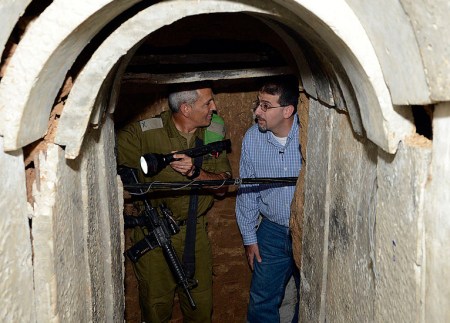 Pictured: On October 17, 2013, then U.S. Ambassador to Israel Dan Shapiro visited a tunnel penetrating Israel from Gaza, which had been discovered by the Israeli army. Shapiro said: “I was shocked from what I saw in the tunnel. It is clear that this tunnel has only one purpose: to carry out terrorist attacks against Israeli civilians and IDF soldiers.” (Image source: Matty Stern/U.S. Embassy Tel Aviv)
The “reconciliation” accord does not require Hamas to stop terror attacks on Israel. Nor does it require Hamas to abandon its charter, which explicitly calls for the elimination of Israel. Instead, the agreement, which has yet to be implemented, requires Abbas’s PA government to resume funding for various government institutions and civil servants in the Gaza Strip.
In other words, this agreement benefits Hamas by absolving it of its responsibilities toward the two million Palestinians living under its control in the Gaza Strip. Moreover, the agreement emboldens Hamas by allowing it to redirect its resources and energies towards amassing weapons and digging tunnels to be used for launching terror attacks against Israel. The accord requires Abbas to lift the sanctions he recently imposed on the Gaza Strip, such as refusing to pay Israel for the electricity it supplies to Gaza, reducing medical supplies and forcing thousands of civil servants in the Gaza Strip into early retirement. It also requires Abbas to resume payment of salaries to thousands of Palestinians who served time in Israeli prison for terror-related offenses. All this in return for one “concession” on the part of Hamas: dismantling the shadow government it established in the Gaza Strip a few months ago — something to which Hamas happily agreed in return for Abbas lifting the sanctions.
Make no mistake: Hamas has no intention of relinquishing security control over the Gaza Strip. Thousands of Hamas “security officers” and members of its military wing, Ezaddin Al-Kassam, will remain the law-enforcement force in the Gaza Strip. This means that even if Abbas’s government will be allowed to operate in the Gaza Strip, it would have limited civilian powers only, such as paying salaries and funding various projects.
One week after the Cairo “reconciliation” agreement, Hamas is still urging Abbas to lift the sanctions he imposed on the Gaza Strip. Why the rush? Jihad against Israel is calling. Hamas’s message to Abbas: Hurry up and give us the funds because we need to invest our energies and money in building more tunnels and smuggling weapons (through Egypt) into the Gaza Strip.
Hamas has been seeking international recognition and legitimacy and is hoping that the agreement with Abbas’s Palestinian Authority will facilitate this mission. Above all, Hamas wants to use the agreement to be removed from the U.S. State Department List of Foreign Terror Organizations.
This position was relayed last week to the Russian government by a senior Hamas delegation that visited Moscow. Hamas is hoping that in wake of the Egyptian-sponsored agreement with the PA, the Russians will exert pressure on the U.S. to remove Hamas from the terror list.
Musa Abu Marzouk, a senior Hamas official who participated in the Moscow discussions, confirmed that he and his friends had asked the Russians for their help. “We asked the Russians to help stop the US from keeping Hamas on the (terror) list,” Abu Marzouk said. “We also asked that the Russians help remove the (Israeli and Egyptian) blockade on the Gaza Strip.” Abu Marzouk and the Hamas delegation appear to have found a sympathetic ear in Moscow. They now claim that the Russians told them that Moscow does not consider Hamas a terror organization “because Hamas won a free and fair (parliamentary) election in 2006.”
If true, the Russians seem to have bought the lie that Hamas is headed towards moderation and pragmatism, supposedly thanks to the latest “reconciliation” agreement. More disturbing still, concerning the reported Russian position, is that Moscow, it seems, does not view Hamas as a terror group; the reason for this omission is apparently that Hamas “won” an election. The Russians are ignoring the fact that since Hamas won in 2006, the terror movement has launched thousands of rocket and other terror attacks against Israel. The Russians are also ignoring Hamas’s continued buildup and preparation for war by digging tunnels and amassing weapons in the Gaza Strip. More significantly, the Russians are closing their ears to what Hamas itself declares day after day: that its true goal is to eliminate Israel and that it has no intention of abandoning its murderous, genocidal agenda.
How do the Russians and the rest of the world define “non-negotiable”? The same way as Abu Marzouk after the Moscow visit, with regards to the Hamas weapons: “The weapons of the resistance belong to all the Palestinians and are non-negotiable,” Abu Marzouk emphasized. “No one can tamper with this issue.”
The statement means that Hamas insists on maintaining its terror and military capabilities in preparation for war against Israel.
At the risk of overwhelming the international community with troubling facts, here is a final one: Hamas aims to use the agreement with the Palestinian Authority as a smokescreen for concealing its true goal: the destruction of Israel.
Here is how it works: Hamas is telling Abbas, “You continue to pretend as if you want to talk peace with the Jews, while we prepare for war.”
In the eyes of Hamas, the “reconciliation” agreement should serve as functional sharing between the PA and Hamas, with each side playing the role it wants. Abbas will go on pretending he wants peace, while Hamas builds more tunnels and acquires additional weapons. That is their real agenda: Hamas wants to collaborate with Abbas in fooling the world. Abbas’s job will be to “pursue peace” and rake in the money, while Hamas plans for the next round of terrorism against the Jews.
It remains to be seen whether the Western-funded Palestinian Authority will be complicit in this scheme to scam the world. Also interesting should be seeing whether the international community will once again fall into the web of lies woven by the master manipulators, Abbas and Hamas.
Bassam Tawil is a Muslim based in the Middle East.
Source: Turkish army at Iraqi border and ready to take ‘necessary steps’ – Erdogan — RT News

Turkish Army tanks manoeuvre during a military exercise near the Turkish-Iraqi border in Silopi, Turkey, September 25, 2017 © Umit Bektas / Reuters
After members of the KRG voted for independence, Erdogan proffered a veiled threat that military force could be used to preserve the status quo in the region.
Erdogan said Turkey’s neighbors “should not expect us to turn a blind eye.”
READ MORE: Kurds go to polls in controversial independence referendum Live updates
“We will continue to work in accordance with the territorial integrity of Iraq,” he said in a tweet.
He added that with regards to Iraq and Syria “who pose a threat to our country… we use all options in front of us.”
Erdogan’s comments come on the back of a Turkish Foreign Ministry statement, which promised that “we will take every measure that emanates from international law and from the authority granted by the Grand National Assembly of Turkey.”
Responding to the federated Kurdish region’s attempt at a mandate for independence from Iraq, Erdogan said Turkey could block petrol coming from the region.
The two nations operate the Kirkuk-Ceyhan line, which at 970km long is one of Iraq’s main means to export oil to the west.
“After this, let’s see through which channels the northern Iraqi regional government will send its oil, or where it will sell it,” Erdogan said in a speech delivered Monday.
“We have the tap. The moment we close the tap, then it’s done.”
READ MORE: As Kirkuk boils, Kurdistan about to hurl Iraq into turmoil over ‘independence’ referendum
Turkey’s south-eastern border has been the scene of a long-running separatist battle by those seeking a Kurdish state. According to International Crisis Group, which tracks violence in the region, an estimated 2,448 people have died in the conflict since 2016.
Source: ‘US declared war first’: N. Korea says it has right to shoot down strategic bombers — RT News

A rocket is fired during a drill by anti-aircraft units of the Korean People’s Army © KCNA / Reuters
Speaking to reporters in New York on Monday, North Korean Foreign Minister Ri Yong Ho said that US President Donald Trump has effectively declared war on Pyongyang, meaning all options were on the table for his country’s leadership.
“The whole world should clearly remember it was the US who first declared war on our country,” Reuters quoted him as saying.
“Since the United States declared war on our country, we will have every right to make countermeasures, including the right to shoot down United States strategic bombers even when they are not inside the airspace border of our country.”
Earlier, an open letter from North Korea to several international parliaments said that President Trump’s remarks in his UN General Assembly speech last week amounted to an “intolerable insult to the Korean people, a declaration of war against North Korea and grave threats to the global peace,” the Korean Central News Agency (KCNA) said in a report.

Speaking before the UN General Assembly last week, Trump said that while the “United States has great strength and patience,” it may have “no choice but to totally destroy North Korea” if the US or its allies are threatened.
Tensions have been running high on the Korean Peninsula, with bellicose rhetoric and provocative military activities coming from both the Democratic People’s Republic of Korea (DPRK) on one side, and the United States and South Korea on the other. Pyongyang has conducted several missile and nuclear tests in defiance of rulings by the UN Security Council, while the US has continued to carry out joint exercises with South Korea and Japan while ramping up its own war of words against Pyongyang.
Russia and China have repeatedly called for a ‘double-freeze’ solution to the crisis, in which the United States ceases its drills with South Korea in exchange for the North suspending its weapons programs. However, Washington has not accepted the proposal, saying it has every right to carry out exercises with its allies.
On Saturday, tens of thousands of North Koreans held a rally on Kim Il-Sung Square in Pyongyang to denounce President Trump, in which students marched, chanting slogans and holding banners, proclaiming their willingness to stand behind leader Kim Jong-un.




 anneinpt
 artaxes
 danmillerinpanama
 davidking1530
 Peter Hofman
 Joseph Wouk
 Peter
Peter Louisiana Steve
 WarSclerotic
Recent Comments