In an interview with Arutz Sheva, philanthropist Kenneth Abramowitz spoke about Iran, terror organizations, and US President Donald Trump’s first speech at the United Nations General Assembly.
Abramowitz is the co-founder of NGN Capital and founder of a blog about the threats facing the West called SaveTheWest.com.
“Mr. Trump is the clearest it’s been in a long time,” Abramowitz said, noting that the US President could still be “a little more clear.”
“In the Middle East, we are fighting four terror organizations,” he explained. “People think we’re fighting ISIS, Al-Qaeda. They also know we’re fighting Iran, which is the number one terror organization today. But we’re also fighting the Muslim Brotherhood, financed by Turkey and Qatar, who are half friends, half enemies… And we’re also fighting the Wahhabis financed by Saudi Arabia and Pakistan, who are half friends half enemies.”
“Trump is the best we can do, but he still does not have quite the clear enough picture to realize we’re fighting four terror organizations at the same time.”
Regarding cohesion within the Trump administration, Abramowitz said, “Trump has a good vision of whats going on. Not all his security advisers are on the same page, but knowing Trump, he’ll just make sure the security advisers come onto the same page. ”
According to Abramowitz, war is inevitable.
“We’re basically in World War Three,” he said. “Iran has promised to kill everyone in America: Death to America, genocide against America, [and] now genocide against Israel, too. But as President of the United States, he has a responsibility to protect us.”
“It’s one thing to speak about Iran, it’s another thing to do something about Iran. The administration hasn’t yet realized that there’s no non-military solution for Iran and North Korea. When you’re dealing with professional terror organizations like that, you can’t negotiate your differences.
“In the next fifteen years, either Iran or America will not exist as we now know it. Basically, we’ll find out which one wont exist in fifteen years.”
The Iran deal is a figment of the world’s imagination, Abramowitz said, noting that “Iran never signed the deal.”
“The deal with Iran doesn’t exist, it’s all in the imagination of people. Iran never signed the deal. There is no deal. It’s just a question of when America accepts the fact that there’s no deal, that it realizes that it must protect itself. Iran’s working on nukes and ICBMs (intercontinental ballistic missiles), you only need ICMs to blow up America. So the plans are there to blow up America, we just can’t sit around and think about it.”
Predicted that Israeli Prime Minister Binyamin Netanyahu would give a “great” speech at the General Assembly, Abramowitz noted that Israel is “vitally important” to America.
“I’m sure [Netanyahu] will give his usual great defense of Israel and how important Israel is to America. Israel basically protects America from the four political Islam terror organizations, and is therefore vitally important to America.”
Prime Minister Benjamin Netanyahu told world leaders Tuesday at the 72nd United Nations General Assembly that he would still like to visit Antarctica someday, because the population there is comprised of penguins, who he said he’d heard are also enthusiastic supporters are Israel.
“You laugh,” said Netanyahu, “but penguins have no difficulty recognizing that some things are black and white, are right and wrong,” he said with irony, adding that “Unfortunately, when it comes to UN decisions about Israel, that simple recognition is too often absent.”
Following is the full text of Prime Minister Benjamin Netanyahu’s remarks to the 72nd United Nations General Assembly.
Mr. President,
Ladies and gentlemen,
We’re in the midst of a great revolution, a revolution in Israel’s standing among the nations. This is happening because so many countries around the world have finally woken up to what Israel can do for them. Those countries now recognize what brilliant investors like Warren Buffet and great companies like Google and Intel, what they’ve recognized and known for years: That Israel is the innovation nation – the place for cutting-edge technology in agriculture, in water, in cyber security, in medicine, in autonomous vehicles – you name it, we’ve got it.
Those countries now also recognize Israel’s exceptional capabilities in fighting terrorism. In recent years, Israel has provided intelligence that has prevented dozens of major terrorist attacks around the world. We have saved countless lives. You may not know this, but your governments do, and they are working closely together with Israel to keep your countries safe and your citizens safe.
I stood here last year on this podium and I spoke about this profound change in Israel’s standing in the world and just look at what has happened since in one year: Hundreds of presidents, prime ministers, foreign ministers and other leaders have visited Israel, many for the first time.
Of these many visits, two were truly historic. In May, President Trump became the first American president to include Israel in his first visit abroad. President Trump stood at the Western Wall, at the foot of the Temple Mount, where the Jewish people’s temples stood for nearly a thousand years. When the President touched those ancient stones, he touched our hearts forever.
In July, Prime Minister Modi became the first Indian Prime Minister to visit Israel. You may have seen the pictures. We were on a beach in Hadera. We rode together in a jeep outfitted with a portable desalination device that some thriving Israeli entrepreneur invented. We took off our shoes, waded into the Mediterranean and drank seawater that had been purified only a few minutes earlier. We imagined the endless possibilities for Israel, India, for all humanity.
In the past year, Israel hosted so many world leaders, and I had the honor of representing my country on six different continents. One year. Six continents.
I went to Africa, where I saw Israeli innovators increasing crop yields, turning air into water, fighting AIDS.
I went to Asia, where we deepened our relations with China and with Singapore, and expanded our cooperation with our Muslim friends in Azerbaijan and Kazakhstan.
I went to Europe, where in London and Paris, Thessaloniki and Budapest, we enhanced our security and economic ties.
I went to Australia, becoming the first Israeli prime minister to visit our great allies Down Under.
And just last week, I went to South America, visiting Argentina and Colombia, and then I went on to Mexico, becoming, if you can believe it, the first Israeli prime minister ever to visit Latin America.
After 70 years, the world is embracing Israel, and Israel is embracing the world. One year. Six continents. Now, it’s true I haven’t yet visited Antarctica, but one day I want to go there too because I’ve heard that penguins are also enthusiastic supporters of Israel. You laugh, but penguins have no difficulty recognizing that some things are black and white, are right and wrong.
Unfortunately, when it comes to UN decisions about Israel, that simple recognition is too often absent. It was absent last December when the Security Council passed an anti-Israel resolution that set back the cause of peace. It was absent last May, when the World Health Organization adopted – you have to listen to this: the World Health Organization adopted a Syrian-sponsored resolution that criticized Israel for health conditions on the Golan Heights.
As the great John McEnroe would say, “You can-not be serious!” I mean, this is preposterous.
Syria has barrel-bombed, starved, gassed and murdered hundreds of thousands of its own citizens and wounded millions more, while Israel has provided lifesaving medical care to thousands of Syrian victims of that very same carnage. Yet who does the World Health Organization criticize? Israel.
So is there no limit to the UN’s absurdities when it comes to Israel?
Well, apparently not, because in July, UNESCO declared the Tomb of the Patriarchs in Hebron a Palestinian World Heritage site. That’s worse than fake news. That’s fake history. Mind you, it’s true that Abraham, the father of both Ishmael and Isaac, is buried there, but so too are Isaac, Jacob, Sarah, Rebecca – Sarah is a Jewish name, by the way – and Leah, who just happen to be patriarchs and matriarchs of the Jewish people. You won’t read about that in the latest UNESCO report.
But if you want to, you can read about that in a somewhat weightier publication – it’s called the Bible. I highly recommend it. I hear it even got 4 ½ out of 5 stars on Amazon. And it’s a great read. I read it every week.
Ladies and gentlemen,
A moment to be serious: Despite the absurdities, despite the repetition of these farcical events, there is change. Slowly but surely, there are signs of positive change even at the United Nations.
Mr. Secretary General, I very much appreciate your statement that denying Israel’s right to exist is anti-Semitism, pure and simple. Now, that’s important, because for too long the epicenter of global anti-Semitism has been right here at the UN. And while it may take many years, I am absolutely confident that the revolution in Israel’s ties with individual nations will ultimately be reflected in this hall of nations. I say that because there is also a marked change in the position of some of our key friends.
Thanks to President Trump’s unequivocal support for Israel in this body, that positive change is gathering force. So, thank you, President Trump. Thank you for supporting Israel at the UN. And thank you for your support, Ambassador Nikki Haley. Thank you for speaking the truth about Israel.
But, ladies and gentlemen, here at the UN, we must also speak the truth about Iran, as President Trump did so powerfully this morning. Now, you know I’ve been ambassador to the UN and I’m a long-serving Israeli Prime Minister, so I’ve listened to countless speeches in this hall, but I can say this: none were bolder, none more courageous and forthright than the one delivered by President Trump today.
President Trump rightly called the nuclear deal with Iran, he called it an embarrassment. Well, I couldn’t agree with him more. And here’s why: Iran vows to destroy my country every day, including by its chief of staff the other day. Iran is conducting a campaign of conquest across the Middle East and Iran is developing ballistic missiles to threaten the entire world.
Two years ago, I stood here and explained why the Iranian nuclear deal not only doesn’t block Iran’s path to the bomb, Iran’s nuclear program has what’s called a sunset clause. Let me explain what that term means: It means that in a few years, those restrictions will be automatically removed – not by a change in Iran’s behavior, not by a lessening of its terror or its aggression. They’ll just be removed by a mere change in the calendar. And I warned that when that sunset comes, a dark shadow will be cast over the entire Middle East and the world, because Iran will then be free to enrich uranium on an industrial scale, placing it on the threshold of a massive arsenal of nuclear weapons.
That’s why I said two years ago that the greater danger is not that Iran will rush to a single bomb by breaking the deal, but that Iran will be able to build many bombs by keeping the deal.
Now, in the last few months, we’ve all seen how dangerous even a few nuclear weapons can be in the hands of a small rogue regime.
Now imagine the danger of hundreds of nuclear weapons in the hands of a vast Iranian Islamist empire, with the missiles to deliver them anywhere on earth.
I know there are those who still defend the dangerous deal with Iran, arguing that it will block Iran’s path to the bomb.
Ladies and gentlemen,
That’s exactly what they said about the nuclear deal with North Korea, and we all know how that turned out. Unfortunately, if nothing changes, this deal will turn out exactly the same way.
That’s why Israel’s policy regarding the nuclear deal with Iran is very simple: Change it or cancel it, fix it or nix it. Nixing the deal means restoring massive pressure on Iran, including crippling sanctions, until Iran fully dismantles its nuclear weapons capability. Fixing the deal requires many things, among them inspecting military and any other site that is suspect, and penalizing Iran for every violation. But above all, fixing the deal means getting rid of the sunset clause.
And beyond fixing this bad deal, we must also stop Iran’s development of ballistic missiles and roll back its growing aggression in the region. I remember we had these debates. As you know, I took a fairly active role in them. And many supporters of the nuclear deal naively believed that it would moderate Iran. It would make it a responsible member, so they said, of the international community.
Well as you know, I strongly disagreed. I warned that when the sanctions on Iran would be removed, Iran would behave like a hungry tiger unleashed, not joining the community of nations, but devouring nations, one after the other. And that’s precisely what Iran is doing today.
From the Caspian Sea to the Mediterranean, from Tehran to Tartus, an Iranian curtain is descending across the Middle East. Iran spreads this curtain of tyranny and terror over Iraq, Syria, Lebanon and elsewhere, and it pledges to extinguish the light of Israel.
Today I have a simple message for Ayatollah Khamenei, the dictator of Iran: The light of Israel will never be extinguished.
נצח ישראל לא ישקר.
Those who threaten us with annihilation put themselves in mortal peril. Israel will defend itself with the full force of our arms and the full power of our convictions. We will act to prevent Iran from establishing permanent military bases in Syria for its air, sea and ground forces. We will act to prevent Iran from producing deadly weapons in Syria or in Lebanon for use against us. And we will act to prevent Iran from opening new terror fronts against Israel along our northern border.
As long as Iran’s regime seeks the destruction of Israel, Iran will face no fiercer enemy than Israel.
But I also have a message today for the people of Iran: You are not our enemy; you are our friends. Shomaah doosteh mah hasteed [You are our friends]. One day, my Iranian friends, you will be free from the evil regime that terrorizes you, hangs gays, jails journalists, tortures political prisoners, and shoots innocent women like Neda Sultan, leaving her choking on her own blood on the streets of Tehran. I have not forgotten Neda. I am sure you haven’t too.
And when that day of liberation finally comes, the friendship between our two ancient peoples will surely flourish once again.
Ladies and gentlemen,
Israel knows that in confronting the Iranian regime, we are not alone. We stand shoulder to shoulder with those in the Arab world who share our hopes for a brighter future. We’ve made peace with Jordan and Egypt, whose courageous President Abdel Fattah a-Sisi I met here last night. I appreciate President a-Sisi’s support for peace, and I hope to work closely with him and other leaders in the region to advance peace.
Israel is committed to achieving peace with all our Arab neighbors, including the Palestinians. Yesterday President Trump and I discussed this, all of this, at great length. I appreciate President Trump’s leadership, his commitment to stand by Israel’s side, his commitment to advance a peaceful future for all. Together we can seize the opportunities for peace and together we can confront the great dangers of Iran.
The remarkable alliance between the United States and Israel has never been stronger, never been deeper. Israel is deeply grateful for the support of the Trump administration, the American Congress and the American people.
Ladies and gentlemen,
In this year of historic visits and historic anniversaries, Israel has so much to be grateful for. A hundred and twenty years ago, Theodor Herzl convened the First Zionist Congress to transform our tragic past into a brilliant future by establishing the Jewish state. One hundred years ago, the Balfour Declaration advanced Herzl’s vision by recognizing the right of the Jewish people to a national home in our ancestral homeland. Seventy years ago, the United Nations further advanced that vision by adopting a resolution supporting the establishment of a Jewish state. And 50 years ago, we reunited our eternal capital Jerusalem, achieving a miraculous victory against those who sought to destroy our state.
Theodor Herzl was our modern Moses – and his dream has come true. We’ve returned to the Promised Land, revived our language, ingathered our exiles and built a modern, thriving democracy.
Tomorrow evening, Jews around the world will celebrate Rosh Hashanah, the beginning of our new year. It’s time of reflection, and we look back with wonder at the miraculous rebirth of our nation, and we look ahead with pride to the remarkable contributions Israel will continue to make to all nations.
You look around you and you will see those contributions every day – in the food you eat, the water you drink, the medicines you take, the cars you drive, the cell phones you use, and in so many other ways that are transforming our world.
You see it in the smile of an African mother in a remote village, who, thanks to an Israeli innovation, no longer must walk eight hours a day to bring water to her children.
You see it in the eyes of an Arab child, who was flown to Israel to undergo a life-saving heart operation.
And you see it in the faces of the people in earthquake-stricken Haiti and Nepal who were rescued from the rubble and given new life by Israeli doctors.
As the prophet Isaiah said,
“ונתתיך אור לגויים, להיות ישועתי עד קצה הארץ.”
“I have made you a light unto the nations, bringing salvation to the ends of the earth.”
Today, 2,700 years after Isaiah spoke those prophetic words, Israel is becoming a rising power among the nations. And at long last, its light is shining across the continents, bringing hope and salvation to the ends of the earth.
Happy New Year, Shana Tova from Israel. Thank you.
An al Qaeda-backed media group has issued a “wanted poster” for President Donald Trump that features a picture of the U.S. president with the words, “Wanted dead or alive for crimes against Islam,” according to a copy of the poster and accompanying screed published by a Middle East media watchdog group.
Al-Hijrah Media, a pro al Qaeda group, released a statement earlier this week seeking the death of Trump for the United States’ involvement in Afghanistan, according to the Middle East Media Research Institute, or MEMRI.
In addition to the wanted poster, the group released a statement lashing out at America for its continued presence in Afghanistan.
The “message to Trump and the Americans” claims that the United States is “weaker today than ever” and that it continues to fail in its efforts to defeat jihadi groups in Afghanistan.
“The U.S. was unable to defeat the Mujahideen when it had more than 100,000 troops in Afghanistan,” the message states.
“Trump is talking about winning in Afghanistan,” it continues. “And Americans what do you think?? Do you have no insight? Do you not know history?”
“Thousands of U.S. soldiers were injured and killed by the Mujahideen. Even, Obama had admitted before his retirement that America was unable to defeat the Mujahideen in Afghanistan,” the message reads.
“America has no advantage to continue the war in Afghanistan,” it continues. “It is clear that Trump is waging this war only for his hatred against the Muslims.”
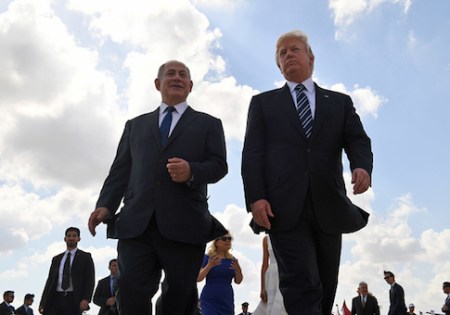
Israeli Prime Minister Benjamin Netanyahu speaks with President Donald Trump in Tel Aviv on May 23 / Getty Images
Israeli Prime Minister Benjamin Netanyahu lauded President Donald Trump’s address to the United Nations General Assembly on Tuesday, calling it “bold” and “courageous.”
“In over 30 years in my experience with the UN, I never heard a bolder or more courageous speech,” Netanyahu tweeted. “President Trump spoke the truth about the great dangers facing our world and issued a powerful call to confront them in order to ensure the future of humanity.”
and issued a powerful call to confront them in order to ensure the future of humanity.
Netanyahu watched Trump’s speech enthusiastically from Israel’s seat in the U.N.’s General Assembly Hall.
During his address, Trump castigated the Iran nuclear deal brokered by the former Obama administration as “one of the worst and most one-sided transactions the United States has ever entered into”
“We cannot abide by an agreement if it provides cover for the eventual construction of a nuclear program,” Trump said. “Frankly, that deal is an embarrassment to the United States and I don’t think you’ve heard the last of it, believe me.”
Netanyahu and much of the Israeli public strongly opposed the nuclear deal when it was being negotiated and after it was passed. He criticized the direction in which negotiations were headed in an address before the U.S. Congress in 2015, further pushing him and then-President Barack Obama apart.
Trump also rebuked the Iranian government for committing human rights abuses against its own people and for supporting terrorist groups.
“The longest suffering victims of Iran’s leaders are, in fact, its own people,” Trump said. “Rather than use its resources to improve Iranian lives, its oil profits go to fund Hezbollah and other terrorists that kill innocent Muslims and attack their peaceful Arab and Israeli neighbors.”
Essebsi is implementing reforms he deems necessary for his country’s social progress. These reforms already are having a ripple effect in the region and might lead to further social progress. Essebsi has done what al-Sisi called for about for more than two years ago, but never took any tangible steps to implement. These reforms may be not exactly what al-Sisi wanted when he called for a complete change of Islamic rhetoric that shuns all forms of extremism and violence. Nevertheless, Essebsi’s reforms are a bold step forward for total social and religious reforms that the Middle East desperately needs.
*********************************
Tunisian President Beji Caid Essebsi marched straight into a battle with Egypt’s highest Sunni authority, Al-Azhar’s mosque and university, when he proposed social and religious reforms giving women more freedom in marriage and guaranteeing them equal inheritance rights.
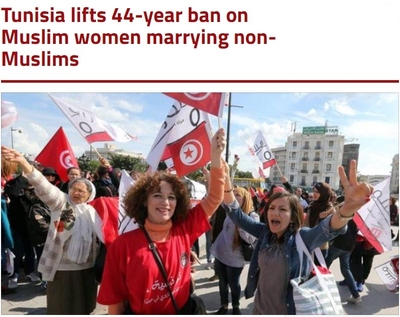
A substantial part of that agenda became law last Thursday when Tunisia’s parliament ended the ban on Muslim women marrying non-Muslim men. It is a direct result of controversial reforms Essebsi proposed, ending a ban imposed in 1973.This was done while proposing new law to secure gender equality in inheritance rights.
Egypt’s Al Azhar has ferociously condemned these reforms as un-Islamic, contradicting what it called the “Fundamentals of the Faith.” Marriage to non-Muslims may harm Muslim women due to differences in faith and traditions and could lead to women being prohibited from practicing their faith freely, said Al Azhar Deputy Imam Abbas Shoman.
Essebsi’s proposals mark the first time the leader of a Muslim-majority nation personally announced critical social reforms, which also include giving women equal inheritance to men despite traditional Shari’a-based laws. These reforms aim for gender equality in Tunisia.
Al-Azhar also opposes the inheritance changes, Shoman said, saying they contradict the Quran’s guidance. “Allah instructs you concerning your children: for the male, what is equal to the share of two females,” it says.
Though not wielding the same influence as the Vatican Pope’s over Catholics, the moral authority wielded over Muslims by Al Azhar’s grand imam is recognized in all four corners of the globe. Al Azhar once represented a pillar of modernity and moderation in the Islamic world, but that changed when ultra-conservative Wahhabism and Muslim Brotherhood Jihadist doctrine ascended during the 1950s. More radical Salafi doctrines became part of the core curriculum.
Opposing Modernity
Essebsi’s call for gender equality is a step toward a secular path, which is a radical departure from most predominantly-Muslim countries. It’s not surprising, therefore, that it generated a storm of protest and condemnation from the Al Azhar sheikhdom (administration). To them, Tunisia’s reforms counter straight-forward Quranic versesconcerning the distribution of the inheritance between women and men and marriage to non-Muslims.
Those verses dictate that a man receives twice as much inheritance as a woman. That’s because men traditionally pay for the expenses of the house that includes the family’s women until they get married and move into their own homes. Thus, a man should acquire twice as much as his sister or women counterpart to carry on with his duties. That mayhave made sense 1,400 years ago, but in the 21stcentury that is hardly the case anymore.
Women have attained huge milestones in the past two centuries and even in the Muslim majority nations. For example, Egypt’s feminist movement started in the early 20th century, and by the 1950s, Egyptian women had voting rights even before women in Switzerland. Egypt has a major representation of women in all political, economic and social fields. Countries such as Pakistan, Indonesia, and Turkey had a female presidents or prime ministers.Today, more than a third of Egyptian households are financed by women, the Egyptian National Centre for Social and Criminological Research (NCSCR) reports.
The issue of Muslim women marrying non-Muslims has been a source of debate and conflict for centuries. Advocates of Tunisia’s reforms argue that the Quranic verses governing marriage outside the faith apply to men and women. The only prohibition is marrying an atheist or a follower of polytheistic religions.
Nevertheless, for more than 1,400 years it became the norm that Muslim women are prohibited from marrying non-Muslim men. Scholars argued Muslim women who married outside the faith might not be free to practicing their religion. Reform advocates believe that 21st century women freely choose their own life partners and are aware of any consequences.
Renouncing Al Azhar’s criticism, Essebsi condemned “foreign interference” in internal Tunisian affairs. Tunisian religious bodies, including the Diwan of Fatwa, support his reforms.
Counter-Reform Syndicate
Al Azhar Grand Imam Ahmed Al Tayeb was reputed to be a moderate Sufist who many in Egypt hoped would counter the growing influence of the university’s radical alumni. Alas, he has faced criticism from liberal Egyptian intellectuals and secularists for blocking any tangible Islamic reforms. During his reign, Al Azhar has waged witch hunts against Egyptian Islamic reformers such as Islam Al-Beheiry. Al-Beheiry spent a year in prison for blasphemy because he dared to condemn some major Islamic traditionalist scholars’ works, calling them the source of modern terrorist ideologies. He was later released after being granted a presidential pardon.
More than two years ago, Egyptian President Abdel Fattah al-Sisi made a historic call for a religious revolution targeting interpretations and misconceptions of religious scripture that drives jihadist ideologies. Al-Azhar’s sheikhdom met the call with defiance, despite displaying fake enthusiasm for the government and the media. As a result, no new laws have been introduced and no curricula have changed with Al Azhar’s influence on Egyptian state affairs is growing stronger.
Yet al-Sisi is not challenging the religious institution enough out of fear that the Muslim Brotherhood and Egyptian Salafists might use the pressure to restore their influence in Al-Azhar. However, a confrontation with Al Azhar seems inevitable since it has already been infiltrated by the very Salafists and radicals whose influence al-Sisi wishes to eradicate.
Ironically, Tunisia’s Muslim Brotherhood-affiliated Ennahda Party has been mostly vague about the social reforms. Despite the protest of some of its main leaders, no official statement has been issued Ennahda vice President Abdel Fattah Mourou said that marriage is a matter of personal freedom under Tunisia’s constitution.
Ennahda, which rose to power after the 2011 Arab Spring, was voted out just three years later. Now it is trying to appear as moderate as possible to regain its strength and weather the storm of anti-Islamist sentiment prevailing in many Middle Eastern nations.
Essebsi is implementing reforms he deems necessary for his country’s social progress. These reforms already are having a ripple effect in the region and might lead to further social progress. Essebsi has done what al-Sisi called for about for more than two years ago, but never took any tangible steps to implement. These reforms may be not exactly what al-Sisi wanted when he called for a complete change of Islamic rhetoric that shuns all forms of extremism and violence. Nevertheless, Essebsi’s reforms are a bold step forward for total social and religious reforms that the Middle East desperately needs.
(This is a lengthy article but provides very useful insights. — DM)
The latest North Korean nuclear and missile tests have caused Chinese public opinion towards North Korea to become even more hostile. According to opinion polls North Korea has, over the last few years, turned into a larger military threat to China than the U.S. or anyone else. To deal with this China has increased the number of troops and border police stationed near the North Korean border and conducted more military exercises in the area. This also addresses another Chinese fear (that gets less publicity in China) that a government collapse in North Korea would send millions of desperate, and opportunistic, North Koreans into China. There is no way China or the Chinese living along the North Korean border would tolerate that. Meanwhile China is becoming more hostile to North Koreans no matter what their legal or economic status is. Part of that is because North Korea has become a very unpleasant place for Chinese to visit or do business in.
******************************
Every nation has its priorities and for North Korea it is all about image. Most people see that in terms of North Korean nuclear weapons and ballistic missiles. But there are other equally important (to the North Korean leaders) issues that get little publicity, and that is intentional. In mid-2017 North Korea ordered its secret police to expand its operations in northeast China (the area just across the northern border) so as to suppress news about the growing number of senior and mid-level officials who are, often with their families, illegally leaving North Korea. The single incident that prompted this new secret police effort was the suicide of one of these families (all five of them). The five took poison after being arrested by Chinese police and facing repatriation to North Korea, wherethe entire family would probably die anyway but more slowly and painfully. The secret police were ordered to increase efforts to prevent such defections in the first place. That will be difficult because the mood among many North Korean officials can best be described as suppressed (so the secret police don’t take note) panic and increased efforts to escape from the country and get to South Korea.
Senior North Korean officials who have gotten out in the last few years all agree that Kim Jong Un is considered a failure by more and more North Koreans and that his days are numbered, even if China does not step in and take over beforehand. Yet these senior officials report that Kim Jong Un could keep his police state going into the late 2020s. But time is not on his side and the signs backing that up are increasingly obvious. Kim Jong Un has triggered a trend that will destroy him and nothing he does seems to fix the problem. He believes having workable nukes and a reliable delivery system (ballistic missiles) will enable him to extort the neighbors for enough goodies to bail him out. That is a high-risk strategy. Kim Jong Un is betting everything on this and none of the potential victims seems ready to give in and are instead planning to meet nuclear threats with force not surrender. Escalation and intimidation work both ways.
Coming Up Short
North Korea has reduced its physical standards for military service. Previously conscripts had to be 150 cm (59 inches) tall and weigh at least 48 kg (106 pounds). But that standard has been reduced over the last decade to 137 cm (54 inches) and 43 kg (95 pounds). Now the government is urging teenage boys to volunteer for service when they are 15 years old. Actually, local officials have been given quotas and are coercing families of 15 year old boys to go along with this. With all the food shortages and unemployment the government sees that as an incentive. But most teenagers prefer to try their luck with the market economy and eventually make enough money to get out of North Korea.
The government needs more soldiers because of a lower birthrate and the inability to reverse the problem. South Korea also has this problem but for different reasons. By 2010 South Korea had the lowest birth rate (1.15 children per woman, on average) in the world and held that dubious achievement for two years in a row. This is because of growing affluence over the last half century. South Korea is now one of the wealthiest nations on the planet. At the current birth rate, the South Korean population is expected to stop growing in the 2020s, after reaching about 52 million (about twice the population of the north). If the birth rate stays under 2.1, the population will then begin to shrink. In North Korea, the birth rate is 1.9, and is also declining, because of increasing poverty and famine. For example, life expectancy in the north has declined from 72.7 years in the early 1990s, to 69.3 now. That’s ten years less than in South Korea. Northerners are not only living shorter lives, they are also shorter. A study of teenagers in the north and south revealed that the northerners are 8 percent shorter, and weigh nearly 20 percent less. It’s not as bad with older adults, because they were not born during the famine (which began after Cold War Russian subsidies ended in the early 1990s).
By 2012 there was a very visible shortage of recruits for the North Korean armed forces. A lower birth rate in the 1990s, because of the famine (that killed five percent of the population back then) has reduced the number of 18 year old recruits for the army and security forces. So fewer exemptions are being allowed, and more 17 years olds are being taken. That escalated to pressuring 16 year olds to volunteer. Now the government is after 15 year olds. North Korean men serve at least six years (and up to ten) in the military, keeping them out of trouble for that time in their lives (18-24), when they are most likely to act out revolutionary fantasies. The military is really a large prison system. While the troops are trained to use weapons, they get little ammunition for training, and the weapons are locked up most of the time. Young North Koreans increasingly know how poor they are, and in greater and greater detail. The soldiers born during the great famine of the 1990s are well-aware that they are physically much smaller than their South Korean counterparts. They also know that the average South Korean lives ten years longer and lives a much more pleasant life. All the more reason to limit the time North Korean troops can handle their weapons, especially when they have ammunition (which is actually very infrequently.)
By 2017 North Korean army officers were ordered to encourage their troops to steal food during the harvest and that failure to do so could result in punishment and would definitely result in hunger. Naturally this has caused more popular anger towards the military. This is nothing new. In 2016 hungry troops grew bolder because the government made it clear they would not punish soldiers unless people are killed or badly injured during these incidents. Police are often called to catch soldiers who have robbed someone. At first this was usually troops breaking into a house seeking food and valuables. The soldiers that are caught are often arrested but must be taken back to their base where the military takes over. The soldiers are “punished” with some verbal abuse for getting caught and that is all. The government was desperate because earlier efforts to address the problem had failed. In 2015 there was a new program to expand food production by the military. Troops were allowed to raise pigs as well as the usual vegetable and grain crops. Meat has been in particularly short supply for the troops in the past few years and hungry troops often steal small livestock (chickens, ducks and pigs), kill them on the spot and carry them off to be cooked and eaten before returning to base. As more reports came in it became apparent that most military units didn’t have enough to eat, either because the food was not to be had or, as is more often the case, corruption (someone in a position of power stole it.) This led to more soldiers stealing food from civilians or selling military clothing and equipment on the black market so they could buy food. Soldiers have opportunities to steal food and sell stolen goods when they are off their base doing construction or farm work. This is how troops spend a lot of their time and they receive no extra pay or food even when the outside work requires heavy (and calorie consuming) labor. All this is illegal, but commanders were not eager to punish hungry soldiers. For commanders their troops have become profitable slaves who can be rented out with the commanders getting part of the payment. Now the government insists that disobedient slaves be executed.
Visible Signs Of Decline
Declining discipline in the police is more evident in many obvious ways. For example a growing number of North Korean women are operating openly as prostitutes (usually near border areas where there are more foreigners). These women get $20 or more per customer but get to keep less than 20 percent of that because the rest goes to bribes (for police) and “fees” to various middlemen (or women) who supervise it all. Thus it is not surprising that these young (from late teens to 30s) women will also offer to sell drugs (usually meth) to customers as well. Many of these prostitutes are married and some have children but no money to keep the kids fed and healthy.
With the growth of free markets and police getting jealous, greedy and corrupted by demanding and getting bribes, there has also developed criminal gangs. These groups often have connections (usually financial) with the security forces and of course the gangsters are all veterans. The gangs act as middlemen between donju (free market entrepreneurs) and the government but as a matter of law, the gangs do not exist. As a matter of fact the gangs are very real and one of the fastest growing sectors of the market economy.
China Chooses Sides
The latest North Korean nuclear and missile tests have caused Chinese public opinion towards North Korea to become even more hostile. According to opinion polls North Korea has, over the last few years, turned into a larger military threat to China than the U.S. or anyone else. To deal with this China has increased the number of troops and border police stationed near the North Korean border and conducted more military exercises in the area. This also addresses another Chinese fear (that gets less publicity in China) that a government collapse in North Korea would send millions of desperate, and opportunistic, North Koreans into China. There is no way China or the Chinese living along the North Korean border would tolerate that. Meanwhile China is becoming more hostile to North Koreans no matter what their legal or economic status is. Part of that is because North Korea has become a very unpleasant place for Chinese to visit or do business in.
News of the bad treatment Chinese are suffering in North Korea gets around, even when the Chinese government tries to keep the worst examples out of the news. Chinese individuals and firms doing business in North Korea complain that the North Koreans have become even more unreliable when it comes to handling foreign investments from China. In the past China could impose some degree of discipline on North Korea for abuse of Chinese investors and investments. The North Koreans are increasingly ignoring this sort of pressure and as a result Chinese investors are backing away from current and planned investments. China could order state owned firms to do business in North Korea but does not because these firms are poorly run compared to the privately owned firms and would suffer even larger losses when dealing the increasingly treacherous and unreliable neighbor.
North Korea used to be a dependable place, at least for Chinese with the right connections in the Chinese government. While corruption in China has declined in the past few years it appears to have gotten worse in North Korea, to the point where long-term deals are avoided and transactions are made carefully, usually with payment before delivery. The smugglers and various other criminal gangs in China that do business with their North Korean counterparts have been forced to operate this way as well and for the same reasons. South Korea and Japan have already learned how unreliable North Korea can be when it comes to business deals and Russia has already adopted the wary approach to economic deals with North Korea.
China has visibly increased enforcement of economic sanctions on North Korea but this has not made North Korea any more willing to negotiate. The growing number of police and secret police night patrols in areas where North Korean smugglers long operated is hard to miss, as is the fact that when North Korean smugglers are encountered they get arrested and taken away. Even higher bribes (over $3,000 to make an arrest not happen) no longer work because the Chinese cops will still demand that amount of cash before they will turn the smugglers over to North Korean officials. China never came down so hard on North Korean smuggling before.
China is also cracking down on North Korean drug production and smuggling. This is a matter of self-defense for China and is effective because North Korea make the highest profits from methamphetamine (“meth”). But this drug requires a key ingredient (phenylacetic acid, in the form of white crystals) to be smuggled in from China. Now the Chinese are cracking down on that as well as the meth coming into China. North Korea is seeking another, probably more expensive, supplier in Russia.
While Russia is still doing business with North Korea China and Russia are also cooperating with many of the new rules banning North Korean workers they long employed legally. This exported labor was outlawed by the latest round of sanctions. North Korea responded by quietly ordering overseas workers to stay where they are and work illegally (in deals arranged by their government minders). Yet in many instances the export ban on slave labor is being enforced by Russia and especially China and that is hurting North Korea economically.
The North Koreans see this as yet another challenge that can be worked around. While it is true that there are still a lot of corrupt Chinese and Russians willing to do business with North Korea if the bribe is large enough, that is not working as well as it used to in China. This is because North Korea is very unpopular with Chinese in general and a growing number of senior Chinese officials in particular. Russians are less upset with North Korea and, while having fewer economic resources than China, are more receptive to shady deals. The problem is that North Korea has become very dependent on the much larger and still expanding Chinese economy. Russia simply cannot supply a lot of what North Korea needs. It is possible to still buy the forbidden goods in China and have them shipped to a fictitious customer in Russia who will quietly send it to North Korea. That does not always work and when it does it costs a lot more than getting the goods directly from China. North Korea has less cash for the extra expenses. The Chinese know this and are quite willing to slowly squeeze until North Korean leaders are all dead or more receptive to Chinese needs (no nukes next door and fewer desperate illegal migrants). Yet there is the growing risk that North Korea will get (or thinks it has) reliable nukes and keep threatening China. That is not the desired outcome but the Chinese have quietly reminded leaders of both Koreas (and their foreign allies) that in the past China has occupied much of Korea when the Koreans become troublesome.
Meanwhile China is not happy with South Korea either, fearing the growing military power of South Korea and the recent installation of a THAAD anti-missile battery despite vigorous Chinese diplomatic and economic efforts to prevent that. The diplomatic and economic pressure continues but the South Koreans are in no mood to back off as long as the North Korean threat remains. South Korea believes China could do more to eliminate the North Korean threat. While many, if not most, Chinese and Russians agree with that the Russian and Chinese governments still see economic opportunities in North Korea and are unwilling to do anything drastic.
September 14, 2017: In coincidental, nearly simultaneous, events North Korea fired a ballistic missile over Japan while South Korea fired two Hyunmoo 2 ballistic missiles. One of these failed while the other accurately hit the target area (at sea) 250 kilometers away. The North Korean missile travelled about 2,200 kilometers and landed in the Pacific. Japan said it tracked the missile and did not try to intercept because it was obvious the missile was following a trajectory that would take it far from Japan. The identity of the North Korean missile was not known.
South Korea has developed a longer (500 kilometer) version; Hyunmoo 2C. South Korea developed a 180 kilometer range ballistic missile (Hyunmoo 1) and a 300 kilometer one (Hyunmoo 2) in the 1980s. Both are about 13 meters (40 feet) long and weigh 4-5 tons. Both of these were based on the design of the U.S. Nike-Hercules anti-aircraft missile, which South Korea used for many years.
September 13, 2017: Google and YouTube have banned videos from North Korean media, apparently because it is a source of income for North Korea and now in violation of sanctions. This reduces open source access to North Korean TV although intelligence agencies will still be able to get these.
China has restricted access to Mount Paektu, apparently for safety reasons related to the recent North Korean nuclear test, which was conducted 110 kilometers away. Mount Paektu is a dormant volcano on the Chinese border. In fact, half the volcano is in China, where it is a popular tourist destination for South Koreans. That’s because Koreans and Manchus (as in Manchuria, the native people of northeast China) both consider Mt Paektu as a sacred place where their tribes originated thousands of years ago. In 2013 North Korea put some silos for their long range (2,000-3,000 kilometers) ballistic missiles up there because that part of North Korea is a triangle, surrounded on two sides by China. This makes it difficult for the Americans to launch air attacks without entering Chinese territory and makes it easier for North Korean anti-aircraft forces to defend against cruise missile. On the down side, Paektu is a dormant volcano that is active (lava flows and the like) about once a century. The last time it erupted (throwing large quantities of rocks and dust into the atmosphere) was in 1703 and an eruption in the late 10th century blew the top off the mountain and created the current 4.5 kilometers wide crater lake. Volcanologists consider Paektu capable of another major eruption but North Korea considers that less likely than an American air attack. So the silos stay, despite the risk of destruction by lava flows and earthquakes. Before all these silos were built North Korea planned to keep its long range ballistic missiles mobile and launch them from any number of launch sites (a flat field where the missile could be fueled and the guidance system programmed before launch.) Bad weather could complicate the use of mobile launchers (washing out bridges or blocking roads with snow). The quality of North Korean roads has also declined sharply (from lack of maintenance) since the late 1990s. Then there is the increased American surveillance (from satellites, U-2s and high-altitude UAVs) that makes mobile missiles more vulnerable to air or missile attack. Silos can also be attacked from the air, but in a war the more numerous and shorter range ballistic missiles to the south would also be subject to air attack as these missiles would be aimed at the South Korean capital. North Korea apparently believes that silos protected by a sacred volcano are a worthwhile investment to ensure that some of long-range missiles will get launched during a crises. China is more concerned about nuclear radiation coming from North Korea.
September 12, 2017: Chinese radiation monitors on the North Korean border recorded levels were up seven percent since the September 3rd test and have appeared to have peaked. This data was released because the population along the border know that they face some health risks if radiation levels increase too much for too long.
September 11, 2017: The UN approved new economic sanctions against North Korea and China said it would enforce them all and repeated that it had been enforcing sanctions since March. The new sanctions limit the export of refined petroleum product to two million barrels a year and ban North Korea from importing liquefied natural gas. This followed China condemning North Korea nuclear tests openly in the UN for the first time.
Meanwhile the United States continues to call on China and Russia to do more to halt the North Korean evasion of sanctions via corrupt officials and businesses in China and Russia. China in particular does not want too much international attention focused on that corruption, which has long been quite active along the North Korean border and still is. The United States is not being diplomatic in pointing this out but it is correct in showing how Chinese enforcement of sanctions does not really work unless China effectively curbs the Chinese corruption that enables North Korea to continue doing whatever it wants. For the North Korea the increased sanctions pressure merely increases costs (larger bribes are required in China and Russia).
September 10, 2017: Chinese banks have been warning its customers to stay away from bitcoin because of the threat from North Korean hackers, who are believed to be responsible for several recent multi-million dollar thefts from bitcoin exchanges. North Korea is believed to be targeting bitcoin and other Internet based cryptocurrencies even though North Korea has used bitcoin exchanges as a substitute for sanctions that ban it from accessing the international banking system. The Chinese government fears that North Korean hackers are now going after Chinese firms, something they are not supposed to do because China is still the main source of foreign trade. This sort of irrational behavior leads China to fear that North Korea would even be foolish to become a real military threat to China.
September 9, 2017: China orders all Chinese banks (including foreign banks licensed to operate in China) to not only stop opening accounts for North Koreans but also to close any such accounts immediately. This is a very harmful economic sanction and the North Koreans respond by ignoring the new rules any way they can.
September 8, 2017: North Korea has quietly freed a Russian yacht it had seized in mid-June. A North Korean warship seized the Russian yacht when both were 80 kilometers off the coast. The yacht and the vessel towing it to Vladivostok were definitely in international waters and the Russian ambassador demanded the release of the yacht and three man crew. North Korea was not responsive until now. This was similar to a May 2016 incident where North Korean warship seized a Russian sailing yacht some 160 kilometers from the east coast of North Korea (very much in international waters). The yacht and crew of five were taken to a North Korean port. The yacht was released two days later and continued on its way to its original destination (Vladivostok) for a sailboat race. In both cases North Korea would not say why they took the yacht and then released it.
September 7, 2017: South Korea has completed deploying an entire THAAD battery to a site some 300 kilometers south of the North Korean border. The United States will share radar data generated by the high-powered radar installed as part of a THAAD anti-missile battery that began arriving in early 2017. The THAAD battery is operated by American personnel and costs $3.5 million a year to operate. The battery consists of six truck-mounted missile launchers (eight missiles per launcher), a fire control and communications unit and an AN/TPY-2 radar. Villagers living near the site of the THAAD base oppose the presence of the anti-missile battery because it will be a target for North Korean (or even Chinese) attack. Locals also fear (without any evidence) that the powerful THAAD radar will cause health problems.
September 6, 2017: A recent online opinion survey in China showed that 66 percent believed North Korea was a larger military threat to China than the United States. Only 10 percent felt the Americans were a larger threat and 15 percent believed the U.S. was no threat at all. This is consistent with earlier surveys only the degree of hostility towards North Korea keeps increasing. Chinese see North Korea has a poorly managed nation that is ungrateful towards China and unpredictable.
September 4, 2017: North Korean living near the site of the recent underground nuclear weapons test are demanding compensation for the damage done to their home by the earthquake (estimated to be 5.6 on the Richter scale) the test produced. Across the Yalu River some Chinese buildings also suffered damage from the quake and several aftershocks.
South Korea announced that its policy towards North Korea will now on “punishment” rather than negotiation.
September 3, 2017: North Korea carried out its sixth nuclear test. This one appeared to be the largest one yet indicating a yield of 100-200 tons and described as a hydrogen bomb. The first nuclear test was in 2006 (less than one kiloton) but the first one that was truly successful occurred in 2013 (6 kilotons) and despite the fact that the test was not a complete success, the nuclear bomb program continued with two tests in 2016. In late 2015 Kim Jong Un claimed that North Korea had developed a hydrogen (fusion) bomb. Foreign experts openly expressed skepticism given that North Korea didn’t really have a reliable fission type nuclear bomb yet. You need an efficient fission bomb to trigger the fusion reaction that makes the “H-Bomb” so much more destructive than a fission bomb of the same weight and size. Nuclear test number four in January 2016 was described by North Korea as a fusion (H-bomb) test when it clearly was not, or not a successful one. That would be in contrast to the 2013 test which appeared to be seven kilotons and a complete detonation. The second test was a two kiloton weapon in 2009. Western intelligence believed that the original North Korean nuclear weapon design was flawed, as the first two tests were only a fraction of what they should have been. The first one was less than a kiloton and called in the trade, a “fizzle.” The second test was less of a fizzle and apparently a modified version of the original design. Thus North Korea needed more tests to perfect their bomb design and was still years away from a useful nuclear weapon even though the second bomb appeared to be more effective. The third test in 2013 was considered overdue and that may have been because more time was spent designing and building a smaller device that could fit into a missile warhead. The second 2016 test is still something of a mystery. U.S. intelligence agencies have collected air samples (as have most other neighboring countries) from the test which can tell much about the design of the bomb. The January 2016 nuke appeared to be the same as the 2013 one. The second 2016 test in September appeared to be a better design and was about ten kilotons. North Korea insisted this was a fusion bomb. Air samples are still being collected on the test today but it will take weeks to analyze the samples and come to some useful conclusion. The sheer size of the most recent test indicated either a fusion bomb or an enhanced fission bomb. But for a yield of over 100 tons a fusion bomb is more likely. Such designs have been around and in use since the late 1940s. After the Soviet Union collapsed in 1991 a lot of Russian nuclear weapons designers and technicians were out of a job and the pensions of the retired ones were suddenly worth a lot less. The security for nuclear weapons designs, especially much older ones, became a lot more lax. There were plenty of opportunities to obtain previously unavailable tech.
August 29, 2017: North Korea fired a Hwasong-12 ballistic missile over Japan. This was the 18th North Korean ballistic missile test of 2017 and this one appeared to break into pieces before it fell into the ocean after travelling 2,700 kilometers from North Korea. This was the second successful test of the Hwasong-12.
August 28, 2017: South Korea announced its largest increase (6.9 percent for 2018) in its defense budget since 2009. This is a direct result of the increasing threat from North Korea. Next year South Korea will spend $38 billion, which is more than a third larger than the annual GDP of North Korea (which spends about a third of GDP on defense compared to less than three percent in South Korea). South Korea is in the top ten of national economies, something which annoys North Korea but is admired by the other neighbors (including China). Meanwhile Japan is also increasing its defense spending by 2.5 percent in 2018 (to $48 billion). Japan, like China and the U.S., are among the top five economies on the planet. Japan, because of the post-World War II constitution the United States insisted on (and Japan did not much object to) has been largely demilitarized considering the size of its economy. That is changing and the U.S. has dropped nearly all restrictions on what weapons it will export to South Korea and Japan and is ignoring treaties it has with both nations that restrict what types of advanced weapons (like ballistic missiles and nukes) they can develop. The Americans would still prefer that South Korea and Japan not build nukes (which both these nations could easily and quickly do). China and Russia would also prefer that Japan and South Korea remain non-nuclear weapon nations. But if North Korean military ambitions and threats (especially against South Korea and Japan) are not curbed popular opinion in South Korea and Japan is becoming more comfortable with the having their own nukes.
August 25, 2017: China banned North Korea from establishing any new businesses in China or expanding existing ones. Russia has done the same, but the Chinese are a much larger market and apparently intent on following through. Meanwhile the August 15 order for Chinese firms to halt imports of minerals and seafood cost some Chinese firms with physical operations (trucks, mines) and warehouses in North Korea to suffer losses because they were given only 24 hours to get this stuff back to China and that was not enough time. This was especially true when many North Korean officials demanded special payments before these goods could be moved.
August 24, 2017: A Russian Tu-95 bomber flew south from a base north of Korea until it got close enough to South Korea to cause South Korean F-16s to come up and investigate. Russia said it was a scheduled training flight.
First broadcast in Great Britain 50 years ago, The Prisoner – a dystopian television series described as “James Bond meets George Orwell filtered through Franz Kafka” – confronted societal themes that are still relevant today: the rise of a police state, the freedom of the individual, round-the-clock surveillance, the corruption of government, totalitarianism, weaponization, group think, mass marketing, and the tendency of humankind to meekly accept their lot in life as a prisoner in a prison of their own making.
Perhaps the best visual debate ever on individuality and freedom, The Prisoner (17 episodes in all) centers around a British secret agent who abruptly resigns only to find himself imprisoned, monitored by militarized drones, and interrogated in a mysterious, self-contained, cosmopolitan, seemingly tranquil retirement community known only as the Village.
The Village is a virtual prison disguised as a seaside paradise: its inhabitants have no true freedom, they cannot leave the Village, they are under constant surveillance, their movements are tracked by surveillance drones, and they are stripped of their individuality and identified only by numbers.
The series’ protagonist, played by Patrick McGoohan, is Number Six.
“I am not a number. I am a free man,” was the mantra chanted on each episode of The Prisoner, which was largely written and directed by McGoohan.
In the opening episode (“The Arrival”), Number Six is told that he is in The Village because information stored “inside” his head has made him too valuable to be allowed to roam free “outside.”
Throughout the series, Number Six is subjected to interrogation tactics, torture, hallucinogenic drugs, identity theft, mind control, dream manipulation, and various forms of social indoctrination and physical coercion in order to “persuade” him to comply, give up, give in and subjugate himself to the will of the powers-that-be.
Number Six refuses to comply.
In every episode, Number Six resists the Village’s indoctrination methods, struggles to maintain his own identity, and attempts to escape his captors. “I will not make any deals with you,” he pointedly remarks. “I’ve resigned. I will not be pushed, filed, stamped, indexed, debriefed or numbered. My life is my own.”
Yet no matter how far Number Six manages to get in his efforts to escape, it’s never far enough.
Watched by surveillance cameras and other devices, Number Six’s getaways are continuously thwarted by ominous white balloon-like spheres known as “rovers.” Still, he refuses to give up. “Unlike me,” he says to his fellow prisoners, “many of you have accepted the situation of your imprisonment, and will die here like rotten cabbages.”
Number Six’s escapes become a surreal exercise in futility, each episode an unfunny, unsettling Groundhog’s Day that builds to the same frustrating denouement: there is no escape.
The series is a chilling lesson about how difficult it is to gain one’s freedom in a society in which prison walls are disguised within the trappings of technological and scientific progress, national security and so-called democracy.
As Thill noted when McGoohan died in 2009, “The Prisoner was an allegory of the individual, aiming to find peace and freedom in a dystopia masquerading as a utopia.”
The Prisoner’s Village is also an apt allegory for the American Police State: it gives the illusion of freedom while functioning all the while like a prison: controlled, watchful, inflexible, punitive, deadly and inescapable.
The American Police State, much like The Prisoner’s Village, is a metaphorical panopticon, a circular prison in which the inmates are monitored by a single watchman situated in a central tower. Because the inmates cannot see the watchman, they are unable to tell whether or not they are being watched at any given time and must proceed under the assumption that they are always being watched.
Eighteenth century social theorist Jeremy Bentham’s panopticon has become a model for the modern surveillance state in which the populace is constantly being watched, controlled and managed by the powers-that-be and funding its existence.
Nowhere to run and nowhere to hide: this is the new mantra of the architects of the police state and their corporate collaborators (Facebook, Amazon, Netflix, Google, Instagram, etc.).
Consider that on any given day, the average American going about his daily business will be monitored, surveilled, spied on and tracked in more than 20 different ways, by both government and corporate eyes and ears.
This is the electronic concentration camp—the panopticon prison—the Village—in which we are now caged.
It is a prison from which there will be no escape if the government gets it way.
Even now, the Trump Administration is working to make some of the National Security Agency’s vast spying powers permanent.
And just like that, we’re back in the Village, our escape plans foiled, our future bleak.
Except this is no surprise ending, as I make clear in my book Battlefield America: The War on the American People: for those who haven’t been taking the escapist blue pill, who haven’t fallen for the Deep State’s phony rhetoric, who haven’t been lured in by the promise of a political savior, we never stopped being prisoners.
So how do we break out?
For starters, wake up. Resist the urge to comply.
Think for yourself. Be an individual. As McGoohan commented in 1968, “At this moment individuals are being drained of their personalities and being brainwashed into slaves… As long as people feel something, that’s the great thing. It’s when they are walking around not thinking and not feeling, that’s tough. When you get a mob like that, you can turn them into the sort of gang that Hitler had.”
We have come full circle from Bentham’s Panopticon to McGoohan’s Village to Huxley’s Brave New World.
Fox News contributor John Bolton called Donald Trump’s speech before the United Nations Tuesday the best of his young presidency.
Bolton, who served as U.S. Ambassador to the United Nations under President George W. Bush, praised Trump for his direct denunciation of North Korea’s nuclear ambitions and criticism of the Iran nuclear deal brokered by the Obama administration.
“This was the best speech of the Trump presidency, in my view,” Bolton said. “I think he was as clear and direct as it’s possible to be.”
Trump said the U.S. would destroy North Korea if forced to defend itself or its allies; Bolton said that was a memorable line.
“I think it’s safe to say, in the entire history of the United Nations, there has never been a more straightforward criticism of the behavior, the unacceptable behavior of other member states,” Bolton said.
In addition, he said Trump’s critiques of the nuclear deal revealed the White House would not tolerate “half-measures and compromises” that allowed Iran and North Korea to progress to the verge of having deliverable nuclear weapons.
He also praised Trump’s line, which was met with near silence at first, that the collapsing regime in Venezuela was an example of socialism being successfully implemented.
“There are a lot of people in the UN. who have never heard anything like that from an American president,” Bolton said. “I think this was an outstanding speech, and I think it will serve the president very well.”
(A transcript is available here. PM Netanyahu tweeted “In over 30 years in my experience with the UN, I never heard a bolder or more courageous speech.” — DM)
An Israeli air force Patriot missile Tuesday shot down an Iran-made Hizballah drone over the Syrian border town of Quneitra in the demilitarized zone. The UAV took off from Damascus air port. The IAF first scrambled fighter jets, before launching the missile from a site near the Galilee town of Safed.
“Israel will not allow Iran, Hizballah or other forces to infiltrate or approach its territory in the Golan Heights,” the IDF Spokesperson said in a statement.
DEBKAfile’s military sources report: This was the first time an IDF missile had intercepted a Hizballah drone in Syrian air space. In the past, fighter jets found it hard to down drones entering Golan air space and ended up shooting a Patriot missile. Hizballah’s purpose in sending the drone was apparently to test the state of readiness of IDF air defenses in northern Israel – but no less to see how the Russians would react when an Israeli UAV flew over a Russian-US de-escalation zone in southern Syria, that is under Russian surveillance.







 anneinpt
 artaxes
 danmillerinpanama
 davidking1530
 Peter Hofman
 Joseph Wouk
 Peter
Peter Louisiana Steve
 WarSclerotic
Recent Comments